Host Phenology and Geography as Drivers
of Differentiation in Generalist Fungal
Mycoparasites
Alexandra Pintye1☯, Jeanne Ropars2,3☯, Nick Harvey4, Hyeon-Dong Shin5, Christel Leyronas6, Philippe C. Nicot6, Tatiana Giraud2,3*, Levente Kiss1*
1Plant Protection Institute, Centre for Agricultural Research, Hungarian Academy of Sciences (MTA), Budapest, Hungary,2CNRS (Centre National de la Recherche Scientifique), Ecologie, Systematique et Evolution (ESE), Orsay, France,3Univ Paris Sud, Ecology, Systematique et Evolution (ESE), Orsay, France,4Genetic Marker Services, 7 Brighton, United Kingdom,5Division of Environmental Science and Ecological Engineering, College of Life Sciences and Biotechnology, Korea University, Seoul, Republic of Korea,6Institut National de la Recherche Agronomique (INRA), Unite de Recherche UR407, Unité de Pathologie Végétale, Domaine St. Maurice, Montfavet, France
☯These authors contributed equally to this work.
*[email protected](TG); [email protected](LK)
Abstract
The question as to why parasites remain generalist or become specialist is a key unre-solved question in evolutionary biology.Ampelomycesspp., intracellular mycoparasites of powdery mildew fungi, which are themselves plant pathogens, are a useful model for stud-ies of this issue.Ampelomycesis used for the biological control of mildew. Differences in mycohost phenology promote temporal isolation between sympatricAmpelomyces myco-parasites. Apple powdery mildew (APM) causes spring epidemics, whereas other powdery mildew species on plants other than apple cause epidemics later in the season. This has re-sulted in genetic differentiation between APM and non-APM strains. It is unclear whether there is genetic differentiation between non-APMAmpelomyceslineages due to their spe-cialization on different mycohosts. We used microsatellites to address this question and found no significant differentiation between non-APMAmpelomycesstrains from different mycohosts or host plants, but strong differentiation between APM and non-APM strains. A geographical structure was revealed in both groups, with differences between European countries, demonstrating restricted dispersal at the continent scale and a high resolution for our markers. We found footprints of recombination in both groups, possibly more frequent in the APM cluster. Overall,Ampelomycesthus appears to be one of the rare genuine general-ist pathogenic fungi able to parasitize multiple hosts in natural populations. It is therefore an excellent model for studying the evolution of pathogens towards a generalist rather than host-specific strategy, particularly in light of the tritrophic interaction betweenAmpelomyces mycoparasites, their powdery mildew fungal hosts and the mildew host plants.
OPEN ACCESS
Citation:Pintye A, Ropars J, Harvey N, Shin H-D, Leyronas C, Nicot PC, et al. (2015) Host Phenology and Geography as Drivers of Differentiation in Generalist Fungal Mycoparasites. PLoS ONE 10(3): e0120703. doi:10.1371/journal.pone.0120703
Academic Editor:Zhengguang Zhang, Nanjing Agricultural University, CHINA
Received:November 2, 2014
Accepted:January 25, 2015
Published:March 24, 2015
Copyright:© 2015 Pintye et al. This is an open access article distributed under the terms of the
Creative Commons Attribution License, which permits unrestricted use, distribution, and reproduction in any medium, provided the original author and source are credited.
Data Availability Statement:All relevant data are within the paper and its Supporting Information files.
Introduction
The question of why parasites remain generalist or become specialist remains a key unresolved issue in evolutionary biology. Generalist parasites have access to a larger number of individual hosts, but there may be trade-offs impeding optimal adaptation to several host species at the same time [1–3]. These trade-offs may take the form of constraints or a lower speed of coevolu-tion when tracking a particular host species [4]. Specialist species may therefore be at an advan-tage, as they should exploit their hosts more efficiently, but this is likely to be the case only if the principal host is sufficiently abundant [5]. For specialization to occur, there must also be a mechanism preventing gene flow between sympatric parasite species adapting to different hosts, to avoid the break-up of adaptive combinations of alleles [6–8]. If this condition is not fulfilled, specialization cannot evolve and parasites remain generalists on multiple sympatric hosts. The mechanisms underlying reproductive isolation in parasites include mate choice and intersterility [9], as in free-living organisms, but also temporal isolation due to differences in host phenology [10,11], mating within hosts after growth [12–15] and selfing [8,16].
It is therefore not straightforward to predict whether and when a parasite will remain generalist or evolve towards specialization. Many case studies are required before we can draw general inferences. True generalist parasites appear to be rare; morphological species long considered generalist are often found to be cryptic specialist species in studies based on molecular markers [8,17,18]. However, genuine generalist parasites do exist, and this group includes the fungiBotrytis cinerea,Sclerotinia sclerotiorum, andBatrachochytrium dendrobati-dis[19–22].
Geography is another driver of genetic differentiation in parasites. Spatial genetic structure has been detected in a number of parasites, even in fungi with wind-borne spores [15,23–29]. Spatial genetic structure can be used to infer dispersal distances, which is useful for the moni-toring and prediction of epidemics caused by pathogenic fungi [23,24,30–32]. In this respect, however, our current knowledge on fungal pathogens is relatively limited, especially in the case of mycoparasites,i.e., fungi parasitizing other fungi, with only a few studies available, on tre-mellalean mycoparasites [33] and some lichenicolous fungi [34,35].
Ampelomycesis an interesting biological model in this concept. These fungi are intracellular mycoparasites of powdery mildew fungi, which are themselves plant pathogens [36,37]. Differ-ences in host phenology promote temporal isolation between sympatric mycoparasites infect-ing apple powdery mildew (Podosphaera leucotricha) and those infecting other powdery mildew species on host plants other than apple [11]. Indeed, apple powdery mildew (APM) ep-idemics occur in spring, whereas the fungal hosts of the otherAmpelomycesspecies cause epi-demics mostly in the summer and fall. Consequently,Ampelomycespopulations infecting APM display strong differentiation from mycoparasites infecting other mildews, despite their ability to infect these other mildews in laboratory and field experiments [11]. However, it was not possible to investigate genetic differentiation between theAmpelomycesparasites of differ-ent mildews species causing epidemics in summer and fall in these previous studies. Indeed, the microsatellite markers developed for the mycoparasites of apple powdery mildew gave no amplification inAmpelomycesstrains isolated later in the season, because the level of genetic differentiation was too high. Gene sequences revealed no clear separation according to host species in non-APMAmpelomyces[38–41] but differentiation may have occurred too recently for detection by this approach.
No strong geographic structure was found in our previous study focusing on European
Ampelomycesstrains from apple powdery mildew [11]. Microsatellite markers revealed long-distance spread across Europe, consistent with the wind dispersal of these mycoparasites within airborne parasitized powdery mildew spores (Szentivanyi & Kiss 2003; Kiss 2008). However,
roles of these authors are articulated in the‘author contributions’section.
further knowledge of the geographical structure and dispersal ability ofAmpelomyces popula-tions is required, especially becauseAmpelomycesstrains are sold as biological control agents [42].
Another interesting question inAmpelomycesis the extent of recombination. Sexual struc-tures have never been observed in the field, but some footprints of recombination have been detected inAmpelomycesfrom apple powdery mildew [11]. Recombination traces have proved to be common in fungal species previously thought to be asexual [43–51], reflecting rare sexual events or the occurrence of sex in places or at times not accessible to observation. We were un-able to investigate the occurrence of sex inAmpelomycesfrom hosts other than apple powdery mildew, because of the lack of polymorphic markers [11].
We report here the development of new microsatellite markers for mycoparasites isolated from powdery mildew fungi in the summer and fall, and their use to genotype a large collection of mycoparasites from a number of powdery mildew species and host plants, worldwide but with a particular effort in Europe. We addressed the following questions: 1) Is there any genetic differentiation betweenAmpelomycesstrains isolated from different host plants affected by mildew epidemics in the summer and fall that might indicate specialization? 2) Is there any geographic structure withinAmpelomyces? 3) Are there footprints of recombination in Ampe-lomyces, within and between powdery mildew hosts?
Materials and Methods
Fungal materials
We studied 469Ampelomycesstrains maintained in culture and 168 dried powdery mildew-in-fected leaf samples containingAmpelomycespycnidia (S1 Table). Leaf samples were obtained as described by Kisset al. (2011) and each was treated as a singleAmpelomycesstrain (haplo-type) on the basis of microsatellite genotyping results [52]. We thus studied 637Ampelomyces
strains in total. Twelve of these strains were newly obtained fromBlumeria graminis, the only powdery mildew species known to infect various monocot species. These new strains were iso-lated as described previously [40]. The rest of the strains came from previous works [11,38,40,
41,53–55] (S1 Table). Most of these strains, 157 in total, came fromArthrocladiella mougeotii, a powdery mildew species infecting a solanaceous weed,Lycium halimifolium. A group of 17 strains were isolated fromErysiphe necator(formerlyUncinula necator) infecting grapevine. The remaining strains came from powdery mildew species infecting various host plant species, none of which was widely sampled. Overall, our dataset of 637Ampelomycesstrains contained 394 strains infecting apple powdery mildew (APM) and 243 non-APM strains. We choseB.
graminis,A.mougeotiiandE.necatorto be the most intensively sampled non-APM mycohost species because these three powdery mildews have been shown to be representative of the di-versity of non-APM species [56].
DNA extraction
Total genomic DNA was extracted from about 10 to 15 mg of freeze-dried mycelium for each
Ampelomycesstrain and from about 5 to 10 mg of dried leaf sample for samples containing
Ampelomycespycnidia. We used the DNeasy Plant Mini Kit (Qiagen) for DNA extraction.
Development of microsatellite markers
China. They belonged to different ITS and actin gene clades [38]. The genotypes of all the strains tested in this work are given inS2andS3Tables.
Population genetic analyses
Microsatellite genotyping.Amplifications were carried out with forward primers labeled with fluorescent FAM or HEX dyes (Sigma Aldrich). Each PCR was performed in a final volume of 10μl containing 5μl Multiplex PCR Master Mix (Qiagen) and 0.2μl of each primer at a
con-centration of 10μM and 2μl of genomic DNA. The primer sequences are shown inTable 1.
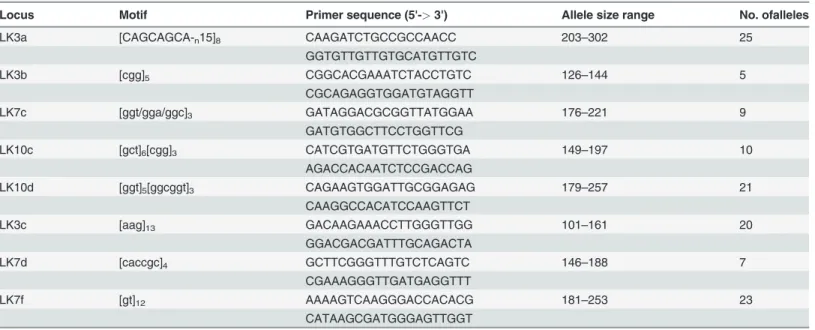
Three primer combinations were used: set 1 (LK3c and LK7d), set 2 (LK3a, LK7c and LK10c) and set 3 (LK3b, LK7f and LK10d). Assays were carried out in the following conditions: initial denaturation for 5 minutes at 95°C, followed by 28 cycles of denaturation for 45 s at 95°C, an-nealing for 50 s at 54°C, extension for 1 minute at 72°C, and a final extension for 5 minutes at 72°C. PCR products were heated at 94°C for 5 minutes, chilled on ice and separated on an ABI Prism 3130XL Genetic Analyzer (Applied Biosystems). Each gel contained GenScan-500LIZ Size Standards (35 to 500 bp, Applied Biosystems), for the analysis of microsatellite data with GeneMapper Software (Applied Biosystems).
Genetic analyses: SplitsTree, correspondence analyses, linkage disequilibrium, and structure.SplitsTree 4 [57] (http://www.splitstree.org/) was used to visualize differentiation and the occurrence of recombination, (i) for the total dataset, with the five microsatellite mark-ers yielding amplification products for all samples, and (ii) on the 209 non-APM strains that could be genotyped with all eight markers. Factorial correspondence analyses (FCA) were per-formed with GENETIX v4.05 [58]. FSTand linkage disequilibrium between the five markers
and population differentiation were assessed online with Genepop [59,60],http://genepop. curtin.edu.au/. We used the Genclone software [61] to determine the number of different mul-tilocus genotypes (MLGs) in the datasets and for the estimation, by permutation, of the ex-pected number of MLGs for different numbers of markers.
We used the individual-based Bayesian clustering methods implemented in STRUCTURE 2.3.3 [62] to infer population structure. STRUCTURE makes use of Markov Chain-Monte Carlo (MCMC) simulations to infer the proportion of ancestry of genotypes fromKdistinct clusters. The underlying algorithms attempt to minimize deviations from Hardy–Weinberg and linkage disequilibria. Ten independent analyses were carried out for each number of clus-ters, fromK= 2 toK= 10, with admixture models and 500,000 MCMC iterations, after a burn-in of 500,000 steps. Outputs were processed with CLUMPP v1.1.2 [63], to identify clustering solutions in replicated runs for each value ofK. Population structure was then displayed graph-ically with DISTRUCT v1.1 [64]. We used the Evanno method, via the STRUCTURE Harvester website (http://taylor0.biology.ucla.edu/structureHarvester/) [65], to identify theKvalue corre-sponding to the strongest structure.
Results
Development and characteristics of new microsatellite markers
We identified and developed eight new microsatellite markers (Table 1) using 11Ampelomyces
of the world (China, France, Germany, Hungary, Israel, Italy, Korea, South Africa, the United Kingdom and the USA); the season in which isolation occurred was not known for a few strains (S1 Table).
Genetic diversity and population structure in
Ampelomyces
strains
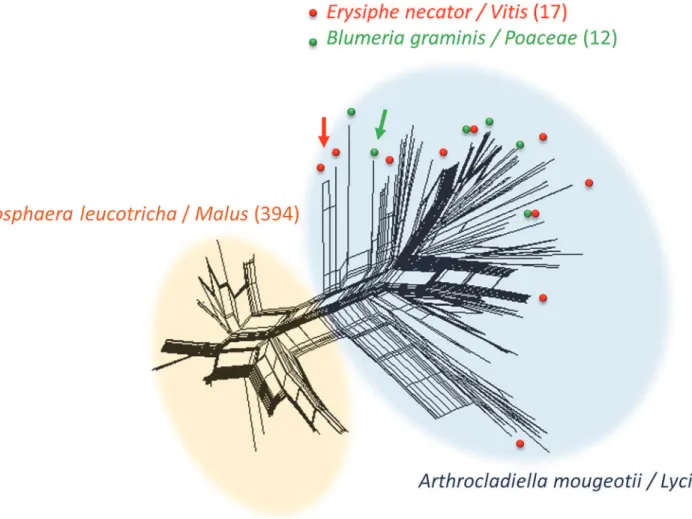
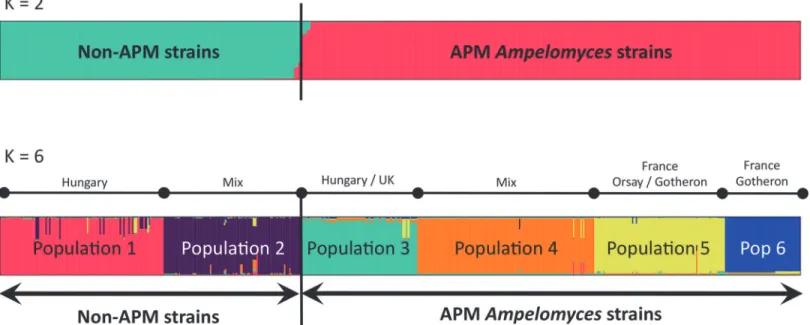
We first investigated the population structure ofAmpelomycesstrains with STRUCTURE [66]. SplitsTree analyses were also carried out, separately for the genotypes of all the strains based on five microsatellite markers (Fig. 1), and for the 209 non-APM strains genotyped with the eight markers (Fig. 2). STRUCTURE yielded well defined clusters atKvalues of up to 6 (Fig. 3andS1 Fig.), indicating the existence of six genetically differentiated clusters. For values ofKof 7 and above, each new cluster included only admixed genotypes, indicating a lack of further structure. The deltaK value [67] confirmed that the split into six populations corresponded to a peak in the strength of the structure in the dataset, the strongest peak being atK= 4 (S2 Fig.). AtK= 2, apple powdery mildew (APM) strains were separated from all other (non-APM) strains. This differentiation between APM and non-APM strains also appeared clearly on the SplitsTree (Fig. 1). AtK= 6, non-APM strains were split into two clusters (Fig. 3, populations 1 and 2), whereas strains isolated from apple powdery mildew were split into four clusters
Table 1. Characteristics of the eight polymorphic microsatellite loci identified inAmpelomycesstrains isolated from many different mycohosts in autumn.
Locus Motif Primer sequence (5'->3') Allele size range No. ofalleles
LK3a [CAGCAGCA-n15]8 CAAGATCTGCCGCCAACC 203–302 25
GGTGTTGTTGTGCATGTTGTC
LK3b [cgg]5 CGGCACGAAATCTACCTGTC 126–144 5
CGCAGAGGTGGATGTAGGTT
LK7c [ggt/gga/ggc]3 GATAGGACGCGGTTATGGAA 176–221 9
GATGTGGCTTCCTGGTTCG
LK10c [gct]6[cgg]3 CATCGTGATGTTCTGGGTGA 149–197 10
AGACCACAATCTCCGACCAG
LK10d [ggt]5[ggcggt]3 CAGAAGTGGATTGCGGAGAG 179–257 21
CAAGGCCACATCCAAGTTCT
LK3c [aag]13 GACAAGAAACCTTGGGTTGG 101–161 20
GGACGACGATTTGCAGACTA
LK7d [caccgc]4 GCTTCGGGTTTGTCTCAGTC 146–188 7
CGAAAGGGTTGATGAGGTTT
LK7f [gt]12 AAAAGTCAAGGGACCACACG 181–253 23
CATAAGCGATGGGAGTTGGT
Thefirstfive loci listed below were also used to genotypeAmpelomycesstrains isolated from apple powdery mildew (APM) in spring.
doi:10.1371/journal.pone.0120703.t001
Table 2. Number of alleles detected at the five microsatellite markers in 394Ampelomycesstrains isolated in spring from apple powdery mildew (APM strains), and in 243 non-APM strains isolated later in the season from many other powdery mildew species infecting various host plants.
Strain type Locus
LK7c LK3a LK10c LK3b LK10d
APM strains 1 5 4 2 3
non-APM strains 8 20 7 3 18
The microsatellite profiles of the strains are shown inS2 Table.
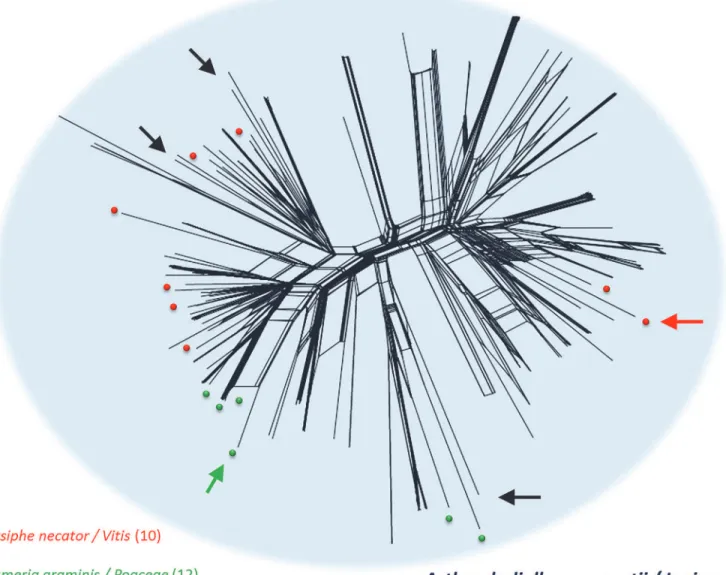
(Fig. 3, populations 3 to 6). The clusters of non-APM strains did not correspond to either dif-ferent host mildews or difdif-ferent host plants, but some geographical clustering was revealed: one of the clusters encompassed most of the Hungarian strains (128 of 130), together with two Italian strains, whereas the second cluster contained strains of more diverse origins, from Hun-gary, France, the United Kingdom, China, the USA, and Israel. Some geographical structure was also observed within APM strains: populations 5 and 6 mostly included strains from France, together with 13 of the 104 strains from Hungary (in population 5), and 3 of the 60 strains from the UK (in the population 6), whereas populations 3 and 4 included strains from different parts of Europe (Hungary, France, Germany, and the UK). On the other hand, the non-European strains appeared scattered in the SplitsTree (arrows onFig. 2).
The existence of six genetically divergent populations was confirmed by FSTanalyses. The
fixation index was 0.25 between the non-APM populations (populations 1 and 2), indicating strong genetic differentiation. Pairwise fixation indices ranged between 0.22 and 0.42 between
Fig 1. SplitsTree analysis of all 637Ampelomycesstrains, based on five microsatellite markers.Widely sampled fungal hosts and the plant hosts from which they were collected are indicated by colors and the number of strains is indicated in brackets. Two main clusters were identified, one consisting of the 394 strains from apple powdery mildew (APM,Podosphaera leucotricha, light orange cloud), isolated in spring, and the other comprising all the non-APM strains,i.e. the 157 strains isolated fromArthrocladiella mougeotiiinfectingLycium halimifoliumplants in Hungary (light blue cloud) and the strains isolated from other powdery mildew hosts in Europe and elsewhere, later in the season. In this second cluster, positions are shown by arrows for the 17 strains isolated from grapevine powdery mildew (Erysiphe necator, in red) and the 12 strains isolated fromBlumeria graminisinfecting wild grass species (in green). Reticulation indicates the occurrence of recombination.
the other four populations, indicating that there was also strong genetic differentiation between APM populations. The level of genetic differentiation was strongest between APM and non-APM clusters, with an FSTvalue of 0.49 between the two clusters obtained atK= 2.
A factorial correspondence analysis (FCA) yielded further support for the genetic patterns revealed above (S3 Fig.), with 7.82%, and 4.38% of the variance explained by axes 1 and 4, re-spectively). APM strains and non-APM strains appeared to be strongly separated along axis 1. The other populations were also segregated, but less strongly.
Fig 2. SplitsTree analysis of the 209 non-APMAmpelomycesstrains in which the eight microsatellite markers could be amplified.Widely sampled fungal hosts and the plant hosts from which they were collected are indicated by colors and the number of strains is shown in brackets: 134 strains came from
Arthrocladiella mougeotiiinfectingLycium halimifoliumplants (blue cloud), 12 strains came fromBlumeria graminisinfecting grasses (green points), 10 strains from grapevine powdery mildew (Erysiphe necator) (red points), and 53 other strains were isolated from several other powdery mildew species infecting various host plants, isolated in summer and fall. The position of anAmpelomycesstrain isolated fromE.necatorin the USA and that of another strain isolated fromB.graminisin Korea are indicated by red and green arrows, respectively. Black arrows indicate the positions of the other three non-European strains. Reticulation indicates the occurrence of recombination.
Recombination footprints
In the dataset based on five markers and 637 strains, only 93 MLGs were detected, with a mean of 6.7 strains per MLG. These identical MLGs probably did not correspond entirely to clones, resulting instead from the insufficiently high discriminatory power of the five markers, as a permutation estimating the number of MLGs as a function of the number of markers used did not reach a plateau (S4 Fig.); actually, most of these identical MLGs could be differentiated using eight markers. In the dataset based on eight markers and 209 strains, 91 MLGs were de-tected, with a mean of only 2.3 strains per MLG, and a single abundant MLG for 17 strains in the APM cluster. In this analysis, the number of MLGs as a function of the number of markers used did begin to reach a plateau (S4 Fig.), although the shape of the curve indicated that dis-crimination could probably be increased further by the use of a larger number of markers. Thus, the identical MLGs obtained probably do not strictly correspond to clones and did not, therefore, bias the structure analyses.
We assessed the occurrence of sex, by looking for footprints of recombination in the split decomposition analysis, in which recombination events were identified as reticulations (Figs.1
and2). The SplitsTree analyses yielded networks with long branches, but also with some reticu-lations, mostly within each of the APM and non-APM clusters, with a smaller number between APM and non-APM strains. This pattern is indicative of pervasive clonality with occasional re-combination events, these events being less frequent between than within the APM and non-APM clusters, confirming that differences in host plant phenology impede gene flow between these two groups. The branches appeared to be shorter and the reticulations more frequent within the APM cluster than within the non-APM cluster (Fig. 1), confirming the lower level of diversity and suggesting less ancient clonality and/or more frequent recombination events. The SplitsTree analyses have also shown that there was no detectable genetic differentiation within non-AMP strains as a function of the powdery mildew host, as strains from different powdery mildew species were scattered (Figs.1and2). Non-APM strains belonging to different
Fig 3. Population structure inAmpelomyces.Structure was inferred by STRUCTURE forK= 2 andK= 6 (seeS1 Fig.for the bar plots corresponding to otherKvalues). STRUCTURE yielded well defined clusters up toK= 6, indicating the existence of six genetically differentiated clusters.K= 2 separates APM and non-APM strains. The geographical origin of strains is indicated on theK= 6 barplots.
phylogenetic lineages based on their ITS and actin gene sequences [38–40] did not form dis-tinct groups in any of the SplitsTree analyses (Figs.1and2).
Linkage disequilibrium analyses were consistent with the SplitsTree and STRUCTURE anal-yses, indicating frequent clonality with occasional recombination events, these events being more frequent in the APM cluster. Linkage disequilibrium was, indeed, significant within both AMP and non-APM clusters, at least partly reflecting a Wahlund effect due to the genetic structure. When the populations were considered separately, we also detected significant link-age disequilibrium within both the non-APM populations (populations 1 and 2), whereas no significant linkage disequilibrium was detected for the three APM populations for which link-age disequilibrium could be calculated.
Discussion
In this study, we developed eight new polymorphic microsatellite markers for investigating the population structure and diversity ofAmpelomycesstrains isolated from many powdery mil-dew species infecting very different host plant species and representative of the genetic diversity in Erysiphales. Five out of eight of our newly developed microsatellite markers could be ampli-fied in both AMP and non-AMP strains, which was not the case for previous microsatellite markers [11]. The newly developed markers will be useful for detecting and monitoring Ampe-lomycesstrains released as commercial biological control agents in vineyards [42] and in agri-cultural fields, because they were amplified reliably from environmental samples as well as from strains maintained in culture.
Various analyses, using a comprehensive dataset with the genotypes of APM and non-APM strains, confirmed that there was a high level of genetic differentiation between these two groups, with no evidence of gene flow. This is consistent with the findings of our previous study, indicating that APM strains form a distinct cryptic species, genetically isolated from non-APM strains by temporal isolation due to differences in the phenology of their powdery mildew hosts [11]. Indeed, apple powdery mildew overwinters in apple buds [41] and begins to sporulate soon after bud burst, becoming widespread on its host plants in spring and persist-ing without much further spread, mostly on green shoots, durpersist-ing the summer and fall. By contrast, the other powdery mildew species, the mycohosts of the non-APM strains, begin to sporulate and spread on their respective host plants later in the season. They also continue to display active sporulation and spread on host plants until late fall [11]. Phylogenetic analyses have previously suggested that the non-APM strains could be classified into distinct molecular taxonomic units (MOTUs), which were not specific to particular mycohost or plant host spe-cies [38–40,53]. Neither SplitsTree nor STRUCTURE analyses however confirmed here the distinction of the non-APM strains according to the MOTUs defined in these previous works [38–40,53].
[15,23–29]. The ability of our markers to reveal geographical structure in European popula-tions highlights their discriminatory power and indicates that the lack of structure according to host is real and not due to low power.
The analyses of non-APMAmpelomycespopulations detected no structure according to powdery mildew mycohost and/or host plant species, even in the most widely sampled areas. Moreover, strains isolated from different powdery mildew species, infecting different host plants, sometimes had identical, or very similar, microsatellite profiles. These results suggest that there are no barriers restricting gene flow amongAmpelomycesstrains affecting different powdery mildew species, on different host plants, in the same environment. These findings suggest that this mycoparasite is a genuine generalist. This may appear contrary to the results of laboratory experiments showing thatAmpelomycesstrains from grapevine powdery mil-dew parasitize their original mycohost species more strongly than two other test powdery mildew species [55], or showing differences in the virulence ofAmpelomycesstrains against three powdery mildew species [68]. However, there may be some polymorphism in the ability of different strains to infect various host species or aggressiveness towards different host spe-cies within a given mycoparasite spespe-cies. By contrast, other cross-inoculation experiments have repeatedly shown that a number ofAmpelomycesstrains isolated from different pow-dery mildew species were all able to parasitize test powpow-dery mildew species in the laboratory [40,41,69] with similar intensities of mycoparasitism for strains isolated from conspecific and other powdery mildew species [11]. Moreover, a field experiment has clearly demon-strated that genetically differentiatedAmpelomycesstrains occurring naturally in certain powdery mildew species can easily disperse and parasitize other powdery mildew species on their respective host plants [11]. Furthermore, a broad sampling campaign revealed that grapevine powdery mildew was naturally parasitized by phylogenetically diverse Ampelo-mycesstrains in the field [38].
Some of these previous studies, and the results reported in this work, indicate that Ampelo-mycesmycoparasites are not strictly specialized on the powdery mildew species in which they are found in the field, with each cluster instead naturally parasitizing a wide range of powdery mildew species. Moreover, this study provides the first evidence for recombination events in
Ampelomycesstrains isolated from different, non-APM mycohost species in the field. The sexu-al fruiting bodies ofAmpelomyceshave never been observed, despite intensive morphological studies on this mycoparasite [37]. The recombination footprints detected may, therefore, be the result of ancient sexual events, before a loss of sex, or recombination may result from a parasexual process in the hyphal anastomoses within the powdery mildew mycelium, the sole habitat ofAmpelomyces. It may also be that sex events are very rare and were not observed so far.
Supporting Information
S1 Fig. Population structure inAmpelomyces.The structure has been inferred by STRUC-TURE for K = 2 to K = 7. The STRUCSTRUC-TURE program could form well-defined clusters up to K = 6, indicating the existence of six genetically differentiated clusters. The two different solu-tions found by Structure at certain K values are shown. The strains are in the same order as in
Fig. 1. (TIF)
S2 Fig. Result of the Evanno method for detecting the number of K groups for which the subsequent increase in K yield less information than the previous increase in K.
(TIF)
S3 Fig. Factorial Correspondence Analysis (FCA) illustrating the differentiation of the six populations ofAmpelomycesaccording to axes 1 and 4.The populations are defined based on STRUCTURE assignations (Fig. 1at K = 6).
(TIF)
S4 Fig. Number of MLGs (MultiLocus Genotypes) depending on the number loci consid-ered using permutations A) for the five markers dataset, B) for the eight markers datasets.
(TIF)
S1 Table. Designations of strains, their fungal host and host plant species of collection, and dates and places of collection of theAmpelomycesstrains and powdery mildew-infected apple leaf samples bearingAmpelomycesmycoparasites included in this study.The 11 strains used to develop the microsatellite markers are shown in red boldface. Strains of Ampelo-myceswere designated with upper case letters and/or numbers. When more than one strain was isolated from the same site/plant, these were distinguished by lower case letters (e.g., B119-a and B119-b). If available, public culture collection designations of the strains are also shown. Lower case designations (b1-b365) were applied for apple leaf samples, preserved as herbarium materials and used in the microsatellite genotyping work. Dates and places of col-lections given with all known details. If several strains were used, collected from more than one site within a locality, or from more than one plant individual within one site, the site and/or the plant number was shown in the table. The identities of the host fungal and host plant spe-cies of the strains obtained from earlier works were determined by their suppliers.
(PDF)
S2 Table. Genotypes ofAmpelomycesstrains isolated from different mycohosts, genotyped with five microsatellite markers.
(PDF)
S3 Table. Genotypes ofAmpelomycesstrains isolated from different mycohosts in autumn, genotyped with eight microsatellite markers.
(PDF)
Author Contributions
References
1. Barrett LG, Heil M. Unifying concepts and mechanisms in the specificity of plant-enemy interactions. Trends Plant Sci. 2012; 17: 282–292. doi:10.1016/j.tplants.2012.02.009PMID:22465042
2. Bruns E, Carson ML, May G. The Jack of all trades is a master of none: a pathogen's ability to infect a greater number of host genotypes comes at a cost of delayed reproduction. Evolution 2014; 68: 2453–
2466. doi:10.1111/evo.12461PMID:24890322
3. van Tienderen PH. Evolution of generalists and specialists in spatially heterogeneous environments. Evolution 1991; 45: 1317–1331.
4. Whitlock MC. The red queen beats the Jack-of-all-trades: the limitations of phenotypic plasticity and niche breadth. Am Nat. 1996; 148: S65–S77.
5. Soler JJ, Martin Vivaldi M, Moller AP. Geographic distribution of suitable hosts explains the evolution of specialized gentes in the European cuckooCuculus canorus. BMC Evol Biol. 2009; 9: 88. doi:10.1186/ 1471-2148-9-88PMID:19405966
6. Rice WR. Disruptive selection on habitat preference and the evolution of reproductive isolation: a simu-lation study. Evolution 1984; 38: 1251–1260.
7. Johnson PA, Hoppensteadt FC, Smith JJ, Bush GL. Conditions for sympatric speciation: a diploid model incorporating habitat fidelity and non-habitat assortative mating. Evol Ecol. 1996; 10: 187–205.
8. Giraud T, Refrégier G, de Vienne DM, Le Gac M, Hood ME. Speciation in fungi Fung Genet Biol. 2008; 45: 791–802. doi:10.1016/j.fgb.2008.02.001PMID:18346919
9. Le Gac M, Giraud T. Existence of a pattern of reproductive character displacement in Basidiomycota but not in Ascomycota. J Evol Biol. 2008; 21: 761–772. doi:10.1111/j.1420-9101.2008.01511.xPMID: 18312316
10. Théron A, Combes C. Asynchrony of infection timing, habitat preference, and sympatric speciation of schistosome parasites. Evolution 1995; 49: 372–375.
11. Kiss L, Pintye A, Kovacs GM, Jankovics T, Fontaine MC, Harvey N, et al. Temporal isolation explains host-related genetic differentiation in a group of widespread mycoparasitic fungi. Mol Ecol. 2011; 20: 1492–1507. doi:10.1111/j.1365-294X.2011.05007.xPMID:21261766
12. Giraud T, Villaréal L, Austerlitz F, Le Gac M, Lavigne C. Importance of the life cycle in host race forma-tion and sympatric speciaforma-tion in parasites. Phytopathology 2006; 96: 280–287. doi: 10.1094/PHYTO-96-0280PMID:18944443
13. Giraud T, Gladieux P, Gavrilets S. Linking emergence of fungal plant diseases and ecological specia-tion. Trends Ecol Evol. 2010; 25: 387–395. doi:10.1016/j.tree.2010.03.006PMID:20434790
14. Gladieux P, Guerin F, Giraud T, Caffier V, Lemaire C, Parisi L, et al. Emergence of novel fungal patho-gens by ecological speciation: importance of the reduced viability of immigrants. Mol Ecol. 2011; 20: 4521–4532. doi:10.1111/j.1365-294X.2011.05288.xPMID:21967446
15. Fournier E, Giraud T. Sympatric genetic differentiation of a generalist pathogenic fungus,Botrytis cinerea, on two different host plants, grapevine and bramble. J Evol Biol. 2008; 21: 122–132. PMID: 18028352
16. Gibson AK, Hood ME, Giraud T. Sibling competition arena: selfing and a competition arena can com-bine to constitute a barrier to gene flow in sympatry. Evolution 2012; 66: 1917–1930. doi:10.1111/j. 1558-5646.2011.01563.xPMID:22671556
17. Taylor JW, Jacobson DJ, Kroken S, Kasuga T, Geiser DM, Hibbett DS, et al. Phylogenetics species recognition and species concepts in Fungi. Fung Genet Biol. 2000; 31: 21–32. PMID:11118132
18. Le Gac M, Hood ME, Fournier E, Giraud T. Phylogenetic evidence of host-specific cryptic species in the anther smut fungus. Evolution 2007; 61: 15–26. PMID:17300424
19. Giraud T, Fortini D, Levis C, Lamarque C, Leroux P, LoBuglio K, et al. Two sibling species of the Botry-tis cinereacomplex, transposa and vacuma, are found in sympatry on numerous host plants. Phytopa-thology 1999; 89: 967–973. doi:10.1094/PHYTO.1999.89.10.967PMID:18944743
20. Amselem J, Cuomo CA, van Kan JAL, Viaud M, Benito EP, Couloux A, et al. Genomic analysis of the necrotrophic fungal pathogensSclerotinia sclerotiorumandBotrytis cinerea. Plos Genet. 2011; 7: e1002230. doi:10.1371/journal.pgen.1002230PMID:21876677
21. Farrer RA, Weinert LA, Bielby J, Garner TWJ, Balloux F, Clare F, et al. Multiple emergences of geneti-cally diverse amphibian-infecting chytrids include a globalized hypervirulent recombinant lineage. Proc Natl Acad Sci USA. 2011; 108: 18732–18736. doi:10.1073/pnas.1111915108PMID:22065772
23. Barres B, Halkett F, Dutech C, Andrieux A, Pinon J, Frey P. Genetic structure of the poplar rust fungus
Melampsora larici-populina: Evidence for isolation by distance in Europe and recent founder effects overseas. Infect Genet Evol. 2008; 8: 577–587. doi:10.1016/j.meegid.2008.04.005PMID:18499532
24. Giraud T, Enjalbert J, Fournier E, Delmotte F, Dutech C. Population genetics of fungal diseases of plants. Parasite-Journal De La Societe Francaise De Parasitologie 2008; 15: 449–454. PMID: 18814721
25. Giraud T. Patterns of within population dispersion and mating of the fungusMicrobotryum violaceum
parasitising the plantSilene latifolia. Heredity 2004; 93: 559–565. PMID:15292913
26. Grunwald NJ, Hoheisel GA. Hierarchical analysis of diversity, selfing, and genetic differentiation in pop-ulations of the oomyceteAphanomyces euteiches. Phytopathology 2006; 96: 1134–1141. doi:10.1094/ PHYTO-96-1134PMID:18943502
27. Rieux A, De Bellaire LD, Zapater MF, Ravigne V, Carlier J. Recent range expansion and agricultural landscape heterogeneity have only minimal effect on the spatial genetic structure of the plant pathogen-ic fungusMycosphaerella fijiensis. Heredity 2013; 110: 29–38. doi:10.1038/hdy.2012.55PMID: 22990310
28. Rieux A, Halkett F, de Bellaire LD, Zapater MF, Rousset F, Ravigne V, et al. Inferences on pathogenic fungus population structures from microsatellite data: new insights from spatial genetics approaches. Mol Ecol. 2011; 20: 1661–1674. doi:10.1111/j.1365-294X.2011.05053.xPMID:21410575
29. Gladieux P, Zhang XG, Afoufa-Bastien D, Sanhueza RMV, Sbaghi M, Le Cam B. On the origin and spread of the scab disease of apple: out of central Asia. PLoS One 2008; 3.
30. Dutech C, Rossi JP, Fabreguettes O, Robin C. Geostatistical genetic analysis for inferring the dispersal pattern of a partially clonal species: example of the chestnut blight fungus. Mol Ecol. 2008; 17: 4597–
4607. doi:10.1111/j.1365-294X.2008.03941.xPMID:19140983
31. Rieux A, Lenormand T, Carlier J, de Bellaire LD, Ravigne V. Using neutral cline decay to estimate con-temporary dispersal: a generic tool and its application to a major crop pathogen. Ecol Lett. 2013; 16: 721–730. doi:10.1111/ele.12090PMID:23517600
32. Gladieux P, Byrnes E, Fisher M, Aguileta G, Heitman J, Giraud T. Epidemiology and evolution of fungal pathogens, in plants and animals. In: T. M, editor editors. Genetics and Evolution of Infectious Dis-eases. Elsevier. 2010; pp. 59–132.
33. Millanes A, Truong C, Westberg M, Diederich P, Wedin M. Host switching promotes diversity in host-specialized mycoparasitic fungi: uncoupled evolution in theBiatoropsis-Usneasystem. Evolution 2014; 68: 1576–1593. doi:10.1111/evo.12374PMID:24495034
34. Molina M, DePriest P, Lawrey J. Genetic variation in the widespread lichenicolous fungus Marchandio-myces corallinus. Mycologia 2005; 97: 454–463. PMID:16396353
35. Werth S, Millanes A, Wedin M, Scheidegger C. Lichenicolous fungi show population subdivision by host species but do not share population history with their hosts. Fungal Biology 2013; 117: 71–84. doi: 10.1016/j.funbio.2012.11.007PMID:23332835
36. Kiss L, Russell J, Szentivanyi O, Xu X, Jeffries P. Biology and biocontrol potential ofAmpelomyces
mycoparasites, natural antagonists of powdery mildew fungi. Biocontrol Sci Technol 2004; 14: 635–
651.
37. Kiss L. Intracellular mycoparasites in action: interactions between powdery mildew fungi and Ampelo-myces. In: Avery S., Stratford M. and Van West P., editors. Stress in Yeasts and Filamentous Fungi. London: Academic Press, Elsevier. 2008; pp. 37–52.
38. Pintye A, Bereczky Z, Kovacs GM, Nagy LG, Xu XM, Legler SE, et al. No Indication of strict host associ-ations in a widespread mycoparasite: grapevine powdery mildew(Erysiphe necator)Is attacked by phy-logenetically distantAmpelomycesstrains in the field. Phytopathology 2012; 102: 707–716. doi:10. 1094/PHYTO-10-11-0270PMID:22512466
39. Park M-J, Choi Y-J, Hong S-B, Shin H-D. Genetic variability and mycohost association of Ampelo-myces quisqualisisolates inferred from phylogenetic analyses of ITS rDNA and actin gene sequences. Fungal Biol. 2010; 114: 235–247. doi:10.1016/j.funbio.2010.01.003PMID:20943134
40. Liang C, Yang JR, Kovacs GM, Szentivanyi O, Li BD, Xu XM, et al. Genetic diversity ofAmpelomyces
mycoparasites isolated from different powdery mildew species in China inferred from analyses of rDNA ITS sequences. Fungal Diversity 2007; 24: 225–240.
41. Szentivanyi O, Kiss L, Russell JC, Kovacs GM, Varga K, Jankovics T, et al.Ampelomyces mycopara-sites from apple powdery mildew identified as a distinct group based on single-stranded conformation polymorphism analysis of the rDNA ITS region. Mycol Res. 2005; 109: 429–438. PMID:15912930
43. Ropars J, Dupont J, Fontanillas E, de la Vega RCR, Malagnac F, Coton M, et al. Sex in cheese: evi-dence for sexuality in the fungusPenicillium roqueforti. PLoS One 2012; 7: e49665. doi:10.1371/ journal.pone.0049665PMID:23185400
44. Burt A, Carter DA, Koenig GL, White TJ, Taylor JW. Molecular markers reveal cryptic sex in the human pathogenCoccidioides immitis. Proc Natl Acad Sci USA. 1996; 93: 770–773. PMID:8570632
45. Dyer PS, O'Gorman CM. A fungal sexual revolution:AspergillusandPenicilliumshow the way. Curr Op Microbiol. 2011; 14: 649–654.
46. Giraud T, Levis C, Fortini D, Leroux P, Brygoo Y. RFLP markers show genetic recombination inBotrytis cinereaand transposable elements reveal two sympatric species. Mol Biol Evol. 1997; 14: 1177–1185. PMID:9364775
47. Paoletti M, Rydholm C, Schwier EU, Anderson MJ, Szakacs G, Lutzoni F, et al. Evidence for sexuality in the opportunistic fungal pathogen Aspergillus fumigatus. Curr Biol. 2005; 15: 1242–1248. PMID: 16005299
48. O'Gorman CM, Fuller HT, Dyer PS. Discovery of a sexual cycle in the opportunistic fungal pathogen As-pergillus fumigatus. Nature 2009; 457: 471–U475. doi:10.1038/nature07528PMID:19043401
49. Lee SC, Ni M, Li W, Shertz C, Heitman J. The evolution of sex: a perspective from the fungal kingdom. Microbio Mol Biol Rev. 2010; 74: 298–340. doi:10.1128/MMBR.00005-10PMID:20508251
50. Hoff B, Poeggeler S, Kueck U. Eighty years after its discovery, Fleming'sPenicilliumstrain discloses the secret of its sex. Euk Cell 2008; 7: 465–470.
51. Lopez-Villavicencio M, Aguileta G, Giraud T, de Vienne DM, Lacoste S, Couloux A, et al. Sex in Penicil-lium: Combined phylogenetic and experimental approaches. Fung Genet Biol. 2010; 47: 693–706. doi: 10.1016/j.fgb.2010.05.002PMID:20460164
52. Harvey N. Characterization of six polymorphic microsatellite loci fromAmpelomyces quisqualis, intra-cellular mycoparasite and biocontrol agent of powdery mildew. Mol Ecol Notes. 2006; 6: 1188–1190.
53. Kiss L, Nakasone KK. Ribosomal DNA internal transcribed spacer sequences do not support the spe-cies status ofAmpelomyces quisqualis, a hyperparasite of powdery mildew fungi. Curr Genet. 1998; 33: 362–367. PMID:9618587
54. Sullivan RF, White JF.Phoma glomerataas a mycoparasite of powdery mildew. App Env Microbiol. 2000; 66: 425–427.
55. Falk SP, Gadoury DM, Pearson RC, Seem RC. Partial central of grape powdery mildew by the myco-parasiteAmpelomyces quisqualis. Plant Dis. 1995; 79: 483–490.
56. Takamatsu S. Phylogeny and evolution of the powdery mildew fungi (Erysiphales, Ascomycota) in-ferred from nuclear ribosomal DNA sequences. Mycoscience 2004; 45: 147–157.
57. Huson D, Bryant D. Application of phylogenetic networks in evolutionary studies. Mol Biol Evol. 2006; 23: 254–267. Available at:http://www.ncbi.nlm.nih.gov/pubmed/16221896. PMID:16221896
58. Belkhir K, Borsa P, Chikhi L, Raufaste N, Bonhomme F. GENETIX 4.05, logiciel sous Windows TM pour la génétique des populations. 1996–2004.
59. Raymond M, Rousset F. GENEPOP (version 1.2): Population genetics software for exact tests and ec-umenicism. J Hered. 1995; 86:: 248–249.
60. Rousset F. Genepop’007: a complete re-implementation of the genepop software for Windows and Linux. Mol Ecol Res. 2008; 8: 103–106. Available at:http://www.ncbi.nlm.nih.gov/pubmed/21585727. doi:10.1111/j.1471-8286.2007.01931.xPMID:21585727
61. Arnaud-Haond S, Belkhir K. GENCLONE: a computer program to analyse genotypic data, test for clon-ality and describe spatial clonal organization. Mol Ecol Notes 2007; 7: 15–17.
62. Pritchard J, Stephens M, Donnelly P. Inference of population structure using multilocus genotype data. Genetics 2000; 155: 945–959. PMID:10835412
63. Jakobsson M, Rosenberg N. CLUMPP: a cluster matching and permutation program for dealing with label switching and multimodality in analysis of population structure. Bioinformatics 2007; 23: 1801–
1806. PMID:17485429
64. Rosenberg N. DISTRUCT: a program for the graphical display of population structure. Mol Ecol Notes. 2004; 4: 137–138.
65. Earl D, VonHoldt BM. STRUCTURE HARVESTER: a website and program for visualizing STRUC-TURE output and implementing the Evanno method. Conserv Genet Res. 2012; 4: 359–361.
66. Pritchard J, Stephens M, Donnelly P. Inference of population structure using multilocus genotype data. Genetics 2000; 155: 945–959. PMID:10835412
68. Angeli D, Pellegrini E, Micheli S, Maurhofer M, Gessler C, Pertot I. Is the biocontrol efficacy of Ampelo-myces quisqualisagainst powdery mildew related to the aggressiveness of the strain?. In: A. Calonnec, editor. Proc 6th Int Workshop on Grapevine Downy and Powdery Mildew. Bordeaux, France: INRA ISVV. 2010; pp. 164–166.