Enhancement of an Error Minimizing
Framework for Localizing Jammers in
Wireless Networks: A Survey
Dr.P.Sivakumar1S.Padmapriya2, Dr.M.Senthil1
2
Embedded System Technologies, SKP Engineering College 1
SKP Engineering College, Thiruvannamalai, Tamilnadu, India 1
2
Abstract-Jammers can sternly mess up the communication in wireless networks. The jamming attacks can be aggressively eradicate by the protector thus permits by the jammer location information. Our intensions to plan a framework that can be localize multiple jammers with high accuracy. Maximum of surviving jammer localization scheme exploit indirect measurement such as neighbor lists, PDR, hearing range that can be disturbed by jamming attacks which is tough to focus the jammers perfectly. In its place we utilize a direct measurements-JSS. It is difficult to estimate and it can be derive in order signals. So we formulate an estimation scheme that is relying on ambient noise floor. To measure the estimation errors, we can explain an evaluation feedback metric. In addition to decrease the estimation errors by explain an evaluation feedback metric. We utilize the jammer localization problem as nonlinear optimization issue then global optimal solution is nearby jammer location. Then we discover many experimental algorithms for this global optimal solution but the watchdog timer shows our error minimizing framework obtains enhanced performance than the current scheme.
Key terms: Localization, PDR, Jamming attacks, Radio interference.
I. INTRODUCTION
In wireless sensor network jamming attacks have become a great disquiet recently. Finding the position of a jamming device is important so as to take security actions against the jammer and restore the network communication. A wireless sensor has not only a sensing component, but also on board processing, communication and storage competences. With these enhancements, a sensor node is often not only responsible for data collection, but also for in network analysis, fusion and correlation of its own sensor data and data from other sensor nodes. When many sensors co-operatively monitor large physical environment, they form a WSN.
A. Jamming attacks in wireless network.
A jammer is an entity who is purposefully trying to interfere with the physical transmission and reception of wireless communication. A jammer continuously emits RF signal to fill a wireless channel so that legitimate traffic will be completely blocked. Common characteristic for all jamming attack is that their communications are not amenable with MAC protocols.
1) Jamming attack models: There are four types of jamming attacks in wireless network. The jamming
attack model is shown in figure i) Constant jammer
ii) Deceptive jammer iii) Random jammer iv) Reactive jammer
Constant jammer- It continuously emits a radio signal and sends out random bits to the channel. It does not
follow any MAC layer etiquette and does not wait for the channel to become indolent.
Deceptive jammer- It constantly injects regular packets to the channel. Usual nodes will be deceived by the
packets and normal nodes just check the preamble and remain noiseless. Jammer can only send out introductions.
Random jammer- It alternates between sleeping and jamming after jamming for tj time units of time, it turns off
its radio and enters sleeping mode. After sleeping for ts units of time, it wakes up and resumes jamming constant or deceptive. tj and ts may be random or fixed intervals energy conservation.
Reactive jammer-Jammer stays quiet when the channel indolent and it starts transmitting a radio signal as soon
Fig. 1 . Jamming Attacks
It does not preserve energy because the jammers’ radio must be continuously on in order to intellect the channel however it is harder to detect.
2) Level of interference:It is distance between jammer and nodes. And also the relative transmission
power of the jammer and nodes. In wireless network the MAC protocols engaged by the nodes.
3) Detecting jamming attacks: The jamming attacks can be perceived by using strength of signal, carrier
sensing time and PDR.
II. Lightweight jammer localization
It is based on the principle of gradient descent minimization algorithm. The PDR has lower values when we move nearby jammer. Gradient based pattern functioning isolate level of the network topology. It helps to positioning the jamming device. i) We examine through enquiry and protestation in the process that the jamming effects flow through the network. ii) For this lightweight jammer no other reforms to the driver/firmware of commercial NIC’s. iii) We gadget and estimate our localization system on our 802.11 indoor test bed. An effective and vital feature of our process does not based on special network.
A. Associated effort
1) Signal processing localization method:By using this technique, we had improve extensive deployment
of various methods (ultrasound, infrared or laser organization).
2) RSS based localization method: RSS measurement used to discern the spot of wireless devices certain
the location AP’s. By using these methods, it needs warddriving and can be ruminate as centralized algorithm.
3) Gradient descent minimization: Gradient based algorithm is utilized for the competent forwarding of
probes in sensor network.
B. Our localization algorithm
The packet delivery ratio value lower [1] when we move with in the vicinity of the jammer we can vary the above gradient descent method in order to localize the jammer. We had an idea to examine different modification to decline the sensitivity of our Algorithm to local minima by improving its performance.
III. Determining the position of jammer using VFIA
We previewed the matter depending wireless networks with localizing jammers. We had used the jamming effects using two jamming models.
i) Region-based model ii) Signal-to-noise ratio model
And we listed network nodes into three ways by the level of disturbance caused by the jammer. We propose to location of jammer in wireless networks using a virtual- force iterative approach. We compare the mean error for different algorithms in Table. I.
A. Associated effort
Jammer location was also observed in the sensor networks and in networks influencing frequency hopping. Based on localization infrastructure, infrared and ultrasound are hired to achieve localization, both of which require deploying specialized infrastructure for localization.
B. Network model and jamming model
1) Formulation of jamming effects: There are many various attacks strategies that jammers will plays in order to dislocate wireless communication.
TABLE.I
Mean Error for Different Algorithm.
Algorithm Node density NLB radius Jammer’s position
N-200 N=300 N=400 R=65.6ft R=92.8ft N=200 N=300
VFIL-Tr
RBM 2.8ft 1.8ft 1.3ft 3.4ft 2.4ft 2.8ft 2ft
SBM 7.5ft 6.5ft 5.4ft 8.8ft 7.8ft 4.2ft 4.9ft
VFIL-NoTr
RBM 3.8ft 2.4ft 1.8ft 4.4ft 3.1ft 3.8ft 2.9ft
SBM 9.6ft 7.9ft 6.8ft 10.6ft 9.7ft 7.9ft 5.2ft
CL RBM 7.9ft 6.3ft 5.5ft 8.4ft 8.4ft 2.9ft 6.9ft SBM 11.3ft 9.6ft 8.3ft 12.1ft 12.1ft 5.2ft 6.3ft
2) Region based model: A jammer with a directional antenna region and with an omnidirectional antenna
consist circular jammed part used for the jamming localization in this model.
C. Jammer localization algorithm
A prevailing range free localization algorithm that can be realistic to regulate the position of a jammer, centroid localization. After that we existing our method of virtual force iterative localization (VFIL).
D. SNR based model
The region based model does not afford a comprehensive description of composite relationshipbetween the transmission power of senders and thejammer. The probability of success reception of a packet is primarily a function of the signal to noise ratio at the receiver. In the jamming setup, the ‘noise’ contains ambient noise and jamming signal. We functional the SNR based model to regulate the assessed status of the nodes in every repeated. To make the calculation effective, we accepted the notion of nearest and furthest un-jammed neighbors.
We concentrated on localizing the jammer after a jamming attack is noticed. We diagnosed the jamming effects in two jamming models. And we increase the VFIL algorithm that makes use of the network topology to iteratively correct the planned location of a jammer when it reaches a close approximation of two locations.
IV. Exploiting jamming-caused neighbor changes
We participate on improving processes to position a jammer by abusing neighbor changes. We firstly leads jamming effect inquiry toobserve how the connecting range modify with the jammer’s location and transmission power by the procedure of free space model. We can manner the jammer position planning dependable by determining the neighbor changes produced by jamming attacks. By solving a Least Squares (LSQ) problem that activities the other new communication range.
A. Analysis of jamming effects
In this we define the effect of one jammer with an omnidirectional antenna on the wireless communication at two stages
1) Individual communication range level 2) Network topology level
B. LSQ-based jammer localization
The initial idea of our LSQ-based algorithm [3] is to focus the jammer depending to the newer of a node’s hearing range.
C. Localizing a jammer in reality
In this the recital associated with realistic radio propagation, some challenges improves when realizing our localization algorithm in preparation we altered the LSQ-based algorithm to define the challenges encouraged by the complex radio propagation. In this process, we determined our estimation on the act of LSQ based localization algorithm utilizing the log normal shadowing model.We have analyzed the effect of a jammer on both a node’s hearing range and sending range. We have proposed (LSQ) depends on localization algorithm that evaluates the jammer’s location by using the fluctuations of neighbor nodes produced by jamming.
V. RADAR: In-building RF based user location and tracking system
located to afford overlying attention in the area of interest. We current experimental effect that proves the ability of RADAR to evaluate the user position with a higher degree of accuracy.
A. Associated work
In this work the area of user location and tracking falls into the following broad categories: 1) In-building IR
2) Wide area cellular network 3) Global positioning system(GPS)
B. Research methodology
In this we initiate with experimental test bed after that the description of data collection and the data processing also be described. In data collection we are using the signal information to construct and authorize models for signal propagation during off-line analysis. In data processing system [4] we examine the signal strength information and building floor layout information.
C. Analysis and experimental analysis
We converse various algorithm for user location and tracking, and existing an analysis of how well these perform utilize experimental data. In this we differentiate the goodness of our estimate of the user’s location using the error remoteness beneath the physical location of the user and the assessed position.
We have presented RADAR a system for locating and tracking users’ exclusive a building. RADAR is based on empirical signal strength measurement as well as a simple yet active signal propagation model. It is probable to build an affected class of location-aware services, suchas printing to the close by printers, navigating through a building.
VI. Jammer localization by exploiting node’s hearing ranges
In this we focus on refining mechanism to localize a jammer and thus first manner jamming effect analysis to survey how a hearing range. Hearing range designates the area from the node can effectivelyreceive and decode the packet changes with the jammer’s location and transmission power. When compared with our preceding iterative search centered virtual force algorithm. Our anticipated hearing range base algorithm displays lower computational cost and higher localization precision. The mean error is compared in Table.II.
A. Outline
To certify efficacious deployment of the application in this wireless jamming localization the reliability of the beneath wireless communication suits utmost popular. A pressure that is exclusively risky in jamming attacks. To certify the reliability of wireless communication much effort has been prepared to notice and preserve beside jamming attacks. In relations of notice, single based and consistent check-based algorithm.
B. Analysis of jamming effects
In this process we started the initial wireless networks that use throughout this paper and concisely appraising the theoretical underpinning for analyzing the jamming effects. And we define the detail of a jammer on the wireless communication at two levels.
1) Individual communication range level 2) Network topology level
C. Algorithm description
In previous method, we displayed [5] that the hearing range of a node can contract when jammer turn into active and the state of alteration is derived by the distance to the jammer and jamming signal strength. In this we are using jammer localization algorithm. It is used to estimate the hearing ranges. The performance is relying on the impact of the node density and jammer’s position.
TABLE.II Comparison of Mean Errors.
Algorithm Node density NLB radius Jammer’s position
N=200 N=400 Tr=2o dbm
Tr=60 dbm
Tr=80 dbm
Tr=100 dbm
Center Corner
LSQ Smart 4.2m 1.8m 3m 2m 2m 2m 2m 5m
Simple 5.9m 3m 5.9m 3.1m 3.1m 3.1. 2.1m 9m
VFIL Smart 18.8m 12.2m 12m 10m 9m 8m 9.1m 40m
Simple 47.5m 38.2m 29m 25m 23m 22m 22m 52m
completes the location calculation in one step that decreasing the computation cost while reaching improved performance.
VII. Multiple attackers in wireless networks
Jamming attacks and accidental radio interfere are one of the most extortion produce detriments the trustworthiness of wireless communication and exposing the setting out of universal application madeup on top of wireless networks. In this we discourse about the issues of localizing multiple jamming attacker coexisting in wireless networks by forcing the network topology fluctuations caused by jamming. We methodically examine the jamming effects and design a framework that can separate the network topology into clusters and effectively evaluate the location of multiple jammers even their areas are overlapped.
Our research on multi hop network that using MicaZ sensor nodes. This approach is highly efficient in localizing multiple attackers with or without the erstwhile understanding of the order that the jammers are turned on.
A. Model
In this we are using two models that is adversary model and network model [6] after that we afford an analysis of jamming effects when multiple jammers exist in the network.
B. Localizing multiple jammers
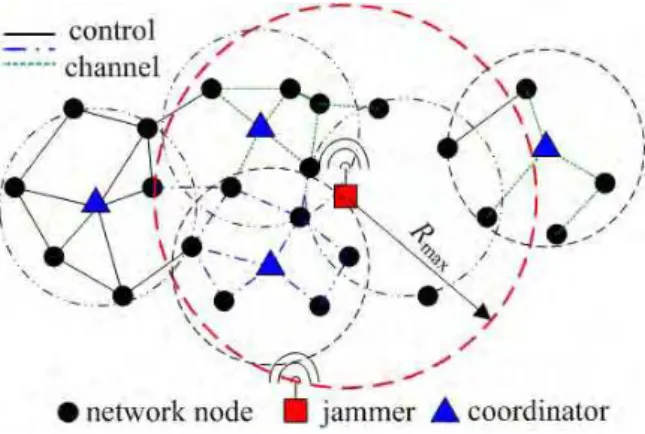
We design a framework that can focus multiple jammers by abuse the collected network topology changes. Our framework made up of two components [6]. They are Automatictopology partition and intelligent multi-jammer localizer. A) We are using the current jamming detection method to detect the jamming and our automatic network topology partitioner will categorize the network topology into altered groups and forms two sets of clusters.
1) Jammed cluster (JC) 2) Boundary cluster (BC)
Characteristically there will be one different BC and different JC fashion around a jammer. We improved a minimum spanning tree rely topology partitioning method to detect them. B) In this we are using the basic algorithm to localize to evaluate the location of single jammer.
1) Centroid based algorithm 2) Adaptive LSQ-based algorithm
C. Assumption
Node topology partition-This method confirm that our network topology partition works amenably when the distance between jammer changes. Localization algorithm selection-We detected that our multi jammer localization utilize Adaptive LSQ algorithm to perform localization all the time.Impacts of distance between jammers-This is boosting as it specifies that multi jammer localizer can attain the comparable performance even without the past knowledge.
VIII. An algorithm for jammer localizing
In this work, we take a wide ranging learning on the jammer localization issue and we put forward a simple efficient algorithm called Double circle localization [7]. It is rely on Minimum Bounding Circle (MBC). We gadget and estimate DCL beneath various conditions and it associate with three conditions.
The mean error for various algorithms is tabulated in Table. III
TABLE.III
Comparison of different mean error
Algorithm Node density Jammer’s Transmission power
N=100 N=300 Tr=20dbm Tr=30dbm Tr=40dbm
DCL 1m 0.5m 00.6 0.4 0.2
VFIL 1.2m 0.8m 0.9 0.6 0.5
CL 2m 1.2m 1.3 1.2 1.2
WCL 3.1m 2m 2.1 2 2
A. Existing algorithm
We afford three current jammer localization algorithms: i) Centroid localization (CL)
Centroid localization: It is resulting from indication of centroid which is the geometric center in geometry. CL utilizes the position info of all neighboring nodes. CL collects all coordinates of jammed node and norms over their coordinates as the evaluated location of the jammer.
B. Weighted centroid localization
WCL adds various contributions to the node coordinate information in evaluation the position of the target node. Virtual force iterative localization [7]: VFIL attempts to increase CL by regulation the estimation of CL to rendering to the jammed nodes sharing. It calculates the jammer’s transmission range.
C. The Double Circle Localization algorithm
Both CL and WCL are delicate to node sharing and network density and VFIL has complications on jammer transmission range estimation. VFIL utilize a circle area to simulate the jammed area and arrange it iteratively associate to node distribution on the edge of a jammed region.We observe that these entire algorithm are delicate to node and we discover double circle localization always accomplish the best in all the circumstances. We observe that these entire algorithm are delicate to node and we discover double circle localization always accomplish the best in all the circumstances.
IX.Error minimizing jammer localization through smart estimation of ambient noise
We discuss the issue of localizing jammer. The previous method depends on indirect measurement that is resultant from jamming special effects properties and it is hard to position jammer. We focus the jammer by direct measurements instead of indirect measurements using jamming signal strength. It is difficult to estimate. We develop an estimation method rely on ambient noise floor. To increase the localization accuracy, we develop an evaluation feedback metric to evaluate the estimation error and derive jammer localization as a nonlinear optimization problem. Our error minimizing based algorithm performs well than the current algorithm.
A. Measuring the jamming signals
One of most widely used measure is RSS in localization [8]. The Wi-Fi system can estimate its position by comparing the measured RSS value with pre trained radio frequency value.
B. Ambient Noise Floor
It is sum of all unwanted signals that are always present and the ambient noise floor is the measurement of surrounding noise.
C. JSS estimation
To originate the jamming signal strength, our method contains sampling surrounding noise values nevertheless of whether the channel is indolent or busy.
D. Algorithm description
To exploration for the finest assessment, we intend to use a simulated annealing algorithm. It searches for the optimal solution by the physical method of warming a material and then furiously dropping the temperature to decrease fault. We tabulate the different mean error in Table.IV
TABLE.IV
Comparison of Mean Error for Different Algorithm
Algorithm Node density Jamming transmission power N=200 N=300 N=400
Tr=-42db
Tr=-40db
Tr= -38bd
Tr=-36db
SA Smart 2.7m 2.1m 1.6m 2.6m 2.8m 3.0m 3.5m
Simple 3.3m 3.2m 3.1m 3.2m 3.3m 3.4m 3.6m
LSQ Smart 11m 9m 7.3m 16m 13m 11.3m 11m
Simple 9m 8m 7m 9m 8.9m 8.9m 8.8m
X. The feasibility of launching and detecting jamming attacks
Jamming attacks can sternly interrupt with the operation of wireless networks. In this method, we survey the radio interference attacks from two verges of the problem. The first one is issue of steering radio interference attacks on wireless networks. The second one is the acute problem of establishing the jamming attacks. In this we are using the four jamming attack models that is utilized by an adversary to inactive the process of wireless networks and estimates their efficiency.
A. Jamming characteristics and metrics.
The communal characteristics for all jamming attacks in that their communications are not amenable with MAC protocols.
Hence we outline a jammer to be an entity who is trying to hinder with the physical transmission and reception of wireless communication. There are two metrics to measure the efficiency of a jammer [9]. That is packet delivery ratio and packet send ratio.
B. Jamming models
1. Constant jammer 2. Deceptive jammer 3. Random jammer 4. Reactive jammer
C. Jamming detection with consistency checking
Two consistency checks are available in this scheme. They are, 1. Signal strength consistency check 2. Location consistency check
The jammer detection algorithm is used to check the packet delivery ratio measurement consistency with observed signal strength readings. And the location detection jammer algorithm used to check the packet delivery ratio measurement consistency with location information. The problem of finding the jamming attacks and analyzes the strength of various measurements to Categorize the jammer and we display by help of signal strength, carrier sensing time and packet delivery ratio.
XI. Localization systems
We review many methods associated to localization system for WSN as well as how to focus the nodes in these wireless networks. We share the localization system into three different components. They are distance, estimation, and position calculation and localization algorithm [10]. The position of the sensor nodes may not determine. Thus, a localization system is needs to afford localization to the nodes.
A. Components
• Distance: This component is in authority for evaluating the info about the distance between two nodes. It is used by further component of localization system.
• Position estimation: This component is in authority for calculating a node’s localization relies on obtainable info regarding distance and position reference nodes.
• Localization algorithm: It is the core module of localization system. It defines how the accessible info will be operated to allow or all the node of a WSN to evaluate their localization.
1)Distance estimation: It contains in classifying the distance between two nodes. It is utilized by
positioncomponents and localization algorithm. Various methods are used to evaluate the information. Some of these models are very exact but very higher cost. Others are less accurate. It includes strength of received signal indication, time of arrival and angle of arrival.
2)Position estimation: When a node has its sufficient information about distance and position, it can
calculate its own localization using by these modules. Several modules can be utilized to calculate the node location. Such methods are trilateration, multilateration, triangulation, probabilistic approaches, bounding box and the position of central [10]. Triangulation and multilateration methods are utilized to calculate a node’s position. The bounding box module anticipated in uses squares. An alternative of circles as initial to bound the available localization of a node.
3)Localization algorithm: It is main part of the localization system. It can be classified as, distributed
position evaluation with or without structure, design for indoor or outdoor situation and relative positioning. Some offered algorithms are Ad-hoc positioning system (APS), Recursive position estimation (RPE), Localization with Mobile beacon (LMB).
B. Ad-hoc positioning system
In APS, a decreased number of beacon nodes are employed with the unknown nodes. Each node calculates its distance to the beacon nodes in a way of multi hop. Once this distance is calculated, the node can calculate their position utilizing the trilateration. These hop by hop module angle calculations are projected: DV-Hop, Dv-Dist and Euclidean.
C. Recursive position estimation
The localization system should attain best outcomes if the distance of arrival module is utilized instead of strength of received signal indication to calculate the distance. This method has number of resolution for localization system each with an importance on a special state and application.
XII. Selective jamming attacks in wireless networks
We examine the issue of selective jamming attacks in wireless networks. We regulate the effects of selective jamming on the network recital by defining the various selective attacks in contradiction of the TCP protocol. We display that such attacks can belaunched by carrying out the real time packet classification at the PHY layer.We observe the mixture of cryptographic original with physical layer qualities for preventing real time packet arrangement and cancel out the inside knowledge of the attacker[11].
The quite a few another jamming approaches have been considered jammers into four model. i) Constant jammer that incessantly produce noise, ii) Deceptive jammer that endlessly broadcast invented messages or replays old ones. iii) Random jammer that replacements between periods of continuous jamming and passively iv) Reactive jammer who jams only when transmission dynamically is noticed.
We have some problems in this method they are assessing the capability of the adversary in ordering transmitted messages in real-time and evolving resource - effectual mechanism for avoiding real-time packet classification. In this method we have various attackers model. They are network model, communication model and adversary model. The adversary is proficient of physically compromising network device and recovering stored data containing cryptographic keys, pseudo- random sequences, certificates, etc. It is encrypted with globally known keys and can decrypt any information or attack communication endangered by globally recognized PRN sequence.
In this we recommend three methods for contradicting selective jamming [11]. Our aim is to transform a selective jammer to arbitrary one. This is attained by irresistible the adversary’s computational ability to achieve real-time packet arrangement.
A. Effects of selective jamming on TCP
We establish the effects of selective jamming on TCP. In specific, we executed a selective jamming attack counter to a TCP connection recognized over a multi hop wireless route. In this four jamming approaches were deliberated. 1) Selective jamming of data packets, 2) selective jamming of RTS messages, 3) selective jamming of CTS messages, 4) selective jamming of increasing TCP ACKs.
B. Performance development
In this, to enumerate the effects of selective jamming. We calculated the smear delay until the file transfer was finalized. And we estimate the any effective throughput of the TCP connection as the portion of the file size over the time until the transfer was finalized. At last we calculated the no. of packets that the adversary blocked in each of the jamming approaches.
C. Assumption
We noticed the issues of selective jamming in wireless networks. We demonstrated the effectiveness of selective jamming attacks by executing such attacks counter to the TCP protocol. To diminish selective jamming, we anticipated to various models that syndicate the cryptographic original such as obligation methods, cryptographic puzzles and all-or-nothing transformation with physical layer qualities.
TABLE.V
Comparison of Mean Error ofDifferent Algorithms.
Algo
rithm Node density Jamming power
Propagation irregularity SD=2.0
No.of jammers
N=200 N=300 N=400 N=500 Tr=-42db
Tr=-40db
Tr=-38db
Tr=-36db
Sig= 1
Sig= 2
J=1 J=2 J=3 J=4
GPS 2.5m 2.3m 2m 1.8m 1.7m 1.8m 2m 2.4m 1.7m 2.2 m
1.8 7.5 9.8 12.3
GA 2..5m 2.3m 2m 1.8m 1.7m 1.8m 2m 2.4m 1.7m 2.2 m
1.8 7.3 9.8 23.8
SA 2.5m 2.3m 2m 1.8m 1.7m 1.8m 2m 2.4m 1.7m 2.2 m
1.8 7.2 10. 1
15
LSQ 7m 5m 4.8m 3.9m 3.8m 4m 4.2m 4.5m 2.5m 3.8 m
- - - -
XIII. Error minimization using GA
networks. The effective, accurate and cost efficient algorithm known as genetic algorithm. It has been proposed for focusing
static and mobile nodes in a WSN. GA [12] is established to be efficient in examining a solution space and can be exhibited for localization problem in WSN. The genetic algorithm outlines Weighted Centroid and Event Triggered algorithms by consuming a lesser localization error.
These sensor nodes have limited memory, calculation power and energy. These networks are erratically organized and ad-hoc in nature. The localization develops compulsory as majority of the applications need the location of the sensor.
A. Localization algorithm
The future localization algorithm has two phases. They are,
• Discover the estimate coordinates by utilizing weighted centroid algorithm.
• Error minimizing localization utilizes GA by in view of population as organizes attained by weighted centroid algorithm.
B. Weighed centroid algorithm
Genetic algorithm based localization algorithm for a sensor nodes [12] is anticipated on the source of the distance from anchor node to the unknown node. It is estimated by RSSI. This algorithm is combination of weighted centroid method and genetic algorithm to position the unknown nodes.
1) Static nodes:
Measuring distance: It estimates the distance from unknown nodes to anchor nodes by joining the RSSI value
and model of path loss.
Weighted centroid algorithm: It utilizes the largest for the effective coordinates that each unknown node
acknowledged from RSSI as reference information of localization. So that it certify the localization accuracy. 2) Mobile nodes:The mobile node path planning in direction to focus all the unknown nodes in identifying area. This node is required to discover a best mobile model node and the optimal time to send reference point in localization algorithm. In this method, the mobile node accepts a model that is commonly used for Ad-hoc network model.
C. Genetic Algorithm
The genetic algorithm is an experiential search model based on Darwinian moralities of natural selection. It is an accurate programming performance that impressionists’ development as a problem explaining approaches. A genetic algorithm contains three main parts, they are
• Approaches of selecting the stayer set.
• Approaches of selecting the genetic operator for generating each new entity. • Condition of terminating.
D. Assumption
Changing a current algorithm known as weighted centroid algorithm such that it position mobile nodes. Improving the error of localization utilizing GA after valuing the organize using weighted centroid algorithm with the outcome of WC and ET algorithms to estimate the efficiency of offered algorithm. The GA obtains very high accuracy of localization. It resolved that GA is a non- luxurious and effectiveness strategy it provides very high localization accuracy.
XIV. Conclusion
We deliberated the issues of minimizing errors when we localizing a jammer in wireless networks. The jammer can be some wireless device producing unintentional radio interference or malicious jammer troubling the network. To reduce the estimation error, we further designed an error minimizing based framework to focus the jammer. We outline an evaluation feedback metric that quantifies the estimation error of jammer’s position and we analyzed the affiliation between the evaluation feedback metric and estimation errors. And also to increase the estimation accuracy we design an error minimizing framework to localize jammers.
REFERENCES
[1] K. Pelechrinis, I. Koutsopoulos, I.Broustis, and S.V.Krishnamurthy, “Lightweight jammer localization in wireless networks: System design and implementation,” in Proceedingsof IEEE GLOBECOM, 2009.
[2] H. Liu, Z. Liu, Y. Chen, and W. Xu, “Determining the position of a jammer using a virtual-force iterative approach,” WirelessNetworks (WiNet), vol. 17, pp. 531–547, 2010.
[3] Z. Liu, H. Liu, W. Xu, and Y. Chen, “Exploiting jamming caused neighbor changes for jammer localization,” IEEE TPDS,vol. 23, no. 3, 2011.
[4] P. Bahl and V. N. Padmanabhan, “RADAR: An in-building RF-based user location and tracking system,” in Proceedings ofINFOCOM, 2000.
[5] Z. Liu, H. Liu, W. Xu, and Y. Chen, “Wireless jamming localization by exploiting nodes’ hearing ranges,” in Proceedings ofDCOSS, 2010.
[6] H. Liu, Z. Liu, Y. Chen, and W. Xu, “Localizing multiple jamming attackers in wireless networks,” in Proceedings ofICDCS, 2011. [7] Tianzhen Cheng, Ping Li, Sencun Zhu “An Algorithm for Jammer Localization in wireless Sensor Networks,” in proceedings of IEEE
AINA,2012.
[8] Z.Liu, H.Liu, W.Xu, and Y.Chen, “Error Minimizing Jammer Localization through Smart Estimation of Ambient Noise,” in proceedings of IEEE MASS,2012.
[9] W.Xu, W.Trappe, Y.Zhang, and T.Wood “The Feasibility of Launching and Detecting Jamming Attacks in Wireless Networks,” MobiHoc’05, 2005.
[10] Boukerche.A., Oliveira.H.A.B. Loureiro.A.F.A.“Localization System for Wireless Sensor Networks”, Wireless Communications, IEEE volume 14, 2007.
[11] Prano.A, Lazos.L, “Selective Jamming Attacks in Wireless Networks”, in proceedings of IEEE ICC, 2010.