Abstract— The paper deals with the concept of control design and Processor-in-the-loop (PIL) model of Automated Transportation Center (ATS) designed as a heavy laboratory operated by VSB-Technical University of Ostrava. It presents technical description of the object, the main concept of PIL model and its particular solution for ATS. It uses REX Control system as a real-time target running on ALIX system board that handles the software model of real technology while the real control system based on Simatic PLCs stays unchanged. The communication between PLCs and ALIX is provided by PROFINET protocol while all of the original I/O signals are re-mapped to match the PROFINET communication standard.
Index Terms — Automated Transportation Center, control system, processor-in-the-loop, REX Control System.
I. INTRODUCTION
HIS article deals gives an overview of control design and technical solution of PIL model for particular Automated Transportation Center but the principle of this solution can be easily applied in a wider scale to match various general technology complex units.
The main benefit of the paper and the project is to provide a tool for complex testing of real control systems without connecting to real technology.
During the construction of the new building of the Faculty of Electrical Engineering and Computer Science at VSB - Technical University of Ostrava (VSB-TUO) with financial support of European Union, a unique heavy laboratory – Automated Transportation Center (ATC) – was built. It is an absolutely rare real mechatronic system representing a fully automated pallet stacker machine that is able to reach four floors to store, for example, cars on pallets [1].
Within a single building, ATC deals with a connection between theory and practice – the research and development of security software and the real verification of the system of the automated, computer-controlled operation of the multi-story capacitive stacker machine with a direct transfer of R&D results to the application area.
The parcel designated for ATC – a square-shaped building with a space for a lab intended for teaching students on the ground floor, with technical facilities, four storage
Manuscript received June 29th 2013; revised July 29th, 2013. This work was supported by the project SP2013/168, named “Methods of collecting and transfer of the data in distributed systems” of Student Grant Agency (VSB - Technical University of Ostrava).
All authors are with the Department of Cybernetics and Biomedical Engineering, VSB-Technical University of Ostrava, 17. listopadu 2172/15, 70833 Ostrava, Czech Republic, Europe, e-mail: [email protected].
spaces and three other storage floors, and an automatic storage system with a total capacity of 37 cells – is situated on a free, unused area of the premises of VSB where, according to an area future development urban study, parking spaces are to be concentrated to eliminate the movement of motor vehicles within the university's large-scale campus. Fig. 1 shows a view of Automated Transportation Center located in VSB-TU Ostrava campus.
Fig. 1. A view of the Automated Transportation Center in Ostrava.
Currently, when working on theses, students learn the lab's technology and their teachers participate in the further development and experimental verification of new features of the technology. The main usefulness of this infrastructure can be seen in the following points:
• Faculty vehicles used for the purpose of educational and research activities can be safely stored here. Many of these vehicles were obtained as a gift from Hyundai Motor Manufacturing Czech in Nosovice and serve students as an educational tool. Other vehicles are a result of the faculty's own development activities, for example, Kaipan electric-drive cars. In ATC, these vehicles are protected against both weather conditions and vandalism.
• It is a complex real mechatronic system equipped with a modern distributed control system, which demonstrates real issues associated with the operation of such a system. During lessons, when laboratory simulations are mostly performed, this can be seen as a great benefit and a unique experience for students.
• The lab, which is located on the first floor, allows monitoring, analyzing, and storage of real-time data from the system's operation. Students can see this operation with their
Concept of Automated Transportation Center
and its PIL Model
Stepan Ozana, Martin Pies, Ondrej Horacek, and Jan Zidek
own eyes and become much more aware of potential risks related to errors in the control of such systems.
• In the future, the concept of the automated parking system, which is the technological heart of the laboratory, could be used in densely populated urban agglomerations. Today, there are more and more places where such systems are being used. This laboratory allows teachers and students to participate in its further development.
• The plan is to interconnect the concept of the automated unmanned parking system and the concept of electromobility which also becomes very popular. There is a large capacity of renewable energy sources available at the university. These can be used to build an infrastructure for the charging of electric vehicles and thus create the basic module of an emission-free transportation system for urban agglomerations.
• When charging inside the center, electric vehicles and the charging infrastructure are again protected against weather conditions and vandalism, which are a major concern in public spaces.
• The fact that several electric vehicles can be charged in one place allows for developing and experimentally verifying the possibility to use this storage element for building so-called smart grids, i.e., intelligent networks that must deal with unpleasant consequences related to an increased capacity of renewable energy sources (especially photovoltaic power stations). Their output power cannot be predicted and planned and it is necessary to solve this problem by using storage elements in the network [10].
II. EDUCATIONAL AND RESEARCH ACTIVITIES WITHIN THIS LABORATORY
Both the mechanical and control aspects of the laboratory's technological section have been analyzed so far. The technological section is a rather complex mechatronic system. When parking, it is necessary to avoid injury to persons or damage to vehicles. Therefore, the ATC technology is equipped with sophisticated sensors and control systems. The following steps must be performed in sequence: First, drive the car close to the front of the gate and open the outer gate by touching the smart card to the card reader attached to the gatepost. Then, drive the car on the pallet, put the handbrake on and leave the car in gear. After that, get out of the car and leave the check-in area. Finally, start the parking sequence by retouching the smart card to the card reader.
The parking sequence is divided into the following steps: 1. When the conditions checked and indicated on the information panel (vehicle size and weight) are met, the car is fixed to the pallet with linear actuators.
2. The fixed pallet, which is attached to the slewing unit, rotates 90 degrees in the direction of the first floor's ready skip.
3. After rotating the pallet and opening the inner gate, the pallet on the slewing unit is locked off and the skip's lift arm is released. The lift arm catches the pallet with the car and moves it to the skip.
4. The skip then moves to a designated parking spot on
the first floor or change its position to reach the level of the lifting device (elevator).
5. Using the lift arm, which releases the pallet with the car to the opposite side, the car is moved to the elevator area.
6. The elevator brings the car to the designated floor where it is to be parked.
7. The ready skip on the particular floor, which is intended for moving the car on the pallet within the floor, releases its lift arm to catch the pallet in the elevator and move it to skip.
8. Once the car is positioned on the skip, the car is transported towards the designated parking spot.
9. The lift arm then moves the car to the parking spot. 10. Simultaneously with these steps, an empty pallet from another parking spot is moved to the slewing unit.
The heart of the system which controls the automatic operation of the parking sequence is a Siemens SIMATIC ET 200S PLC located in the switchboard of the technology's stationary section. Via a Wi-Fi network, this controller configures autonomous tasks which are performed on transport carts (skips) by a SIMATIC S7-1200 PLC.
Students are not allowed to interfere in the control algorithms in these PLCs so that the safe operation of the entire system is protected from being endangered. To visualize details of the entire parking sequence, which is subject to the conditions of dozens of sensors within the system, an application created in the Control Web development environment is used. This application assumes all information about the running process from an OPC server which runs on the same PC.
In addition to this basic automatic mode visualization, the system includes an operator's console in the form of a tablet which allows for turning off automatic mode and, in service mode, performing the parking sequence in a step-by-step manner.
In class, students can program their applications that visualize the entire process based on the values retrieved from the OPC server.
III. SCADA/HMIVISUALIZATION
Thanks to the generosity of the Czech company GEOVAP, we managed, on very favorable terms, to equip the laboratory with their software product – the Reliance 4 SCADA/HMI system. Reliance is a professional SCADA/HMI system designed for the monitoring and control of various industrial processes and for building automation. Data is acquired from control or telemetry systems, logged to databases, and presented to end users in a graphical form (schemes, charts, tables, etc.).
Students will be assigned a number of tasks (projects) that will allow for visualizing and storing information from running parking sequences. Students will be able to carry out these tasks without endangering the safe operation of the entire process. Their applications will be based on reading data from a running OPC server. According to the results of the analysis of the system structure and parking sequences, they will visualize these sequences.
designed to run a visualization project over the Internet. Reliance 4 Smart Client is designed for use with smartphones and tablets running iOS, Android, Windows Phone, or BlackBerry OS. Students will thus be able to get acquainted with all these technologies while developing their applications.
Creating a visualization project is substantially accelerated by a well-arranged manager and wizard system. The basic features can be configured with no need for programming. Thanks to this, students can achieve significant time savings that can later be invested in creating further applications and their productivity should therefore increase rapidly with each newly created application.
To reliably detect errors and inconsistencies in an application, Project Diagnostics can be used. It is a tool built into the development environment that not only warns students of invalid links, non-existent tags, and syntax errors, but it also discovers unused tags. The results are displayed in a well-arranged list from which it is possible to access the respective property with just a mouse-click and fix the problem.
IV. CONCEPTOFPILMODEL A. Motivation
PIL is a technique for a rapid prototyping when mathematic model is running in real-time, the control system is running on the target platform [1], [2].
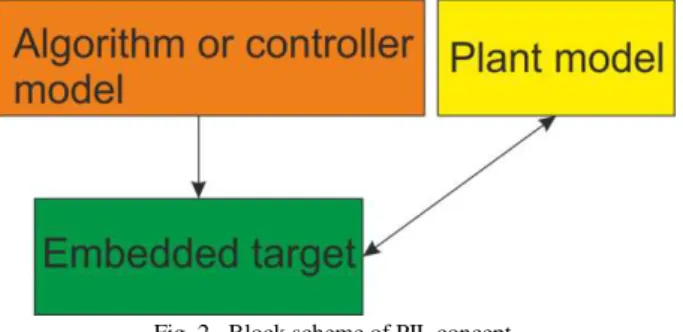
During the processor-in-the-loop (PIL) phase, the control is compiled and downloaded into an embedded target processor and communicates directly with the plant model via standard communications such as Ethernet. In this case, no I/O devices are used for the communication.
The scheme of PIL model is represented by Fig. 2 and it consists of 3 blocks:
Fig. 2. Block scheme of PIL concept.
The following conditions must be followed for PIL approach:
Mathematic model is running in real-time
Control system is running on the target hardware platform
No input/output devices are used, a data connection is used to exchange data between the control system and the model
It is mainly intended for testing the computing power of the target hardware platform and testing the control system by simulating machine malfunction.
B. Design of PIL model for ATS
Control process of the technology is performed by a distributed control system which contains several PLC communicating over the deterministic protocol PROFINET. The main PLC is SIMATIC S7 300 and it communicates with the other PLCs (S7 1200) located in the center of each floor of the object. Furthermore, the technology contains two I/O modules and drive converters.
Due to the PIL concept, all of the signals from PLCs, I/O modules and drive converters are subject to PIL simulation and thus must be re-mapped to match the PROFINET protocol standard with the aim of establishing communication with the “slave” side of the system that is ALIX PC with PROFINET slave card CIFX90-RE\F.
The particular structure of PIL model of ATS is represented by Fig. 3. It contains the following parts:
Control system on target hardware
It is embedded target with the current control system. Usually it is the original control system with no changes. For the purposes of this project we used the identical copy of the control system except I/O modules that have been emulated (re-mapped) to profinet communication while the control algorithms of course stay unchanged.
Mathematical model (CPU+HW)
This the CPU declared by the definition of PIL model. Technically it is a computer board with a slave profinet card with the running real-time target, particularly the REX Control System. This part (software simulation) emulates the real technology and thus it has to act in the same way.
Host PC
Any remote PC connected by the Ethernet. It can serve for design and implementation of mathematical model, SCADA/HMI visualization, diagnostic and remote control and of all variables in the system. Its main goal is to perform tests of behavior of the original control algorithms because unlike the real technology, the software model can represents any states of the system that can occur, including possible dangerous constellation representing highly non-standard, unlikely or impossible situations.
Fig. 3. PIL model of Automated Transportation Center in Ostrava.
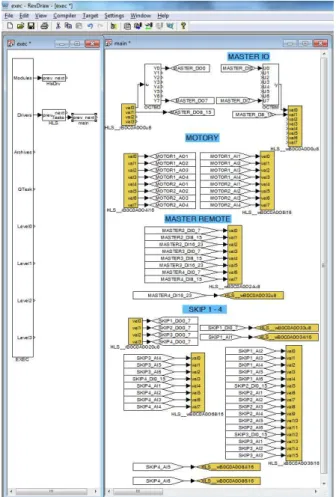
Fig. 4 shows the example of software model for a part of the system, particularly for motors and skips. It consists of two parts that is executive and main task. An example of implementation of control structure is mentioned in [7].
Fig. 4. Example of the source scheme in REX Control System (RexDraw).
It presents the way how the I/O data is read and written by so called “flags” from/into the PROFINET slave (Simatic PLCs). The particular flags represents step-by-step the signals defined in the original control system based on PLCs, while the definition is read from HW configuration of the PLC. Hence, by use of standard or user-defined software blocks, it is possible to process the signals according users’ needs and requirements [8], [9], see the screenshot of RexView utility in Fig. 5. Typically, it helps to simulate the most common sequences in the system with the aim of either optimization or finding critical or weak links in the system during putting a car inside the ATS and out.
Fig. 5. A view of the diagnostic and visual utility (RexView).
V. FEATURES AND NOVELTY OF THE SOLUTION
The main objective of using PIL model for Automated Transportation Center was to implement possibility to carry out various load tests of the designed control system performed by PLCs that control real technology. Unlike HIL model (hardware-in-the-loop), there is no need to use real i/o modules as all the signals are re-mapped for PROFINET protocol. Also, due to the large number of the signals, this approach helped to save up costs significantly.
Fig. 6. Basic overview of REX control system configuration
VI. CONCLUSION
The main idea of the presented paper is to describe the concept of Automated Transportation Center and the use of the REX Control System for processor-in-the-loop model.
At present day, the PIL communication between physical control system and CPU has been established over the PROFINET network. Due to the security reasons, identical copy of the PLC CPUs have been used to work with the PIL model (1x IM 151-8, 4x S7-1200). Besides, the Automated Transportation Center is declared as a heavy laboratory so it will serve for educational purposes, too. Students will be able to deal with programming and visualization of typical real example of automation problematic with the use of modern software and hardware equipment. Fig. 7 shows the plant model of the technology implemented on computer ALIX 2D13+REX Control System under Linux OS with CIFX90-RE-\F PROFINET Slave card in mini-PCI Express.
Fig. 7. PIL model of the technology of ATS
The software blocks representing the particular technology units (lift, skips, and the others) are not implemented at the moment and it is planned to be ready in 09/2013. Creation of these models will start with definition of inputs/outputs interface, followed by application of mathematical background and expert knowledge of technology functionality of particular blocks.
However, existing experience confirm the correctness of technical solution. The main contribution of the approach is the fact that configuration of the PIL model with the REX Control System can be applied not only for particular Siemens PLCs with the PROFINET communication but also for a general control system based on different brands of PLCs communicating over some of the standard communication protocols.
The objective approach belongs to the group of techniques generally referred to as “Model based design” and recently intensively developed by many software companies, for example by MathWorks as a part of Matlab&Simulink real-time tools.
REFERENCES
[1] VysokeSkoly.cz, “Automatizované dopravní centrum Ostrava na
VŠB-TUO,” 2012, [Accessed on 26th Jun 2013]. [Online]. Available: http://www.vysokeskoly.cz/clanek/novy-clanek-5309 [2] G. Francis, R. Burgos, P. Rodriguez, F. Wang, D. Boroyevich, R. Liu
and A. Monti, “Virtual prototyping of universal control architecture systems by means of processor in the loop technology,” presented at
the APEC 2007: TWENTY-SECOND ANNUAL IEEE APPLIED
POWER ELECTRONICS CONFERENCE AND EXPOSITION, VOLS 1 AND 2, Anaheim, CA, Feb. 25 – Mar. 1, 2007, pp. 21-27, DOI: 10.1109/APEX.2007.357491.
[3] ZH. Jiang, R. Leonard, R. Dougal, H. Figueroa and A. Monti,
“Processor-in-the-loop simulation, real-time hardware-in-the-loop testing, and hardware validation of a digitally-controlled, fuel-cell powered battery-charging station,” presented at the PESC 04: 2004 IEEE 35TH ANNUAL POWER ELECTRONICS SPECIALISTS
CONFERENCE, VOLS 1-6, Aachen, Germany, Jun. 20-25., 2004,
pp. 2251-2257.
[4] P. Balda, M. Schlegel, and M. Stetina, “Advanced Control Algorithms+ Simulink Compatibility + Real-time OS = REX,” In 16th Triennial World Congress of International Federation of Automatic
Control, vol. 16, Prague, Czech Republic, 2005, pp. 121-126.
[5] M. Kocanek and P. Balda, “General sequential function charts
editor,” in 12th International Carpathian Control Conference, Velke
Karlovice; Czech Republic, 2011, pp. 191-194.
[6] REX Controls, “REX controls,” ZCU Plzen, Czech Republic, 2009, [Accessed on 10th Jun 2013]. [Online]. Available: http://www.rexcontrols.com
[7] S. Ozana, M. Pies, Z. Slanina and R. Hajovsky, “Design and Implementation of LQR controller for Inverted Pendulum by use of REX Control System,” In 12th International Conference on Control,
Automation and Systems, 2012, pp. 343-347, Jeju, South Korea.
[8] J. Kocian, M. Tutsch, S. Ozana and J. Koziorek, “Application of Modeling and Simulation Techniques for Technology Units in Industrial Control”, In Lecture Notes in Electrical Engineering, 3rd International Conference on Computer, Communication, Control
and Automation, 3CA 2011, Nov. 19.-20., Zhuhai, China.
[9] J. Kocian, M. Tutsch, S. Ozana and J. Koziorek, “Modeling and Simulation of Controlled Systems and Technologies in Industrial
Control,” In ICACTE 2011: Proceedings of the 4th International
Conference on Advanced Computer Theory and Engineering, New
York: ASME Press, 2011, pp. 213-217.
[10] M. Tutsch, P. Vojcinak, J. Koziorek and M. Skrepek, “Using
Automated Evaluation of Efficiency for Photovoltaic Power Plant,” In
Proceedings of the 16th IEEE Symposium on Emerging Technologies
and Factory Automation, ETFA 2011, Sep. 5.-9. 2011, Toulouse,