Journal of HerbMed Pharmacology
Journal homepage: http://www.herbmedpharmacol.com J HerbMed Pharmacol. 2015; 4(4): 133-137.
Antibacterial effects of
Arctium lappa
and
Artemesia
absinthium
extracts in laboratory conditions
*Corresponding author: Mohsen Rajabi, Madani Town, Moosivand Professor Boulevard, Islamic Azad University, Young Researchers and Elite Club, Hamedan, Iran. Tel: 00988134373587, Fax: 00988134373606, Email: [email protected]
Introduction
Herbal remedies utilization in order to treat diseases goes back to thousands of years in Iran and there are several scientific documents in this era (1). Medicinal plants have considerable antimicrobial activities that can be used for preventing or inhibiting growth of infectious microorgan-isms and degeneration factors. High interest in replacing chemical materials with natural ones caused performing thousands of studies on natural resources researches on different plants extracts resulted in discovery of suitable
natural substances of treatment of various diseases (2). The therapeutic properties of extracts and essential oils against microbial and non-microbial diseases have been known from many years ago and many positive effects have been reported from different plant species against microorganisms (3,4). In recent decades, antimicrobial properties of herbal products have attracted many re-searchers because of a rapid increase in antibiotic resis-tance to microorganisms (5). Many members of the genus Artemisia are important medicinal plants. Previously, the Reza Habibipour1, Mohsen Rajabi2*
1Department of Microbiology, Faculty of Basic Sciences, Hamedan Branch, Islamic Azad University, Hamedan, Iran 2Young Researchers and Elite Club, Hamadan Branch, Islamic Azad University, Hamadan, Iran
Implication for health policy/practice/research/medical education:
Extracts of Arctium lappa and Artemesia absinthium have good antibacterial properties against some gram positive and negative bacteria. Nevertheless, more investigations need for identification of the active chemical compositions of these extracts responsible for their antibacterial properties as well as their certain mechanisms of accomplishment.
Please cite this paper as:Habibipour R, Rajabi M. Antibacterial effect of extracts of Arctium lappa and Artemesia absinthium in laboratory conditions. J HerbMed Pharmacol. 2015;4(4):133-137.
Introduction: Arctium lappa (Great burduck) andArtemesia absinthium are medicinal plants that some of their antibacterial and antivirus properties have been suggested in nutritional industries. The objective of this research was to study the effects of A. lappa and A. absinthium onsome microorganisms including Pseudomonadsaeraginosa, Haemophilus influenza, Bacillus subtilis,
Bacillus cereus, Klebsiellapneumonia and Staphylococcusaureus.
Methods: Extracts were prepared by maceration method and tested on Mueller Hinton agar medium based on disc diffusion method. The minimum inhibitory concentration (MIC) and minimum bactericidal concentration (MBC) were determined by micro-dilution method. Antibiotic disks used for controlling and standardizing the examination.
Results: The extractsof A. lappa and A. absinthium had significant effect on S. aureus. The MIC and MBC concentrations of the extract of A. lappa on B. subtilis were respectively 600 and 750 mg/ml. Also, these values were 230 and 540 mg/ml for H. influenza. Extract of A. absinthium showed more inhibitory effect on B. subtilis. All extracts showed inhibitory effect on B. cereus. The extracts of A. lappa and A. absinthium had inhibitory effects on H. influenza and P. aeraginosa. Among antibiotics, only Ofloxacin and Ciprofloxacin had effects on H. influenza. Extract of A. lappa showed flimsy effect on K. pneumonia, while extract of A. absinthium had no effect on this bacterium.
Conclusion: Due to the effects of A. lappa and A. absinthium on some bacteria, they might be good substitutes for synthetic substances.
A R T I C L E I N F O
Keywords: Arctium lappa Artemesia absinthium Haemophylus inluenza
Antibacteria drugs
Article History:
Received: 2 July 2015 Accepted: 24 August 2015
Article Type: Original Article
Habibipour and Rajabi
antibacterial effects of some Artemisia species have been reported (6,7). Artemisia is one of the various genera of Asteraceae family with many important medicinal prop-erties (8). Essential oils of Artemisia spp. have been widely used for different medicinal purposes for several years (9,10). Artemisia species have been used in folk medicine as antipyretic, antiseptic, anthelmintic, tonic and diuretic remedy (11). A. lappa was brought from Japan and ac-climated in Brazil. It is widely used in popular medicine all over the world for its well-known therapeutic applica-tions. It has anti-bacterial, antifungal (12), diuretic (13), anti-oxidant (14) anxiolytic (15), anti-platelet aggregating (16) and HIV-inhibitory properties (17). Bacterial resis-tant to antibiotics is increasing, requiring introduction of new and safe antibacterial substances. The present investi-gation was undertaken to evaluate the antibacterial activ-ity of hydro-alcoholic extracts of A. lappa and Artemesia absinthium on P. aeruginosa, H. influenza, B. subtilis, B. cereus, Klebsiella pneumonia and Staphylococcus aureus in laboratory conditions.
Materials and Methods
In this research, A. lappa and A. absinthium were collected from Dare-Moradbeig region and Buali-Sina garden of Agriculture and Natural Research Center of Hamedan in June 2012, respectively. Herbarium samples were pre-pared and authenticated by Dr. Kalvandi (Botanist of Ag-riculture and Natural Research Center). Aerial parts of A. absinthium (including flower, leaf and stem) and A. lappa (including leaf and stem) were dried in shade and pow-dered (18). Hydro-alcoholic (70%) extracts were prepared by Maceration method. Microorganisms (including P. ae-ruginosa PTCC1599, H. influenza PTCC1623, B. subtilis PTCC1156, B. cereus PTCC1247, Klebsiella pneumonia PTCC1290 and Staphylococcus aureus PTCC1337) were obtained from Fungi and Industrial Bacterial Collection of Iran (Scientific Industrial Researches Center of Iran). Standard medium was used for microorganism culture. Antibiotics (such as Penicillin, Gentamicin, Ciprofloxacin, Ofloxacin and Erythromycin) were obtained from Padtan Teb Company of Tehran. The microorganisms were trans-ferred to tubes containing sterile distilled water and their turbidities were analyzed with McFarland Turbidity Stan-dardsthrough optic method. Then, they were inoculated in optimum mediums (19,20). Antibacterial activity was assessed by diffusion disk method. Extracts were used in different concentrations (0, 45, 90, 166, 230, 285, 333, 500, 600, 666, 714 and 750 mg/ml). Blank disks were soaked into the extract solutions and incubated in 37°C at incu-bator for 30 minutes. Then, the disks containing extracts were placed on culture medium in equal distances and were incubated in 37°C at incubator for 24 hours. Mean of inhibitory halos diameter of bacterial growth was mea-sured and recorded by Murray et al (21). Minimum In-hibitory Concentration (MIC) and Minimum Bactericidal Concentration (MBC) were determined by micro dilution
method (22). In order to compare the means of inhibitory halos diameter of bacterial growth, values were compared with the antibiotics ones and each test was carried out with 4 replications (21). Statistical analysis was performed using analysis of variance by SPSS version 18.0 software. Data considered significant when P ≤ 0.05.
Results
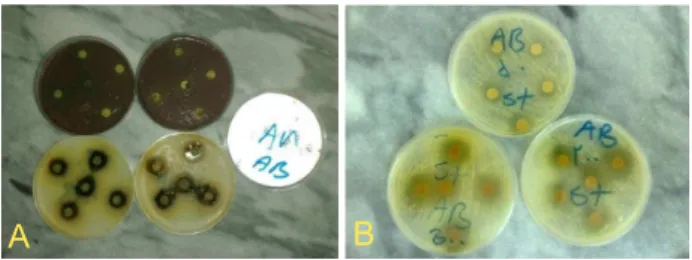
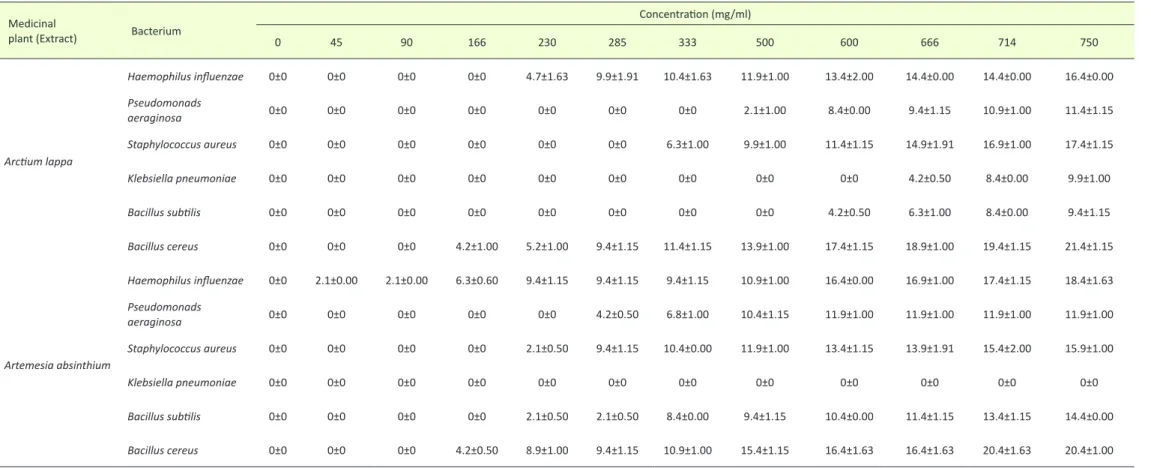
Results showed that extract of A. lappa had inhibitory ef-fect on H. influenza and P. aeruginosa (16.4 mm and 11.4 mm, respectively) (Figure 1A). Also, extract of A. absinthi-um showed inhibitory effect on H. influenza and P. aerugi-nosa (18.4 mm and 11.9 mm, respectively) (Table 2; Figure 2A). The MIC and MBC of A. lappa on H. influenza were obtained 230 mg/ml and 540 mg/ml, respectively. These values for extract of A. absinthium were 45 mg/ml and 90 mg/ml, respectively. Among antibiotics just Ofloxacin had effect on H. influenza (16.4 mm). MIC and MBC of A. absinthium against P. aeruginosa were 285 and 430 mg/ml, respectively. These values for A. lappa were 500 and 750 mg/ml, respectively. Ofloxacin and Gentamicin showed higher inhibitory halos diameter of bacterial growth on P. aeruginosa. Extract of both medicinal plants showed in-hibitory effects against B. cereus in low concentration (166 mg/ml) and increased inhibitory effect with increasing the concentration. All antibiotics were effective on B. cereus, so that the highest effect was related to gentamicin (32.4 mm) and the lowest effect was related to Penicillin (10.4 mm). The MIC of A. lappa against B. cereus was obtained in 166 mg/ml and inhibitory effect increased with higher concentrations. Extract of A. lappa did not show MBC in studied concentrations. The MIC and MBC of A. absin-thium were obtained to be 166 and 440 mg/ml, respec-tively. A. lappa showed inhibitory effect on B. subtilis less
A B
Figure 1. Effect of Arctium lappa on (A) Haemophilus inluenza and (B) Staphylococcus aureus.
A B
Habibipour and Rajabi
Journal of HerbMed Pharmacology, Volume 4, Number 4, October 2015 http://www.herbmedpharmacol.com 135
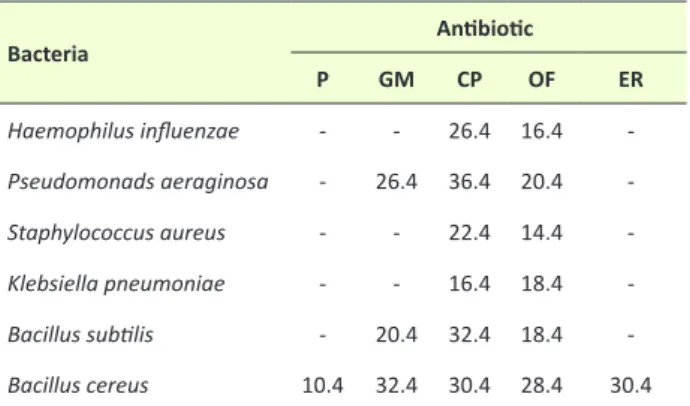
than A. absinthium (based on inhibitory halos diameter of bacteria growth). The MIC and MBC of A. absinthium on B. subtilis were 600 and 750 mg/ml, respectively, obtained by micro dilution method. These values for A. absinthium were 166 and 430 mg/ml, respectively. Gentamicin (20.4 mm), Ofloxacin (18.4 mm) and Ciprofloxacin (32.4 mm) had effect on B. subtilis, but Penicillin and Erythromycin had no effect. A. lappa and A. absinthium showed signifi-cant effect on Staphylococcus aureus (P < 0.01) (Figures 1 and2B). MIC of A. absinthium on Staphylococcus aureus was 230 mg/ml. Ofloxacin developed 14.4 mm inhibitory halos diameter of bacterial growth, while extract of A. ab-sinthium in concentration of 666 mg/ml (14.9 ± 1.91) and 750 mg/ml (17.4 ± 1.15) showed higher inhibitory halos diameter (Tables 1 and 2). Different concentrations of A. absinthium extract had no effect on Klebsiella pneumonia, while MIC and MBC of A. lappa against Klebsiella pneu-monia were obtained 666 and 750 mg/ml, respectively. Ofloxacin and Ciprofloxacin were able to inhibit this bac-terium (18.4 mm and 16.4 mm, respectively) (Table 2).
Discussion
From past decades, anything that was used as drug, ob-tained from natural resources and mainly from plants. Us-ing of chemical drugs developed acute problems such as auto safety due to continues taking and without caring of certain taking drug and beside effects that some of them were more dangerous than diseases. On the other hand, in recent years, microorganism resistance to chemical drugs and undesirable beside effects resulted to has been attend-ed using of extracts and essential oils of mattend-edicinal plant that showed antibacterial effects (23). Bactericidal effects of studied plants extracts against H. influenzae were equal to Ofloxacin.
Based on the results, it was determined that sensitivities of gram positive bacteria like Staphylococcus aureus and B. cereus compared with gram negative bacteria such as P. ae-ruginosa and Klebsiella pneumonia to plants extracts were higher (Table 1). It has been demonstrated that A. lappa has antimicrobial activity against oral microorganisms. Three forms of the extract of this plant (20% tincture, ex-Table 1. Mean of inhibitory halos diameter of Bacteria growth based on used antibiotic in this study
Bacteria
Anibioic
P GM CP OF ER
Haemophilus inluenzae - - 26.4 16.4
-Pseudomonads aeraginosa - 26.4 36.4 20.4
-Staphylococcus aureus - - 22.4 14.4
-Klebsiella pneumoniae - - 16.4 18.4
-Bacillus subilis - 20.4 32.4 18.4
-Bacillus cereus 10.4 32.4 30.4 28.4 30.4
P: Penicillin (10 µg), GM: Gentamicin (10 μg), CP: Ciproloxacin (5 μg), OF: Oloxacin ( 5 μg), ER: Erythromycin (5 μg).
tract concentrated by rotary-evaporation and lyophilized extract) were examined and reported that the lyophilized extract was the most effective against B. subtilis and C. al-bicans (24). In another research study it was shown that essential oil of S. amanica affected on all positive gram bacteria except Staphylococcus epidermidis. Also, these components just inhibited 2 negative gram bacteria like Chryseomonas luteola MU 65 and Stenotrophomonas maltophilia MU 64 (25). Similar results were obtained in this research from A. absinthium against this bacterium (Table 1).
Higher resistance in gram negative bacteria can be attrib-uted to external phospholipid membrane that is infiltrated to lipophilic components. Lack of this membrane in gram positive bacteria causes easier entrance of the essential oil and extract components to bacterium. This process may cause increase in ionic permeability and permeation of vital inner cellular components which finally result in damage to enzyme system of bacterium. Other research-ers have proved inhibition of growth of Staphylococcus aureus, B. cereus, Klebsiella pneumonia sub sp. Pneumo-nia, Pseudomonas aeruginosa and B. subtilis by medici-nal plants (26,27). The higher effect on H. influenza was obtained by extract of A. absinthium. Extract of A. lappa had effect on this bacterium similar to Ofloxacin, while A. absinthium was better than Ofloxacin. Similar results about A. lappa have been obtained showing inhibitory effect on P. aeruginosa, B. cereus and B. subtilis (28). In comparison with studied medicinal plants, the effects of essential oil of different medicinal plants have been evalu-ated which showed positive effects on different microor-ganisms (29). Therefore, these plants might be suitable to be used instead of synthetic drugs. However, more studies are needed to establish the effective and safe use of these plant extracts.
Acknowledgements
The authors would like to thank Ms. Sara Vesaghati Ez-atpoor, Ms. Safura Vesaghati EzEz-atpoor, Ms. Marjan Pir-mohammadain and Ms. Leila Moradi Haghgoo for their professional assistance during this research project.
Authors’ contributions
MR contributed to the conception of the work, conduct-ing the study, revisconduct-ing the draft, approval of the final ver-sion of the manuscript, and agreed for some aspects of the work. RH contributed to the conception of the work, ap-proval of the final version of the manuscript, and agreed for some aspects of the work.
Conflict of interests
Authors declare no conflict of interests.
Ethical considerations
submis-Table 2. Average diameter (mm) of inhibition halos produced by Arctium lappa and Artemesia absinthium Extracts on the target microorganisms
Medicinal
plant (Extract) Bacterium
Concentraion (mg/ml)
0 45 90 166 230 285 333 500 600 666 714 750
Arcium lappa
Haemophilus inluenzae 0±0 0±0 0±0 0±0 4.7±1.63 9.9±1.91 10.4±1.63 11.9±1.00 13.4±2.00 14.4±0.00 14.4±0.00 16.4±0.00
Pseudomonads
aeraginosa 0±0 0±0 0±0 0±0 0±0 0±0 0±0 2.1±1.00 8.4±0.00 9.4±1.15 10.9±1.00 11.4±1.15
Staphylococcus aureus 0±0 0±0 0±0 0±0 0±0 0±0 6.3±1.00 9.9±1.00 11.4±1.15 14.9±1.91 16.9±1.00 17.4±1.15
Klebsiella pneumoniae 0±0 0±0 0±0 0±0 0±0 0±0 0±0 0±0 0±0 4.2±0.50 8.4±0.00 9.9±1.00
Bacillus subilis 0±0 0±0 0±0 0±0 0±0 0±0 0±0 0±0 4.2±0.50 6.3±1.00 8.4±0.00 9.4±1.15
Bacillus cereus 0±0 0±0 0±0 4.2±1.00 5.2±1.00 9.4±1.15 11.4±1.15 13.9±1.00 17.4±1.15 18.9±1.00 19.4±1.15 21.4±1.15
Artemesia absinthium
Haemophilus inluenzae 0±0 2.1±0.00 2.1±0.00 6.3±0.60 9.4±1.15 9.4±1.15 9.4±1.15 10.9±1.00 16.4±0.00 16.9±1.00 17.4±1.15 18.4±1.63
Pseudomonads
aeraginosa 0±0 0±0 0±0 0±0 0±0 4.2±0.50 6.8±1.00 10.4±1.15 11.9±1.00 11.9±1.00 11.9±1.00 11.9±1.00
Staphylococcus aureus 0±0 0±0 0±0 0±0 2.1±0.50 9.4±1.15 10.4±0.00 11.9±1.00 13.4±1.15 13.9±1.91 15.4±2.00 15.9±1.00
Klebsiella pneumoniae 0±0 0±0 0±0 0±0 0±0 0±0 0±0 0±0 0±0 0±0 0±0 0±0
Bacillus subilis 0±0 0±0 0±0 0±0 2.1±0.50 2.1±0.50 8.4±0.00 9.4±1.15 10.4±0.00 11.4±1.15 13.4±1.15 14.4±0.00
Bacillus cereus 0±0 0±0 0±0 4.2±0.50 8.9±1.00 9.4±1.15 10.9±1.00 15.4±1.15 16.4±1.63 16.4±1.63 20.4±1.63 20.4±1.00
Antibacterial efects of Arctium lappa and Artemesia absinthium
Journal of HerbMed Pharmacology, Volume 4, Number 4, October 2015
http://www.herbmedpharmacol.com 137
sion, redundancy) have been completely observed by the authors. This work has been performed in culture medi-um; so ethical committee approval was not needed.
Funding/Support
Personal funding.
References
1. Saad B, Azaizeh H, Said O. Tradition and perspectives of Arab herbal medicine: a review. Evid Based Complement Alternat Med. 2005;2:475-9.
2. Weinstine RA. Controlling antimicrobial resistance in hospitals: Infection control and use of antibiotics. Emerg Infect Dis. 2001;7(2):188-192.
3. Arrieta J, Reyes B, Calzada F, Cedillo-Rivera R, Navarrete A. Amoebicidal and giardicidal compounds from the leaves of Zanthoxylum liebmannianum. Fitoterapia. 2001;72(3):295-297.
4. Ciani M, Menghini L, Mariani F, Pagiotti R, Menghini A, Fatichenti F. Antimicrobial properties of essential oil of Satureja montana L. on pathogenic and spoilage yeasts. Biotechnol Lett. 2000;22(12):1007-1010. 5. Guangrong H, Jiaxin J, Dehui D. Antioxidative
and antibacterial activity of the methanol extract of Artemisia anomala S. Moore. Afr J Biotechnol. 2008;7:1335-1338.
6. Hedi M, Hajlaoui H, Akrout A, Najjaa H, Neffati M. Antimicrobial and antioxidant activities of Artemisia herba-alba essential oil cultivated in Tunisian arid zone. CR Chim. 2010;13:380-386.
7. Karabegovic I, Nikolova M, Velickovic D, Stojicevic S, Veljkovic V, Lazic M. Comparison of antioxidant and antimicrobial activities of methanolic extracts of the Artemisia sp. recovered by different extraction techniques. Chin J Chem Eng. 2011;19:504-519. 8. Zia M, Mannan A, Chaudhary MF. Effect of growth
regulators and amino acids on Artemisinin production in the callus of Artemisia absinthium. Pak J Bot. 2007;39(2):799-805.
9. Ahameethunisa AR, Hopper W. Antibacterial activity of Artemisia nilagirica leaf extracts against clinical and phytopathogenic bacteria. BMC Complement Altern Med. 2010;10:6.
10. Yano Y, Satomi M, Oikawa H. Antimicrobial effect of spices and herbs on Vibrio parahaemolyticus. Int J Food Microbiol. 2006;111:6-11.
11. Ramezani M, Fazli-Bazzaz BS, Saghafi-Khadem F, Dabaghian A. Antimicrobial activity of four Artemisia species of Iran. Fitoterapia. 2004;75 (2):201-203. 12. Silva RC. Plants as Medicinals na Saúde Bucal. Vitória:
Artgraf; 2001.
13. Holetz FB, Pessini GL, Sanches NR, Cortez DA, Nakamura CV, Dias-Filho BP. Screening of some plants used in the Brazilian folk medicine for the treatment of infectious diseases. Mem Inst Oswaldo Cruz. 2002;97:1027-1031.
14. Maruta Y, Kawabata J, Niki R. Antioxidative caffeoylquinic acid derivatives in the roots of burdock. J Agric Food Chem. 1995;43:2592-2595.
15. Sbolli KC, Rieck L, Oliveira BH. Estudo Farmacológico da atividade depressora do sistema nervosa central (SBC) do extrato bruto da A. lappa. In: XIV Simpósio de Plantas Medicinais do Brasil. Livro de Resumos: Florianópolis, SC; 1996.
16. Iwakami S, WU J, Ebizuka Y. Platelet activating factor antagonists contained in medical plants ligants and sesquiterpenes. Chem Pharm Bul Tokyo. 1992;40:196-197.
17. Ito M, Nakashima H, Baba M, et al. Inhibitory effect of glycyrrhizin on the in vitro infectivity and cytopathic activity of human immunodeficiency virus. Antiviral Res. 1987;7:127-137.
18. Arunkumar S, Muthuselvam M. Analysis of phytochemical constituents and antimicrobial activities of Aloe vera L. against clinical pathogens. World J Agr Sci. 2009;5(5):572-576.
19. Nejatzadeh-Barandozi F. Antibacterial activities and antioxidant capacity of Aloe vera. Org Med Chem Lett. 2013; 3(5): 1-8.
20. Thiruppathi S, Ramasubramanian V, Sivakumar T, Thirumalai Arasu V. Antimicrobial activity of Aloe vera L. Burm Against Pathogenic Microorganisms. J Bio Sci Res. 2010;1(4):251-258.
21. Murray PR, Rosenthal KS, Pfaller MA. Medical Microbiology. Elsevier Health Sciences press; 2009:947. 22. Rasooli I, Mirmostafa SA. Bacterial susceptibility and
chemical composition of essential oils from Thtmus Kotschyanus and Thymus persicus. J Agr Food Chem. 2003;51(8):2200-2205.
23. Chitsaz M, Barton M, Bazargan M, Kamali Nejad M. Essential oil components and antibacterial effect of Ziziphora clinopodioides. Int J Antimicrob Agents. 2007; 29(suppl 2):S512-S513.
24. Perin FM, França SC, Saquy PC, Sousa-Neto MD. In vitro antimicrobial of aqueous herbal extracts for Endodontics. J Dental Res. 2002;81:157.
25. Ugur A, Sarac N, Varol O. Antimicrobial activities of the essential oils of endemic Stachys rupestris and Stachys amanica against multi-resistant bacteria. Indian J Pharmacol. 2013;45:201-202.
26. Heidari Sureshjani M, Tabatabaei Yazdi F, Mortazavi SA, Alizadeh Behbahani B, Shahidi F. Antimicrobial effects of Kelussia odoratissima extracts against food borne and food spoilage bacteria “in vitro”. Journal of Paramedical Sciences. 2014;5(2):115-120.
27. Sengula M, Ercislib S, Yildizb H, Gungorc N, Kavaza A, Çetina B. Antioxidant, Antimicrobial Activity and Total Phenolic Content within the Aerial Parts of Artemisia absinthum, Artemisia santonicum and Saponaria officinalis. Iran J Pharm Res. 2011;10(1):49-56. 28. Pereira JV, Bergamo DC, Pereira JO, França Sde C,
Pietro RC, Silva-Sousa YT. Antimicrobial activity of A. lappa constituents against microorganisms commonly found in endodontic infections. Braz Dent J. 2005;16(3):192-196.