FUNDAC
¸ ˜
AO GETULIO VARGAS
ESCOLA DE P ´
OS-GRADUAC
¸ ˜
AO EM ECONOMIA
Lu´ıs Fabiano Carvalho Monteiro
Optimal Unemployment Insurance for Couples
Lu´ıs Fabiano Carvalho Monteiro
Optimal Unemployment Insurance for Couples
Dissertac¸˜ao submetida a Escola de P´os-Graduac¸˜ao em Economia como requisito parcial para a obtenc¸˜ao do grau de Mestre em Economia.
Orientador: Carlos Eugˆenio da Costa
Ficha catalográfica elaborada pela Biblioteca Mario Henrique Simonsen/FGV
Monteiro, Luís Fabiano Carvalho
Optimal unemployment insurance for couples / Luís Fabiano Carvalho Monteiro. - 2015.
29 f.
Dissertação (mestrado) - Fundação Getulio Vargas, Escola de Pós-Graduação em Economia.
Orientador: Carlos Eugênio da Costa. Inclui bibliografia.
1. Seguro-desemprego. 2. Seguros. 3. Domicílios. 4. Procura de emprego. I. Costa, Carlos Eugênio da. II. Fundação Getulio Vargas. Escola de Pós-Graduação em Economia. III. Título.
Abstract
This work analyzes the optimal design of an unemployment insurance program
for couples, whose joint search problem in the labor market differ significantly
from the problem faced by single agents. We use a version of the sequential search
model of the labor market adapted to married agents to compare optimal
con-stant policies for single and married agents, as well as characterize the optimal
constant policy when the agency faces single and married agents simultaneously.
Our main result is that an agency that gives equal weights to single and married
agents will want to give equal utility promises to both types of agents and spend
more on the single agent.
Contents
1 Introduction 8
2 The Single Agent Model 9
a The Problem . . . 9 b Search Strategy: CARA Preferences . . . 10
3 The Joint-Search Model 10
a The Problem . . . 10 b Search Strategy: CARA Preferences . . . 12
4 The Unemployment Insurance Program 14
a Single Agent . . . 15 b Couple . . . 16 c Single and Married Agents . . . 19
5 Reservation Wages as Sufficient Statistics for Welfare 20
a The Hand-to-Mouth Joint-Search Model . . . 21 a.1 The Problem . . . 21 a.2 Search Strategy: CARA utility . . . 22
6 Conclusion 26
List of Figures
1 Reservation wage function under risk-neutrality . . . 25 2 Reservation wage functions for the CARA utility case . . . 26
1
Introduction
The purpose of this paper is to study the optimal design of unemployment insur-ance for couples. The job-search problem of couples is substantially distinct from the problem faced by single workers. Focusing on a couple, rather than individual workers, makes it possible to think about intrahousehold consumption smoothing and other aspects of household behavior that may affect the design of the unem-ployment insurance program. Surprisingly, this aspect of the job search problem has been neglected in the theoretical literature on optimal unemployment insurance, which has focused on the single-agent search model.
We adopt a modified version of the job search model of Guler et al. (2012), where the relevant decision unit is the couple. A couple is modeled as a pair of ex-ante iden-tical individuals with access to borrowing and lending of a riskless asset and linked by perfect income pooling and by the consumption of a single good that is private within the household. Each unemployed worker sequentially samples job opportu-nities as in McCall (1970). Some differences arise relative to the original Guler et al. (2012) model: In their environment, when the couple is risk-averse, they adopt a joint search strategy: A dual-searcher couple (where both spouses are unemployed) quickly accepts a job offer, accepting job offers that a single unemployed agent would reject. Once a spouse is employed, the unemployed spouse becomes more selec-tive and, once he accepts a job offer, his higher wage may trigger a quit by the other spouse in order to search for a better job. This switching of the ‘breadwinner’ pro-vides the couple with some consumption smoothing while at least one of the spouses is unemployed. In our setting, this does not happen: Access to liquidity nullifies the need for intrahousehold consumption smoothing through joint labor market deci-sion.
attention to constant policies. After analyzing the problem of the agency when deal-ing with a sdeal-ingle agent or a couple, we compare the optimal policies in those cases. Then we solve the problem of the agency when dealing with a single and a married agent simultaneously. In Section 5, we discuss the main result in Shimer and Wern-ing (2007) after presentWern-ing the hand-to-mouth job search model of Guler et al. (2012). (Incomplete)
2
The Single Agent Model
a
The Problem
We present the job-search problem of a single agent following Shimer and Wern-ing (2008). There is a sWern-ingle risk-averse agent with access to borrowWern-ing and lendWern-ing in a riskless asset who maximizes his expected utility,
E0
Z ∞
0
e−ρtu(c(t))dt (1)
where ρ > 0is his discount rate and the utility function u(·) is assumed to be strictly concave and strictly increasing. At each instant, the agent is either employed at some wage w or unemployed and searching. A worker employed at wage w re-ceiveswunits of the consumption good and pays a constant tax ofτunits of the con-sumption good. We assume that jobs last forever, following Shavell and Weiss (1979), Hopenhayn and Nicolini (1997), Shimer and Werning (2008), among others. An un-employed agent receives a benefit ofb units of the consumption good and receives independent wage draws from an exogenous cummulative distribution functionF(·)
according to a Poisson process with arrival rateα >0. The worker observes the offer and can either accept it or reject it and keep searching.
The agent also has free access to lending and borrowing in a riskless asset with net return r and faces the budget constraint a˙(t) = ra(t)− c(t) + b if unemployed and a˙(t) = ra(t) − c(t) +w − τ if employed at wage w. The no-Ponzi condition
limt→∞e−rta(t)≥0must also be satisfied. We assume thatr=ρ.
b
Search Strategy: CARA Preferences
In this section we discuss the problem of the single agent with CARA preferences,
u(c) = −exp(−γc)withc∈Randγ > 0the coefficient of absolute risk aversion. The proposition presented below, taken from Shimer and Werning (2008), characterizes the solution to the problem of the agent in this environment.
Proposition 1(Shimer and Werning (2008)). Assume CARA preferences. Given a con-stant benefits policy(¯b,τ¯)withB¯ = ¯b+ ¯τ, the reservation wage, consumption, and utility of the unemployed satisfy
γ( ¯w−B¯) = α
r
Z ∞
¯
w
(1 +u(w−w¯))dF(w) (2)
cu(a) = ra−τ¯+ ¯w (3)
Vu(a) = u(ra−τ¯+ ¯w)
r (4)
3
The Joint-Search Model
a
The Problem
We consider the job-search problem of a couple similar to the one developed in Guler et al. (2012). Time is continuous and there is no aggregate uncertainty. A col-lective model of a household is adopted, where a couple is composed of two ex ante identical individuals who pool their income perfectly and consume a private good.
There is one risk-averse couple with free access to a riskless asset that maximizes its expected utility from the consumption of the private good,
E0
Z ∞
0
e−ρt2u
c(t) 2
dt (5)
whereρ >0is the discount rate,u(·)is an increasing, concave utility function and
c(t)is the consumption flow att. Notice that we have already used the result that the partners will split their resources equally, which allows us to restrict attention to the problem of a married individual.
se-quential search model of McCall (1970). At each instant, each worker is either em-ployed at some wage w or unemployed and searching. When unemployed, each worker earns a benefitb > 0and receives a single independent wage draww accord-ing to a Poisson process with arrival rateα >0. These wage offers are drawn from an exogenous continuous distributionF(·)with support[0,∞)such thatF(w) < 1for somew > 0, so there is a positive probability of getting a positive wage. The worker observes the offer and can either accept it or reject it and keep searching. Following Shavell and Weiss (1979), Hopenhayn and Nicolini (1997) and Shimer and Werning (2008), we assume that workers cannot search on-the-job and that there is no exoge-nous breakup of employment. The couple can be in one of three labor market states: (i) A dual-searcher state where both individuals are unemployed and searching, (ii) a dual-worker state where both individuals are employed, and (iii) a worker-searcher state where one spouse is employed and the other is unemployed and searching.
Workers can save and borrow using a riskless asset with net returnr, that we as-sume to be equal to the couple’s discount rate ρ.1 Therefore, the couple faces the
budget constrainta˙(t) =ra(t)+2b−c(t)when unemployed,a˙(t) = ra(t)+b+w−τ−c(t)
when when only one spouse is employed at wagewanda˙(t) =ra(t) +w+w′−2τ −
c(t)when each spouse is employed with wages w and w′. The no-Ponzi condition
limt→∞e−rta(t)≥0must also be satisfied.
Denote byU(a),T(w, w′, a)andΩ(w, a)the value functions of a married individual in a dual-searcher, dual-worker and worker-searcher couple, respectively, when each couple has assetsa, the dual-worker couple earns wagesw andw′ and the worker-searcher couple earns wagew. These value functions satisfy the following Hamilton-Jacobi-Bellman equations:
rU(a) = max
c
n
uc
2
+Ua(a) (ra+ 2b−c)
o +2α
Z ∞
0
max{Ω(w, a)−U(a),0}dF(w) (6)
(7)
rΩ(w1, a) = max
c
n
uc
2
+ Ωa(w1, a) (ra+b+w1−τ−c)
o
+α
Z ∞
0
max{T(w1, w2, a)−Ω(w1, a),Ω(w2, a)−Ω(w1, a),0}dF(w2)
1Henceforth, we substituterforρ.
rT(w1, w2, a) = max
c
n
uc
2
+Ta(w1, w2, a) (ra+w1+w2−2τ −c)
o
(8)
Where subscript denotes the partial derivative with respect to the corresponding variable. Equations (6) and (8) are straightforward to interpret. When both spouses are employed, the flow value is given by the flow utility of consumption, which is equal to the sum of earned wages w and w′, plus the change in value due to the change in the asset position over time,Ta(w1, w2, a)·a˙. When both spouses are
unem-ployed, the flow value is determined by the flow utility of consumption, in this case the sum of the unemployment benefits, plus the change in value due to the change in the asset position over time,Ua(a)·a˙ and the expected value of a future wage offer. Since we assume that both agents’ wage offers are independent and arrive at rateα, the total wage offer arrival rate of this couple is2α. Notice that the event when both spouses receive offers simultaneously occurs with probability zero in this continu-ous time setting.
Equation (7) is the most pronounced difference of the joint-search problem in relation to its single-agent counterpart. When a spouse is employed at wagewand the other is unemployed, the flow utility is given by the flow utility of consumption, equal to the sum of the unemployment benefit and the wage, plus the change in value due to a change in the asset position over time,Ωa(w1, a)·a˙, and the expected
value of a future wage offer (which arrives at rate α since there is only one agent searching). There are three possible choices to be made upon the arrival of a wage offerw2: First, the offer may be accepted while the employed spouse keeps his job,
in which case the value increases by the differenceT(w1, w2, a)−Ω(w1, a). Second,
the offer may be accepted while the employed spouse quits his job, in which case the value increases by the differenceΩ(w2, a)−Ω(w1, a). Third, the offer may be rejected;
in this case, the value does not change.
b
Search Strategy: CARA Preferences
define the constantw∗as the solution to2
(9)
w∗ =b+τ+ 2α
γr
Z ∞
w∗
u
w′−w∗
2
+ 1
dF(w′)
Also, define the functionsφ+(·)andφ−(·)as follows. Givenw, letφ+(w)be the
low-est wage offer that makes the couple indifferent betweenT(w, w′)andΩ(w). There-fore, it satisfies
T(w, φ+(w)) = Ω(w) ∀w∈[0,∞) (10)
And givenw, letφ−(w)be the lowest wage offer that makes the couple indifferent betweenΩ(w)andΩ(w′). Therefore, it satisfies
Ω(φ−(w)) = Ω(w) ∀w∈[0,∞) (11)
SinceΩ(·)is invertible, this conditions impliesφ−(w) =w ∀w∈[0,∞).
Proposition 2. Assume CARA preferences, free access to lending and borrowing of a riskless asset and a loose debt constraint. Then the consumption, reservation wage and utility of the married agent satisfy
φ(w, a) = w∗∗(a) = w∗ (12)
cu(a) = ra+ 2(w∗−τ) (13)
ceu(w, a) = ra+w+w∗−2τ (14)
ce(w1, w2, a) =ra+w1+w2−2τ (15)
rU(a) = u
ra+ 2(w∗−τ)
2
(16)
rΩ(w, a) =u
ra+w+w∗−2τ
2
forw≥w∗ (17)
rT(w1, w2, a) =u
ra+w1+w2−2τ
2
(18)
2Notice thatw∗ is unique, since the left-hand side is increasing while the right-hand side is
whereφ(w, a) = w∗,c
eu(w, a)andΩ(w, a)are, respectively, the reservation wage, consumption and value function of a couple with assetsaand one partner employed at wagew;w∗∗(a),c
u(a)andU(a)are, respectively, the reservation wage, consump-tion and value funcconsump-tion of a couple with assets a and both partners unemployed;
ce(w1, w2, a)andT(w1, w2, a)are, respectively, the consumption and value function of
a couple with assetsaand both partners employed.
Proof. See appendix.
Lemma 1. Letw∗
s denote the reservation wage adopted by the single agent. Then the reservation wage of the married agent is greater than the reservation wage of the single agent:w∗ > w∗
s.
Proof. Remember thatw∗
s solves
(19)
w∗s =b+τ +
α γr
Z ∞
w∗
s
(u(w′−w∗) + 1)dF(w′)
By the strict concavity ofu,
(20)
2u
w′−w∗
2
+ 2> u(w−w∗) +u(0) + 2 =u(w−w∗) + 1
Together with (9) this implies
(21)
1 =
2α γr
R∞
w∗ u
w′
−w∗
2
+ 1dF(w′)
w∗−(b+τ)
>
α γr
R∞
w∗(u(w
′−w∗) + 1)dF(w′)
w∗ −(b+τ) Since 1 =
α γr
R∞
w∗
s(u(w
′
−w∗
s)+1)dF(w
′
)
w∗
s−(b+τ) and the right-hand side is strictly decreasing in
w∗
s, (21) impliesw∗ > w∗s.
4
The Unemployment Insurance Program
initial asset level. We consider the dual problem of minimizing the total cost3of
de-livering a given utility level. The problems presented here follow Shimer and Werning (2008).
The restriction to constant policies does not preclude it from achieving the opti-mal allocation when providing insurance to a single agent, see Shimer and Werning (2008). When dealing with a married agent, this is not necessarily true. Further dis-cussion of this point will be presented in future versions of this paper.
a
Single Agent
The optimal constant benefits policy for a single agent solves
Cs(v
0, a0)≡min
b,τ
Z ∞
0
e−R0t(r+α(1−F(w
∗
s(a(s);b,τ))))ds
b−α(1−F (ws∗(a(s);b, τ))) τ
r
+a0
(22)
s.t.V(a0;b, τ) = v0
Notice that a Ricardian equivalence result hold for both the agent, that isV(a0;b, τ) =
V(a0 + xr;b−x, τ +x)for allx, and for the agency, since policies(a0, b, τ)and(a0 +
x
r, b−x, τ +x) cost the same; this can be verified by plugging those policies in the problem above. Therefore, the cost functionCs(v
0, a0)is independent ofa0 and we
refer to it asCs(v
0).
Remember that the reservation wage for a single agent is constant, allowing us to writew∗
s(a;b, τ) =w∗s(b, τ)for alla. Then we can rewrite (22) as
Cs(v
0)≡min
b,τ (r+α(1−F (w ∗
s(b, τ)))) −1
b−α(1−F (ws∗(b, τ))) τ
r
+a0 (23)
s.t.V(a0;b, τ) =v0
Then if we use (4) to eliminateτ and (2) to eliminateB =b+τ, we arrive at
3That is, including expenses with benefits and the initial asset level, minus the revenue from the
tax.
Cs(v
0) = min
w′ (
−α γr
R∞
w′ (1 +γw
′+u(w−w′))dF(w)
r+α(1−F(w′))
)
+u
−1(rv 0)
r (24)
DefineΦs(w′) = n−γrα
R∞
w′(1+γw ′
+u(w−w′
))dF(w)
r+α(1−F(w′
))
o
andw¯∗
s =argminw′
n−α
γr
R∞
w′(1+γw ′
+u(w−w′
))dF(w)
r+α(1−F(w′
))
o
. We then obtain the following proposition.
Proposition 3(Shimer and Werning (2008)). Assume CARA preferences. Then the optimal constant benefits policy for a single agent is such thatB∗ is independent of the expected utility promisev0and initial assetsa0. The minimum cost is
(25)
Cs(v0) = Φs( ¯w∗s) +
u−1(rv 0)
r
Givenw¯∗
s,a0andv0, we can pin down the optimal valuesb∗s andτs∗through equa-tions (2) and (4). But remember that, by Ricardian equivalence, arbitrary combina-tions of policies{a0, b, τ}deliver the same expected utility to the agent, so optimality
pins down onlyB∗
s through equation (2).
b
Couple
Similarly, the optimal constant benefits policy for a married agent solves
Cm(v
0, a0)≡min
b,τ
Z ∞
0
e−R0t(r+α(1−F(w
∗
(a(s);b,τ))))dsb−α(1−F(w∗(a(s);b, τ)))τ
r
+a0
(26)
s.t.V(a0;b, τ) =v0
The Ricardian equivalence result valid for the single agent problem also applies here, which impliesCm(v
0, a0)is independent ofa0and we refer to it asCm(v0). In this
section we work under the assumption that the couple has assets2a, which results from the assumption that each agent (single or married) in this economy has assets
a.
The reservation wage for a married agent is also constant, sow∗(a;b, τ) =w∗(b, τ) for allaand we rewrite (26) as
Cm(v
0)≡min
b,τ (r+α(1−F (w
∗(b, τ))))−1
b−α(1−F(w∗(b, τ)))τ
r
+a0 (27)
s.t.V(a0;b, τ) = v0
Now we use (16) (with assets2a) to eliminateτ and (9) to eliminateB = b+τ to arrive at
Cm(v
0) =
( −2α
γr
R∞
w′ 1 +
γ
2w
′+u(w−w′
2 )
dF(w)
r+α(1−F(w′))
)
+u
−1(rv 0)
r (28)
DefineΦm(w′) =
−2α γr
R∞
w′
1+γ2w′
+u(w−w′
2 )
dF(w)
r+α(1−F(w′))
andw¯∗
m =argminw′Φm(w′).
We then obtain the following proposition.
Proposition 4. Assume CARA preferences. Then the optimal constant benefits policy for a married agent is such thatB∗is independent of the expected utility promisev
0
and initial assetsa0. The minimum cost is
(29)
Cm(v
0) = Φm( ¯w∗m) +
u−1(rv 0)
r
Givenw¯∗
m,a0andv0, we can pin down the optimal valuesb∗mandτm∗ through equa-tions (9) and (16). But again remember that, by Ricardian equivalence, arbitrary combinations of policies{a0, b, τ}deliver the same expected utility to the agent, so
optimality pins down onlyB∗
mthrough equation (9).
The following lemmas help in characterizing and comparing the two problems of the agency.
Lemma 2. Assume CARA preferences for both the single and the married agent. Then (i) the marginal cost of utility is identical in both cases:Cs′(v
0) =Cm′(v0)for all
v0 < 04; and (ii) the cost functions of the agency are convex: Cs′′(v0) = Cm′′(v0) > 0
for allv0 <0.
4The CARA utility function adopted implies that the expected utility of the agent is always
nega-tive, therefore we restrict attention tov0<0.
Proof. Proving (i) is straightforward:
Cs′(v
0) =Cm′(v0) =
ru−1′(rv
0)
r =−
1
γrv0
(30)
For allv0 <0.5
Compute the second derivative of both functions to obtain (ii):
Cs′′(v
0) =Cm′′(v0) =
1
γrv2 0
>0 (31)
Lemma 3. Assume CARA preferences for the single and the married agent. If the con-stant policy treats single and married agents symmetrically, then (i) married agents obtain a higher expected utility than single agents; and (ii) the cost of the unemploy-ment insurance program is higher for married than for single agents.
Proof. Statement (i) is a direct implication of the results presented in sections 2 and 3. By Lemma (1), (4) and (13), we obtainVu(a) < U(2a)for all a, when the policy treats single and married agents symmetrically.
Statement (ii) is obtained by comparing the expected cost, given a policy{b, τ, a0},
for both cases. First, from (23) and (27), define the expected cost functions for both cases, given a policy{a0, b, τ}:
Ξs(a
0, b, τ) = (r+α(1−F (ws∗(b, τ)))) −1
b−α(1−F (ws∗(b, τ)))τ
r
+a0 (32)
Ξm(a
0, b, τ) = (r+α(1−F (w∗(b, τ))))−1
b−α(1−F (w∗(b, τ)))τ
r
+a0 (33)
Then we obtain
(34)
Ξm(a
0, b, τ) = (r+α(1−F (w∗(b, τ))))−1
b−α(1−F (w∗(b, τ))) τ
r
+a0
>(r+α(1−F (ws∗(b, τ)))) −1
b−α(1−F (w∗s(b, τ)))
τ r
+a0
= Ξs(a
0, b, τ)
Sincew∗(b, τ)> w∗
s(b, τ)by Lemma (1).
Lemma 4. Assume CARA preferences for the single and the married agent. Then the cost of delivering a given utility promisev0to a single agent is greater than the cost
of providing it to a married agent, that is:Cs(v
0)> Cm(v0)for everyv0 <0.
Proof. Consider an ‘autarky’ policy, withb = τ = a0 = 0. This policy has cost zero
and delivers expected utilitiesVˆs=Cs
−1
(0)andVˆm =Cm
−1
(0)to the single and to the married agent, respectively. From Lemma (3) we know thatVˆs <Vˆm.
Then, given promised utilityv0 <0, we know that
(35)
Cm(v
0) = Φ( ¯wm∗) +
u−1(rv 0)
r
=Cm( ˆV m)
| {z }
=0
+u
−1(rv 0)
r −
u−1(rVˆ
m)
r < Cs( ˆV
s)
| {z }
=0
+u
−1(rv 0)
r −
u−1(rVˆ
s)
r
= Φ( ¯ws∗) + u
−1(rv 0)
r
=Cs(v
0)
where we use thatu−1(·)is increasing and thatVˆ
s < Vˆmto obtain the inequality.
c
Single and Married Agents
Now, consider the problem of the agency when there are both single and married agents. The agency will be concerned with maximizing the weighted utility of the two types of agents by choosing a constant benefit, a constat tax and an asset level at0,{bi, τi, ai0}i∈{s,m}, contingent on the civil status of the agent (single or married). Equivalently, we can let the agency choose the expected utility promises constrained only by the budget constraint. We can then recover
The problem of the agency is
max
V0s<0 V0m<0
λV0s+ (1−λ)V0m s.t.Cm(V0m) +Cs(V0s) =K
whereK ∈R.
Proposition 5. Assume CARA preferences for the single and the married agent. If the agency gives both types of agents the same weight (λ = 1/2), the optimal pol-icy would give equal utility promises to both agents and spend more with the single agent.
Proof. Write the lagrangean for the problem
L(V0s, V0m, µ) =
1 2V0s+
1
2V0m+µ(C
m(V
0m) +Cs(V0s)−K) (36) The first order conditions are
1
2 +µC
m′(V∗
0m) = 0
1
2+µC
s′(V∗
0s) = 0
Together, they imply Cm′(V∗
0m) = Cs′(V0∗s). From Lemma (2), we know that those cost functions are convex and their derivatives coincide, so that we must haveV∗
0m =
V∗
0s=V∗. From Lemma (4),Cm(V∗)< Cs(V∗).
5
Reservation Wages as Sufficient Statistics for Welfare
In this section we discuss the main result presented in Shimer and Werning (2007) regarding the role of the net reservation wage in presenting all relevant information regarding the welfare of the worker. We present a counter-example to this result un-der CARA preferences in a joint-search setting when the couple lives hand-to-mouth, consuming their income in each period. Note that Shimer and Werning (2007) do mention that their result could be upset if workers were willing to take jobs tem-porarily but not permanently. This happens in our setting, though it remains to be discussed whether it is a quantitatively important phenomenon. First, we present the hand-to-mouth joint-search model.
a
The Hand-to-Mouth Joint-Search Model
a.1 The Problem
We consider the job-search problem of a couple as in Guler et al. (2012). Time is continuous and there is no aggregate uncertainty. A unitary model of a household is adopted, where a couple is composed of two ex ante identical individuals who pool their income in order to buy a good that is public within the household. There is one risk-averse couple that maximizes its expected utility from the consumption of the “public” good:
E0
Z ∞
0
e−ρtu(c(t))dt (37) whereρ >0is the discount rate,u(·)is an increasing, concave utility function and
c(t)is the consumption flow att.
Each individual faces the same economic environment as in the single-agent se-quential search model of McCall (1970). At each instant, each worker is either em-ployed at some wage w or unemployed and searching. When unemployed, each worker earns a benefit b ∈ [0,w¯] and receives independent wage offers w accord-ing to a Poisson process with arrival rateα > 0. These wage offers are drawn from an exogenous continuous distributionF(·) with support [0,w¯], where w >¯ 0. The worker observes the offer and can either accept it or reject it and keep searching. Following Shavell and Weiss (1979), Hopenhayn and Nicolini (1997) and Shimer and Werning (2008), we assume that workers cannot search on-the-job and that there is no exogenous breakup of employment6. Workers cannot save or borrow.
The couple can be in one of three labor market states: (i) A dual-searcher state where both individuals are unemployed and searching, (ii) a dual-worker state where both individuals are employed, and (iii) a worker-searcher state where one spouse is employed and the other is unemployed and searching.
Denote byU,T(w, w′)andΩ(w)the value functions of a dual-searcher, dual-worker and worker-searcher couple, respectively, when the dual-worker couple earns wages
wandw′and the worker-searcher couple earns wagew. Using continuous time
Bell-6Workers are, however, allowed to quit and there will be in some casesendogenous breakup of
employment, when an agent voluntarily leaves his job to search for a better job. This does not happen in the single agent version of this model.
man Equations, these value functions can be shown to satisfy
ρU =u(2b) + 2α
Z w¯
0
max{Ω(w)−U,0}dF(w) (38)
ρΩ(w) = u(w+b) +α
Z w¯
0
max{T(w, w′)−Ω(w),Ω(w′)−Ω(w),0}dF(w′) (39)
ρT(w, w′) =u(w+w′) (40) Equations (38) and (40) are straightforward to interpret. When both spouses are employed, their flow value is given by the flow utility of consumption, which is equal to the sum of earned wages w and w′. When both spouses are unemployed, their flow value is determined by the flow utility of consumption, in this case the sum of the unemployment benefits, plus the expected value of a future wage offer. Since we assume that both agents’ wage offers are independent and arrive at rate α, the total wage offer arrival rate of this couple is2α. Note that we ignore the events when both spouses receive offers simultaneously, which occurs with probability zero in this continuous time setting.
Equation (39) is the most pronounced novelty of the joint-search problem in re-lation to its single-agent counterpart. When a spouse is employed at wagewand the other is unemployed, their flow utility is given by the flow utility of consumption, equal to the sum of the unemployment benefit and the wage, and the expected value of a future wage offer (which arrives at rateα since there is only one agent search-ing). There are three possible choices to be made upon the arrival of a wage offerw′: First, the offer may be accepted while the employed spouse keeps his job, in which case the value increases by the differenceT(w, w′)−Ω(w). Second, the offer may be accepted while the employed spouse quits his job, in which case the value increases by the differenceΩ(w′)−Ω(w). Third, the offer may be rejected; in this case, the value does not change.
a.2 Search Strategy: CARA utility
Lemma 5(Guler et al. (2012)). Ω(w)is a continuous and strictly increasing function ofw.
This lemma from Guler et al. (2012) guarantees the uniqueness of the dual-searcher couple reservation wagew∗∗, obtained by the equalityΩ(w∗∗) =U.
Next, consider the problem of a worker-searcher couple that receives a wage offer
w′ while the already employed spouse earns wagew. The optimal decision can be characterized more easily by breaking up the problem in two stages:
First, ask when the offer should be accepted. This happens whenever Ω(w) < T(w, w′)orΩ(w)<Ω(w′).
Second, ask when the already employed spouse should quit, conditional on the offer being accepted7. Conditional on the offer being accepted, this happens if and
only ifT(w, w′)<Ω(w′).
To help us graphically visualize the optimal decision of the worker-searcher cou-ple, define two functions,φ+(·)andφ−(·), as follows. Givenw, letφ+(w)be the lowest
wage offer that makes the couple indifferent betweenT(w, w′)andΩ(w). Therefore, it satisfies
T(w, φ+(w)) = Ω(w) ∀w∈[0,w¯] (41)
And givenw, letφ−(w)be the lowest wage offer that makes the couple indifferent betweenΩ(w)andΩ(w′). Therefore, it satisfies
Ω(φ−(w)) = Ω(w) ∀w∈[0,w¯] (42)
Lemma 1 guarantees that Ω is an invertible function, so that the last condition impliesφ−(w) =w∀w∈[0,w¯].
Now, notice that these functions establish thresholds for the accept/reject deci-sion, so we can define the reservation wage of the worker-searcher couples as fol-lows:
φ(w)≡min{φ−(w), φ+(w)} (43)
7It can be easily shown that an employed individual never quits his job unless his partner accepts
a job offer.
Furthermore, we can characterize the quitting function q(·) giving the highest wage w such that the couple prefers Ω(w′) to T(w, w′). This function must satisfy the following condition:
T(q(w′), w′) = Ω(w′) ∀w∈[0,w¯] (44)
Note that (41) and (44) imply φ+(·) ≡ q(·)- the accept/reject decision is
analo-gous to the stay/quit decision with roles reversed - in the first case, the unemployed spouse decides whether to accept his job offer or not given the wage of the already employed spouse; in the second case, the already employed spouse decides whether to quit his job or not given that his partner has accepted the job offer.
The following lemma (adapted from Guler et al. (2012)) characterizes the reserva-tion wage funcreserva-tionφ(·)
Lemma 6. There exist: (i) a wage wˆ ≥ w∗∗ such thatφ+(·)and φ−(·)intersect at wˆ and, for allw <wˆ,φ+(w)> φ−(w), and (ii) a wagew˜ ∈[ ˆw,w¯)such that, for allw >w˜,
φ+(w)< φ−(w)and there are no quits.
As a result of this lemma, we can characterize the reservation wage functionφ(·)
of the worker-searcher couple:
φ(w) =
φ−(w) =w ifw≤wˆ
φ+(w) ifw >wˆ
(45)
The following proposition (adapted from proposition 2 of Guler et al. (2012)) is cen-tral to the distinction between the joint-search and the single-agent search versions of the model.
Proposition 6(Breadwinner Cycle (Guler et al., 2012)). If u is strictly concave, the reservation wagew∗∗of a dual-searcher couple is strictly smaller thanwˆ.
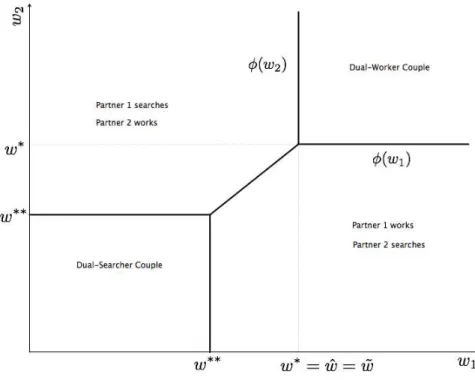
This proposition guarantees that, under risk aversion, there is a “breadwinner cy-cle”: A region where the worker-searcher couple adopts the reservation wageφ(w) =
(2012)). Figure 1 show these reservation wage functions in the(w1, w2)space when
the couple is risk-neutral.
Figure 1: Reservation wage function under risk-neutrality
Notice that w∗ = w∗∗, where w∗ is the reservation wage of a risk neutral single individual in this setting.
The following proposition (adapted from proposition 3 of Guler et al. (2012)) pro-vides further characterization of the reservation wage functions of the worker-searcher couple for the CARA case. Figure 2 plots the reservation wage functions for the CARA utility case using these results.
Proposition 7(CARA utility (Guler et al., 2012)). With CARA preferences, forw1 >w˜,
the reservation wage functionφ(w1)andw˜satisfy
φ′(w1) = 0andw˜ = ˆw=w∗
Figure 2: Reservation wage functions for the CARA utility case
6
Conclusion
Appendices
Proof.Proposition (2). We guess and verify thatrT(w1, w2, a) = u(ra+w1+2w2−2τ).
De-riving with respect toaand substituting into (8) yields
max
c
uc
2
+u
′(ra+w1+w2−2τ
2 )
2 (ra+w1+w2−2τ−c)
(46)
The FOC impliesu′(c
2) = u
′(ra+w1+w2−2τ
2 ), thereforec
e(w
1, w2, a) = ra+w1+w2−2τ.
Plugging this back into (8) confirms the guess.
Similarly, we guess that rΩ(w, a) = u(ra+w+φ+2(w,a)−2τ)for w ≥ w∗. Following the same steps as before, we obtain
max
c
(
uc
2
+u
′(ra+w+φ+(w,a)−2τ
2 )
2 (ra+b+w−τ −c)
)
(47)
The FOC impliesceu(w, a) = ra+w+φ+(w, a)−2τ. If we plug this back into (7), we
obtain
rΩ(w, a) = u
ra+w+φ+(w, a)−2τ
2
+
u′ra+w+φ+(w,a)−2τ
2
2 b+τ −φ
+(w, a)
+ α r Z ∞ 0 max u
ra+w+w′−2τ
2
−u
ra+w+φ+(w, a)−2τ
2
, u
ra+w′+φ+(w′, a)−2τ
2
−u
ra+w+φ+(w, a)−2τ
2
,0
dF(w′)
(48)
Sinceuis CARA, we can rewrite this as
rΩ(w, a) =u
ra+w+φ+(w, a)−2τ
2 1−
γ
2 b+τ −φ
+(w, a)
− α r Z ∞ 0 max u
w′−φ+(w, a)
2
+ 1, u
w′ +φ+(w′, a)−w−φ+(w, a)
2
+ 1,0
dF(w′)
(49)
Remember that φ+(w, a) is given by the identity Ω(w, a) = T(w, φ+(w, a), a) =
u(ra+w+φ+(w,a)−2τ
2 )
r and plug into (49) to obtain
(50)
φ+(w, a) =b+τ+ 2α
γr Z ∞ 0 max u
w′−φ+(w, a)
2
+ 1, u
w′+φ+(w′, a)−w−φ+(w, a)
2
+ 1,0
dF(w′)
Next, we conjecture that there is a wage after which there are no quits. Notice that this implies thatφ+(w, a)≤φ−(w, a) =win this range. Therefore, we can rewrite (50) as
(51)
φ+(w, a) = b+τ +2α
γr
Z ∞
φ+(w,a)
u
w′−φ+(w, a)
2
+ 1
dF(w′)
This implies thatφ+(w, a)is independent of(w, a)and unique, since the left-hand
side is increasing while the right-hand side is decreasing in φ+(w, a). Comparison
with (9) shows that φ+(w, a) = w∗. This confirms our conjecture that there are no quits beyond some wage equal tow∗in this case.
Finally, we guess thatrU(a) = u(ra+2(2w∗−τ)). Plugging in this guess into the right-hand side of (6) and obtaining the FOC yieldscu(a) = ra+ 2(w∗−τ). Substituting this into (6) and substitute the value function forΩ(w, a)in this range, we arrive at
(52)
rU(a) = u
ra+ 2(w∗−τ)
2 + 1 2u ′
ra+ 2(w∗−τ)
2
(2b−2(w∗−τ))
+ 2α
Z ∞ 0 max
u ra+w+w∗
−2τ
2
r −
ura+2(2w∗−τ) r ,0
dF(w)
Using the properties of CARA utility, we can rewrite this as
rU(a) =u
ra+ 2(w∗−τ)
2
1−1
2γ(2b−2(w
∗−τ)) + 2α
Z ∞
w∗
u(w−w∗
2 )
r + 1
!
dF(w) !
(53)
Rearranging (9) we obtain
(54)
−1
2γ(2b−2(w
∗−τ)) + 2α
Z ∞
w∗
u(w−w∗
2 )
r + 1
!
dF(w) = 0
Substituting in (53),
(55)
rU(a) = u
ra+ 2(w∗−τ)
2
References
Guler, B., F. Guvenen, and G. L. Violante (2012). Joint-search theory: New opportuni-ties and new frictions.Journal of Monetary Economics, 352–369.
Hopenhayn, H. A. and J. P. Nicolini (1997). Optimal Unemployment Insurance. Jour-nal of Political Economy 105(2), 412–38.
McCall, J. J. (1970). Economics of Information and Job Search.The Quarterly Journal of Economics 84(1), 113–26.
Shavell, S. and L. Weiss (1979). The Optimal Payment of Unemployment Insurance Benefits over Time. Journal of Political Economy 87(6), 1347–62.
Shimer, R. and I. Werning (2007). Reservation wages and unemployment insurance.
The Quarterly Journal of Economics 122(3), 1145–1185.
Shimer, R. and I. Werning (2008). Liquidity and insurance for the unemployed. Amer-ican Economic Review 98(5), 1922–42.