Vol-7, Issue-2, 2016, pp551-557 http://www.bipublication.com
Research Article
A study on the connection and physical properties of Cadmium selenide
nanoparticles and zinc sulfide nanoparticles made by ultrasonic method
Shabnam Taheriniya1 and Mohammad Kazemi2
1
Master of Science, Nanophysics, Faculty of Plasma Physics, Science and Research Branch,
Islamic Azad University, Tehran, Iran 2
Asistent professor of physics University of Mohaghegh Ardabili. [email protected]
[Received-27/03/2016, Accepted-09/04/2016, Published-29/04/2016]
ABSTRACT
Ultrasonic waves are called to hordes of mechanical waves that their oscillation frequency exceeds from human hearing range (20 Hz- 20 KHz). These waves have various applications due to their properties; ultrasonic frequency acoustic waves (16 KHz to 2 MHz) are used for curing and ultrasonic process parameters (amplitude, frequency and power) can be controlled properly. Ultrasonic process in fluids is followed by acoustic cavitation phenomenon (cavitation). Indeed, acoustic cavitation refers to the formation of bubbles (pores) due to the rapid drop in water caused by passing the sound waves through it. In this research, an action was made to produce CdSe and ZnS nanoparticles using this method. Ultimately, ZnS quantum dots and ZnS nanoparticles were connected to each other using a coupling agent copolymer (PEG-PCA). The optical properties of this nanoparticle were examined by using X-ray diffraction and evaluated using UV-Visblel range of coupling effect.
Key words- Cadmium selenide, zinc sulfide, coupling agent copolymer
INTRODUCTION
With development, design and manufacture of integrated circuits especially the increasing accumulation of large -scale parts in the 1980s, an attempt to downsize micro- electronic components continued.On the other hand, new demand for manufacture of integrated circuits especially memory circuits including Dynamic random-access memory (DRAM) and Static Random Access Memory (Static RAM or SRAM) with features such as high-speed
operation together with reduced power
dissipation steadily increased. In evolutionary
process, miniaturization of electronic
components especially in geometry and sub-micron scale of less than 0.2 micrometres i.e.
design of nano-technology electronic
integrated circuits with nanometer structure, use of new materials and better production processes, it can raise more precise methods.Quantum dot or quantum dots are semiconductors that have a variety of uses in medicine and industry. Quantum dots are used in the industry for the manufacture of LED lamps, solar cells, etc. In medicine, quantum dots are highly used for design and manufacture of sensitive nano-biosensors with higher optic stability than conventional colored pigments. Quantum dots have unique properties such as higher optic stability, separated excitation and emission spectra and so forth. Electrons in quantum dots likewise clumped semi-conductor tend to have transitions near the edges of the energy gap. Energy levels depend on the size and shape of the quantum dots. The smaller quantum dot, the energy levels fall apart and energy levels increase. Semiconductor quantum dots with low dimension due to various applications including solar cells, catalysts, biological labels, laser media and optoelectronic devices have attracted much attention [2, 3]. A major problem in the production of nano-particles lies on chemical reactivity, which is caused by their high surface to volume ratio. To solve this problem, a stabilizer is required. The stabilizer prevents the interaction of nanoparticles with each other and adherence and accumulation of them in solution by forming a layer around a nanoparticle. These materials, in addition to stabilizing nanoparticles in the environment, prevent from their oxidation in the environment. In this project, a simple method has been reported for making quantum dots at small size (about 1-3 nm) in water. In this method, the precursors react with each other in the presence of a suitable coating agent in ultrasonic (Working: ~ 30KHZ Operating:
50HZ) [4]. Polymerization copolymer
[[polyethylene glycol (PEG) - poly citric acid (PCA) was carried out by melting at 110 - 150 C.
Ultimately CdSe quantum dots and ZnS
nanoparticles using a coupling agent copolymer (PEG-PCA) were connected to each other.
Lead sulphide nanoparticles
Group 12-16 (II-VI) semiconductor nanoparticles such as ZnSe, CdSe, CdS, ZnS which are called quantum dots (Quantum Dots) have numerous
applications in Optoelectronics, photocatalytic activity and solar energy industries. The application of ZnSe and CdSe nanoparticles has been reported in medicine and life sciences. Nanoparticles of lead sulfide quantum dots have included of semiconductor materials with unique optical properties of Group IV-VI. Due to the very small band gap (0.41 eV) and properties of absorption and emission of various spectra in making biological sensors for accurate medical diagnosis especially in deep tissues and diagnosis of cancer have attracted particular attention [8,9]. Disadvantage of this nanoparticle is that it is easily exposed to degradation and release of toxic ions+ Pb2 by hydrolysis or oxidation in the biological environment [10, 11]. To solve these problems, to date many methods have been used which have faced problems [11, 14]; Cadmium sulfide is a chemical compound with the formula CdS. This compound is in yellow and a semiconducting color. This compound is extracted in two different minerals called a hex greenockite (the natural cadmium sulfide) with the Latin name (Hexagonal greenockite) and another Cubic hawleyite (Sphalerite such as ZnS and FeS) with the Latin name (Cubic hawleyite). It has numerous functional properties that causes this compound are highly regarded today. Cadmium sulfide acquired can be acquired by sulfur ion to the Cadmium and deposition of cadmium sulfide regarding the equation below:
This method was used in the past with Gravimetric measurement. With the creation of the yellow pigments in the solution, it can perceive deposition of this compound.
solution) is used for pH control. This compound can be produced from cadmium alkyl species, e.g. it can reach to a film of cadmium sulfide by the reaction between dimethyl cadmium and Diethyl sulfide.
Ultrasonic Test: Ultrasonic test (UT) is one of
the non-destructive tests which is grounded on sending high ultrasound into the part to be inspected and examining how the emission occurs in the part. Until ultrasonic wave goes through a steady environment inside the part, it continues its initial path and reflects in total or a part in collision with fault (discontinuity or structural heterogeneity) in the intersection of the first environment and second environment. One of the oldest non-destructive study methods lies on comparison of the sound of hitting small hammer to the part under test with the sound of the hit with that severity to the healthy part. Thereby, whether the part is healthy or unhealthy is specified. Yet this study method has not been sensitive to provide the possibility to detect fine faults. On the other hand, the detectable fault depended on sensitivity of ear of the tester. By achieving high-frequency ultrasound waves, detecting small defects in the parts was facilitated and application of this method was extended.
Test method
In this research, to produce selenium source, firstly 0.59 gr of Na2So3 is dissolved in an amount of distilled water inside 50 cc flask and then 0.200 gr selenium is added to the flask reaching to 50 ml with distilled water and remaining under nitrogen gas and magnetic stirrer at temperature of about 90 degrees Celsius four 24 hours, and then the mentioned mixture is passed through filter paper twice so as to separate the additional selenium. To produce CdSe nanoparticles, firstly 0.3406 gr of CdCl2.H2O is dissolved in 20 ml distilled water inside 100 ml two-opening balloon. 0, 1707 gr of Cysteamine stabilizing factor is dissolved in 15 ml of distilled water and added to the flask containing cadmium source. Then Molar mass (1 M) is added to the solution until PH solution reaches to reach 11. After 15 minutes, 10 ml of selenium source which has been previously prepared is injected to the flask containing cadmium source by syringe under ultrasonic
(temperature about 60 C) and nitrogen gas. After one hour, the flask was removed from Ultrasonic (CdSe quantum dots have been prepared from cadmium chloride aqueous solution and sodium selenosulfate in the presence of Cysteamine as a stabilizing factor); after cooling, deposition comes to realize with acetone in 3 4000 rpm for an hour by centrifugal. The precipitation was dried in vacuum at a temperature of 50 C and the obtained nanoparticle was kept in dark environment and in the same way ZnS nanoparticle was acquired with precursors ZnCl2 and Na2S and cysteamine as a stabilizing agent. In the polymerization of PEG-PCA, the amount of 2,021 gr PEG is poured into polymerization vial and remained at 80 C temperature under magnetic stirrer until the aqueous solution flows. Then 4.2028 g of poly (citric acid) is taken and poured into polymerization vial. Then it undergoes magnetic stirrer at 110 C for 15 minutes and undergoes vacuum at 130 C for 30 minutes until the produced water is extended to the reaction. At this stage, the temperature increases to 150 C and undergoes vacuum in the magnetic stirrer for 10 minutes. Then, the copolymer is cooled and dissolved in THF and smoothened via filter paper. The existing solvent in the solution beneath the filter paper is removed with rotary until it appears in viscous state. Then it is purified with Diethyl ether. Ultimately, it undergoes vacuum for 2 hours at 55 C temperature until THF and Diethyl ether are removed. The weight ratio of 1:10 of CdSe: CopPolymer undergoes reaction at a temperature of 80 C under magnetic stirrer. Due to Coulomb attraction between the positively charged quantum dots and quantum dots and negatively charged copolymer, quantum dots and copolymer interact each other.After 1 hour, an amount of ZnS NPs in ratio 1: 1 of CdSe: ZnS is added to the solution.
DISCUSSION AND CONCLUSION
Β: Wave width at half maximum
Θ: Dispersion angle
Λ: X -ray wavelength[5]
Figure 1. XRD patterns of CdSe QDs & ZnS NPs
Figure 1 shows the absorption spectrum (CdSe QDs-black curve) and the solution containing quantum dots of cadmium selenide with
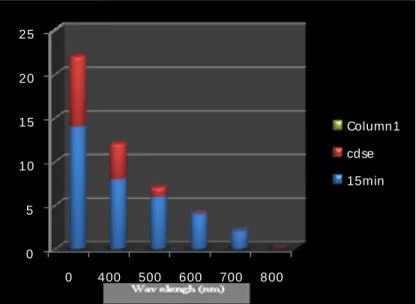
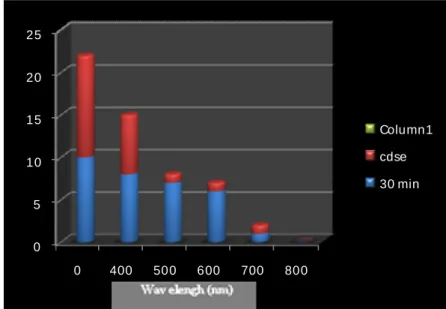
PEG-PCA copolymer at different times ( 15 min, 30 min, 45 min and 60 min). Absorption spectra are called to the interaction between nanoparticles of cadmium selenide and copolymer PEG-PCA. Due to the opposite charges on the surfaces of
nanoparticles of cadmium selenide and
copolymer PEG-PCA, this connection will be of electrostatic interaction between the opposite charges. Electrostatic interaction between nanoparticles of Ag / CdTe with opposite charges has been reported in the article [6]. As shown in figures 1-4, by the passage of time in red shift absorption spectrum, it can observe that energy gap of nanoparticle reduces by the passage of time and as the result the size of particle increases. In figures 1-4, effect of adding ZnS QDs on UV-Vis absorption spectrum of the solution containing quantum dots of cadmium selenide with copolymer PEG – PCA has been shown at different times( 15 min, 30 min, 45 min and 60 min). Change in absorption spectrum lies on the interaction between
nanoparticles of cadmium selenide and
nanoparticles of ZnS with Copolymer coupling of PEG PCA.
0 5 10 15 20 25
0 400 500 600 700 800
Column1 cdse 15min
FIGURE 1. Absorption spectrum CdSe QDs and the solution containing quantum dots of cadmium selenide with
Copolymer coupling of PEG PCA at 15 min
0 5 10 15 20 25
0 400 500 600 700 800
Column1 cdse 30 min
FIGURE 2. Absorption spectrum CdSe QDs and the solution containing quantum dots of cadmium selenide with
Copolymer coupling of PEG PCA at 30 min
FIGURE 3. Absorption spectrum CdSe QDs and the solution containing quantum dots of cadmium selenide with
Copolymer coupling of PEG PCA at 45 min
FIGURE 4. Absorption spectrum CdSe QDs and the solution containing quantum dots of cadmium selenide with
Copolymer coupling of PEG PCA at 60 min
Absorbance (a.u) . 10
Absorbance (a.u) . 10
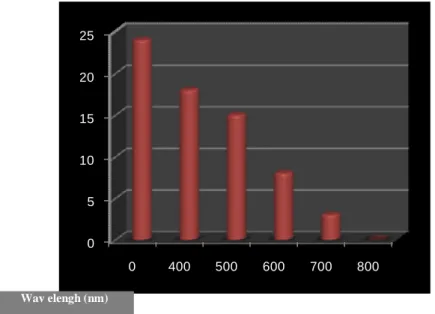
Figure 5 displays absorption spectrum(Uv-Vis) of the solution containing quantum dots of cadmium selenide with copolymer PEG – PCA and figure 6 displays effect of adding ZnS QDs to the solution containing quantum dots of cadmium selenide with Copolymer coupling of PEG PCA.
0 5 10 15 20 25
0 400 500 600 700 800
FIGURE 5. Absorption spectrum (Uv-Vis) and the solution containing quantum dots of cadmium selenide with
Copolymer coupling of PEG PCA
0 5 10 15 20 25
0 400 500 600 700 800
FIGURE 6. Absorption spectrum (Uv-Vis) and adding ZnS QDs to the solution containing quantum dots of
cadmium selenide with Copolymer coupling of PEG PCA
REFERENCES
1. H.Hu, W.Zhang; “ Synthesis and properties of transition metals and rare-earth metals doped ZnS nanoparticles ” Optical Materials 28, (2006) 536–550.
2. J.H. Yoon, W.S.Chae,S.J.Im and Y.R. Kim; “ Mild synthesis of ultra-small CdSe quantum dots in ethylenediamine solution”; Materials Letters, 59, (2005) 1430– 1433.
3. R.Sathyamoorthy,
V.Manjuladevi,P.Sudhagar, S.Senthilarasu and U.Palb; “ Surfactant-assisted
room-temperature synthesis of CdSe nanoclusters ”; Materials Chemistry and Physics, 105 (2007) 20–24
4. Han, Z.Sheng and J.Liang; “ A novel method for the preparation of water-soluble and small-size CdSe quantum dots ”; Materials Letters,60, (2006) 3782–3785.
5. Ch.Cheng and H.Yan; “ Bandgap of the core-shell CdSe/ZnS nanocrystal within the temperature range of 300-373K Physica E, (2009), doi:10.1016/j.physe.2008.12.019 6. Y.Wang, M.Li, H. Jia, W.Song, X.Han,
J.Zhang, B.Yang W.Xu and B.Zhao; “ Optical
Absorbance (a.u) . 10
Absorbance (a.u) . 10
Wav elengh (nm)
properties of Ag/CdTe nanocomposite self-organized by electrostatic interaction; Spectrochimica Acta Part A 64,(2006) 101– 105
7. McDonald S, Cyr P, Levina L, Sargent E, Photoconductivity from PbS-nanocrystal /semiconducting polymer composites for solutionprocessible, quantum-size tunable infrared photodetectors, Appl. Phys. Lett., 85, 2014, 2089–2091.
8. Hines M, Scholes G, Colloidal PbS nanocrystals with size tunable near infrared emission: observation of post-synthesis self-narrowing of the particle size distribution, Adv. Mater 2013,186-187.
9. Derfus A, Chan W, Bhatia S, Probing the Cytotoxicity of Semiconductor Quantum Dots, Nano Lett., 4, 2004, 11-18.
10.Sutherland A, Quantum dots as luminescent probes in biological systems, Curr. Opin. Solid State Mater. Sci., 6, 2003, 365-370
11.Pellegrino T, Manna L, Kudera S,
Hydrophobic nanocrystals coated with an amphiphilic polymer shell: a general route to water soluble nanocrystals, Nano Lett., 4, 2004, 703-707.
12.Duncan R, The dawning era of polymer therapeutics, Nat. Rev. Drug Discov., 2, 2013. -360-367.