223
Pakistan Veterinary Journal
ISSN: 0253-8318 (PRINT), 2074-7764 (ONLINE)Accessible at: www.pvj.com.pk
Serobiochemical Alterations in Subclinically Affected Dromedary Camels with
Trypanosoma
evansi
in Iran
Alireza Sazmand, Aria Rasooli٭1, Mohammad Nouri1, Hosein Hamidinejat2 and Seyedhossein Hekmatimoghaddam3 Veterinary Medicine Student, 1Department of Clinical Sciences, 2Department of Pathobiology, School of Veterinary Medicine, Shahid Chamran University, Ahvaz, Iran; 3Department of Laboratory Medicine, School of Paramedicine, Shahid Sadoughi University of Medical Sciences, Yazd, Iran.
*Corresponding author: [email protected]
A R T I C L E H I S T O R Y A B S T R A C T
Received: Revised: Accepted:
November 27, 2010 December 25, 2010 December 28, 2010
Key words: Camel Dromedary Iran
Serobiochemical Trypanosoma evansi
The aim of this study was to investigate the effects of subclinical Trypanosoma evansi infection on serum biochemical parameters of dromedary camels. Jugular vein blood samples were taken weekly for three successive weeks from 110 apparently healthy male camels and examined for the presence of trypomastigote form of T. evansi in blood smears. The parasite was seen in 17 (15.45%) blood smears. Various serum biochemical parameters i.e., glucose, urea, cholesterol, triglyceride, calcium, magnesium, sodium, potassium, phosphorus, total protein, albumin, triiodothyronine (T3), thyroxine (T4), cortisol, and activities of aspartate aminotransferase (AST), alanine aminotransferase (ALT), alkaline phosphatase (ALP), lactate dehydrogenase (LDH) and creatine kinase (CK) were determined. Infected camels had significantly lower serum glucose, T3 and T4 concentrations (P<0.05), and significantly higher triglycerides concentration and ALT activity (P<0.05). It was concluded that subclinical infection of camels with T. evansi can also affect some biochemical parameters.
©2011 PVJ. All rights reserved To Cite This Article: Sazmand A, A Rasooli, M Nouri, H Hamidinejat and S. Hekmatimoghaddam, 2011. Serobiochemical alterations in subclinically affected dromedary camels with Trypanosoma evansi in Iran. Pak Vet J, 31(3): 223-226.
INTRODUCTION
Camel is one of the best adopted animals of the desert, a source of milk, meat and wool and is used for transportation and racing (Kamal, 2008; Meiloud et al., 2011). Camel trypanosomiasis, also known as Surra, is a disease caused by Trypanosoma evansi. This parasite affects many species of mammals in Africa, Asia and Latin America (Omer et al., 2007). Camels are most often affected in the Middle East and Africa (Brun et al., 1998). Surra is the most economically important disease of camel herds with morbidity of up to 30% and mortality of around 3% (Enwezor and Sackey, 2005). The disease may occur in both acute and chronic forms, but generally the chronic form is more common. The acute form of the disease is usually fatal within a few weeks, but the chronic form lasts for years and is characterized by anemia, emaciation, recurrent fever, edema, conjunctivitis, lacrymation, enlargement of the lymph nodes, and abortions (Gutierrez et al., 2005). Many investigators have shown alterations in blood constituents and tissue lesions in infected camels (Chaudhary and Iqbal, 2000;
Al–Qarawi et al., 2001; Saleh et al., 2009). The aim of this study was to investigate the effects of subclinical T.
evansi infection on serum biochemical parameters of
dromedary camels.
MATERIALS AND METHODS
The research was carried out in the Yazd province, an arid region in center of Iran having minimum and maximum summer temperature 14.50 and 45.50ºC, respectively. This study was performed on 110 apparently healthy one–humped male 5 to 10 years old camels kept by local farmers and were fed low quality diets contained mainly straw, barley and wilted grass. Repeated jugular vein thin and thick blood smears were prepared weekly for three successive weeks during summer season (23th June to 22nd September 2008) to confirm parasites microscopically. Giemsa staining of slides revealed trypomastigote form of parasite in the blood of infected animals (Soulsby, 1982). Non infected animals were considered as control. Jugular vein blood samples were also collected without any anticoagulant and were
Pak Vet J, 2011, 31(3): 223-226. 224
subjected to extraction of serum and stored at –20oC till analysis.
Serum glucose was measured by enzymatic (GOD-PAP) colorimetric method, urea by enzymatic (Urease) colorimetric, cholesterol by enzymatic (CHOD-PAP) colorimetric, triglyceride by enzymatic (GPO-PAP) colorimetric, calcium by orthocresolphethalein complex, magnesium by xylidyl blue, phosphorus by ammonium molybdate, albumin by bromcresol green (BCG), total protein by biuret method. Activity of alanine aminotransferase (ALT) and aspartate aminotransferase (AST) were determined by enzymatic (IFCC) colorimetric method, alkaline phosphatase (ALP) and lactate dehydrogenase (LDH) by enzymatiac (DGKC) colorimetric and creatine kinase (CK) by enzymatic (IFCC/DGKC) colorimetric method (Shimadzu spectrophotometer, model AA200, Tokyo, Japan). Estimation of triiodothyronine (T3), thyroxine (T4) and cortisol levels in serum were made by ELISA method. Sodium and potassium concentrations were determined by flame photometry method (digital flame analyzer, model 2655–00 Cole–Pulmer Instrument Company, Chicago, IL, USA) (Latimer et al., 2003). The data were analyzed by SPSS software ver. 16, with Independent Student’s t–test.
RESULTS
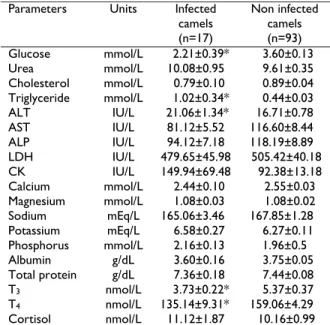
Thin and thick blood smears revealed slender and flagellated trypomastigote forms that were morphologically compatible with T. evansi. The parasite was seen in 17 (15.45%) blood smears. As the area of sampling was out of Tsetse belt zone and according to the morphological and morphometric indices, the parasites were diagnosed as T. evansi. The mean (±SE) values of biochemical parameters in dromedary camels naturally infected with T. evansi and non–infected camels are presented in Table 1. A significant (P<0.05) reduction was seen in the values of glucose, T3 and T4 whereas values of triglyceride and ALT were significantly elevated in infected camels in comparison with non–infected group (Table 1). The concentrations of serum urea, cholesterol, calcium, magnesium, sodium, potassium, phosphorus, albumin, total protein, cortisol and activity of AST, ALP, LDH and CK differed non-significantly between infected and non infected groups.
DISCUSSION
In the present study, a significant (P<0.05) reduction was seen in the values of T3 and T4 whereas values of triglyceride and ALT were significantly elevated in infected camels in comparison with non–infected group. Serum glucose concentration had a significant decrease in the infected subjects. Similar results were documented by Raisinghani and Lodha (1980) in camel. This is a common finding in trypanosomiasis, and is reported due to excessive utilization of blood glucose by the parasites for their metabolism (Anosa, 1988). It has also been shown that parasite count is inversely proportional to glucose concentration (Jatkar and Singh, 1974). Increased metabolic rate caused by fever and hepatocyte degeneration could also be a reason for hypoglycemia in trypanosomiasis (Cadioli et al., 2006). In contrast, Hilali
et al. (2006) reported no significant changes in the mean serum glucose of buffalo calves.
Table 1: The mean (±SE) serum biochemical parameters of
infected and non–infected dromedary camels with Trypanosoma
evansi Non infected camels (n=93) Infected camels (n=17) Units Parameters 3.60±0.13 2.21±0.39* mmol/L Glucose 9.61±0.35 10.08±0.95 mmol/L Urea 0.89±0.04 0.79±0.10 mmol/L Cholesterol 0.44±0.03 1.02±0.34* mmol/L Triglyceride 16.71±0.78 21.06±1.34* IU/L ALT 116.60±8.44 81.12±5.52 IU/L AST 118.19±8.89 94.12±7.18 IU/L ALP 505.42±40.18 479.65±45.98 IU/L LDH 92.38±13.18 149.94±69.48 IU/L CK 2.55±0.03 2.44±0.10 mmol/L Calcium 1.08±0.02 1.08±0.03 mmol/L Magnesium 167.85±1.28 165.06±3.46 mEq/L Sodium 6.27±0.11 6.58±0.27 mEq/L Potassium 1.96±0.5 2.16±0.13 mmol/L Phosphorus 3.75±0.05 3.60±0.16 g/dL Albumin 7.44±0.08 7.36±0.18 g/dL Total protein 5.37±0.37 3.73±0.22* nmol/L T3 159.06±4.29 135.14±9.31* nmol/L T4 10.16±0.99 11.12±1.87 nmol/L Cortisol
Values bearing asterisk in a row differ significantly (P<0.05).
The results of enzyme assays showed elevation of ALT activity in the infected animals, while no changes were noted in the ALP, AST, CK and LDH activity in the present study. Increase in AST and ALT activity has been reported in T. evansi infected camels (De La Rue et al., 1997). The rise in AST activity can be attributed partly to cellular damage caused by the trypanosomes lysis, while the increase in ALT activity probably results from host destruction of trypanosomes (Enwezor and Sacky, 2005). Compared with the previous report in which ALP, AST and LDH enzymes displayed increase during trypanosomiasis (Rahman, 1992), in the present study, no changes were observed in these enzymes of infected camels. There is possibility that vital organs (liver and kidneys) could have not been affected at the time of examination. Our findings are in accordance with the works of Chaudhary and Iqbal (2000) and Gutierrez et al. (2005).
Pak Vet J, 2011, 31(3): 223-226. 225
chronic stage could be due to a significant decrease in the albumin levels that possibly indicates great liver damage (Enwezor and Sacky, 2005).
In the present study, subclinical infection with T. evansi was associated with significant reduction in the concentrations of T3 and T4. It was shown that trypanosomal infection rapidly impairs function of the thyroid gland in goats experimentally infected with T.
congolense (Mutayoba et al., 1988) and induces
hypothyroidism in cattle (Abebe and Eley, 1992). Also in camel, T. evansi can induce a significant reduction in serum T3 and T4 levels associated with parallel decrease in the blood concentration of TSH (Al–Qarawi et al., 2001). Mechanisms by which trypanosoma affect the thyroid functions are not completely understood. However, in the infected calves release of cytokines could inhibit the thyroid hormone production (Kahl et al., 2002). Bartalena et al. (1998) indicated that all steps of thyroid hormones synthesis may negatively be affected by cytokines.
Increased serum lipid, hypertriglyceridemia and hypercholesterolemia were reported in experimentally infected rats with T. brucei (Igbokwe et al., 2009). Rouzer and Cerami (1980) showed that rabbits infected with T. brucei developed a hypertriglyceridemia which could be due to defective plasma triglyceride degradation that probably cause free fatty acid unavailable for importation into hepatocytes despite of serum triglyceride elevation. While, Adamu et al. (2009) showed that T. brucei in pigs significantly reduced the serum levels of cholesterol and triglycerides. The results of the present study showed a significant increase in the serum triglyceride in the infected camels but no change was observed in the serum cholesterol concentration.
From the present study, it may be concluded that subclinical infection of camels with T. evansi can also affect some biochemical parameters, but these variations were very limited compared with clinical cases.
Acknowledgments
The authors would like to acknowledge the Vice Chancellor, Shahid Chamran University for the financial support.
REFERENCES
Abebe G and RM Eley, 1992. Trypanosome–induced hypothyroidism in cattle. Br Vet J, 148: 63–70. Adamu S, N Barde, JN Abenga, NM Useh, NDG Ibrahim
and KAN Esievo, 2009. Experimental Trypanosoma
brucei infection–induced changes in the serum
profiles of lipids and cholesterol and the clinical implications in pigs. J Cell Anim Biol, 3: 15-20. Al–Qarawi AA, H Abdel–Rahman and SA ElMougy,
2001. Impairment in the pituitary–thyroid axis of the
Camelus dromedarius infected with Trypanosoma
evansi. Deut Tierarztl Wochenschr, 108: 172–174. Anosa VO, 1988. Haematology and biochemical changes
in human and animal trypanosomiasis. Part II. Rev Elev Med Vet Pays Trop, 41: 151–164.
Bartalena L, F Bogazzi, S Brogioni, L Grasso and E Martino, 1998. Role of cytokines in the pathogenesis of the euthyroid sick syndrome. Eur J Endocrinol, 138: 603–614.
Brun B, H Hecker and ZR Lun, 1998. Trypanosoma evansi and T. equiperdum: distribution, biology, treatment and phylogenetic relationship (a review). Vet Parasitol, 79: 95–107.
Cadioli FA, LC Marqus, RZ Machado, AC Alessi, LPCT Aquino and PA Barnabe, 2006. Experimental
Trypanosoma evansi infection in donkeys:
hematological, biochemical and histopathological changes. Arq Bras Med Vet Zootec, 58: 749-756. Chaudhary ZI and J Iqbal, 2000. Incidence, biochemical
and haematological alterations induced by natural trypanosomosis in racing dromedary camels. Acta Trop, 77: 209–213.
De La Rue ML, GA De Carli, HM Herrera and RAMS Silva, 1997. Biochemical changes in acute infection of dogs with Trypanosoma evansi. J Protozool Res, 7: 28–35.
Enwezor FNC and AKB Sackey, 2005. Camel trypanosomiasis - a review. Vet Arch, 75: 439–452. Gutierrez C, JA Corbera, MC Juste, F Doreste and I
Morales, 2005. An outbreak of abortions and high neonatal mortality associated with Trypanosoma evansi infection in dromedary camels in the Canary Islands. Vet Parasitol, 130: 163–168.
Hilali M, A Abdel-Gavad, A Nassar and A Abdel-Wahab, 2006. Hematological and biochemical changes in water buffalo calves (Bubalus bubalis) infected with Trypanosoma evansi. Vet Parasitol, 139: 237-243. Igbokwe IO, LB Buratai, UL Ubah, A Aromnde and NA
Igbokwe, 2009. Serum and hepatic lipid levels in rats infected with Trypanosoma brucei. Comp Clin Pathol, 18: 191–195.
Jatkar PR and M Singh, 1974. Pathogenesis of anaemia in
Trypanosoma evansi infection. IV. Blood glucose
studies. Indian Vet J, 51: 710–714.
Kahl S, TH Elsasser, JL Sartin and R Fayer, 2002. Effect of progressive cachectic parasitism and growth hormone treatment on hepatic 5'–deiodinase activity in calves. Domest Anim Endocrinol, 22: 211–221. Kamal AM, 2008. Some biochemical, hematological and
clinical studies of selected ruminal and blood con constituents in camels affected by various diseases. Res J Vet Sci, 1: 16–27.
Latimer KS, EA Mahaffey and KW Prasse, 2003. Duncan and Prasse,s Veterinary Laboratory Medicine. 4th Ed., Blackwell Publishing, Iowa State Press, pp: 119-285. Meiloud GM, IN Ould Bouraya, A Samb and A
Houmeida, 2011. Composition of mauritanian camel milk: results of first study. Int J Agric Biol, 13: 145– 147.
Mutayoba BM, HB Ohara–Ireri and S Gombe, 1988. Trypanosome–induced depression of plasma thyroxine levels in prepubertal and adult female goats. Acta Endocrinol (Copenhagen), 119: 21–26. Omer OH, HM Mousa and N Al-Wabel, 2007. Study on
the antioxidant status of rats experimentally infected with Trypanosoma evansi. Vet Parasitol, 145: 142-145.
Pak Vet J, 2011, 31(3): 223-226. 226
Rahman ZU, 1992. Serum biochemical, enzymes and haematological changes in one–humped camels infected with Surra, Proceedings of the first international camel conference, R &W Publications Limited, Dubai, pp: 405.
Raisinghani PM and KR Lodha, 1980. Prognostic values of some haematological and biochemical parameters of camels affected with surra following the treatment with Antrycide methyl sulphate, Naganol and Berenil. Indian Vet J, 50: 479-484.
Rouzer CA and A Cerami, 1980. Hypertriglyceridemia associated with Trypanosoma brucei infection in rabbits: role of defective triglyceride removal. Mol Bioch Parasitol, 2: 31–38.
Saleh MA, MB Al–Salahy and SA Sanousi, 2009. Oxidative stress in blood of camels (Camelus dromedaries) naturally infected with Trypanosoma evansi. Vet Parasitol, 162: 192–199.