A theory of planning horizons
(1): market design in a
post-neoclassical world
Frederic B. Jennings, Jr.
Volume V issue 2 spring 2012
issn 1843-2298
copyright note
Introduction
A theory of planning horizons (1):
A theory of planning horizons (1):
A theory of planning horizons (1):
A theory of planning horizons (1):
A theory of planning horizons (1):
market design in a post-neoclassical world
market design in a post-neoclassical world
market design in a post-neoclassical world
market design in a post-neoclassical world
market design in a post-neoclassical world
Frederic B. Jennings, Jr.
Abstract AbstractAbstract
AbstractAbstract: The neoclassical case supporting competitive frames and market solutions has failed to promote stable world-wide economic development. Other approaches in economics incorporate social culture, increasing returns, market power, ecological limits and complementarity, yielding broader applications for development theory. In this paper a theory of planning horizons is introduced to raise some meaningful questions about the traditional view with respect to its substitution, decreasing returns and independence assumptions. Suppositions of complementarity, increasing returns and interdependence suggest that competition is inefficient by upholding a myopic culture resistant to learning. Growth – though long believed to rise from markets and competitive values – may not derive from these sources. Instead, as civilizations advance, shifting from material wants to higher-order intangible output, they evolve from market tradeoffs (substitution and scarcity) into realms of common need (complementarity and abundance). The policy implications of horizonal theory are explored, with respect to regulatory aims and economic concerns. Such an approach emphasizes strict constraints against entry barriers, ecological harm, market power abuse and ethical lapses. Social cohesion – not competition – is sought as a means to extend horizons and thereby increase efficiency, equity and ecological health. The overriding importance of horizon effects for regulatory assessment dominates other orthodox standards in economics and law. Reframing economics along horizonal lines suggests some meaningful insight on the proper design of economic systems.
Keywords: Keywords: Keywords:
Introduction
Introduction
Introduction
Introduction
Introduction
The ‘Washington Consensus’ – as the term is currently used (Williamson 2000) – illustrates an ideological view which places privatization and competition at the top of the social agenda for economic development. This paper raises some basic questions about the virtues of competition, deriving from its suppositions about human relations. Social theory in economics starts with individual wants, independently framed and pursued. Furthermore, rivalry is seen as endemic: competition provides the best means to reconcile opposing intentions, shaking out those who want things most in a process of financial gain. The whole story is founded on neoclassical theory and its view of competition as efficient in the general case. Neoclassical economics is centrally based on substitution as the defining characteristic of economic relations. Substitution, in turn, derives from production under rising cost (diminishing returns). Substitution also warrants independence assumptions (Krupp 1982, p. 390; Jennings 2007b) and the use of equilibrium models.
The whole scheme unravels with these suppositions relaxed, to favor
complementarity, increasing returns and interdependence. In this setting, there are no equilibria and the economy opens along a path-dependent track where ethics and history count. The virtues of freedom and efficiency – individualism in general – ought to be addressed differently in a post-neoclassical world; their ramifications suggest that collaboration – not competition – may be a better route to economic growth in a more realistic context. The aim of this paper is to explore the optimality of free-market economies under revised assumptions, and the social policy implications of this shift away from mainstream models of choice.
Opening economics into realms of nonconvexity – as increasing returns will do – alters many established ‘truths.’ Substitution and decreasing returns allow equilibrium models to close, satisfying existence proofs for scientific acceptance. So would economic ‘convenience’ set the terms for legitimate discourse at the cost of realism. Complementarity and increasing returns are the way of our world; this paper aims to show why and trace some meaningful lessons therefrom. The paper is structured as follows. First, the joint importance of substitution and complementarity in economic relations is addressed to show why substitution is only one side of a two-sided coin where conflicts and concerts of value coexist throughout economic phenomena. Next, the twin notions of planning horizons and interhorizonal complementarity untangle an institutional quandary in which cooperation – not competition – is shown as efficient. The third section to follow will limn the growth and policy implications of a horizonal economics of complex systems and rational limits, suggesting a post-neoclassical view of free-market economies shaped by ethical laws, social culture and other considerations so far ignored in neoclassical theory. The last part of the paper restates its central conclusions and implications for economic growth and development in a world defined by ecological limits, rational bounds, common aims and horizon effects. So would doctrine need to evolve from competition to an inclusive frame adopting cooperation as our route to growth and development through an expansion of planning horizons in a new economics of information and organizational learning.
The nature of economic relations
The nature of economic relations
The nature of economic relations
The nature of economic relations
The nature of economic relations
Substitution assumptions stand on notions of opposition as the basic
characteristic of economic interdependence: social relations are rivalrous, since scarcity is the problem motivating individual effort to meet human needs. Substitution and tradeoffs state the nature of our relations; such is the way of physical goods, which either belong to you or another. The conflicts of value assumed in this setting – associated with things as the source of economic well-being – create a rivalrous social linkage as a means to serve common needs. So would Smith’s (1776, p. 423) “invisible hand” deliver an optimal level of
satisfaction to the public through free trade in a market society. Although some problems are acknowledged with this central lesson, it remains a prime
those of physical goods. As Romer (1996, p. 204) expressed it, two types of input – things and ideas, or atoms and bits – serve to explain growth: the ‘nonrivalry’ of immaterial goods is seen to be important to the development process through R&D, information and learning.
But Romer doesn’t go far enough in assuming constant and decreasing returns to scale in things: substitution is not the only form of interdependence, even in realms of physical output. The implications of falling cost – that transformed economics during the 1930s debates – suggest diminishing returns are not the long-term nature of production technology, even as noted by Adam Smith in his pin factory illustration of virtuous specialization (Warsh 2006, p. 46). Pigou (1927, pp. 193-97; 1928, pp. 252-56) ruled diminishing returns “impossible,” to be “excluded completely”: “only the laws of constant or decreasing supply price … are admissible.” Kaldor (1972; 1975, p. 348) endorsed increasing returns as the general case in production, yielding complementarity in our relations: “The principle of substitution … ignores the essential complementarity between … different types of activities … which is far more important for an understanding … of the economy than the substitution aspect.” Myrdal (1978, pp. 772-74)
outlined a similar view of “cumulative causation.” If true, then economics should embrace substitution and complementarity in a nondecomposable mix. Standard theory in economics seized on one form of interdependence at the expense of another, which may be “far more important…”
The relation of value to scarcity is also at issue here. In traditional economics, scarcity enhances worth, as with the water-diamond paradox: water is free though needed for life when useless jewels are rare and costly. A scarcity economics sees no problem with this scenario, whereas information network economies suggest a blindspot in this approach. As Matthew (2001, p. 2) reported in an essay on “The New Economy”:
‘In the networked economy, the more plentiful things become, the more valuable they become. …Value is derived from plenitude, the concept of abundance. … Abundance is everything. Ubiquity drives increasing returns in a networked world. In fact, the only factor becoming scarce in a world of abundance is human attention.’
has entered a stage of informational abundance which bears little resemblance to the conventional mainstream economic assumption of scarcity.” Quoting
Lamberton (2001, pp. 115, 117f), Elsner continued:
‘“The limitations of information as a commodity…” call for a “thoroughgoing innovation in organizational design” to include “a very high level of collaboration.” This renders economics a science of (…) adequate coordination mechanisms rather than a science of individual maximization, general equilibrium and ‘optimality.’ An economics of complementarity opens some meaningful questions about traditional models of thought. If we step back from profit and pricing to look at human desires, why on earth would economists ever assume our social needs are opposed? Don’t we applaud each others’ success, as I might rejoice in yours? Is not the purpose of organization to align economic incentives into a more harmonious social process (Jennings 2009b)? Are not emotions contagious in their interpersonal impact? Why aren’t we helping each other succeed, instead of competing in opposition? All these spreading effects show complementary
interdependence.
Social conscience and personal growth internalize ‘externalities’ into the planning involved in all choice. Substitution is not the only economic connection, nor is competition always efficient: in the presence of
complementarity, cooperation is sought. Embracing complementarity opens economics in new ways: equilibrium may not occur in a positive-feedback system with a path-dependent historical lineage. Complex interdependence –
substitution and complementarity – undermines acquisitive values, showing cooperation may be preferred. The notion of planning horizons offers a way to resolve the dilemma.
The institutional economics of planning horizons and
The institutional economics of planning horizons and
The institutional economics of planning horizons and
The institutional economics of planning horizons and
The institutional economics of planning horizons and
complementarity
complementarity
complementarity
complementarity
complementarity
meaningful limits upon our range of anticipation: this is how planning horizons serve as an index of bounded rationality. A network connection of pricing effects so will extend through planning horizons into a general case for
complementarity in economics. The argument goes as follows: first, the
individual pricing decision is examined; then its horizonal aspects are explored and applied in network contexts. Subsequently, a vital link between our planning horizons suggests contagious social horizon effects called ‘interhorizonal complementarity.’ After that, the post-neoclassical growth implications of planning horizons shall be considered as well.
The Individual Pricing Decision
Decisions are not made on known results but rather among imagined projections of outcomes based on theory. ‘If I do this, then that will occur’ expresses a causal belief about the world derived from models selectively based on their own ‘essentials.’ Such essentials are only asserted: a theory’s acceptance shows in its use. Selective focus is also restrictively blind to what is ignored: theories’ silence on their omissions sums to a sweeping case for openness, multiple models and pluralism (Jennings 2007a); we cannot see what we miss or even imagine what we omit. The act of choice is a normative process of multidimensional causal projection; these selective visions show an extension dependent on knowledge, experience, self-awareness and clarity in our assumptions and applications. So will the role of expectations suggest a linkage of prices to planning horizons in need of formalization.
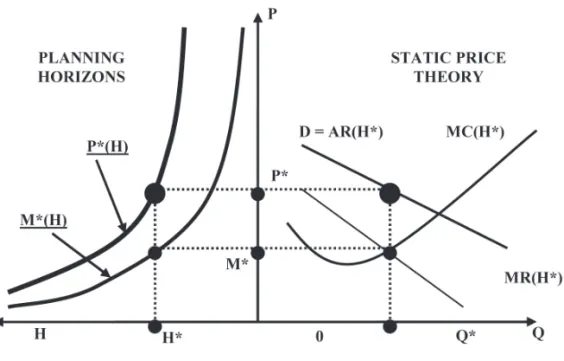
A static conception of pricing can be inferred through induction thus: a price is set, fixing output at one point on the market demand curve (functionally positioned through advertising, product design, etc.) over a unit cost determined by estimating the marginal value of inputs adjusted for risk. The opportunity cost of that price (P*) incorporates all the expected profit streams of foregone prices on a demand curve framed by the agent,[1] trying to fit her anticipations to the reality as it unfolds. The range of projection involved defines the planning horizon in choice; every pricing decision has a horizonal length as well: long-run curves in economics are more elastic than shorter-long-run curves. Such is the focus of any horizonal explanation of price.
is a measure of unit cost combined with a markup term E* E* E* E* E* ≡≡≡≡≡ εεεεε*/(*/(*/(*/(*/(εεεεε*+1) > 1*+1) > 1*+1) > 1*+1) > 1*+1) > 1
based on its own-demand elasticity εεεεε* * * * * ≡≡≡≡≡ dlnQ/dlnP < -1 dlnQ/dlnP < -1 dlnQ/dlnP < -1 dlnQ/dlnP < -1 dlnQ/dlnP < -1. The main conceptual
change involves epistemological status: P*P*P*P*P* rises out of inductive inference from an observed reality, based on uncertain expectation. In other words, the pricing decision depends on belief and assertion, not on knowledge and definite truth; the explanation entails a horizonal range in its suppositions. So must the run length of cost and demand curves – often derived deductively – be inductively inferred from price-setters’ planning horizons. The relation of price to planning horizons can be stated thus: dP*/dH* < 0dP*/dH* < 0dP*/dH* < 0dP*/dH* < 0dP*/dH* < 0 with ddddd22222P*/dH*P*/dH*P*/dH*P*/dH*P*/dH*22222 > 0 > 0 > 0 > 0 > 0.[2]
As Matthew (2001, p. 2) said, “the only factor becoming scarce in a world of abundance is human attention.” Indeed a planning horizon (H*H*H*H*) exists in everyH* act. Though H*H*H*H*H* is unobservable, our projections have a range for each
contingent track considered in a balancing of awareness among competing demands. Attention is selective and scarce, so our choice of essentials counts: if frames don’t fit to applications (due to rigid assumptions), then our planning horizons shorten relative to what they might have been. The case for realistic conceptions shows in horizon effects, stemming from inappropriate theories. This paper reports an example in neoclassical claims.
Planning horizons serve as an aid to thinking about decisions and foresight. But H*
H*H* H*
H* is ordinal; ‘wits’ are innumerable, like ‘utils’ (Boulding 1966, pp. 22-23). So we speak of ‘horizon effects’ as changes in planning horizons, without exact calibration. The relation of P*P*P*P*P* to H*H*H*H*H* is seen in the following way: the longer the planning horizon – due to internal factors (such as self-confidence, knowledge, effort and energy) and to external factors (such as stability of the decision environment, trust in others’ reliability, and a lack of surprise) – the lower will be the marginal cost (M* > 0M* > 0M* > 0M* > 0M* > 0), the markup (E* > 1E* > 1E* > 1E* > 1E* > 1) and the price, where P* = M* P* = M* P* = M* P* = M* P* = M* • E* E* E* E* E* applies to all market forms. Perhaps Margolis (1960, pp.
531-32) said it the best; his statement is one in a long debate about time in relation to cost:[3]
A useful way to intuit the relation of planning horizons to price is that the planning horizon in choice is like the ‘move horizon’ in chess (Jennings
2009b).[4] Standard assumptions – of free agents, known outcomes, stable wants – do not apply in chess. One must abstract from positions to address the problem of chess (or of oligopoly too). Chess is a process of planning in the face of strategic contingencies shifting with each turn. Outcomes are projected uncertainly, and the purpose – to win – neither restricts nor requires actions sufficiently to identify moves. The field of chess is as much an opponent’s style of play as the board. The chessboard demands a different approach to understanding choice than neoclassical theory allows.
The better tradeoffs are understood and near-move contingencies culled, the more moves ahead can a player project. The stress here is on planning in unpredictable changing conditions. Choices in chess are path dependent, spatially interdependent and irreversible, as in real life. One must step back from moves on a chessboard to analyze its economics: the move horizon in chess is analogous to the time horizon in choice. But time horizons are only extended by knowledge of other relations, so planning horizons remain the focus.
Planning horizons serve as an ordinal index of ‘savvy’ in practical life, framing the degree of ‘appropriateness’ of applications.
Figure One Static and horizonal pricing
The Interrelations of Pricing Decisions
But Figure One only describes single price-setting agents, with no account of externalities (pecuniary or otherwise). In neoclassical theory, aggregation from individual prices to group patterns is set by industries, which impose
substitution by fiat. This is fine for beer vs. wine in the context of having a drink, but fails for wine, beer, cheese and pretzels when the choice is to party or not.[5] A transportation network captures the problem in a more flexible way; that is where Chamberlin’s work on monopolistic competition began (Chamberlin 1961).[6]
In this setting, concern should focus on externality issues, on the impact of any particular price on the profits of other price-setters, either ceteris paribus for their prices or mutatis mutandis. Either way, net interdependence within any group with respect to PPPPPjjjjj is the difference between an uncompensated PPPPPjjjjj***** and PPPPPjjjjj′′′′′
adjusted for external profit effects. The impact of PPPPPjjjjj on any firm iiiii≠jjjjj’s profit is
simply sssssiiiii≠jjjjj ≡≡≡≡≡ (Q (Q (Q (Q (Qiiiii≠jjjjj/Q/Q/Q/Q/Qjjjjj) ) ) ) ) • (P (P (P (P (Piiiii≠jjjjj* - M* - M* - M* - M* - Miiiii≠jjjjj*) *) *) *) *) ··· [ [ [ [ [εεεεεijijijijij*/(*/(*/(*/(*/(εεεεεjjjjj*+1)]*+1)]*+1)]*+1)]*+1)], so net effects are a
combinatorial SSSSSIIIII = = = = = ΩΩΩΩΩsssss
iiiii≠jjjjj.[7] Thus, PPPPPjjjjj* = P* = P* = P* = P* = Pjjjjj′′′′′ + S + S + S + S + SIIIII: if SSSSSIIIII < 0 < 0 < 0 < 0 < 0 then we have net
is much like an industry model. But with SSSSSIIIII > 0 > 0 > 0 > 0 > 0, we have net complementarity (or ‘positive feedbacks’). The interdependence within any group with respect to a single member can thus be expressed in general terms unrestricted by industry aggregation.[8]
But now, without blinders of substitution, we find an institutional problem. With substitution, competition will lead to greater output: that is the orthodox story, where PPPPPjjjjj* < P* < P* < P* < P* < Pjjjjj′′′′′. Yet among complementarities, collusion augments
output and growth; rivalry yields scarcity here, with PPPPPjjjjj* > P* > P* > P* > P* > Pjjjjj′′′′′. Any
institutional system, be it competitive or cooperative, enhances substitutes – starving complements – or just the reverse. This is why intangibles suffer in adversarial systems. Sadly, we must choose, at the (invisible) cost of foregone options.
Rivalrous social incentives stifle complementary output. A nondecomposably intertwined tangle of substitutes and complements sets up a problem of policy choice: which is more important, substitution or complementarity? Do we know? Have we studied the question? Can we design our institutions for competition across substitutes and collusion among complements, when that distinction is so preference- and purpose-specific? Is there a way around this problem of
interdependent typologies?
In the formal analysis of a transportation network context, the term SSSSSIIIII expresses the balance of substitution and complementarity in any group with respect to one member. The question to ask concerns the impact of a horizon effect – for longer or shorter, wider or narrower, better or worse – on that balance (SSSSSIIIII). This question has an answer, under one important condition of interhorizonal
So what effect does interhorizonal complementarity yield on the interrelation of prices and output? This is the key to horizonal theory: longer planning horizons – social or private – change economic relations in favor of complementarity and away from substitution: dSdSdSdSdSIIIII/dH/dH/dH/dH/dHjjjjj* > 0* > 0* > 0* > 0* > 0 in the general case.[11] Simply put, horizonal lengthening alters social relations away from conflict toward a concert of interest: this is achieved through wider internalization of externalities, and through greater rationality undermining coercive force. Longer horizons expand the alignment of social and personal goals;[12] they also improve ecological health through an activation of conscience, and they draw individuals into a more cooperative frame of mind (Jennings 2003). The lesson of planning horizons is the importance of complementarity in any economic
culture (Jennings 2008a).
Under increasing returns in production – at least according to Kaldor (1972, 1975) – reciprocity overrules substitution in human affairs. Acknowledging ‘bits’ along with ‘atoms’ strengthens the argument too. Introducing horizon effects and interhorizonal complementarity – as a new form of interdependence – seals the case for complementarity as our dominant tie. If so, then neoclassical theory has misspecified human relations as rival, licensing competition as optimal in economics. Such should yield to complementarity and cooperation, calling for new economic conceptions and methods, some of which shall be explored (Jennings 2003, 2008a).
The growth and social policy implications of
The growth and social policy implications of
The growth and social policy implications of
The growth and social policy implications of
The growth and social policy implications of
complementarity
complementarity
complementarity
complementarity
complementarity
An economics of complementarity – as a ‘positive feedback’ system – overturns some long-held techniques and doctrines in economics. Substitution,
collusion of substitutes. If human relations are complementary, competition divides society and detracts from growth. Guided by orthodox economics, we are raping the earth for immediate gain at a cost of future reserves set beyond our horizon. Is it not time to address shortsightedness as an economic concern, in all its savage effects on well-being?
Legend for Figure Two Legend for Figure TwoLegend for Figure Two Legend for Figure Two Legend for Figure Two Case 1
Case 1Case 1 Case 1
Case 1: Here (PPPPP11111*,Q*,Q*,Q*,Q*,Q11111*****) is set with a short horizon (HHHHH11111*****), yielding a high discount rate (rrrrr11111*****), high price (PPPPP11111*****) and low output (QQQQQ11111*****).
Case 2 Case 2Case 2 Case 2
Case 2::::: Here (PPPPP22222*,Q*,Q*,Q*,Q*,Q22222*****) is set with a long horizon (HHHHH22222*****), yielding a low discount rate (rrrrr22222*****), low price (PPPPP22222*****) and high output (QQQQQ22222*****). But the observed effects are srQsrQsrQsrQsrQ22222***** which is growing at ggggg22222* > 0* > 0 toward the ‘target’ Q* > 0* > 0* > 0 QQQQ22222***** at PPPPP22222***** on the long-run demand curve LRDLRDLRDLRDLRD. The macroeconomic effects operate through the impact of H*H*H*H* on the discount rate r*H* r*r*r* affecting the aggregate growth rate ofr* Y*
Y*Y* Y* Y*.
Figure Two A horizonal representation of economic growth
thwarted by opposition and conflict. Argyris (1971, pp. 262-63, 268-69) showed the effects of institutional leadership practices in conventional organizations that treat their members like children: mature individuals in these settings show symptoms of poor mental health, including a sense of “frustration, failure, short time perspective and conflict.” A loss of system integrity often ensues through a breakdown of vital loyalties: “The nature of the formal principles of
organization causes the subordinates, at any given level, to experience
competition, rivalry, intersubordinate hostility and to develop a focus toward the parts rather than the whole.”
As McGregor (1960, p. 310) reported in a well-known management theory article:
‘The deprivation of needs has behavioral consequences. … The man whose needs for safety, association, independence or status are thwarted is sick, just as surely as he who has rickets. We will be mistaken if we attribute … passivity, or … hostility, or … refusal to accept responsibility to … inherent ‘human nature.’ These forms of
behavior are symptoms of illness – of deprivation of … social and egoistic needs.’ McGregor (1960, p. 311) went on to explore the connection to rampant
consumerism in a distinctly Maslowian argument on the progression of human needs from materialism to intangibles, and on the effect of frustrating personal growth through control:
‘…the fact that management has provided for these physiological and safety needs has shifted the motivational emphasis to the social and egoistic needs. Unless there are opportunities at work to satisfy these higher-level needs, people will be deprived; and their behavior will reflect this deprivation. … People will make insistent demands for more money under these conditions. It becomes more important than ever to buy the material goods and services which can provide limited satisfaction of the thwarted needs. Although money has only limited value in satisfying many higher-level needs, it can become the focus of interest if it is the only means available.’
– thrive under reciprocity. All are complementary outputs stimulated by cooperation and its successful alignment of social incentives in favor of ‘higher’ ends (in Maslow’s sense of that term). Acquisitive values are not the means to longer horizons and growth; they are a sign of competitive failure, as McGregor and Argyris said. The inefficiencies of competition appear in horizon effects, so elude the exclusive focus of a neoclassical lens. Substitution assumptions – simply asserted along with decreasing returns – serve us ill in this setting, though we cannot see their effect without any theory of planning horizons.
The aim of social incentive design needs to move beyond competition into a more reciprocal frame, as a means to longer planning horizons through learning and organization, by engineering a closer alignment of private rewards with public concerns. This alignment process – so well described in the management literature (e.g., cf. note 12 above) – relates not only to firms but across social systems and cultures. All living ecologies offer examples of complementary systems savaged by competition in its fragmentation of effort. There are many other realms suggesting competitive failures (still invisible in neoclassical theory) due to perverse horizon effects. All imply a need to shift away from prevailing cultural attitudes standing on substitution assumptions to a cooperative frame encouraging greater maturity and generosity. Orthodox standards in economics impose staggering costs, showing up in horizon effects spreading across social milieux.
Social welfare implications
Social welfare implications
Social welfare implications
Social welfare implications
Social welfare implications
only brief observations. There is work to be done. The four issues of concern are sources of social welfare: efficiency, equity, ecological health and horizonal growth.
Efficiency
Much has already been said on efficiency, on the importance of longer planning horizons for reduction of costs and markups, so economic growth may arise from better procedures and prices. But this is only a small part of what economists mean by ‘efficiency.’ In any dynamic complex system of interdependent
transactions, it is the ‘fit’ of frames to their applications shaping effort to need. A consonance of theory and use is a matter of ‘realism’ in the assumptions stating the ‘ifs’ surrounding our ‘then’ conclusions in policy choice. Substitution
assumptions shall not apply in complementary settings such as in education, ecology and human relations. Competitive failures shall ensue, with outcomes straying from what we expect. This shows a need for systems approaches in economic analysis (Jennings 1999, 2009b).
Perhaps an example of positive feedback can help present the problem. If we assume opposition of interests and design society on a premise of its members’ selfishness, such shall be the result. The very fact that we ignore each others’ well-being in normal life, frames social behavior into egocentric concerns, so will keep us socially immature, reducing conscience and generosity. If no one else cares, we look out for ourselves and thereby reap what we sow. As Senge (1990, p. 274, quoting Badaracco and Ellsworth 1989) noted, the belief “that people are motivated by self-interest and by … power and wealth” is “self-fulfilling” in its effects:
‘If people are assumed to be motivated only by self-interest, then an organization automatically develops a highly political style, with the result that people must continually look out for their self-interest in order to survive. An alternative assumption is that, over and above self-interest, people truly want to be part of something larger than themselves. … When organizations foster shared visions, they draw forth this broader commitment and concern.’
and to greater efficiency. In a darkening age of anti-intellectual arrogance and troublesome methodological ignorance, it should not surprise us to find
disturbing elementary errors in economic conceptions. The putative virtues of competition appear in its short-run effects, where its suppositions best apply. As soon as we step beyond the immediate term into a larger realm, microeconomic policy ought to examine entry barriers, organization and other related domains for perverse horizon effects. There is much work to be done on the efficiency implications of horizonal economics.
Equity
The equity issues so introduced also challenge orthodox standards, since a more inclusive view reveals an ethical linkage of private and social welfare results suppressed in neoclassical theory (Jennings 2005a, 2007b, 2009c). Again, our rivalrous structures show acquisitive values and narcissism because Smith’s invisible hand deems selfishness a public good. Diminishing returns support this claim; increasing returns suggest instead that power rules over equity in and beyond the firm. But this is only a start to the problem manifest in acquisitive values, short horizons and the role of power relations in economics. Marginal productivity theory only operates smoothly in the presence of substitution and decreasing returns to scale. Among complements, some other representation of free markets applies, stated well by Nelson (1981, pp. 1053-55):
‘If factors are complements, growth is superadditive. … The growth of one input augments the marginal contribution of others. Where complementarity is important, it makes little sense to try to divide up the credit for growth, treating the factors as if they were not complements. … In short, there are not neatly separable sources of growth, but rather a package of elements all of which need to be there.’
In other words, when “one input augments the … contribution of others,” these sources “are not … separable” but must be considered together. In this situation, power rules for redistributing income at the expense of equity and the poor. Short horizons imply executive salaries are inflated, that labor – in the absence of unions – shall be exploited as well. In a less myopic world, the outcome might be different, due to a shift of values away from greed to a larger ethical realm. Myopic cultures differ from more enlightened domains in this sense.
Why? Longer horizons suggest a more resilient social conscience, and a
look out for each other, understanding that in a complementary world, ‘what goes around, comes around’ too. With common interests, your misfortunes become my own as well as we thrive and decline together. Rewards in a competitive frame, maladapted to our well-being, encourage just the sort of behavior resistant to cooperation, where we all must work together on a better outcome for all. The insights stemming from complementarity open numerous avenues for reform in economics, and for research into how equity yields economic growth. These issues stand at the center of any horizonal economics.
Ecological health
All ethical and ecological losses are horizonal, almost by definition. If what we do ripples outward forever, as is the case with complementarity, it is our range of accurate anticipation that determines well-being. An economics of
substitution defines itself as short-term theory, at the expense of foresight and ecological viability. This is why economists turned away from meaningful long-term problems to narrowly-focused short-long-term equilibria and delong-terminate choice. Subjectivity is excluded from mainstream models in economics; ‘objectivity’ opened a means to examine tradeoffs and draw conclusions without the
confounding effect of complexity or rational limits. So ethics, organization and planning horizons are ignored, despite the enduring impact of vital living ecologies on our existence. Substitution assumptions shall not apply in complementary settings such as ecosystem management (Jennings 1999, 2003, 2005b): the harm done by competition to the diversity of all life forms – so to our resilience in the face of global change – has been tragic and disastrous. So one shudders to think of future generations’ opinion of us, squandering goods in narcissistic consumption that we should keep for them, once they inherit a world deflowered by our rapacious savagery.
of frames to the complementary universe of all living systems. An individual effort to extend one’s planning horizon will lead to contagious social horizon effects spreading outward to others. Systems should be designed to favor reciprocity over rivalry and horizons will lengthen accordingly. Too many incentive structures in neoclassical theory extol the virtues of fragmentation and disaggregation of firms (and decisional agents) in the presence of substitution, while an ecology is an integral balance of interlinked complementarities all of whose components must be in place for the whole process to work. Cooperation is the key to ecological health, as it is to horizonal growth.
Horizonal growth
The failures of neoclassical theory arise from its substitution assumptions standing on diminishing returns which were never more than asserted (Jennings 1985, 2008ab). The ‘objectivity’ of economics (as scientific criterion) does not tally with the personal nature of all human cognition (Polanyi 1958).[13] Economics – indeed all learning – is subjective and open-ended; there is no way that deterministic concepts shed any insight to the analysis of volitional action in nonlinear realms. Subjective features show in every aspect of social life; failing to include them makes pseudo-scientific constructions spurious in any study of choice. Subjectivity is where we live in emotion, attitude, thought and belief; fundamental lacunae emerge without these psychological links. We achieve horizonal growth through realistic conceptual structures set in
conditions that meet the facts; H*H*H*H*H* is an ordinal ‘measure of fit’ of theory to truth in this sense. In other words, if the essential ‘ifs’ surrounding a model of
outcomes hold, then that framework carries a longer horizon than otherwise. It is precisely the correspondence between our images and the reality (to which we have no direct access) that determines our planning horizons, along with the time, energy and attention that we devote to our acts.
Stable social environments – such as achieved through cooperation – allow extension of (both private and social) planning horizons in choice. Such
financial crises as exist today in our world derive from myopic cultures spawned by competition’s short horizons. Successful learning is also important to
discourages output of complementary goods, such as in social learning
communities. For example, look at the worldwide media that displace substance with frivolous strife. Freeing economics from erroneous substitution assumptions shall lead to changes in our apprehension of social laws and their effects,
specifically of planning horizons and their role in growth. This study offers but a first step to a new economics full of research potential.
Summary and conclusions
This paper reviewed the economics of planning horizons, stating a case for complementarity as the essence of human relations. Economists’ substitution assumptions have led us severely astray if increasing returns are the way of our world throughout production technology (Jennings 2008b). Even without this supposition, the case for reciprocity of intangibles is strong: ideas or bits are more than ‘non-rival’; they are reciprocal and complementary in their relations. Scarcity yields to abundance in this setting, calling for coordination through institutional engineering of vital living systems standing on integrative frames supporting collaboration and trust. The introduction of planning horizons and interhorizonal complementarity into this scheme makes substitution alone obsolete: the balance of substitution and complementarity among goods and activities shifts with horizon effects, either for good (to reciprocity) or for bad (toward opposition). Indeed, to know that rivalrous systems starve intangible outputs steers our attention to a myopic culture resulting from mainstream views. Some management theory was cited to show why organizational stress engenders symptoms of failure, rivalry, immaturity, conflict, disengagement, disintegration, dishonesty and myopic concerns, suggesting questions about the social impact of a competitive frame. Many insights support an economic
conclusion that neoclassical theory – especially in its singleminded endorsement of rivalry – undermines social integrity, ecological health and human well-being.
economics of complementarity in its analytical limits or ramifications? The social policy implications of complementarity open a case for: role model effects; spreading ethical and ecological links; systems theory; integration; network conceptions: all stretching beyond the orthodox standards of neoclassical theory. Indeed, the favored tools of orthodoxy – additivity, econometrics, simple linear relations, static constructions – shrink in importance in any dynamic complex system. A need for more understanding of these subjects is stunningly urgent, most especially with regard to war and ecological health.
The ‘Washington Consensus’ said development turned on free markets, smoothly operating competitively in an open economy. Yet if increasing returns serve as our rule and not the exception, then the importance of market power, regulation and democratic control lacerate the imagined delusions of free market theory. Indeed, the elusive freedom of opportunity offered by open rivalry – in an economic context dominated by market power and other (so-called)
‘imperfections’ – simply is an illusion, just like competition is said to motivate effort and achievement though other disciplines see it differently.[14]
Economists seem to avoid difficult topics showing categorical limits surrounding conventional views, opening questions about our resilience in evolving global settings starved for enlightened discussion. Why are we economists so resistant to any novel departures from mainstream models and methods? Is the academic community – organized for rivalry – undermining innovation and the development of new ideas due to its self-protective focus on traditional views (Jennings 2007a)?
Substitution assumptions have no application to complementarities, such as in educational, ethical and ecological realms. Selective focus entails
simultaneously an exclusive blindness: theory is silent on what it ignores and we only see opportunity costs through one theoretical lens at a time. Substitution assumptions show collusion as socially harmful; if we never relax suppositions and test them against some alternative frame – by adopting multiple models in a pluralistic approach – then new options shall not be uncovered. There is no way to encounter our own intellectual limits save by exploring unfamiliar
realms;[15] single-minded doctrines stay imprisoned in their own box.
diversity in their research. Otherwise substitution assumptions shall not be overturned.
The ideology of free markets should deal with its simplifications and not deny their reality. Any honest discipline ought to welcome open discussion of challenges to its central ideas, instead of forcing them out of frame. A strategy of fierce opposition to innovation is symptomatic of a rivalrous system
maladaptively imposed; the only way out of this self-contained trap is by
entertaining alternatives. Social policies standing on orthodox suppositions have failed due to their improper application, nailed in place by a pattern of stubborn denial spurred by rivalrous social incentives. So would a disciplinary inertia undermine development – to disastrous social effect – unwilling to fathom its own intellectual limits.
Substitution is not the only form of economic connection; indeed, it may be a special case in an open domain of complementarity. An organizational question turns on their relative force in diverse settings, such that designing institutions for efficiency is not possible without defining their relevance to any given application. ‘If all one has is a hammer, then everything looks like a nail,’ while the earth and our economy operate much more like a flower! Opposition is not the answer where human aims are aligned; the twin realms of intangibles and horizons are of this sort. This is why a competitive frame may encourage short-term output at the expense of foresight, long-run growth and human
development. The nature of economic relations – and their representation as substitution or complementarity – is elementary in economics, so an erroneous specification thereof falsifies everything else. As Nicholas Georgescu-Roegen (1970, p. 9) warned, “the history of every science, including that of economics, teaches us that the elementary is the hotbed of the errors that count most.” Is it not yet time for renewal and to relax substitution assumptions, even to welcome a novel approach based on planning horizons? Our relative ignorance of these issues should be an impetus for research, and not for rigid denial in an economics of growth and development. Thus shall we progress…
Endnotes
Endnotes
Endnotes
Endnotes
Endnotes
‘There is a certain arbitrariness in drawing the boundary between inner and outer environments of artificial systems. …We might well have considered the business firm’s cost function to be part of the inner environment. Instead we abstracted the decision-making process from the production technology and regarded only the limits on rational calculation as inner constraints on adaptivity. The cost function was treated, along with the demand function, as part of the outer environment to which the firm was seeking to adapt.’
[2] This finding can be derived – if done properly – from Alchian’s (1959) nine propositions on cost, despite the erroneous effort by Hirshleifer (1962) and its acceptance by Oi (1967) and Alchian (1968): cf. Jennings (1985, ch. 5).
Formally, M* M* M* M* M* ≡ MR = MC MR = MC MR = MC MR = MC MR = MC at Q*Q*Q*Q* (the maximum profit condition), withQ*
E* E* E* E*
E* ≡ [ [ [ [ [ε*/(*/(*/(*/(*/(ε*+1)]*+1)]*+1)]*+1)]*+1)] where E*>1E*>1E*>1E*>1 because ---E*>1 ∞∞∞∞∞ < < < < < ε* < -1* < -1* < -1* < -1* < -1 [and here ε ≡ dlnQ/dlnP dlnQ/dlnP dlnQ/dlnP dlnQ/dlnP dlnQ/dlnP ≡
(dQ/Q)/(dP/P) (dQ/Q)/(dP/P)(dQ/Q)/(dP/P) (dQ/Q)/(dP/P)
(dQ/Q)/(dP/P), the elasticity of demand, which can be thought of as the percentage response of QQQQ to a one-percent increase in PQ PPPP]. This expression can be derived very simply by substitution from the definition of MRMRMRMRMR as dR/dQdR/dQdR/dQdR/dQdR/dQ (where R R R R R ≡ PxQ) with respect to Q PxQ PxQ PxQ PxQ QQQQ or PPPPP, which can be written simply as
P = MR x [ P = MR x [P = MR x [ P = MR x [
P = MR x [ε /( /( /( /( /(ε+1)]+1)]+1)], yielding P* = M* x E*+1)]+1)] P* = M* x E*P* = M* x E*P* = M* x E*P* = M* x E*, where the asterisk (*****) denotes the level actually chosen as best by an agent. The horizonal outcome is
summarized thus: dM*/dH < 0dM*/dH < 0dM*/dH < 0dM*/dH < 0dM*/dH < 0 with ddddd22222M*/dHM*/dHM*/dHM*/dHM*/dH22222 > 0 > 0 > 0 > 0 > 0; dE*/dH < 0dE*/dH < 0dE*/dH < 0dE*/dH < 0dE*/dH < 0 with d
dd
dd22222E*/dHE*/dHE*/dHE*/dHE*/dH22222 > 0; so dP*/dH < > 0 > 0 > 0 > 0 dP*/dH < dP*/dH < dP*/dH < dP*/dH < 0 and ddddd22222P*/dHP*/dHP*/dHP*/dHP*/dH22222 > 0 > 0 > 0. If so, for g > 0 > 0 g g g g ≡ dlnQ/dt dlnQ/dt dlnQ/dt dlnQ/dt dlnQ/dt, the growth rate of sales, dg*/dH > 0dg*/dH > 0dg*/dH > 0dg*/dH > 0 with ddg*/dH > 0 dddd22222g*/dHg*/dHg*/dHg*/dHg*/dH22222 < 0 < 0 < 0 < 0 < 0 (cf. Margolis 1960, Jennings 2008a).
[3] Knight (1921, esp. pp. 186-87) described the problem in his opening sentence with clarity:
‘Great difficulties are met with in stating a clear and straightforward exposition of price theory because of the fact that the given conditions or data of the problem are so different according to the length of the time period which the explanation takes into account. … The essential fact in economics is that different changes take place at different rates, that for certain time periods certain aspects of the situation may be assumed to remain unchanged, while for longer periods some of these will undergo change. The data or given conditions are different when different periods of time are under consideration.’
A helpful discussion of Marshall’s views in this regard can be found in Shackle (1965, ch. 3, pp. 27-42); also cf. Frisch (1950). Stigler (1939, esp. pp. 306, 311-12, and 320-21) closed his paper in a manner revealing the problem as
‘… a complete presentation (for any given set of price anticipations) involves a third axis, time, and the marginal and other cost functions become surfaces. … But … it is no longer possible to handle the problem … by the use of plane geometry, since future prices are now important variables.’
J. M. Clark (1940, esp. pp. 246-48) said “the whole functional relationship is probably so complex as to defy mathematical plotting.” Then Clark (1955, esp. p. 459) noted that:
‘This complex of variables would overload any possible system of graphic presentation. A family of three-dimensional surfaces – the third dimension being time – with a different surface for each initial price or price situation, would still be a simplification.’
Also cf. Turvey (1969, esp. pp. 285-87), who concluded on p. 287 that:
‘…The definition of marginal cost as the first derivative of cost with regard to output is too simple to be useful. Both cost and output have time dimensions, and both may be subject to uncertainty.’
[4] Waldrop (1992, pp. 150-51) quotes Brian Arthur’s response to “What is the real problem with economics?” as “Chess!”
[5] In this case all of these products are complementary, competing with non-party options.
[6] Cf. Jennings (1985, 2006). Friedman (1953, pp. 38-39), as quoted in Jennings (1968, pp. 21-21), rejected Chamberlin’s framework on the grounds of the impossibility of relaxing the industry designation:
fuzziness and undefinable terms into the abstract model where they have no place, and serves only to make the theory analytically meaningless – “close” and “substantial” are in the same category as a “small” air pressure. In one connection Chamberlin implicitly defines an industry as a group of firms having identical cost and demand curves. But this, too, is logically meaningless so long as differentiation of product is, as claimed, essential and not to be put aside. …
The theory of monopolistic competition offers no tools for the analysis of an industry and so no stopping place between the firm at one extreme and general equilibrium at the other. It is therefore incompetent to contribute to the analysis of a host of important problems: the one extreme is too narrow to be of great interest; the other, too broad to permit meaningful generalizations.’
Also cf. Hayek (1948, pp. 99-100), who covered this issue too:
‘We shall probably learn more about … the competitive process if … we forget about the artificial assumptions … of perfect competition and ask whether competition would be any less important if, for example, no two commodities were ever exactly alike. If it were not for the difficulty of the analysis of such a situation, it would be well worth while to consider in some detail the case where the different commodities could not be readily classed into distinct groups, but where we had to deal with a continuous range of close substitutes, every unit somewhat different from the other but without any marked break in the continuous range. The result of the analysis of competition in such a situation might in many respects be more relevant to the conditions of real life than … the analysis of competition in a single industry producing a homogeneous commodity sharply differentiated from all others. Or, if the case where no two commodities are exactly alike be thought … too extreme, we might at least turn to the case where no two producers produce exactly the same commodity, as is the rule not only with all personal services but also in the markets of many manufactured commodities…’
Chamberlin (1957, pp. 68-69) outlined a
‘… much simpler … formulation … [that] begins with the individual seller and uses the spatial example to illustrate how the entire economic system may be viewed as an elaborate network of interrelated firms… The group has disappeared from the formulation here given … since the individual seller … is … isolated… The problem of entry disappears along with the group, and becomes absorbed into the larger problem of the distribution of resources throughout the entire economic system.’
[8] Our measure of ‘net interdependence’ in any group IIIII with respect to member jjjjj is SSSSSIIIII = = = = = ΩΩΩΩΩsssss
iiiii≠≠≠≠≠jjjjj, where compensation sssssiiiii≠≠≠≠≠jjjjj to or by each iiiii≠≠≠≠≠j j j j j member is:
sssssiiiii≠≠≠≠≠jjjjj ≡ (Q (Q (Q (Q (Qiiiii≠≠≠≠≠jjjjj/Q/Q/Q/Q/Qjjjjj) ) ) ) ) • (P (P (P (P (Piiiii≠≠≠≠≠jjjjj* - M* - M* - M* - M* - Miiiii≠≠≠≠≠jjjjj*) *) *) *) *) • [ [ [ [ [εεεεεijijijijij*/(*/(*/(*/(*/(εεεεεjjjjj*+1)]*+1)]*+1)], whose sign is the negative of*+1)]*+1)]
the cross-elasticity of demand for iiiii with respect to jjjjj, εεεεε
ij ij ij ij
ij ≡ dlnQ dlnQ dlnQ dlnQ dlnQiiiii≠≠≠≠≠jjjjj/dlnP/dlnP/dlnP/dlnP/dlnPjjjjj, where
own-elasticity of demand for jjjjj is εεεεε
jjjjj* * * * * ≡ dlnQ dlnQ dlnQ dlnQ dlnQjjjjj/dlnP/dlnP/dlnP/dlnP/dlnPjjjjj < -1 < -1 < -1. Then P < -1 < -1 PPPPjjjjj* = P* = P* = P* = P* = Pjjjjj′′′′′ + S + S + S + S + SIIIII, as explained.
[9] This expands the number of near-move contingencies to be projected, and also weakens the planning incentives for a master player.
[10] An exception could be a jealous reaction to friends’ successful learning. [11] PPPPPjjjjj* = P* = P* = P* = P* = Pjjjjj′′′′′ + S + S + S + S + S
IIIII for any group IIIII of firms, where SSSSSIIIII is the difference between the compensated (joint-profit maximizing) PPPPPjjjjj′′′′′ and the PPPPP
jjjjj***** set independently of its pecuniary impact on the other (iiiii≠≠≠≠≠jjjjj) firms’ profits. Interhorizonal
complementarity means dHdHdHdHdHiiiii≠≠≠≠≠jjjjj*/dH*/dH*/dH*/dH*/dHjjjjj* > 0* > 0. If so, then dS* > 0* > 0* > 0 dSdSdSdSIIIII/dH/dH/dH/dH/dHjjjjj* > 0* > 0* > 0* > 0* > 0: an increase in HHHHHjjjjj***** yields – through its contagious effects on HHHHHiiiii≠≠≠≠≠jjjjj***** – a shift of SSSSSIIIII away from
substitution in favor of complementarity. For any iiiii≠≠≠≠≠jjjjj element of SSSSS
IIIII, namely sssssiiiii≠≠≠≠≠jjjjj ≡ (Q (Q (Q (Q (Qiiiii≠≠≠≠≠jjjjj/Q/Q/Q/Q/Qjjjjj) x (P) x (P) x (P) x (P) x (Piiiii≠≠≠≠≠jjjjj* - M* - M* - M* - M* - Miiiii≠≠≠≠≠jjjjj*) x [*) x [*) x [*) x [*) x [εεεεεijijijijij*/(*/(*/(*/(*/(εεεεεjjjjj*+1)]*+1)]*+1)], an extension of H*+1)]*+1)] HHHHjjjjj***** will likely reduce the magnitude of both QQQQQiiiii≠≠≠≠≠jjjjj/Q/Q/Q/Q/Qjjjjj > 0 > 0 > 0 > 0 > 0 (as a weighting scalar) and (P
(P(P (P
(Piiiii≠≠≠≠≠jjjjj* - M* - M* - M* - M* - Miiiii≠≠≠≠≠jjjjj*) > 0*) > 0*) > 0, while increasing own-elasticity (*) > 0*) > 0 εεεεεjjjjj*****) and thus the negative magnitude of |||||(((((εεεεε
jjjjj*+1) < 0*+1) < 0*+1) < 0*+1) < 0*+1) < 0|||||, while the cross-elasticity (εεεεεijijijijij*****) is shifted away from substitution (εεεεε
ij ij ij ij
ij* > 0* > 0* > 0* > 0) toward complementarity (((((* > 0 εεεεεijijijijij* < 0* < 0* < 0* < 0* < 0), so dddddεεεεεijijijijij*/dH*/dH*/dH*/dH*/dHjjjjj* < 0* < 0* < 0 as* < 0* < 0 well. So regardless of the sign of SSSSSIIIII (as an aggregation of sssssiiiii≠≠≠≠≠jjjjj across any group IIIII
around member jjjjj), dddSddSSSSIIIII/dH/dH/dH/dH/dHjjjjj* > 0* > 0* > 0* > 0* > 0: a mutual lengthening of planning horizons shifts our relations away from substitution in favor of complementarity (in virtually all economic contexts).
[13] E.g., cf. Arrow’s (1969), p. 495, dismissal of Negishi’s (1960-61) “model of general monopolistic equilibrium” for making…
‘…the problem manageable by regarding the demand functions facing the monopolists as those perceived by them, with only loose relations to reality. Such a theory would have little in the way of deducible implications (unless there were a supplementary psychological theory to explain the perceptions of demand functions) and certainly no clear welfare implications.’
But also cf. note 1 above. As Polanyi (1958, pp. 139-42) put it: “The ideal of strictly objective knowledge, paradigmatically formulated by Laplace, continues to sustain a universal tendency to enhance the observational accuracy and systematic precision of science, at the expense of its bearing on its subject matter.” Georgescu-Roegen (1967, p. 104) remarked on this subject thus:
‘From time indefinite, the natural sciences have cherished a positivist epistemology according to which scientific knowledge covers only those phenomena that go on irrespective of whether they are observed or not. Objectivity … requires then that a proper scientific description should not include man in any capacity whatsoever. This is how some came to hold that even man’s thinking is not a phenomenon. True, the ideal of a man-less science is gradually losing ground even in physics… However, for a science of man to exclude altogether man from the picture is a patent incongruity. Nevertheless, standard economics takes special pride in operating with a man-less picture.’
[14] E.g., cf. Kohn (1986, pp. 55, 61-65, 108, 110, 113, 123, 129-31 and 143 without author’s original emphasis):
‘The simplest way to understand why competition generally does not promote excellence is to realize that trying to do well and trying to beat others are two different things. … Competition … precludes the more efficient use of resources that cooperation allows. … Beyond the greater efficiency of cooperation, it is also true that competition’s unpleasantness diminishes performance. … At best, the
stressfulness of a competitive situation causes us to try to avoid failure. And trying to avoid failure is not at all the same thing as trying to succeed. …Competition does not promote excellence. ... Whereas cooperation apparently contributes to high self-esteem, competition often seems to have the opposite effect. … Psychological health requires unconditionality… In competition, by contrast, self-esteem is conditional. …Something very like an addiction is at work here…: the more we compete, the more we need to compete. … In sum, the security that is so vital to healthy human
substantial and authentic … individualism. On the contrary, it encourages rank conformity [and] … dampens creativity. … Creativity is anticonformist at its core; it is … a process of idiosyncratic thinking and risk-taking. Competition inhibits this process … [and] affects the personality. Turning life into a series of contests turns us into cautious, obedient people. … The chief result of competition … is strife.’ [15] As Hutchison (1977, p. 4) warned: “No kind of ignorance can be more dangerous than ignorance regarding the limits and limitations of one’s knowledge.” This sentiment was also expressed by Hayek (1955, p. 92): “It may indeed prove to be far the most difficult and not the least important task for human reason rationally to comprehend its own limitations.”
References
References
References
References
References
Alchian, Armen A. (1968), ‘Cost’, International Encyclopedia of the Social Sciences, Vol. 3, New York: Macmillan and Free Press, pp. 404-15; reprinted as ch. 12 of his Economic Forces at Work (1977), Indianapolis: Liberty Press, pp. 301-23.
Argyris, Chris (1971), ‘The Impact of the Organization on the Individual’, in D.S. Pugh (ed.), Organization Theory, New York: Penguin.
Arrow, Kenneth J. (1969), ‘The Organization of Economic Activity: Issues Pertinent to the Choice of Market Versus Nonmarket Allocation’, reprinted in Edwin Mansfield (ed.) (1982), Microeconomics: Selected Readings, 4th ed., New York: Norton.
Badaracco, J.L., Jr. and R.R. Ellsworth (1989), Leadership and the Quest for Integrity, Boston: Harvard Business School Press.
Boland, Lawrence A. (1984), On the State of Economic Methodology, in Warren J. Samuels (ed.), Research in the History of Economic Thought and
Methodology, Greenwich, CT: JAI Press.
Chamberlin, Edward H. (1957), Monopolistic Competition Revisited, ch. 3 of his Towards a More General Theory of Value, New York: Oxford University Press.
_____ (1961), ‘The Origin and Early Development of Monopolistic Competition Theory’, Quarterly Journal of Economics, 75(4), November. Clark, John Maurice (1940), ‘Toward a Concept of Workable Competition’, American Economic Review, 30(3), pp. 241-56.
_____ (1955), ‘Competition: Static Models and Dynamic Aspects’, American Economic Review, Papers and Proceedings, 45(2), pp. 450-62.
Culbert, Samuel A. and John J. McDonough (1985), ‘How Reality Gets Constructed in an Organization’, in Tannenbaum, Margulies, Massarik and Associates (eds.), Human Systems Development: New Perspectives on People and Organizations, San Francisco: Jossey-Bass.
Elsner, Wolfram (2004), ‘The “New” Economy: Complexity, Coordination and a Hybrid Governance Approach’, International Journal of Social Economics, 31(11/12), pp. 1029-49.
Friedman, Milton (1953), ‘The Methodology of Positive Economics’, in ch. 1 of his Essays in Positive Economics, Chicago: University of Chicago Press.
Frisch, Ragnar (1950), ‘Alfred Marshall’s Theory of Value’, Quarterly Journal of Economics, 64, pp. 495-524; reprinted as ch. 3 of H. Townsend (ed.) (1971), Price Theory: Selected Readings, Baltimore: Penguin.
Georgescu-Roegen, Nicholas (1967), Analytical Economics: Issues and Problems, Cambridge: Harvard University Press.
_____ (1970), ‘The Economics of Production,’ American Economic Review, Papers and Proceedings, 60(2-5).
Hayek, Friedrich (1948), ‘The Meaning of Competition,’ ch. 5 of his Individualism and Economic Order, Chicago: Regnery.
Hirshleifer, Jack (1962), ‘The Firm’s Cost Function: A Successful Reconstruction?’, Journal of Business, vol. 35, no. 3.
Hutchison, Terence W. (1977), Knowledge and Ignorance in Economics, Chicago: University of Chicago Press.
Hirshleifer, Jack (1962), ‘The Firm’s Cost Function: A Successful Reconstruction?’, Journal of Business, 35(3).
Jennings, Frederic B., Jr. (1968), Competition Theory and the Welfare Optimum: A Methodological Analysis, Harvard Department of Economics, Undergraduate Honors Thesis submitted in March.
_____ (1985), Public Policy, Planning Horizons and Organizational Breakdown: A Post-Mortem on British Canals and Their Failure, Ph.D. dissertation, Department of Economics, Stanford University, Stanford, CA. _____ (1999), ‘Scaring the Fish’: A Critique of the NRC’s Justification for Individual Transferable Quotas (ITQs) and a Systems Analysis of Their Likely Effects, Washington DC: Greenpeace USA, Ipswich, MA: CEEEE.
_____ (2003), ‘Ecology, Economics and Values’, Environmental Health, 3(2-6).
_____ (2005a), ‘How Efficiency/Equity Tradeoffs Resolve Through Horizon Effects’, Journal of Economic Issues, 39(2-6), pp. 365-73.
_____ (2005b), ‘The Privatization of Ocean Fisheries: A Paradigmatic View,’ presented at the United States Society of Ecological Economics (USSEE) Conference, Tacoma, WA, July.
_____ (2006), ‘A Horizonal Challenge to Orthodox Theory: Competition and Cooperation in Transportation Networks’, in Michael Pickhardt and Jordi Sarda Pons (eds) , INFER Research Perspectives, Volume 1: Perspectives on
Competition in Transportation, Berlin: Lit Verlag.
_____ (2007b), ‘The Economics of Conscience and the Ethics of Externalities,’ presented at the 2007 INFER Annual Conference in Loughborough, UK, October 12-14, 2007.
_____ (2007c), ‘Competition or Collaboration?: The Interrelations of Firms and Agents in Regional Economic Development’ presented at the INFER Workshop on Business Policy and Regional Development at the College of Wooster, Wooster, Ohio, 14 July 2007.
_____ (2008a), ‘A New Economics of Complementarity, Increasing Returns and Planning Horizons’, in Wolfram Elsner and Hardy Hanappi (eds), Varieties of Capitalism and New Institutional Deals, Cheltenham, England: Edward Elgar.
_____ (2008b), ‘“The Hicksian Getaway” and “The Hirshleifer Rescue”: Increasing Returns from Clapham to Kaldor,’ presented at the 2008 European Association for Evolutionary Political Economy (EAEPE) Conference, University of Roma Tre, Rome, Italy, 6-8 November 2008.
_____ (2009a), ‘Does Competition Advance or Retard Economic Development? – An Institutional View,’ presented at the 2009 WSSA Conference for the Association for Institutional Thought (AFIT), Albuquerque, NM, April.
_____ (2009b), ‘Six Choice Metaphors and their Social Implications,’ Journal of Philosophical Economics, 2(2).
_____ (2009c), ‘Toward an Ethical Economics of Planning Horizons and Complementarity,’ ch. 15 of John B. Davis (ed.), Global Social Economy: Development, Work and Policy, London: Routledge.
Kaldor, Nicholas (1972), ‘The Irrelevance of Equilibrium Economics’, Economic Journal, 82, pp. 1237-55.
_____ (1975), ‘What Is Wrong With Economic Theory’, Quarterly Journal of Economics, 89(3), pp. 347-57.
Kohn, Alfie (1986), No Contest: The Case Against Competition, Boston: Houghton Mifflin.
Krupp, Sherman Roy (1982), ‘Axioms of Economics and the Claim to Efficiency’, in W. J. Samuels (ed.), The Methodology of Economic Thought: Critical Papers from the Journal of Economic Issues, New Brunswick, NJ: Transaction Books.
Lamberton, D.M. (2001), ‘The Knowledge Based Economy: Better Living or Bigger Profits?’, Innovation, Economic Progress and the Quality of Life, Cheltenham, UK: G. Sweeney, Edward Elgar, pp. 111-19.
Margolis, Julius (1960), ‘Sequential Decision Making in the Firm’, American Economic Review, Papers and Proceedings, 50(2), pp. 526-33.
Maslow, Abraham (1954), Motivation and Personality, New York: Harper and Row.
_____ (1968), Toward a Psychology of Being, New York: Van Nostrand. Matthew, Angus (2001), ‘The New Economy – Truth or Fallacy?’, Pool: Business and Marketing Strategy, Winter, http://www.poolonline.com/archive/issue13/ iss13fea4.html.
McGregor, Douglas (1960), ‘Theory X and Theory Y’, in Organization Theory, in D. S. Pugh (ed.) (1971), New York: Penguin.
Myrdal, Gunnar (1978), ‘Institutional Economics’, Journal of Economic Issues, 12(4), pp. 771-83.
Negishi, T. (1960-61), ‘Monopolistic Competition and General Equilibrium’, Review of Economic Studies, 28, pp. 196-201.
Nelson, Richard R. (1981), ‘Research on Productivity Growth and Productivity Differences: Dead Ends and New Departures,’ Journal of Economic Literature, 19 (3), September.
Oi, Walter Y. (1967), ‘The Neoclassical Foundations of Progress Functions’, Economic Journal, 77, pp. 579-94.
_____ (1928), ‘An Analysis of Supply’, Economic Journal, 38(150-6), pp. 238-57. Polanyi, Michael (1958), Personal Knowledge: Towards a Post-Critical
Philosophy, ed. 1962, Chicago: University of Chicago Press.
Romer, Paul (1996), ‘Why, Indeed, in America? Theory, History, and the Origins of Modern Economic Growth’, American Economic Review, 86(2-5), pp. 202-06.
Senge, Peter M. (1990), The Fifth Discipline: The Art and Practice of the Learning Organization, New York: Doubleday/Currency.
Shackle, George L. S. (1965), A Scheme of Economic Theory, Cambridge, UK: Cambridge University Press.
Simon, Herbert A. (1981), The Sciences of the Artificial, 2nd ed., Cambridge, MA: MIT Press.
Smith, Adam (1776), An Inquiry into the Nature and Causes of the Wealth of Nations, in ed. (1937), New York: Modern Library.
Stigler, George J. (1939), ‘Production and Distribution in the Short Run,’ Journal of Political Economy, 47(3), pp. 305-327.
Turvey, Ralph (1969), ‘Marginal Cost,’ Economic Journal, 79 (314) June, pp. 282-99.
Waldrop, M. Mitchell (1992), Complexity: The Emerging Science at the Edge of Order and Chaos, New York: Simon & Schuster, Touchstone.
Warsh, David (2006), Knowledge and the Wealth of Nations: A Story of Economic Discovery, New York: W.W. Norton.
Williamson, John (2000), ‘What Should the World Bank Think about the Washington Consensus?’ in The World Bank Research Observer, 15 (2-8), pp. 251-64.
Frederic B. Jennings Jr. is President of the Center for Ecological Economic and Ethical Education (CEEEE), Ipswich, Massachusetts (MA)