HESSD
5, 2319–2345, 2008The dynamics of cultivation and floods
E. F. Viglizzo et al.
Title Page
Abstract Introduction
Conclusions References
Tables Figures
◭ ◮
◭ ◮
Back Close
Full Screen / Esc
Printer-friendly Version
Interactive Discussion Hydrol. Earth Syst. Sci. Discuss., 5, 2319–2345, 2008
www.hydrol-earth-syst-sci-discuss.net/5/2319/2008/ © Author(s) 2008. This work is distributed under the Creative Commons Attribution 3.0 License.
Hydrology and Earth System Sciences Discussions
Papers published inHydrology and Earth System Sciences Discussionsare under open-access review for the journalHydrology and Earth System Sciences
The dynamics of cultivation and floods in
arable lands of central Argentina
E. F. Viglizzo1,2, E. G. Jobbagy3, L. V. Carre ˜no1, F. C. Frank1, R. Arag ´on3, L. De Oro2, and V. S. Salvador1
1
INTA, Centro Regional La Pampa, Area of Environmental Management, Av. Spinetto 785, P.O.Box 302, 6300 Santa Rosa, La Pampa, Argentina
2
CONICET, Av. Spinetto 785, P.O.Box 302, 6300 Santa Rosa, La Pampa, Argentina 3
Grupo de Estudios Ambientales IMASL, Universidad Nacional de San Luis y CONICET, Ej ´ercito de los Andes 950, 5700 San Luis, Argentina
Received: 25 June 2008 – Accepted: 27 June 2008 – Published: 21 August 2008
Correspondence to: E. F. Viglizzo ([email protected])
HESSD
5, 2319–2345, 2008The dynamics of cultivation and floods
E. F. Viglizzo et al.
Title Page
Abstract Introduction
Conclusions References
Tables Figures
◭ ◮
◭ ◮
Back Close
Full Screen / Esc
Printer-friendly Version
Interactive Discussion
Abstract
Although floods in watersheds have been associated with land-use change since an-cient times, the dynamics of flooding is still incompletely understood. In this paper we explored the relations between rainfall, groundwater level, and cultivation to explain the dynamics of floods in the extremely flat and valuable arable lands of the Quinto river
5
watershed, in central Argentina. The analysis involved an area of 12.4 million hectare during a 26-y period (1978–2003), which comprised two extensive flooding episodes in 1983–1988 and 1996–2003. Supported by information from surveys as well as field and remote sensing measurements, we explored the correlation among precipitation, groundwater levels, flooded area and land use. Flood extension was associated to the
10
dynamics of groundwater level, but these two variables displayed a poor association with rainfall, being particularly decoupled from it during the rainy periods. Correla-tions between groundwater level and flood extension were positive in all cases, but while highly significant relations (P <0.01) were found in highlands, non significant re-lations (P >0.05) predominate in lowlands. Our analysis supports the existence of a
15
cyclic mechanism driven by the reciprocal influence between cultivation and ground-water levels in highlands. This cycle would involve the following stages: (a) cultivation boosts the elevation of groundwater levels through decreased evapotranspiration; (b) as groundwater level rises, floods spread causing a decline of land cultivation; (c) flood-ing propitiates higher evapotranspiration favourflood-ing its own retraction; (d) cultivation
ex-20
pands following the retreat of floods. Thus, cultivation would trigger a destabilizing feedback self affecting future cultivation in the highlands. It is unlikely that such se-quence can work in lowlands. The results suggest that rather than responding directly and solely to the same mechanism, floods in lowlands may be the combined result of various factors like local rainfall, groundwater level fluctuations, surface and
subsur-25
HESSD
5, 2319–2345, 2008The dynamics of cultivation and floods
E. F. Viglizzo et al.
Title Page
Abstract Introduction
Conclusions References
Tables Figures
◭ ◮
◭ ◮
Back Close
Full Screen / Esc
Printer-friendly Version
Interactive Discussion to smooth the undesirable impacts of floods.
1 Introduction
Since ancient times, the hydrological dynamics of watersheds were associated to land use/land cover change. Floods were frequently attributed to the conversion of wood-lands and grasswood-lands into grazing, cropping and urban wood-lands. Various studies (Elwell
5
and Stocking, 1976; Lee and Skogerboe, 1985; Francis and Thornes, 1990) concluded that water runoff decreases exponentially as plant cover increases, yet a review of 137 paired experiments showed that the hydrological response of vegetated and de-vegetated watersheds is highly variable, rather unpredictable, and poorly understood (Andr ´eassian, 2004). However, it is generally accepted that forests have greater water
10
storage and retention capacity than grassland, and the latter have more than arable lands.
Beyond increased runoff, the effect of cultivation on groundwater levels and its re-lation to land flooding was less studied and is still poorly understood. Because of the expansion of saline areas in agricultural lands of Australia, Ferdowsian and Bee (2006)
15
reported an excessive groundwater recharge under traditional cultivation that led to the rising of the water table. They recommended the use of deep-rooted perennial pastures (such asalfalfa) to reduce recharge and lower water level.
As it happens in complex biotic and non biotic systems (Jeong et al., 2000), the large scale dynamics of flooding processes are also essentially unknown. Holistic
ap-20
proaches are necessary to improve our knowledge and forecasting ability (Clark et al., 1988). Data from long-term series have supported watershed studies, but they are frequently criticised because most research was focused on certain spatial scales (Hornbeck et al., 1993). This is a relevant issue because agronomists, ecologists, environmentalists, land managers, policy makers and development agents who make
25
hierarchi-HESSD
5, 2319–2345, 2008The dynamics of cultivation and floods
E. F. Viglizzo et al.
Title Page
Abstract Introduction
Conclusions References
Tables Figures
◭ ◮
◭ ◮
Back Close
Full Screen / Esc
Printer-friendly Version
Interactive Discussion cal systems (Viglizzo et al., 2005).
Some authors (Buringh and Dudal, 1987; Bailey, 1995; O’Neill et al., 1991; Wa-genet, 1998) have stated that high-level environmental factors like landform, climate and land quality have strong top-down influence on lower levels. On the other hand, human-dependent factors at lower levels, such as land-use and management, may
ex-5
ert bottom-up influences, that are smoothed at successively higher levels (King, 1993; Viglizzo et al., 2004).
In this paper we (1) describe the dynamics of flooding in the Pampas of Argentina and (2) revise their triggering mechanisms, based on the analysis of∼30 y-long tempo-ral series of precipitation, land cultivation, groundwater levels, and flooded area for the
10
Quinto river watershed (124 000 km2). Lowlands in the watershed represent a typical case of flood-prone area in the Pampas, where regular floods undermine the regional economy (Fuschini Mej´ıa, 1994). To guide our analysis we propose two extreme and simple hypotheses that explain the onset of floods in the Quinto river watershed, ac-knowledging that a more complex combination of both is most likely taking place. Our
15
climate-oriented hypothesis suggests that flooding is the result of increased precipita-tion inputs, which accumulated through a certain period, causes a widespread eleva-tion of groundwater levels that eventually reach the surface and limit cultivaeleva-tion. Our ecosystem-oriented hypothesis, on the other hand, proposes that flooding emerges as a result of increasing cultivation, which enhances recharge and raises groundwater
20
level when high consuming pastures and grasslands are replaced by low water-consuming annual crops. In this paper we explore the temporal variation and correla-tion of rainfall, groundwater level, flooding and cultivacorrela-tion, and use our extreme guiding hypotheses to explain the development of flooding, and suggest possible non-linear interactions and feedback mechanisms that might regulate the system.
HESSD
5, 2319–2345, 2008The dynamics of cultivation and floods
E. F. Viglizzo et al.
Title Page
Abstract Introduction
Conclusions References
Tables Figures
◭ ◮
◭ ◮
Back Close
Full Screen / Esc
Printer-friendly Version
Interactive Discussion
2 Materials and methods
In order to understand the dynamics of floods in the study area, the associations among rainfall, groundwater and cultivation were explored. We use the term cultivation to indicate the proportion of arable land that is allocated to extensive grain crops (mainly wheat, soybean, maize and sunflower) every year, based on the fact that the rest of the
5
land is typically occupied by perennial pastures (Hall et al., 1992).
2.1 The study region
The Argentine Pampas (33–35◦S, 62–64◦W) is a wide plain of around 54 million hectare of fertile lands suitable for cattle and crop production (Hall et al., 1992; Viglizzo et al., 2001). Soil quality varies (Satorre 2001) and rainfall declines from NE to SW.
10
The climate of the western Pampas is temperate (mean annual temperature=16.2◦C) with 70% of rainfalls, that average 750 mm y−1(D´
ıaz Sorita et al., 1998), occurring be-tween October and April. Winds are more intense (around 16.8 km h−1) and frequent (only 14% of calmed days) during the hot season (Hall et al., 1992), triggering wind erosion episodes. Cyclical drought and flood episodes that affect both crop and cattle
15
production have been described by Viglizzo et al. (1997) and Moncaut (2001).
The western or “sandy” Pampas (Fig. 1) occupy approximately one third of the region and consist of a large and complex system referred as the “Sand Sea” that comprise a large regional configuration of longitudinal, mega-parabolic dunes (Iriondo, 1990). The region was shaped during the last Pleistocene glaciation and was partially reworked
20
during later desertification episodes (Iriondo, 1999), particularly during the 1930–40’s dust bowl that affected the western Pampas (Zarrilli, 1999; Fig. 1b). The linear features normally observed in satellite images correspond to a succession of elongated mounds and inter-dune depressions that constrain the natural evacuation of water (Malagnino, 1991). The Late Pleistocene-Holocene deposits provide the parent material for the
25
modern cultivated soils (Z ´arate, 2003).
HESSD
5, 2319–2345, 2008The dynamics of cultivation and floods
E. F. Viglizzo et al.
Title Page
Abstract Introduction
Conclusions References
Tables Figures
◭ ◮
◭ ◮
Back Close
Full Screen / Esc
Printer-friendly Version
Interactive Discussion the result of the convergence of Araucana, Puelche and Pampeana formations, being
the last one the top of the aquifer, which is relatively shallow (Aradas and Thorne, 2001). Very often, rainfall adds to already water saturated soils and leads to multiple ephemeral water bodies that, depending upon topographical configurations, can join and produce extensive flooding episodes (Aradas and Thorne, 2001). Losses from the
5
system occur by runoffand vertical water fluxes that involve infiltration, evaporation and evapotranspiration from a plethora of occasional lakes and wetlands (Scarpati et al., 2002). In order to relieve vulnerable lands from flooding and water-logging problems in part of the region, and also to improve conditions for agricultural production, the political authority of Buenos Aires province commissioned in 1987 the elaboration of
10
an Integrated Master Plan (Saravia et al., 1987) that later was only partially carried out.
2.2 The Quinto river watershed
The Quinto river watershed, where floods occur, is in part located inside the western Pampas. It extends from NW to SE following a topographic gradient that ranges be-tween 900 m in the central hills of San Luis province (outside the Pampas), to less
15
than 100 m a.s.l. on the flooding lowlands of NW Buenos Aires province. The Quinto river mainstream flows into the Amarga lagoon (Carignano, 1999). A broad-scale NE-SW spill-over area (of around 12.3 million hectare) raises along the river, which favours water drainage into a flooding area (Fig. 1) that comprise highly productive and valu-able lands in which cultivation has increased since the 1960s (Viglizzo et al., 2001).
20
Drainage is robust in the higher part of the watershed (hereafter highlands) because of the steep topographic gradient that cuts across the Southern districts of San Luis and C ´ordoba provinces. The lower part of the watershed (hereafter lowlands) is, on the other hand, a flat depression that extends over the NE districts of Buenos Aires province with elevations ranging from 130 and 50 m a.s.l. Despite flatness, episodes of
25
HESSD
5, 2319–2345, 2008The dynamics of cultivation and floods
E. F. Viglizzo et al.
Title Page
Abstract Introduction
Conclusions References
Tables Figures
◭ ◮
◭ ◮
Back Close
Full Screen / Esc
Printer-friendly Version
Interactive Discussion highlands and lowlands are prone to flooding.
We used different sources of information to place the limit between highlands and lowlands. In first place we used a digital elevation model (DEM) that included most of the Rio Quinto watershed to identify sharp shifts in slope and elevation. Independently we worked with a Landsat scene (227–85, 32 400 km2) that covers the transition zone
5
within the watershed to characterize “baseline” flooding intensity based on the total area covered by ponds during the dry year of 1997. Elevation ranges between 300 and 80 m, gradually decaying towards the SE. The topography is extremely flat with 90% of the area having<1% slope. A pronounced slope shift takes place across the range of 110–120 m a.s.l. contour line. Using this contour as a limit for highlands and lowlands,
10
the mean elevation and slope for the two regions were, respectively 183 m and 0.73% and 91 m and 0.45%. Based on the 1997 Landsat scene the area covered by water bodies was 2% for highlands and 6% for lowlands (Fig. 2).
2.3 Data sources and analysis
Data on latitude, longitude and landform were obtained from field measurements,
satel-15
lite images and topographic maps. Land-use datasets were provided by the Annual Agricultural Surveys for the period 1978–2003 provided by the Secretary of Agriculture of Argentina. Public hydrological organizations (The Provincial Water Administration in La Pampa and The Plains Hydrology Institute in Buenos Aires provinces) and the Na-tional Meteorological Services provided iii) long-term precipitation data and iv)
ground-20
water level records from a large network involving 58 phreatimetric nodes scattered among 29 locations. A subset of 11 of these data points (see Fig. 1) had continuous and homogenous data for the whole study period.
We focused our work at two spatial and temporal scales: A broad-scale analysis for the 1978–2003 period comprising highlands and lowlands as whole units in the
flood-25
HESSD
5, 2319–2345, 2008The dynamics of cultivation and floods
E. F. Viglizzo et al.
Title Page
Abstract Introduction
Conclusions References
Tables Figures
◭ ◮
◭ ◮
Back Close
Full Screen / Esc
Printer-friendly Version
Interactive Discussion characterize the patterns of precipitation, groundwater level and % of cultivation at the
broad highland and lowland scales during 1978–2003. Simple correlation analyses us-ing best-fittus-ing linear models were used to evaluate relations at both scales. Correlation analysis were used at the district level during the period of 1996–2003 to estimate the degree of association between a) the groundwater level and the % of croplands affected
5
by floods and b) the change of cultivation during the inter-flooding period of 1989–1995 and the groundwater level during the 1996–2003 flooding period. It should be noticed that cultivation increased in all districts during the inter-flooding period (Viglizzo et al., 2001).
Given that no numerical measurements of flood extension were available for the last
10
30-y period we estimated it based on the values of reduction of cultivated area obtained from survey data for the 1996–2003 flooding event. This estimate assumed that the cul-tivated area was exclusively reduced by flooding. To validate this procedure, we relied on the support of satellite images in order to estimate the extension of flooded lands along the flooded period of 1996–2003. Both, survey and satellite data sources were
15
then correlated to check the consistency of the first approach. Considering that cor-relation coefficients were significant in nine out of eleven study districts, we assumed that the reduction of the cultivated area is an appropriate estimator of flood extension during the flooding periods.
3 Results and discussion
20
3.1 Precipitation, groundwater and land use at the broader, highland/lowland scale of analysis
Despite the similar behaviour of districts in the western Pampas regarding land-use until the middle of the 20th century, the flooded area tended to deviate from such behaviour during the rainy period that started in the 70‘s, suggesting a functional
de-25
HESSD
5, 2319–2345, 2008The dynamics of cultivation and floods
E. F. Viglizzo et al.
Title Page
Abstract Introduction
Conclusions References
Tables Figures
◭ ◮
◭ ◮
Back Close
Full Screen / Esc
Printer-friendly Version
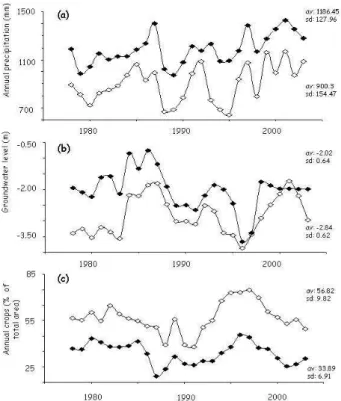
Interactive Discussion Throughout the 25 y-long study period (1978–2003) highlands and lowlands displayed
similar trends in precipitation, groundwater level and cultivated area, with correlation coefficients between regions of 0.75, 0.64 and 0.70 (P <0.01). Considering that both areas tend to show parallel behaviour, it can be argued that they are connected in functional terms. However, highlands were on average drier (lower precipitation and
5
deeper groundwater) and more cultivated than lowlands, which in average show 20% more precipitation (Fig. 3a). In spite of having lower precipitation variability, lowlands displayed similar groundwater level variability than highlands, with water tables being on average 80 cm shallower throughout the study period (Fig. 3b). Highlands had on average 50% of their area cultivated with a peak of 70% of cultivation in 1995–1997
10
(Fig. 3c). In the lowlands, cultivation averaged and peaked 34% and 45% of the area, respectively. It should be noticed that in relation to highlands, the higher precipita-tion regime of lowlands agrees with a higher groundwater level and a lower cultivaprecipita-tion percentage.
Hypothetically, this could be explained not only by large recharge due to the higher
15
rainfall regime of lowlands, but also by other factors like transfer of runoffwater from highlands to lowlands. The cultivation pattern seems to show a cyclical behaviour with increasing and decreasing phases that probably responds to flooding events. This flooding/cultivation cycle deserves particular attention in our hypothetical interpretation. The relations between rainfall and groundwater on the one hand, and rainfall and
20
cultivation on the other hand, are less clear (Table 1). While rainfall and groundwater level are positively and significantly (P <0.05) correlated in highlands, such correlation is not significant (P >0.05) in the case of lowlands. The relation between rainfall and cultivation was non significant (P >0.05) in both areas, but the correlation coefficientR in lowlands was substantially higher than in highlands. Therefore, in terms of flooding
25
HESSD
5, 2319–2345, 2008The dynamics of cultivation and floods
E. F. Viglizzo et al.
Title Page
Abstract Introduction
Conclusions References
Tables Figures
◭ ◮
◭ ◮
Back Close
Full Screen / Esc
Printer-friendly Version
Interactive Discussion relationship between groundwater and cultivation may have practical implications in
highlands: first, groundwater level can be useful to predict a cultivation reduction in response to flood expansion; second, considering the slow movement of groundwater in soils, groundwater level can be monitored to anticipate flood risk, helping to cope in advance with its potentially harmful consequences.
5
Whenever we use rainfall or groundwater arguments to explain flooding, both tend to support our climate-oriented hypothesis, which suggests that floods are the result of increased precipitation that directly expands water bodies, or indirectly cause a widespread elevation of groundwater that saturates land surface and limits cultivation. Nevertheless, in isolation this hypothesis seems to be unable to explain the potentially
10
cyclical behaviour of floods and cultivation.
3.2 Groundwater and floods at the district scale
Considering the predominant and significant positive correlations between survey and satellite data to estimate the extension of floods, we proceeded on our analysis by us-ing the first set of records from annual surveys. Figure 4 shows the temporal change
15
of the flooded area at the district scale in highlands (Fig. 4a) and lowlands (Fig. 4b). Three aspects should be highlighted: i) Lowlands showed a more disperse and erratic behaviour than highlands, where a relatively homogeneous flooding pattern predomi-nated ii) the flooding extension picked one year earlier in highlands than in lowlands, probably suggesting a slow transference of water from highlands to lowlands. In fact,
20
when floods began to decrease in highlands (2002), they showed maximum expansion in lowlands (2003).
The association between groundwater and flooding is likely to be the most promising relation to explore (Table 1). Results show curious relations (Fig. 5) because highlands (Fig. 5a) and lowlands (Fig. 5b) behaved differently when groundwater level and the
25
HESSD
5, 2319–2345, 2008The dynamics of cultivation and floods
E. F. Viglizzo et al.
Title Page
Abstract Introduction
Conclusions References
Tables Figures
◭ ◮
◭ ◮
Back Close
Full Screen / Esc
Printer-friendly Version
Interactive Discussion lowlands. While groundwater level seems to play a dominant role to trigger floods in
highlands, drivers other than groundwater seem to predominate in lowlands. Because of the flat landscape, it is likely that some other factors like local rainfall, outside and inside runoff, subsurface drainage, and even the coalescence of scattered water bodies can be enhanced in wet periods. These factors probably merge with groundwater levels
5
to trigger anarchic and unpredictable flooding episodes in lowlands.
3.3 The potential effect of cultivation on flooding
Our ecosystem-oriented hypothesis can provide an extra insight to the study problem. Two hydrological mechanisms have been suggested to explain the potential influence of cultivation on flooding: increased runoff and decreased evapotranspiration (ET).
10
Various authors (Fullen, 1985; Faulkner, 1990; Evans, 1993; McNeill and Winiwarter, 2004; Withers et al., 2007) have reported that cultivation is likely to increase surface runoffand flooding. On the other hand, ET rates can decline in cultivated lands (New-man et al., 2006). Changes of ET in response to land use change proved to have a powerful effect on soil water balance (Wilcox et al., 2003; Nosetto et al., 2005; Wilcox
15
and Thurow, 2006) in turn affecting groundwater level (Scanlon et al., 2005). The timing of groundwater raise in relation to land-use/land-cover change is not still well understood, but different spatial and temporal plant-cover configurations can create different ET patterns (Gilfedder et al., 2003). While perennial vegetation tends to show long-term and rather continuous ET patterns, annual crops show short-term ET pulses
20
that agree with periods of active growing (Doorenbos and Pruitt, 1977). Therefore, it is expected that the substitution of permanent or perennial plants by annual crops may reduce ET rates, and eventually increase groundwater level because of a shortened growing period. In Australia, Allison et al. (1990), Ward et al. (2006) and Ferdowsian and Bee (2006) reported that the broad-scale clearing of perennial vegetation and its
25
HESSD
5, 2319–2345, 2008The dynamics of cultivation and floods
E. F. Viglizzo et al.
Title Page
Abstract Introduction
Conclusions References
Tables Figures
◭ ◮
◭ ◮
Back Close
Full Screen / Esc
Printer-friendly Version
Interactive Discussion often ceases to be sown and is deprived from plant transpiration. This process can
proceed until groundwater reaches the surface and direct surface evaporation occurs. There is an incomplete understanding about the time lag between land-use change and groundwater level change, but today this information is essential to design sound land use and land management strategies (Gilfedder et al., 2003).
5
Given that both the percentage of annual crops and the flooded croplands were es-timations obtained from the same data source, any correlation between them would inevitably connote circular calculation and spurious results. To manipulate indepen-dent data periods, we alternatively explored the correlation between cultivation during the inter-flooding period (1989–1995) and groundwater level during the flooding period
10
(1996–2003). Our hypothesis was that cultivation increase leads to groundwater ele-vation. Correlation results are presented in Fig. 6. Provided that positive correlations were obtained for all highland districts (Fig. 6a), this response gives room to speculate that the increase of cultivation during the inter-flooding period can trigger groundwater elevation that later saturates the soil and expands floods. Thus, with a variable time
15
lag, increased cultivation in one period would reduce the chance of cultivation in the following period. This interpretation is consistent with our ecosystem-oriented hypoth-esis, which proposes that flooding possibly responds to increasing cultivation, which enhances recharge and raises groundwater level when high water-consuming pastures and grasslands are replaced by low water-consuming annual crops. However, in
princi-20
ple this interpretation is not strictly applicable to lowland districts (Fig. 6b), which again showed a random behaviour that deviates from that showed by highlands. Probably, the same multiple drivers of flood mentioned above generated noisy responses.
3.4 Cyclical behaviour and the ecosystem-oriented hypothesis
A complete and useful compilation of drought and flooding episodes that occurred
25
HESSD
5, 2319–2345, 2008The dynamics of cultivation and floods
E. F. Viglizzo et al.
Title Page
Abstract Introduction
Conclusions References
Tables Figures
◭ ◮
◭ ◮
Back Close
Full Screen / Esc
Printer-friendly Version
Interactive Discussion nature of such information, quantification was not possible. Considering that
coloniza-tion of lands in the study area started between the end of the 19th and the beginning of the 20th century, it is likely that cultivation affected the intensity and frequency of flooding episodes. The rapid cultivation wave that began at the end of 1970’s and still persists probably untied a force that destabilized the hydrology of the flooding lands.
5
The abrupt transition from cultivation to flooding, and again to cultivation, especially in highlands, suggests that both hydrology and cultivation are probably subjected to a cyclical behaviour.
One hypothetical interpretation to this cycle is that the competition between ampli-fying (positive) and controlling (negative) feedbacks is probably modulating the
hydro-10
logical response of flooding lands. The inversion of phases within each cycle probably occurs when one feedback dominates over the opposite one. By triggering a positive feedback, cultivation could destabilize the hydrological balance of the area. On the other hand, floods could trigger a negative feedback that forces the ecosystem to a lower cultivation level that would stabilize the regional hydrology. While positive and
15
negative feedbacks may be mutually neutralizing in a sequential order, we can pre-sume that the flooding process moves between two (upper and lower) critical thresh-olds that, in theory, were not still irreversibly surpassed (Scheffer et al., 2001; Rial et al., 2004). The consequences of positive feedbacks prevailing over the negative ones in the long term are pure speculative at this point, yet the possibility of irreversibly
sur-20
passing threshold as stated by Peters et al. (2004) and Briske et al. (2006), should be considered.
Beyond the competing-feedback interpretation to explain cycles, one answered question in our ecosystem-oriented hypothesis is what can explain water withdrawal once flooding extension peaks. Flooding can favour vertical water-loss pathways
25
HESSD
5, 2319–2345, 2008The dynamics of cultivation and floods
E. F. Viglizzo et al.
Title Page
Abstract Introduction
Conclusions References
Tables Figures
◭ ◮
◭ ◮
Back Close
Full Screen / Esc
Printer-friendly Version
Interactive Discussion chains of water bodies, favouring surface flows towards the Atlantic Ocean. This
situa-tion was observed under the extreme flooding condisitua-tions of 2001 when the Quinto river watershed get a surface connection with the Eastern Salado river watershed (Scarpati et al., 2002). Certainly, a nested-scale configuration seems to be necessary to interpret the agro-eco-hydrological dynamics of the study region.
5
4 Conclusions
Our findings are useful to interpret the complex and dynamic relations between rain-fall, groundwater level and cultivation in flooding lands of the Quinto river watershed. Results indicate that a purely climate-oriented perspective that sets aside essential bio-logical aspects like those related to land-use and land-cover change may be insufficient
10
to explain the potential cyclical behaviour of floods and cultivation, and a complemen-tary, ecosystem-oriented view, may be required. Cultivation may have a strong influ-ence on the dynamics of groundwater and floods in the highlands of the study region. In practice, cropping would cause a negative self-impact that could deplete cultivation in the near future. Besides, because of its location in an upper transitional drainage
15
area, the hydrological effect of cultivation in highlands could indirectly contribute to al-ter the dynamics of floods in lowlands. So, on broad-scale basis both the climate- and the ecosystem-oriented hypothesis should not be considered mutually excluding but complementary hypothesis.
Mediated by groundwater variability, the recurrent occurrence of cultivation-flooding
20
cycles appears to be an outstanding feature of highlands that is not so evident in low-lands. Floods in lowlands appear to be the combined result of various factors that may include not only groundwater variations, but also local rainfall inputs, runoff from up-per lands, subsurface drainage and interlinking of water bodies. Considering the flat configuration of lowlands, such factors can converge to mask a foreseeable relation
25
between groundwater and flooding.
HESSD
5, 2319–2345, 2008The dynamics of cultivation and floods
E. F. Viglizzo et al.
Title Page
Abstract Introduction
Conclusions References
Tables Figures
◭ ◮
◭ ◮
Back Close
Full Screen / Esc
Printer-friendly Version
Interactive Discussion of flood, land planners and decision makers can take advantage of this condition to
prevent catastrophic situations: the slow pace of groundwater processes is suitable to implement an early-warning monitoring system to facilitate adaptation before the flood-ing outbreak. Likewise, a knowledge-based land-use policy for highland should not discard the potential effect of cultivation on flooding. To deal with this, we suggest the
5
following hypothetical mechanism to explain the cultivation-flood relation: first, cultiva-tion boosts the elevacultiva-tion of groundwater level through decreased evapotranspiracultiva-tion; second, as groundwater level rises, floods spread causing a decrease of land cultiva-tion; third, flooding propitiates higher evaporation favouring its own retraction. Despite nowadays most drivers of the hydrological dynamics escape to human control,
cultiva-10
tion emerges a promising human-controlling factor that could be managed to smooth the undesirable impact of floods. This view would become more relevant under a wetter climate scenario like that the IPCC (2007) report predicts for the Argentine Pampas.
Given that drainage from highlands appears to be a strong factor affecting the low-lands hydrology, a sensible land-use policy should treat the flooding area a whole
15
hydrological unit. In practical terms, the combination of an engineered channel-infrastructure plus a designed plant-cover structure in highlands seems to be neces-sary to smooth the impact of drainage water on lowlands.
Acknowledgements. We thank researchers and public agents of the Secretary of Agriculture and the Provincial Water Administration of La Pampa province, as well as the Instituto de
20
Hidrolog´ıa de Llanuras of Buenos Aires province for providing the statistical information to elaborate our data bases. We also acknowledge the financial support of INTA, SECyT in Ar-gentina and a grant from the Inter-American Institute for Global Change Research (IAI, CRN II 2031), which is supported by the US National Science Foundation (Grant GEO-0452325).
References
25
HESSD
5, 2319–2345, 2008The dynamics of cultivation and floods
E. F. Viglizzo et al.
Title Page
Abstract Introduction
Conclusions References
Tables Figures
◭ ◮
◭ ◮
Back Close
Full Screen / Esc
Printer-friendly Version
Interactive Discussion Andr ´eassian, V.: Waters and forests: from historical controversy to scientific debate, J. Hydrol.,
291, 1–27, 2004.
Aradas, R. D. and Thorne, C. R.: Modelling Groundwater and Surface Water Interaction for Water Resources Management in Buenos Aires Province, Argentina. Proceedings of the Specialty Symposium on Integrated Surface and Ground Water Management Symposium,
5
edited by: Panigrahi, B. K., Singh, U. P., Pandit, A., Obeysekera, J., Krishnamurthy, M., Orlando, Florida, USA, 120–129, 2001.
Bailey, R. G.: Description of the Ecoregions of the United States, Misc, Publ. No. 1391, USDA Forest Service, Washington, DC, 1995.
Briske, D. D., Fuhlendorf, S. D., and Smeins, F. E.: A unified framework for assessment and
10
application of ecological thresholds, Rangeland Ecol. Manag., 59, 225–236, 2006.
Buringh, P. and Dudal, R.: Agricultural land use in space and time, in: Land Transformation in Agriculture SCOPE, edited by: Wolman, M. G. and Fournier, F. G. A., John Wiley & Sons, 1987.
Clark, J. S., Carpenter, S. R., Barber, M., Collins, S., and Dobson, A.: Ecological forecasts: an
15
emerging imperative, Science, 293, 657–660, 1988.
Carignano, C.: Late Pleistocene to recent climate change in C ´ordoba Province, Argentina: Geomorphological evidence, Quatern. Int., 57/58, 117–134, 1999.
D´ıaz Sorita, M., Pepi, M., and Grosso, G.: Estudio de las precipitaciones en el oeste
bonaerense, Publicaci ´on T ´ecnica no. 23, EEA INTA General Villegas, Buenos Aires,
Ar-20
gentina, 15 pp., 1998.
Doorenbos, J. and Pruitt, W. O.: Crop Water Requirements, FAO Irrigation and Drainage Paper N0.24, Rome, 1977.
Elwell, H. A. and Stocking, M. A.: Vegetal cover to estimate soil erosion hazard in Rhodesia, Geoderma, 15, 61–70, 1976.
25
Evans, R.: Extent, frequency and rates of rilling of arable land in localities in England and Wales, in: Farm Land Erosion in Temperate Plains Environment and Hills, edited by: Wicherek, S., Elsevier, Amsterdam, 177–190, 1993.
Faulkner, H.: Vegetation cover density variations and infiltration patterns on piped alkali sodic soils: Implications for the modelling of overland flow in semi-arid areas, in: Vegetation and
30
Erosion, Processes and Environments, edited by: Thornes, J. B., Wiley, Chichester, 363– 384, 1990.
HESSD
5, 2319–2345, 2008The dynamics of cultivation and floods
E. F. Viglizzo et al.
Title Page
Abstract Introduction
Conclusions References
Tables Figures
◭ ◮
◭ ◮
Back Close
Full Screen / Esc
Printer-friendly Version
Interactive Discussion Lucerne and the subsequent recharge value. Proceedings of the 13th Agronomy Conference,
The Australian Society of Agronomy, The Regional Institute Ltd., www.regional.org.au/au/ asa/2006, 2006.
Francis, C. F. and Thornes, J. B.: Runoffhydrographs from three Mediterranean vegetation cover types, in: Vegetation and Erosion, Processes and Environments, edited by: Thornes,
5
J. B., Wiley, Chichester, 363–384, 1990.
Fullen, M. A.: Soil compaction, hydrological processes and soil erosion on loamy sands in East Shropshire, England, Soil Till. Res., 29, 17–29, 1985.
Fuschini Mej´ıa, M.C.: El Agua en las Llanuras (UNESCO, Oficina Regional de Ciencia y Tec-nolog´ıa para Am ´erica Latina y el Caribe), Montevideo, 1994.
10
Gilfedder, M., Smitt, Ch., Dawes, W., Petheram, C., Stauffacher, M., and Walker, G.: Impact of increased recharge on groundwater discharge: development and application of a simpli-fied function using catchment parameters, Landscape and Industries, CSIRO/CRC/MDBC Publications, Canberra (Australia), 28 pp., 2003.
Hall, A., Rebella, C., Ghersa, C., and Culot, P.: Field-crop systems of the Pampas, in: Field
15
Crop Ecosystems, edited by: Pearson, C., Elsevier, Amsterdam, 413–450, 1992.
Hornbeck, J. W., Adams, M. B., Corbett, E. S., Verry, E. S., and Lynch, J. A.: Long-term impacts of forest treatments on water yield: a summary of northeastern USA, J. Hydrol., 150, 323– 344, 1993.
IPCC, Climate Change 2007: The Physical Science Basis, Summary for Policy Makers,
Work-20
ing Group 1 Report, Geneva, 18 pp., 2007.
Iriondo, M.: Map of the South American plains – its present state, Quaternary of South America and Antartic Peninsula, 6, 297–308, 1990.
Iriondo, M.: Climatic changes in the South American plains: Records of a continent-scale oscillation, Quatern. Int., 57/58, 93–112, 1999.
25
Jeong, H., Tombor, B., Albert, R., Oltvai, Z. N., and Bar ´abasi, A. L.: The large-scale organiza-tion of metabolic networks, Nature, 407, 651–654, 2000.
King, A. W.: Considerations of scale and hierarchy, in: Ecological Integrity and the Management of Ecosystems, edited by: Woodley, S. J., Francis, K., and Francis, G., St. Lucie Press, Delray Beach, Florida (USA), 19–45, 1993.
30
HESSD
5, 2319–2345, 2008The dynamics of cultivation and floods
E. F. Viglizzo et al.
Title Page
Abstract Introduction
Conclusions References
Tables Figures
◭ ◮
◭ ◮
Back Close
Full Screen / Esc
Printer-friendly Version
Interactive Discussion Kruse, E., Forte Lay, J. A., Aiello, J. L., Basualdo, A., and Heinzenknecht, G.: Hydrological
processes on large flatlands, Case study: Northwest region of Buenos Aires province (Ar-gentina), Remote Sensing and Hydrology 2000, IAHS Publication, 267, 531–536, 2001. Kruse, E. and Zimmermann, E.: Hidrogeolog´ıa de Grandes Llanuras. Particularidades en la
Llanura Pampeana (Argentina), Workshop publication on Groundwater and Human
Devel-5
opment 2025–2038, Mar del Plata, Argentina, 2002.
Lee, C. R. and Skogerboe, J. G.: Quantification of erosion control by vegetation on problem soils, in: edited by: El-Swaify, S.A., Moldenhauer, W.C., and Lo, A., Soil Erosion and Con-servation, Soil Conservation Soc. of America, 437–444, 1985.
Malagnino, E. C.: Late Pleistocen to late Holocene evolution of the paleodesert of the central
10
region of Argentina and its paleoclimatic implications, International Conference on Desert Landscapes, International Geological Correlation Program, Project 252, Australia, 1991. McNeill, J. R. and Winiwarter, V.: Breaking the sod: humankind, history and soil, Science, 304,
1627–1629, 2004.
Moncaut, C. A.: Inundaciones y Sequ´ıas en la Pampa Bonaerense 1576–2001, Editorial El
15
Aljibe, City Bell (Argentina), 102 pp., 2001.
Saravia, J. R., Benavidez, R. Canziani, O., Ferreiro, V., and Hern ´andez, M. A.: Lineamien-tos Generales y Regionales para un Plan Maestro de Ordenamiento H´ıdrico del Territorio Bonaerense, Convenio Ministerio de Obras y Servicios P ´ublicos de la Naci ´on-Provincia de Buenos Aires, 323 pp., 1987.
20
Nosetto, M. D., Jobb ´agy, E. G., and Paruelo, J. M.: Land use change and water losses: the case of grassland afforestation across a soil textural gradient in central Argentina, Glob. Change Biol., 11, 1101–1117, 2005.
Newman, B. D., Wilcox, B. P., Archer, S. R., Breshears, D. D., Dahm, C. N., Duffy, C. J., McDowell, N. G., Phillips, F. M., Scanlon, B. R., and Vivoni, E. R.: Ecohydrology of
water-25
limited environments: A scientific vision, Water Resour. Res.h, 42, 1–15, 2006.
O’Neill, R. V., Turner, S. J., Cullinan, V. I., Coffin, D. P., Cook, T., Conley, W., Brunt, J., Thomas, J. M., Conley, M. R., and Gosz, J.: Multiple landscape scales: an inter-site comparison, Landscape Ecol., 5, 137–144, 1991.
Peters, D. P. C., Pielke, S. R., Bestelmeyer, B., Allen, C. D., Munson-McGee, S., Havstad, K. M.:
30
Cross-scale interactions, nonlinearities, and forecasting catastrophic events, Proceedings of the National Academy of Sciences USA, 101(15), 130–135, 2004.
Noblet-HESSD
5, 2319–2345, 2008The dynamics of cultivation and floods
E. F. Viglizzo et al.
Title Page
Abstract Introduction
Conclusions References
Tables Figures
◭ ◮
◭ ◮
Back Close
Full Screen / Esc
Printer-friendly Version
Interactive Discussion Ducoudr ´e, J., Prinn, R., Reynolds, J. F., and Salas, J. D.: Nonlinearities, feedbacks and
critical thresholds within the earth’s climate system, Climatic Change, 65, 11–38, 2004. Scanlon, B. R., Reedy, R., Stonestrom, D. A., Prudic, D. E., and Dennehy, K. F.: Impact of land
use and land cover change on groundwater recharge and quality in the southwestern USA, Glob. Change Biol., 11, 1577–1593, 2005.
5
Satorre, E.: Production systems in the Argentine Pampas and their ecological impact, in: The impact of Global Change and Information on the Rural Environment, edited by: Solbrig, O., di Castri, F., and Paalberg, R., Harvard University Press, Cambridge, MA, 81–102, 2001. Scarpati, O. E., Spescha, L., and Capriolo, A. D.: The impact of the heavy floods in the
Sal-ado River basin, Buenos Aires province, Argentina, Mitigation and Adaptation Strategies for
10
Global Change, 7, 285–301, 2002.
Scheffer, M., Carpenter, S., Foley, J. A., Folkes, C., and Walker, B.: Catastrophic shifts in ecosystems, Nature, 413, 591–596, 2001.
Viglizzo, E. F., L ´ertora, F., Pordomingo, A. J., Bernardos, J., Roberto, Z. E., and Del Valle, H.: Ecological lessons and applications from one century of low external-input farming in the
15
pampas of Argentina, Agr. Ecosyst. Environ., 83, 65–81, 2001.
Viglizzo, E. F., Pordomingo, A. J., Buschiazzo, D., and Castro, M. G.: A methodological ap-proach to assess cross-scale relations and interactions in agricultural ecosystems of Ar-gentina, Ecosystems, 8, 546–558, 2005.
Viglizzo, E. F., Pordomingo, A. J., Castro, M. G., L ´ertora, F. A., Bernardos, J. N.:
Scale-20
dependent controls on ecological functions in agroecosystems of Argentina, Agr. Ecosyst. Environ., 101, 39–51, 2004.
Viglizzo, E. F., Roberto, Z. E., L ´ertora, F. A., L ´opez Gay, E., and Bernardos, J.: Climate and land-use change in field-crop ecosystems of Argentina, Agr. Ecosyst. Environ., 66, 61–70, 1997.
25
Wagenet, R. J.: Scale issues in agroecological research chains, Nutr. Cycl. Agroecosys., 50, 23–34, 1998.
Ward, P., Dolling, P., and Duning, F.: The impact of Lucerne phase in a crop rotation on ground-water recharge in South-West Australia. Proceedings of the 13th Agronomy Conference, The Australian Society of Agronomy, The Regional Institute Ltd, www.regional.org.au/au/
30
asa/2006, 2006.
HESSD
5, 2319–2345, 2008The dynamics of cultivation and floods
E. F. Viglizzo et al.
Title Page
Abstract Introduction
Conclusions References
Tables Figures
◭ ◮
◭ ◮
Back Close
Full Screen / Esc
Printer-friendly Version
Interactive Discussion New York, 791–794, 2003.
Wilcox, B. P. and Thurow, T. L.: Emerging issues in rangeland eco-hydrology: vegetation change and the water cycle, Rangeland Ecol. Manag., 59, 220–224, 2006.
Withers, P. J. A., Hodgkinson, R. A., Bates, A., and Withers, C. L.: Soil cultivation effects on sediment and phosphorus mobilization in surface runofffrom three contrasting soil types in
5
England, Soil Till. Res., 93, 438–451, 2007.
Z ´arate, M.: Loess of southern South America, Quaternary Sci. Rev., 22, 1987–2006, 2003. Zarrilli, A.: Producci ´on Agraria y Transformaciones Ecol ´ogicas en la Argentina, Los L´ımites de
la Producci ´on Rural Pampeana, 1930–1950, X Congreso Nacional y Regional de la Historia, Santa Rosa (La Pampa), Argentina, 1999.
HESSD
5, 2319–2345, 2008The dynamics of cultivation and floods
E. F. Viglizzo et al.
Title Page
Abstract Introduction
Conclusions References
Tables Figures
◭ ◮
◭ ◮
Back Close
Full Screen / Esc
Printer-friendly Version
Interactive Discussion
Table 1.Correlation analysis between rainfall, groundwater level and percentage of cultivation.
Correlation between a b R S E
High-lands Rainfall Groundwater level −4.48 0.002 0.46 141.17
% annual crops 62.15 −0.006 −0.09 158.52
Groundwater level % annual crops 37.04 −6.79 −0.41 0.56
Low-lands Rainfall Groundwater level −2.37 −0.000 −0.06 130.37
% annual crops 51.67 −0.015 −0.28 125.50
Groundwater level % annual crops 28.85 −2.52 −0.23 0.64
HESSD
5, 2319–2345, 2008The dynamics of cultivation and floods
E. F. Viglizzo et al.
Title Page
Abstract Introduction
Conclusions References
Tables Figures
◭ ◮
◭ ◮
Back Close
Full Screen / Esc
Printer-friendly Version
Interactive Discussion
HESSD
5, 2319–2345, 2008The dynamics of cultivation and floods
E. F. Viglizzo et al.
Title Page
Abstract Introduction
Conclusions References
Tables Figures
◭ ◮
◭ ◮
Back Close
Full Screen / Esc
Printer-friendly Version
Interactive Discussion
HESSD
5, 2319–2345, 2008The dynamics of cultivation and floods
E. F. Viglizzo et al.
Title Page
Abstract Introduction
Conclusions References
Tables Figures
◭ ◮
◭ ◮
Back Close
Full Screen / Esc
Printer-friendly Version
Interactive Discussion
HESSD
5, 2319–2345, 2008The dynamics of cultivation and floods
E. F. Viglizzo et al.
Title Page
Abstract Introduction
Conclusions References
Tables Figures
◭ ◮
◭ ◮
Back Close
Full Screen / Esc
Printer-friendly Version
Interactive Discussion
HESSD
5, 2319–2345, 2008The dynamics of cultivation and floods
E. F. Viglizzo et al.
Title Page
Abstract Introduction
Conclusions References
Tables Figures
◭ ◮
◭ ◮
Back Close
Full Screen / Esc
Printer-friendly Version
Interactive Discussion
Fig. 5. Relationships between groundwater levels and % of cropland affected by floods in the flooding area of the Quinto River basin during the period 1996–2003. Highland districts(a)
comprise 1. Chapaleuf ´u (R=0,99,P <0.01), 2. Realic ´o (R=0.84,P <0.01), 3. Trenel (R=0,97,
P <0.01), 4. Quem ´u (R=0.91, P <0.01), 5. Marac ´o (R=0.95, P <0.01). Lowlands district(b)
comprise 6. Bolivar (R=0.92,P <0.01), 7. Rivadavia (R=0.18,P >0.05), 8. 9 de Julio (R=0.86,
HESSD
5, 2319–2345, 2008The dynamics of cultivation and floods
E. F. Viglizzo et al.
Title Page
Abstract Introduction
Conclusions References
Tables Figures
◭ ◮
◭ ◮
Back Close
Full Screen / Esc
Printer-friendly Version
Interactive Discussion