Effect of Flexible Fuels on Mechanical Properties of
Reinforced Polyoxymethylenes (POM)
M. Gómez Mares1*, M. E. Martinez Ortega 1 , G. Arroyo Ortega1 and C. Márquez Márquez1 1
Departamento de Ingeniería de Materiales, Delphi Automotive Systems S.A. de C.V. , Av. Hermanos Escobar 5756, FOVISSSTE Chamizal, C.P. 32310, Ciudad Juárez, Chihuahua, Mexico
Abstract. The use of flexible fuels has been increased during the last years making essential to run compatibility tests with those materials exposed to them. In this work the effect of the flexible fuels M15A (Volume Mixture of 85% fuel C and 15 % Aggressive methanol) and M30A (Volume mixture of 70% fuel C and 30 % Aggressive methanol) on the mechanical properties of some polymers of the Polyoxymethylene (POM) family is evaluated. The polymers chosen had different levels of glass fiber filler (0, 10 and 25%). The samples were immersed on fuel and kept on a chamber at 80°C during 1008h. The results showed that the properties of polymers with filler are more affected than the ones of the polymers without it. Tensile stress at break and tensile stress at yield diminished with the fuel exposure. The most aggressive fuel was found to be M30A, due to the higher methanol concentration.
Keywords: flexible fuel; compatibility study; polymer; Polyoxymethylene (POM).
Introduction
In Mexico, primary energy production is based on hydrocarbons which represent the 90% regarding other energy sources [1]. In nowadays, new renewable and cleaner fuel alternatives are being developed all over the world. Biofuels are a viable and attractive option due to the availability of raw materials and the production costs. Biodiesel and alcohol based fuels are the new alternatives emerging around the planet [2]. In general, a mixture of gasoline with alcohol is considered as a biofuel and as a flexible fuel [3, 4].
In China, methanol use as fuel is increasing [13] but only little information regarding the compatibility of it with polymers is available.
Although flexible fuels have a higher octane number than conventional fuels, they are more aggressive with the materials in direct contact with them, for example polymers.
Several compatibility studies have been
the extraction of soluble components, such as stabilizers, additives or plasticizers [7], causing the variation on the mechanical properties. That is the reason why compatibility studies are essential to assure that polymers and fuels are compatible, and thus they can be used, for example, at automotive industry.
Among the materials employed on
automobiles, specifically in the fuel systems, the polymers of the Polyoxymethilene (POM) family are very common. They are generally reinforced with different fillers in order to enhance their mechanical properties. However information concerning the compatibility of POM materials exposed to Methanol-gasoline blends is scarce, and the influence of filler on these systems fuel-polymer is also limited. Thus, in this paper the effect of two methanol based biofuels, M15A and M30A, on reinforced polymers from POM family is analyzed. The impact on the mechanical properties of polymers with different filler levels was assessed.
Experimental Section
Methodology
Tensile bars of the selected materials were employed to carry out the tests as specified on ASTM D638 [8] or ISO 527 [9, 10]. They were dumb-bell-shaped specimens with the following dimensions: 4 mm thickness x 170 mm length x 10 mm wide. Samples were conditioned bringing them to a temperature of 23°C, the standard laboratory temperature, according to ASTM D-618 [11]. A total of five specimens were used for each material. Samples were located inside a stainless steel special container. The tank was filled with the selected fuel until the pieces were totally covered. Next, the containers were sealed and introduced into a chamber at 80°C and samples were taken at 168, 360, 504 and 1008 hours. Tensile tests were carried out with the obtained samples using an Instron 5581 machine. Tensile tests consisted on extending the specimen along its major longitudinal axis at a constant speed (5
mm/min) until the specimen was fractured. Tensile tests were according to ISO 527 [9,10].
Materials and fuels
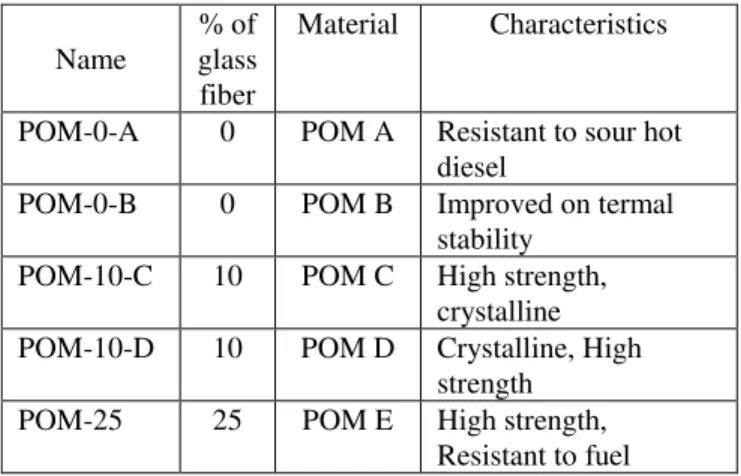
Different POM polymer grades with different filler levels were selected. The filler was glass fiber and the chosen load levels were 0, 10 and 25%. A summary of the selected materials and their characteristics is shown in table 1.
Table 1. Materials
Name
% of glass fiber
Material Characteristics
POM-0-A 0 POM A Resistant to sour hot diesel
POM-0-B 0 POM B Improved on termal stability
POM-10-C 10 POM C High strength, crystalline POM-10-D 10 POM D Crystalline, High
strength POM-25 25 POM E High strength,
Resistant to fuel
The flexible fuels employed for the tests were a mixture of Fuel C with aggressive methanol in two different levels. These fuels were selected due to their use in Asia, mainly China, where they are aggressively introducing methanol into the gasoline [13]. Little information about the compatibility of the abovementioned fuel with these automotive materials is available. The aggressive version of these fuels includes reagent water, sodium chloride and formic acid according to SAE J1681 [12]. The aggressive fuel was chosen for this study in order to assess the results of a worst case scenario. More details about the selected fuels are reported on Table 2.
Table 2. Fuels
Name Composition
M15A Volume mixture of 85% Fuel C + 15% Aggressive methanol
Results and discussion
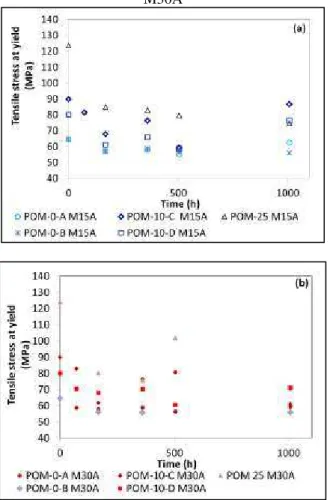
In figure 1 the effect of fuel exposure on polymers with 0% load can be observed (POM-0-A and POM-0-B): both, M15A and M30A, caused a small reduction on the tensile stress at
yield (13% on the maximum case).
Compatibility among POM materials and flexible fuels is affected by the glass fiber load content on the polymer. The tensile stress at yield decreases in all the cases (0, 10% and 25% of load) but the fuel effect is more pronounced on the material with the highest load (it diminishes 43%).
Figure 1. Tensile stress at yield: a) in M15A and b) in M30A
This can be explained considering the interface load – matrix. In this region exists an abrupt discontinuity among the material properties which leads to a greater effect of the
fuel over the polymer. Bonding between resin and filler is not as strong as the covalent bonds on the polymer molecule. Several processes may take place when the filler is introduced into the polymer. They are can be structural, kinetic and thermodynamic, and thus they can have repercussion over the polymer mechanical properties, for example, they can be stress concentrators or an obstacle to crack propagation; they can change the polymer crystallinity degree or affect the rate of adsorption or desorption of oligomers and monomers [14].
Figure 2. Tensile stress at break: a) in M15A and b) in M30A .
hydroxyl group on the interface polymer – fuel, modifying the mechanical properties of the exposed material.
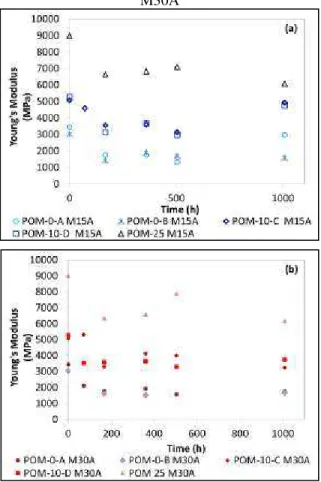
Figure 3. Young’s Modulus: a) in M15A and b) in M30A
The same phenomenon can be seen on the tensile stress at break (Figure 2). The greatest effect corresponds to the 25% load sample, where the tensile stress at break diminished almost 40% compared to the unexposed sample. The most dramatic changes took place during the first 200 hours of fuel exposure. The most aggressive fuel was the M30A, which is a logical result due to the higher methanol concentration in contact with the polymer. Nevertheless, the results of both fuels are similar: both of them generate a reduction on the tensile stress at break as a function of the load level.
Regarding to the Young’s modulus (Figure
3), it diminished in all the polymers exposed to
either M15A or M30A. It can be pointed out that even considering the fuel effect over the
Young’s modulus, the material with the highest
load of glass fiber is the one with the highest modulus. Thus, although the most affected material was the one with the highest load (25%), this material still has the best mechanical properties compared with other materials with lower loads or without load: the higher the
Young’s modulus, the greater the elongation
resistance of the material.
The tensile strain at yield suffered an increase on those polymers without load for both fuels, while in those polymers with low load the rise was lower (Figure 4).
Figure 4. Tensile strain at yield: a) in M15A and b) in M30A .
Conclusions
The exposure of POM polymers to flexible fuels such as M15A and M30A modifies the mechanical properties of the aforementioned materials. The fuel effects over the samples are influenced by the amount of load contained on the polymer, being greater for those polymers with high content of load, due to the heterogeneity of the interfase polymeric matrix – glass fiber and the interaction among the hydrogen bonds and the hydroxyl groups from
the fuel and the polymer.
Although the most aggressive fuel was found to be the M30A, due to the high methanol concentration, the effects of this fuel over the analyzed polymers were only slightly more pronounced that those of the M15A.
Acknowledgements
The authors are grateful to CONACyT for the grant FORDECYT-Doctores number 174509
employed to carry out this project.
References
[1] O. Masera Cerutti. Potenciales y Viabilidad del Uso de Bioetanol y Biodiesel para el Transporte en México. Gobierno Federal, Secretaría de Energía (SENER). México, D.F., 2006. ISBN 970-9983-14-8.
[2] J. Hassan, H. Kalam. An overview of biofuel as a renewable energy source: development and challenges. Procedia Engineering56 (2013) 39-53.
[3] L. Baena, F. Jaramillo, J. A. Calderón. Aggressiveness of a 20% bioethanol 80% gasolina mixture on autoparts: II Behavior of polymeric materials. Fuel95 (2012) 312-319.
[4] V. M Pasa Duarte. Recomendaciones de especificaciones técnicas para el etanol y sus mezclas (E-6) y la infraestructura para su manejo en México. Gobierno Federal, Secretaría de Energía (SENER). México, D.F. 2010.
[5] C. Berlanga-Labari, A. Albistur-Goñi, I. Barado-Pardo, M. Gutierrez-Peinado, J. Fernández-Carrasquilla. Compatibility study of high density polyethylene with bioethanol-gasoline blends,
Materials and Design32 (2001) 441-446.
[6] S. M. Alves, V. S. Mello, J. S. Medeiros. Palm and soybean biodiesel compatibility with fuel system elastomers, Tribology International65 (2013) 74-80.
[7] V. M. Pasa Duarte, A. V. Maciel, J. C. Machado, G. O. Barra. Compatibility Study of NBR/PVC blend with gasolines and etanol fuel. Rubber Chemistry and Technology85 (2012) 195-206.
[8] ASTM D638. 10 Standard Test Method for Tensile Properties of Plastics.2003.
[9] ISO 527-1. Plastics – Determination of tensile properties – Part 1: General Principles. Second Edition. Switzerland. 2012.
[10] ISO 527-2,2. Plastics Determination of tensile properties. Part 2: Test conditions for moulding and extrusion plastics. Second Edition. Switzerland. 2012.
[11] ASTM D618-13. Standard Practice for Conditioning Plastics for Testing. 2013.
[13] C. J. Yang, R. B. Jackson. China’s growing methanol economy and its implications for energy and the environment, Energy Policy41 (2012) 878-884.