Submitted 17 March 2015 Accepted 23 June 2015 Published21 July 2015
Corresponding author Michael Rathleff,
Academic editor Floris Lafeber
Additional Information and Declarations can be found on page 10
DOI10.7717/peerj.1102
Copyright 2015 Faber et al.
Distributed under
Creative Commons CC-BY 4.0
OPEN ACCESS
The majority are not performing
home-exercises correctly two weeks after
their initial instruction—an
assessor-blinded study
Mathilde Faber1, Malene H. Andersen2, Claus Sevel3,
Kristian Thorborg4, Thomas Bandholm5and Michael Rathleff6,7 1Kjellerup Fysioterapi og Træning, Kjellerup, Denmark
2Fysioterapeutisk Specialistteam, Aarhus, Denmark
3Faculty of Health Sciences, Physiotherapy, VIA University College, Aarhus, Denmark 4Sports Orthopedic Research Center—Copenhagen (SORC-C), Arthroscopic Centre Amager,
Copenhagen University Hospital, Copenhagen, Denmark
5Physical Medicine & Rehabilitation Research—Copenhagen (PMR-C), Department of
Occupational and Physical Therapy, Department of Orthopedic Surgery, and Clinical Research Center, Hvidovre Hospital, University of Copenhagen, Copenhagen, Denmark
6Department of Health Science and Technology, Center for Sensory-Motor Interaction (SMI),
Aalborg University, Denmark
7Department of Occupational and Physiotherapy, Aalborg University Hospital, Aalborg,
Denmark
ABSTRACT
Introduction.Time-under-tension (TUT) reflects time under load during strength training and is a proxy of the total exercise dose during strength training. The purpose of this study was to investigate if young participants are able to reproduce TUT and exercise form after two weeks of unsupervised exercises.
Material and Methods.The study was an assessor-blinded intervention study with 29 participants. After an initial instruction, all participants were instructed to perform two weeks of home-based unsupervised shoulder abduction exercises three times per week with an elastic exercise band. The participants were instructed in performing an exercise with a predefined TUT (3 s concentric; 2 s isometric; 3 s eccentric; 2 s break) corresponding to a total of 240 s of TUT during three sets of 10 repetitions. After completing two weeks of unsupervised home exercises, they returned for a follow-up assessment of TUT and exercise form while performing the shoulder abduction exercise. A stretch sensor attached to the elastic band was used to measure TUT at baseline and follow-up. A physiotherapist used a pre-defined clinical observation protocol to determine if participants used the correct exercise form.
Results.Fourteen of the 29 participants trained with the instructed TUT at follow-up (predefined target: 240 s±8%). Thirteen of the 29 participants performed the shoulder abduction exercise with a correct exercise form. Seven of the 29 participants trained with the instructed TUT and exercise form at follow-up.
form as too many or too few exercise stimuli in relation to the initially prescribed amount of exercise most likely will provide a misinterpretation of the actual effect of any given specific home exercise intervention.
Subjects Kinesiology, Orthopedics, Psychiatry and Psychology
Keywords Adherence, Compliance, Exercises, Time-under-tension
INTRODUCTION
Elastic exercise bands are often used during rehabilitation of patients (Alvarez et al., 2006;
Andersen et al., 2010;Andersen et al., 2011;Jensen et al., 2014;Rathleffet al., 2014a;Thomas et al., 2005). An elastic exercise band is a versatile training tool allowing patients to perform different types of home-based training including strength training and injury prevention training (Alvarez et al., 2006;Andersen et al., 2011;Jensen et al., 2014). Using elastic exercise bands during rehabilitation has multiple advantages; they are user-friendly, can be adjusted to different resistances, they are cheap and they do not take up much space (Colado et al., 2010;Matheson et al., 2001;Melchiorri & Rainoldi, 2011). Multiple studies have compared the effect of training with elastic exercise bands with the effect of training with free weights (e.g., dumbbells) on neuromuscular activation during exercise. These studies generally show that training with elastic exercise bands activates the contracting agonists to the same level as dumbbells, and therefore, the elastic exercise bands are expected to be just as efficacious in improving strength and reducing pain during a rehabilitation program. (Andersen et al., 2010;Beers et al., 2008;Colado et al., 2010;Melchiorri & Rainoldi, 2011).
order to determine if the executed training constitutes a sufficient clinical and physiological stimulus (Buitrago et al., 2012;Burd et al., 2012;Gentil, Oliveira & Bottaro, 2006;Goto et al., 2009;Munn et al., 2005;Nogueira et al., 2009;Toigo & Boutellier, 2006;Tran & Docherty, 2006;Tran, Docherty & Behm, 2006).
After a single initial instruction, the patients often complete their exercises unsupervised at home and return for follow-up assessment after, e.g., two weeks (Andersen et al., 2011;
Beers et al., 2008;Rathleffet al., 2014a;Thomas et al., 2005). During the execution of the home exercises is it assumed that the patient follows the exercises as instructed and prescribed by the physiotherapist and thereby receives the exercise dose intended by the physiotherapist. However, the question remains if the patients are able to follow the exercise prescription and perform the exercise as instructed after only a single initial instruction as common in clinical practice. Clinical experience suggests that exercises are performed too fast at follow-ups thus reducing TUT. A correct execution of home-based exercises is vital in order to know the exercise dose received by the patients during their home-based unsupervised exercises. Exercise dosages that are either too small or too large in relation to the initially prescribed dosage introduce misinterpretation when concluding on effect estimates of any specific intervention in both clinical scenarios and in research.
Therefore, the purpose of this study was to investigate if young participants were able to reproduce TUT and exercise form after two weeks of unsupervised shoulder abduction. This exercise was selected as it has previously shown to be effective in reducing pain in the neck and shoulder muscles (Andersen et al., 2011;Andersen et al., 2008b;Andersen et al., 2008a;Salo et al., 2010;Walther et al., 2004). The main hypothesis was that participants would perform a shorter TUT at follow-up and thus not perform the exercise as instructed.
METHODS
Design
This study was designed as an assessor-blinded intervention study with baseline measure-ments and follow-up after 14 days of unsupervised home-based exercises.
Ethical considerations
According to the Helsinki Declaration, all participants were provided with verbal and written information about the purpose of the study (WMA Declaration of Helsinki, 2013). They signed a written consent as part of the duty to the Ethics Committee (Justitsministeriet, 2000), and The Central Denmark Region Committee on Health Research Ethics approved the study (ref: 80/2014).
Setting and participants
blind them for our primary outcome (TUT). Inclusion criteria included fully active range of motion (AROM) in the shoulder joint and no pain in the shoulder region.
Equipment
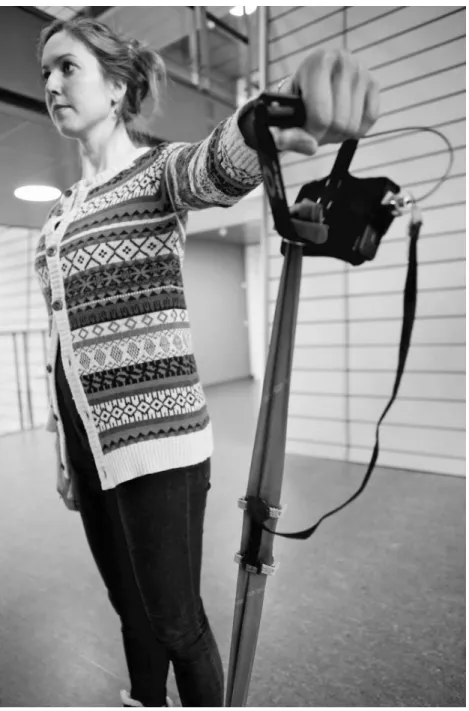
A stretch sensor was used to measure TUT at baseline and follow-up but not during the 14 days of unsupervised home-based exercise. The stretch sensor was based on the technology designed by Danfoss PolyPower. It acted as an elastic capacitive material stretchable in one direction. It allowed us to measure how much the sensor was being stretched (for further details refer toKappel et al. (2012)). The sensor was attached to the rubber band through two clips that made the sensor easily transferable to other elastic exercise bands. The sensor was attached via a USB to a small box that recorded data 200 times per second. A switch was mounted in the handle of the elastic exercise band so that the data recording would start whenever the handle was pressed. The participants were told that the sensor could measure if the exercise was performed correctly. They were not informed about the primary purpose of measuring TUT.
The elastic bands were standard red and green Thera-Bands, which are commonly used in rehabilitation studies (Andersen et al., 2008a;Andersen et al., 2008b;Andersen et al., 2011;Salo et al., 2010;Walther et al., 2004). To ensure that each strength exercise scenario was performed with the same external resistance, corresponding to a relative load of 12 repetition maximum (RM), lines were drawn for every 5 cm in the entire length of the exercise band. The 12 RM load was determined prior to data collection and reflected a load typically prescribed to treat conditions of the shoulder and neck (Andersen et al., 2008a;
Andersen et al., 2008b;Andersen et al., 2011;Salo et al., 2010;Walther et al., 2004).
Test procedure
The participants were instructed to perform a shoulder abduction exercise using a Thera-Band. This specific exercise has proven effective in reducing pain in the neck and shoulder muscles (Andersen et al., 2008a;Andersen et al., 2008b;Andersen et al., 2011;Salo et al., 2010;Walther et al., 2004), and this type of live instruction has previously shown to be effective in learning exercises and reflects clinical practice (Reo & Mercer, 2004). The instruction was to stand with hip width distance between the feet and place one end of the elastic band under the foot and the other in the hand. Then the subject was to raise the arm slightly in front of the body from 0 to 90 degrees shoulder abduction and 30 degrees horizontal shoulder flexion. The elbow was to be in a slightly flexed position during the entire range of motion. The palm was to face the floor. The participants were instructed that tension was to be present in the elastic band at 0 degrees’ abduction (seeFig. 1).
Further, they were instructed that each exercise session should consist of three sets of 10 repetitions at 12 RM with a two-minute break between each set. A mark was made on the elastic band at a length corresponding to 12 RM. TUT was 3 s concentric (con); 2 s isometric at 90 degrees’ abduction; 3 s eccentric (ecc); 2 s pause at 0 degrees’ abduction. Therefore, total TUT during the three sets of 10 repetitions was 240 s.
Figure 1 Shoulder abduction with the stretch-sensor attached to the elastic band.
baseline. After the exercise, the participants were given a training diary as well as date and time for the follow-up. They were informed that the exercise had to be performed at home three times every week for two weeks. The exercise instruction lasted 7–10 min and resem-bled the time spent on exercise instructions for one exercise in normal clinical practice.
Fourteen days later the participants returned for the follow-up assessment and were asked to perform three sets of 10 repetitions, using the exercise form as instructed at the first visit and practised at home for the past two weeks. At the follow-up assessment no verbal feedback was given and the metronome was not turned on. The participants were also asked to hand over their training diary to the assessor.
Outcomes
The primary outcome was defined as the total TUT during all three exercise sets with the aim to investigate if the participants were capable of reproducing total TUT during the shoulder abduction exercise. Matlab (r2011a; MathWorks, Nattick, USA) was used to analyse the data from the stretch-sensor. A custom-written Matlab programme transformed the stretch sensor data into an image showing the stretch of the sensor as a function of time. The rating of every repetition was done manually by moving the mouse cursor to the visually observed time points corresponding to the contraction-specific phases. This approach has previously been used and demonstrates good validity and reliability (Skovdal Rathleff, Thorborg & Bandholm, 2013).
The secondary outcome was the exercise form. This was measured using a clinical observation form similar to a previous study (Reo & Mercer, 2004). The following parameters were noted: hip width distance between the feet, 0–90 degrees shoulder abduction, 30 degrees horizontal flexion, palm facing the floor, slight flexion of the elbow, tension in the elastic exercise band at 0 degrees’ shoulder abduction and alignment though the standing position. The assessor noted the number of errors in the exercise execution by visual observation.
Rating of data
The assessor was a female physiotherapist with no previous experience in rating data from the stretch sensor. The assessor received one hour of practice rating data from the stretch sensor using data from participants who were not part of the current study. The rating of data was carried out after completion of all measurements from baseline to follow-up. After this the collected data from each participant, from both baseline and follow-up, were anonymised and given a random number. The assessor was blinded and therefore, did not know whether the data were from baseline or follow-up. Further, the assessor did not know which of the three exercise sets she was rating.
Intertester reliability
reliability would be higher). The intraclass correlation coefficient (ICC 2.1) was used as a relative expression of the reliability while limits of agreement (LoA) were used as an absolute expression of agreement. The ICC for the interrater reliability for single TUT was 0.93. The agreement between raters for TUT ranged from−0.57 to 0.56 s (8% of mean TUT). Therefore, the predefined target for total TUT was 240 s±8% (limits: 220.8–259.2 s) to reflect measurement uncertainty.
Sample size
As the main hypothesis was that the participants would use a shorter TUT at follow-up, the study was powered to detect a 20-s lower TUT (approximately 8% of the mean TUT) at follow-up compared with baseline. Using a standard deviation of 25 s at 5% significance and 80% power, it was necessary to include 25 participants. To account for potential dropouts, we included 32 participants.
Statistical analysis
All calculations were performed using Stata version 11 (StataCorp, College Station, Texas, USA). Descriptive statistics are presented as mean and standard deviation. The level of statistical significance was set asP<0.05. Parametric statistics were used because the data were normally distributed. Total TUT from baseline to follow-up was compared using pairedt-tests.
RESULTS
A total of 35 participants signed up for the study, but three of them had shoulder pain and did not fulfil the inclusion criteria and were excluded from the study. A total of 32 physiotherapy students aged 20–27 (10 men and 19 women) fulfilled the inclusion criteria and were included. Further three participants dropped out during the two weeks of unsupervised exercises: Two sustained an injury to the arm (unrelated to the exercise) and could not participate, and one did not turn up for follow-up for unknown reasons. Therefore, 29 participants completed both baseline and follow-up visits.
Twenty of the 29 participants completed the six exercise sessions over two weeks as prescribed. One participant completed the exercise more than the recommended 6 times, and 8 completed the exercise less than recommended. One participant completed the exercise three times, two participants completed the exercise four times and five participants completed the exercise five times during the 14 days.
Total TUT at baseline was 255.2 s (±10.6). At follow-up, total TUT was 252.5 s (±41.0 s) with a range from 160 s and up to 370 s. No significant difference was detected in total TUT between baseline and follow-up (2.6 s 95% CI[−13.2; 18.5])p=0.74). Fourteen of the 29 participants used the instructed TUT at follow-up (predefined target: 240 s±8%). Six used a lower TUT and 15 used a higher TUT than instructed (Fig. 2).
Figure 2 Total time-under-tension at baseline and follow-up.
Table 1 Exercise form at follow-up.
Exercise parameters Number performing the
exercise as instructed
Hip width distance between the feet 26/29
0–90 degrees shoulder abduction 24/29
30 degrees horizontal flexion 25/29
Palm facing the floor 28/29
Slight flexion of the elbow 20/29
Tension in the elastic exercise band at 0 degrees shoulder abduction 28/29
Alignment though the standing position 29/29
DISCUSSION
Contrary to our hypothesis, the participants did not systematically use a lower TUT at follow-up but varied considerably. Half of the participants used the instructed TUT and less than half used the instructed exercise form at follow-up. Physiotherapists may think they know the exercise dose received by the patients during their home-based exercises, but these results suggest that some receive a higher exercise dose, while others receive an exercise dose too low to constitute a sufficient clinical stimulus.
Practical relevance of the study
follow-up reflected the exercise dose during unsupervised exercises, then some participants would receive a 50% higher exercise dose than instructed, while others would receive a 40% lower dose. The largest concern would most likely be those receiving a lower exercise dose than intended as it may not elicit a sufficient clinical stimulus. Participants receiving an exercise dose higher than prescribed may end up with a secondary overuse injury hampering the rehabilitation of their original injury. However, the main concern with patients not receiving the prescribed exercise dosage is that decisions on further progression or cessation of a specific program are difficult. It leaves the treating therapist or researcher in doubt whether the lack of progression or the increase in symptoms is due to not following the exercise intervention as prescribed, or whether this is caused by other factors than the actual intervention.
The large difference in exercise dose may result in different clinical outcomes (Osteras & Torstensen, 2010;Rathleffet al., 2015a). Previous studies suggest that the length of TUT influences the physiological response, and longer TUT is associated with larger physiological response (Burd et al., 2012;Munn et al., 2005;Tran & Docherty, 2006). The optimal TUT may depend on the goal of the exercise and the response of the patients (American College of Sports Medicine, 2009;Carpinelli, Otto & Winnett, 2004). Nevertheless, TUT needs to be defined when giving exercise prescriptions in order to describe the exercise dose (Fukumoto et al., 2014;McBride et al., 2009;Toigo & Boutellier, 2006;Tran & Docherty, 2006).
At baseline the participants received a live instruction of the exercise by a physiothera-pist. This approach has previously been shown to improve the performance of an exercise compared to a written leaflet, both immediately after the instruction and after one day (Reo & Mercer, 2004). Both the objective and subjective outcome of this study demonstrate that it is difficult for participants to perform the exercise as instructed. These findings support older studies using subjective outcomes to determine if the exercise was performed as instructed and highlight how difficult it can be to perform an exercise correctly after a short initial instruction (Reo & Mercer, 2004;Henry, Rosemond & Eckert, 1999). This raises the question of how thorough an initial instruction is to be before the physiotherapist can send offthe patient to perform home-based exercises. One way to ensure proper exercise execution would be to perform the exercise under supervision during the first couple of weeks and then slowly transit to home-based exercises. Based on these results, it is assumed that some kind of feedback may be needed to avoid a too low exercise dose. This could be done using a simple metronome on the mobile phone of the patient or using exercise-integrated tools such as the Bandcizer to continuously monitor TUT and adherence to exercise (Rathleffet al., 2015b). Indeed, such information collected during every home-based exercise session would help qualify the follow-up visits where a patient is not responding as expected based on the treatment plan.
Strengths and weaknesses of the study
Bandholm, 2013). The assessor who rated data was blinded towards the rating of baseline or follow-up data. The assessor judging the exercise form was not blinded, which may have biased the secondary analysis on the exercise form. No TUT data were measured during the home-based exercises, and it is unknown if the subjects performed their exercise differently while at home. The participants were all physiotherapy students and aware that they were being watched while performing the exercise. Further, it might be speculated that physiotherapy students are better at understanding exercise instructions and thereby have a less steep learning curve compared with, e.g., patients. Therefore, these results are most likely a conservative estimate and it would be expected that an even lower proportion of the patients in clinical practice will perform the exercises using the prescribed TUT and exercise form. It is also possible that physiotherapy students would have less motivation to perform the exercises as instructed than patients because patients suffer from pain and functional limitation which could motivate them to do the exercises as instructed.
Future research
Future studies should investigate if the current findings also apply to patients with shoulder disorders. There is a need to investigate the amount and type of instruction required in order for the participants to perform the exercise as instructed or if real-time feedback during exercises is required. To further elucidate why the participants are not able to reproduce the exercise, an interview could be performed asking the participants questions on this issue. This could provide valuable information on participant preferences for type and form of the exercise instruction.
CONCLUSION
Contrary to our hypothesis, the participants did not systematically perform a lower TUT at follow-up but varied considerably, both above and below the instructed TUT. Less than 25% of the participants performed the instructed TUT and the correct exercise form at follow-up after two weeks of unsupervised home-based exercises. These findings emphasize the importance of clear and specific home exercise instruction if participants are to follow the given exercise prescription regarding TUT and exercise form as too many or too few exercise stimuli in relation to the amount of exercise initially prescribed most likely will provide a misinterpretation of the actual effect of any given specific home-based exercise intervention.
ADDITIONAL INFORMATION AND DECLARATIONS
Funding
There was no external funding for this study.
Competing Interests
Author Contributions
• Mathilde Faber and Malene H. Andersen conceived and designed the experiments, performed the experiments, analyzed the data, contributed reagents/materials/analysis tools, wrote the paper, prepared figures and/or tables, reviewed drafts of the paper.
• Claus Sevel, Kristian Thorborg and Thomas Bandholm conceived and designed the experiments, contributed reagents/materials/analysis tools, wrote the paper, reviewed drafts of the paper.
• Michael Rathleffconceived and designed the experiments, performed the experiments, analyzed the data, contributed reagents/materials/analysis tools, prepared figures and/or tables, reviewed drafts of the paper.
Human Ethics
The following information was supplied relating to ethical approvals (i.e., approving body and any reference numbers):
The Ethics Committee of the Central Region Denmark was contacted before the beginning of the intervention and approved the study.
Supplemental Information
Supplemental information for this article can be found online athttp://dx.doi.org/ 10.7717/peerj.1102#supplemental-information.
REFERENCES
Alvarez RG, Marini A, Schmitt C, Saltzman CL. 2006.Stage I and II posterior tibial tendon dysfunction treated by a structured nonoperative management protocol: an orthosis and exercise program.Foot & Ankle International27(1):2–8.
American College of Sports Medicine. 2009.American College of Sports Medicine position stand. Progression models in resistance training for healthy adults.Medicine and Science in Sports and Exercise41(3):687–708DOI 10.1249/MSS.0b013e3181915670.
Andersen LL, Andersen CH, Mortensen OS, Poulsen OM, Bjornlund IB, Zebis MK. 2010.
Muscle activation and perceived loading during rehabilitation exercises: comparison of dumbbells and elastic resistance.Physical Therapy90(4):538–549DOI 10.2522/ptj.20090167.
Andersen LL, Kjaer M, Andersen CH, Hansen PB, Zebis MK, Hansen K, Sjogaard G. 2008a.
Muscle activation during selected strength exercises in women with chronic neck muscle pain.
Physical Therapy88(6):703–711DOI 10.2522/ptj.20070304.
Andersen LL, Kjaer M, Sogaard K, Hansen L, Kryger AI, Sjogaard G. 2008b.Effect of two contrasting types of physical exercise on chronic neck muscle pain.Arthritis and Rheumatism 59(1):84–91DOI 10.1002/art.23256.
Andersen LL, Saervoll CA, Mortensen OS, Poulsen OM, Hannerz H, Zebis MK. 2011.Eff ective-ness of small daily amounts of progressive resistance training for frequent neck/shoulder pain: randomised controlled trial.Pain152(2):440–446DOI 10.1016/j.pain.2010.11.016.
Beers A, Ryan M, Kasubuchi Z, Fraser S, Taunton JE. 2008.Effects of multi-modal physiotherapy, including hip abductor strengthening, in patients with iliotibial band friction syndrome.
Buitrago S, Wirtz N, Yue Z, Kleinoder H, Mester J. 2012.Effects of load and training modes on physiological and metabolic responses in resistance exercise.European Journal of Applied Physiology112(7):2739–2748DOI 10.1007/s00421-011-2249-9.
Burd NA, Andrews RJ, West DW, Little JP, Cochran AJ, Hector AJ, Cashaback JG, Gibala MJ, Potvin JR, Baker SK, Phillips SM. 2012.Muscle time under tension during resistance exercise stimulates differential muscle protein sub-fractional synthetic responses in men.The Journal of Physiology590(Pt 2):351–362DOI 10.1113/jphysiol.2011.221200.
Carpinelli RN, Otto RM, Winnett RA. 2004.A critical analysis of the ACSM position stand on resistance training: insufficient evidence to support recommened training protocols.Journal of Exercise Physiology Online7(3):1–60.
Colado JC, Garcia-Masso X, Pellicer M, Alakhdar Y, Benavent J, Cabeza-Ruiz R. 2010. A comparison of elastic tubing and isotonic resistance exercises.International Journal of Sports Medicine31(11):810–817DOI 10.1055/s-0030-1262808.
Fukumoto Y, Tateuchi H, Ikezoe T, Tsukagoshi R, Akiyama H, So K, Kuroda Y, Ichihashi N. 2014.Effects of high-velocity resistance training on muscle function, muscle properties, and physical performance in individuals with hip osteoarthritis: a randomized controlled trial.
Clinical Rehabilitation28(1):48–58DOI 10.1177/0269215513492161.
Gentil P, Oliveira E, Bottaro M. 2006.Time under tension and blood lactate response during four different resistance training methods.Journal of Physiological Anthropology25(5):339–344
DOI 10.2114/jpa2.25.339.
Goto K, Ishii N, Kizuka T, Kraemer RR, Honda Y, Takamatsu K. 2009. Hormonal and metabolic responses to slow movement resistance exercise with different durations of concentric and eccentric actions.European Journal of Applied Physiology106(5):731–739
DOI 10.1007/s00421-009-1075-9.
Henry KD, Rosemond C, Eckert LB. 1999.Effect of number of home exercises on compliance and performance in adults over 65 years of age.Physical Therapy79(3):270–277.
Jensen J, Holmich P, Bandholm T, Zebis MK, Andersen LL, Thorborg K. 2014.Eccentric strengthening effect of hip-adductor training with elastic bands in soccer players: a randomised controlled trial. British Journal of Sports Medicine48(4):332–338
DOI 10.1136/bjsports-2012-091095.
Justitsministeriet. 2000.Lov om behandling af personoplysninger.Available athttps://www. retsinformation.dk/Forms/R0710.aspx?id=828(accessed 4 June 2014).
Kappel SL, RathleffMS, Hermann D, Simonsen O, Karstoft H, Ahrendt P. 2012.A novel method for measuring in-shoe navicular drop during gait.Sensors12(9):11697–11711
DOI 10.3390/s120911697.
Matheson JW, Kernozek TW, Fater DC, Davies GJ. 2001.Electromyographic activity and applied load during seated quadriceps exercises.Medicine and Science in Sports and Exercise 33(10):1713–1725DOI 10.1097/00005768-200110000-00016.
McBride JM, McCaulley GO, Cormie P, Nuzzo JL, Cavill MJ, Triplett NT. 2009.Comparison of methods to quantify volume during resistance exercise.Journal of Strength and Conditioning Research23(1):106–110DOI 10.1519/JSC.0b013e31818efdfe.
Melchiorri G, Rainoldi A. 2011.Muscle fatigue induced by two different resistances: elastic tubing versus weight machines.Journal of Electromyography and Kinesiology21(6):954–959
DOI 10.1016/j.jelekin.2011.07.015.
Nogueira W, Gentil P, Mello SN, Oliveira RJ, Bezerra AJ, Bottaro M. 2009.Effects of power training on muscle thickness of older men. International Journal of Sports Medicine 30(3):200–204DOI 10.1055/s-0028-1104584.
Osteras H, Torstensen TA. 2010.The dose–response effect of medical exercise therapy on impairment in patients with unilateral longstanding subacromial pain.The Open Orthopaedics Journal4:1–6DOI 10.2174/1874325001004010001.
Pereira MI, Gomes PS. 2003. Movement velocity in resistance training.Sports Medicine 33(6):427–438DOI 10.2165/00007256-200333060-00004.
RathleffMS, Bandholm T, Ahrendt P, Olesen JL, Thorborg K. 2014a.Novel stretch-sensor technology allows quantification of adherence and quality of home-exercises: a validation study.British Journal of Sports Medicine48(8):724–728DOI 10.1136/bjsports-2012-091859.
RathleffMS, Roos EM, Olesen JL, Rasmussen S. 2015a.Exercise during school hours when added to patient education improves outcome for 2 years in adolescent patellofemoral pain: a cluster randomised trial.British Journal of Sports Medicine 49(6):406–412
DOI 10.1136/bjsports-2014-093929.
RathleffMS, Thorborg K, Rode LA, McGirr KA, Sørensen AS, Bøgild A, Bandholm T. 2015b.
Adherence to commonly prescribed, home-based strength training exercises for the lower extremity can be objectively monitored using the Bandcizer.Journal of Strength and Conditioning Research29(3):627–636DOI 10.1519/JSC.0000000000000675.
Reo JA, Mercer VS. 2004.Effects of live, videotaped, or written instruction on learning an upper-extremity exercise program.Physical Therapy84(7):622–633.
Salo PK, Hakkinen AH, Kautiainen H, Ylinen JJ. 2010.Effect of neck strength training on health-related quality of life in females with chronic neck pain: a randomized controlled 1-year follow-up study.Health and Quality of Life Outcomes14(8):48DOI 10.1186/1477-7525-8-48.
Skovdal RathleffM, Thorborg K, Bandholm T. 2013.Concentric and eccentric time-under-tension during strengthening exercises: validity and reliability of stretch-sensor recordings from an elastic exercise-band.PLoS ONE8(6):e68172DOI 10.1371/journal.pone.0068172.
Thomas KS, Miller P, Doherty M, Muir KR, Jones AC, O’Reilly SC. 2005.Cost effectiveness of a two-year home exercise program for the treatment of knee pain.Arthritis and Rheumatism 53(3):388–394DOI 10.1002/art.21173.
Toigo M, Boutellier U. 2006.New fundamental resistance exercise determinants of molecular and cellular muscle adaptations.European Journal of Applied Physiology97(6):643–663
DOI 10.1007/s00421-006-0238-1.
Tran QT, Docherty D. 2006.Dynamic training volume: a construct of both time under tension and volume load.Journal of Sports Science & Medicine5(4):707–713.
Tran QT, Docherty D, Behm D. 2006.The effects of varying time under tension and volume load on acute neuromuscular responses.European Journal of Applied Physiology98(4):402–410
DOI 10.1007/s00421-006-0297-3.
Walther M, Werner A, Stahlschmidt T, Woelfel R, Gohlke F. 2004.The subacromial impingement syndrome of the shoulder treated by conventional physiotherapy, self-training, and a shoulder brace: results of a prospective, randomized study.Journal of Shoulder and Elbow Surgery 13(4):417–423DOI 10.1016/j.jse.2004.02.002.