http://www.bipublication.com
Research Article
Factors affecting the dairy industry's products export in Iran
Aazam Yazdaninasab and Mohammad Aghapour Sabaghi
Agricultural Management, Shoushtar Branch, Islamic Azad University, Shoushtar Iran
ABSTRACT
Export dairy products as an important part of non-oil exports can play an important role in improving the economic situation of Iran. Therefore, in this study factors affecting the exports of dairy products in the period 2002-2014 will be discussed. The results indicate a trend of increasing exports of dairy products during the 13 year study. This reflects the fact that the dairy industry of great potential capacity to provide part of the non-oil revenues in the agricultural subsector. In this study, the dependent variable was the amount of exports of dairy products. Independent variables included: investment in large dairy factories, the price of goods and services consumed by this sector, GDP, exchange rate, export prices for dairy products. The results showed that the effect of all independent variables on the dependent variable is positive and rising: such as investment and exchange rate. So that with an increase of 10 percent each of the indicators the country's exports of dairy products will be increase. The original proposal of the present study is: the use of policies and financial instruments and non-financial, such as paying attention to the comparative advantages of export, focusing on the right target export markets in order to support the country's dairy industry to increase production and exports.
Keywords: export supply / Dairy Industry / regression model / comparative advantage
INTRODUCTION:
The key factors in achieving development are sources of foreign currency sources. Agricultural exports, a significant share of non-oil exports to be allocated. This is part of a significant position in import of foreign exchange to the country. Export growth will not only directly affect the agricultural production, but also to the development of exports, productivity of labor and capital will improve. The importance of this issue for policy makers and planners on the strategies and solutions to increase agricultural exports has encouraged (Sarvari and Hatef, 2011). Studies show that the dairy industry is a subset of the agricultural sector, which in recent years has seen the growth of the manufacturing industry (Iran Statistical Center, 2013). Iran since 2004 has been significant growth in the quantity and
colleagues (2013), Tajyani and Koohpaei (2006), Wang (2005), in their studies of the effects of exchange rate volatility on export supply agricultural products concluded that the exchange rate index effective on exports. But the impact on some of the positive was effects and negative effects in others.Hatef et al (2012), Fathi (2003), Echkvaand Smotka (2013), in his studies to assess the comparative advantage of agricultural exports concluded that, some agricultural products are exported with comparative advantage, and others have no comparative advantage for export or to compete with other competing countries in the region do not have power to export. Zoghi and Torkamani (2008), Mahmoodzadeh and Zibaee (2005), in his study of the factors affecting the export supply of agricultural products, concluded that GDP had the greatest impact on the export supply of agricultural products.Kazemzade and Abounoori (2007), Mahmoodzadeh and Zibaee (2007), Khalilian and Farhadi (2003), Naryan and Reddy (1992), in examining the factors affecting export of some agricultural products concluded that the increase in export prices has a positive impact on exports. This result is consistent with a theory.Givani and colleagues in a study titled limit exports of agricultural products for food per year (2010) concluded, export restrictions have dramatically negative effects on food security is due to the when rapid and unexpected increase on the price of the products occurs.In the past, quite similar study has not been done on the supply of exports of dairy products.With regard to the exports dairy industry to improve the economic situation, especially in the developing countries and the importance that the foreign exchange to the country, do any research on the issue and the challenges it is necessary.
Research Methodology
To evaluate the efficiency of the Dairy Industry exports a simple regression model was used. To estimate the model, the different forms have been
used. Based on the econometric model the best form was logarithmic 2-way form. The advantage of using a logarithmic form is the dependent variable elasticity can be gained with respect to each of the independent variables (Noferesti, 2000). t c t u D a EXPt L a GNPt L a CAPt L a PIf L a PIEXPt L a a EXPt L ) ( ) ( ) ( ) ( ) ( ) ( 5 4 3 2 1 (1) EXP value of exports of dairy industry products , PIEXP, the price index of total exports, at constant prices year (1991). PIF, wholesale food price index as an indicator of food prices in the fixed price. CAP, a amount of investment in large dairy industry workshops (in billion riall). GNP, GDP as an indicator of the country's production capacity of 1991 year fixed price (in billion rials). EXR (real dollar exchange rate to rials). For the purposes of this study is to collect data needed for this study was conducted in two parts. The first section, which includes a review of literature and history research has been done, are using library study, the use of relevant academic books, papers presented at scientific conferences proceedings, theses, information search and translation of electronic resources, refer to the organization and various agencies. The second part includes the collection of data related to the study variables. This part of the study referred to, data centers or sites associated with them, such as the Central Bank, the Statistical Center of Iran and Iran's milk industry.
RESULTS
In this study, the econometric model to investigate the effect of variables on the exports of dairy products has been used.
(B) Investment in dairy industry
The investment in the dairy industry can have a direct positive impact on exports in the country. The average investment in dairy industry in the country during the period under review was about 15 trillion rials and minimum was 9 trillion riyals in 2002 and maximum was 27 trillion rials in 2012.
(C) The price index of consumer goods and services
In this study, this variable as independent variable affecting the rate of exports and it is intended. Index of the general level of prices of goods and services in the country has experienced average of 169 percent. The index of at least 64 percent in 2002 and 295% in 2014 is the maximum.
(D) Exchange rate
The literature on foreign trade there is always the theory that the exchange rate value of money in the country of the main factors considered in the exporting and importing countries. This variable in this study as one of the independent variables affecting the dairy export is intended. The average exchange rate in the country is about 12660 rials at least 800 in 2002 and maximum 31830 rials in 2014.
(E) GDP
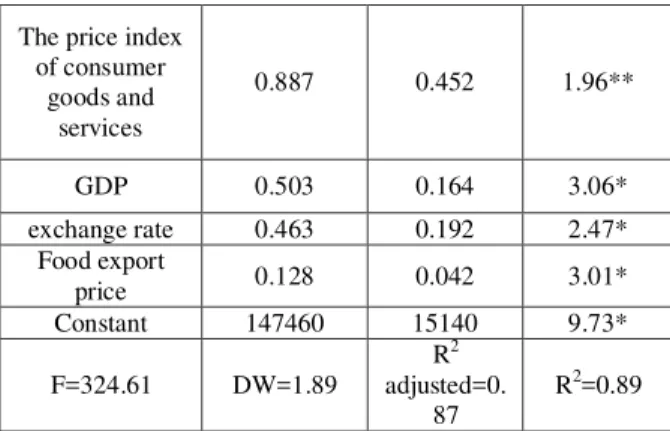
The GDP of the factors that has attracted the attention of researchers in research related to foreign trade was. According to a recent study of GDP is considered as independent variables. Average GDP during the period under review 89.1 trillion rials. Max GDP was about 3.2 trillion riyals in 2004. In 2002, the lowest GDP in the amount of 990 billion rials has happened. Finally, regression results are reported in Table 1. There is also the problem of unequal variants of conventional methods have been used to solve this problem.
Variables coefficient t-statistic standard
deviation Investment in
dairy industry 0.121 0.048 2.49*
The price index of consumer
goods and services
0.887 0.452 1.96**
GDP 0.503 0.164 3.06*
exchange rate 0.463 0.192 2.47*
Food export
price 0.128 0.042 3.01*
Constant 147460 15140 9.73*
F=324.61 DW=1.89
R2
adjusted=0. 87
R2=0.89
Table 1. Regression model to estimate the exports of dairy products * Significant at 1% ** significant at 5%.
As specified in the table above, except changing the ratio of price index of goods and services at the 5% level statistically significant, the coefficients of other variables all at the level of 1 percent are statistically significant. The goodness of fit coefficients, R2, show that export supply variables in the model have been able to explain 89 percent of the variation in exports during the period under review. Given the number of variables in the model is a good value as well. Durbin-Watson statistic nearly 2 also indicates a lack of problem the serial solidarity. The results also showed a significant F test of the model is estimated. As specified in the table for the variable investment coefficient is 0.12 with a positive sign and is significant at the 1% level. This indicates that increased investment in the country's dairy industry could lead to an increase in exports in the country. The resulting factor is the fact that the 10% increase in the exports of dairy products in the country increased by 1.2 percent. In the model variable price index for consumer goods and services as well as coefficient of 0.88 with a positive mark which shows an increase in the prices of domestic goods and services could lead to an increase in exports of goods.
0.503 with a positive sign, indicating the positive effect of the increase in GDP, exports of dairy products is on offer. The resulting ratio means that a 10 percent increase in GDP could lead to a 5% increase in exports. The exchange rate devaluations in other words, against other currencies such as dollars cheaper imports from other countries and thus can be expected to impact positively on the domestic exports. 0.46 coefficient for this variable reflects the fact that the exchange rate can be increased by 10 per cent to 4.6 per cent of the country's exports of dairy products increased. In the variable price index for exports of dairy products with a 0.128 coefficient The positive sign is that the increase of export prices of dairy products can increase the supply of export of these products. In other words, increases in prices can be expected that supply will increase. The resulting index shows a 10% increase in price can lead to the 1.28% increase in exports.
DISCUSSION AND SUGGESTIONS
Studies show that during the 13-year trend of increasing exports of dairy products is investigated. This reflects the fact that the dairy industry of great potential capacity to provide parts of the non-oil revenues, in the subdivision the agriculture. The original proposal of the present study is the use of financial instruments and non-financial policies and in support of the country's dairy industry to increase production and export of these products.
Due to the variety of its comparative advantages and create tools, with emphasis on appropriate target markets for local products, the use of protectionist instruments to provide appropriate inputs in the livestock sector, focusing on income stabilization policy in the livestock sector and reduce the risk of price fluctuations, including the policies and tools are. The results of the research studies with Azad et al (2010) and Kotler & Armstrong, in 1998 matches. The results suggest a positive impact on increased exports of dairy
products in the the country's GDP. In addition to the increase in GDP can be entailed increased investment in the dairy industry, also can strengthen the economic base of the country's dairy industry in manufacturing of agricultural competitiveness in the the global arena. GDP impact on exports of agricultural products in Alamdar Lu and colleagues reported in 2013, Mohammadi in 2012, Zooraghi and Turkamani 2008, Kazem Zadeh and Abounoori in 2007, Khalilian and Farhadi in 2003, Naryan and Redi in 1992 will be emphasized. This result shows the effectiveness of fiscal policy as exports increase and stabilize prices on the export of dairy products. Thus, according to these policies and tools in order to increase exports, is recommended.Among other results is the positive effect of the investment on the export of dairy products. Increase investment in the dairy industry, particularly the use of new technology also involves an increase in production can reduce production costs in this sector.
It will be seen as a step towards increasing exports. The use of incentive instruments such as government policies to reduce risk in the agricultural sector in order to increase investment in the dairy industry is one of the most important recommendations of this study.
REFERENCES:
1. Abounoori, Kazem-zadeh, L, 2007, Estimate the date export supply and demand functions using a system of simultaneous equations, Agriculture and Development, Volume 14, Issue 54, pp. 124-103
2. The Central Bank database, 2014.
3. Tajyani and Koohpaee, 2006, The supply and demand for saffron exports 3-stage least squares method.
4. Khalifi Sikaroodi and Shokatfadaeei, (2013). the effect of exchange rates and currency policy on the export of Iranian dates, .
Agricultural Economics / Volume 2/1 / S33-23
6. Khalilian, S and Farhadi, A. (2003) Factors affecting agricultural exports of Iran, Journal of Agricultural Economics and Development, 39: 84-71
7. Khalifi Sikaroodi and Shokatfadaeei, (2013). the effect of exchange rates and currency policy on the export of Iranian dates, .
8. Ramezani, 2016, Detail statistics agricultural exports, the newspaper world economy, Issue 2930: Page 5
9. 8-Fathi, A (2003), An analysis of comparative advantage in the export of various food groups in Iran, Journal of Agricultural Economics and Development, 38: 152-129
10.Azad, M., Ghalebi, S., Jahangiri, S. (2010). The comparative advantage and prioritizing target markets and leather industry's skin, Economic Sciences Research Journal, Vol. VI, No. 10.. Statistical Center of Iran, 2013, Strategy book of industry, trade and Mine. 11.Mahmoud Zadeh, M., Zibaee, M. (2005) the
factors affecting the export of Iran a co-integration analysis.
12.12-Najafi Alamdari, Hamd- Mortazavi, Syed Abulghasem, Shemshadi, Katayoun., Factors affecting the exports of agricultural products in the countries of ECO: 2012
13.Noferesti, M., 2000, unit root and co-integration in econometrics, Services and Cultural center rasa, Tehran
14.Hataf Hakimeh., Sarvari, Aliakbar, 2011, supply and demand for saffron exports forecast welfare changes, Journal of Agricultural Extension and Education, Issue 1, Spring 2011.
15.Achykva and Asmvtka, Russia's comparative advantage in certain agricultural exports, 2013 16.Athukorala, P.C,K.Sen. (1998). Processed food exports from develop countries: patterns and determinants,food policy,23:1-109 17.Asnavly, 2000, Providing a competitive
advantage theory.
18.Giovani anania(2010). Agricultural export restriction University of Calabria, Italy, Giovanni. anania@ uncial.it, Paper prepared forpresentatial
19.Kotler, P, and G. Armestrong(1998) marketing principles, trans Forozandeh, Atropatinstitation, Tehran(In Persian)
20.MarianVerdi(1992), a function of net exports for some agricultural commodities in India 21.Tvdanyand Mvnyana(2005) Effect of
exchange rate volatility on exports of South Africa