O R I G I N A L A R T I C L E UDC: 616.441-08 DOI:10.2298/VSP1109767A
Possibilities of nontoxic autonomous thyroid nodules treatment by
percutaneous ethanol injection
Mogu
ć
nosti le
č
enja netoksi
č
nih autonomnih
č
vori
ć
a tiroideje perkutanim
ubrizgavanjem etanola
Zoran Andjelković*, Snežana Kuzmić-Janković*, Dragan Pucar†,
Ivan Tavčar*, Tamara Dragović*
Military Medical Academy, *Clinics of Endocrinology, †Institute of Nuclear Medicine,
Belgrade, Serbia
Abstract
Background/Aim. According to the current principles, autonomous functional thyroid nodules are treated by sur-gery or by radioiodin therapy. Ultrasound guided percuta-neous ethanol injection into solid tumors of the soft tissues was a starting point in attempts to treat the thyroid nodules by the same method. The aim of the study was to assess the efficiency of percutaneous injection in treating solitary, nontoxic, autonomous thyroid nodules of up to 15 mL vol-ume. Methods. In 25 patients with solitary nontoxic autonomous thyroid nodules diagnosed by tehnetium-99m scanning as an intensive area having a complete supremacy in the paranodal tissue, an ultrasound guided percutaneous ethanol injection was applied. The procedure was carried out repeatedly once a week until the reduction in nodule size to 50% of the initial size was achieved. Results. An av-erage size of the nodule before curing was 9.68 ± 5.01 mL. An average quantity of the injected ethanol was 9.52 ± 5.08 mL, ie 1.06 ± 0.48 mL/mg of the tissue. The regression of the nodule size in the successfully (Δvol% u = -57.09 ± 13.75%, p < 0.001) and partly successfully cured
(Δvol du = -48.45 ± 14.35%, p < 0.05) was statistically sig-nificant compared to the size before the treatment. After ceasing ethanol injection, 18 months later, a further size re-gression (Δvol% = -79.20 ± 9.89%) compared to the initial one (p < 0.001) was noticed. Soon, after the procedure was finished, a statistically significant concentration increase of Thyroid Stimulating Hormone (TSH) was noticed com-pared to the initial values (0.18 ± 0.16 vs 0.34 ± 0.31 mU/L, p < 0.01). According to the given criteria, in two female pa-tients satisfactory results were not achieved, but, a year later, in one of them the nodule was not seen by repeated scinti-gram. The number and frequency of side effects were insig-nificant. Conclusion. Repeated percutaneous ethanol injec-tions into nontoxic solitary autonomous thyroid nodules re-sult in disappearing of authonomy. The regression of the nodule size of more than 50% compared to its initial vol-ume, as well as the increase in concentration of TSH for more than 50% are the signs of a successful treatment.
Key words:
thyroid diseases; thyroid hormones; goiter, nodular; ethanol; ultrasonics.
Apstrakt
Uvod/Cilj. Prema sadašnjim principima, autonomni fun-kcionalni tiroidni nodusi leče se operativno ili terapijskom primenom radioaktivnog joda. Perkutana, ultrazvučno vođena aplikacija etanola u solidne tumore mekih tkiva bila je polazna osnova za pokušaje lečenja tiroidnih nodu-sa istom metodom. Cilj ovog rada bio je da se ocene tera-pijski efekti perkutane aplikacije etanola kod solitarnih, netoksičnih autonomnih tiroidnih nodusa zapremine do 15 mL. Metode. Kod 25 bolesnika sa solitarnim
netoksi-čnim nodusima koji se scintigrafski (tehnecijum 99m) in-tenzivnije prikazuju i potpuno suprimiraju paranodalno tkivo, uz pomoć ultrazvuka perkutano je aplikovan etanol.
hormo-kti lečenja, s tim što se kod jedne, nakon godinu dana, na ponovljenom scintigramu nodus više nije prikazivao. Broj i učestalost neželjenih efekata bio je zanemarljivo mali. Zaključak. Ponavljane perkutane aplikacije etanola u netoksične solitarne autonomne noduse štitaste žlezde
do-pešnog ishoda lečenja.
Ključne reči:
tireoidna žlezda, bolesti; tireoidna žlezda, hormoni; gušavost; etanol; ultrazvuk.
Introduction
Solitary autonomous functional thyroid nodules (AFTN) are parts of thyroid parenchymas which in func-tional and in the sense of controlling growth act separately from the regulatory action of hypophysis, ie thyroid stimu-lating hormone (TSH). Laboratory criterion for diagnosing is an inability to suppress the function of nodules by suppres-sive doses of thyroid hormones. At the same time, the sup-pressed paranodal tissue has retained the ability to answer the stimulation by exogenous giving TSH. Unlike toxic ones, nontoxic nodules have normal serum levels of thyroid hor-mones.
According to the current principles, toxic nodules are treated surgically or with therapeutic application of radioac-tive (RA) iodine. The need for curing the nontoxic AFTNs is based on the observation that most of the ill have subnormal TSH levels and, hence, subclinical hyperthyreosis. On the other hand, taking larger quantities of iodine, which occurs when giving iodine contrast media, the drugs containing io-dine, or when eating food rich in ioio-dine, multiplies the possi-bility of evolution of nontoxic nodules into the toxic ones.
The results achieved by the use of ethanol in treatement of hepatocellular carcinomas 2 and benign cysts in the thy-roid gland 3 were a starting point for the attempts to cure the autonomous nodules by the same method. The procedure of percutaneous ethanol injection (PAE) into the nodules of thy-roid gland was promoted at the beginning of the 1990s. Then, there were the first results published of treating eight patients in this way in whom the regression in nodules size and the disappearance of autonomy 4 were achieved, regard-less a small number of ethanol injections. Later observations of a few tenths to over a hundred patients who were followed during long intervals (4–8.5 years) proved good effects of curing. In the largest number of the cured, PAE led to a complete or a partial curing, with a very small number of re-cidives. In a certain number of patients (about 12%), mainly with toxic nodules, there were no results of curing 5–7.
In an attempt to contribute to the achievements which would make this method generally accepted we started with the fact that there was not a single study with a selection of patients regarding the autonomy level, as well as that most studies included heterogeneous groups of patients with nodal, polynodal, most often toxic nodules of various sizes.
The aim of this study was to estimate therapeutical ef-fects of 15 mL percutaneous ethanol injection in patients with nontoxic, solitary AFTNs, which most often occur in clinical practice.
Methods
The study included 25 patients with solitary nodules which appeared more intense on scintigraphy (Te-99m) and had a complete supremacy in paranodal tissue. According to serum concentration of thyroid hormones and TSH, the pa-tients with toxic nodules were excluded. By cytological analysis of aspirates from nodules any doubts of malignancy were eliminated.
A Hewlett Pacard apparatus with a linear probe of 7.5 MHz was used for echotomographic estimation and control-ling the injection. The volume of nodules was calculated ac-cording to the formula for ovoid: V = π/6 × A x B × C (A – craniocaudal, B – anteroposterior, C – mediolateral nodule diameter) and it was expressed in millilitres, ie milligrams of tissue. The amount of the injected ethanol per seance was not determined in advance, but ethanol was injected up to the point of perfusion and not more than 2/3 of the visible sur-face of the nodule. Color Doppler was used to direct the in-jection into the areas with the largest number of exposed capillaries. The quantity of ethanol determined in this way was expressed in mL of ethanol/mL (mg) of the nodule tis-sue. The injections were done in the outpatient department, repeatedly, at intervals of once a week.
With the aim to estimate the effects, control scintigra-phy was carried out on condition that the following three criteria were fulfilled: regression of nodule volume to at least 50% compared to the initial one; significantly changed echotomographic structure of the nodule with the earlier hy-poechographic fields disappearing; when not a single ex-posed capillary within the nodule could be seen on colour Doppler.
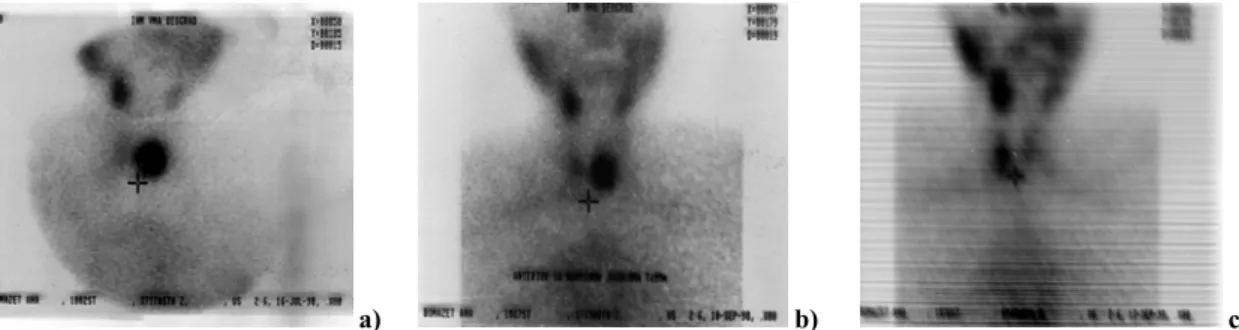
The effects of treatment were defined as: successful (s), partly successful (ps), and unsuccessful (u), the scintigraphic finding being a determiner. Criteria for estimating success of treatment were: disappearance of all clinical manifestations of the illness; increase in concentration of TSH for at least 50% compared to its level before treatment; decrease in nodule vol-ume for 50% compared to the initial one; scintigraphic finding on which the earlier suppressed paranodal tissue is completely shown (Figure 1 a, b). Partly successful: the patients with three of the four formerly mentioned criteria fulfilled. Unsuccessful: only two of the four mentioned criteria fulfilled.
in-cluded in the study. The criterion for excluding the patients was their own decision.
All the results in tables were shown as an average value ± standard deviation (ґ ± SD). Depending on the distribution of features, statistical importance among the groups was es-timated by the Student’s t-test or by the Mann-Whitney U -test. Comparison of the frequencies, depending on their lo-cation, was made by using χ2
-test or by Kolmorogov-Smirnov test. Connection with various features was tested by using the Pearson’s correlation quotient. A statistically singi-ficant difference in the groups was defined on the three lev-els of possibilities: p < 0.05; p < 0.01 and p < 0.001.
Results
The procedure was applied on 25 patients (23 women and 2 men), 19–76 (47.18 ± 16.3) years of age. An average nodule volume before treatment was 9.68 ± 5.01 mL. As for echo structure, 64% (16/25) of those being cured had a clearly parenchymatous structure, while 36% (9/25) had nodules with the signs of cystic degeneration. Regardless echo structure, all the nodules showed diffusionally accentu-ated vascularisation.
An average quantity of the injected ethanol was 9.52 ± 5.08 mL ie 1.06 ± 0.48 mL/mg of tissue. Injection rate was 4 to 12 applications.
The regression of nodules was expressed in percents of nodules diminishing at the end of treatment compared to
their initial volume (Δvol %). In all the patients, a statisti-cally significant diminishing of nodules volume was achieved, being slightly larger nodules with the signs of cys-tic degeneration (Table 1).
As for the results, the successfully (Δvol% s = -57.09 ± 13.75%, p < 0.001) and partly successfully cured (Δvol ps = 48.45 ± 14.35%. p < 0.05) showed a statistically singificant difference in diminishing as compared to nodules volume before the treatment. Although the successfully cured, compared to the partly successfully cured ones, showed a higher level of volume diminishing, this difference was not statistically singificant. However, if nodules vol-umes were expressed in milliliters, we would find a higher level of nodule size regression in the successfully cured than in the partly successfully cured ones. This difference is sta-tistically singificant (s = 3.17 ± 1.24 vs ps = 3.17 ± 1.24 mL p < 0.01) (Table 2; Figures 2a, b and 3 a, b and c).
After stopping ethanol injection, all the patients were followed during the next 18 months. Control examinations were done every 6 months. Nodules volume reduction after 18 months was Δvol% = -79.20 ± 9.89% as compared to the initial one (p < 0.001) (Table 3).
The function of the thyroid gland was estimated by measuring the levels of thyroid hormones: triodothyronine (T3), tyroxine (T4), TSH and tyreoglobulin (Tg). The values were controlled before, immediately after finishing the pro-cedure and after 6, 12, and 18 months following finishing the injection (Table 4, Figure 4).
a) b)
Fig. 1 – Scintigraphic findings: a) appearance before and b) afther the successful treatment with percutaneous ethanol injection
Table 1 Nodules volume before and after percutaneous ethanol injection in realtion to echo structure
Nodules volume, ґ SD (mL) ECHO structure
Before p After vol (%), before/after
Parenchymatous 7.90 3.31 0.001 3.78 1.99 -52.08 13.69 Cyst.degener. 12.84 6.11 0.01 5.57 3.47 -55.26 16.36
p < 0.05 ns ns
ns – non significant
Table 2 Nodules volume before and after percutaneous ethanol injection in relation to outcomes of the treatment
Nodules volume, ґ SD (mL) Treatment outcome
Before p After vol (%), before/after
Successfull 7.91 3.68 0.001 3.17 1.24 -57.09 13.75
Partly successfull 12.70 6.39 0.05 6.20 3.11 -48.45 14.35
p ns < 0.01 ns
a) b)
Fig. 2 – Echotomographic appearance of AFTN: a) before and b) after successful treatment with percutaneous ethanol injection
a) b) c)
Fig. 3 – Scintigraphic appearance of a nodule in the left lobe of the thyroid before, immediatly after percutaneous ethanol injection
(a and b) and one year later (c)
Table 3 Nodules volume (%) at the begining and vol(%) during 18 month period
Time period (month) Nodules volume (mL) vol (%)
0 9.68 5.01 –
6 3.55 2.44‡ 63.00 13.36
12 3.19 2.21† 70.70 12.08
18 2.51 2.51* 79.20 9.89
*p < 0.05; †p < 0.01; ‡p < 0.001 in relation to the value at the begining (0)
Table 4 Function of the thyroid gland during 18 month period
Thyroid hormones levels Time period
T3 (nmoL/L) T4 (nmoL/L) TSH (IJ/L) Tg (g/L)
Before 2.84 0.97 156.32 54.68 0.18 0.16 62.84 39.13 After 2.33 0.49* 140.92 31.52 0.34 0.31† 108.32 44.70‡ 6 months 1.87 0.40‡ 124.21 14.96† 0.69 0.40‡ 38.49 26.70† 12 months 1.97 0.28† 128.17 12.97 0.77 0.44† 33.50 16.18† 18 months 1.90 0.38* 126.62 15.26 1.12 0.39* 25.95 23.53*
*p < 0.05; †p < 0.01; ‡p < 0.001 in relation to levels at the begining
Normal levels: T3 = 1.2 - 2.8; T4 = 60 – 160; TSH = 0 – 4; Tg = up to 50
Effects of treatement Days between two applications
4 8 12 16 20 24 28 32
s ps(u)
Mean valuae
Mean valuae p < 0.01
s - successfully
ps(u) – partly succ. and
Discussion
Autonomous thyroid nodules represent 5%–10% of all palpable or in other ways recognisible thyroid nodules. There are a few phases in the development of AFTN. First, there appears a functional nodule without an autonomy. In its fur-ther evolution it can grow into an autonomus hyperfunctional or toxic tyroid nodule. In the controlled, prospective clinical studies it is shown that after a 5-year follow up, 15%–20% of the autonomous nodules larger than 3 cm become toxic 8, 9, and that they are treated with either surgery or therapeutical application of RA iodine. In treatment nontoxic AFTN is still a subject of discussion, with a number of objections. The op-posite attitudes are problematic promoting either clinical following or surgical treatment. Those who are for clinical following base their attitude on the fact that only a small number of AFTNs evoluate into the toxic ones, as well as that the possibility of malignancy is slight 10, 11.
During the last 20 years or so, ultrasound guided percu-taneous ethanol injection has become a successful way of curing both malignat and benign soft tissue tumors. The prin-ciple of treatment is based on the knowledge that after inject-ing ethanol regularly spreads within the tumor lesion by diffu-sion and, then, it causes an inactivity of the oxidative enzymes, dehydration of the cells, denaturation of proteins, venous mi-crothrombosis and coagulation necrosis followed by fibrosis 12. The surrounding tissue is saved since it appears that ethanol stays within the tumor lesion. The first reports of positive ef-fects refer to local ethanol injection into hepatocellular carci-nomas derived from cirrhosis of the liver 2. Inactivation of parathyroid adenomas by ethanol appeared to be successful in an important number of those having primary hyperparathyro-ism and, in some cases, after an unsuccessful surgical explora-tion, it can be the only possible choice of treatment 13, 14. Scle-rosing of benign cystic nodules in the thyroid gland has been used for a long time, and there are more and more proofs of reduction in its size and therapeutical efficiency of PAE in the treatement of benign solid nodules 15.
Percutaneous ethanol injection was introduced into clinical practice by Livraghi et al. 16 in 1990. It was shown then that regression in nodule size, followed by disappear-ance of autonomy, was achieved, despite a small number of ethanol injections. Later examinations of a larger number of patients who were followed over longer time intervals proved positive effects of this way of curing with only a slight number of complications 5–7. It was also shown that subclinical hyperthyreosis was corrected in all, while the manifested one was cured in 52%–80% of patients, with only a slight number of recidives. The achieved nodule size re-gression was from 21% to 88% compared to the initial size.
In our group of patients there were 16 (64%) success-fully treated, 7 (28%) partly successsuccess-fully treated, while in 2 (8%) patients the treatment had no effect. Despite the fact that the criteria for estimation success in the results were very strict, looking for the reasons for such results we started with the question whether nodule volume had an effect on the results of treatment. The attitudes concerning the con-nection between nodule size and the results of treatment,
ac-cording to the current knowledge, are not completely unique. There prevails an attitude that nodule size only partly affects the results of treatment. Best results were achieved in non-toxic AFTN the volume of which was not bigger than 10–13 mL 16–18. Average nodule volume in our patients was 9.68 ± 5.01 mL where the cystic degenerated nodules had quite a bigger volume compared to the parenchymatous ones. Regarding the results, the nodules which were partly cured and unsuccessfully cured were bigger in comparison with the successfully cured ones. This difference, however, was not statistically singificant (Vol ps + u > Vol s; ns). The cited re-sults led to a conclusion that the nodules of smaller volumes could be cured more easily. However, by linear regressive analysis the correlation between the nodule volume and the results of treated was not proved. It was shown that the de-gree of nodule vascularisation had far greater importance for a successful curing. It was noticed that during the treatment, at the time of the planned ultrasound controls, the shape of vascularisation changed in that way that the blood flow gradually weakened, first within parenchyma, and later around the edge of the nodule. At the end of the procedure, in the successfully cured, both types of vascularisation com-pletely disappeared. Together with the lower blood flow we noticed a regression in nodule size and appearance of fibrosis in parenchyma. The explanation for this could lie in the no-ticed occurence that the well vascularised nodules made pos-sible a quicker and a more regular distribution of the injected ethanol, so that even the small amounts of the injected etha-nol reached evenly all the parts of nodules and caused the tissue degradation.
difference. Looking for the reasons of curing to be successful in some patients, but partly successful or unsuccessful in other we analysed some characteristics of nodules and the curing procedures. Nodules in the subgroup of the success-fully treated were of smaller dimensions compared to the un-successfully treated but this difference was not statistically singificant. So, we could not accept nodules size as a reason for the unsuccessful results of curing. Both subgroups did not differ in ultrasound structure of the nodules, the ways of vas-cularisation, the quantity of the injected ethanol and the number of injections. A statistically singificant difference was noticed in only the time intervals between the two injec-tions. In the successfully cured, a period between the two injections was 12.7 days on average, and in the partly suc-cessfully treated and unsucsuc-cessfully treated 7.43 days (p < 0.01). The difference in a period between the two etha-nol injections was made on purpose as the result of the first experiences during the introduction of the procedure into practical work. Namely, very early it was noticed that the nodule size regression continued even after ceasing ethanol injection. It appeared that a year following ceasing ethanol injection nodules regressed another 16% in comparison with their volume at the end of curing. We supposed that for the occurence of a number of involutive changes, from cyto-chemical to fibrosal ones, a certain period of time was neces-sary. Having that in mind, there is a small possibility that a larger quantity of the injected ethanol would fasten, or that a smaller quantity would slow down this process which has its logical sequence, from functional to definite morphological changes. We supposed that the newly injected quantity of ethanol only perpetuated the process of degradation and con-tinued progression towards final necrosis and replacement by a fibrotic tissue. Considering the first noticing in mind and thinking in this way, we controlled all the patients weekly, but we adjusted ethanol injection individually to a period from 2 to 3 weeks, giving chance to the previously injected ethanol to do its function of destruction. We followed our patients 18 months after finishing the treatment. Despite stopping ethanol injections, further regression in size was noticed, which proved the cited suppositions and conclusions.
In the patient with the results of curing initially defined as unsuccessful, with already described clinical findings, af-ter a year, during repeated scintigraphy, the nodule was not visible any more. We suppose that quite probably, after a pe-riod of time, in all the patients who were partially treated (as they were classified at the end of ethanol injection), the re-sults of scintigraphy approved the disappearance of the autonomy.
By observing the thyroid gland function, an increase in TSH was noticed as a sign of autonomy disappearance, and as the proof of a successful treatment. The values of Tg im-mediately after the end of curing showed an increase in value which we considered was due to degeneration in nodule tis-sue. In the later course, with the development of fibrosis and regression of the size, Tg values lowered, too.
fects. Some of them, such as pain, overflowing of the thyroid hormones into circulation, and the development of thyroid antigen are justifiably present and are the consequence of a direct contact of ethanol with the nodule tissue. In our series of patients, the side effects of the procedure were milder and did not disturb further carrying out or possible ceasing of therapy. The degree of discomforts that appeared and the definition of the efficiency of treatment were estimated on the basis of the questionnaire which was filled in by the pa-tients at the end of therapy, and their intensity was ranged by the index from 1 to 5. In 91.3% of the treated patients there was pain and burning at the site of injection of an average intensity of 2.7 index points. In nearly one half of the treated (43.47% to 52.17%) pain spreaded to the jaw, shoulder, chest and ear, and it was marked with the index from 1.08 to 1.26. The appearance of local and/or projected pain, as it can be seen, represents an inevitable manifestation of the procedure. Luckily, these manifestations which can, to some extent, complicate the procedure, had a very weak intensity. Nearly 10% of the treated did not feel pain, or, what was more likely, they did not consider it an important side effect. It seems that the intensity of pain and its eventual further spreading mostly depend on the location of the nodule, its ultrasound structure and its vicinity to the thyroid capsule. Pain was less severe in cystically degenerated nodules com-pared to the ones with parenchymal structure, but it became more intense as the number of injections grew and with the appearance of sclerosis within the nodule. Then, it was prac-tically impossible to prevent overflowing of even small quantities of ethanol extranodally. Thyroid capsule seems to be the best innerved part of the thyroid since curing nodules in its vicinity was most painful, and pain always spreaded away, most often as far as the temporomandibular joint and ear. In nodules localized quite near the lower pole of the thy-roid lobe propagation of pain went along the middle chest or into shoulder. The mentioned discomforts were temporary and mainly lasted short. Thus, in 86.9% of the treated the discomforts were present for only a few hours after injection while in 13.1% of patients they prolonged until the next day. A slight number of patients reported having difficulty with moving their neck, an occiput headache and a temporary sense of slackening of vigour, as described by other authors.
Conclusion
R E F E R E N C E S
1. Hamburger JI. Solitary autonomously functioning thyroid
le-sions. Diagnosis, clinical features and pathogenetic considera-tions. Am J Med 1975; 58(6): 740–8.
2. Bastid C, Azar C, Sahel J. Ultrasound guided percutaneous
ethanol treatment of hepatic neoplasms: a therapeutic alterna-tive in the nineties. Ultrasound Med Biol 1995; 21(1): 129–31.
3. Verde G, Papini E, Pacella CM, Gallotti C, Delpiano S, Strada S, et
al. Ultrasound guided percutaneous ethanol injection in the treatment of cystic thyroid nodules. Clin Endocrinol (Oxf) 1994; 41(6): 719–24.
4. Livraghi T, Paracchi A, Ferrari C, Bergonzi M, Garavaglia G, Raineri
P, et al. Treatment of autonomous thyroid nodules with per-cutaneous ethanol injection: preliminary results. Work in prog-ress. Radiology 1990; 175(3): 827–9.
5. Monzani F, Caraccio N, Goletti O, Casolaro A, Lippolis PV, Cavina
E, et al. Treatment of hyperfunctioning thyroid nodules with percutaneous ethanol injection: Eight years' experience. Exp Clin Endocrinol Diabetes 1998; 106(Suppl 4): S54–8.
6. Tarantino L, Francica G, Sordelli I, Sperlongano P, Parmeggiani D,
Ripa C, et al. Percutaneous ethanol injection of
hyperfunc-tioning thyroid nodules: long-term follow-up in 125 patients. AJR Am J Roentgenol 2008; 190(3): 800–8.
7. Tarantino L, Giorgio A, Mariniello N, de Stefano G, Perrotta A,
Aloisio V, et al. Percutaneous ethanol injection of large
autonomous hyperfunctioning thyroid nodules. Radiology 2000; 214(1): 143–8.
8. Hamburger JI. Evolution of toxicity in solitary nontoxic
autonomously functioning thyroid nodules. J Clin Endocrinol Metab 1980; 50(6): 1089–93.
9. Fumarola A, Sciacchitano S, Danese D, Andreoli M. The
autono-mous nodule. Clinical aspects. Minerva Endocrinol 1993; 18(4): 147–54. (Italian)
10.Terzioglu T, Tezelman S, Onaran Y, Tanakol R. Concurrent
hy-perthyroidism and thyroid carcinoma. Br J Surg 1993; 80(10): 1301–2.
11.Mizukami Y, Michigishi T, Nonomura A, Yokoyama K, Noguchi M,
Hashimoto T, et al. Autonomously functioning (hot) nodule of
the thyroid gland. A clinical and histopathologic study of 17 cases. Am J Clin Pathol 1994; 101(1): 29–35.
12.Crescenzi A, Papini E, Pacella CM, Rinaldi R, Panunzi C, Petrucci
L, et al. Morphological changes in a hyperfunctioning thyroid adenoma after percutaneous ethanol injection: histological, en-zymatic and sub-microscopical alterations. J Endocrinol Invest 1996; 19(6): 371–6.
13.Karstrup S, Holm HH, Glenthoj A, Hegedus L. Nonsurgical
treatment of primary hyperparathyroidism with sonographi-cally guided percutaneous injection of ethanol: results in a se-lected series of patients. AJR Am J Roentgenol 1990; 154(5): : 1087–90.
14.Cappelli C, Pelizzari G, Pirola I, Gandossi E, De Martino E,
Del-barba A, et al. Modified percutaneous ethanol injection of
parathyroid adenoma in primary hyperparathyroidism. QJM 2008; 101(8): 657–62.
15.Zingrillo M, Collura D, Ghiggi MR, Nirchio V, Trischitta V.
Treatment of large cold benign thyroid nodules not eligible for surgery with percutaneous ethanol injection. J Clin Endocrinol Metab 1998; 83(11): 3905–7.
16.Livraghi T, Paracchi A, Ferrari C, Reschini E, Macchi RM,
Boni-facino A. Treatment of autonomous thyroid nodules with
per-cutaneous ethanol injection: 4-year experience. Radiology 1994; 190(2): 529–33.
17.Di Lelio A, Rivolta M, Casati M, Capra M. Treatment of
autonomous thyroid nodules: value of percutaneous ethanol injection. AJR Am J Roentgenol 1995; 164(1): 207–13.
18. Ferrari C, Reschini E, Paracchi A. Treatment of the autonomous
thy-roid nodule: a review. Eur J Endocrinol 1996; 135(4): 383–90.
19.Paracchi A, Ferrari C, Livraghi T, Reschini E, Macchi RM, Bergonzi
M, et al. Percutaneous intranodular ethanol injection: a new treatment for autonomous thyroid adenoma. J Endocrinol In-vest 1992; 15(5): 353–62.
20.Monzani F, Goletti O, Caraccio N, Del Guerra P, Ferdeghini M, Pucci
E, et al. Percutaneous ethanol injection treatment of autono-mous thyroid adenoma: hormonal and clinical evaluation. Clin Endocrinol (Oxf) 1992; 36(5): 491–7.
21.Nakada K, Katoh C, Kanegae K, Tsukamoto E, Itoh K, Tamaki N.