3 - ORIGINAL ARTICLE
Alimentary tract
Biodistribution of the radiophamarceutical sodium pertechnetate (Na
99mTcO
4)
after massive small bowel resection in rats
1Biodistribuição do radiofármaco pertecnetato de sódio (Na
99mTcO
4
) em ratos
submetidos a ressecção extensa de intestino delgado
Dâmaso de Araújo Chacon2, Irami Araújo-Filho2,Arthur Villarim-Neto2, Amália Cínthia Meneses Rêgo3, Ítalo
Medeiros Azevedo4, Mário Bernardo-Filho5, José Brandão-Neto6, Aldo Cunha Medeiros6
1. Research performed at Nucleus for Experimental Surgery, Federal University of Rio Grande do Norte (UFRN), Brazil. 2.Fellow PhD degree, Postgraduate Program in Health Sciences, UFRN, Brazil.
3.Graduate Student, Scientifi c Initiation Program, UFRN, Brazil. 4.Statistician, Department of Surgery, UFRN, Brazil.
5.PhD, Chairman, Biophysics and Biometry Department, UERJ, Brazil 6.PhD, Full Professor, Postgraduate Program in Health Sciences, UFRN, Brazil.
ABSTRACT
Purpose:To evaluate the biodistribution of sodium pertecnetate (Na99mTcO
4) in organs and tissues, the morphometry of
remnant intestinal mucosa and ponderal evolution in rats subjected to massive resection of the small intestine. Methods: Twenty-one Wistar rats were randomly divided into three groups of 7 animals each. The short bowel (SB) group was subjected to massive resection of the small intestine; the control group (C) rats were not operated on, and soft intestinal handling was performed in sham rats. The animals were weighed weekly. On the 30th postoperative day, 0.l mL of Na99mTcO
4, with mean activityof 0.66 MBq was injected intravenously into the orbital plexus. After 30 minutes, the rats
were killed with an overdose of anesthetic, and fragments of the liver, spleen, pancreas, stomach, duodenum, small intestine, thyroid, lung, heart, kidney, bladder, muscle, femur and brain were harvested. The biopsies were washed with 0.9% NaCl.,The radioactivity was counted using Gama Counter WizardTM 1470, PerkinElmer. The percentage of radioactivity
per gram of tissue (%ATI/g) was calculated. Biopsies of the remaining jejunum were analysed by HE staining to obtain mucosal thickness. Analysis of variance (ANOVA) and the Tukey test for multiple comparisons were used, considering p<0.05 as signifi cant. Results: There were no signifi cant differences in %ATI/g of the Na99mTcO
4 in the organs of the
groups studied (p>0.05). An increase in the weight of the SB rats was observed after the second postoperative week. The jejunal mucosal thickness of the SB rats was signifi cantly greater than that of C and sham rats (p<0.05). Conclusion: In rats with experimentally-produced short bowel syndrome, an adaptive response by the intestinal mucosa reduced weight loss. The biodistribution of Na99mTcO
4 was not affected by massive intestinal resection, suggesting that short bowel
syndrome is not the cause of misleading interpretation, if an examination using this radiopharmaceutical is indicated.
Key words: Short Bowel Syndrome. Sodium Pertechnetate Tc 99m. Pharmacokinetics. Rat
RESUMO
Objetivo: Avaliar em modelo animal com ressecção extensa do intestino delgado a biodistribuição de pertecnetato de sódio (Na99mTcO
4) em órgãos e tecidos, a evolução ponderal e a morfometria da mucosa do intestino delgado remanescente. Métodos: Vinte e um ratos Wistar foram aleatoriamente divididos em três grupos de sete animais cada. O grupo intestino curto (IC) foi submetido a ressecção extensa do intestino delgado, o grupo controle (C) não foi operado e o grupo
sham foi submetido a leve manipulação cirúrgica das alças intestinais.Todos foram pesados semanalmente. No 30º dia pós-operatório foi administrado 0,l mL de Na99mTcO
4 aos animais dos três grupos,IV no plexo orbital, com atividade
radioativa média de 0,66MBq. Após 30 minutos os ratos foram mortos e retirados fragmentos do fígado, baço, pâncreas, estomago, duodeno, intestino delgado, tireóide, pulmão, coração, rim, bexiga, músculo, fêmur, e cérebro. As amostras foram lavadas com solução de NaCl 0,9%.A radioatividade foi contada peloContador Gama 1470, WizardTM
Perkin-Elmer e calculado o percentual de atividade radioativa por grama (%ATI/g) de cada órgão. Biópsias do jejuno foram submetidas a análise da espessura da mucosa (coloração HE). Utilizou-se avaliação estatística paramétrica (ANOVA) e teste de Tukey, considerando p<0,05 como signifi cante. Resultados: Não houve diferenças signifi cantes da %ATI/g nos órgãos dos grupos estudados (p>0,05). Verifi cou-se acentuada redução inicial de peso, em seguida um aumento do peso dos animais tratados a partir da segunda semana de observação e aumento da espessura da mucosa jejunal do grupo IC, comparado com os demais. Conclusão: Em ratos com síndrome do intestino curto, uma adaptação na espessura da mucosa contribuiu para reversão na perda de peso inicial e para que a biodistribuição do Na99mTcO
4 não fosse afetada pela
ressecção extensa do intestino, sugerindo que o intestino curto não é causa de interpretações duvidosas, quando exame cintilográfi co com este radiofármaco estiver indicado.
Introduction
Radioisotopes are used in nuclear medicine for diagnostic and therapeutic purposes. The labelling capacity of these isotopes for the plasmatic proteins is well known, and their bioavailability and pharmacokinetics can be modifi ed by drugs and diseases1,2. Among the most useful
artifi cial radioisotopes, technetium-99m, in the chemical form of sodium pertechnetate (Na99mTc0
4), is the most
important. Its use in nuclear medicine is due to the emission of gamma energy of 140 KeV, enabling it to take advantage of the scintillation detectors and obtain enhanced image quality; this is known as scintigraphy3. It has a short life, is
low cost, and is obtained from a molybdenum/technetium generator (99Mo/99mTc).3 It is easily distributed through the
vascular fl uid, intersticial space with uptake by the salivary glands, thyroid, stomach, intestines and other organs3. It
is rapidly eliminated by the urine and when incorporated to specifi c substances, produces organ images of different densities and functions4. Experimental studies carried out
with the labelling of red blood cells with 99mTc identi
fi ed important biological effects, in addtion to alterations in the labelling process5,7. Gomes et al carried out a study with
mitomicin-C that described alterations in the labelling of red blood cells6. The literature reports that several natural drugs
reduce the effi ciency of labelling red blood cells with 99mTc7.
An experimental study with Vincristin, used in oncology protocols, showed an interaction of this drug with 99mTc in
several organs8. However, there are no reports of research
studying the biodistribution of radiopharmaceuticals after surgical procedures. In the present study, we used an experimental model of massive resection of the small intestine, characterizing the short bowel syndrome, which results in unsuitable water and nutrient absorption, causing malnutrition9,10. In spite of the short bowel syndrome, the
intestine can be adapted through physiologic, cellular and moleculares mechanisms9. In some patients, dilation
and lengthening of the remnant small intestine occur as a phenomenon of functional adaptation. Surgical techniques have been reported that attempt to lengthen this intestinal segment. Such procedures are complex and frequently ineffective, and call for assessments of their effi cacy11.
Recently, new therapeutic methods, such as isolated small intestine transplantation or combined with liver transplantation, have been an alternative for cases of hepatic failure due to total parenteral nutrition in the treatment of short bowel syndrome12. Given the antiabsorptive effect of
the operation, with great repercussions on the metabolism, radioisotope images may be necessary in the postoperative, in order to control the series of pathological conditions resulting from short bowel syndrome. Scintigraphy can be used in the postoperative of intestinal resections to assess the morphology and metabolism of several organs. Under these conditions, it becomes relevant to study the biodistritubion of Na99mTc0
4 in specifi c organs and tissues.
Therefore, the present paper aims to study, in an animal
model of massive resection of the small intestine, the biodistribution of Na99mTcO
4 in several organs by means of
radiation counting in organs and tissues in the postoperative period. We also evaluated the ponderal evolution of the animals after the operation, as well as the mucosal morphometry of the remnant small intestine.
Methods
Twenty-one Wistar rats, age around 180 days, weighing 265g±31g were used. They were supplied by the animal colony of the Nucleus for Experimental Surgery of the Federal University of the Rio Grande do Norte, Brazil. All the animals were weighed and observed in individual cages with water and food (Labina ® Purina) ad libitum
and acclimated in the laboratory for 7 days. They were maintained under temperature control (21ºC), air humidity (60 – 70 %) and lighting (12/12 hours light/dark cycle) and handled in accordance with the Animal Experimentation Code of Ethics (Council for International Organizations of Medical Sciences ) and the rules of the Brazilian College of Animal Experimentation. They were randomly divided into three groups: the experimental group rats, denominated short bowel, (SB, n=7) were subjected to massive resection of the small intestine (90%); control group rats were not operated on (C, n=7) and the third group underwent a simulated operation, called sham (n=7). Rats were fasted overnight before surgery, and anesthetized with sodium pentobarbital (20mg/kg intraperitoneal) and ketamine (20mg/kg intramuscular); they were operated on under sterile conditions. A 3 cm midline laparotomy was performed and intestinal transections were done 5 cm above the ileocecal junction and 5 cm from the duodenojejunal transition. With the aid of a surgical microscope (DF Vasconcelos, São Paulo, Brazil), interrupted sutures of 6-0 prolene (Ethicon®, Brazil) were used for bowel anastomosis. The animals typically have a small bowel length of 100 cm, and accordingly, residual length was 5 cm of jejunum and 5 cm of ileum (10 cm), corresponding to 90% of resection. After surgery, the abdomen was closed with interrupted sutures of 4-0 nylon suture (Ethicon®). The animals were allowed water immediately after surgery and food on the second postoperative day. The sham rats were subjected to a 3 cm medium laparotomy and mild manipulation of the small bowel. The rats were weighed weekly with a digital scale (Filizola® São Paulo, Brazil) and observed for 30 days. On the 30th day all the animals were anaesthetized again, and injected with 0.lmL of Na99mTcO
4 in the venous orbital
Gamma Counter- Perkin-Elmer, with automatic correction of radiation decline. The percentage of radioactive activity/g (%ATI/g) of each organ was calculated by dividing the activity/g of the tissue by the total activity administered to each animal. Samples with 2cm of jejunum were harvested 2 cm below the anastomosis. After washed in 0.9% saline, the excised tissues were fi xed in 10 % buffered formalin for 48 h, dehydrated and embedded in paraffi n. Sections cut at 5μm thickness were stained with hematoxilyn and eosin and morphology was assessed by an observer, who was unaware of the tissue origin. For the morphometric study of intestinal mucosa, Media Cybernetics – LP, USA, Image Pro-Plus software was used with an Olimpus BX-50 microscope fi tted with a digital (Samsung®) video camera. The video camera transferred the image from the microscope to the computer screen. The measurement of the mucosal thickness was delimited with a computer mouse from the apex of the villus to the muscularis mucosae and was expressed in microns (μm). The analysis was made under 40x magnifi cation using specimens in which the villi and the crypts were perpendicular to the muscularis mucosae.
For the analysis of the different data related to postsurgical weight loss, to the measurements of total mucosal thickness, and to the biodistribution of sodium pertechnetate of the different groups, parametric variance (ANOVA) was used. For the multiple comparisons, the Tukey test was used. A signifi cance level of 5% (p<0.05) was established.
Results
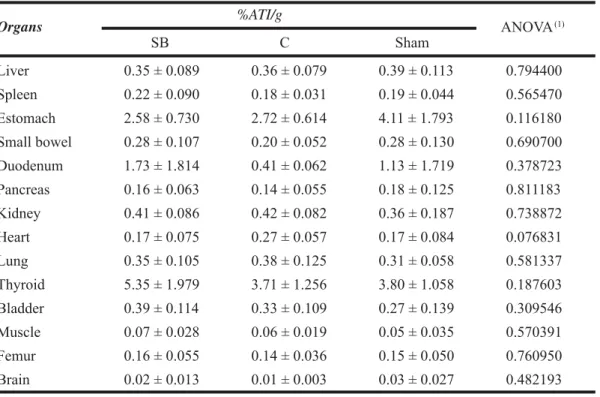
All the animals survived the surgical procedures. Table 1 shows the results of the differences in %ATI/g among groups SB, C and sham. We observed an increase in the biodistribution of Na99mTcO
4 in the thyroid and duodenum
of SB rats, when compared to control rats. However, since the standard deviation was high, there was no signifi cant difference (p>0.05). In the stomach, an apparent tendency for reduced biodistribution of the %ATI/g occurred in the SB rats, compared to sham rats, but without statistical signifi cance (p>0.05). In several organs the percentages of radioactive activity (%ATI/g) had very similar values among the groups, without signifi cant differences (Table
TABLE 1 – Biodistribution of Na99mTcO
4 in the organs of the respective groups
%ATI/g
SB C Sham
Liver 0.35 ± 0.089 0.36 ± 0.079 0.39 ± 0.113 0.794400
Spleen 0.22 ± 0.090 0.18 ± 0.031 0.19 ± 0.044 0.565470 Estomach 2.58 ± 0.730 2.72 ± 0.614 4.11 ± 1.793 0.116180
Small bowel 0.28 ± 0.107 0.20 ± 0.052 0.28 ± 0.130 0.690700
Duodenum 1.73 ± 1.814 0.41 ± 0.062 1.13 ± 1.719 0.378723
Pancreas 0.16 ± 0.063 0.14 ± 0.055 0.18 ± 0.125 0.811183 Kidney 0.41 ± 0.086 0.42 ± 0.082 0.36 ± 0.187 0.738872
Heart 0.17 ± 0.075 0.27 ± 0.057 0.17 ± 0.084 0.076831
Lung 0.35 ± 0.105 0.38 ± 0.125 0.31 ± 0.058 0.581337
Thyroid 5.35 ± 1.979 3.71 ± 1.256 3.80 ± 1.058 0.187603 Bladder 0.39 ± 0.114 0.33 ± 0.109 0.27 ± 0.139 0.309546
Muscle 0.07 ± 0.028 0.06 ± 0.019 0.05 ± 0.035 0.570391
Femur 0.16 ± 0.055 0.14 ± 0.036 0.15 ± 0.050 0.760950
Brain 0.02 ± 0.013 0.01 ± 0.003 0.03 ± 0.027 0.482193
Mean ± Standard deviation
(1) P- from analysis of variance (ANOVA).
The results of the test did not show statistically signifi cant differences (p>0.05), for all the variables. %ATI/g, percent radioactivity per gram of tissue.
Organs ANOVA (1)
TABLE 2 – Jejunal mucosa thickness of rats and their respective groups.
Groups
SB C Sham
Mucosal thickness in μm(2) 334.34 ± 25.9ab 194.40 ± 39.0a 194.22 ± 33.2b 0.0000
Values expressed in Mean ± Standard deviation (1) p-value of analysis of variance (ANOVA).
(2) Groups identifi ed with the same letter differ signifi cantly at a level of 5% (Tukey test). SB = Short bowel; C = control.
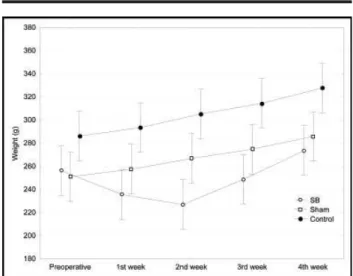
FIGURE 1 – Mean weight of rats in each group and postoperative period; SB, short bowel.
FIGURE 2 – Small intestine morphology and mucosal cell proliferation on day 30 in short bowel (A) control (B) and sham (C) animals. Massive intestinal resection (A) induced signifi cant increases in total mucosal thickness (arrows), when compared to control and sham animals (B, C) (see Table 2; p<0.05). HE, 40x
1). The weight of SB rats decreased during the fi rst and second weeks of survival and, after that, their weight gradually increased until the 30th postoperative day, when
it was nearly the same as the C and SHAM rats, which continually increased their weight over time (Figure 1). The differences in the mean weight of SB rats at the end of the second week were signifi cant, when compared to C and SHAM rats (p<0.05). The presence of an increase in intestinal mucosa thickness was detected in all IC rats, when compared to C and SHAM rats until the end of the observation period, as seen in Table 2 (p<0.05) and Figure 2.
Discussion
The alterations in the biodistribution of Na99mTcO 4
in organs and tissues are very well identifi ed in several studies that used no experimental surgical models 1,,6,,8,13,14.
However, in the postoperative of major surgical procedures, there are no reports concerning the biodistribution of radiopharmaceuticals. The present experimental model of the short bowel syndrome in rats submitted to massive resection of the small intestine was used to determine the biodistribution profi le of Na99mTcO4 in several organs and
tissues. Intestinal failure is characterized by malnutrition and/or dehydration as a result of the inadequate digestion and absorption of nutrients. The most common cause of intestinal failure is short bowel syndrome, which occurs when the functional small bowel mass is reduced below the level necessary for adequate nutrient and water absorption. This condition frequently results from a massive resection of the small bowel. Following resection, the intestine is capable of adaptating in response to enteral nutrients as well as other trophic stimulation. Rodents are commonly used in well-characterized models to assess the process of intestinal adaptation16. Following small bowel resection in the rat,
the remnant intestinal mucosa undergoes compensatory
alterations in an attempt to restore normal absorptive capacity. Morphologic and functional changes include increases in mucosal length, enterocyte proliferation, as well as increased electrolyte, glucose and amino acid uptake16,17.
In humans, the alterations of intestinal absorption due to massive resection of the small intestine usually cause signifi cant weight loss15. However, in rodents, there is
a rapid adaptation of the intestinal mucous membrane, which minimizes weight loss16. These mechanisms of
intestinal adaptation take place at physiologic, cellular and molecular levels and they do not correspond to what occurs in the human intestine 17. Nutrients, electrolytes, hormones,
cytokines and other elements take part in the process, which involves mainly the intestinal mucous membrane. The process begins with apoptosis and continues with an increase in epithelial cells, vilosities and mucosal crypts, and a consequent remodeling of their architecture. Functionally, this allows for increased substance transport through the intestinal mucosa17. In the present study a
adaptations of the jejunum were observed between the
fi rst and second postoperative weeks18. This phenomenon
was also shown in the morphometry of the jejunal mucous membrane of the animals subjected to massive resection of the present study. Therefore, the mucous membrane hyperplasia observed in the jejunal mucosa of the SB rats of the present experiment, likely contributed to the rapid weight recovery of the animals, starting from the second postoperative week. Welters et al (2002) verifi ed that intestinal function recovery begins with the hyperplasia of the intestinal mucosa and that absorptive function depends on the maturity of the enterocytes, a fundamental factor for nutrient metabolism19. The precocious postoperative
recovery of the animals, represented by weight and morphology of the intestinal mucosa recovery, and the healthy behavior of the SB rats, comparable to the controls, certainly contributed to the absence of signifi cant clinical alterations and malnutrition. Consequently, there was no negative effect on the biodistribution of Na99mTcO
4 in the
vital organs. In an experimental study using malnutrition-inducing diets, Passos et al20 (2000) showed that malnutrition
affected the biodistribution of Na99mTcO
4 in different
organs such as the thyroid, brain, stomach and heart. In their study, the intestine was not surgically manipulated. Studies in animals have been investigating substances that regulate the absorptive function of the intestine21. These
mechanisms are mediated by multiple factors, including enteral or parenteral nutrition, hormones and growth factors22. Recently, studies on the use of the human growth
hormone (GH), the epidermal growth factor (EGF) and the glucagons-like peptide-2 (GLP-2), produced in the L-cells of the small intestine, have confi rmed them as agents that increase intestinal adaptation after massive resection23.
The study suggests that, whereas GLP-2 is important in controlling adaptation, there are spatial or regional systems in place that use varying pathways. The signifi cant increase in nutrient-stimulated GLP-2 secretion suggests that GLP-2 is involved not only in the initiation, but also in maintaining the ongoing adaptive process. The increases in mucosal proliferation that are temporally associated with a maintained GLP-2 release, suggest that GLP-2 is important in initiating and maintaining the small intestine’s adaptive response to resection24. Curtis et al (1984) studied
rats submitted to massive resection of the small intestine using marker 51mCrl3mC and protein, and observed the
animals for one week. They concluded that the rats had no alteration in absorption and digestion time when compared to the treated group and the control; this demonstrated the fast physiological adaptation of the animals25. A growing
number of tissue factors are being investigated for having great potential in promoting intestinal adaptation in animals and humans with short bowel syndrome, in the hope of obtaining effective therapies for the syndrome in the future23,26. In summary, massive intestinal resection in
the current study did not interfere signifi cantly with the biodistribution of the radiopharmaceutical Na99mTcO
4 in
the organs studied. Certainly the mucosal hyperplasia of the remnant intestine was a preponderant factor for the quick weight loss reversal of the animals, and consequent preservation of their healthy metabolism. The present study does not allow us to comment on the mechanisms by which intestinal resection results in the stimulation of trophic effects and mucosal adaptation, allowing normal biodistribution of Na99mTcO
4 in rats. Identifying factors
that may enhance the process of intestinal adaptation is an exciting area of research with important potential clinical applications. This area will require further studies.
Conclusion
In rats with experimentally-induced short bowel syndrome, an adaptive response by the intestinal mucosa reduced weight loss. The biodistribution of Na99mTcO
4 was
not affected by massive intestinal resection, suggesting that short bowel syndrome could not be the cause of misleading image interpretation when an examination with this radiopharmaceutical is indicated.
References
1. Mattos DM, Gomes ML, Freitas RS, Rodrigues PC, Nascimento VD, Boasquevisque EM, Paula EF, Bernardo-Filho M. Assessment of the effect of vincristine on the biodistribution of 99Tcm-labelled glucoheptonic acid in female Balb/c mice. Nucl Med Commun. 2000; 21:557-60.
2. Holanda CMCX, Leite RCH, Catanho MTJ, Souza GML, Bernardo-Filho M The effect of glucantime™ on the labeling of blood constituents with technetium-99m. Acta Cir Bras. 2005; 20 (suppl.1):126-30. 3. Kuni CC. Manual of Nuclear Medicine Imaging. New
York: Thieme Medical Publishers; 1997.
4. Castro LF, Silva ATA, Chung MC, Ferreira AG, Ferreira EI. Biofosfatos (BFs) como transportadores osteotrópicos no planejamento de fármacos dirigidos. Quim Nova. 2004;27:456-60.
5. Gomes ML, Oliveira MBN, Bernardo-Filho M. Drug interaction with radiopharmaceuticals: effect on the labeling of red blood cells with technetium-99m and on the bioavailability of radiopharmaceuticals. Braz Arch Biol Technol. 2002; 45: 143-9.
6. Gomes ML, Mattos MMD, Freitas RS, Diré GF, Lima EAC, Souza SMS, Bernardo-Filho M. Evaluation of the effect of mitomicin-C on the bioavailability of technetium-99m-labelled sodium pyrophosphate in mice. Cell Mol Biol. 2002; 48:757-9.
7. Oliveira JF, Avila AS, Braga ACS, de Oliveira MB, Boasquevisque EM, Jales RL, Cardoso VN, Bernardo-Filho. Effect of extract of medicinal plants on the labeling of blood elements with Technetium-99m and the morphology of red blood cells: a study with
8. Mattos D M M, Gomes M L, Freitas R S, Boasquevisque EM, Cardoso VN, Paula EF, Bernardo-Filho M. The effect of vincristine on the biodistribution of technetium-99m-DTPA, GHA and DMSA in balb/c female mice. J Nucl Med Technol. 2000; 28:271-4.
9. Zhou X, Li YX, Li N,Li JS. Effect of bowel rehabilitative therapy on structural adaptation of remnant small intestine: animal experiment. World J Gastroenterol. 2001;7:66-73.
10. Tannuri U. Síndrome do intestino curto na criança - tratamento com nutrição parenteral domiciliar. Rev Assoc Med Bras. 2004;50:330-7.
11. Bianchi A. Intestinal loop lengthening: a technique for increasing small intestinal length. J Pediatr Surg. 1980; 15:145-51.
12. Iyer K, Kaufman S, Sudan D, Horslen S, Shaw B, Fox I, Langnas A. Long-term results of intestinal transplantation for pseudo-obstruction in children. J Pediatr Surg. 2001; 36:174-7.
13. Santos-Filho,SD, Bernardo-Filho,M. Efeito de um extrato de Hipérico (Hypericum perforatum) na marcação in vitro de elementos sangüíneos com tecnécio-99m e na biodisponibilidade do radiofármaco pertecnetato de sódio em ratos Wistar. Acta Cir Bras. 2005;20 (suppl.1):121-5.
14. Holanda CMCX, Leite CH, Nunes RAS, Oliveira HA, Catanho MTJ, Souza GM, Bernardo-Filho M. Effect of antimalarial drugs on the bioavailability of the methylenediphosphonic acid labeled with technetium99m (99mTc-MDP) in Wistar rats. Braz Arch Biol Technol. 2006; 49:207-14.
15. Goulet O, Baglin-Gobet S, Talbotec C, Fourcade L, Colomb V, Sauvat F, Jais JP, Michel JL, Jan D, Ricour C. Outcome and long-term growth after extensive small bowel resection in the neonatal period: a survey of 87 children. Eur J Pediatr Surg. 2005; 15:95-101.
16. O’Connor TP, Lam MM, Diamond J. Magnitude of functional adaptation after intestinal resection. Am J Physiol Regul Integr Compar Physiol. 1999; 276: 1265-75.
17. Drozdowski L, Thomson ABR. Intestinal mucosal adaptation. World J Gastroenterol. 2006; 12: 4614-27. 18. Hanson WR, Osborne JW, Sharp JG. Compensation
by the residual intestine after intestinal resection in the rat. II. Infl uence of postoperative time interval. Gastroenterology. 1977; 72:701-5.
19. Welters CFM, Dejong CHC, Deutz NEP, Heineman E. Intestinal adaptation in short bowel syndrome. ANZ J Surg. 2002; 72: 229–36.
20. Passos MC, Ramos CF, Bernardo-Filho M, Mattos DMM, Moura EG. The effect of protein and energy restriction on the biodistribution of Na99TcmO
4 in Wistar
rats. Nucl Med Commun. 2000;21:1069-62.
21. DiBaise JK, Young RJ, Vanderhoof JA. Intestinal rehabilitation and the short bowel syndrome: Part 2. Am J Gastroenterol. 2004;99:1823–32.
22. Spadoni JM, Aguilar-Nascimento JE, Silva MHGG, Spadoni-Neto B, Costa PATFB, Aléssio DMT. Effects of the combined use of glutamine and growth hormone in the intestinal adaptation after massive resection of the small bowel in rats. Acta Cir Bras. 2005; 20:382-9. 23. Cisler JJ, Buchman AL. Intestinal adaptation in short
bowel syndrome. J Invest Med. 2005; 53:402-13. 24. Martin GR, Wallace LE, Hartmann B, Holst JJ,
Demchyshyn L, Toney K, Sigalet DL. Nutrient-stimulated GLP-2 release and crypt cell proliferation in experimental short bowel syndrome. Am J Physiol Gastrointest Liver Physiol. 2005;288:431–8.
25. Curtis KJ, Sleisenger MH, Kim YS. Protein digestion and absorption after massive small bowel resection. Dig Dis Sci. 1984; 29:834-40.
26. Drucker D, Ehrlich P, Asa SL, Brubaker P. Induction of intestinal epithelial proliferation by glucagon-like peptide 2. Proc Natl Acad Sci USA. 1996; 93:7911–6.
Correspondence:
Dâmaso de Araújo Chacon
Rua Almte. Nelson Fernandes, 797/1200 59022-600 Natal - RN Brazil
How to cite this article
Chacon DA, Araújo-Filho I, Villarim-Neto A, Rego ACM, Azevedo IM, Bernardo-Filho M, Brandão-Neto J, Medeiros AC. Biodistribution of the radiopharmaceutical sodium pertechnetate (Na99mTcO
4) after massive small bowel resection in
rats. Acta Cir Bras. [serial on the Internet] 2007 Nov-Dec;22(6). Available from URL: http://www.scielo.br/acb
*Color fi gures available from www.scielo.br/acb
Confl ict of interest: none Financial source: CNPq