•
•
FUNDAÇÃO GETULIO VARGAS
セセ@
FGV
EPGE
SEMINÁRIOS DE ALMOÇO
DA EPGE
Do equity and foreign currency risk
premiums display commmon patterns?
PAULO ROGERIO FAUSTINO MATOS
(EPGE/FGV)
Data: 24/11/2006 (Sexta-feira)
Horário: 12 h 15 min
Local:
Praia de Botafogo, 190 - 11
0andar
Auditório nO 1
Coordenação:
•
•
•
Do llisk Premiums in the Equity and the Foreign Currency
Markets Display Common Patterns?
Carlos E. da Costa,
Paulo Rogério F. Matos,
Getulio Vargas Foundation
Getulio Var:qas Foundation
November 22, 2006
Abstract
In da Co"ta et al. (2006) we have shown how a same pricing kernel can account for the exces" returns of the S&:P500 over the US short term bond and of the uncovered over the covered trading of foreign government bonds. In this paper we estimate and test the overidentifying restrictiom; of Euler equations associated with "ix different versions of the Consumption Capital Asset Pricing I\Iodel. Our main finding is that the same (however often unreasonable) values for the parameters are estimated for ali models in both nmrkets. In most cases, the rejections or otherwise of overidentifying restrictions occurs for the two markets, suggesting that success and failure stories for the equity premium repeat themselves in foreign exchange markets. Our results corroborate the findings in da Costa et al. (2006) that indicate a strong similarity between the behavior of excess returns in the two markets when modeled as risk premiums, providing empirical grounds to believe that the proposed preference-based solutions to puzzles in domestic financiaI markets can certainly shed light on the Forward Premium Puzzle.
JEL Code: G12: G15
Keywords: Equity Premium Puzzle, Forward Premi um Puzzle, CCAPM. Habit Formation, Ex-ternaI Time-varying Reference Consumption Level.
1
Introd uction
Two of the most famous puzzles in financiaI economics are the Equity Premium Puzzle-EPP-and The Forward Premium Puzzle-FPP.
The EPP, commonly associated with the works of Ransen and Singleton (1983) and :rvIehra and Prescott (1985), is the failure of the traditional Consumption Capital Asset Pricing-CCAP1'vI-to account for the excess return of stock market with respect to the risk free bond in the United States, with reasonable preferenc:e parameters. The FPP. 011 the other hand. relates to the differenc:e between
"
•
expectations and risk neutrality.l More important for our purposes is the failure of the canonical CCAPM to generate a pattern of prices for risk that couid explain the FPP being only related to the implicit risk neutrality assumption.
Despite the skepticism about risk based explanations for the FPP from part of the literature, in da Costa et aI. (2006), we try to relate the puzzles. We are not able to reject that the same stochastic discount factor-SDF-that explains the equity premium also explains the forward premium. We do not use a model to investigate the puzzles. Instead we use statistical methods to extract a time series for the realized SDF and show how the moment restrictions on discounted excess returns on both equity and forward markets are not rejected. Excess returns in both markets are simply a premium for risk, if we accept the covariance with the SDF as the right measure of risk.
Because we do not spelI out a fulI specified model it is hard to justify our calling the covariance of returns with the SDF as a risk measure. In this paper, we take the discussion of the previous paper one step further by evaluating the performance of different models in pricing excess returns for each market. Once again, our goal is not to find a model that solves alI the problems. Rather, our concern is to verify if the same failures and successes attained by the CCAPM in its various forms in pricing the excess returns of equity over short term risk-free bonds will be manifest in the case of forward exchange markets.
We estimate and test for the two markets six different consumption-based asset pricing models using the Generalized Method of l\loments-Gl\{I'vl: the canonical CCAPM, Abel's (1990) catching
up with the Joneses, Abel's (1999) keeping up with the Joneses models, Epstein and Zin's (1991)
recursive utility specification, CampbelI and Cochrane's (1999) slow-moving habit formation model and a simplified version of Garcia's (2006) model which nests CampbelI and Cochrane (1999) and Epstein and Zin (1991) for an appropriate choice of the state variables. For the equity market we test the excess return of the S&P500 over the short-term American government bond, while for the foreign exchange markets we consider the excess return on the uncovered over the covered trading of Canadian, German, Japanese and British government bonds jointly.
As for the instruments used to generate the over-identifying restrictions that are tested in our procedure, for both puzzles, we use the same set of macroeconomic instrumental variables proven to be useful in forecasting the SDF. We also use lags of the real returns in question as the financiaI variables, specific for each puzzle. This procedure alIows us to verify the robustness of the empirical results anel the common pattern of the equity anel foreign currency premiums. In order to analyze the preelictability power of the forwarel premium pointed as a specificity of the FPP, we aIs o use lags of this variable insteael lags of the returns in question as financiaI instruments.
I3riefiy, accoreling to our results, i) we can evielence the importance of the absolute value of the past and current aggregate per capita consumption, when used as a reference leveI in the utility function for both puzzles. ii) breaking the tight link between the coefficient of relative risk aversion anel the
,
"
elasticity of intertemporal substitution alone can not explain none of the puzzles, but iii) when besides this separation, is also considered a slow-moving externaI habit, theu for both puzzles the agent really seems to derive utility from the leveI of consumption relative to this benchmark in ratio and also in difference.
Our main findings are: i) the evidence of the strong similarity between the behavior of these excess returns when modeled as risk premiums, which allows us to provide empirical grounds to believe that the proposed preference-based solutions to puzzles in domestic financiaI markets can certainly shed light ou the FPP and ii) the prominent role played by the forward premium, relative to lags of real returns in question, as instrument in a externaI habit formation approach explanation of the FPP.
In particular, we show that the generalized version of the model developed by Campbell and Cochrane HQYYYIセキゥエィ@ low interest rates. roughly i.i.d. consumption growth with small volatility and acceptably low values of risk aversion-is able to explain not only the high market Sharpe ratio that characterizes the EPP and but also the predictability of the foreign government bond returns.
The remainder of the paper is orgallized as follows. Section 2 gives an account of the literature that tries to relate the two puzzks. Section 2.1 discusses some characteristics of early work with consumption based model エイセGゥャャァ@ to ('lllpllilsize the reasons why they have encountered difficulties in
explaining the stylized facts. Se('t i()ll セLャL@ 1 describes in details the features shared by most externaI habit formation models that a<1<1I<'" tIl!' [1'1'. Finally, in section 3, the empirical exercise is performed, testing all these Euler equatioll" Il'it 11 (;\1\1. ScctiOll 4 analyses the results in order to support that the equity and the currency foreigu ri,j; 11I('lllilllWi have a similar behavior in a preference-based approach. Conclusion is the last sectiOll.
2 Literature Overview
2.1 Economic Theory, and thc equity and foreign currency risk premiums
2.1.1 Stochastic Discount Factor and Asset returns
It is now a well known fact that. givell free portfolio formation, the law of one price is equivalent to the existence of a SDF through Riesz representation theorem.
Following Harrison and Kreps (1979) and Hansen and Richard (1987), we write the asset pricing equations,
(1)
and
(2)
Here. lEt (.) denotes the cOllditional expectation given the information available at time t. rセKャ@
",
'lO the SDF, a random variable that generates unitary prices from asset returns. Under no arbitrage, we
can further guarantee that there exists a strictly positive SDF that correctly prices the returns of alI assets.
An immediate consequence of (2) is that excess returns are explained by the way in which returns covary with the SDF, in fact, if we take Rj to be the return on the risk-free asset, Ri, equation (2) can be expanded to read
(3)
It is then, usual practice to interpret the excess expected return as a risk premi um and the covariance in the right hand si de of (3) as the relevant measure of risk. Using this interpretation, da Costa et aI. (2006) have shown that one can use the same measure of risk to explain the equity and the forward premiums. An important question remains open, however: what does this measure of risk measure? Without a model that generates Jv1t+1 from the primitives (preferences, endowments,
technologies. etc.) of the economy the meaning of this covariance term is somewhat elusive. Not surprisingly. it is the main purpose of alI research in finance economics exactly to find a model capable of generating A1t+1 from the primitives of the economy. It is aIs o the failure of most attempts to find such a model that defines most of the puzzles in finance theory.
We shalI in the rest of this section present some of the models for 1.1t+1 written in the past quarter
of century and discuss their main features and drawbacks. We shalI refrain from discussing mo deIs that try to account for puzzles by incorporating market incompleteness. We do so not because we think that this in not an important issue, but because folIowing this path requires a completely different consumption data set, which we leave for later work.
2.1.2 The consumption capital asset pricing model
The single most important advance in asset pricing from an economist 's perspective was the de-velopment of the consumption capital asset pricing model associated with the names of Lucas (1978) and Breeden (1979).2
Consider an economy endowed with an infinitely lived representative consumer whose preferences are representable by a von Neumann-Morgenstern utility function. It is not hard to show that the SDF is simply the growth of the representative agent's marginal utility of consumption.
FormalIy, the first order conditions for the choice of an optimal consumption and portfolio of this investor, with exogenously specified utility function who faces exogenous asset return process, yield
[
Ui (Ct+d i. ] '-'"
1
=
pIEt Ui ( Ct) Rt+ 1 v "
(4)
and, consequently,
(5)
"Kocherlakota (l()!)(j). for iJlstallce. arglles that. frOlJl all academic eCOllOmist"s perspecti\·e. this Illudel is mo]"e
•
where (3 E (0,1) is the subjective time discount factor in the representative agent's utility function and, in equilibrium, Ct represents aggregate consumption at time
t.
Equations (4) and (5) are consistent with equations (1) and (2) if we define the SDF at time t
+
1, as111
=
(3u'(Ct+1 )t+l - u'(Cd' (6)
At first, and considering the very restrictive conditions under which aggregation is possible, one may wonder whether such model is not too off the mark to be taken seriously. It turns out that-see Constantinides (1982)-if markets are complete and agents have von-Neumann Morgenstern prefer-ences, aggregation is not needed for the existence of a representative agent.3 This is true even if
individuaIs are heterogeneous in preferences and in leveIs of wealth. Moreover, the representative individual's relative risk aversion is no larger than the most risk averse individual and no smaller than the least risk averse individual. The logic is easy to grasp. Perfect risk sharing, which is what complete markets allow for, requires equalization of marginal growth of consumption across agents in all states of the world.
2.1.3 The canonical consumption-based model and the asset pricing puzzles
Once we have decided that we are going to rely on a representative agent framework, a first important issue to de aI with is the specification of utility for this investor. The observation that interest rates and risk premiums have remained stationary over more than a century of US economic growth suggests the use of a few specifications among which the most popular is the time-separable power utility defined over aggregate consumption, Ct,!
(7)
In this case, equation (5) can be rewritten as
t+l i j
[(C
)
-U1
0= lEt
-c:
(Rt+l - Rt+l) (8)This utility function has some other important properties: it is scale-invariant and if agents in the economy have different leveIs of wealth but have the same power utility, then this will also be
:\This statemeut requires some qualificatiou. The sense iu which a representative agent is defined here is not the one proposed by Gormau (1953). There. oue asks whether an aggregate fuuction that cau be rationalized as the choice of a representative consumer exists for au,' distributiou of wealth. Here. the distributiou of wealth is giveu by a function that maps aggregate wealth to individual wealth. \Vhat Constautinicles (1982) shows is that. with complete markets. the implied fuuctiou ernulates in the aggregate demaud functiou ali the propertieo implietl 「セᄋ@ the choices of a rational ageut.
セs・ー@ e.g. Samue!sou (1969). Rubinsteiu (1976). Lucas (lD78). I3reeden (1D79). Grossmau autl Shiller (lD81) émd
•
the utility function of the representative agent. Although it has been extensively used in finance literature due to its empirical, analytical and intuitive convenience. it really does not work well in practice, there being many evidences of its incapability to account for important stylized facts. The equity and the forward premium puzzles are two of the most famous and reported empirical failures of this consumption-based approach.To give a summary account of the theoretical and empirical issues related to the EPP and the FPP, let this representative agent be an American investor who can freely trade American and foreign assets, besides having access to forward and spot exchange rate markets .. 5
The consumption Euler equation (8) is useful to access the EPP, if one takes assets i and j to be
S&P500 index and the short-term American government bond.
When analyzing the FPP. the relevant assets are the covered and uncovered trade of a foreign government bond. The real returns ou these foreign assets in terms of the representative investor's numeraire can be written イ・ウー・」エゥョセャセG@ as
and (9)
where tFt+l and St are the f 01"\\',11"<1 ,Illc! sjlot prices of foreign currency in terms of domestic currency,
Pt is the dollar price leveI alltl
i;
!'('jl]"('S"lllS nominal net return on a foreign asset in terms of theforeign investor's preferences. II j". I 11('1l. jlossible to express the consumption Euler equation of the
excess returns of uncoverecl m','! ("U'II'c! op('ration with foreign bonds as
(10)
along the lines of Lucas' HQYWセQ@ IlIt"kl.
Most tests reported in th(' lill'r:tl ml' an' IlHsed on over-identifying restrictions on estimations that
use Hansen's (1982) Generaliz,'c! \11'1 lIot! oI' \Ioments (GMM). With regards to the FPP, the results obtained in Mark (1985) anti Hot!li .. k ( 1 AIセiI@ ) l'('])ort values of the coefficient ofrelative risk aversion, a,
above to 40 and 60, イ・ウー・」エゥカ・ャセGN@ \\'hil(' Engel (1996) reports some estimates for í in excess of 100. The findings in the case of EPP are similar. in the sense that in both cases the estimated values are above 10, which is viewed as unacceptable and unreasonable, according to Krugman (1981), Mehra and Prescott (1985) and Romer (1995).
It is beyond the scope of this papel' to give a full account of the large body of research produced in the area, we must however call into attention the fact that in both cases an extremely high coefficient of risk aversion is estimated in both cases. Part of our story will be to ask whether the same values for the parameters of different models are needed to account for both puzzles. This is not the whole story, however. Even if we are willing to accept the 'unrealistic' values for the relevant parameters,
the over-identifying restrictions may be rejected. We may then check whether the circumstances in which one model is accepted (or rejected) are the same for the two markets.
There is some skepticism with this regard since the risk premiums involved in these different financiaI markets have their specificities: the high Sharpe ratio related to the equity premium and the predictability of foreign currency excess returns based on the respective forward discount. In da Costa et aI. (2006) we have shown that the same l'vlt+l is able to account for risk premium in both markets. We sha11 now investigate in detail the relative performance of different consumption based models to explain these features. Before doing so, let us briefty describe some stylized facts regarding both markets.
Stock markets commonly show familiar patterns. Observing the US quarterly data over the period 1977:1 to 2004:3, the summary statistics reported in the table 1 are in accordance with the data widely reported in the literature. The average real return on S&P500 has been 8.67% at an annual rate, while the real return on 90-day Treasury bill has been 1.76% per year. Clearly, real stock returns are much more volatile than the US Treasury bill, which is risk-free in nominal terms. Its annualized standard deviation are, respectively, 16.02% and 1.61 %.6 We then observe an annualized Sharpe ratio for the US stock market equal to 0.44. which implies this value as the lower bound of the standard deviation for the SDF. Certainly, a very large value for the SDF, a random variable whose mean must be dose to one and whose lower bound is zero.
Since our representative agent can freely trade domestic and foreign assets and since the SDF relates a11 payoffs to market prices, which necessarily indudes both uncovered and covered trading of foreign government bonds. should not be important, or even possible, to reconcile the characterization of the SDF provided by foreign government bond-market data with the evidence from US stock-market data?
Over this same period. the real return on covered trading of Canadian, German, Japanese and British government bonds show mean and standard deviation quite similar to the American 90-day Treasury bill one, which is reasonable, since it reftects the covered interest rate parity in a frictionless economy. Regarding the return on uncovered trading, the means are ranging from 2.47% to 4.70%, while the standard deviation from 5.44 IJ(1 to 12.91 %. For these foreign bonds. we have that the Sharpe ratios for the uncovered trading of foreign bonds range from 0.04 to 0.28.
Shiller (1982), Hansen and Jagannathan (1991) and Cochrane and Hansen (1992) relate the EPP to the volatility of the SDF, or equivalently the volatility of the intertemporal marginal rate of sub-stitution of a representative investor required to match Sharpe ratio of the stock market. Since the higher the Sharpe ratio. the tighter the lower bonnd on the volatility of the SDF, when we observe these stylized facts of the Arnerican dornestic and foreign government bond markets, should we con-sider thern as an evidence that if we were able of writing down a mo deI that consistently generated a SDF that accounts for the EPP. this mo deI would also explain the FPP? Bearing in mind the fact
OI that an extremely high risk aversion leveI in the canonical approach for both markets we ask whether
there would be other similarities between these risk premiums when other preferences are considered? The main difficulty one must face in order to answer this question is the non-existence of a widely accepted model capable of generating the observed behavior of A1t+l' On the one hand, we have the poor performance of the canonical CCAPM as evidenced by the FPP and the EPP, while on the other, we have the still incipient discussion of the underlying assumptions (and empirical consequences) of more successful consumption models as Campbell and Cochrane (1999) and Garcia (2006).
Given our purposes, of simply relating the puzzles, both the successful stories and the failures are useful. The fact that the same unacceptably high risk aversion is needed to account for the two puzzles in the case of the canonical CCAPM help us relate the two puzzles quite as much as the finding of a reasonably low parameter that accounts for the two.
Finding mo deIs that produce non-acceptable values is easy. As for the successful ones a natural route is to use the externaI habit formation mo deIs which, in some versions, has proven to be able to account for the EPP and check whether it works for the FPP. In the next few pages we describe some of the properties of these models.
2.1.4 ExternaI reference leveI consumption-based mo deIs
The habit formation literature emerges as a natural attempt to capture some features of the consumption behavior, such as the effect of today's consumption on tomorrow's marginal utility of consumption, or in macroeconomic terms, the perception that recessions are so feared even though the recession period may not be one of the worst periods in the history. The major theoretical papers on this subject are Ryder and Heal (1973), Sundaresan (1989), and Constantinides (1990).
The main issue to be addressed in this framework is the specification of state variables that will be incorporated in the utility function of the agent, playing the role of a reference consumption leveI. When the state variable, Xt, depends on an agent's own consumption and the agent takes it into account when choosing how much to consume, then we have a standard internaI habit model, such as those in Sundaresan (1989) and also Constantinides (1990). When this habit depends on variables which are unaffected by the agent's own choice, rather depending on what others do, we are dealing with all externaI habit modeI. The literature based on this latter framework is rather extensive, including the works of Abel (1990), Abel (1999) and Campbell and Cochrane (1999), to name a few. We willlimit our analysis to the externaI habit models,7 for simplicity, since our intent is to explore two other common features of the habit framework when dealing with equity and foreign currency risk premiums.
When modelling habit formation the first thing we must decide is whether to use ratio or
ence.8 In the first case, with constant risk aversion, the standard time-separable power utility function
becomes
(11)
where a is the curvature parameter for relative consumption, while 1 - cp assumes this same function for the benchmark leveI.
In the second case, i.e., when one is considered with the difference in consumption with respect to the reference leveI, the same preferences yield
(C X) 1 (C )1-n X'P
U t, t = ( ) t - Xt t .
1 - a cp (12)
The second feature is related to the speed with which habit reacts to aggregate consumption, where this habit can depend on current andj or lags of the reference consumption leveI or it can still reacts only gradually to changes in the benchmark.
In the next subsections we describe in details the modeling strategies of the consumption reference leveI used in this paper, proposing possilJle extensions of these models and establishing how the presence of this benchmark changes the respective Euler equations.
Catching-up with the Joneses First, we start following the Abel's (1990) catc1úng up with the
Joneses model, one of the most traditional and mentioned habit formation approaches. This ratio
modeL which was initially introduced in order to account for the high observed value for the equity premium, assumes that the habit leveI depends only on the first lag of aggregate consumption, denoted by C.
It is easy to see this formulation as a special case of the equation (11), where cp = O and the leveI habit is given by Xt = cセ⦅iG@ which enalJles us to rewrite it as
1 Ct
( )
1-a
u(Ct )
=
(1 - a)cセ⦅Q@
(13)Since, in equilibrium the relation Ct+1
==
Ct+1 holds, we have that the SDF can be defined asMeJ - (3 セ@ _t_,
( C )
-a ( C ) "(0'-1)
t+l - Ct Ct -1 (14)
Note that the special case with '"
=
O corresponds to the standard time-separable model, while'" =
1 corresponds to the catching up with the Joneses model, where only relative consumption matters to the agent. In our estimation exercise, we follow Fuhrer (2000) in not imposing any restriction to the values of this parameter. Our intent is to figure out whether the absolute reference leveI matters to the representative agent and whether the agent is of the jealous or patriotic kind.'There might llot be a clear ftllS,,"er t.o tJw CjnestioIl of whieh Olle is opt.illlal for eaeh case, sillee both lllOdels ccm he
•
Keeping-up with the Joneses Starting with the Abel (1990) model is an interesting choice for it has many possibilities of extension. To disentangle the relative risk aversion from the elasticity of intertemporal substitution and to deal with a problem that appears when this model is used, namely, the high volatility of the risk-free rate of return, Abel (1999) assumes that the agent may take into account not only the information available to him at timet,
but also some information available at timet
+
1, when he forms his reference consumption levei, Xt+l . More specifically, this framework capturesthe notion that the agent's benchmark levei depends on current and recent leveis of consumption per capita, given by the increasing function
x
t = e'C" (Gt t-I t ),) , (15)where O ::; I ::; 1, O ::; セ@ ::; L O ::; TI ::; 1 and G
2:
1, which allows for the possibility that the benchmark levei grows simply with the passage of time. The special case with セ@>
O and I=
TI=
O corresponds tothe simple formulation of catching up with the Joneses in Abel (1990) and when I
>
O and セ@=
TI=
O, we have the Gali's (1994) specification of consumption externalities.Once again, we consider cp
=
O, so that this formulation is a special case of equation (ll) where the utility is given by(16)
Since, in equilibrium the relation Ct+1
==
Ct+1 holds, we have that the SDF now can be defined as(17)
With regards the parameters involved in this Abel (1999) preference specification, there are two important issues to be mentioned. First, there are six parameters (3, G, TI, 。Lセ@ and I that affect the SDF. but only three of them are independent parameters, which implies that, relative to the power utility the current framework introduces only one additional degree of freedom. Second, although this fact allows for a variety of interpretations of preferences, our analysis will consider the Abel's (1990) estimation results.
One of the main consequences of considering a contemporaneous reference levei is that it allows for disentangling risk aversion and intertemporal elasticity of substitution. We shall return to this after discussing Epstein and Zin's formulation.
2.1.5 Epstein-Zin utility specification
..
to accept too low an intertemporal marginal rate of substitution, the consequence of which is the appearance of a risk-free puzzle whenever one is willing to accept the high coefficient of relative risk aversion that is needed to correctly price the equity premium. To avoid this trap a successful model must disentangle the two.This is accomplished within the framework of Epstein and Zin (1991) and Weil (1989) who, building on the work of Kreps and Porteus (1978), define more general (than von-Neumann Morgenstern) preferences which: i) preserve many of the attractive features of power utility as the scale-invariance;
ii) break the tight link between the coefficient of risk aversion and the elasticity of intertemporal substitution as in Abel (1999), and; iii) provide an amplified permanent component of the SDF, satisfying the Alvarez and Jermann's (2002) criticism of the lower bound of the size of this component term.9 The key of this current approach is the link between the reference leveI and the return on the
market portfolio.
The Epstein-Zin objective function can be written as
"
u(Ct,IEt(Ut+d)
=
[(1-
f3)C/-;;n+
ヲSHieエHuエQ[エIIセ}@
y::-;;- , (18)where 1) = (1 - Ct) / (1 - p) and l/pis the elasticity of intertemporal substitution. In the special case with p
=
ex one can recover easily the time-separable power utility.One important fact to bear in mind is that the Epstein-Zin non-expected recursive utility specifi-cation is observationally equivalent to the ratio habit formation model given by equation (11) if one assumes that
(Xt+1 ) 1
log X
t
=
1-cp log(RJ\1.t+1)+w,
(19)where w is a constant and RlII.t+1 is the US real gross return on the market portfolio. The proof of this equivalence as well as the intuition of this assumption can be see in details in Garcia (2006).
Using this equivalence or the assumption that the investor has no labor in come and lives entirely off financiaI wealth. one is able to show that the SDF can now be written as
AfEZ - f3 セ@ R(p-a)/(l- p)
(
C ) p(n-1)/(1-p)
t+1 - Cf 1II.t+1· (20)
2.1.6 Campbell and Cochrane habit formation
Several papers have followed Abel (1990, 1999) in proposing ratio models where the habit depends on the current or on some lags of aggregate consumption. These mo deIs however fail to account for some other "recent" stylized facts of the stock market, as the predictable variation in stock returns, pointed as an important source of stock market volatility.
An alternative and promising route to explain this variation predictability is to assume that the price of risk c:hanges through time. Campbell and Cochrane (1999) built a model where the habit
!)Alymez anel ./PrIllR.llll·' (2()(I2) arglle, t!Int llsillg SDF as a fUllctioll oI" ullI,' CUllSllIllptiull elata it i, IlU! possihle to
leveI responds only gradually to changes in consumption, giving emphasis on the role played by a time-varying risk aversion. This model makes the volatility of the SDF vary in a stochastic fashion with the business cycle pattern allowing for a understanding of stock market volatility and the high equity premium.
Campbell and Cochrane (1999) assume that the power utility of the representative agent is a function of the difference between his own leveI of consumption and a slow-moving habit, or a time-varying subsistence level. Consequently, as consumption declines toward the habit in a business cycle trough, the curvature of the utility function rises, so risky asset prices fali and expected returns rise. The key aspects responsible for the empirical success of this approach will become more clear as we describe the main features of the model.
First, the utility function is a special case of the utility given by (12) with cp = O.
Second, let St
==
(Ct - X t ) / Ct denote the surplus consumption ratio. This variable captures therelation between consumption and the habit leveI, so the closer its value is to one, the better is the state. Note that the curvature of the utility function, rlt, is now time-varying and it can be related to the surplus consumption ratio by 7)t
==
a/St, which implies a higher local curvature in the worst states. Since the model adopts an externaI habit specification in which habit is determined by the history of aggregate consumption, define St==
(C t - Xt ) / C t. Once again, note that in equilibrium therelations Ct+1
==
Ot+1 and St+1==
St+1 hold. which enables us to rewrite the SDF as(21)
Third, with regards the consumption growth, this process is modeled as an independently and identically distributed (i.i.d.) lognormal process, 10
(22)
where the variables in small letters are the logs of the variables in capital letters.
Finally, in order to specify how each individual's habit Xt responds to the history of aggregate
consumption C, let the log surplus consumption ratio St = In(St) evolves as a heteroskedasticity AR( 1) process,
(23)
where
qy,
S and 9 are the parameters that correspond respectively to the persistence coefficient, the surplus consumption ratio steady state and the mean of the log consumption growth.11 The À(8t)term, labeled sensitive function, is specified following
IOThe CampLell aud Cochralle (I!!!)!)) lllodel cau also aCCOllllllodate more cOlllplex cOllsumption processes. including processes with predietaLilitr. conditiollal heteroskedasticity. and オoャュッイiャャrャゥエセᄋN@
..
(24)
where Srnax
==
S+
セ@
(1 -S)
and S = IIJ
/!_<p
in order to produce a constant risk-free rate and to restrict habit behavior to keep the specification dose to the traditional and sensible notions on habit. One of the main purposes of the Campbell and Cochrane (1999) model, which has infiuenced the choice of the sensitivity function and of the parameters, is to guarantee the constancy of the risk-free rate.
2.1. 7 Generalized Campbell and Cochrane mode}
Reference models such as that of Cochrane and Campbell (1999) assume that agents derive utility from the relationship between their private consumption and the reference leveI. They do not allow for the reference leveI to directly affect utility.12 In a recent paper, Garcia (2006) have found evidence that the reference leveI plays an independent role in the agent's utility function. We follow them in proposing an extension of Campbell and Cochrane (1999) model in which the agent derives utility from its own leveI of consumption relative to the reference leveI both in the ratio and in difference forms. This more general framework is a special case of the setting proposed by Garcia (2006) with
cp=a-l.
In our generalized setting, the utility function and the SDF can be written respectively as
(25)
and
(26)
3
Empirical application
In this section, we estimate the Euler equations derived from the six consumption-based models
described in section 2. Our intent is to either validate or better understand the reasons for the empirical failure of each preference specification, first for the excess return on the S&P500 over the short-term American government bond and, second, for the excess returns on the uncovered over the covered trading of Canadian, German, Japanese and British government bonds jointly.
We first describe the details and sources of the data that is used. Next, we discuss the estimation procedure in light of the identification issues surrounding the preference parameters. vVe shall also try and justify the criteria used in the choice of the instrurnents.
12This lllea!lS tlla! a higller GDP does !lO! Illakp age!lb llHl'pier if the:_ do !lot lmve !heir illCOllles illcrease lllOre tlmll
·
3.1
Data and instruments
In principIe, whenever econometric or statistical tests are performed, it is preferable to employ a long data set either in the time-series or in the cross-sectional dimensiono There are some obvious limitations, especially when the FPP is concerned, the main one being due to the forward rate series, since a sufficiently large time-series is hardly available1:3. Regarding the EPP these limitations are less severe. In order to have a common sample we covered the period starting in 1977:1 and ending in 2004:3, with quarterly frequency. We collected foreign exchange data for the following countries: Canada, Germany, Japan, U.K. and the U.S.
When testiug the EPP or the FPP we ueed first to compute excess returns rセ@ - rセN@ On that regard, our data set is composed of the following. To study the EPP we used the US$ real returns ou the S&P500 and on 90-day T -Eill. To analyze the FPP, we used the US$ real returns ou short-term British, Cauadian. German and Japanese government bonds, where both spot and forward exchange-rate data were used to transform returus denominated in foreigu currency into US$. The forward exchange-rate series were extracted from the Chicago Mercantile of Exchange database, while the spot rate series were extracted from Bank of Englaud database.
As for macroeconomic variables. we have used the consumer price index of services and nondurable goods in the US in order to compute the U S$ real returns besides the seasonally adjusted US per capita consumption of services and nondurable goods and US per capita gross domestic product. All of these variables were extracted from FED's FRED database.
The final ingredient for testing these two puzzles consists in the additional variables used in or-thogonality tests. In choosing these instrumental variables. we follow Mark (1985), since we believe that the instruments he used, which are macroeconomic and financiaI variables observed at time t
by all agents, are alllong the most illlportant variables used in forecasting, respectively, the SDF and the returns in questiono Consequently, this set may be capable of characterizing the conditional distribution of the discounted excess returns.
For the equity premium, we use the instrulllent sets IS1 and IS2 , given respectively by
IS1: Two ャ。ァセ@ of the real US$ returns on S&P500 anel on the !lO-da! T-Bill
antI three lags of real coオセ|ャャャャーエゥHIョ@ anel real GDP growth イ。エ・セN@
IS2: Three lags of the real US$ retums ou S&P500 antI on the 90-day T-Dill
antI three lags of real cOllsUlnption anel real GDP growth rates.
For the foreign currency premiums, we use the instrument sets IS3 and IS4 , given respectively by
IS3: Two lags of the real US$ returns on the 90-day T-DiII and on uncovered traeliug of short-term Dritish, Cauadiau, German, anel Japanese governrllent bonds and
three lags of real consumptiou and real GDP growth rates.
IS4: Three lags of the real U S$ returns ou the !lO-day T -DiII and on uncovered trading of sllOrt-terrn Dritish, Canadian. Gerrllau. auel .Japauese governlllent bonds anel
three lags of real consumption and real GDP growth rates.
This procedure allows us to verify the robustness of the empirical results and the common pattern of the equity and foreign currency premiums,11
In order to analyze the predictability power of the forward premium pointed as a specificity of the
FPP, we also use the instrument sets IS5 and IS6 , given respectively by
ISs: The curreut aud the firs!. lag of the forwarel prerniums on the currencies in question and three lags of real consumption' and real GDP gro\\'th rates.
IS6: The curreut, the fir;;t and the secouel lag;; of the forwarel premiuIll;; on the currencies in question anel three lags of real consumption anel real GDP growth rates.
3.2
Estimation
In order to evidence the common pattern displayed by the equity and the foreign currency risk premiums based on a representative agent approach, we start by testing and estimating the Euler equation derived from the canonical consumption modeL which works as our benchmark To better understand the behavior of the equity premium, the pricing error on the excess return on the S&P500
over the short-term American government bonel is minimized with the Hansen's (1982) Generalized Method of l\loments (GMl\I). For this case the Euler equation is given by
]E,
[(CI+,l)
-o (RsP - RTb
)]
=
O,I C
t
t+l t+1
(27)al1d the sets of instruments used are IS1 and IS2 .
If the purpose is, however, to analyze the behavior of the foreign currency risk premiums, then the pricing errors 011 the excess return on the uncovered over the covered trading of Canadian, German,
ャセ|v・@ recoguize that in order to obtain a "perfect" comparisOil of the behaviors of the equity anel the foreign curreucey
risk prellliullls. the instrulllent ;;ets IS3 aud IS4 shoulel iuclude lags of the U S$ real return;; ou the covered trading of
foreign government bonds insteael of ou retmn:; ou !lO-elat T-bill. Dnt. ;;ince the covered interest rate ー。イゥエセᄋ@ must holel, thi:; ou!' procedure IJrovides an excellent approxilllatiou that still €nables us to eleal with the problelll of !'edullelallt
Japanese and British government bonds are jointly minimized with the Hansen's (1982) GMM. We, therefore, apply the same estimation procedure to the fàUowing Euler equations
=õ,
(28)and the sets of instruments used are 183,184 , 18s and 186 .
Regarding to the instruments, when we alter the set, adding lags of the financiai variables our intent is to evidence the robustness of the results. while when we change aU the financiai variables, which happens only with the analysis os the FPP, we intend to analyze the relative predictability power of the financiai variables in questiono
The typical procedure adopted to validate or to better understand the reasons of the empirical failure of each preference specification for the excess returns in question consists in verifying if the model is supported by the data, in the sense of rejecting (or not) the over-identifying restriction and of analyzing the values of the parameters estimated in the light of the literature besides their significance at the 5% leveI. The results for this first model are reported in table 2.
There is a complete similarity between the methodologies used to estimate the canonical Euler equations and the Euler equations derived from the catching up with the Joneses model, given by
E [(Ct+1)
セ@ HセI@
BHセャI@
(RsP - RTb )] = Ot C C t+l t+l ,
t エセQ@
(29)
and
(30)
and from the keeping up with the Joneses model, given by
Et [
HcセZQ@
) AHcセセj@
o
(RfJl - Rr;I)]=
O,
(31)and
[(Ct+l)A ( Ct
)0
u c]
-Et
-c:
cエセQ@ (Rt+l - Rt+l)=
O. (32) The results for these models are reported respectively in tables 3 and 4.Now, consider the Euler equations derived from the Epstein and Zin utility specification, which are given by
[(
C IpHHxセiIOHiセpI@ ]
E t+.l rHーセN@ 。IOHャセーIHrウp@ - R Tb ) - O
t C
t 1\1.1+1 t+l t+l - ,
(33)
and
E セ@ rHーセ。IOHiセーIHZry@ -
ii
c )=
Õ.[(
C IpHoセャIOHiセpI@ ]
t C
t 1\1,1+1 t+l t+l (34)
Security Prices (CRSP) as a proxy for the unobservable gross return on market portfolio. The results for this model are reported in table 5.
Finally. we consider the Euler equations derived form the Campbell and Cochrane (1999) model, which are given by
(35)
and
(36)
and the Euler equations derived from the generalized version of this latter model, given by
(37)
and
(38)
When we use the Camphpll allCI ('()Chralle specification and its generalized version, our main interest remains to evidence t]1(' {"()1lI111011 pattern displayed by the equity and the foreign currency risk premiums. Once again. til(' pr(J('('dlln' aclopted to estimate these more complex models is the typical one already described \\'it]1 illl ill II lit iOllal specificity related to the non-observality of the surplus consumption ratio, St. In onl('1 t" ("()lllptlt(' the time series of this process, we need to set its initial value and the values ofthe pm;llIJ('t,'r" rr.y.o and ex.
With regards to the initial \·;tllI'· oI t li,' surplus consumption ratio, we set it at the steady state
value, 80 =
s.
In choosing the parameter,; rr. fi illld 'I. \\"(' follow Campbell and Cochrane (1999), calibrating them.
Since (j and 9 correspond resp('{"t i \'1'1.\' tI) til(' ,;tandard deviation and the mean of the log consumption
growth, we take them to matell t]1(' ('()lIstllJlption data over the period 1977:1 to 2004:3, obtaining the values 0.005 and 0.004. \Yit li rq-\arcb t l!e persistence parameter
cp,
we take it to match the serial correlation of log pricej diviclelHI ratio ratios. obtaining a value of 0.989.For the risk aversion coefficient n. we follow Garcia (2006), proceeding by grid search to obtain an initial value that is dose to the value obtained from the estimation of the Euler equations by GMl\L where ex varies between 0.00 and 50.00.
4
Results
problems with the significance of the relative risk aversion a and we do not reject the over-identifying restrictions. Comparing the puzzles more closely, for both of them the inclusion of the third lag of the real returns in question provides a lower risk aversion.
This empirical failure widely reported in the literature is related with the smoothness of the consumption growth along with its low correlation with the excess returns in question which require extremely high values for the risk aversion to account for the equity and the foreign currency Sharpe ratios.15
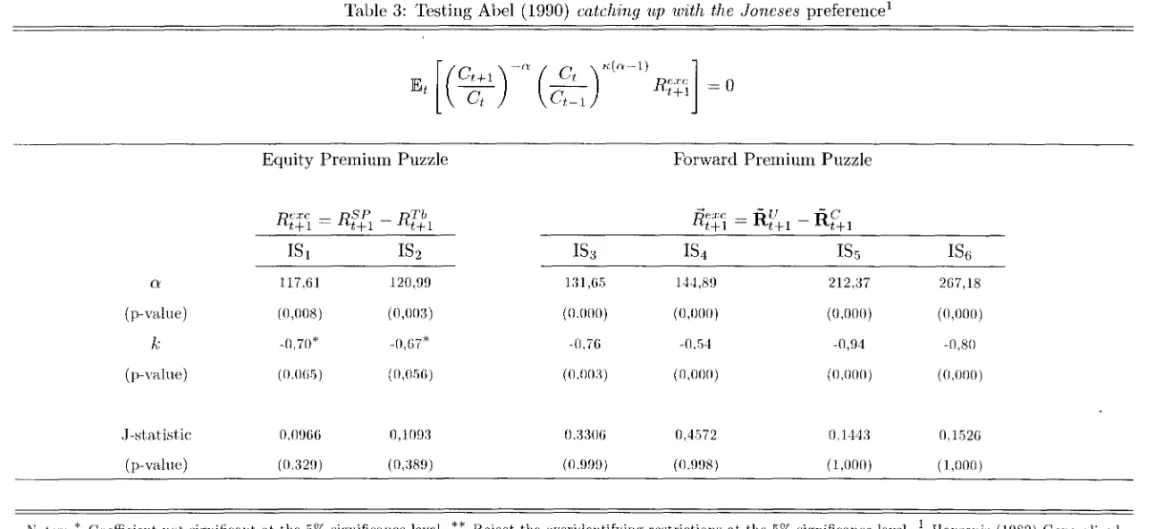
In order to try to account for the puzzles we analyze the more complex preference specifications. Table 3 presents the findings associated with Euler equations (29) and (30) derived from the Abel (1990) specification where the reference leveI is a function of past aggregate consumption. Comparing both puzzles: i) the EPP and the FPP are exacerbated, in the sense that, for each instrument set used, the relative risk aversion is larger then the respective one obtained with the canonical model,
ii) we have the same magnitude order of the parameter K, and iii) contrary to the ratio models, but in
accordance with Garcia (2006), we find support for the hypothesis that the absolute value 01' the past aggregate consumption enters the utility function. Only for the EPP, the parameter K, is significant
at the 10% significance leveI but not at the 5% leveI.
This model is not supported by the equity market neither the foreign currency market data, since the representative agent is of a jealous sort. Even with a positive K, - where, according to Abel (1990)
it would be possible to increase the risk aversion to solve the EPP without generating the risk-free rate puzzle one should not expect to explain both puzzles with this modeI.
In order to de aI with this problem that appears when this Abel (1990) model is used, the high volatility of the risk-free rate of return, and to allow the disentangling of the relative risk aversion from the elasticity 01' intertemporal substitution, we estimate the Euler equations (31) and (32) derived from the Abel (1999) modeI. Observing the results reported in table 4, once more the equity and the foreign currency risk premiums show common patterns.
For interpretation purposes, we analyze the results in the light of Abel's (1990) results. First, we consider that only the parameters K, and
r
are independent. In this case, with regards the pastaggre-gate consumption the agent is a jealous sort, while with regards the current aggreaggre-gate consumption the agent is patriotic. vVhen we consider that a and
r
are the independent parameters, the agent remains patriotic with regards the current aggregate consumption and both puzzles are still more exacerbated.•
table 5, show clearly that this attempt to break the tight link between the coefficient of risk aversion and the elasticity of intertemporal substitution does not produce a complete explanation of none of the puzzles. In fact, even when we obtaining p
<
ex, which is a necessary condition to fit the patterns of the risk premiums, both puzzles are still more exacerbated. When we are modeling the risk premiums in these different markets we obtain close values for the elasticity of intertemporal substitution, but these values are not large enough, ranging from 0.014 to 0.022.Our evidence about the incapacity of the Epstein and Zin (1989) framework to explain the FPP corroborates Colacito and Croce (2005), while with regards this same incapacity to explain the EPP, parts way from Epstein and Zin (1991) and Garcia (2006).16
Even though several papers in this literature have followed Abel (1990, 1999) in the sense of propos-ing ratio mo deIs where the habit depends on the current or on some lags of aggregate consumption, this path seems to be doomed, since it cannot account for the predictable variation in stock returns which is an important source of stock market volatility.
An alternative and promising route is to assume that the price of risk changes through time. With this in mind, and intending to account for the most stock market stylized facts and to better understand asset pricing puzzles, Campbell and Cochrane (1999) built a model where the habit leveI responds only gradually to changes in consumption, giving emphasis on the role played by a time-varying risk aversion. This model is able to make the volatility of the SDF stochastically time-time-varying with the business cycle pattern and to better understand the stock market volatility.
Although this model can not be considered as a complete or even as a definite model of stock market behavior, it has been pointed as the main contender to explain it. This success is certainly due to its refined and pragmatic theoretical conception besides its excellent performance in the calibration exercise proposed by Campbell and Cochrane (1999). According to the results of this exercise, the artificial data generated from the model display the patterns found in the empirical literature, but they do not estimate the coefficient of relative risk aversion and set it equal to 2.
Here, our strategy to evidence if the risk premiums in the equity and the foreign currency markets have a similar behavior is different. We propose a GMM estimation procedure to see if these versions of this habit formation model are supported by the data, instead of calibrating them.
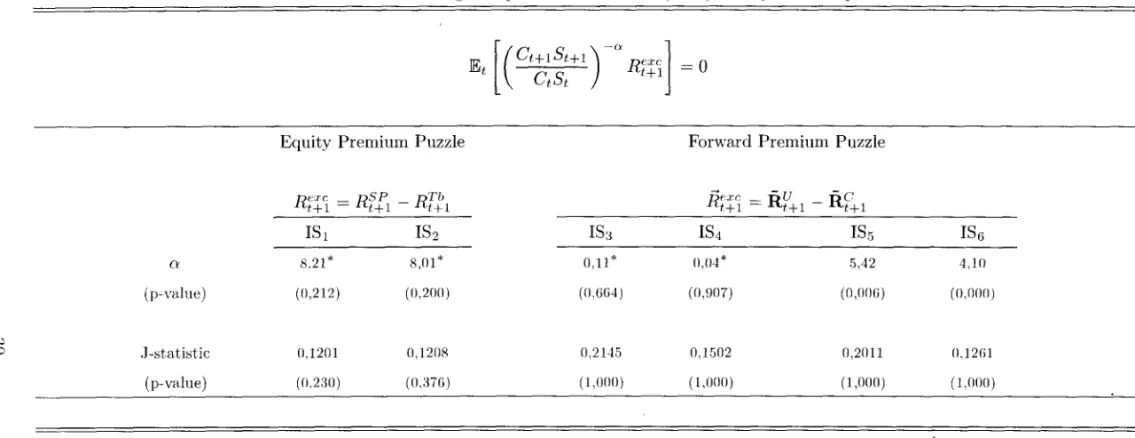
The estimation and test results of the Euler equations (35) and (36) derived from the Campbell and Cochrane (1999) model are reported in Table 6. For the equity and for the foreign currency risk premiums, using the lags of the returns in question as the financiaI instruments, the values of ex are acceptably low but not significant at the 10% significance level. When we test the Euler equation (36) using the current and the past leveIs of the forward premium as the financiaI instruments, the values of ex remain acceptably low but now we do not have problems with the significance. This result gives
•
us support to emphasize the prominent role played by the forward premium, relative to lags of real returns in question, as instrument in a externaI habit formation approach explanation of the FPP, which may be related to the strong predictability power of the forward premium.
Comparing our results for the EPP with the result reported in the literature, while our insignificant values of o: range from 8.01 to 8.21, Tallarini and Zhang (2005) obtains a significant o: equal to 6.30.
Our last attempt to model the risk premiums in these different markets relies on an extension of the Campbell and Cochrane (1999) setting, considering the case where the agent derives utility from its own leveI of consumption relative to the reference leveI both in the ratio and in difference forms. Besides allowing for a time-varying risk-free interest rate and disentangling the relative risk aversion coefficient and the elasticity of intertemporal substitution, according to the results of the Euler equations (37) and (38) reported in table 7, we can say that this extended model - with low interest rates, roughly i.i.d. consumption growth with small volatility and acceptably low values of risk aversion - is able to explain the high market Sharpe ratio that characterizes the EPP and also the strong predictability of the forcigll goycmment bond returns which characterizes the FPP.
It is hard to compare accurald,' our n'sults with others reported in this literature, since the estimation strategies used and tlH' llll)(kb tcsted are different. At any rate, with regards the EPP, our values of o: range from 7.64 to <".m. quite largcr than 0.31 obtained in Garcia (2006), where the Euler equations for the excess market )lorl foi iu reI mil and for the risk free rate are jointly estimated. About the FPP, we could compare our jHGセャiャエセ@ \\'ith \'erdelhan (2006), where the model proposed allows for a time-varying risk-free interest r<lll' "111 dUI'''; Ilot break the tight link between the relative risk aversion
coefficient and the elasticity uI' illll'lII'lllporal substitution. Our values for of o: range from 1.68 to 8.81, while his values range frulll .-'.(i(l lu <".:W.
In general terms: i) we ('ali ('\'idell<'(' t hc robustness of our estimation results for the EPP and
the FPP when the instrumcllt ";1'1 ゥセ@ ;I!t(']'('d. except for the Euler equations derived from the Abel
(1999) and the Epstein and Zill (1 %!J ) 1lI!H!Pi,.; and ii) according the Hansen's test of over-identifying restrictions, neither of the six lllodPi" i" r('.ip('ted statistically.17
Up to this point, we belieyp to haw provided evidence in support of the fact that, under a preference-based approach, the ・アオゥエセᄋ@ and the foreign currency risk premiums display common
pat-terns.
5
Conclusion
It was never clear that solving puzzles in domestic financiaI markets would help explaining puzzles in foreign currency markets. In facto traditional consumption-based models do not seem to be able to account for the high equity Sharpe ratio nor to capture the non-shared characteristic of the foreign
exchange market the question ceased to be posed for a long time.
Recent research, however, has lead many in the profession to believe that is a tight association between puzzles in domestic and foreign markets. We join the recent crowd in this paper adopting the following procedure: we analyze the behavior of the risk premiums in these different markets using different models and seeking not only for successes but mostly by the relative performance of different models in the two markets.
We model the excess returns of the S&P500 over the US short term bond and of the uncovered over the covered trading of foreign government bonds, using the canonical and some externaI habit formation consumption approaches. Based on estimates of these consumption eオャ・セ@ equations and on the test of its over-identifying restrictions using Hansen's (1982) Generalized Method of Moments (GMM), we intend to validate or to better understand the reasons of the empirical failure of each preference specification for both excess returns in questiono
We present an empirical evidence of the strong similarity between the behavior of the equity and the uncovered excess returns when modeled as risk premiums, which allows us to argue that, under a preference-baseel approach, the equity anel the foreign currency risk premiums display common patterns. We find empirical grounds to believe that the proposed preference-based solutions to puzzles in domestic financiaI markets can certainly shed light on the FPP.
In particular, our results offers some support to the ide a that a generalized version of the
slow-moving externaI habit formation model proposeel by Campbell and Cochrane (1999) which disentangles the relative risk aversion coefficient anel the elasticity of intertemporal substitution is able to explain both puzzles.
References
[1] Abel, A B. (1990), "Asset prices under habit formation and catching up with the Joneses,"
American Economic Revie11l Papers and Proceedings 80, 38 - 42.
[2] Abel, A B. (1999), "Risk premiums anel term premiums in general equilibrium," Journal oi
Monetary Econornics 43, 3 - 33.
[3] Alvarez, F. and Jermann, U. J. (2002), "Using asset prices to measure the persistence ofthe
marginal utility of wealth," unpublisheel paper, University of Chicago.
[4] Breeden, D. (1979), "An intertemporal asset pricing model with stochastic consumption and
investment opportunities," Journal oi Financial Econornics 7, 265 - 296.
[5] Burnside, C. , Eichenbaum, M. Kleshchlski, I. and Rebelo, S. (2006), "The returns to
[6] Campbell, J. Y. (2000), "Asset pricing at the millennium," Harvard Institute of Economic Research Discussion paper nO 1897.
[7] Campbell, J. Y. and Cochrane, J. H. (1999), "By force of habit: a consumption-based explanation of aggregate market behavior," Journal of Political Economy 107, 205 - 251.
[8] Cochrane, J.H. (200l),"Asset Pricing," Princeton University Press.
[9] Cochrane, J. H. and Hansen, L. P. (1992), " Asset pricing lessons for macroeconomics," in O.J. Blanchard and Fischer, eds., NBER Macmeconomics Annual1992 (MIT Press, Cambridge, MA)
[10] Colacito, R. and Croce, M. (2005), "Risks for the long run and the real exchange rate," Mimeo.
[11]
Constantinides, G. M. (1982), "Intertemporal asset pricing with heterogeneous consumers and without demand aggregation," Journal of Business 55(2), 253 - 267.[12] Constantinides, G. (1990), "Habit formation: a resolution of the equity premium puzzle,"
Journal of Political Economy 98, 519 - 543.
[13] da Costa, C. E. E., Issler, J. V. and Matos, P. R. F. (2006). "The forward and the equity premi um puzzles: two symptoms of the same illness?" Mimeo. Getulio Vargas Foundation
[14] Engel, C. (1996), "The forward discount anomaly and the risk premium: a survey of recent evidence," Journal of Empirical Finance 3, 123 - 192.
[15] Epstein, L. and Zin, S. (1989), "Substitution, risk aversion and the temporal behavior of consumption and asset returns: a theoretical framework," Econometrica 57, 937 - 969.
[16] Epstein, L. and Zin, S. (1991), "Substitution, risk aversion and the temporal behavior of consumption and asset returns: an empirical investigation," Journal of Political Economy 99, 263 - 286.
[17] Fuhrer, J. (2000), "Habit formation in consumption and its implications for monetary policy models," American Economic Review 90, 367 - 390.
[18] Gali, J. (1994), "Keeping up with the Joneses: consumption externalities, portfolio choice and asset prices," Journal of Money Credit and Banking 26, 1 - 8.
[19] Garcia, R. (2006), "A consumption CAPM with a reference leveI," Mimeo.
[20] Gorman, W., M. (1953), "Community preference fields," Econometr'ica 21, 63-80.
[22] Hansen, L. P. (1982), "Large sample properties of generalized method of moments estimators, "
Econometrica 50, 1029 - 1054.
[23] Hansen, L. P. and Richard, S. F. (1987), "The role of conditioning information in deducing testable restrictions implied by dynamic asset pricing models," Econometrica 55, 587 - 613.
[24] Hansen, L. P. and Jagannathan, R. (1991), "Restrictions on the intertemporal marginal rates of substitution implied by asset returns," Jou,rnal of Political Economy 99, 225 - 262.
[25] Hansen, L. and K. Singleton (1982) "Generalized instrumental variables estimation of non-linear expectations models," Econometrica 50(5), pp. 1269-1286.
[26] Hansen, L. and K. Singleton. (1983), "Stochastic consumption. risk aversion and the temporal behavior of asset returns," Jou,rnal of Political Economy 91(2), 249-265.
[27] Hansen, L. and K. Singleton (1984) "Erratum of the article: 'Generalized instrumental variables estimation of nonlinear expectations models," Econometrica 52(1), pp. 267-268.
[28] Harrison, J. M. and Kreps, D. M. (1979), "Martingales and arbitrage in multiperiod secu-rities markets," Jou,rnal of Economic Theory 20, 249 - 268.
[29] Hodrick, R. J. (1987), "The empirical evidence on the efliciency of forward and futures foreign exchange markets," (Harwood, Chur).
[30] Hodrick, R. J. (1989), "US international capital fiows: perspectives from rational maximizing models," Carnegie-Rochester Conference Series on Public Policy 30, 1 - 29.
[31] Kocherlakota, N. R. (1996), "The equity premi um puzzle: it' s still a puzzle," Jou,rnal of
Economic Litemtu,re 34(1), 42 - 71.
[32] Kreups, D. M. and Porteus, E. L. (1978), "Temporal resolution of uncertainty and dynamic choice theory," Econometrica 46, 185 - 200.
[33] Krugman, P. (1981), "Consumption preferences, asset demands, and distribution effects in international financiaI markets," Working paper no 651 (National Bureau of Economic Research, Cambridge, MA).
[34] Lucas, R. E. (1978), "Asset pricing in an exchange economy," Econometrica 46,1429 - 1445.
[35] Lucas, R. E. (1982), "Interest rates and currency prices in a two-country world," Jou,mal of
Monetary Economics 10, 335 - 360.
[37] Mark, N. (1985), "On time varying risk premiums in the foreign exchange market: an econo-metric analysis," Joumal o] Nlonetary Economics 16, 3 - 18.
[38] Mehra, R. and Prescott, E. (1985). "The equity premium: a puzzle," Joumal o] Monetary
Economics 15, 627 - 636.
[39] Romer, D. (1995), "Advanced macroeconomics," (McGraw-Hill, New York).
[40] Rubinstein, M. (1976), "The valuation of uncertain income streams and the pricing of options,"
Bell Joumal o] Economics 7, 407 - 425.
[41] Ryder, H. E. and Heal, G. M. (1973), "Optimum growth with intertemporally dependent preferences," Review o] Economics Studies 40, 1 - 33.
[42] Samuelson, P. A. (1969), "Lifetime portfolio selection by dynamic stochastic programming,"
Rev'iew o] Econornics and Statistics 51, 239 - 246.
[43] Shiller, R. (1982), "Consumption, asset markets and macroeconomic fiuctuations," Cameg'ie
Mellon Con]erence Series on Pablic Policy 17, 203 - 238.
[44] Sundaresan, S. M. (1989), "Intertemporally dependent preferences and the volatility of con-sumption anel wealth." Review o] Financiai Studies 2, 73 - 88.
[45] Tallarini, T. D. and Zhang, H. H. (2005), "ExternaI habit anel the cyclicality of expecteel stock returns," Joumal o] Business 78, 1023 - 1048.
[46] Verdelhan, A. (2006), liA habit-based explanation ofthe exchange rate risk premium," Mimeo.
[47] Weil, P. (1989). "The equity premium puzzle anel the riskfree rate puzzle," Joumal o] Monetary
•
Tables
Table 1: Data summary statistics*
real conSlllllption (of nondurable anel services) growth**
l\lean Stanc\. Dev. l"'t autocorrelation
U nitec\ States
un8
0,799 0,365real return on 90-day real return on real excess annualized quarterly correlatiou
Treasury bill** S&P500** return** sharp hetweeu excess returu and
tv
UI
Stand. Dev.
l\Iean Mean Stanel. Dev. l\Iean Stanel. Dev. ratio US COUSUlllpt.iou growt.h
U nitec\ States 1,762 1,607 8,666 16,019 6,904 15,674 0,440 0,274
real return on real return on real excess annualizeel q uarter Iy correlatiou covered traeling** uncovered trac\ing** return** sharp betweell excess ret.uru aud l\lean Stanel. Dev. Mean Stanel. Dev. l\lean Stand. Dev. ratio US COIlSlllllptiou growth
Canada 2,254 2,209 2,471 5,441 0,217 4,922 0,044 0,027
Germany 2,053 2,638 2,912 11,623 0,859 11,962 0,072 0,066
Japan 2.568 1,801 3,836 12,908 1,268 12,816 0,099 0,141
United Kingelom 1,756 2,212 4,695 10,198 2,940 10,450 0,281 0,050