*Corresponding author: Safar Farajnia, Tel: +98 41 33363234, Fax: +98 41 33363231, Email: [email protected] ©
2015 The Authors. This is an Open Access article distributed under the terms of the Creative Commons Attribution (CC BY), which permits Adv Pharm Bull, 2015, 5(Suppl 1), 621-627
doi: 10.15171/apb.2015.084 http://apb.tbzmed.ac.ir
Advanced
Pharmaceutical
Bulletin
Chaperone-Assisted Soluble Expression of a Humanized Anti-EGFR
ScFv Antibody in
E. Coli
Kamal Veisi1,2,3, Safar Farajnia1,4*, Nosratollah Zarghami2, Hamid Reza Khoram Khorshid5, Nasser Samadi4,2, Shiva Ahdi Khosroshahi4, Hossein Zarei Jaliani6
1
Biotechnology Research Center, Tabriz University of Medical Sciences, Tabriz, Iran. 2
Department of Medical Biotechnologies, Faculty of Advanced Medical Sciences, Tabriz University of Medical Sciences, Tabriz, Iran. 3
Student Research Committee, Tabriz University of Medical Sciences, Tabriz, Iran. 4
Drug Applied Research Center, Tabriz University of Medical Sciences, Tabriz, Iran. 5 University of Social Welfare and Rehabilitation Sciences, Tehran, Iran.
6 Department of Medical Genetics, School of Medicine, Shahid Sadoughi University of Medical Sciences, Yazd, Iran.
Introduction
Engineered strains of E. coli have been well-documented as ideal and often first- choice expression systems when fast and economical production of recombinant proteins is desired.1-3 This system has several advantages over other expression systems including well-characterized genetic structure, easy cultivation in inexpensive culture media, and rapid biomass accumulation.4 This expression system is particularly preferable to other systems when relatively small and unmodified proteins are to be produced.5
Despite advantages mentioned for E. coli, several limitations including formation of inclusion bodies (IBs) in case of aggregation- prone proteins, system inability in yielding proper soluble proteins of large- size (>60 kD), impotency of the system in producing glycosylation-needed proteins, and disturbance of correct folding imposed by unfavorable disulfide bonds formation, are restrictive factors in using this host for recombinant protein production.6-8
IBs are defined as accumulation of over-expressed insoluble proteins in which the correct tertiary structures of proteins has been agitated leading to generally mis-folded proteins devoid of biological functions.8,9
Protein refolding from IBs is often considered an undesirable process suffering from constraints such as poor recovery yields, optimization necessity of refolding conditions and the potential obtaining of inactive proteins from resolubilization procedures which affect the integrity of refolded proteins. Furthermore, the purification of a highly expressed soluble protein is less expensive and time-consuming than in-vitro refolding and purification from IBs. Despite all drawbacks mentioned for refolding from IBs, this procedure is the method of choice largely because of its ability in achieving massive quantity of inexpensive protein of interest.10,11
To overcome the problems related to protein misfolding and solubility, various strategies have been proposed
Research Article
Article History:
Received: 21 August 2014 Revised: 21 October 2014 Accepted: 1 November 2014 ePublished: 31 December 2015
Keywords: Solubleexpression Molecular chaperones ScFv
EGFR
Abstract
Purpose: Formation of inclusion bodies is a considerable obstacle threatening the advantages of E. coli expression system to serve as the most common and easiest system in recombinant protein production. To solve this problem, several strategies have been proposed among which application of molecular chaperones is of remarkable consideration. The aim of this study was to evaluate the effects of molecular chaperones on soluble expression of aggregation-prone humanized single chain antibody.
Methods: To increase the solubility of a humanized single chain antibody (hscFv), different chaperone plasmids including PG-tf2 (GroES- GroEL- tig), ptf16 (tig) and pGro7 (GroES- GroEL) were co-expressed in BL21 cells containing pET-22b- hscFv construct. The solubility of recombinant hscFv was analyzed by SDS-PAGE. After purification of soluble hscFv by Ni-NTA column, the biological activity and cytotoxicity of the recombinant protein were tested by ELISA and MTT assay, respectively.
Results: SDS-PAGE analysis of the hscFv revealed that chaperone utility remarkably increased (up to 50%) the solubility of the protein. ELISA test and MTT assay analyses also confirmed the biological activity of the gained hscFv in reaction with A431 cells (OD value: 2.6) and inhibition of their proliferation, respectively.
Veisi et al.
among which are co-expression of molecular chaperones that facilitate the correct folding of proteins and gene fusions in which fusion partners such as glutathione- S- transferase (GST) and maltose- binding protein (MBP) function both as protein solubility enhancers and protein purification tags.12,13
Molecular chaperones have already proven invaluable in protein quality control (an essential cellular process) and considered extremely important in protein stabilization.10 Once insolubiliy-related difficulties occur in the production of heterologous proteins in biotechnology, co-expression of molecular chaperones considers as a promising strategy in retaining the correct folding of the proteins resulting in the active recombinant proteins.14,15 The most abundant and functionally important classes of chaperones existing in E. coli are DnaK, DnaJ, GrpE, GroEL and GroES which are controlled positively by minor sigma factor (Sigma 32) encoded by rpoH gene.16 Co-expression of plasmids carrying DnaK-DnaJ- GrpE and/ or GroEL-GroES chaperone teams are used to overcome the obstacles relating to protein aggregation (IBs) in E. coli.17,18
The chaperone plasmids applied in this study possess a
pACYC- derived origin of replication and a
chloramphenicol- resistance gene (Cmr). This system is fully compatible with E. coli expression system utilizing ColE1- type plasmids which contain the ampicillin resistance gene as a marker but not with E. coli strains or expression plasmids containing chloramphenicol resistance gene. Therefore, E. coli BL21 (DE3), often used with pET system, is an optimal host.19
Single chain antibodies are minimized recombinant antibodies whose variable regions of heavy and light chains are joined together by a flexible linker.20-22 These types of antibodies are smaller than full-length antibody so their penetration into tumor tissues is much easier and their production procedures are more economical.23 In our study the effects of plasmid chaperones pGro7 containing GroES-GroEL chaperone team, pG-Tf2 containing GroES- GroEL- tig chaperone team and pTf16 containing tig chaperone on soluble expression of hscFv were investigated.
Materials and Methods
Cloning of humanized single chain antibody
The pUC19 containing target protein (PUC19-hscFv construct) was double digested by BamHI and XhoI, after that this construct was subcloned into pET -22b and transformed into the E. coli DH5α for cloning.
Restriction analysis and PCR were employed to confirm the integrity of this recombinant construct (pET -22b – hscFv).
Expression of humanized single chain antibody without employing chaperones
The expression vector pET 22b containing hscFv (pET -22b – hscFv construct) was transformed into E. coli
BL21 competent cells.24 Single colonies were inoculated in LB medium containing 100ug/ml of ampicillin. Then,
the culture was incubated with shaking (140 rpm) at 37ºC until the optical density at 600 nm (OD600) reached about 0.7. The cells were induced with IPTG (0.5mM) and incubated at 26ºC (150 rpm) for 4 h. Cells were then harvested by centrifugation and the expression was analyzed by 12% SDS-PAGE.
Purification and refolding of hscFv from IBs
Purification of recombinant hscFv was performed as described.20,25,26 Briefly, 500 ml LB media containing
100μg/ ml ampicillin was inoculated with 5 ml of an
overnight culture of recombinant bacteria and incubated at 37°C with shaking (150 rpm).At mid-log phase; the culture was induced by adding 0.125 mM IPTG permitting to grow for 6 h. Then, the Bacteria were harvested (10000 x g, for 15 min), resuspended in 10 ml lysis buffer A (50 mM NaH2PO4, pH-8, 300 mM NaCl, 10 mM imidazole, 1 mg/ml lysozyme) and disrupted by sonication (five 30s pulses interrupted with cooling on ice). Soluble and insoluble fractions were separated by centrifugation at 12000 x g for 10 min at 4°C and recombinant hscFv was found mainly in the insoluble fraction in the form of IBs. Ni-NTA affinity chromatography method (Qiagen, Chatsworth, CA, USA) was employed for His- tagged fusion protein purification according to the manufacturer instructions.
The pellet containing IBs was washed 3x with PBS + 1%Txt-100 and dissolved in 4-6 ml of 8M urea lysis buffer. The supernatant was then mixed with 2 ml resin, incubated 30 minutes at room temperature, and transferred to chromatography column. The recombinant hscFv was collected from column by elution with imidazole (250 mM) after several washing steps. The purity of protein was analyzed by SDS-PAGE and the concentration of hscFv was assessed by Bradford method. To remove contaminants from pellet containing inclusion 50mM Tris-HCl (pH 8.0) containing 2M urea, 1 mM EDTA, and 2% Triton X-100 (v/v) was used. The prepared IBs were then solubilized in 50mM Tris-HCl (pH 8.0) containing 8 M urea, and 10 mM dithiothreitol (DTT) overnight at 4 °C. After equilibration of Ni-NTA column with denaturing buffer (8M urea and 10mM DTT in 50mM Tris–HCl, pH 8.0) 10 ml of the solubilized IBs were loaded into the column. Purified hscFv was collected by elution with denaturing buffer containing imidazole (250 mM) after several washing steps. The quality of purified hscFv was analyzed by SDS- PAGE and the protein concentration was determined using the Bradford method.
Refolding of the hscFv was done by successive dialysis against buffer (containing 3 mM GSH, 1 mM GSSG, 150 mM NaCl) containing urea at 8, 4, 2, 1 and 0 molar. Finally, the refolded sample was dialyzed against PBS (pH 7.4) and to remove the insoluble materials centrifugation at 12000g for 15 min was done.
Co- expression of hscFv with chaperone
Chaperon-assisted soluble expression of hscFv
pTf16 were separately transformed into E. coli BL21 cells containing pET -22b- hscFv.
The cells were cultured in LB medium containing 20 µg/ml chloramphenicol and 50 µg/ml ampicillin for selection and 1 mg/ml of arabinose for induction of chaperone expression was induced (L-arabinose for pGro7, and pTf16 and tetracycline for pG-Tf2). After addition of IPTG to the medium in a final concentration of 0.5mM, the solubility of recombinant hscFv was tested using SDS-PAGE as described above.
Purification of soluble hscFv
The harvested cells were sonicated as described above and soluble part of cells was subjected to affinity
chromatography. The supernatant collected by
centrifugation was agitated with Ni-NTA beads for 2 h at room temperature. After that the unattached proteins were removed using wash buffer of 25mM imidazole. Finally the sample was eluted with elution buffer containing 250mM imidazole. The concentration of hscFv was determined by nanodrop analyzer and finally the purity was assessed by SDS-PAGE and coomassie blue staining. This purification procedure was performed for cultures with or without chaperones to compare the solubility parameter with or without using chaperons.
Affinity analysis by ELISA test
To assess the affinity of humanized single chain antibody, ½ serial dilutions of A431 cells was coated in ELISA plates and incubated overnight at 4 °C. Then plates were blocked (PBS containing 2% BSA, 300 µL per well) for 1 hour at room temperature. Affinity purified humanized single chain antibody was used at five different concentrations and detected by HRP- L protein (0.5 µg/ml).20 Finally, TMB substrate was added and colorimetric measurements were conducted at 450 nm wavelength.
Proliferation inhibition analysis
Cell growth inhibition of the hscFv was assessed by mitochondrial reduction of MTT. EGFR- overexpressing A431 cells were plated at 2×10³ cells/well in 96-well plates containing 180 µl growth medium (RPMI 1640) and allowed to attach overnight. The medium was then removed and wells were divided into three groups of six parallel wells each. Group one contained 200µl of growth medium and served as negative control group. The other two groups contained different concentrations of recombinant hscFv and murine scFv (counterpart of hscFv). After 48 hours, the medium was removed from the wells, replaced with 50 µl of MTT solution (2.5mg/ml) and incubated for 4 hour at 37ºC. Then, the MTT solution was carefully aspirated and replaced with
150 µl DMSO + 50 µl Sorenson’s glycine buffer and
incubated for 15 min. The absorbance of each well was measured at 570 nm. Results are expressed as percentage of viable cells compared with untreated cells.
Results
Cloning, expression and purification of hscFv
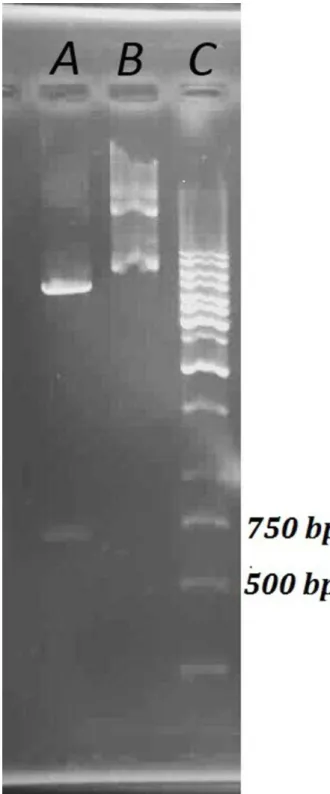
For expression in E. coli, the hscFv encoding fragment was subcloned into the pET -22b expression vector in frame with C-terminal 6His-tag and confirmed by subsequent restriction digestion analysis (Figure 1). Analysis by SDS-PAGE revealed that the majority of expressed protein appeared as IBs (Figure 2).
Figure 1. Restriction digestion analysis of the pET-22b-hscFv construct.
Veisi et al.
Figure 2. SDS-PAGE analysis of hscFv expression in supernatant and pellet. Comparing to pellet the amount of hscFv in supernatant is ignorable.
Lane A indicates the protein marker Lane B indicates hscFv in supernatant Lane C indicates hscFv in pellet
Refolding of hscFv from IBs
The correct refolding of proteins from IBs is sometimes difficult to gain. Analysis for yield of soluble protein after refolding revealed that up to 90% of the hscFv re-aggregated in the form of insoluble protein and excluded from the experiment. The remaining soluble fraction of the refolded hscFv displayed a weak reactivity when ELISA test conducted.
Soluble expression of hscFv with chaperones
application
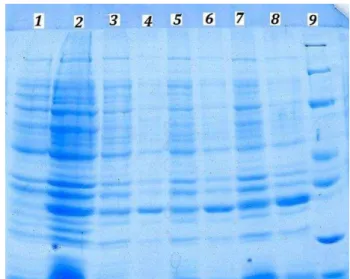
Before using chaperones, the majority of hscFv was found in pellet than in supernatant displaying the low soluble expression of the protein.To increase the protein solubility, co-expression with chaperones (pGro7, pG-Tf2 and pTf16) was employed. The results demonstrated a remarkable increase (up to 50%) in the solubility of the recombinant hscFv following chaperone application. The results also showed much more efficiency for pTf16 in solubility increase of hscFv than the other two chaperones. Compared to pGro7, pG-Tf2 chaperon had a better effect on solubility (Figure 3).
Figure 3. Analysis of different chaperones on hscFv solubility. In this figure the most effective chaperon plasmids are PG-tf2, ptf16 and pGro7 respectively
Lane 1 and 2 indicate hscFv before and after IPTG induction Lane 3 and 4 indicate supernatant and pellet after pGro7 co-expression
Lane 5 and 6 indicate supernatant and pellet after ptf16 co-expression
Lane 7 and 8 indicate supernatant and pellet after PG-tf2 co-expression
Lane 9 indicates the protein size marker
ELISA test for reactivity analysis
To test the potency of the hscFv purified from chaperon-containing cells in reactivity with EGFR over-expressing A431 cells, a whole cell ELISA was applied. This assessment revealed that the purified hscFv had a high reactivity with A431 cells (OD value of 2.6) indicating correct folding of purified protein.
MTT assay of hscFv
Humanized scFv displayed a concentration-dependent growth inhibition effect on EGFR-expressing A431 cells. The calculated IC50 for hscFv and its murine counterpart were 967.8 and 2572.6 nM, respectively, indicating that hscFv represents 2.6 times higher activity than murine scFv (Figure 4).
Chaperon-assisted soluble expression of hscFv
Discussion
Although E. coli expression system is the most widely used system in producing heterologous proteins, several considerable obstacles challenge its leading role as an ideal host. Aggregation of recombinant proteins in the form of IBs with incorrect tertiary structure is a serious limitation severely affecting production of biologically active recombinant proteins from this expression system. When meeting this problem, various strategies including in-vitro refolding from insoluble IBs and application of molecular chaperones are proposed to facilitate the correct folding of proteins in soluble forms. Due to occurrence of reaggregation during in-vitro refolding process which adversely influence the protein structures, production of large amount of recombinant proteins in the soluble form is preferred.
In this study, both in vitro refolding and chaperon-assisted expression were examined to produce correctly folded active hscFv. Refolding from IBs revealed that more than 90% of the denatured hscFv re-aggregated in the form of IBs and the remaining soluble portion of refolded hscFv was inactive indicating the occurrence of undesired misfolding in hscFv structure during refolding conditions. Upon co-expression of different plasmid chaperone sets with hscFv, the solubility was remarkably increased (up to 50%). These findings were consistent with the previous reports confirming the positive effects of molecular chaperones on solubility parameter and disaggregation.21,22,27-29 Among the molecular plasmid chaperones, PG-tf2 exhibited a fairly much more positive effect on solubility of our aggregation-prone hscFv than the other two plasmid chaperones. The efficiency of ptf16 was also higher than that observed for pGro7. The differing functions of plasmid chaperones (pGro7, pG-tf2, ptf16) on the solubility of recombinant hscFv could be logically related to the type of chaperones included in these plasmids. Since the most effective plasmid chaperone in this study (pG-tf2) contains GroES- GroEL- tig chaperone team, and the least effective plasmid chaperone (pGro7) also contains GroES- GroEL chaperone team, the higher efficiency of the pG-tf2 may be attributed to the presence of the tig chaperone proposing it as a particularly suitable chaperone for hscFv solubility. On the other hand, the ptf16 containing tig chaperone also manifested an enhancing effect on hscFv solubility which could be implied as another evidence for the pivotal role of tig chaperone on solubility. Another logical interpretation that could be deduced from the higher efficiency of pG-tf2 compared to ptf16 is the existence of a constructive
cooperation between GroES- GroEL and tig
chaperones.22
In addition to the appreciable effects of these chaperone plasmids (pGro7, pG-tf2, ptf16) on hscFv solubility, the remarkable reactivity of the purified hscFv with A431cells and its inhibitory effect on cell proliferation could be considered as an indication of correct tertiary structure of hscFv.
While checking different chaperones on solubility, Nishahara, K and colleagues reported the higher efficiency of trigger factor (TF) in soluble expression of` recombinant human lysozyme.18 Another study has shown that ptf16 promotes the soluble expression of human sequence marker protein 30 (SMP30) more effectively than its counterpart pG-tf2.28 Watanabe K.I. et.al and colleagues studied the role of different chaperones on soluble expression of human ST6Gal I (hST6Gal I), and showed that chaperon pGro7 is the efficient chaperon of choice for solubility increase of the protein.30 Altogether, these results demonstrate the protein specific effects of molecular chaperones in solubility enhancement.
Conclusion
The result of this study indicates that application of chaperones can be followed as an effective strategy in producing active soluble proteins which considerably diminishes difficulties relevant to the refolding form IBs.
Acknowledgments
This study was funded by Biotechnology Research Center, Tarbiz University of Medical Science, Tabriz, Iran. The results presented in this work are based on data set of PhD thesis, registered in Tarbiz University of Medical Sciences.
Ethical Issues
Not applicable in this study.
Conflict of Interest
There is no conflict of interests.
References
1. Samuelson JC. Recent developments in difficult protein expression: a guide to E. coli strains, promoters, and relevant host mutations. Methods Mol Biol 2011;705:195-209. doi: 10.1007/978-1-61737-967-3_11
2. Sorensen HP, Mortensen KK. Soluble expression of recombinant proteins in the cytoplasm of Escherichia
coli. Microb Cell Fact 2005;4(1):1. doi:
10.1186/1475-2859-4-1
3. Terpe K. Overview of bacterial expression systems for heterologous protein production: from molecular and biochemical fundamentals to commercial systems. Appl Microbiol Biotechnol 2006;72(2):211-22. doi: 10.1007/s00253-006-0465-8
4. Ghosh S, Rasheedi S, Rahim SS, Banerjee S, Choudhary RK, Chakhaiyar P, et al. Method for enhancing solubility of the expressed recombinant
proteins in Escherichia coli. Biotechniques
2004;37(3):418, 20, 22-3.
5. Demain AL, Vaishnav P. Production of recombinant proteins by microbes and higher organisms.
Veisi et al.
6. Jenkins N, Curling EM. Glycosylation of
recombinant proteins: problems and prospects.
Enzyme Microb Technol 1994;16(5):354-64. doi: 10.1016/0141-0229(94)90149-x
7. Gupta P, Aggarwal N, Batra P, Mishra S, Chaudhuri TK. Co-expression of chaperonin GroEL/GroES enhances in vivo folding of yeast mitochondrial aconitase and alters the growth characteristics of Escherichia coli. Int J Biochem Cell Biol
2006;38(11):1975-85. doi:
10.1016/j.biocel.2006.05.013
8. Villaverde A, Carrio MM. Protein aggregation in recombinant bacteria: biological role of inclusion bodies. Biotechnol Lett 2003;25(17):1385-95. 9. Carrio MM, Villaverde A. Role of molecular
chaperones in inclusion body formation. FEBS Lett
2003;537(1-3):215-21. doi:
10.1016/s0014-5793(03)00126-1
10. Chen B, Retzlaff M, Roos T, Frydman J. Cellular strategies of protein quality control. Cold Spring Harb Perspect Biol 2011;3(8):a004374. doi: 10.1101/cshperspect.a004374
11. De Marco A. Protocol for preparing proteins with improved solubility by co-expressing with molecular
chaperones in Escherichia coli. Nat Protoc
2007;2(10):2632-9. doi: 10.1038/nprot.2007.400 12. Schlicke M, Brakmann S. Expression and purification
of histidine-tagged bacteriophage T7 DNA
polymerase. Protein Expr Purif 2005;39(2):247-53. doi: 10.1016/j.pep.2004.10.022
13. Ahmad N, Michoux F, Mccarthy J, Nixon PJ. Expression of the affinity tags, glutathione-S-transferase and maltose-binding protein, in tobacco
chloroplasts. Planta 2012;235(4):863-71. doi:
10.1007/s00425-011-1584-8
14. Schlieker C, Bukau B, Mogk A. Prevention and reversion of protein aggregation by molecular chaperones in the E. coli cytosol: implications for their applicability in biotechnology. J Biotechnol
2002;96(1):13-21. doi:
10.1016/s0168-1656(02)00033-0
15. De Marco A, Deuerling E, Mogk A, Tomoyasu T, Bukau B. Chaperone-based procedure to increase yields of soluble recombinant proteins produced in E.
coli. BMC Biotechnol 2007;7(1):32. doi:
10.1186/1472-6750-7-32
16. Grall N, Livny J, Waldor M, Barel M, Charbit A, Meibom KL. Pivotal role of the Francisella tularensis
heat-shock sigma factor RpoH. Microbiology
2009;155(Pt 8):2560-72. doi: 10.1099/mic.0.029058-0 17. Mogk A, Mayer MP, Deuerling E. Mechanisms of
protein folding: molecular chaperones and their
application in biotechnology. ChemBioChem
2002;3(9):807-14.
18. Nishihara K, Kanemori M, Yanagi H, Yura T. Overexpression of trigger factor prevents aggregation of recombinant proteins in Escherichia coli. Appl Environ Microbiol 2000;66(3):884-9. doi: 10.1128/aem.66.3.884-889.2000
19. Nishihara K, Kanemori M, Kitagawa M, Yanagi H,
Yura T. Chaperone coexpression plasmids:
differential and synergistic roles of DnaK-DnaJ-GrpE and GroEL-GroES in assisting folding of an allergen of Japanese cedar pollen, Cryj2, in Escherichia coli.
Appl Environ Microbiol 1998;64(5):1694-9.
20. Safdari Y, Farajnia S, Asgharzadeh M, Khosroshahi SA, Veisi K, Ahmadzadeh V, et al. Protein L: a robust enzyme-conjugated molecule for detection of humanized single chain antibodies. Monoclon Antib Immunodiagn Immunother 2013;32(6):409-12. doi: 10.1089/mab.2013.0049
21. Folwarczna J, Moravec T, Plchova H,
Hoffmeisterova H, Cerovska N. Efficient expression of Human papillomavirus 16 E7 oncoprotein fused to C-terminus of Tobacco mosaic virus (TMV) coat protein using molecular chaperones in Escherichia coli. Protein Expr Purif 2012;85(1):152-7. doi: 10.1016/j.pep.2012.07.008
22. Shuo-Shuo C, Xue-Zheng L, Ji-Hong S. Effects of
co-expression of molecular chaperones on
heterologous soluble expression of the cold-active lipase Lip-948. Protein Expr Purif 2011;77(2):166-72. doi: 10.1016/j.pep.2011.01.009
23. Ma L, Koyota S, Myoen Y, Yamashita T, Yatabe N, Koizumi Y, et al. Generation of intracellular single-chain antibodies directed against polypeptide GalNAc-transferase using a yeast two-hybrid system.
Biochem Biophys Res Commun 2012;418(4):628-33. doi: 10.1016/j.bbrc.2012.01.062
24. Kazemi-Lomedasht F, Behdani M, Pooshang
Bagheri K, Habibi Anbouhi M, Abolhassani M, Khanahmad H, et al. Expression and Purification of Functional Human Vascular Endothelial Growth Factor-A121; the Most Important Angiogenesis Factor. Adv Pharm Bull 2014;4(4):323-8. doi: 10.5681/apb.2014.047
25. Safdari Y, Farajnia S, Asgharzadeh M, Omidfar K, Khalili M. humMR1, a highly specific humanized single chain antibody for targeting EGFRvIII. Int Immunopharmacol 2014;18(2):304-10. doi: 10.1016/j.intimp.2013.12.006
26. Zarei Jaliani H, Farajnia S, Safdari Y, Mohammadi SA, Barzegar A, Talebi S. Optimized condition for enhanced soluble-expression of recombinant mutant anabaena variabilis phenylalanine ammonia lyase.Adv Pharm Bull 2014;4(3):261-6. doi: 10.5681/ apb.2014.038
27. Sygmund C, Staudigl P, Klausberger M, Pinotsis N, Djinovic-Carugo K, Gorton L, et al. Heterologous overexpression of Glomerella cingulata FAD-dependent glucose dehydrogenase in Escherichia coli and Pichia pastoris. Microb Cell Fact 2011;10:106. doi: 10.1186/1475-2859-10-106
Chaperon-assisted soluble expression of hscFv
Cancer Prev 2013;14(4):2383-6. doi: 10.7314/apjcp.2013.14.4.2383
29. Rodrigo WW, Dassanayake RS, Karunanayake EH, Gunawardene YI, Weerasena OV. Heterologous expression, chaperone mediated solubilization and purification of parasitic nematode-specific growth factor-like protein of Setaria digitata. Asian Pac J
Trop Med 2014;7(2):85-92. doi: 10.1016/s1995-7645(14)60001-8
30. Watanabe K, Hidari KIPJ, Suzuki T. Cold-shock Protein Expression System Facilitates the Solubility of Human ST6Gal I in Escherichia Coli. Open
Glycosci 2012;5:13-8. doi: