
Potential Role of Masting by Introduced
Bamboos in Deer Mice (Peromyscus
maniculatus) Population Irruptions Holds
Public Health Consequences
Melissa C. Smith1*, Richard Gomulkiewicz2, Richard N. Mack2
1USDA-ARS, Invasive Plant Research Laboratory, 3225 College Ave, Fort Lauderdale, Florida, United States of America,2Washington State University, School of Biological Sciences, Pullman, Washington, United States of America
Abstract
We hypothesized that the ongoing naturalization of frost/shade tolerant Asian bamboos in North America could cause environmental consequences involving introduced bamboos, native rodents and ultimately humans. More specifically, we asked whether the eventual masting by an abundant leptomorphic (“running”) bamboo within Pacific Northwest conifer-ous forests could produce a temporary surfeit of food capable of driving a population irrup-tion of a common native seed predator, the deer mouse (Peromyscus maniculatus), a hantavirus carrier. Single-choice and cafeteria-style feeding trials were conducted for deer mice with seeds of two bamboo species (Bambusa distegiaandYushania brevipaniculata), wheat,Pinus ponderosa, and native mixed diets compared to rodent laboratory feed. Adult deer mice consumed bamboo seeds as readily as they consumed native seeds. In the cafe-teria-style feeding trials,Y.brevipaniculataseeds were consumed at the same rate as native seeds but more frequently than wheat seeds or rodent laboratory feed. Females produced a median litter of 4 pups on a bamboo diet. Given the ability of deer mice to reproduce fre-quently whenever food is abundant, we employed our feeding trial results in a modified Rosenzweig-MacArthur consumer-resource model to project the population-level response of deer mice to a suddenly available/rapidly depleted supply of bamboo seeds. The simula-tions predict rodent population irrupsimula-tions and declines similar to reported cycles involving Asian and South American rodents but unprecedented in deer mice. Following depletion of a mast seed supply, the incidence of Sin Nombre Virus (SNV) transmission to humans could subsequently rise with dispersal of the peridomestic deer mice into nearby human set-tlements seeking food.
OPEN ACCESS
Citation:Smith MC, Gomulkiewicz R, Mack RN (2015) Potential Role of Masting by Introduced Bamboos in Deer Mice (Peromyscus maniculatus) Population Irruptions Holds Public Health Consequences. PLoS ONE 10(4): e0124419. doi:10.1371/journal.pone.0124419
Received:December 22, 2014
Accepted:March 13, 2015
Published:April 21, 2015
Copyright:This is an open access article, free of all copyright, and may be freely reproduced, distributed, transmitted, modified, built upon, or otherwise used by anyone for any lawful purpose. The work is made available under theCreative Commons CC0public domain dedication.
Data Availability Statement:All relevant data are within the paper and its Supporting Information files.
Funding:This research was supported by USDA— APHIS contract #1081001205CA to Washington State University and greatly facilitated by A.V. Tasker. RG was supported in part by National Science Foundation grants DMS 0540524 and DEB 1354264. The funders had no role in study design, data collection and analysis, decision to publish, or preparation of the manuscript.
Introduction
A plant invasion can trigger a concatenation of ecological consequences within the new range by creating, enhancing/dampening or eliminating species’interactions in ways the native biota cannot e.g., through introduction of a N-fixing plant into a range with chronically low soil N [1–3], creation of an arboreal canopy in a heretofore treeless community [4,5] or habitat alter-ation conducive to a parasite-carrying insect [6]. Novel consequences could also arise if the in-vader were to provide a highly palatable, nutritious food subsidy that boosts population growth rates for an opportunistic native predator [7]. An invader that periodically and rapidly aug-ments the food supply for consumers, i.e., a pulsed resource event (sensuOstfeld & Keesing [8]), could amplify species’responses beyond those produced by native non-masting species.
Many temperate bamboos reproduce in species-wide masting events, wherein all individuals simultaneously flower and set seeds across a wide range and then die [9–11]. In temperate for-ests in South America and eastern Asia, the synchronous maturation of bamboo seeds provides a pulsed resource that in short order attracts rodents that gorge upon the temporarily plentiful seed crop [9,12,13]. Although predation may restrict the size of seed predator’s populations at low density, predators have little effect when their prey is not food-limited [14]. Consequently, the rodent population undergoes a rapid increase [12,15,16]. After exhausting the transient seed supply, the starving animals disperse in search of food, even attacking crops and invading dwellings [13,17,18].
Such a surge in the size of a peridomestic rodent population can trigger a consequence far more serious than crop destruction—an increase in the frequency of transmission of rodent-borne pathogens to humans. For example, masting bamboos in temperate South American for-ests have been implicated in rapid population outbreaks among granivorous rodents that serve as reservoirs for human pathogens [12]. In each of these South American scenarios, a masting bamboo is the source of the pulsed resource (seeds) that initiates the series of events, ultimately resulting in a spike in the number of human infections.
Coniferous forests in western North America are physiognomically similar to these South American forests as well as coniferous forests in eastern Asia but they lack native bamboos [19]. The absence of bamboos in coniferous forests in western North America may however change. Growing horticultural interest in ornamental bamboos has accelerated bamboo impor-tation into the U.S., including the West Coast [20]. As a result, a growing list of Asian bamboos are now naturalized in the U.S. (e.g.,Phyllostachys aurea,P.aureosulcata,P.nigra,Pseudosasa japonica) (http://www.eddmaps.org, accessed 20 October, 2014), including species with pro-nounced masting cycles [9]. Increasingly prominent among these introductions are lepto-morphic, i.e., running, bamboos (e.g.,Phyllostachysspp.,Sasaspp.) that tolerate prolonged frost and snow cover [21], intense shade [22] and spread by vigorously growing clones [23]. These naturalizations have occurred at multiple locations in California (Phyllostachys aurea)
and the Pacific Northwest of the U.S. (hereafter PNW) (Pseudosasa japonica) (http://www. eddmaps.org, MCS, unpublished data), thereby placing extensive western coniferous forests well within these species’potential new ranges. Masting events in each bamboo species is trig-gered by intrinsic, rather than extrinsic factors, such that all individuals, regardless of location mast simultaneously, including those in North America [9]. For example, all observed individ-uals ofPhyllostachys aurea,Bambusa textilisandFargesia murilaeflowered simultaneously in native Chinese communities and cultivated sites in North America and Europe (seeS1 Table).
mouse), a widespread native rodent in many western North American forests and adjacent grasslands, is a voracious omnivore (e.g. arthropods, seeds, fungi) [24,25] that also readily attacks untreated grain seed. Furthermore, these rodents will migrate to a pulsed resource and display a marked increase in fitness, including an extension of reproduction into winter [26–28].
Similar to rodents elsewhere, deer mice are also a reservoir of human pathogens, including Sin Nombre Virus (SNV) [29],Francisella tularensissubsp.holartica(Tularemia) [30], and
Borrelia burgdorferi(Lyme disease, transmitted byIxodes pacificus) [31–33]. Sin Nombre Virus, the primary cause of hantavirus pulmonary syndrome, is an especially serious health threat with an average mortality rate of 37% mortality rate in the United States [34]. Seropreva-lance, the proportion of individuals carrying viral antibodies, can rise when deer mice popula-tions reach high densities [35]. During population booms of deer mice, humans are at
increased risk of encountering an infected animal in peridomestic settings and dwellings: sero-positive mice in Oregon and Montana ranged from 0–68% of the population, and 121 cases of SNV have been reported in Idaho, Montana, Oregon and Washington since 1993 [7,36,37].
We asked whether synchronous flowering/fruiting by a naturalized bamboo population in PNW forests could cause a feast and famine response in deer mice populations similar to the response of bamboo seed-feeding rodents in Asia and South America [13,15,38], thereby in-creasing the intensity of seed predation by deer mice as well as the opportunity for transmis-sion of human pathogens. We addressed through experimentation and modeling three questions about the potential foraging ofP.maniculatuson Asian bamboo seeds. 1) Can deer mice survive, i.e., maintain weight, on a diet comprised solely of bamboo seeds? 2) To what ex-tent can deer mice reproduce solely on a diet of bamboo seeds? 3) What demographic conse-quences ensue for a deer mouse population gorging on the temporarily abundant seeds produced by masting populations?
Materials and Methods
Ethics Statement
All protocols involving research animals were conducted with strict adherence to guidelines set by the National Research Council’s Guidelines to the Care and Use of Laboratory Animals (3rd Ed.) and were approved by Washington State University’s Institutional Animal Care and Use Committee under the protocols #03821–001 and #03885–002.
Feeding Trials
have occurred. However, the seeds we obtained approximate the seed length (3–5 mm) and form (dry caryopses) of other temperate leptomorphic bamboos and did not vary nutritionally. Live insect larvae were obtained from Fluker Farms (Port Allen, LA). Caloric content of each food item is reported inS3 Table.
The first feeding trial examined the outcome for animals on a single-choice diet. Same-sex paired mice were kept in standard polycarbonate cages (8 cm x 12.5 cm x 5.5 cm) with nesting material to provide environmental enrichment and reduce stressors [41].
Cages were randomly assigned to 28-day feeding trials with cage as the experimental unit (N = 8 cages per feed type) and shelf as the blocking factor. Cages received 16 g of food per day (8 g/animal); uneaten food was removed daily. Mice were individually weighed every two days. Two male mice (from separate cages) died during the second week of the study. Based on the necropsies and histopathology reports conducted by the Washington Animal Disease Diagnos-tic Laboratory, Washington State University, Pullman, WA, the deaths were ascribed to non-specific natural causes, with no clear cause of death. Neither animal displayed unhealthy tissues or lesions. Changes in combined and individual weights of the animals were analyzed using a repeated measures ANOVA in a linear mixed-effects model (package [nlme] in R [42]), al-though we only report the combined cage weight here because individual mouse weights within the cage are not independent.
Multiple-choice feeding trials were conducted in single-mouse cages. Mice were allowed to openly feed for 12 h beginning at 20:00 and ending at 08:00 with 5 g of each of the food choices listed above (Note: the native mixed diet was comprised of 50% forbs and 50% grass by volume, and bamboo seeds in this trial were restricted toY.brevipaniculata). Uneaten food and seed cast-offs were then collected, sorted and weighed. Six feeding trials were conducted with 10 mice each; a minimum of 24 h elapsed between feeding trials and the same 10 mice were used for each trial. These data were evaluated with multivariate analyses because food choices pre-sented within the trial are not considered independent [43,44]. To account for potentially con-founding effects of food choice based on factors other than availability, we standardized trials by analyzing the proportion of each food choice within the whole diet. We then pooled data for each mouse (N = 10) and used Hotelling'sT2approach, as described in Lockwood [43], within the R software package (version 3.0.2, Package‘Hotelling’, [45]) to analyze proportional feed-ing choices.
Effects of single-choice diets on reproduction and pup weight at weaning were estimated by randomly assigning females to one of six diets and housing them individually in cages arranged in a completely randomized block design (shelf as the blocking factor, N = 10). We conducted this procedure with naïve females and females that had first reared a litter while consuming laboratory rodent feed before initiating the single-choice feeding trial. Rearing experience had no effect on conception rates, litter size or rearing success (χ2, P>0.09 for all responses);
there-fore, we pooled data from both experienced and naïve females. Each female received 8 g of the assigned diet for 10 days before a male was added to the cage. Males were paired with females for 10 days during which both animals received the assigned diet. After males were removed, feed was increased to 16 g per female, and females were weighed daily to detect impregnation. Uneaten food was removed daily. Nursing deer mice may cannibalize young when handled, so pups were not weighed at birth. Lactating females were maintained on a 16 g per day diet for 24 days after producing pups; pups were then weighed and weaned. Several pups died from cannibalization (no statistical difference between treatments, ANOVA, P>0.31) and a
days old (approximately two weeks after weaning). We analyzed pups per litter using the Krus-kal-Wallis non-parametric test (due to violations of normality assumptions). Pup weight at weaning was analyzed using a one-way ANOVA within the R software package [42]. Shelf (block) was ruled out as a factor using a two-way ANOVA for both pups per litter and pup weight (P>0.27). Cochran’s Q was performed using PROC FREQ within SAS (version 9.3) to
compare rates of conception among diets.
Parameterizing the Mathematical Model of Bamboo Seed-Deer mouse
Feeding Dynamics
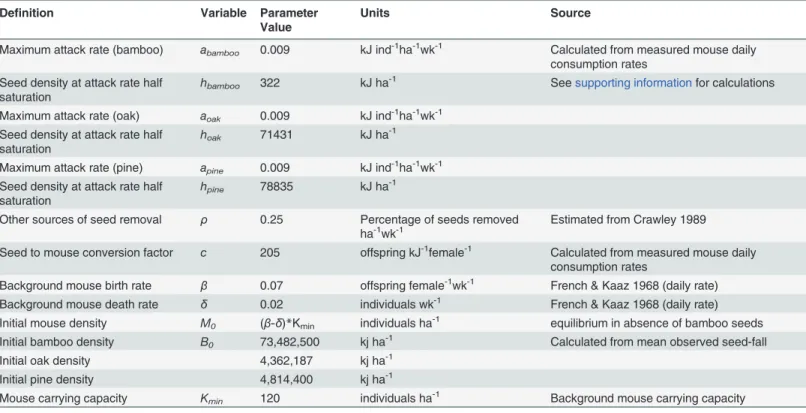
Data from the reproduction trials were used to parameterize a mathematical model describing the joint dynamics of bamboo seeds and deer mice densities after a masting event. Pines and oaks also undergo masting events that incur seed predation [47,48]; data from these native ex-amples were also used to parameterize comparative models. We used a modified version of the Rosenzweig-MacArthur consumer-resource model [49] ([50] for additional background on the model and its parameters) (Table 1, seeS2 Tablefor value derivations). The dynamics of the masting seeds are described by the differential equation
dB
dt ¼ a
MB
hþb rB ðEq 1Þ
whereB=B(t) is the average energy available per hectare based on the average seed values [51–54],Pinus ponderosa[48], and North AmericanQuercusspp. [55]tweeks after a masting event, andM=M(t) is the mouse density at weekt(individuals per hectare [56,57]). All seed densities were converted to kJ per ha to account for differences in relative seed size and caloric content (i.e. fewer, larger seeds are weighted differently in a model than many small seeds).
Table 1. Model parameter variables and values.
Definition Variable Parameter
Value
Units Source
Maximum attack rate (bamboo) abamboo 0.009 kJ ind-1ha-1wk-1 Calculated from measured mouse daily consumption rates
Seed density at attack rate half saturation
hbamboo 322 kJ ha-1 Seesupporting informationfor calculations
Maximum attack rate (oak) aoak 0.009 kJ ind-1ha-1wk-1 Seed density at attack rate half
saturation
hoak 71431 kJ ha-1
Maximum attack rate (pine) apine 0.009 kJ ind-1ha-1wk-1 Seed density at attack rate half
saturation
hpine 78835 kJ ha-1
Other sources of seed removal ρ 0.25 Percentage of seeds removed ha-1wk-1
Estimated from Crawley 1989
Seed to mouse conversion factor c 205 offspring kJ-1female-1 Calculated from measured mouse daily
consumption rates
Background mouse birth rate β 0.07 offspring female-1wk-1 French & Kaaz 1968 (daily rate)
Background mouse death rate δ 0.02 individuals wk-1 French & Kaaz 1968 (daily rate)
Initial mouse density M0 (β-δ)*Kmin individuals ha-1 equilibrium in absence of bamboo seeds
Initial bamboo density B0 73,482,500 kj ha-1 Calculated from mean observed seed-fall
Initial oak density 4,362,187 kj ha-1
Initial pine density 4,814,400 kj ha-1
Mouse carrying capacity Kmin 120 individuals ha-1 Background mouse carrying capacity
The maximum per mouse seed attack rate isa(measured in kJ per ha per week), andhis the seed density (kJ per ha) at which the per mouse attack isa/2, i.e., half the maximum. We esti-matedhby back-calculating from the average length of the mast event for each taxon (oaks, 3 months; pines, 3 months; bamboo, 12 months; seesupporting information). Rate of seed re-moval by other sources including fungal attack and germination is symbolized byρ. Deer mice
dynamics are described by the differential equation
dM
dt ¼ bþca
B hþB
M dþ M
KðBÞ
MþiðBÞ ðEq 2Þ
where parameterβis background per capita mouse birthrate (i.e., rate in the absence of seeds),
cis a conversion factor for seed density consumed to mice density produced,δis background per capita mouse death rate andi(B)is an immigration term (individuals arriving per ha per week). The termK(B), the functional carrying capacity of mice on a given seed diet, is inversely related to the strength of intraspecific density regulation in deer mice, which may depend on the seed availability (B). We included an immigration termi(B) based on observations from other population irruption events [57] in which 30 new individuals enter the population every week as long asBthreshold<B, whereBthresholdis the energetic value in seeds (in kJ) required to attract immigrants. We estimated this value at 3000 kJ based on per capita consumption rates. OnceB<Bthreshold, immigration ceases. That is,i(B) = 30 forB>3000 andi(B) = 0 for B3000.
In general,K(B) should increase withB, indicating weaker intraspecific competition as seed abundance increases. We utilized a logarithmic equation forK(B)for the results below,
KðBÞ ¼Kminþlnð1þBÞ ðEq 3Þ
based on the reproductive biology ofP.maniculatus[58]. The population dynamics are, how-ever, qualitatively similar whenK(B) increases linearly or even exponentially fromKmin(the
pre-mast mouse carrying capacity) whenB= 0. Our projections are then qualitatively robust for any monotonic increasing relationship between intraspecific competition and seed density.
Masting events are fundamentally transitory and produce abundant seeds in a very short pe-riod [9]. Consequently we assume a high density of bamboo seeds is present att= 0,B0, the
time of the masting event. In turn, we assume the initial density of deer mice is at equilibrium before the onset of masting, whenB= 0. This initial density can be found by settingdM/dt= 0 andB= 0 in Eq (2) and solving forMgiving:
M0¼ ðb dÞ þKmin ðEq 4Þ
We solved the system of differential Eq (1) and (2) with initial conditionsB(0) =B0andM
(0) =M0(Eq 4), numerically in the programming language R for Mac OS X, version 1.65 [42]
using the library‘desolve’. All values used to parameterize the model were extrapolated from field studies (B,K,M,β,δ) [54,57–60] or calculated and measured from our experiments (c,a,
h,ρ) [61–63] (Table 1).
Results
We initially evaluated the ability ofP.maniculatusto survive and reproduce solely on a diet of seeds of the bamboos,B.distegiaorY.brevipaniculata, in laboratory feeding trials. We com-pared weight change in all mice in single-choice feeding treatments (laboratory rodent feed,
P.ponderosa,Avenaspp.,B.distegia,Y.brevipaniculataseeds and native mixed diet). All ani-mals maintained weight on all diets throughout the feeding trials (ANOVA, F7, 48 = 0.637,
Population growth ofP.maniculatuscan be markedly responsive to a rapidly available food: females enter estrus every five days, and pups are weaned and reproductive six weeks after con-ception [64]. Single choice diets had no significant effect on the rate of conception except for females fed a diet of pine seeds; these animals had a significantly lower rate of conception (Cochran’s Q, McNemar’s Test, P = 0.045). Neither the number of pups per litter (KWχ2=
5.42, df = 5, P = 0.36,Fig 1) nor weight per pup at weaning (F5, 60 = 1.553, P = 0.187, mean:
17.33g/pup, see Supplemental materials) was significantly different among treatments.
In multiple-choice cafeteria-style feeding trials, we found that mice did not consume signifi-cantly more native seeds or pine seeds by mass than bamboo seeds (F = 2.07, df = 4, P>0.09,
Fig 2), and they preferredP.ponderosaseeds and the native seed mix to rodent laboratory feed
Fig 1. Box and whisker plot of number of pups per litter (at weaning) for each single-choice diet (open circles represent outliers which were included in the analysis).Although the median litter size (thickened bar) differs slightly, all treatments yielded a mean of four pups per litter, thereby producing an exponential growth rate assuming equal sex ratios among treatments.
doi:10.1371/journal.pone.0124419.g001
Fig 2. Seed choice based on proportion of the feed consumed in multiple-choice feeding trials.Deer mice consumed approximately 20% of their diet as bamboo (Yushania brevipaniculata) seeds (per 12 h); they consumed significantly more bamboo (P<0.05*) mixed native seeds (P<0.001***)(1:1 mix ofBalsamorhiza sagittataandPseudoregnaria spicata) andPinus ponderosaseeds (P<0.001***) than locally grown wheat
seeds or Harlan-Teklad Rodent Chow (ANOVA, F3,8 = 3.45, P<0.0001).
and wheat seeds (F = 12.1, df = 4, P<0.0001). Mice consumed approximately 4 g of feed per
12 h feeding period and consumed 20% of their diet as bamboo seeds (ranging from 18% to 26%,Fig 2). Seeds ofB.distegia,Y.brevipaniculata, wheat,P.spicata(native grass), and Harlan Teklad Rodent Chow have approximately the same caloric content and are composed primarily of carbohydrates. Seeds ofP.ponderosaandB.sagittata, in contrast, have a substantially higher caloric content, reflecting these seeds’higher fat and protein content (S3 Table).
We incorporated estimates of the density and duration of bamboo seed production in Asia [52–54] along with reportedP.maniculatusdensities [56,57] into our modified Rosenzweig—
MacArthur consumer-resource model (Eq1–4) to assess the potential impact of bamboo mast fruiting on deer mice population growth (Fig 3). We also modeledPinusandQuercusmasting events in North America, to compare these previously measured events with our theoretical bamboo masting event. With the reproduction values we measured, the model predicts a time frame, based on mast length, during which mouse densities attain significantly higher levels (~150–200 mice per hectare) than normal observed mouse densities in these areas (8–20 mice
Fig 3. Joint dynamics of seeds ([a] bamboo, [b] oak and [c] pine) and deer mice densities following a mast event.Deer mice densities (dashed line) rise sharply in response to newly available seeds (solid line) to a new plateau several times higher thanM0, their initial abundance. As mice consume seeds, they are
initially only limited by their maximum rate of consumption (i.e. handling time [h]), not by supply, producing a prolonged quasi-equilibrium (QE). QE lasts until seed density falls below the immigration threshold and then again when deer mice become seed-limited again; seeds are depleted completely and the deer mice population returns to its pre-mast density. The QE period for bamboo lasts much longer than the other two native species and reaches a higher peak value than either oaks or pines. Parameter values for this figure are listed inTable 1with derivations inS2 Table.
per hectare) [65,66]. The time frame of the bamboo mast event is much longer than masting events among native pines and oaks. Consequently, mice could reach a higher maximum popu-lation density that can be sustained for longer due to the larger energy contribution from bam-boo compared to native resources.
Dynamics of the mast consumer-resource system exhibit a sequence of distinct phases. In the first phase, the deer mice population increases exponentially at rater =β+ ca-δuntil it reaches a
“quasi-equilibrium”(QE), or maximum sustained density at population densities 5–7 fold great-er than background levels. The initial exponential rate of increase,r, is derived by assuming that the initial seed supply is well above the attack rate half-saturation density (i.e.,B0>>h) and that intraspecific competition is extremely weak [viz.,M<<K(B0)]. Both this phase and the
subse-quent phase account for new immigrants arriving in the plot onceBsurpasses the energetic threshold to attract mice from adjacent areas.
Mice numbers during the subsequent quasi-equilibrium phase decline slowly and their abundance at any time is approximately a function of seed density alone. The QE densities of deer mice can be found by solvingdM/dt= 0 forMassumingB>>h, which gives
MQEðBÞ ¼KðBÞðbþca dÞ ðEq 5Þ
Mouse populations remain relatively stable until bamboo seeds fall below the immigration threshold, after which immigrants no longer arrive and the density of bamboo seedsBis ap-proximately the same order ash(Fig 3). OnceB ~ h, seed consumption is limited by supply rather than the consumption capacity of deer mice, and during this final phase, seed abundance falls precipitously and mice densities return to pre-mast levels,M0(B!0).
Discussion
The population dynamics of the interaction are intrinsically driven by the amount and persis-tence of a new energy resource. Results of our feeding trials and modeling predictions for
P.maniculatusare consistent with rapid population changes in rodent populations during bamboo masting events in Asia and South America [12,38,67]. We contend that a substantial risk of a similar sequence could arise in North America due to the rapid proliferation and ex-pansion of non-native running bamboos within the range ofP.maniculatus. As a result, mast fruiting by a naturalized bamboo species, or any potential naturalized masting species, could cause a rapid increase inP.maniculatuspopulations that persists for multiple generations as successive generations of deer mice feed on fallen bamboo seeds [26,27,68](Fig 3).
Extensive field sampling and subsequent simulations of deer mice populations indicate a similar influence of native species’primary productivity on deer mice population dynamics [29,69]. A direct link between the incidence of infectious diseases andPeromyscuspopulation irruptions is elusive, but a pronounced increase in the number of SNV cases in the Four Cor-ners region of the U.S. in the 1990s nonetheless correlates to increases in seed production in the local vegetation, including masting by Piñon pines [70].
season for currently reproductiveP.maniculatusfemales and also provides resources for breed-ing to resume earlier in sprbreed-ing [27,28]. Many deer mice populations within the already natural-ized range of bamboos (Oregon, Washington and California) breed year-round, and their response to bamboo masting could be even more pronounced than we modeled [72]. Addition-ally, the prolonged breeding season could enable young-of-the-year [73], the offspring born during the current reproductive season, to reproduce within their first season. This potential for reproduction in young-of-the-year females closely approximates exponential population growth in which all members of the population contribute equally [74]. The quasi-equilibrium phase persists because the plot of seed consumption by the mice reaches a plateau (expressed asB>>h, mice are limited by maximum consumption rate, not seed availability) and lasts
until the bamboo seed density declines to the attack rate half-saturation density (Bh). In this phase the dynamics of predator satiation play out: mice are limited by a saturated seed density, leaving the excess seeds to germinate if unattacked by other seed predators [75,76]. Eventually (the third phase) the attack rate surpasses the seed abundance and intra-specific competition for food increases, and mouse density declines rapidly. Mouse density also declines rapidly due to diminishing food and correspondingly lowers population growth rates. Deer mice popula-tions then reach the fourth and final phase in which they return to background pre-mast popu-lation densities. Results from our three modeled scenarios differ primarily in the second phase, the equilibrium. Bamboo is able to satiate seed predators for a much longer time than pines or oaks due to much higher output. Bamboos however, reproduce once during their lifecycle, whereas pines, oaks, and most other masting species may undergo several smaller mast events. The modeled event maintains the same shifts through the three phases, making it applicable to other consumer—resource events (e.g.Pinus,Picea,Nothofagus,FagusandQuercusspecies (see[75]) with a single pulse in new resources [28,77](Fig 3B–3C).
Our model assumes that food availability is the primary factor determining deer mice popu-lation levels. Predation could conceivably exert a strong constraint on popupopu-lation growth. Ex-periments with food additions during and after active reproductive periods have however produced contrasting results. For instance, the numerical response in small populations of mice resulted in their increased predation and decreased survivorship [78], butP.maniculatus
populations in Canada increased when presented with more food resources [27]. AlthoughP.
maniculatusis preyed upon by multiple avian and mammalian predators (e.g., raptors, coy-otes) in these communities, experimental removal of its predators reveal these“top-down”
forces collectively exert little influence on mice abundance [79]. In contrast, deer mice undergo a rapid numerical response to the“bottom up”effect of a food subsidy [27,28], paralleling the results in our feeding trials and the model’s predictions. Pearson and Fletcher [80] showed that the now abundant larvae of introduced gall flies (Urophoraspp.), biological control agents on
Centaurea maculosa, provide a substantial portion of deer mice diet from late spring through winter. As a result, deer mice abundance can be two fold greater when this subsidy is available compared with the abundance in controls. Ominously,P.maniculatusthat tested seropositive for SNV were three times more abundant when this food subsidy was available. Although deer mice density increased as a direct consequence of the food addition, the rate of transmission of SNV among these mice may have been enhanced by the food subsidy due to resulting increased intraspecific interactions [7]. This rate of population increase is attributable to a numerical re-sponse among the mice, given their 28-day reproductive cycle and their ability to migrate to a food subsidy [27,81].
Deer mice produce litters of similar size when fed an equal biomass of seeds of either bam-boo or the native grassP.spicata. Why then are surges in the size of deer mice populations not produced by this native food in the Pacific Northwest? Leptomorphic bamboos andP.spicata
different outcomes for deer mice under field conditions. The caespitoseP.spicata, has a much lower adult density even in habitats in which it is dominant than the culm density common among clonally spreading leptomorphic bamboos (cf. [82,83]). Furthermore, total seed mass per unit area in mature communities and duration of seed production are strikingly lower for
P.spicatathan the corresponding values for bamboos. A bamboo seed rain typically lasts for 6–18 months and can produce as much as 2000 kg of seeds per hectare [53,54]. Given the aver-age biomass ofP.spicataseeds [60], we estimate seed production for a steppe community with maximum (95%) reported cover of matureP.spicata[84] would be<5 kg-1ha-1y-1. Pseudor-oegnaria spicataoccurs in few coniferous forests in the PNW; its maximum reported canopy cover in a forest understory is 80% but is commonly much lower [85]. In neither forest nor steppe communities would seed production ofP.spicatasupport population growth for deer mice on the scale we predict here for a masting bamboo. Although deer mice are capable of de-riving the majority of their nutrients from seeds, these low-protein and low-fat foods must be supplemented by insects with high protein and fat contents [86]. Insect populations also expe-rience numerical increases following a masting event [87], which could directly support grow-ing rodent populations [76].
Peromyscus maniculatus
—
A Persistent Threat to Forests and Crops
Upon depletion of the seed subsidy, starving omnivorous deer mice would disperse in search of food and rapidly encounter crops in much of the interior PNW. The region’s native steppe has been largely converted to the production of cereals (e.g., wheat, oats, barley) and legumes (len-tils, dry peas, alfalfa) [88,89], which are readily consumed by deer mice [90]. For example, in eastern Washington and northern Idaho much farmland lies adjacent to low elevationP. pon-derosaforest, native habitat for deer mice. Soil survey maps [88,89] delineate the long, interdig-itating ecotone across which mice readily move between forest habitat and fields [90,66]. In steppe and forest habitats, seed consumption from deer mice alters seed recruitment, especially for species with high palatability (e.g.P.ponderosa,Lupinus sericeus,Pinus contorta, Lithos-perma ruderale, among others) [91,92]. Even if an outbreak of deer mice were foreseen, con-trolling, much less eradicating, the immigration of mice into crop fields would likely prove challenging. A rodenticide, such as zinc phosphide, can be spread as pellets or impregnated on grain outside the fields but is only temporarily effective [90].
Importation of Ornamental Bamboos: New Opportunities for Spread and
Naturalization
Use of ornamental running bamboos in landscaping is increasing in the U.S., as indicated by the steady 30-year increase of the number of species available on the American Bamboo Society’s species list (http://www.bamboo.org/BambooSourceList). As the array of bamboo species in the horticulture trade increases, so does the likelihood that one or more of these spe-cies will escape cultivation and establish large, persistent populations. On the U.S. East Coast, large infestations ofPhyllostachysspp. have spread from abandoned plantings into forest un-derstories (http://www.eddmaps.org, RNM, pers. observation). In the PNW, escapedP. japoni-cais locally and repeatedly naturalized in coastal forests dominated byPseudotsuga menziesii
adjacent to old residences (http://www.eddmaps.org, MCS, unpublished data); these incursions are not surprising given the extraordinary shade tolerance among the temperate Asian bam-boos [22].
As a result, coniferous forests along the North American West Coast and inland, in which
similarities with Asian coniferous forests in whichSasa kurilensisand other dwarf (<2 m)
leptomorphic bamboos, commonly form a continuous hedge-like layer [52,94]. Extensive naturalization of leptomorphic bamboos with aggressively spreading rhizomes could eventu-ally produce massive seed crops in PNW forests. In a worst-case scenario a naturalized bam-boo population undergoes mass flowering/fruiting on forested public lands; residentP.
maniculatuspopulations rapidly increase, the increase driven by the newly available resource, followed by the bamboo soon waning as a food source. As a consequence, starving perido-mesticP.maniculatusseek food in structures, including dwellings [95] with subsequent pub-lic health imppub-lications.
Preemptively Curbing a Bamboo-Deer mouse Link
Results of our experiments and model analyses meet the premise of the precautionary principle [96], i.e., justifying measures to be taken before a larger body of retrospective evidence has been assembled on a link between masting in leptomorphic bamboos and the population dynamics of deer mice in coniferous forests. In effect, our conclusions are an early warning from which deliberate action can be taken. Two revisions to U.S. and Canadian plant quarantine policy [97,98] regarding the importation and distribution of bamboos now seem advisable. Early De-tection/Rapid Response (ED/RR), i.e., deliberate steps now taken to detect and eradicate ag-gressively spreading non-native plants, as practiced in U.S. National Parks (http://www.nature. nps.gov/biology/invasivespecies/EPMT_teams.cfm), needs to be directed at non-native bam-boos on public lands. Second, any leptomorphic bamboo’s flowering interval and the palatabili-ty of its seeds for rodents (and other seed predators) in its native range should be included in evaluating its potential introduction into the U.S. This information could then be coupled with results from experimental gardens in a new range that gauge the species’potential to spread vegetatively and persist [99].
Supporting Information
S1 Dataset. Single-choice feeding trial.Raw, untransformed data from single-choice feeding trials to determine survivability of single choice diets.
(PDF)
S2 Dataset. Single-choice reproductive feeding trial.Raw, untransformed data from com-bined naïve and experienced females for reproductive output, single-choice feeding trial. (PDF)
S3 Dataset. Multiple-choice feeding trial.Raw, untransformed data from multiple-choice feeding trials done with 10 individual mice.
(PDF)
S1 Table. Bamboo flowering and fruiting records from National Herbarium (US).All flow-ering events took place in cultivated patches in the USA. All flowflow-ering bamboos formed caryop-ses with rates from 40–100% in the introduced range including naturalized species,Phyllostachys aureaandSasa palmata.
(DOCX)
S2 Table. Supporting Information.Calculations, derivations and r-code for the maximum seed attack rate (a) and the seed density at attack rate half saturation (h).
S3 Table. Caloric content of seeds used in our study.All measurements are an average (± SE) of three 5-g samples that were ground and combusted in an oxygen bomb calorimeter.
(DOCX)
Acknowledgments
We thank Jiaqing Ding and Xinmin Lu of the Wuhan Botanical Garden for assistance procur-ing bamboo seeds. S.C.H. Barrett, M. Evans, C. Gaskin and J. Rprocur-ingwood provided invaluable as-sistance at other stages in the study.
Author Contributions
Conceived and designed the experiments: RNM MCS. Performed the experiments: RNM MCS. Analyzed the data: MCS RG. Contributed reagents/materials/analysis tools: RNM. Wrote the paper: MCS RNM.
References
1. Vitousek PM, Walker LR, Whiteaker LD, Mueller-Dombois D, Matson PA. Biological invasion byMyrica fayaalters ecosystem development in Hawaii. Science. 1987; 238: 802–804. doi:10.1126/science.238. 4828.802PMID:17814707
2. Richardson DM, Pyšek P, Rejmánek M, Barbour MG, Panetta FD, West CJ. Naturalization and invasion of alien plants: concepts and definitions. Divers Distrib. 2000; 6: 93–107. doi:10.1046/j.1472-4642. 2000.00083.x
3. Hiltbrunner E, Aerts R, Bühlmann T, Huss-Danell K, Magnusson B, Myrold DD, et al. Ecological conse-quences of the expansion of N2-fixing plants in cold biomes. Oecologia. 2014; 176: 11–24. doi:10.
1007/s00442-014-2991-xPMID:24938834
4. Mack RN. Phylogenetic constraint, absent life forms, and preadapted alien plants: A prescription for bio-logical invasions. Int J Plant Sci. 2003; 164: S185–S196.
5. Rundel PW, Dickie IA, Richardson DM. Tree invasions into treeless areas: mechanisms and ecosystem processes. Biol Invasions. 2014; 16: 663–675. doi:10.1007/s10530-013-0614-9PMID:24952464 6. Mack R, Smith M. Invasive plants as catalysts for the spread of human parasites. NeoBiota. 2011; 9:
13. doi:10.3897/neobiota.9.1156
7. Pearson DE, Callaway RM. Biological control agents elevate hantavirus by subsidizing deer mouse populations. Ecol Lett. 2006; 9: 443–450. doi:10.1111/j.1461-0248.2006.00896.xPMID:16623730 8. Ostfeld RS, Keesing F. Biodiversity series: The function of biodiversity in the ecology of vector-borne
zoonotic diseases. Can J Zool. 2000; 78: 2061–2078. doi:10.1139/z00-172
9. Janzen DH. Why bamboos wait so long to flower. Annu Rev Ecol Syst. 1976; 7: 347–391. doi:10.1146/ annurev.es.07.110176.002023
10. Fan D, Jiarong X, Yuming Y, Chaomao H, Jing W. Study on the bamboo flowering phenomenon and its tyopes in Yunnan in the past 15 years. Sci Silvae Sin. 2000; 36: 57–68.
11. Franklin DC. Synchrony and asynchrony: observations and hypotheses for the flowering wave in a long-lived semelparous bamboo. J Biogeogr. 2004; 31: 773–786. doi:10.1111/j.1365-2699.2003. 01057.x
12. Jaksic FM, Lima M. Myths and facts on ratadas: Bamboo blooms, rainfall peaks and rodent outbreaks in South America. Austral Ecol. 2003; 28: 237–251. doi:10.1046/j.1442-9993.2003.01271.x
13. Lalnunmawia F, Jha L, Lalengliana F. Preliminary observations on ecological and economical impacts of bamboo flowering in Mizoram (North East India). J Bamboo Rattan. 2005; 4: 317–322.
14. Blackwell GL, Potter MA, McLennan JA, Minot EO. The role of predators in ship rat and house mouse population eruptions: drivers or passengers? Oikos. 2003; 100: 601–613. doi:10.1034/j.1600-0706. 2003.11026.x
15. Murúa R, González L, González M, Jofré Y. Efectos del florecimiento del arbusto Chusquea qulla Kunth (Poaceae) sobre la demografia de poblaciones de roedores de los bosques templados frios del sur Chileno. Bol Soc Biol Concepc Chile. 1996; 67: 37–42.
Rodent outbreaks: ecology and impacts. Los Banos, Philippines: International Rice Research Institute; 2010. pp. 49–64.
17. Nag S. Bamboo, rats and famines: famine relief and perceptions of British paternalism in the Mizo hills (India). Environ Hist. 1999; 5: 245–252. PMID:20446375
18. Aplin K, Lalsiamliana J. Chronicle and impacts of the 2005–09 mautam in Mizoram. Rodent outbreaks: ecology and impacts. In: Singleton GR, Belmain S, Brown P, Hardy B, editors. Rodent outbreaks: ecol-ogy and impacts. Los Banos, Philippines: International Rice Research Institute; 2010. pp. 13–48.
19. Franklin JF, Dyrness CT. Natural vegetation of Oregon and Washington. [Internet]. U.S.D.A., Forest Service, Pacific Northwest Research Station; 1973 p. 427. Report No.: 008. Available:http://www. treesearch.fs.fed.us/pubs/26203
20. Crompton D. Ornamental bamboos. Portland, OR USA: Timber Press; 2006.
21. Uemura S. Snowcover as a factor controlling the distribution and speciation of forest plants. Vegetatio. 1989; 82: 127–137. doi:10.1007/BF00045026
22. Smith MC, Mack RN. Shade tolerance of temperate Asian bamboos: a harbinger of their naturalization in Pacific Northwest coniferous forests? Biol Invasions. 2013; 15: 2081–2093. doi: 10.1007/s10530-013-0434-y
23. Gratani L, Crescente MF, Varone L, Fabrini G, Digiulio E. Growth pattern and photosynthetic activity of different bamboo species growing in the Botanical Garden of Rome. Flora—Morphol Distrib Funct Ecol Plants. 2008; 203: 77–84. doi:10.1016/j.flora.2007.11.002
24. Jameson EW. Food of deer mice,Peromyscus maniculatusandP.boylei, in the Northern Sierra Ne-vada, California. J Mammal. 1952; 34: 44–58.
25. Johnson DR. The food habits of rodents on rangelands of Southern Idaho. Northwest Sci. 1961; 61: 37–40.
26. Gilbert BS, Krebs CJ. Effects of extra food onPeromyscusandClethrionomyspopulations in the south-ern Yukon. Oecologia. 1981; 51: 326–331. doi:10.1007/BF00540901
27. Taitt MJ. The effect of extra food on small rodent populations: I. Deermice (Peromyscus maniculatus). J Anim Ecol. 1981; 50: 111. doi:10.2307/4035
28. Wolff JO. Population fluctuations of mast-eating rodents are correlated with production of acorns. J Mammal. 1996; 77: 850. doi:10.2307/1382690
29. Luis AD, Douglass RJ, Mills JN, Bjørnstad ON. The effect of seasonality, density and climate on the population dynamics of Montana deer mice, important reservoir hosts for Sin Nombre hantavirus. J Anim Ecol. 2010; 79: 462–470. doi:10.1111/j.1365-2656.2009.01646.xPMID:20015212 30. Wobeser G, Ngeleka M, Appleyard G, Bryden L, Mulvey MR. Tularemia in deer mice (Peromyscus
maniculatus) during a population irruption in Saskatchewan, Canada. J Wildl Dis. 2007; 43: 23–31. doi:
10.7589/0090-3558-43.1.23PMID:17347390
31. Burgdorfer W, Lane RS, Barbour AG, Gresbrink RA, Anderson JR. The western black-legged tick, Ixodes pacificus: a vector ofBorrelia burgdorferi. Am J Trop Med Hyg. 1985; 34: 925–930. PMID:
3898886
32. Lane RS, Piesman J, Burgdorfer W. Lyme Borreliosis: relation of its causative agent to its vectors and hosts in North America and Europe. Annu Rev Entomol. 1991; 36: 587–609. doi:10.1146/annurev.en. 36.010191.003103PMID:2006870
33. Peavey CA, Lane RS. Transmission ofBorrelia burgdorferibyIxodes pacificusnymphs and reservoir competence of deer mice (Peromyscus maniculatus) infected by tick-bite. J Parasitol. 1995; 81: 175. doi:10.2307/3283916PMID:7707191
34. Mills JN, Corneli A, Young LC, Garrison LE, Khan AS, Ksiazek TG. Hantavirus Pulmonary Syndrome—
United States: updated recommendations for risk reduction. Center for Disease Control; 2002 pp. 1–
12. Report No.: 51.
35. Biggs JR, Bennett KD, Mullen MA, Haarmann TK. Relationship of ecological variables to Sin Nombre Virus antibody seroprevalence in populations of deer mice. J Mammal. 2000; 81: 676–682.
36. Calisher CH, Wagoner KD, Amman BR, Root JJ, Douglass RJ, Kuenzi AJ, et al. Demographic factors associated with prevalence of antibody to Sin Nombre Virus in deer mice in the western United States. J Wildl Dis. 2007; 43: 1–11. doi:10.7589/0090-3558-43.1.1PMID:17347388
37. Dizney L, Jones PD, Ruedas LA. Natural history of Sin Nombre Virus infection in deer mice in urban parks in Oregon. J Wildl Dis. 2010; 46: 433–441. PMID:20688636
39. Gunther PM, Horn BS, Babb GD. Small mammal populations and food selection in relation to timber harvest practices in the Western Cascade Mountains. Northwest Sci. 1983; 57: 32–44.
40. Sieg CH, Uresk DW, Hansen RM. Seasonal diets of deer mice on bentonite mine spoils and sagebrush grasslands in southeastern Montana. Northwest Sci. 1986; 60: 81–89.
41. Bartolomucci A, Palanza P, Sacerdote P, Ceresini G, Chirieleison A, Panerai AE, et al. Individual hous-ing induces altered immuno-endocrine responses to psychological stress in male mice. Psychoneur-oendocrinology. 2003; 28: 540–558. doi:10.1016/S0306-4530(02)00039-2PMID:12689611 42. R Development Core Team. R: A language and environment for statistical computing. [Internet].
Vi-enna, Austria: R Foundation for Statistical Computing; 2014. Available:http://www.R-project.org 43. Lockwood JR III. On the statistical analysis of multiple-choice feeding preference experiments.
Oecolo-gia. 1998; 116: 475–481. doi:10.1007/s004420050612
44. Manly BFJ. Comments on design and analysis of multiple-choice feeding-preference experiments. Oecologia. 1993; 93: 149–152. doi:10.1007/BF00321205
45. Curran JM. Hotelling [Internet]. 2013. Available:http://cran.r-project.org/web/packages/Hotelling/ Hotelling.pdf
46. Botten J, Ricci R, Hjelle B. Establishment of a deer mouse (Peromyscus maniculatus rufinus) breeding colony from wild-caught founders: comparison of reproductive performance of wild-caught and labora-tory-reared pairs. Comp Med. 2001; 51: 314–318. PMID:11924788
47. Liebhold A, Sork V, Peltonen M, Koenig W, Bjørnstad ON, Westfall R, et al. Within-population spatial synchrony in mast seeding of North American oaks. Oikos. 2004; 104: 156–164. doi: 10.1111/j.0030-1299.2004.12722.x
48. Krannitz PG, Duralia TE. Cone and seed production inPinus ponderosa: a review. West North Am Nat. 2004; 64: 208–218.
49. Rosenzweig ML, MacArthur RH. Graphical representation and stability conditions of Predator-Prey in-teractions. Am Nat. 1963; 97: 209–223.
50. Turchin P. Complex population dynamics: a theoretical/empirical synthesis. Princeton, NJ USA: Princeton University Press; 2003.
51. Oshima Y. Ecological studies ofSasacommunities II. Seasonal variations of productive structure and annual net production inSasacommunities. Bot Mag Tokyo. 1961; 74: 280–290.
52. Makita A, Konno Y, Fujita N, Takada K, Hamabata E. Recovery of aSasa tsuboianapopulation after mass flowering and death. Ecol Res. 1993; 8: 215–224. doi:10.1007/BF02348534
53. Taylor AH, Zisheng Q. Regeneration from seed ofSinarundinaria fangiana, a bamboo, in the Wolong Giant Panda Reserve, Sichuan, China. Am J Bot. 1988; 75: 1065. doi:10.2307/2443774
54. Li Z, Denich M, Borsch T. Simultaneous flowering of umbrella bamboo (Fargesia murieliae) at its native home in Central China. J For Res. 2006; 17: 293–297. doi:10.1007/s11676-006-0067-4
55. Clotfelter ED, Pedersen AB, Cranford JA, Ram N, Snajdr EA, Nolan V Jr, et al. Acorn mast drives long-term dynamics of rodent and songbird populations. Oecologia. 2007; 154: 493–503. doi:10.1007/ s00442-007-0859-zPMID:17924149
56. Gashwiler JS. Deer mouse reproduction and its relationship to the tree seed crop. Am Midl Nat. 1979; 102: 95. doi:10.2307/2425070
57. Sullivan TP. Demography of populations of deer mice in coastal forest and clear-cut (logged) habitats. Can J Zool. 1979; 57: 1636–1648.
58. Wolff JO. Comparative population ecology ofPeromyscus leucopusand Peromyscus maniculatus. Can J Zool. 1985; 63: 1548–1555. doi:10.1139/z85-230
59. French NR, Kaaz HW. The intrinsic rate of natural increase of irradiatedPeromyscusin the laboratory. Ecology. 1968; 49: 1172. doi:10.2307/1934507
60. Patton BD, Hironaka M, Bunting SC. Effect of burning on seed production of bluebunch wheatgrass, Idaho fescue, and Columbia needlegrass. J Range Manag. 1988; 41: 232. doi:10.2307/3899174 61. Real LA. Ecological determinants of functional response. Ecology. 1979; 60: 481–485.
62. Berryman AA. The orgins and evolution of predator-prey theory. Ecology. 1992; 73: 1530–1535. doi:
10.2307/1940005
63. Chambers JC, MacMahon JA. A day in the life of a seed: movements and fates of seeds and their impli-cations for natural and managed systems. Annu Rev Ecol Syst. 1994; 25: 263–292. doi:10.1146/ annurev.es.25.110194.001403
65. Tallmon DA, Jules ES, Radke NJ, Mills LS. Of mice and men and trillium: cascading effects of forest fragmentation. Ecol Appl. 2003; 13: 1193–1203. doi:10.1890/02-5111
66. Johnson DR. Effect of alternative tillage systems on rodent density in the Palouse region. Northwest Sci USA. 1987; Available:http://agris.fao.org/agris-search/search.do?recordID=US8736243
67. Kitzberger T, Chaneton EJ, Caccia F. Indirect effects of prey swamping: differential seed predation dur-ing a bamboo mastdur-ing event. Ecology. 2007; 88: 2541–2554. doi:10.1890/06-1587.1PMID:18027757 68. Ortega YK, Pearson DE, McKelvey KS. Effects of biological control agents and exotic plant invasion on
deer mouse populations. Ecol Appl. 2004; 14: 241–253. doi:10.1890/02-5276
69. Orrock JL, Allan BF, Drost CA. Biogeographic and ecological regulation of disease: prevalence of Sin Nombre Virus in island mice is related to island area, precipitation, and predator richness. Am Nat. 2011; 177: 691–697. doi:10.1086/659632PMID:21508614
70. Calisher CH, Root JJ, Mills JN, Beaty BJ. Assessment of ecologic and biologic factors leading to hanta-virus pulmonary syndrome, Colorado, U.S.A. Croat Med J. 2002; 43: 330–337. PMID:12035141 71. Horne BV. Niches of adult and juvenile deer mice (Peromyscus maniculatus) in seral stages of
conifer-ous corest. Ecology. 1982; 63: 992–1003. doi:10.2307/1937239
72. Maser C, Mate BR, Franklin JF, Dyrness CT. Natural history of Oregon Coast mammals. Portland, OR USA: USDA, Forest Service, Pacific Northwest Forest and Range Experiment Station; 1981 p. 496. Re-port No.: PNW 133.
73. Jameson EW. Reproduction of deer mice (Peromyscus maniculatusandP.boylei) in the Sierra Ne-vada, California. J Mammal. 1953; 34: 44. doi:10.2307/1375943
74. Vandermeer J. How populations grow: the exponential and logistic equations. Sci Educ Knowl. 2010; 3: 15.
75. Kelly D, Sork VL. Mast seeding in perennial plants: why, how, where? Annu Rev Ecol Syst. 2002; 33: 427.
76. Kelly D, Sullivan JJ. Quantifying the benefits of mast seeding on predator satiation and wind pollination inChionochloa pallens(Poaceae). Oikos. 1997; 78: 143. doi:10.2307/3545810
77. Engelthaler DM, Mosley DG, Cheek JE, Levy CE, Komatsu KK, Ettestad P, et al. Climatic and environ-mental patterns associated with hantavirus pulmonary syndrome, Four Corners region, United States. Emerg Infect Dis. 1999; 5: 87–94. doi:10.3201/eid0501.990110PMID:10081675
78. Yunger JA. Response of two low-density populations ofPeromyscus leucopusto increased food avail-ability. J Mammal. 2002; 83: 267–279. doi:10.1644/1545-1542(2002)083<0267:ROTLDP>2.0.CO;2 79. Maron JL, Pearson DE, Fletcher RJ. Counterintuitive effects of large-scale predator removal on a
mid-latitude rodent community. Ecology. 2010; 91: 3719–3728. doi:10.1890/10-0160.1PMID:21302842 80. Pearson DE, Fletcher RJ. Mitigating exotic impacts: restoring deer mouse populations elevated by an
exotic food subsidy. Ecol Appl. 2008; 18: 321–334. doi:10.1890/07-0766.1PMID:18488599 81. Morrison ML, Hall LS. Responses of mice to fluctuating habitat quality I. Patterns from a long-term
ob-servational study. Southwest Nat. 1998; 43: 123–136. PMID:9822999
82. Tisdale EW. The grasslands of the southern interior of British Columbia. Ecology. 1947; 28: 346. doi:
10.2307/1931227
83. Ohrnberger D. The bamboos of the world: annotated nomenclature and literature of the species and the higher and lower taxa. Amsterdam, The Netherlands: Elsevier; 1999.
84. Daubenmire R. Steppe vegetation of Washington. Pullman, WA USA; 1970 p. 131. Report No.: 62.
85. Daubenmire R, Daubenmire JB. Forest vegetation of Washington. Pullman, WA USA; 1968. Report No.: 60.
86. Ruscoe WA, Wilson DH, McElrea L, McElrea G, Richardson SJ. A house mouse (Mus musculus) popu-lation eruption in response to rimu (Dacrydium cupressinum) seedfall in southern New Zealand. N Z J Ecol. 2005; 28: 259–265.
87. Kon H, Noda T, Terazawa K, Koyama H, Yasaka M. Evolutionary advantages of mast seeding inFagus crenata. J Ecol. 2005; 93: 1148–1155. doi:10.1111/j.1365-2745.2005.01040.x
88. Barker RJ. Soil survey of Latah County area, Idaho. Washington, D.C. USA: USDA, Soil Conservation Service; 1981.
89. Donaldson NC. Soil survey of Whitman, County, Washington. Washington, D.C. USA: USDA, Soil Conservation Service; 1980.
90. Witmer G, Sayler R, Huggins D, Capelli J. Ecology and management of rodents in no-till agriculture in Washington, USA. Integr Zool. 2007; 2: 154–164. doi:10.1111/j.1749-4877.2007.00058.xPMID:
91. Timm RM, Howard WE. White-footed and deer mice. In: Hygnstrom SE, Timm RM, Larson GE, editors. Prevention and Control of Wildlife Damage. Cooperative Extension Service, University of Nebraska, Lincoln, NE; 1994. pp. B47—B51.
92. Everett R, Monsen S. Rodent problems in range rehabilitation. Proceedings of the Fourteenth Verte-brate Pest Conference. 1990. pp. 186–191.
93. Doyle AT. Use of riparian and upland habitats by small mammals. J Mammal. 1990; 71: 14. doi:10. 2307/1381312
94. Tsuyuzaki S, Kanda F. Revegetation patterns and seedbank structure on abandoned pastures in north-ern Japan. Am J Bot. 1996; 83: 1422. doi:10.2307/2446097
95. Douglass RJ, Semmens WJ, Matlock-Cooley SJ, Kuenzi AJ. Deer mouse movements in peridomestic and sylvan settings in relation to Sin Nombre Virus antibody prevalence. J Wildl Dis. 2006; 42: 813–
818. doi:10.7589/0090-3558-42.4.813PMID:17255448
96. Simberloff D. The politics of assessing risk for biological invasions: the USA as a case study. Trends Ecol Evol. 2005; 20: 216–222. doi:10.1016/j.tree.2005.02.008PMID:16701372
97. Liebhold AM, Brockerhoff EG, Garrett LJ, Parke JL, Britton KO. Live plant imports: the major pathway for forest insect and pathogen invasions of the US. Front Ecol Environ. 2012; 10: 135–143. doi:10. 1890/110198
98. Smith AL, Bazely DR, Yan N. Are legislative frameworks in Canada and Ontario up to the task of ad-dressing invasive alien species? Biol Invasions. 2013; 1–20. doi:10.1007/s10530-013-0585-x 99. Minton MS, Mack RN. Naturalization of plant populations: the role of cultivation and population size and

![Fig 3. Joint dynamics of seeds ([a] bamboo, [b] oak and [c] pine) and deer mice densities following a mast event](https://thumb-eu.123doks.com/thumbv2/123dok_br/16294432.185619/8.918.302.666.415.911/fig-joint-dynamics-seeds-bamboo-densities-following-event.webp)
