doi: 10.1590/S1984-46702010000600002
Musk deer (Moschus spp.) are well known for their pro-duction of musk, a substance secreted by adult males, which is highly valued by the perfume industry and used in many Chi-nese traditional medicine procedures. As a result of over-har-vesting and illegal poaching for musk, all musk deer have been included in the appendices of the Convention on International Trade in Endangered Species of Wild Fauna and Flora (CITES), and protected as a Category I key species in China (ZHOUet al. 2004).
Musk deer farming began in China in 1958 as a means of sustainable musk production and ex-situ conservation. Early farming techniques resulted in high mortality rates, low rates of musk production and low reproductive rate. Recent improve-ments in management and the development of a sustainable method of musk extraction from live adult males has seen some improvement in the productivity and welfare of captive musk deer but many challenges remain before the sustainable utili-zation of musk deer resources can be achieved (HOMES 1999, PARRY-JONES & WU 2001). Management practices in Chinese musk
deer farms work on the assumption that musk deer are domes-ticated. Consequently, they focus primarily on factors such as nutrition, while neglecting behavioral characteristics and hus-bandry techniques. A thorough understanding of an animal’s behavior is important to successfully farm and breed a species in captivity and assess its welfare (CARO 1993, ŠPINKA 2006, PRICE
& STOINSKI 2007, WECHSLER 2007).
The Alpine musk deer (Moschus sifanicus) inhabits conif-erous and deciduous forests in the western mountains of China at an altitude of 3000-5000 m. With the exception of the forest musk deer, Moschus berezovskii Flerov, 1929, alpine musk deer are the most commonly farmed species (ZHOUet al. 2004).
De-spite their commercial importance, a comprehensive under-standing of the behavioral ecology of alpine musk deer is lack-ing, due to their cryptic and solitary nature and highly vigilant behavior (GREEN 1987). This study explores the behavioral pat-terns of captive alpine musk deer in relation to reproductive season in the hope of improving our knowledge of the ior of wild populations. Based on these documented behav-ioral patterns and time-budgets, appropriate farming techniques can be refined to improve the welfare of captive musk deer and to attain sustainable farming practices.
MATERIAL AND METHODS
This study was conducted in the Xinglongshan musk deer farm (XMDF), located within the Xinglongshan National Na-ture Reserve, Gansu Province, northwest China. The geographic and climatic characteristics of this site are reported by MENGet
al. (2003a). Animals were housed in groups ranging from five to seven individuals within outdoor enclosures (10 x 10 m). Each enclosure contained a central yard with seven adjoining indoor cells (4 m2). Enclosures were separated by wire mesh,
Seasonal variation in the behavior of captive alpine musk deer,
Moschus sifanicus,
in Xinglongshan Musk Deer Farm, of China
Luan Xiaofeng
1; Zhao Changjie
2; Hui Cenyi
2& Meng Xiuxiang
2, 31 College of Nature Conservation, Beijing Forestry University. Beijing 100083, China.
2 College of Life and Environment Sciences, Minzu University of China. Beijing 100081, China. 3 Corresponding author. E-mail: [email protected]
ABSTRACT.Musk deer farming has the potential to be an effective conservation tool for the protection of musk deer as well as the production of valuable musk. To be successful, this requires a thorough understanding of the behavior of captive musk deer in order to improve their reproductive success and management. Between August 2005 to January 2006, the behavior sampling of 19 male and 13 female captive alpine musk deer, Moschus sifanicus Büchner, 1891, was used to examine the durations of twelve behavioral characteristics during the pre-rut (August to October) and rut seasons (November to January). Both males and females exhibited some seasonal variation in behavior. Males rested and fed more during the pre-rut than the rut and spent more time walking, fighting, and standing alert during the rut. Females spent more time feeding, ruminating, and interacting non-aggressively with other individuals during the pre-rut and more time in agonistic interactions during the pre-rut. The significance of these behavioral changes and their association with husbandry practices and farm management are discussed.
allowing animals to see, hear, and smell animals in neighbor-ing enclosures. A diet of fresh (May to November) or dried leaves (December to April) was provided in each enclosure. Leaves of the preferred forage species, predominantly Crataegus kansuensis Wils, 1928 and Acer tetramerum Pax, 1976 were collected from the Xinglongshan National Nature Reserve, a natural habitat for wild musk deer. This diet was supplemented with a grain mixture containing approximately 50% corn, 25% wheat and 25% soybean, which was prepared onsite. Seasonal vegetables were also provided and water was provided ad libitum.
Thirty-two healthy captive adult alpine musk deer, 19 males and 13 females, were studied. During the study, males and females were housed separately from March to October. From November to February one male was introduced into each of the female enclosures. No observations were made during this period, and the behavior observing was conducted once the animals were returned to their original enclosures. Indi-vidual ages ranged from 2 to 10 years and,all musk dear were born and raised at the XMDF. All females fawned between June and July and were artificially weaned before October. Mating occurred from late November to February. During this study, observations were defined as either ‘pre-rut season’ (August to October) or ‘rut season’ (November to January). Human inter-action was limited to five minutes at dawn and dusk.
Based on previous behavioral studies (ZHANG 1979, GREEN
1987, SHENG 1993, MENGet al. 2003a, b), and preliminary
obser-vations, the following ethogram was established for captive musk deer. Resting, (RE): lying on the ground and in inactive and re-laxed state. Standing-alert (SA): motionless, alert and gazing at stimuli or potential stimuli. Locomotion (LO): moving without any accompanying behaviors. Feeding/Drinking, (FD): feeding or drinking. Ruminating (RU): expressing typical behavioral se-ries of rumination such as chewing, swallowing and regurgitat-ing. Tail pasting (TP): rubbing its tail and scent-marking on the surface of the wall or doorframe. Urinating/Defecating (U/D): fully or partially exhibiting activities such as earth-scratching, urinating and pellet covering. Environmental sniffing (ES): ex-ploring the wall or ground with its nose. Anogenital sniffing (AS): sniffing or licking the anogenital region of another indi-vidual. Self-directed behaviour (SD): expressing activities directed at itself such as self-grooming with mouth and self-scratching. Affinitive interaction (AI): direct physical contact between ani-mals without obvious aggression such as mutual grooming, nurs-ing and licknurs-ing. Agonistic interaction (CI): obvious agonistic behaviors with or without direct contact. Miscellaneous behav-ior, (MB): all other behaviors.
Due to lighting restrictions, behavioral observations were conducted during daylight hours, usually at dusk and dawn. A focal musk deer was selected randomly from an enclosure and its behavior recorded continuously for five minutes by a single researcher twice a day, three times a week, over a period of six months. Binoculars (10 × 42°) were used to confirm individual ear tag numbers.
The duration of each behavior was recorded to the near-est second. Values were averaged and standardized by the num-ber of animals and samples, and comparisons were made be-tween seasons for each sex. Miscellaneous behavior (MB) was not analyzed.
The Kolmogorov-Smirnov Test, indicated that the data was not normally distributed (p < 0.05) and log and square root transformations were unsuccessful (p < 0.05). Conse-quently, the nonparametric Wilcoxon Signed Rank Test was employed for analysis. Statistical analysis was conducted with the SPSS11.0 software (SPSS Inc., Chicago, Illinois), using two tailed probability, with a significance level of p = 0.05.
RESULTS
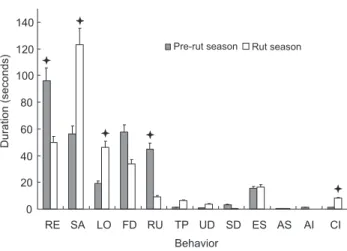
The seasonal duration of male musk deer behavior pat-terns are shown in figure 1. Males spent more time resting (96.14 ± 15.71 s) and ruminating (44.95 ± 10.49 s) during the pre-rut season than during the rut season (RE: 49.68 ± 16.56 s, p = 0.016; RU: 9.14 ± 4.13 s, p = 0.020). Conversely, they spent signifi-cantly more time in locomotion (46.52 ± 9.86 s), standing alert (122.89 ± 17 s), and in agonistic interactions (7.97 ± 3.05 s) dur-ing the rut than durdur-ing the pre-rut (LO, 19.23 ± 4.64 s, p = 0.035; SA, 56.43 ± 9.19 s, p = 0.002; CI: 1.42 ± 0.67 s, p = 0.003). There was also a statistically insignificant trend for males to have more affinitive interactions (1.45 ± 1.09 s) in the pre-rut season than that in rut season (AI, 0.02 ± 0.01 s, p = 0.53), and more tail pasting (6.48 ± 2.76 s) during the rut season than that in pre-rut season (1.39 ± 0.89 s, p = 0.22).
0 20 40 60 80 100 120 140
RE SA LO FD RU TP UD SD ES AS AI CI
Behavior
Duration
(seconds)
Pre-rut season Rut season
ª
ª
ª ª
ª
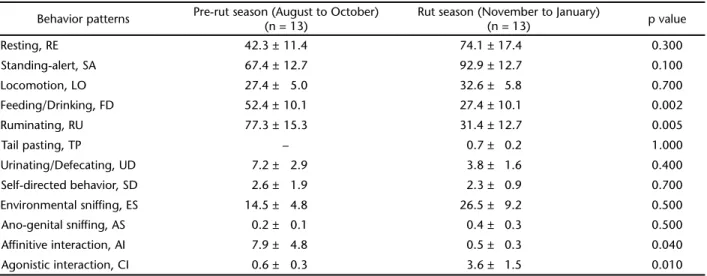
As shown in table I, females spent more time feeding, ruminating, and in affinitive interactions during the pre-rut than rut season. On the other hand, they spent more time in agonistic interactions during the rut (3.55 ± 1.46 s) than dur-ing the pre-rut season. Tail pastdur-ing behavior was only observed during the rut season.
DISCUSSION
Reproduction and the associated activities, such as lacta-tion and competilacta-tion for mates, is an energetically costly pro-cess (CLUTTON-BROCKet al. 1982, FORSYTHet al. 2005, HAMBLYet al.
2007) so it is not surprising that behavior patterns may change in association with the reproductive season. Such variation in behavior was observed in both male and female captive musk deer between the pre-rut and rut seasons.
Lactation coincided with the defined pre-rut season (Au-gust to October), as most fawns were born in early June and weaned in October. Consequently, females would be expected to feed more during the pre-rut season, to compensate for the high energy requirements associated with lactation (ZHANG 1979,
CLUTTON-BROCKet al. 1982, KOMERSet al. 1993). This is in fact what
was observed; female musk deer devoted significantly more time to resource gathering behaviors such as feeding and rumination while reducing the time spent on energetically costly agonistic behavior during the pre-rut season. Females also spent more time engaged in affinitive interactions with other individuals during the pre-rut season. Only some of this increase can be attributed to their interaction with their fawns as females hide their young and only return to them occasionally during the day (GREEN
1987). Perhaps this change is more accurately interpreted as a decrease in affinitive interactions during the rut season due to an increase in aggressive interactions.
Males may also have different energy requirements throughout the year. From May to July males produce musk which is believed to be energetically costly. ZHANG (1979) re-ported that males become excited and stop eating and defecat-ing durdefecat-ing this process. The increase in passive behaviors such as resting and ruminating, accompanied by the decrease in lo-comotion and agonistic behaviors observed during the pre-rut season may indicate a behavioral shift to facilitate recovery after musk production. This resting phase may also prepare them for the more active phase during the rut season when they spend more time in energetically costly activities such as walking, standing alert and fighting.
Musk deer are shy and solitary animals inhabiting steep, forested or shrub-covered slopes, typically in a dense habitat of rhododendron and bamboo undergrowth. As a result, the primary means of communication in musk deer is olfactory, predominantly through feces and urine (SOKOLOV 1984). GREEN
(1987) and ZHANG (1979) reported seasonal peaks of defecating and urinating during December at the height of the mating season, although a similar trend was not evident in this study. A well documented form of scent marking includes tail pasting in which musk deer rub the caudal gland, located at the base of their tail, against surfaces such as stems or dried herbs and grasses throughout their home range (SOKOLOV 1984). SHENG
(1993) observed an increase in scent marking by male forest musk deer (M. berezovskii) during the rut season, and a similar trend was observed in the captive male alpine musk deer in this study.
Tail pasting is thought to be a male specific behavior (GREEN 1987, HOMES 1999) but our study showed that captive
female alpine musk deer at Xinglongshan musk deer farm ex-hibit this behavioral pattern during the rut season. Our pre-liminary observations suggest that sexually experienced females
Table I. Average duration of female musk deer behavior patterns (seconds ± S.E.) from 2005 to 2006 in the Xinglongshan Musk Deer Farm of China.
Behavior patterns Pre-rut season (August to October)
(n = 13)
Rut season (November to January)
(n = 13) p value
Resting, RE 42.3 ± 11.4 74.1 ± 17.4 0.300
Standing-alert, SA 67.4 ± 12.7 92.9 ± 12.7 0.100
Locomotion, LO 27.4 ± 5.0 32.6 ± 5.8 0.700
Feeding/Drinking, FD 52.4 ± 10.1 27.4 ± 10.1 0.002
Ruminating, RU 77.3 ± 15.3 31.4 ± 12.7 0.005
Tail pasting, TP – 0.7 ± 0.2 1.000
Urinating/Defecating, UD 7.2 ± 2.9 3.8 ± 1.6 0.400
Self-directed behavior, SD 2.6 ± 1.9 2.3 ± 0.9 0.700
Environmental sniffing, ES 14.5 ± 4.8 26.5 ± 9.2 0.500
Ano-genital sniffing, AS 0.2 ± 0.1 0.4 ± 0.3 0.500
Affinitive interaction, AI 7.9 ± 4.8 0.5 ± 0.3 0.040
were more likely to exhibit this behavior, which occurred be-tween mating bouts. Female tail pasting was not as common or as intense as males, but the up-down and left-right move-ment of the tail was unmistakable. Further investigation is re-quired to determine the function of tail pasting in both males and females and the possible association with behavioral re-dundancy.
Although wild alpine musk deer have a high fertility rate, with an average litter size of 1.83 (LIU & SHENG 2002), the
cap-tive population of alpine musk deer is not self-sustaining. To persist, the farm requires periodic additions of wild-caught in-dividuals (MENGet al. 2006a). The cause of the suboptimal
re-production and high mortality in musk deer farms needs to be investigated and the first step is a detailed understanding of the behavior of captive and wild animals. Wild musk deer are solitary and territorial, with males and females briefly coming together to mate. On the other hand, in Xinglongshan musk deer farm the animals are kept in enclosures with a density equivalent to 50,000-70,000 individuals/km2. Increased social density can have major impacts on reproduction and life span (PRICE & STOINSKI 2007). Overcrowded housing conditions have
been linked to decreased reproductive success in pigtailed macaques, Macaca nemestrina (Linnaeus, 1766) (HAet al. 1999); black rhinoceros, Deceros bicornis (Linnaeus, 1758) (CARLSTEAD
et al. 1999), and exotic felids (MELLEN 1991). Reducing the group
size of duikers (Cephalophus spp.) from five or more individu-als to pairs or trios increased the average life span from under five years to up to 10 years (BARNESet al. 2002).
Ungulates kept at high densities often show higher lev-els of aggressive and stress-related behaviors (PRICE & STOINSKI
2007); stereotypic behavior is correlated with high social den-sities in giraffes, okapi, and horses (BASHAWet al. 2001, REDBOet
al. 1998) and duikers kept in large groups developed stress-related jaw abscesses (BARNES et al. 2002). MENGet al. (2007)
have previously reported high levels of stereotypic behavior in captive alpine musk deer and this study revealed that both males and females exhibited increased levels of intra-sexual aggres-sion during the rut season. During the rut season, mate search-ing activity such as standsearch-ing alert and locomotion increases and competition for mates within the confines of the enclo-sure, combined with the lack of shelter, results in increased levels of aggression and probably stress. Housing the deer in larger enclosures, reducing the group size within existing en-closures, or enriching the environment increases the behav-ioral diversity of captive alpine musk deer (MENGet al. 2006b)
and may help to reduce the levels of aggression and stress.
ACKNOWLEDGEMENTS
This research was supported by the Nature Science Foun-dation of China (30970374, 30770286, 30811120554), the Pro-gram for New Century Excellent Talents in University (NCET-08-0596) and the National Key Technology R&D Program in the 11th Five year Plan of China (2008BADB0B06).
LITERATURE CITED
BARNES, R.;K. GREENE; J. HOLLAND & M. LAMM. 2002. Management and husbandry of duikers at the Los Angeles zoo. Zoo Biology 21: 107-121.
BASHAW, M.J.; L.R. TAROU; T.S. MAKI & T.L. MAPLE. 2001. A survey
assessment of variable related to stereotypy in captive giraffe and okapi. Applied Animal Behaviour Science 73: 235-247. CARLSTEAD, K.; J. FRASER; C. BENNETT & D.G. KLEIMAN. 1999. Black
rhinoceros (Deceros bicornis) in U.S. zoos: II. Behavior, breeding success, and mortality in relation to housing facilities. Zoo Biology 18: 35-52.
CARO, T.M. 1993. Behavioral solutions to breeding cheetahs in captivity: Insights from the wild. Zoo Biology 12: 19-30. CLUTTON-BROCK, T.H.; G.R. IASON; S.D. ALBON & F.E. GUINNESS. 1982.
Effects of lactation on feeding behaviour and habitat use in wild red deer hinds. Journal of Zoology 198: 227-236. FORSYTH, D.M.; R.P. DUNCAN; K.G. TUSTIN & J.M. GAILLAN. 2005. A
substantial energetic cost to male reproduction in a sexually dimorphic ungulate. Ecology 86: 2154-2163.
GREEN, M.J.B. 1987. Scent-marking in the Himalayan musk deer. Journal of Zoology 1: 721-737.
HA, J.C.; R.L. ROBINETTE & G.P. SACKETT. 1999. Social housing and
pregnancy outcome in captive pigtailed macaques. American Journal of Primatology 47: 153-163
HAMBLY, C.; S. MARKMAN; L. ROXBURGH & B. PINSHOW. 2007. Seasonal
sex-specific energy expenditure in breeding and non-breeding Palestine sunbirds Nectarinia osea. Journal of Avian Biology 38: 190-197.
HOMES, V. 1999. On the scent: Conserving musk deer, the uses
of musk and Europe’s role in its trade. Brussels, TRAFFIC Europe.
KOMERS, P.E.; F. MESSIER & C.C. GATES. 1993. Group structure in
wood bison: nutritional and reproductive determinants. Canadian Journal of Zoology 71: 1367-1371.
LIU, Z.X. & H.L. SHENG. 2002. Effect of habitat fragmentation and isolation on the population of alpine musk deer. Russian Journal of Ecology 33: 121-124.
MELLEN, J.D. 1991. Factors influencing reproductive success in small captive exotic felids (Felis spp.): A multiple regression analysis. Zoo Biology 10: 95-110.
MENG, X.X.; Q.S. YANG; Z.J. FENG; L. XIA; Y.W. JIANG & P.M. WANG. 2003a. Timing and synchrony of parturition in Alpine Musk Deer (Moschus sifanicus). Folia Zoologica, 52: 39-50. MENG, X.X.; Q.S. YANG; L. XIA; Z.J. FENG; Y.W. JIANG & P.M. WANG.
2003b. The temporal estrous patterns of female Alpine Musk Deer (Mochus sifanicus) in captivity. Applied Animal Behaviour Science 82: 75-85.
MENG, X.X.; C.Q.A. ZHOU; J.C. HU; C. LI; Z.B. MENG; J.C. FENG;
Y.J. ZHOU & Y.J. ZHU. 2006a. Musk deer farming in China.
Animal Science (Pencaitland) 82: 1-6.
Xinglongshan musk deer farm. Acta Zoologica Sinica 52: 1026-1033.
MENG, X.X.; Q. YANG; Z. FENG & H. XU. 2007. Stereotyped behaviour of captive Muschus sifanicus in Xinglong Mountain Nature Reserve. Chinese Journal of Ecology 26: 355-358. PARRY-JONES, R. & J.Y. WU. 2001. Musk deer farming as a
conservation tool in China. Hong Kong, TRAFFIC East Asia. PRICE, E.E. & T.S. STOINSKI. 2007. Group size: Determinants in the wild and implications for the captive housing of wild mammals in zoos. Applied Animal Behaviour Science 103: 255-264.
REDBO, I.; P. REDBO-TORSTENSSON; F.O. ODBERG; A. HEDENDAHL & J.
HOLM, J. 1998. Factors affecting behavioural disturbances in race-horses. Animal Science 66: 475-481.
SHENG, H. & N. OHTAISHI. 1993. The status of deer in China, p.
37-60. In: N. OHTAISHI & H.-I. SHENG (Eds). Deer of China:
Submitted: 09.VI.2010; Accepted: 26.IX.2010. Editorial responsibility: Kleber del Claro
Biology and Management. Amsterdam, Elsevier Science Publishers.
SOKOLOV, V.E. 1984. Chemical communication of some species of rodents, ungulates and carnivores. Acta Zoologica Fennica 171: 67-69.
ŠPINKA, M. 2006. How important is natural behaviour in animal
farming systems? Applied Animal Behaviour Science 100: 117-128.
WECHSLER, B. 2007. Normal behaviour as a basis for animal
welfare assessment. Animal Welfare 16 (S1): 107-110. ZHANG, B. 1979. The taming and raising of musk deer. Beijing,
Agriculture Press.