pISSN: 0976 3325 eISSN: 2229 6816
National Journal of Community Medicine Vol 3 Issue 1 Jan-March 2012 Page 153
ORIGINAL ARTICLE.
A RECORD BASED STUDY ON PAEDIATRIC
TUBERCULOSIS IN AHMEDABAD CITY, INDIA
Bhavna Puwar1, Vaibhavi Patel1, Tapasvi Puwar2
1Assistant Professor, AMCMET Medical College, Maninagar, Ahmedabad, 2Public health Consultant,
Ahmedabad
Correspondence:
Dr. Bhavna Puwar 33/273 Vidyanagar Flats,
Himmatlal Park, Ambawadi, Ahmedabad-380015 Email: [email protected], Phone: 9601296013
ABSTRACT
Backdround: Good data on the burden of all forms of TB amongst children in India are scarce. There is an urgent need to study the available data.
Methodology: This record based study was conducted in Ahmedabad city situated in western region of India. Five treatment units out of total ten units were selected by random sampling method. Records of Paediatric TB patients registered between February 2007 and January2008 were studied.
Results: Out of total 382 records studied 193 (50.5%) were girls and 189 (49.5%) were boys with mean age of 8.3 years. Forty six percent of cases were in category III. Fifty four percent cases were of Extra-Pulmonary TB (EPTB). Total 123 patients who missed the doses, only one third were paid home visit. Eighty three percent of the children completed their treatment and 6% cases were declared as cured. Five children died during treatment.
Conclusions: Analysis of records suggests high treatment completion rate amongst RNTCP paediatric TB patients in Ahmedabad city. It also suggests scope of improvement in home visits paid to patients who miss the doses during the treatment.
Key words: Pediatric Tuberculosis, Record based study, RNTCP, Urban
INTRODUCTION
The exact burden of childhood tuberculosis is unknown and World Health Organization estimates the burden between 10 to 11% of all incident cases of tuberculosis1. Global estimates of 1.5 million new cases and 1, 30,000 deaths occur annually due to paediatric tuberculosis (TB) 2. However, globally, national TB control programmes have given low priority to childhood TB.3
Since March 2006 Revised National Tuberculosis Control Program (RNTCP) covers entire country4. In early 2004, in consultation with Indian Academy of Paediatrics, RNTCP has taken steps to make the paediatric drugs available in patient-wise boxes (PWBs) 5. The DOTS strategy also appears to be highly effective for paediatric TB, as reported by
studies from all over the world6. There is an urgent need of analysing available data from the RNTCP. Thus, current study was conducted to analyse the available data with Ahmedabad Municipal Corporation (AMC) run RNTCP. The aim of the study is to contribute to the current knowledge on paediatric tuberculosis.
METHODOLOGY
Ahmedabad city is located in western part of the country. It is divided into six administrative zones and 53 municipal wards. There are 10 Treatment units (TU) under RNTCP program in Ahmedabad Municipal Corporation area.
pISSN: 0976 3325 eISSN: 2229 6816
National Journal of Community Medicine Vol 3 Issue 1 Jan-March 2012 Page 154
up to 14 years.) who were diagnosed and treated between February 2007 and January 2008 in the selected five TUs were studied and analyzed.
Permission was taken from the head of the TB Unit of Ahmedabad Municipal Corporation. Primary information of paediatric TB patient was taken from patients’ register of selected TUs. Detailed information regarding outcome was taken from the individual treatment cards submitted by the DOT worker at TU.
Data Analysis
Data was analysed with the help of free software Epi Info. Proportions and appropriate statistical test of significance were used.
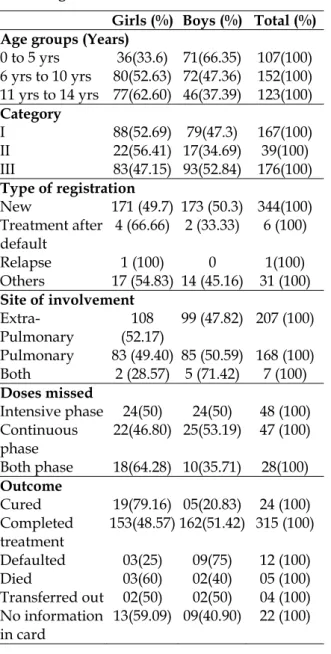
Table 1: Distribution of Tuberculosis patients according sex and various characteristics
Girls (%) Boys (%) Total (%) Age groups (Years)
0 to 5 yrs 36(33.6) 71(66.35) 107(100) 6 yrs to 10 yrs 80(52.63) 72(47.36) 152(100) 11 yrs to 14 yrs 77(62.60) 46(37.39) 123(100)
Category
I 88(52.69) 79(47.3) 167(100)
II 22(56.41) 17(34.69) 39(100)
III 83(47.15) 93(52.84) 176(100)
Type of registration
New 171 (49.7) 173 (50.3) 344(100) Treatment after
default
4 (66.66) 2 (33.33) 6 (100)
Relapse 1 (100) 0 1(100)
Others 17 (54.83) 14 (45.16) 31 (100)
Site of involvement
Extra-Pulmonary
108 (52.17)
99 (47.82) 207 (100)
Pulmonary 83 (49.40) 85 (50.59) 168 (100) Both 2 (28.57) 5 (71.42) 7 (100)
Doses missed
Intensive phase 24(50) 24(50) 48 (100) Continuous
phase
22(46.80) 25(53.19) 47 (100)
Both phase 18(64.28) 10(35.71) 28(100)
Outcome
Cured 19(79.16) 05(20.83) 24 (100)
Completed treatment
153(48.57) 162(51.42) 315 (100)
Defaulted 03(25) 09(75) 12 (100)
Died 03(60) 02(40) 05 (100)
Transferred out 02(50) 02(50) 04 (100) No information
in card
13(59.09) 09(40.90) 22 (100)
RESULTS
pISSN: 0976 3325 eISSN: 2229 6816
National Journal of Community Medicine Vol 3 Issue 1 Jan-March 2012 Page 155
cases, the treatment completion rate was 94% and default rate was 4.2%. All 7 cases with both
pulmonary and extra pulmonary tuberculosis completed the treatment.
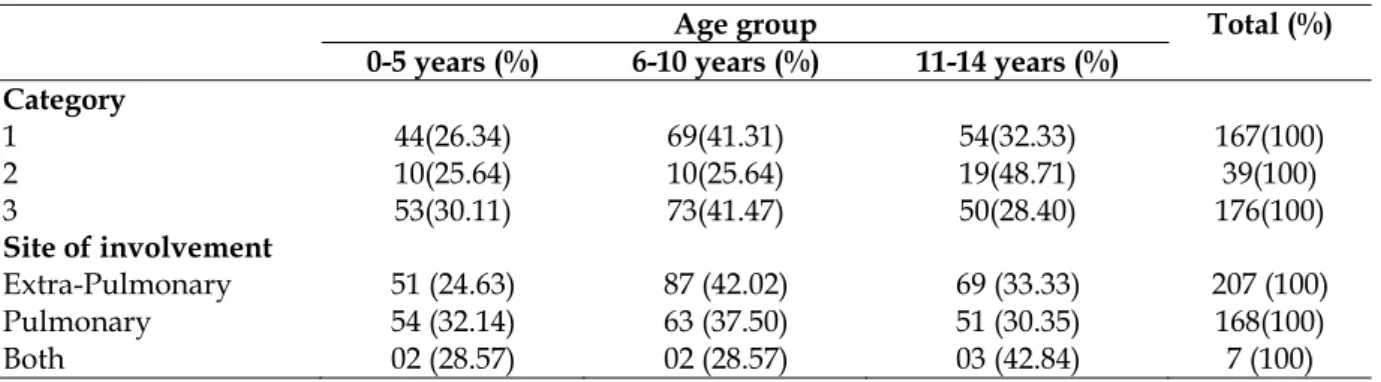
Table-2 Age Group and various characteristics
Age group Total (%)
0-5 years (%) 6-10 years (%) 11-14 years (%) Category
1 44(26.34) 69(41.31) 54(32.33) 167(100)
2 10(25.64) 10(25.64) 19(48.71) 39(100)
3 53(30.11) 73(41.47) 50(28.40) 176(100)
Site of involvement
Extra-Pulmonary 51 (24.63) 87 (42.02) 69 (33.33) 207 (100)
Pulmonary 54 (32.14) 63 (37.50) 51 (30.35) 168(100)
Both 02 (28.57) 02 (28.57) 03 (42.84) 7 (100)
DISCUSSION
RNTCP status report 2008 reported 73430 new paediatric cases out of all new case in India during 2007, which was 6% of total new cases. Similarly in Gujarat state total 3548 new paediatric cases were detected which was again 6% of all new cases. In Ahmedabad Municipal Corporation area 773 new paediatric cases were detected which was 12% of all new cases4.
Table 3: Distribution of home visits against doses missed
Doses missed Home visit Total (%) Yes (%) No (%)
Intensive phase 12 (25) 36 (75) 48 (100) Continuous phase 16 (34) 31 (66) 47 (100) Both phase 13 (46.2) 15 (53.8) 28 (100) Total 41 (33.3) 82 (66.6) 123 (100)
The mean age of the study population was 8.3 years. A similar study on paediatric tuberculosis in South Delhi by Sharma et al reported it at 11.2 years6. However the mean age of boys was 2 years less than that of girls (p= 0.00) in the present study. Majority (40%) of children were in 6 to 10 years of age group while Sharma et al reported that majority of children were in 11-14 years of age group. About the categories of Paediatric TB patients, Sharma et al reported 38.9% in category III, 50.6% in category I and 10.5% in category II similar to our study. Their study reported that majority (87.7%) were new cases, 1.9% were relapses, and 5% default cases, while our study showed low default rate.
Extra-pulmonary TB cases were predominant (54%) with Lymph node being the most common site of involvement (43%) in the
present study. Similarly, unpublished RNTCP data from consensus statement of IAP and GOI also showed Lymph node (LN) TB cases predominated (>75%) amongst the paediatric EPTB registered cases.
Home visit to the patients who missed the dose is an indicator of operational efficiency of the program. As per RNTCP, if patient miss a dose home visit should be made by DOT worker. We observed that only 33% of patients who missed the dose during treatment were visited by workers at home. It was also observed that workers were not recording the home visit in the treatment card even if they had made visit.
REFERENCES
1. World Health Organization. Childhood Tuberculosis
Available from http://www.who.int/tb/challenges/children/en/inde
x.html Accessed on January 4, 2011.
2. Management of Paediatric TB under the Revised
National Tuberculosis Control
Programme (RNTCP). A joint statement of the Central TB Division, Directorate General of Health Services, Ministry of Health and Family Welfare, and experts from Indian Academy of Paediatrics ,New Delhi, 6–7 August 2003.
3. Arora, V.K; Agarwal, S.P. Tuberculosis Control in India
Chapter 12 (115-118) Paediatric Tuberculosis: An Experience from LRS Institute of Tuberculosis and Respiratory Diseases, Available from http://www.tbcindia.nic.in/pdfs/Tuberculosis%20Cont rol%20in%20India12.pdf, Accessed on January 4, 2011 4. Central TB Division, Directorate General of Health
Services, Ministry of Health and Family Welfare, New Delhi. TB India 2008. RNTCP status Report page 8,Available on http://tbcindia.nic.in/pdfs/TB-India-2008.pdf,Accessed on January 4,2011
5. Guidelines for use of Pediatric Patient Wise boxes
pISSN: 0976 3325 eISSN: 2229 6816
National Journal of Community Medicine Vol 3 Issue 1 Jan-March 2012 Page 156
Programme. Available from http://www.tbcindia.org/pdfs/PediatricGuidelinesFi
nal.pdf ,Accessed on January 4 2011.
6. Sharma, S.; Sarin, R; Khalid, U.K; Singla, N; Sharma,
P.P; Behera, D. The DOTS strategy for treatment of