Characterization of the
tonB
Mutant and Its Potential as a Backbone
Strain for Vaccine Development
Tiffany M. Mott1, Sudhamathi Vijayakumar1¤, Elena Sbrana1,2, Janice J. Endsley1,3, Alfredo G. Torres1,2,3*
1Department of Microbiology and Immunology, University of Texas Medical Branch, Galveston, Texas, United States of America,2Department of Pathology, University of Texas Medical Branch, Galveston, Texas, United States of America,3Sealy Center for Vaccine Development, University of Texas Medical Branch, Galveston, Texas, United States of America
¤ Current address: Department of Animal Husbandry, Government of Tamil Nadu, Dharmapuri, Tamil Nadu, India
Abstract
Background
In this study, aBurkholderia mallei tonBmutant (TMM001) deficient in iron acquisition was constructed, characterized, and evaluated for its protective properties in acute inhalational infection models of murine glanders and melioidosis.
Methodology/Principal Findings
Compared to the wild-type, TMM001 exhibits slower growth kinetics, siderophore hyper-secretion and the inability to utilize heme-containing proteins as iron sources. A series of animal challenge studies showed an inverse correlation between the percentage of survival in BALB/c mice and iron-dependent TMM001 growth. Upon evaluation of TMM001 as a potential protective strain against infection, we found 100% survival followingB.mallei
CSM001 challenge of mice previously receiving 1.5 x 10⁴CFU of TMM001. At 21 days
post-immunization, TMM001-treated animals showed significantly higher levels ofB.mallei -specific IgG1, IgG2a and IgM when compared to PBS-treated controls. At 48 h post-chal-lenge, PBS-treated controls exhibited higher levels of serum inflammatory cytokines and more severe pathological damage to target organs compared to animals receiving
TMM001. In a cross-protection study of acute inhalational melioidosis withB.pseudomallei, TMM001-treated mice were significantly protected. While wild type was cleared in allB.
malleichallenge studies, mice failed to clear TMM001.
Conclusions/Significance
Although further work is needed to prevent chronic infection by TMM001 while maintaining immunogenicity, our attenuated strain demonstrates great potential as a backbone strain for future vaccine development against both glanders and melioidosis.
OPEN ACCESS
Citation:Mott TM, Vijayakumar S, Sbrana E, Endsley JJ, Torres AG (2015) Characterization of the
Burkholderia mallei tonBMutant and Its Potential as a Backbone Strain for Vaccine Development. PLoS Negl Trop Dis 9(6): e0003863. doi:10.1371/journal. pntd.0003863
Editor:Maria Elena Bottazzi, George Washington University, UNITED STATES
Received:October 14, 2014
Accepted:June 1, 2015
Published:June 26, 2015
Copyright:© 2015 Mott et al. This is an open access article distributed under the terms of theCreative Commons Attribution License, which permits unrestricted use, distribution, and reproduction in any medium, provided the original author and source are credited.
Data Availability Statement:All relevant data are within the paper and its Supporting Information files.
Funding:The study performed in the laboratory of AGT was supported by NIH/NIAID grant U54 AI057156. The contents are solely the responsibility of the authors and do not necessarily represent the official views of the NIAID or NIH. The funders had no role in study design, data collection and analysis, decision to publish, or preparation of the manuscript.
Author Summary
Burkholderia malleiandB.pseudomalleiare the causative agents of glanders and melioido-sis, respectively. In addition to the recent rise in cases of glanders and the endemicity of melioidosis worldwide, these pathogens have gained attention as potential bioweapons. Further, these pathogens have huge potential for aerosol delivery and often produce fatal infection amongst untreated individuals. Both pathogens are difficult to treat, and even with antibiotic intervention, patients relapse or get re-infected. A big challenge for vaccine development against these pathogens includes identification of broadly protective antigens and a better understanding of the correlates of protection from both acute and chronic infections. Our study is the first to demonstrate significant protection against a lethal chal-lenge with bothBurkholderiaspecies. Because TMM001 persists in immunized mice, we propose that this attenuated organism is a promising backbone-based strain from which a legitimate vaccine candidate can be generated.
Introduction
Melioidosis and glanders are severe zoonotic diseases caused by two closely related Gram-nega-tive pathogens known asBurkholderia pseudomalleiandB.mallei, respectively [1,2]. The geno-mic relatedness between these two pathogens suggests thatB.malleiis a host-adapted clone of
B.pseudomallei, which evolved from a process of reductive evolution. Genes retained byB.
malleishare 99% sequence identity with theirB.pseudomalleiorthologs and of those, 650 genes have been identified as putative virulence determinants viain silicogenomic subtraction from non-pathogenicBurkholderiaspecies [3]. In addition, the presence of very fewB.mallei
specific genes suggest it’s possible to generate a live attenuated vaccine with aB.mallei back-bone that can cross-protect against both melioidosis and glanders [4].
WhereB.pseudomalleiis an environmental saprophytic pathogen ubiquitous in soil and fresh water surfaces,B.malleiis an obligate mammalian pathogen that typically infects solipeds (horses, donkeys, etc) [1,5]. Despite epidemiological differences, the clinical and pathological manifestations ofB.pseudomalleiorB.malleiinfections bear striking resemblance. Both patho-gens can be contracted via the cutaneous, oral and/or inhalational routes. Depending on the dose and route of transmission,B.pseudomalleiorB.malleiinfection may result in an acute or chronic disease. Clinical manifestations of acute infection from either disease, which include fever, malaise, abscess formation, pneumonia and sepsis, are non-specific. The lack of patho-gnomonic symptoms, in addition to their ability to cause silent infection, makes rapid and accurate diagnosis problematic for theseBurkholderiainfections. Since mortality rates among severe infections are high, and there are no reliable antibiotic therapy or licensed pre- and post-exposure vaccines, both pathogens remain top candidates for bioterrorist use and thus have been classified as category B, tier 1, biothreat agents [1]. The destructive potential ofB.
pseudomalleiandB.malleihas heightened concerns among public health officials due to the increased potential of opportunistic infection among growing populations of diabetic and immunocompromised people [2]. For military personnel and susceptible individuals, the avail-ability of a vaccine would be the most efficacious and cost-effective way to protect from disease.
(OMV) [11] have achieved the greatest protection to date. While encouraging, subunit vaccines provided only partial protection, which is attributed to their inability to generate broad protec-tive immunity, specifically cell mediated immunity [12].
Live attenuated vaccines are recognized for their ability to elicit strong broad immune responses that provide long-lasting protection [12]. Thus far, attenuated mutants lacking a functionalpurN,purM,aroB,ilvl, orbipDgenes inB.pseudomallei, andilvlor DD3008 (cap-sule) genes inB.malleihave been evaluated for their protective potential [12]. Although these candidates have proven capable of providing significant protection during the acute stage of infection, none have yet to afford full protection during the chronic stage of infection.
To create a live attenuatedB.malleimutant that will generate a protective immune response against chronic infection, we focused on iron transport systems as a target of mutagenesis. For a majority of bacterial pathogens, the acquisition of iron and iron complexes has long been rec-ognized as major pathogenic determinant and thus also represent a promising target for vac-cine development. In the host environment, free iron is too scarce and iron complexes are too large to diffuse effectively through porin channels. To survive in these growth-limiting condi-tions, bacteria utilize siderophores and/or high-affinity outer-membrane receptors to uptake iron and iron complexes [13]. In the case ofB.pseudomalleiandB.mallei, very little informa-tion exists concerning iron uptake mechanisms in the host and their roles in virulence. In one study, Kvitko el at., generated single, double and quadrupleB.pseudomalleimutants defective in siderophores and/or hemoglobin utilization [14]. While mutants defective in these systems are often attenuated, theB.pseudomalleimutants remained fully virulent in a murine model of acute melioidosis [14]. Failure to eliminate virulence was attributed to redundancy in the iron transport system, citing a reliance on alternative iron sources and acquisition mechanisms.
To negate this redundancy, we targeted the inner membrane energy transfer protein TonB, an essential component that interacts with all outer membrane receptor proteins that carry out high-affinity binding and energy dependent iron uptake [15,16,17]. When assessed in multiple models of infection,tonBmutants displayed severe attenuation compared to their wild-type homologs [18,19,20,21]. In the case ofK.pneumoniae, Hsiehet al. showed 100% protection in challenge mice previously vaccinated with thetonBmutant homolog [20]. Thus,Burkholderia
TonB-dependent iron-transport systems, specifically their contribution to survival, persistence and potential as targets for attenuation, should be investigated further. In this communication, we describe the construction and characterization of aB.mallei tonBmutant as a backbone strain for subsequent vaccine development against acute inhalational murine glanders and melioidosis.
Methods
All manipulations ofB.malleiwere conducted in CDC/USDA-approved and registered bio-safety level 3 (BSL3) facilities at the University of Texas Medical Branch (UTMB), and experi-ments with select agents were performed in accordance with BSL3 standard operating practices. The animal studies were carried out in strict accordance with the recommendations in the Guide for the Care and Use of Laboratory Animals of the National Institutes of Health. The protocol (IACUC #0503014B) was approved by the Animal Care and Use Committee of the UTMB.
Bacterial Strains and Growth Conditions
(LBG), and incubated at 37°C for 3 days. For liquid cultures, a few colonies (2–3) were inocu-lated into 20 mL of LBG broth and incubated overnight with agitation at 37°C. When employ-ing antibiotic selection, we used kanamycin and polymyxin B at concentrations of 50μg/mL
and 30μg/mL, respectively. For counter-selection, co-integrates were grown in YT broth (10 g
of tryptone and 10 g of yeast extract) and then plated on sucrose agar (YT agar supplemented with 5% sucrose), as described by Hamad et al. [22]. When appropriate, LBG broth and agar were supplemented with FeSO4at a concentration of 200μM. Unless otherwise stated, wild
typeB.malleiATCC 23344 or CSM001 (B.malleiLux),B.malleiTMM001 (tonBmutant), and TMM002 (pTonB-comp) were used in all experiments.
DNA, PCR and Cloning Methods
Cloning methods were performed as previously described [22]. Chromosomal and plasmid DNA were isolated by using the DNeasy Qiagen Blood and Tissue kit, and the QIAGEN Plas-mid Mini Kit, respectively (Qiagen, Inc., Valencia, CA). Polymerase chain reaction (PCR) products were purified with either the QIAquick PCR purification kit or QIAquick gel extrac-tion kit (Qiagen). Restricextrac-tion enzymes and T4 DNA ligase were purchased from NEB and used in accordance with the manufacturers’instructions (New England Biolabs Inc., Ipswich, MA). Primers used in this study were purchased from Sigma-Aldrich Co (St. Louis, MO). DNA frag-ments obtained for cloning were amplified with Phusion High-Fidelity DNA polymerase (New England Biolabs) by using the following touchdown PCR protocol: 1 cycle of 95°C for 5 min, 29 cycles of 95°C for 30 sec, 70°C to 55°C (-5°C/cycle) for 30 sec, 72°C for 2 min, 29 cycles of 95°C for 30 sec, 55°C for 30 sec, 72°C for 30 sec, and 1 cycle of 72°C for 7 min.
Construction and Complementation of the TMM001 Strain
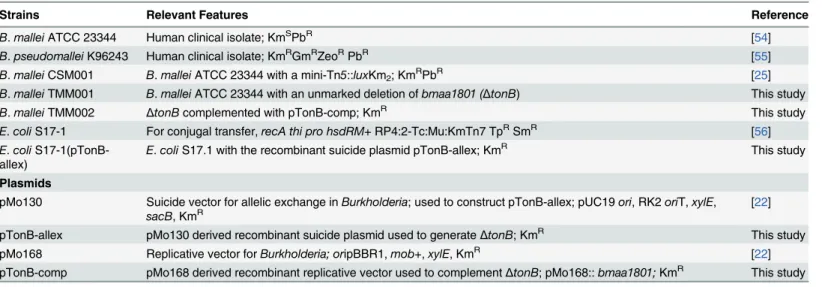
Matched adaptamers containing 3’enzyme restriction sites and 5’complementary sequences were amplified via touchdown PCR. The sequences of the PCR primers were as follows:ΔtonB
US forward primer (AAG CTA GCC CTC GGC GCG GCG ATC CGC GAC GT) (underlined sequence indicatesNheI site);ΔtonBUS reverse primer (CGG TAT TGC CGA GAT TAA CGG TGC GGC ACG TCG T);ΔtonBDS forward primer (ACG ACG TGC CGC ACC GTT AAT CTC GGC AAT ACC G); andΔtonBDS reverse primer (CCA AGC TTT ACG AGC Table 1. Bacterial strains and plasmids.
Strains Relevant Features Reference
B.malleiATCC 23344 Human clinical isolate; KmSPbR [54]
B.pseudomalleiK96243 Human clinical isolate; KmRGmRZeoRPbR [55]
B.malleiCSM001 B.malleiATCC 23344 with a mini-Tn5::luxKm2; KmRPbR [25]
B.malleiTMM001 B.malleiATCC 23344 with an unmarked deletion ofbmaa1801 (ΔtonB) This study B.malleiTMM002 ΔtonBcomplemented with pTonB-comp; KmR This study E.coliS17-1 For conjugal transfer,recA thi pro hsdRM+ RP4:2-Tc:Mu:KmTn7 TpRSmR [56]
E.coli S17-1(pTonB-allex)
E.coliS17.1 with the recombinant suicide plasmid pTonB-allex; KmR This study
Plasmids
pMo130 Suicide vector for allelic exchange inBurkholderia; used to construct pTonB-allex; pUC19ori, RK2oriT,xylE,
sacB, KmR [22]
pTonB-allex pMo130 derived recombinant suicide plasmid used to generateΔtonB; KmR This study
pMo168 Replicative vector forBurkholderia; oripBBR1,mob+,xylE, KmR [22]
pTonB-comp pMo168 derived recombinant replicative vector used to complementΔtonB; pMo168::bmaa1801;KmR This study
ATG ACG TCG ACG AGC GGC GTC ATG TTG) (underlined sequence indicatesHindIII site). The adaptamers were fused together via splicing by overlap extension (SOE) PCR to cre-ate a 1794-bp chimeric fragment containing sequences flanking thetonBgene plus its first 33 codons. The chimeric fragment was digested withNheI andHindIII and ligated into the pMo130 vector to create the allelic exchange plasmid pTonB-allex. The pTonB-allex plasmid was then transformed intoE.coliS17-1 and introduced intoB.malleivia conjugal transfer. Merodiploids were selected based on their growth on kanamycin (Km) and polymyxin B (Pbx) agar plates and ability to turn yellow after exposure to pyrocathecol. Single deletion mutants were counter selected on YT agar supplemented with 5% sucrose and 200μM FeSO4.
After thetonBmutant was screened for Pxb resistance and Km sensitivity, deletion was con-firmed via PCR amplification, followed by sequencing of thetonBgene and flanking DNA regions by using the following primers: confirmation forward primer (5’GCG CCA CGC GGC CGA TTG CCG CTT TCT) and confirmation reverse primer (ACA GAA CCG TGC CGT CGC TTT). To restore thetonBmutant (renamed TMM001) to wild-type function, pMo168 carrying a functionaltonBgene plus its native promoter was used for complementation. Briefly, a fragment containing the wild-typetonBgene plus approximately 120 bp of its upstream sequence flanked by enzyme restriction sites was amplified by using the following PCR primers: complementation forward primer (CCG CTA GCC TGA TTT TCC GCA AGT GAT GCA GCA CT) (underlined sequence indicatesNheI site) and complementation reverse primer (CCA AGC TTT TAA TCG GTC AGA GTG AAG TCA TAA GGC) (underlined sequence indicatesHindIII site). The fragment was then digested withNheI andHindIII and ligated into the pMo168 plasmid to create pTonB-comp. After transformation intoE.coli
S17-1, pTonB-comp was introduced intoB.malleivia conjugal transfer. TMM001 containing pTonB-comp was isolated via selection on LBG + Km agar plates and confirmed by PCR amplification, followed by sequencing of the region flanking thetonBgene by the same primers used to confirm thetonBmutation.
Growth Kinetics Assay
Overnight cultures were used to inoculate 50 mL of LBG with 6 x 10⁶CFU of each strain. Inoc-ulated cultures were then incubated with agitation at 37°C. At the indicated time points, 1 mL aliquots from each culture were taken to measure optical density at 600 nm. Individual data points represent the OD600mean ± standard deviation (SD) of three independent experiments.
A significant difference due to treatment over time was ascertained via two-way ANOVA. Sig-nificant differences (p0.05) of each OD600reading was determined at every time point
com-pared to wild type using one-way ANOVA followed by Dunnett’s multiple comparison test.
Iron Utilization Assay
Overnight cultures were diluted to 1 x 10⁵CFU/ml in LBG + 200μM of 2,2’-dipyridyl and
poured onto plates, as previously described [23]. Disks containing iron sources were placed on the surface of the LBG plates, which were incubated at 37°C for 48 h. Disks contained 10μL of
the following compounds at the specified concentrations: hemin, 8.0μM; hemoglobin, 4.5μM;
myoglobin, 4.5μM; transferrin, and lactoferrin, both at 30μM or FeSO4, 10 mM [23]. Iron
uti-lization was quantified by measuring the diameter of growth around the disk.
Siderophore Secretion Assay
Tenμl samples of overnight cultures, grown in LBG or LBG + 200μM FeSO4or 200μM 2,2’
the CAS agar, solutions were prepared as previously described [24]. An unpairedttest with equal standard deviation was performed on halo measurements to ascertain a significant differ-ence (p0.05) between the strain-specific halos produced.
Animal Studies
Female, 6- to 8-week-old BALB/c mice obtained from Harlan Laboratories (Indianapolis, IN, USA) were housed in microisolator cages under pathogen-free conditions. Animals were pro-vided with rodent feed and waterad libitumand maintained on a 12 h light cycle. Before exper-iments, mice were afforded an adaption period of at least 1 week. Humane endpoints were strictly observed and time of death was recorded upon death of the animal or at the study’s end. Animals were observed closely throughout the study for clinical symptoms (immobility, dyspnea, paralysis) and moribund animals were anesthetized and then euthanized via cervical dislocation.
Survival Study
Anesthetized BALB/c mice (n = 8 per treatment) were inoculated i.n. with the indicated CFU of TMM001, grown in LBG ± 200μM FeSO4and diluted in phosphate-buffered saline (PBS) in
a total volume of 50μL (25μL/ naris). Mice were monitored and deaths recorded over a period
of 14 days. Survival curves were generated and analyzed by using the Kaplan-Meier method. A significant difference (p0.05) in survival curves was ascertained via a log-rank test.
Colonization Study
Anesthetized mice (n = 8 per treatment) were challenged i.n. with 1.5 x 10⁴CFU/50μL of the
B.malleibioluminescent reporter strain CSM001, and TMM001 in LBG ± 200μM FeSO4. At
24, 48 and 72 h post challenge, BALB/c mice were euthanized and necropsied for organ collec-tion. The lungs, liver and spleen were homogenized in 1 mL of PBS by using a tissue grinder (Covidien, Mansfield, MA), and then the bacteria were enumerated by standard plate counts on LBG + 200μM FeSO4. Significant differences (p0.05) in colonization at 24 and 48 h were
individually determined via one-way ANOVA followed by Tukey’s multiple comparisons test. Significant difference (p0.05) in colonization at 72 h was extrapolated by using an unpaired
ttest with equal standard deviation.
Vaccine and Cross Protection Study
Anesthetized mice (n = 8 per treatment) were immunized i.n. with PBS or the indicated CFU of TMM001 diluted in PBS in a total volume of 50μL (25μL/ naris). Mice were challenged 21
days post immunization with 1.5 x 10⁵CFU (~220 LD50) of CSM001 (LD50of 6.81x10²CFU)
or 9 x 10²CFU (~3 LD50) of wild-typeB.pseudomalleiK96243 (LD50of 3.12x10²CFU)
[25,26], diluted in PBS in 50μL (25μL/ naris). Mice were monitored, and deaths were recorded
until the end of the study. Survival curves were generated and analyzed by the Kaplan-Meier method. A significant difference (p0.05) in survival curves was ascertained via log-rank test. To find significant differences in individual treatment, when compared to the PBS-treatment control, an additional log rank test was employed in which an adjusted definition of signifi-cance (p0.05/ the number of pair wise comparisons) was used.
In Vivo
Imaging Evaluation
chamber were transferred to the imaging chamber, which was then connected to an internal anesthesia delivery system that maintained 1–2% isoflurane. Bioluminescence signaling was measured after three minutes’exposure with no excitation (filters blocked) and an open emis-sion filter to capture all luminescent signals from labeled bacteria. To depict the differences in intensity of the signal, bioluminescence was represented in the images with a pseudo-color scale ranging from red (most intense) to violet (least intense). Scales were manually set to the same values for every comparable image to normalize the intensity of the bioluminescence across time points.
B.
mallei-Specific Immunoglobulin Analysis
Serum extracted from PBS or TMM001-vaccinated BALB/c mice at 21 days post treatment, was evaluated forB.mallei-specific IgG1, IgG2a and IgM using the Ready-Set-Go! ELISA Kit (Affymetrix eBioscience, San Diego, CA) as instructed by the manufacturer. Briefly, micro-plates (Costar, Cambridge, MA) were coated with 10μg/ml of heat inactivatedB.malleiand
incubated overnight at 4°C. Wells were then washed twice with PBS, 0.05% Tween-20, and then blocked over night with the Assay Buffer provided in the kit. After the wells were washed, a 1:10,000-fold dilution of sera samples was added to the appropriate wells, followed by the detection antibody provided by the kit. After 3 h incubation, the wells were washed four times before 100μL of the substrate solution was added. After 15 min incubation, 100μL of stop
solution consisting of 2 N H2SO4was added, and absorbance was measured at 450 nm with the
Epoch microplate spectrophotometer (Winooski, VT). An unpaired Student’sttest was per-formed to ascertain a significant difference (p0.05) inB.mallei-specific Ig levels between the PBS and TMM001-treated mice.
Histopathological Evaluation
At the indicated time points, necropsies were performed to collect the lungs, liver and spleen. Organs were instilled with 10% formalin, paraffin-embedded, and processed for histopathol-ogy. Hematoxylin and eosin-stained slides were examined and blindly scored by a pathologist for the follow observations: perivascular and peribronchial inflammatory infiltrates, necrosis and microabscesses in the lung; granulomas, necrosis and histocytosis in the spleen; and inflammation and necrosis in the liver. Severity of pathology was scored using the following combined scale: 0 (unremarkable), 1 (minimal), 2 (mild), 3 (moderate) and 4 (severe). Pathol-ogy scores were combined with a percent factor associated with the extent of the damage (0–
25%, 25–50%, 50–75%, 75–100%) and added together to give the total score for each organ. Each image is representative of three replicates per treatment. A two-way ANOVA was per-formed on each organ individually to assess a significant difference in treatment over time. Stu-dent’sttest was performed to ascertain a significant difference (p0.05) between the
treatments of each organ, individually, at 0 and 48 h.
Cytokine Quantification
IL-12 (p70), IL-13, IL-17A, eotaxin, granulocyte–colony-stimulating factor (G-CSF), granulo-cyte–macrophage colony-stimulating factor (GM-CSF), gamma interferon (IFN-γ), keratino-cyte-derived chemokine (KC), monocyte-chemotactic protein (MCP-1), macrophage
inflammatory protein (MIP)-1α, MIP-1β, RANTES, and (tumor necrosis factor) TNF-α. Data values represent the mean ± the SEM of three animals per treatment and were ascertained as previously described [27]. Out of range values above the asymptote of equation (>OOR) we
set to the highest extrapolated value to provide a conservative estimate that allowed statistical analysis. A significant difference (p0.05) in individual serum cytokine levels in PBS vs. TMM001-treated mice was determined by using the Mann-Whitney test.
Results
Mutant Construction and Initial Characterization
A previously described method for genetic manipulation via allelic exchange was used to create an unmarkedtonBmutant in theB.malleistrain ATCC 23344 [22]. To ensure the mutant phe-notype was not due to polar effects incurred during mutagenesis, the TMM001 was trans-formed with the plasmid pTonB-comp, which carries the intacttonBgene plus its native promoter (Table 1). Unlike the wild type, TMM001 appears as bright yellow colonies that dis-color the surrounding media when grown in Luria Bertani + 4% glycerol (LBG) plates (S1 Fig). This phenotype in iron transport mutants has been attributed to the unregulated production and accumulation of iron-bound siderophores, which are yellow-to-brown in color, in contrast to uncolored iron-free siderophores [28,29,30]. The wild-type phenotype was restored when TMM001 was complemented, which grew as muted yellow-beige colonies with no media discoloration.
Growth Rate Analysis
To determine the effect of thetonBdeletion on growth rate and iron requirement, growth curves were performed with the following strains and broth conditions: wild type in LBG, TMM001 in LBG ± 200μM FeSO4(Fig 1). When grown in LBG, TMM001 exhibited a reduced
growth rate, displaying a longer lag phase, compared to that of the wild type. When grown in LBG + 200μM FeSO4, the growth rate of the TMM001 increased substantially approaching
that of the wild type. Notably, TMM001 grown in iron-supplemented media maintained wild-type growth rates showing statistically significant differences only after 25h of growth.
Siderophore Secretion Assay
To determine if the deletion oftonBinB.malleiresulted in differential siderophore production, both the wild-type and TMM001 were seeded on CAS agar. The CAS media was used because when strong iron chelators, such as siderophores, are secreted, they are able to strip the dye complex of iron, which results in the formation from blue to orange/yellow zones (S2 Fig). Siderophore secretion zones were measured after 96 h and calculated as the diameter of the halo minus the diameter of bacterial colony on the filter disk. TMM001 produced significantly larger halos (33.3 ± 0.5 mm) compared to those of the wild type (12.3 ± 0.6 mm). These results are in line with previously studies that show iron transport mutants hypersecrete siderophores in a futile attempt to acquire iron [28,30,31,32,33,34,35].
Iron Utilization Assay
was determined by measuring the diameter (mm) of bacterial growth around the disk containing specific iron sources placed on iron-depleted media (S1 Table). The wild-type strain was able to grow by utilizing all iron sources, while TMM001 was only capable of utilizing FeSO4, the only
iron source acquired by a TonB-independent process.
In Vivo
Survival Study
In previous characterization studies of our acute respiratory murine inhalational glanders model, we observed that the 50% lethal dose usingB.malleistrain ATCC 23344 was 7.4 x 10⁴ CFU/50μL (Torres lab experimental data). To establish the role oftonBinB.malleivirulence,
we challenged BALB/c mice intranasally (i.n.) with 1.5 x 10⁵CFU, 1.5 x 10⁶CFU and 1.5 x 10⁷ CFU of TMM001 grown in LBG ± 200μM FeSO4and monitored them for survival up to day
14. The Kaplan-Meier curve shows an inverse correlation between the dose and/or iron con-centration and the mouse survival rate (Fig 2). Despite growth conditions, all BALB/c mice challenged with 1.5 x 10⁷CFU of TMM001 succumbed to infection by 4 days post challenge. At lower doses, the effect of supplementing TMM001 with 200μM FeSO4on survival was still
apparent. At day 14, survival increased from 62.5% to 100% and 0% to 12.5% when BALB/c Fig 1. TMM001 attenuated growth kinetics is partially rescued by iron supplementation.Overnight cultures of wild type (solid square) and TMM001 (solid circle) were diluted 1:100 in 50 mL of Luria broth with 4% glycerol (LBG). An additional overnight culture of TMM001 (solid triangle) was diluted 1:100 in 50 mL of LBG + 200μM FeSO4. At the indicated time points, optical densities at 600 nm of all strains were measured. The average with their SD is
representative of three independent experiments. Statistical significance was determined by Dunnett’s test of multiple comparisons relative to wild-type.$$ p0.001,$$$p0.0001,$$$$p0.0001.
mice received a challenge dose of 1.5 x 10⁵CFU and 1.5 x 10⁶CFU of the TMM001, respec-tively, which was grown in LBG alone.
Colonization Study
We next enumerated bacterial counts in infected organs to determine the role of TonB inB.
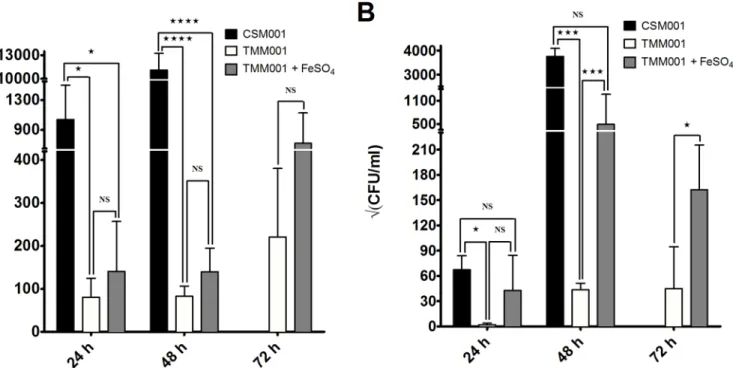
mallei’sability to disseminate and colonize target tissues. BALB/c mice challenged i.n. with 1.5 x 10⁴CFU of the wild-type CSM001 or TMM011 grown in LBG ± 200μM FeSO4were
eutha-nized at 24, 48 and 72 h post challenge. At each time point, the lungs and spleen were processed and plated for CFU quantification. Compared to CSM001, the numbers of TMM001 recovered from the lungs were significantly reduced at 24 h ($p
.05) and 48 h ($$$$p
.0001), inde-pendent of growth conditions (Fig 3A). A similar trend was observed in the spleen with signifi-cantly reduced numbers of TMM001 compared to the CSM001 at 24 h ($p.05) and 48 h ($ $$p.001) (Fig 3B). When grown in LBG + 200
μM FeSO4prior to challenge, TMM001
resembled CSM001, showing no statistical difference in the number of bacteria recovered from the lungs. However, a statistical difference was seen in the recovery of TMM001 grown in FeSO4in the spleen at 72 h ($p.05) (Fig 3A and 3B). BALB/c mice challenged with the
CSM001 expired before the 72 h time point and data are not presented.
Fig 2. Attenuated virulence of TMM001 is partially rescued by iron supplementation.Mice (n = 8) were challenged i.n. with 1.5 x 10⁵CFU (solid circle/
open circle), 1.5 x 10⁶CFU (solid square/open square) or 1.5 x 10⁷CFU (solid triangle/open triangle) of TMM001 grown in LBG with (open) or without
(closed) 200μM FeSO4. The statistical significance of differences in survival times was determined by plotting Kaplan-Meier curves, followed by a log rank
test.$$$$
p0.0001.
Protection Studies
To evaluate the protective efficacy of TMM001 against CSM001 challenge, BALB/c mice received PBS, 1.5 x 10⁴CFU or 1.5 x 10⁵CFU of TMM001 (grown in LBG only), via the i.n. route. At 21 days post-immunization, vaccinated mice were challenged i.n. with 1.5 x 10⁴CFU of CSM001. The wild-type homolog CSM001, containing a luminescent reporter, was used to assess the protective potential of TMM001 via real-timein vivomonitoring. All infected PBS-treated BALB/c mice died by day 4, presenting with a calculated median survival of 3 days post challenge (S3 Fig). In contrast, infected mice immunized with TMM001 at a dose of 1.5 x 10⁵ CFU or 1.5 x 10⁴CFU showed 100% ($$$p = 0.0003) and 87.5% ($$$p = 0.0003) survival,
respectively.
Dissemination and colonization of CSM001 was monitored in TMM001-treated and naïve BALB/c mice using IVIS at 72 h post challenge and every 7 days thereafter until the experiment ended. At 72 h post challenge, PBS-treated BALB/c mice exhibited a luminescent signal associ-ated with anatomical locations corresponding to the lungs, liver, spleen and brain. However, this signal was not detected at similar locations in BALB/c mice immunized with TMM001 (S4 Fig). To evaluate whether TMM001 immunization resulted in the production of sterile immunity, BALB/c mice surviving the experimental challenge were euthanized and organs harvested to be analyzed for gross pathology and bacterial persistence. Although the lungs and livers showed no signs of evident pathology, BALB/c mice presented with splenomegaly accompanied by multiple splenic abscesses (S5 Fig, panels D-F), which mirrors spleens at stage 3 of murine melioidosis infection, as we previously described [27]. Bacterial counts were only recovered from the spleens of mice immunized with a dose 1.5 x 10⁵(334,666 ± 70,465 CFU per spleen) and 1.5 x 10⁴(61,917 ± 18,217 CFU per spleen) CFU of TMM001. Based on the Fig 3. Colonization of target organs by TMM001 is partially rescued by iron supplementation.Bacterial burden in the lungs (A) and spleen (B) of mice infected with CSM001 and TMM001 grown±200μM FeSO4at 24, 48 and 72 h post infection. Bars plotted with their SD represent the mean of three
independent experiments. Significant differences in colonization at 24 and 48 h were individually ascertained via one-way ANOVA followed by Tukey’s multiple comparisons test. Significant difference in colonization at 72 h was extrapolated by using an unpairedttest with equal SD.$
p0.05,$$ $p0.001,$$$$p0.0001, ns = no significance.
phenotypic yellow pigment of the colonies, polymyxin B resistance and kanamycin sensitivity, we were able to conclude that all bacteria recovered were TMM001 and not CSM001.
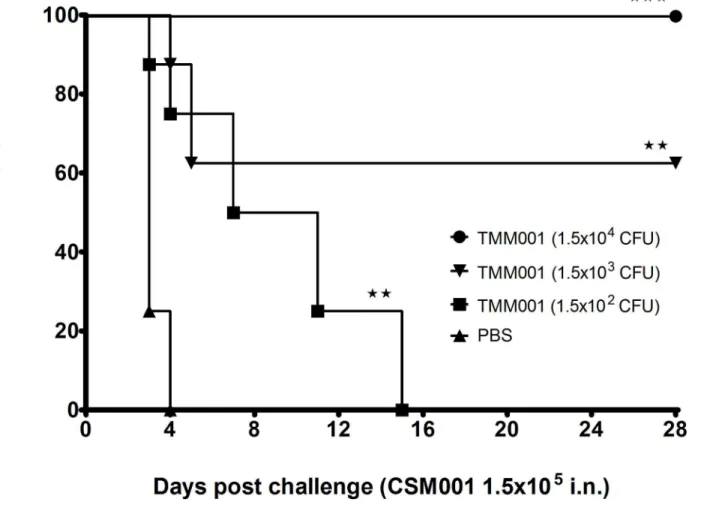
In an attempt to eliminate persistence of the attenuated TMM001 strain, as well as to reduce organ pathology, an attenuated strain titration study was initiated to identify the lowest immu-nization dose that still provided 100% protection. The TMM001 titration study used the fol-lowing CFUs for immunization: 1.5 x 10⁴, 1.5 x 10³and 1.5 x 10². Twenty-one days post-immunization, three mice from each immunization group were euthanized, and organs and serum were harvested for histopathological and cytokine analysis. Forty-eight hours after CSM001 (1.5 x 10⁴ CFU) challenge, an additional 3 mice from each treatment were euthanized, and organs and serum were harvested for histopathological and cytokine analysis. As previ-ously observed, all PBS-treated mice challenged withB.malleiCSM001 died by day 4, with a median survival of 3 days (Fig 4). The titration curve exhibits a significant dose-dependent increase in survival in TMM001-treated mice challenged with CSM001. All mice immunized with 1.5 x 10²CFU expired by day 15, with an increased mean survival of 9 days ($$
p = 0.0016). Mice immunized with 1.5 x 10³CFU or 1.5 x 10⁴CFU, survival up to 28 days increased to 62.5% ($$p = 0.0016) and 100% ($$$p = 0.00016), respectively. Assessment of
Fig 4. TMM001 (1.5x10⁴CFU) provides 100% protection against CSM001 challenge.Mice were immunized i.n. with PBS (solid triangle), 1.5 x 10⁴CFU
(solid circle), 1.5 x 10³CFU (solid inverted triangle), or 1.5 x 10²CFU (solid square) of TMM001. Three weeks later, mice were challenged with 1.5 x 10⁵CFU of CSM001. The statistical significance of differences in survival times was determined by plotting Kaplan-Meier curves, followed by a log rank test.$$$ p0.001,$$
p0.01.
bacterial burden in surviving animals showed the spleen and, to a lower extent, the liver chron-ically infected in the TMM001-treated but not the CSM001 strain.
Development of Humoral Immune Response
The generation of murine humoral immune responses toB.malleifollowing treatment with mock (PBS) or TMM001 was determined by analysis of sera using ELISA. Compared to mock-vaccinated mice, sera from TMM001-treated mice had significantly higher titers ofB.
mallei-specific IgM and IgG antibodies (Fig 5). Mean differences in absorbance for IgG1, IgG2a, and IgM were 5.4-fold (p = 0.0009), 4.8-fold (p = 0.0106), and 10.9-fold (p = 0.0028) higher, respec-tively, in TMM001-vaccinated mice.
Histopathological Analysis
The mouse tissues (lungs, liver and spleen) from the TMM001 titration study (n = 3 per treat-ment) at 0 h and 48 h post-challenge were processed for histology. Representative images of the lungs, liver and spleen from PBS- and TMM001 (1.5 x 10⁴CFU)-immunized mice are pre-sented inS6 Fig. At 0 h, the lungs, livers and spleens of PBS-treated mice were unremarkable, presenting as normal healthy tissue with normal architecture (S6 Fig, panels A-C). BALB/c mice immunized with TMM001 presented with mild-to-moderate changes in pathology: peri-vascular and peribronchial inflammatory infiltrates in the lung sections (S6 Fig, panel D), hepa-titis with multifocal necrosis and scattered abscesses in the liver sections (S6 Fig, panel E), and necrosis of follicles and accumulation of neutrophils in spleen sections (S6 Fig, panel F). At 48 h post challenge with CSM001 (1.4 x 10⁴CFU), PBS-treated mice showed moderate-to-severe pathological changes, such as abscesses and multifocal inflammatory infiltrates in the lungs (S6 Fig, panel G andFig 6A), areas of hepatocellular necrosis, occasional abscesses with necrotic cores and areas of focal necrosis in the liver (S6 Fig, panel H), and congestion of the red pulp, proliferation of large foamy macrophages (inset ofFig 6, panel C) and necrosis affecting the mantle zone (S6 Fig, panel I andFig 6, panel C). Similarly, TMM001-immunized mice showed moderate-to-severe changes in pathology, but with a few differences. In the lungs, large,
Fig 5.B.mallei-specific immunoglobulin levels in TMM001- vs PBS-treated mice before challenge.
Murine serum samples were taken 21 days post-immunization, diluted 1:10,000 and analyzed forB. mallei-specific IgG1 (A), IgG2a (B) and IgM (C). Mean±SEM of three representative animals is plotted. Statistical significance was determined by the unpairedttest with equal SD.$
p0.05$$$
p0.001,$$$$ p0.0001.
multifocal inflammatory infiltrates, as well as abscesses, were present with focal consolidation observed as well (S6 Fig, panel J andFig 6, panel B). The liver presented with hepatitis and mul-tiple foci of hepatocellular necrosis (S6 Fig, panel K), and large granulomas were formed in the spleen (S6 Fig, panel L andFig 6, panel D). Histopathology scores showed significant differ-ences due to treatment over time in the lungs ($$$$p
0.0001), liver ($$$$p
0.0001) and spleen ($$p0.001). When comparing the differences in treatment at 0 h and 48 h, the lungs
($p = 0.05), liver ($p = 0.05) and spleen ($p = 0.05) showed a robust trend toward
signifi-cance (Fig 6, panels E-G). Overall, TMM001-immunization alone does cause some histopa-thology as evident by the histopahistopa-thology at 0 h. That being said, PBS-immunized animals exuded more extensive pathology 48 h after CSM001 challenge compared to TMM001-immu-nized animals.
Serum Cytokine Analysis
Sera that was collected at 48 h post challenge from PBS- and TMM001-treated mice was used to identify pro-inflammatory cytokine and chemokine responses that correspond with disease outcome. Prior to challenge, a similar baseline expression of cytokines and chemokines was detectable in serum of representative animals from both the PBS- and TMM001-immunized animals (Fig 7A). Following CSM001 challenge, the overall cytokine/chemokine expression increased markedly in both PBS- and TMM001-immunized animals (Fig 7B) compared to baseline, consistent with our previous observations of innate immune responses to Burkhol-deriaspecies [27]. An attenuation of the pro-inflammatory serum cytokine/chemokine response to challenge was observed in the TMM001-treated compared to PBS control. The reduction of several pro-inflammatory mediators due to TMM001-treatment was significant, including IL-6 (p = 0.049), GM-CSF (p = 0.037), MCP-1 (p = 0.022), and RANTES (p = 0.032) (Fig 7). A trend for reduction of several other pro-inflammatory IL-1β(p= 0.097), G-CSF, (p= 0.067) and KC (p = 0.05) due to TMM001-treatment was also observed (Fig 7).
Cross Protection Study
We next tested TMM001 for its protective potential againstB.pseudomalleiin an acute inhala-tional model of murine melioidosis. Mice received 1.5 x 10⁴CFU of TMM001 and at 21 days post-immunization, they were challenged with 9.0 x 10²CFU (3 LD50) ofB.pseudomalleistrain
K96243 [26]. All PBS-treated BALB/c mice died by day 5 post-challenge and displayed a median survival of 5 days (Fig 8). In mice immunized with TMM001, survival was increased to 75% ($$$,p0.001) at the end point of 36 days. As with the previousB.malleistudy
described above, the TMM001 strain, but not the wild-typeB.pseudomallei, were recovered from immunized mice who presented with splenomegaly accompanied by abscesses.
Discussion
To date, immune correlates of protection forB.malleiandB.pseudomalleiare not clearly defined. Due to their intracellular lifestyle, these pathogens use an array of virulence factors to invade, replicate, and cause pathogenesis from within host cells, which can impede immune detection and, in some cases, protection. An extensive review of the literature suggested to us Fig 6. Histopathology of TMM001- vs PBS-treated mice 48 h post challenge.H&E-stained lung (A, B) and spleen (C, D) of CSM001 (1.5 x 10⁵CFU) challenged mice previously immunized with PBS (A, C) or
TMM001 (1.5 x 10⁴CFU) (B, D). Scale bar = 100μM. Histological scores were assigned for the liver (E), lungs
(F), and spleen (G) tissue sections after microscopic examination. Mean±SEM, representative of three animals, is plotted. Statistical significance was determined by the Mann-Whitney test.$
p0.05.
Fig 7. Treatment with TMM001 reduces the pro-inflammatory cytokine and chemokine response toB.malleichallenge.Serum cytokine/chemokine profile of PBS- or TMM001-treated mice following exposure toB.malleiCSM001 (1.5x10⁵CFU) at 0 h (A) and 48 h (B) post challenge. Mean±SEM plotted
that an ideal vaccine for both pathogens would induce robust humoral and cell-mediated responses [1,36]. Thus, we decided to examine live attenuated vaccines, as these are often cited as the most efficacious approach to vaccine development against intracellular pathogens because they mimic natural infection, inducing both humoral and cell-mediated immunity, without causing disease. Moreover, exposure to the live attenuated strain allows the immune system to customize a protective response, in addition to generating an immune memory for lifelong protection against infection.
In growth curve experiments, it was found that TMM001 was unable to maintain wild-type growth kinetics (Fig 1). Upon supplementing the culture with free iron, TMM001 exhibited increased growth rates more reminiscent of the wild-type, which is illustrated by a shorter lag phase and prolonged maintenance of wild-type growth kinetics. In a separate growth curve study, full rescue of the wild type phenotype in TMM011 was achieved after both the starter and sub-culture were supplemented with free iron. The correlation between free iron concen-tration and the growth rate of TMM001 illustrates the importance of TonB as a facilitator of iron transport, which has a direct impact on bacterial fitness.
The results of our survival study show an inverse correlation not only between TMM001 dose and survival but also between concentration of free iron and survival (Fig 2). Compared to the wild-typeB.malleistrain (LD50of 7.5 x 10⁴CFU), TMM001 is approximately 3-fold
more attenuated when grown with FeSO4(LD50of 2.38 x 10⁵CFU); and when grown in LBG
Fig 8. TMM001 provides increased protection againstB.pseudomalleiwild-type challenge.Mice were immunized i.n. with PBS (solid triangle) (n = 7) or 1.5 x 10⁴CFU (solid circle) of TMM001 (n = 8). Three weeks later, BALB/c mice were challenged (day 0) with 9.36 x 10²CFU ofB.pseudomalleiK96243.
Statistically significant differences in survival times were determined by Kaplan-Meier curves, followed by a log rank test.$$$
p0.0001.
alone, thetonBmutant is attenuated by approximately 7-fold (5.59 x 10⁵CFU). Differences in virulence are consistent with the data of the dissemination study which showed the lowest bur-den in animals infected with TMM001 and higher bacterial burbur-dens in animals infected with TMM001 grown with FeSO4(Fig 3). In both experiments, FeSO4supplementation failed to
fully reverse attenuation of TMM001in vivo. This outcome was not unexpected as the concen-tration of free iron in the host (10-24M [37]) is well below that is needed to sustain bacterial replication. While FeSO4supplementation would prolong its survival and therefore increase its
virulence, TMM001 would be unable to sustain the wild-type phenotype once its internal stores of iron are exhausted. Lack of full complementation by FeSO4supplementation can also be
attributed to the role of TonB in the import of other substrates. While the majority of TonB-dependent transport systems function to uptake iron, vitamin B12, nickel chelates, and
carbo-hydrates can also be transported by this mechanism. Overall, decreased mortality observed in animals challenged with the TMM001 grown in LBG alone illustrates the importance of iron and its TonB-mediated acquisition to virulence.
In a series of TMM001 titration studies, it was empirically determined that a dose of 1.5 x 10⁴CFU of TMM001 resulted in 100% protection (Fig 4) and CSM001 clearance following challenge. Protected animals developed strongB.mallei-specific IgG1, IgG2a, and IgM responses (Fig 5), which we attribute to TMM001-mediated protection. The observation and correlation of strong IgG and IgM elicitation and protection are cited often inBurkholderia
vaccine studies [38,39,40,41]. In human cases, it was found that patients with less severe, local-ized infection produced detectableBurkholderia-specific IgM antibody titers, whereas none were detected in patients suffering from acute disseminated infection [39]. Thus, it is plausible to suggest TMM001 treatment protects against lethal infection by neutralizing bacteria and/or preventing their dissemination to target organs via antibody-mediated mechanisms.
TMM001 immunization resulted in pathological differences that may explain increased sur-vival and protection. In general, histopathological scoring shows a robust trend toward signifi-cant differences in the pathology seen in the lungs, liver and spleen of PBS- vs. TMM001
-immunized animals (Fig 6, panels E-G). Further analysis of these tissues revealed two discrimi-natory elements of pathologic damage between vaccine treatments. First, despite the finding that the lungs and livers from both PBS- and TMM001-immunized animals displayed some degree of tissue damage, the pathological changes in TMM001-immunized mice were much less severe (S6 Fig, panel A). Second, the differential alteration in spleen architecture implied that the PBS- and TMM001-immunized animals responded differently to infection. For exam-ple, splenic tissues from PBS-treated mice show a diffuse response to injury (i.e. diffuse severe histiocytosis), while splenic tissue from TMM001-immunized mice showed a focal response to injury (i.e. granuloma formation) (S6 Fig, panels C-D). These histological observations sug-gested to us that immunization with TMM001 may result in the induction of an immune response that produces a different type of tissue damage, in addition to confining infection to prevent disseminated disease, an important cause of morbidity and mortality in many diseases [39,42,43,44].
The histopathological differences between PBS- and TMM001-vaccinated mice suggest that TMM001 reduces disease by attenuating immune-mediate pathology at sites of bacterial prolif-eration. Our observation that pro-inflammatory cytokine/chemokine responses are attenuated following TMM001 treatment further supports this conclusion. In models of murine melioido-sis, it has been established that increased expression of IL-1βand IL-6 followB.pseudomallei
pro-inflammatory cytokine/chemokine (e.g. IL-1β, IL-6, G-CSF, KC, MCP-1) expression in the lung [35]. In the study by Judy,et al., a moderate pro-inflammatory response was associated with protection while excessive inflammation caused pulmonary pathology [26]. Further, the protective effects of CpG treatment to reduce lung pathology were attributed to a reduction in neutrophil and inflammatory monocyte recruitment [26,50]. Similarly, we have previously shown that the virulence ofB.pseudomalleistrains in direct comparisons corresponds with excessive production of pro-inflammatory cytokines and chemokines that recruit neutrophils and monocytes [27]. These observations in clinical and animal model studies support a role for exacerbated pro-inflammatory responses to mediate lung pathology in disease due to Burkhol-deriaspecies. Thus, treatment with TMM001 activates a moderate pro-inflammatory cytokine/ chemokine response associated with protective immune responses and attenuates the exacerba-tion of this response that is associated with neutrophil infiltraexacerba-tion and immune-mediated tissue damage.
Lastly, sinceB.malleiandB.pseudomalleiare genetically closely related, TMM001 was fur-ther tested for its potential to provide protection in an acute inhalational model of murine melioidosis. The significant cross protection seen in TMM001-treated mice provides an opti-mistic outlook for the development for a single vaccine for both pathogens. Immunization with TMM001 resulted in full protection and clearance of CSM001 when tested in an acute respira-tory model of murine glanders. This live attenuated strain is unique not only because it pro-vided full protection against both acute and chronic stages of infection but also because it imparted significant cross protection againstB.pseudomalleiinfection.
It is hypothesized that the persistence of viable bacteria is key for protective potential. In previous vaccination studies, the failure to provide successful long-term protection has often be attributed to the quick removal of live attenuated strains from the host [51,52]. Thus, we believe the resulting long-term protection is link to the ability of TMM001 to evade rapid clear-ance. This notion is supported by vaccination studies which reported long-term survivors to be generally colonized at the end of the study [51,52,53]. It is plausible to propose that this persis-tence increases the accessibility of the immune system to protective antigens or it might con-tribute to the development of an environment adverse to wild-type colonization via chronic elicitation of the immune response.
Supporting Information
S1 Fig. TMM001 displays a differential phenotype.Wild-type (lower left), TMM001 (top) and the complementedΔtonB(pTonB-comp) (lower right) were grown on LBG + 200μM
FeSO4for 3 days at 37°C. The figure shows the differences in colony color and modification to
the agar media as result of secretion of a pigment by TMM001. (TIF)
S2 Fig. TMM001 displays hyper-secretion of siderophores.Ten microliters of wild-type (A) and TMM001 (B) overnight cultures grown in LBG were spotted on a filter disk placed on CAS agar media. CAS agar plates were then incubated for at 37°C for 96 h.
(TIF)
S3 Fig. TMM001 (1.5 x 10⁵CFU) provides 100% protection against wild-type challenge. Mice (n = 8) were immunized i.n. with PBS (solid triangle), 1.5 x 10⁴CFU (solid circle) or 1.5 x 10⁵CFU (solid diamond) of TMM001. Three weeks later, BALB/c mice were challenged with 1.5 x 10⁵CFU of aB.malleireporter strain CSM001. The statistical significance in the different survival times was determined by plotting Kaplan-Meier curves, followed by a log rank test.$$ $$p0.0001.
(TIF)
S4 Fig. Representative IVIS images of bacterial burden in CSM001 challenge mice previ-ously immunized with TMM001.Mice immunized with PBS (A) or with 1.5x10⁴or 1.5x10⁵ CFU of TMM001 (B) were challenged with CSM001 and imaged for bioluminescence signals at 72 h post challenge and every 7 days thereafter until the experiment end. The intensity of emission is represented as a pseudo-color image.
(TIF)
S5 Fig. Gross pathology of TMM001-treated mice.BALB/c mice received either PBS (A) or 1.5 x 10⁵CFU of TMM001 (B) and at day 21, lungs (A, D), liver (B, E) and spleen (C, F) were extracted and visually assessed for pathological effects. Differences in lungs and livers of both treatment groups were relatively unremarkable. The spleens of TMM001-treated animals were enlarged and contained one or multiple abscesses.
(TIF)
S6 Fig. Representative images of immunized and CSM001-infected mice organ pathology. Figures A-L display the types of pathology seen in H&E-stained lungs (A, D, G and J), liver (B, E, H and K), and spleen (C, F, I, L) of CSM001 (1.5 x 10⁵CFU) challenged BALB/c mice previ-ously immunized with PBS (A-C, G-I) or 1.5 x 10⁴CFU of TMM001 (D-F, J-L) at 0 h and 48 h post challenge.
(TIF)
S1 Table. Diameter (mm) ofB.malleiwild-type and TMM001 colonial growth utilizing individual iron sources.
(DOC)
Acknowledgments
Author Contributions
Conceived and designed the experiments: TMM JJE AGT. Performed the experiments: TMM SV. Analyzed the data: TMM ES JJE AGT. Contributed reagents/materials/analysis tools: TMM SV ES. Wrote the paper: TMM ES JJE AGT.
References
1. Bondi SK, Goldberg JB. Strategies toward vaccines againstBurkholderia malleiandBurkholderia pseu-domallei. Expert Rev Vaccines 2008; 7: 1357–1365. doi:10.1586/14760584.7.9.1357PMID:
18980539
2. Woods DE, DeShazer D, Moore RA, Brett PJ, Burtnick MN, et al. Current studies on the pathogenesis of melioidosis. Microbes Infect. 1999; 1: 157–162. PMID:10594980
3. Schell MA, Lipscomb L, DeShazer D. Comparative genomics and an insect model rapidly identify novel virulence genes ofBurkholderia mallei. J Bacteriol. 2008; 190: 2306–2313. doi:10.1128/JB.01735-07 PMID:18223084
4. Kim HS, Schell MA, Yu Y, Ulrich RL, Sarria SH, et al. Bacterial genome adaptation to niches: diver-gence of the potential virulence genes in threeBurkholderiaspecies of different survival strategies. BMC Genomics 2005; 6: 174. PMID:16336651
5. Woods DE, Jones AL, Hill PJ. Interaction of insulin withPseudomonas pseudomallei. Infect Immun. 1993; 61: 4045–4050. PMID:7691742
6. Druar C, Yu F, Barnes JL, Okinaka RT, Chantratita N, et al. EvaluatingBurkholderia pseudomalleiBip proteins as vaccines and Bip antibodies as detection agents. FEMS Immunol Med Microbiol. 2008; 52: 78–87. PMID:17995960
7. Burtnick MN, Brett PJ, Harding SV, Ngugi SA, Ribot WJ, et al. The cluster 1 type VI secretion system is a major virulence determinant inBurkholderia pseudomallei. Infect Immun. 2011; 79: 1512–1525. doi: 10.1128/IAI.01218-10PMID:21300775
8. Nelson M, Prior JL, Lever MS, Jones HE, Atkins TP, et al. Evaluation of lipopolysaccharide and capsu-lar polysaccharide as subunit vaccines against experimental melioidosis. J Med Microbiol. 2004; 53: 1177–1182 PMID:15585494
9. Ngugi SA, Ventura VV, Qazi O, Harding SV, Kitto GB, et al. Lipopolysaccharide fromBurkholderia thai-landensisE264 provides protection in a murine model of melioidosis. Vaccine 2010; 28: 7551–7555. doi:10.1016/j.vaccine.2010.08.058PMID:20837078
10. Harland DN, Chu K, Haque A, Nelson M, Walker NJ, et al. Identification of a LolC homologue in Bur-kholderia pseudomallei, a novel protective antigen for melioidosis. Infect Immun. 2007; 75: 4173–4180. PMID:17517877
11. Nieves W, Asakrah S, Qazi O, Brown KA, Kurtz J, et al. A naturally derived outer-membrane vesicle vaccine protects against lethal pulmonaryBurkholderia pseudomalleiinfection. Vaccine 2011; 29: 8381–8389 doi:10.1016/j.vaccine.2011.08.058PMID:21871517
12. Choh LC, Ong GH, Vellasamy KM, Kalaiselvam K, Kang WT, et al.Burkholderiavaccines: are we mov-ing forward? Front Cell Infect Microbiol. 2013; 3: 5. doi:10.3389/fcimb.2013.00005PMID:23386999
13. Braun V. Bacterial iron transport related to virulence. Contrib Microbiol. 2005; 12: 210–233. PMID: 15496782
14. Kvitko BH, Goodyear A, Propst KL, Dow SW, Schweizer HP.Burkholderia pseudomalleiknown sidero-phores and hemin uptake are dispensable for lethal murine melioidosis. PLoS Negl Trop Dis. 2012; 6: e1715. doi:10.1371/journal.pntd.0001715PMID:22745846
15. Letain TE, Postle K. TonB protein appears to transduce energy by shuttling between the cytoplasmic membrane and the outer membrane inEscherichia coli. Mol Microbiol. 1997; 24: 271–283. PMID: 9159515
16. Braun V. Energy-coupled transport and signal transduction through the gram-negative outer membrane via TonB-ExbB-ExbD-dependent receptor proteins. FEMS Microbiol Rev. 1995; 16: 295–307. PMID: 7654405
17. Postle K, Kadner RJ. Touch and go: tying TonB to transport. Mol Microbiol. 2003; 49: 869–882. PMID: 12890014
18. Alvarez B, Alvarez J, Menendez A, Guijarro JA. A mutant in one of twoexbDloci of a TonB system in Flavobacterium psychrophilumshows attenuated virulence and confers protection against cold water disease. Microbiology 2008; 154: 1144–11451. doi:10.1099/mic.0.2007/010900-0PMID:18375806
20. Hsieh PF, Lin TL, Lee CZ, Tsai SF, Wang JT. Serum-induced iron-acquisition systems and TonB con-tribute to virulence inKlebsiella pneumoniaecausing primary pyogenic liver abscess. J Infect Dis. 2008; 197: 1717–1727. doi:10.1086/588383PMID:18433330
21. Torres AG, Redford P, Welch RA, Payne SM. TonB-dependent systems of uropathogenicEscherichia coli: aerobactin and heme transport and TonB are required for virulence in the mouse. Infect Immun. 2001; 69: 6179–6185. PMID:11553558
22. Hamad MA, Zajdowicz SL, Holmes RK, Voskuil MI. An allelic exchange system for compliant genetic manipulation of the select agentsBurkholderia pseudomalleiandBurkholderia mallei. Gene 2009; 430: 123–131. doi:10.1016/j.gene.2008.10.011PMID:19010402
23. Torres AG, Payne SM. Haem iron-transport system in enterohaemorrhagicEscherichia coliO157:H7. Mol Microbiol. 1997; 23: 825–833. PMID:9157252
24. Alexander DB, Zuberer DA. Use of chrome azurol S reagents to evaluate siderophore production by rhi-zosphere bacteria. Biol Fert Soils 1991; 12: 39–45.
25. Massey S, Johnston K, Mott TM, Judy BM, Kvitko BH, et al. In vivo Bioluminescence Imaging of Bur-kholderia malleiRespiratory Infection and Treatment in the Mouse Model. Front Microbiol. 2011; 2: 174. doi:10.3389/fmicb.2011.00174PMID:21904535
26. Judy BM, Taylor K, Deeraksa A, Johnston RK, Endsley JJ, et al. Prophylactic application of CpG oligo-nucleotides augments the early host response and confers protection in acute melioidosis. PLoS One 2012; 7: e34176. doi:10.1371/journal.pone.0034176PMID:22448290
27. Massey S, Yeager LA, Blumentritt CA, Vijayakumar S, Sbrana E, et al. ComparativeBurkholderia pseu-domalleinatural history virulence studies using an aerosol murine model of infection. Sci Rep. 2014; 4: 4305. doi:10.1038/srep04305PMID:24603493
28. Lesuisse E, Knight SA, Courel M, Santos R, Camadro JM, et al. Genome-wide screen for genes with effects on distinct iron uptake activities inSaccharomyces cerevisiae. Genetics 2005; 169: 107–122. PMID:15489514
29. Zhou LW, Haas H, Marzluf GA. Isolation and characterization of a new gene,sre, which encodes a GATA-type regulatory protein that controls iron transport inNeurospora crassa. Mol Gen Genet. 1998; 259: 532–540. PMID:9790585
30. Gauthier GM, Sullivan TD, Gallardo SS, Brandhorst TT, Vanden Wymelenberg AJ, et al. SREB, a GATA transcription factor that directs disparate fates inBlastomyces dermatitidisincluding morphogen-esis and siderophore biosynthmorphogen-esis. PLoS Pathog. 2010; 6: e1000846. doi:10.1371/journal.ppat. 1000846PMID:20368971
31. Thomas MG, O'Toole GA, Escalante-Semerena JC. Molecular characterization ofeutFmutants of Sal-monella typhimuriumLT2 identifieseutFlesions as partial-loss-of-functiontonBalleles. J Bacteriol. 1999; 181: 368–374. PMID:9882647
32. Ochsner UA, Wilderman PJ, Vasil AI, Vasil ML. GeneChip expression analysis of the iron starvation response inPseudomonas aeruginosa: identification of novel pyoverdine biosynthesis genes. Mol Microbiol. 2002; 45: 1277–1287. PMID:12207696
33. Wexler M, Yeoman KH, Stevens JB, de Luca NG, Sawers G, et al. TheRhizobium leguminosarum tonBgene is required for the uptake of siderophore and haem as sources of iron. Mol Microbiol. 2001; 41: 801–816. PMID:11532145
34. Wiggerich HG, Klauke B, Koplin R, Priefer UB, Puhler A. Unusual structure of thetonB-exbDNA region ofXanthomonas campestrispv.campestris:tonB,exbB, andexbD1are essential for ferric iron uptake, butexbD2is not. J Bacteriol. 1997; 179: 7103–7110. PMID:9371459
35. Wiggerich HG, Puhler A. TheexbD2gene as well as the iron-uptake genestonB,exbBandexbD1of Xanthomonas campestrispv.campestrisare essential for the induction of a hypersensitive response on pepper (Capsicum annuum). Microbiology 2000; 146 1053–1060. PMID:10832632
36. Silva EB, Dow SW. Development ofBurkholderia malleiandpseudomalleivaccines. Front Cell Infect Microbiol. 2013; 3: 10. doi:10.3389/fcimb.2013.00010PMID:23508691
37. Aisen P, Leibman A, Zweier J. Stoichiometric and site characteristics of the binding of iron to human transferrin. J Biol Chem. 1978; 253: 1930–1937. PMID:204636
38. Silva EB, Goodyear A, Sutherland MD, Podnecky NL, Gonzalez-Juarrero M, et al. Correlates of immune protection following cutaneous immunization with an attenuatedBurkholderia pseudomallei vaccine. Infect Immun. 2013; 81: 4626–4634. doi:10.1128/IAI.00915-13PMID:24101688
40. Zhang S, Feng SH, Li B, Kim HY, Rodriguez J, et al.In vitroandin vivostudies of monoclonal antibodies with prominent bactericidal activity againstBurkholderia pseudomalleiandBurkholderia mallei. Clin Vaccine Immunol. 2011; 18: 825–834. doi:10.1128/CVI.00533-10PMID:21450976
41. Ulrich RL, Amemiya K, Waag DM, Roy CJ, DeShazer D. Aerogenic vaccination with aBurkholderia malleiauxotroph protects against aerosol-initiated glanders in mice. Vaccine 2005; 23: 1986–1992. PMID:15734072
42. Crump JA, Reller LB. Two decades of disseminated tuberculosis at a university medical center: the expanding role of mycobacterial blood culture. Clin Infect Dis. 2003; 37: 1037–1043. PMID:14523767
43. Pandey V, Rao SP, Rao S, Acharya KK, Chhabra SS.Burkholderia pseudomalleimusculoskeletal infections (melioidosis) in India. Indian J Orthop. 2010; 44: 216–220. doi:10.4103/0019-5413.61829 PMID:20419012
44. von Reyn CF, Kimambo S, Mtei L, Arbeit RD, Maro I, et al. Disseminated tuberculosis in human immu-nodeficiency virus infection: ineffective immunity, polyclonal disease and high mortality. Int J Tuberc Lung Dis. 2011; 15: 1087–1092. doi:10.5588/ijtld.10.0517PMID:21740673
45. Ulett GC, Ketheesan N, Hirst RG. Cytokine gene expression in innately susceptible BALB/c mice and relatively resistant C57BL/6 mice during infection with virulentBurkholderia pseudomallei. Infect Immun. 2000; 68: 2034–2042. PMID:10722599
46. Ulett GC, Ketheesan N, Hirst RG. Proinflammatory cytokine mRNA responses in experimental Burkhol-deria pseudomalleiinfection in mice. Acta Trop. 2000; 74: 229–234. PMID:10674654
47. Simpson AJ, Smith MD, Weverling GJ, Suputtamongkol Y, Angus BJ, et al. Prognostic value of cytokine concentrations (tumor necrosis factor-alpha, interleukin-6, and interleukin-10) and clinical parameters in severe melioidosis. J Infect Dis. 2000; 181: 621–625. PMID:10669346
48. Friedland JS, Suputtamongkol Y, Remick DG, Chaowagul W, Strieter RM, et al. Prolonged elevation of interleukin-8 and interleukin-6 concentrations in plasma and of leukocyte interleukin-8 mRNA levels during septicemic and localizedPseudomonas pseudomalleiinfection. Infect Immun. 1992; 60: 2402–
2408. PMID:1375198
49. Wiersinga WJ, Dessing MC, Kager PA, Cheng AC, Limmathurotsakul D, et al. High-throughput mRNA profiling characterizes the expression of inflammatory molecules in sepsis caused byBurkholderia pseudomallei. Infect Immun. 2007; 75: 3074–3079. PMID:17371859
50. Mott TM, Johnston RK, Vijayakumar S, Estes DM, Motamedi M, et al. Monitoring Therapeutic Treat-ments againstBurkholderiaInfections Using Imaging Techniques. Pathogens 2013; 2.
51. Scott AE, Laws TR, D'Elia RV, Stokes MG, Nandi T, et al. Protection against experimental melioidosis following immunization with liveBurkholderia thailandensisexpressing a manno-heptose capsule. Clin Vaccine Immunol. 2013; 20: 1041–1047. doi:10.1128/CVI.00113-13PMID:23677322
52. Norris MH, Propst KL, Kang Y, Dow SW, Schweizer HP, et al. TheBurkholderia pseudomalleiDeltaasd mutant exhibits attenuated intracellular infectivity and imparts protection against acute inhalation melioi-dosis in mice. Infect Immun. 2011; 79: 4010–4018. doi:10.1128/IAI.05044-11PMID:21807903
53. Breitbach K, Kohler J, Steinmetz I. Induction of protective immunity againstBurkholderia pseudomallei using attenuated mutants with defects in the intracellular life cycle. Trans R Soc Trop Med Hyg. 2008; 102: S89–94. doi:10.1016/S0035-9203(08)70022-1PMID:19121696
54. Yabuuchi E, Kosako Y, Oyaizu H, Yano I, Hotta H, et al. Proposal ofBurkholderiagen. nov. and transfer of seven species of the genusPseudomonashomology group II to the new genus, with the type species Burkholderia cepacia(Palleroni and Holmes 1981) comb. nov. Microbiol Immunol. 1992; 36: 1251–
1275. PMID:1283774
55. Holden MT, Titball RW, Peacock SJ, Cerdeno-Tarraga AM, Atkins T, et al. Genomic plasticity of the causative agent of melioidosis,Burkholderia pseudomallei. Proc Natl Acad Sci U S A. 2004; 101: 14240–14245. PMID:15377794