❊♥s❛✐♦s ❊❝♦♥ô♠✐❝♦s
❊s❝♦❧❛ ❞❡
Pós✲●r❛❞✉❛çã♦
❡♠ ❊❝♦♥♦♠✐❛
❞❛ ❋✉♥❞❛çã♦
●❡t✉❧✐♦ ❱❛r❣❛s
◆◦ ✶✹✼ ■❙❙◆ ✵✶✵✹✲✽✾✶✵
❋✐s❝❛❧ ❘❡❢♦r♠ ❛♥❞ ❙t❛❜✐❧✐③❛t✐♦♥✿ t❤❡ ❇r❛③✐❧✲
✐❛♥ ❊①♣❡r✐❡♥❝❡
❋❡r♥❛♥❞♦ ❞❡ ❍♦❧❛♥❞❛ ❇❛r❜♦s❛✱ ❆♥t♦♥✐♦ ❙❛❧❛③❛r P❡ss♦❛ ❇r❛♥❞ã♦✱ ❈❧♦✲ ✈✐s ❞❡ ❋❛r♦
❖s ❛rt✐❣♦s ♣✉❜❧✐❝❛❞♦s sã♦ ❞❡ ✐♥t❡✐r❛ r❡s♣♦♥s❛❜✐❧✐❞❛❞❡ ❞❡ s❡✉s ❛✉t♦r❡s✳ ❆s
♦♣✐♥✐õ❡s ♥❡❧❡s ❡♠✐t✐❞❛s ♥ã♦ ❡①♣r✐♠❡♠✱ ♥❡❝❡ss❛r✐❛♠❡♥t❡✱ ♦ ♣♦♥t♦ ❞❡ ✈✐st❛ ❞❛
❋✉♥❞❛çã♦ ●❡t✉❧✐♦ ❱❛r❣❛s✳
❊❙❈❖▲❆ ❉❊ PÓ❙✲●❘❆❉❯❆➬➹❖ ❊▼ ❊❈❖◆❖▼■❆ ❉✐r❡t♦r ●❡r❛❧✿ ❘❡♥❛t♦ ❋r❛❣❡❧❧✐ ❈❛r❞♦s♦
❉✐r❡t♦r ❞❡ ❊♥s✐♥♦✿ ▲✉✐s ❍❡♥r✐q✉❡ ❇❡rt♦❧✐♥♦ ❇r❛✐❞♦ ❉✐r❡t♦r ❞❡ P❡sq✉✐s❛✿ ❏♦ã♦ ❱✐❝t♦r ■ss❧❡r
❉✐r❡t♦r ❞❡ P✉❜❧✐❝❛çõ❡s ❈✐❡♥tí✜❝❛s✿ ❘✐❝❛r❞♦ ❞❡ ❖❧✐✈❡✐r❛ ❈❛✈❛❧❝❛♥t✐
❞❡ ❍♦❧❛♥❞❛ ❇❛r❜♦s❛✱ ❋❡r♥❛♥❞♦
❋✐s❝❛❧ ❘❡❢♦r♠ ❛♥❞ ❙t❛❜✐❧✐③❛t✐♦♥✿ t❤❡ ❇r❛③✐❧✐❛♥ ❊①♣❡r✐❡♥❝❡✴ ❋❡r♥❛♥❞♦ ❞❡ ❍♦❧❛♥❞❛ ❇❛r❜♦s❛✱
❆♥t♦♥✐♦ ❙❛❧❛③❛r P❡ss♦❛ ❇r❛♥❞ã♦✱ ❈❧♦✈✐s ❞❡ ❋❛r♦ ✕ ❘✐♦ ❞❡ ❏❛♥❡✐r♦ ✿ ❋●❱✱❊P●❊✱ ✷✵✶✵
✭❊♥s❛✐♦s ❊❝♦♥ô♠✐❝♦s❀ ✶✹✼✮
■♥❝❧✉✐ ❜✐❜❧✐♦❣r❛❢✐❛✳
FISCAL REFORM AND STABILIZATION: THE BRAZILIAN EXPERIENCE*
Fernando de Holanda Barbosa Antônio Salazar Pessoa Brandão Clovis de Faro
1. Introduction
2. Fiscal Reform and Stabilization in High Inflation Countries
3. Fiscal Reform and Stabilization in the 60's
4. Stabilization Without Fiscal Reform: The Magic Kingdom of Heterodoxy
5. Fiscal Reform Without Stabilization: The New Constitution
6. Conclusions
* Paper prepared for the conference on "Economic Reconstruction in Latin America", Getulio Vargas
FISCAL REFORM AND STABILIZATION: THE BRAZILIAN EXPERIENCE
Fernando de Holanda Barbosa*
Antônio Salazar Pessoa Brandão* Clovis de Faro*
1. Introduction
The aim of this paper is to analyze the experience of the Brazilian economy in the post-war period as far as fiscal reforms and stabilization policies are concerned. Two important fiscal reforms have been carried out in Brazil during the period referred to. The first was part of the Stabilization Programme of the Castelo Branco Administration (PAEG, 1964-67), the first administration of the authoritarian military regime. The second fiscal reform was recently promulgated by the Constitution of 1988, a symbol of the new democratic era.
In Brazil's rich tradition of inflation, one can find stabilization plans for all tastes and with different labels. Except for the PAEG, all of those plans have failed, and the inflationary tax is still one of the government's main sources of revenue. Although a fiscal reform does not constitute a stabilization plan, a stabilization plan may be seen as a fiscal reform, as it generally consists in replacing the inflationary tax by other forms of taxation.
The paper is divided as follows. The second section presents a quite simple model of economies subject to high rates of inflation, which contains certain stylized facts and that shows the instability of the monetary-fiscal regime that is usually adopted. The third section is an analysis of the PAEG fiscal reform and stabilization programme. The fourth section describes the recent heterodox experience, when an attempt was made to tackle inflation without the help of a fiscal reform or even coherent and consistent fiscal policies to bring down the public deficit. The fifth part of the paper looks at the fiscal reform approved by the 1988 Constitution and its implications as to the inflationary phenomenon here in Brazil. The sixth and final section summarizes our conclusions.
2. Fiscal Reform and Stabilization in Countries with High Rates of Inflation
The government's primary deficit (G-T) plus payment of interest on the international debt (iB) and of interest on the external debt (i*ED), is financed by increasing credit of the Central Bank to the National Treasury (dC/dt), the internal public debt (dB/dt), and the external debt (EdK/dt), according to the following restriction:
(1) G T i B i EK dC dt
dB dt E
dK dt
− + + * ≡ + +
where i is the nominal domestic rate of interest, i* is the nominal foreign rate of interest, E is the exchange rate, B is the stock of internal public debt, K is the stock of foreign debt, C
* Professor of Economics, Graduate School of Economics, Getulio Vargas Foundation. We would like to
is the total Central Bank credit to the National Treasury, and the symbol dZ/dt = Z is the derivative of the variable Z with respect to time.1
In the Central Bank's simplified balance sheet, expansion of the monetary base (H) is equal to the sum of the increased credit to the National Treasury plus the variation of foreign reserves, evaluated in local currency. That is:
(2) dH dt dC dt E dR dt = +
The variation of foreign reserves in the simplified balance sheet is equal to the total revenue from exports (X) and from the increase in foreign indebtedness (dk/dt), minus the total foreign-currency expenses with imports (M) and foreign debt service (i*D). In symbols:
(3) dR
dt X M
dK
dt i K
≡ − + − *
Consolidation of these three identities shows that the government's primary deficit, the internal debt service, and the balance of non-factor goods and services, are financed through expansion of the monetary base and internal public debt:
G - T + i B + E(X-M) ≡ dH dt
dB dt
+
By dividing both sides of this expression by the nominal output (Py) of the economy, we can write that:
(4) δ +i b+e x e = æèç + öø÷ P y
dH dt
dB dt ( ) 1
where δ is the government's primary deficit as a proportion of GDP, b is the relationship between internal public debt and GDP, e = EP*/P is the real exchange rate, and we suppose that net exports of factor goods and services as a proportion of GDP is a non-decreasing function of the real exchange rate.2
Defining the relation between the monetary base and nominal output as h = H/Py, it follows that:
(5) dh
dt Py
dH
dt hn h
= 1 − − π
where n is the growth rate of the real output and π is the rate of inflation. It is also easy to verify that:
(6) db
dt Py
dB
dt bn b
= 1 − − π
By substituting (5) and (6) in (4), after some algebraic simplifications we obtain:
δ+ − −(i π n b) +e x e( )= db + + + π
dt dh
dt h n h
Let us now admit that the government finances a proportion θ ( 0 ≤θ ≤ 1) of the "total deficit" through expansion of public debt, and a proportion (1-θ) through growth of the monetary base, that is:
(7) db
dt =θ δ+ − −(i π n b) +e x e( )
and
(8) dh
dt +h n +hπ= −(1 θ δ) + − −(i π n b) +e x e( )
One stylized fact of the eighties is that the Brazilian government has systematically set fiscal policy targets in terms of the public sector's operational deficit. In this simplified model this amounts to making changes in the primary deficit through successive fiscal packages. We shall therefore introduce the hypothesis that ∆, defined by,
∆ = + −δ (i π)b+( *i + E −π)
E k
is constant, where k is the relation between foreign debt in local currency and nominal output (k=EK/Py). It may be demonstrated that:3
∆ - nb - nk = δ + (i- π - n) b + e x (e)
Then:
(9) db
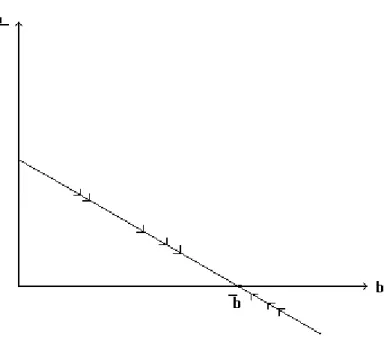
dt =θ(∆−nk)−nb
The phase diagram in Figure 1 shows that internal public debt increases continually when it begins its trajectory from low values. It nonetheless converges to a value b that depends on the operational deficit, transference of resources abroad, and the real growth rate of the economy.
3To obtain this expression we adopt the simplifying hypotheses that the variation of international reserves is
Figure 1. Phase Diagram: Internal Public Debt
Under the hypotheses forwarded up to this point, it can be concluded that the type of economic policy we are describing is conducive to a stable growth process of internal public debt.
Let us examine what happens to the rate of inflation under this type of regime of monetary and fiscal policy. Equation (8) can be rewritten in the following way:
(10) dh
dt +h(π θ+ n)= −(1 θ) ∆−nω−nk
whereω = b+h. Figure 2 shows the values of π and h for which dh
dt = =h 0, as well as the combinations of π and h for which h>0 and h<0.
Figure 2. Phase Diagram: Monetary Base
(11) d
d tπ β= logh+γ π
where β and γ are positive parameters. The acceleration of inflation depends on the monetary base and the rate of inflation. This equation can be interpreted as resulting from the combination of the IS, LM and Phillips Curves. The Phillips Curve in this model supposes the existence of inertia in labor contracts, while in the IS Curve it is admitted that the expected real rate of interest is equal to the rate actually observed. Figure 3 shows the combination of values of π and h for which π =0, as well as those values of these variables for which π >0 and π <0.
Figure 3. Phase Diagram: Rate of Inflation
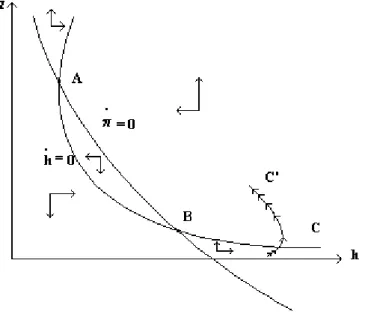
Equation (10) and (11) form a system of differential equations and the phase diagram in Figure 4 shows that there may be two points of equilibrium. Point A, the high rate of inflation, is a saddle point. Point B, the low rate of inflation, can be both locally stable or unstable, depending on the parameters of the model.
This model is consistent with the fact, observed in some countries, of a low correlation between public deficit and the rate of inflation. Indeed, let us suppose that the economy is in equilibrium at point B and that a shock (of the heterodox type, for instance) momentaneously reduces the rate of inflation and increases the real balance of the system (point C of Figure 4). The path of the economy (C C') in these circumstances may eventually lead to a hyperinflation if no measure is taken to halt the process. Other examples of shock, such as a change in the real exchange rate due to the foreign debt crisis or an increase in the government's primary deficit, could provoke a situation of imbalance and trigger the phenomenon of hyperinflation.
An economy with the type of monetary and fiscal policies described by the model represented in the phase diagram in Figure 4 is unstable, as any shock could suddenly set off a hyperinflation, which is defined as a process in which the rate of inflation grows indefinitely as time goes by ( lim )
consequences of Latin Americas, high rates of inflation in the post-war period. Fiscal reform thus consists of an instrument capable of dismantling the regime of fiscal and monetary policies by making room for an active monetary policy that has no commitment to financing the public sector deficit.
Figure 4. Phase Diagram: The Dynamic of the Economy
3. Fiscal Reform and Stabilization in the Sixties
In the early sixties inflation was on the rise in Brazil and several attempts at stabilization were made without success. The Stabilization Program of the Castello Branco Administration, put into effect in the period from 1964 to 1967, was certainly successful in lowering the rate of inflation, as Figure 5 shows. Inflation dropped from the 90% level in 1964 to 20% in late 1967. This plan, which would be considered heterodox in the Northern Hemisphere but is considered by many economists in Brazil as orthodox, fought inflation through a combination of an austere fiscal policy and an incomes policy that used wage and price controls. The austere fiscal policy allowed the government an active monetary policy consistent with low rates of inflation, and so freed the Central Bank from having to supply resources to cover the government deficit.
Some economists who have analyzed this Stabilization Plan [for example, Lara Resende (1982)] attributed the drop of the rate of inflation after 1965 to the PAEG wage policy. This policy readjusted wages so as to preserve the worker's real average in light of the inflation projected by the government. As this projection was always underestimated, in practice what happened was a sharp drop in real wages during the period.
credibility of Brazilian society. So, the hypothesis of rational expectations, although plausible, is not likely.
The wages policy was unquestionably an important instrument for breaking the inertia of the inflationary process. To conclude, however, that the orthodox component of the PAEG was thus completely unnecessary does not appear warranted. Table 1 shows in fact that there was an increase in the inflationary tax during the 1960-64 period, when it reached 5.32% of the GDP in 1964, whereas the gross and net tax burden came down. The state's fiscal situation at the time can also be evaluated by the government savings (current account), which became negative in some years of the early 60's, when the government current expenditures were larger than tax collection.
Table 1
Some Indicators of Fiscal Policy in the 60s (% of the GDP)
Tax Burden Year Gross (1) Net (2) Inflationary Tax (3) Total Gross Tax Burden
(4) = (1) + (3) Savings in Government' s Current Account (5)
1960 17,42 12,90 2,34 19,76 4,72
1961 16,38 11,02 3,54 19,92 1,35
1962 15,76 9,90 3,76 19,30 -0,25
1963 16,05 10,52 5,04 21,04 0,31
1964 17,01 11,42 5,23 22,24 -0,19
1965 19,71 13,19 2,50 22,21 1,90
1966 22,13 15,88 2,74 24,87 5,02
1967 21,62 14,40 1,85 23,47 2,20
1968 24,30 16,38 1,85 26,15 4,86
1969 25,91 17,41 1,44 27,35 6,04
Source:FIBGE and Cysne (1989)
The Stabilization Program of the Castello Branco Administration carried out a fiscal reform in two stages to resolve the public finances situation. In the first stage (1965-1966) it promoted an increase of the tax burden by means of the following instruments: i) increase of the consumer tax rates, ii) reformulation of income tax, increasing the base and broadening the system of withholding taxes at their source, and iii) penalization of taxpayers who fail to pay punctually by charging monetary correction on the tax overdue, besides the appropriate fines. The concrete result of this stage of the fiscal reform was to increase to 17.01% gross rate of taxation in 1964, to 19.71% in 1965, and to 22.13% in 1966, while the inflation tax fell in the same period from 5.23% to 2.74%.
The second stage of the fiscal reform was elaborated so as to satisfy a restriction and in order to accomplish one fundamental objective. The restriction was that the change of the tax system should not reduce the tax burden. Despite a small decrease in 1967 (a natural occurrence in the first year the new system was introduced), in the following two years (1968 and 1969) the tax burden rose to around 25%, and remained at that level for a large part of the 70s. The fundamental objective of the reorganization of the tax system was to create a solid, modern tax base to face the problems of economic growth. Modernization of the tax system took place with the following measures: i) elimination of the sales and consignments tax ( a cascadind tax that encouraged vertical integration of companies and was the chief source of revenue for the sate governments) and its substitution by a value-added type of tax, the so-called tax on circulation of goods (ICM); ii) transformation of the consumption tax into another tax of the value-added type, called the tax on industrialized products (IPI); iii) elimination of the various taxes charged by states and municipalities, which very often had the same base as taxes charged by other levels of the government; iv) transference of the right to charge taxes which are instruments of a national policy to the federal government (export taxes, financial operations and rural property taxes). Another restrictions which was followed in the reorganization of the national tax system was that the different levels of government should maintain their relative shares in tax collection after introduction of the new system. As the states and municipalities faced a reduction in the number of taxes they were allowed to charge, State and Municipality Revenue Sharing Funds were created (see Chart II) with part of the revenue from the consumption and income taxes.
This sweeping fiscal reform allowed the government to use a quite contractionary monetary policy as far back as 1966, a year in which inflation proved rather persistent. The results of this policy were seen in 1967, when inflation reached 20% a year, and remained there until 1973.
CHART I
NATIONAL TAX SYSTEM
Constitution of 1946 and Constitutional Constitutional Amendment nº 18 of 1965 Constitution of 1988
Amendment nº 5 of 1961 (Effective as of January 1967) (Effective as of March 1989)
1. Federal 1. Federal 1. Federal
1.1. Import Tax 1.1. Import Tax 1.1. Import Tax
1.2. Consumer Tax 1.2. Tax on Industrialized Products 1.2. Tax on Industrialized Products
1.3. Single Taxes 1.3. Single Taxes _
1.4. Income tax 1.4. Income Tax 1.3. Income Tax
1.5. Tax on Transference _ _
of Funds Overseas
1.6. Tax on Business of _ _
Economy
1.7. Extraordinary Taxes 1.5. Extraordinary Taxes 1.4. Extraordinary Taxes
1.8. Special Taxes _ _
1.6. Export Tax 1.5. Export Tax
1.7. Transport and Communication Tax _
1.8. Tax on Financial Operations 1.6. Tax on Financial Operations
1.9. Rural Property Tax 1.7. Rural Property Tax
1.8. Tax on Wealth
2. State 2. State 2. State
2.1. Tax on Sales and Consignments 2.1. Tax on Circulation of Products 2.1. Tax on Circulation of Products and
Services
2.2. Inheritance Tax 2.2. Inheritance Tax and Tax on Inter-vivos Transfers 2.2. Inheritance Tax and Donation
2.3. Export Tax _
2.4. Tax on Acts Regulated _
by State Law _
2.5. Special Taxes
2.3. Tax on Ownership of Self-Propelled Vehicles
2.4. Income Tax Surcharge on Capital Income
3. Municipal 3. Municipal 3. Municipal
3.1. Rural Property Tax _ _
3.2. Inter Vivos Transfer Tax _ 3.1. Inter Vivos Transfer Tax
3.3. Urban Law and Property Tax 3.1. Urban Land and Property Tax 3.2. Urban Land and Property Tax
3.4. Industry and Professions Tax 3.2. Services Tax 3.3. Services Tax
3.5. License Tax _
3.6. Public Entertainment Tax _
3.7. Tax on Acts of its Economy _
11
4. Stabilization Without Fiscal Reform: The Magic Kingdom of the Heterodox
Since the acceleration of inflation in Brazil after the late 1970's, several attempts have been made to implement stabilization plans. These plans, especially in the 80's have characteristically suffered from a lack of consistency: either heterodox policies alternated with short-sighted orthodox ones, or else the government lacked the necessary persistence to carry its plans forward.
In December 1979 there began the cycle of heterodox experiences, with the government adopting the following measures to control inflation and restore balance-of-payments equilibrium: 30% devaluation of the exchange rate (this was partly to replace the drop in export subsidies); pre-fixation of monetary correction and exchange-rate devaluation (the announced value was initially 45%, which was later readjusted), control of internal credit expansion and adoption of a wage policy that granted increments higher than inflation for the lower wages and increasingly smaller increments for the higher wage brackets. As a result of the police adopted, a rate of inflation of 110% recorded for that year (as measured by the Variation of the General Price Index computed by the Getulio Vargas Foundation), was substantially above the 77% of the preceding year. Monetary correction was set at 50% and exchange-rate devaluation was 61%. The minimum wage rose 100% and the real GDP growth rate was above 8%. The trade balance showed a deficit of US$ 2.8 billion (practically identical to the previous year), and the balance on current account presented a deficit of US$ 12.8 billion as against US$ 10.7 billion in deficit the year before.
These failures, both with regard to stabilization of the economy and to external adjustment, led the government to change its strategy the following year. Pressures in favor of these changes also came from foreign creditors. The policy of prefixing the monetary and exchange-rate corrections was abandoned. (Actually the intention was to restore exchange-rate competitiveness by a devaluation identical to internal inflation, but this was naturally inadequate to satisfy the objective). The hallmark for this year's economic policy was the extraordinary expansion of internal debt, which grew 250% between December of 1980 and December of 1981, inflation for the same period being 95%. Unfortunately, no attempt was made to bring down the public deficit.
This naive monetarist attempt produced no results. In the following year, due to local elections and the aggravation of the crisis in the foreign sector because of the Mexican default in September, no serious attempt at stabilization was made and inflation reached the 100% mark. New IMF-inspired stabilization policies were implemented in 1983 and 1984, but met with no success and inflation rose to the 200% level. The targets set for the public deficit in the various agreements signed with the IMF were never reached. Yet despite the failures as far as stabilization is concerned, external adjustment proved successful: in 1983 the Trade Balance was 6.4 billion dollars, and the Current Account deficit was brought down from 16 billion dollars the year before, to 7 billion. In 1984 the trade balance and current account figures were 13 billion and 45 million dollars respectively. This favorable situation in terms of the foreign sector is still prevalent today; in fact, only the year of 1986 registered a negative figure, due to the measures adopted during the Cruzado Plan.
12
the securities market. Once again the unpleasant monetarist arithmetic operated, and the team of the economists who began the government had to leave office in August of that year.
Because of the price controls adopted in April, 1985, inflation in the following months was lower than in March, for example. From October on, however, inflation began to speed up until it reached the figure of 17.8% per month in January, 1986, which established a record up to then. As a result, in the following month the government began to implement the Cruzado Plan, the boldest and most wide-sweeping heterodox strategy ever attempted in Brazil.
4.1. The Cruzado Plan: Conception and Instruments
The diagnosis on which the Cruzado Plan was based claimed that Brazil's inflation was 100% inertial. The question of public deficit , or fiscal policy in its broadest sense, was treated with a certain disregard when the Cruzado Plan was implanted. On the theoretical level (see, for instance, Lara Resende and Arida, 1985), the chief economists associated with the Plan developed their argument by assuming that the deficit was equal to zero. This conception also underlies the Plan proper, which can be seen quite clearly when the principal measures adopted are looked at more closely:4
i) Introduction of a new currency unit, the cruzeiro being replaced by the cruzado. ii) De-indexation of the economy through the following measures: extinction of the ORTNs (indexed public securities) and prohibition of indexation clauses in all contracts less than a year long. However, this de-indexation of the economy was only partial. Savings accounts and "forced" savings funds (PIS/PASEP and FGTS) remained indexed by the Consumer Price Index (IPC) computed by the FIBGE while wages were liable to automatic readjustment or "trigger" every time the accumulated variation of the IPC reached 20% and were also to be automatically readjusted by at least 60% of the IPC variation on the data used as the basis for readjustment of the labor contract.
iii) Generalized freezing of prices for an indeterminate period of time.
iv) Conversion of salaries, rents, installments of the Financial System for Housing, and school fees, from cruzeiros to cruzados, using the average value over the last six months.5
v) Use of a "Tablita" to convert contractual liabilities, the objective being to avoid income transfers between creditors and debtors (there were different criteria for contracts with and without a clause for monetary correction).
vi) Establishment of the exchange rate at 13,80 cruzados per dollar. Note that the Decree-Law that created the Plan did not freeze the exchange rate; the Central Bank could thereby alter the rate when it felt this was necessary. (Table 2 shows the rate of exchange devaluation after February 1986, and the trade balance).
Not only did the Cruzado Plan not include a fiscal adjustment, an 8% wage bonus was granted to all workers, thereby swelling the government's own payroll, which certainly contributed to worsening the fiscal imbalance.
4These observations on the Cruzado Plan are based on Barbosa, Brandão and Faro (1989).
5Important differences exist in the way that the principle of conversion by the average was applied in
13
The Cruzado Plan apparently made use of law 7450 of December, 1985, which introduced important changes of a fiscal nature, to justify not adopting new measures in the essence of the plan. In summary, that Law sought to lessen the effects of inflation on the government's fiscal revenue (the so-called Tanzi effect), while also raising taxation on the financial market and on corporate profits. The principle of taxation on current bases was also introduced, which increased the tax burden, chiefly of tax payers in the higher wage brackets.6
The reduction of inflation in the months that followed February 1986 substantially dampened the impact of the alterations introduced by Law 7450, which had actually been conceived to accommodate a significant level of inflation. The smaller amount of inflationary tax collected during the same period led to an even greater deterioration in public finances.
The first signs that the Cruzado Plan was beginning to fail appeared in the form of imbalances between supply and demand in several markets. Even if inflation were 100% inertial,7 the Cruzado Plan would very likely have failed, because some already lagged
prices had not been previously readjusted (as in the case of cars, fuels and electric power), because of the wage shock represented by the across-the-board wage bonus,8 and
because of a loose monetary policy (Table 2). These factors helped to exacerbate the fever of consumerism that led to the appearance of black markets and scarcity of certain products in those sectors in which the market economy was immobilized by the price freeze. In July of 1986 the government announced a new set of measures to correct these distortions, including an increase in taxes (disguised as compulsory loans) on gasoline and alcohol, cars utility vehicles, introduction of new tax rates on the financial market, and alteration of several provisions of Law 7450 to adjust it to the conception of the Cruzado Plan (for further details see Barbosa, Brandão and Faro, 1989).
Table 2 shows the evolution of the monthly inflation rates in 1986 and 1987 with other macroeconomic indicators. Inflation grew during the post-Cruzado period, and in April of 1987 the level was higher than that of January 1986. When inflation measured, by the IGP rose above 25% (in May and June of 1987), the government launched into a new heterodox adventure with a new team of economists.
4.2. The Bresser and Summer Plans
In May 1987 the economist Luiz Carlos Bresser Pereira took office as Minister of Finance to replace Dilson Funaro, who was responsible for introducing the Cruzado Plan. In mid-June the new minister launched a program to tackle inflation which became known as the Bresser Plan, still greatly influenced by the heterodox economists but with the declared intention of using orthodox components for controlling demand (see Table 3 for macroeconomic indicators after June 1986). The Plan involved three stages in order to achieve full stabilization of the economy. The first stage froze prices and wages for a period of ninety days. Prices and wages could then be readjusted monthly to avoid disrupting production and supply, as had happened during the Cruzado Plan. Wages
6For further details, see Barbosa et al, op. cit.
7A proof of the fallacy of this diagnosis is presented in Barbosa and Pereira (1989)
8Another indication that economic agents did not believe in the Plan was the increase of the value of the
14
would be corrected by a new index called the Price Reference Unit (URP), which was updated by the monthly (geometric) average rate of the variation of the IPC for the previous quarter. This index would also provide the maximum limit permitted for increasing prices.
Table 2
MACROECONOMIC INDICATORS: THE CRUZADO PLAN (FEBRUARY 1986)
Months IPC*
Percentual Change
IGP* Percentual
Change
Exchange Rate Devaluation
(%)
Trade Balance US$ Millions
Premium of the Dollar on
the Black Market
(%)
Monthly Interest Rate on Overnight Operations LBC/LFT(%)
M 1 Percentual
Change
M 4 Percentual
Change
January 16,23 17,80 13,0 701 36 - -8,8 12,5
February 27,20 22,40 15,4 628 34 - 14,1 16,4
March - 0,11 - 1,0 6,5 1.136 26 - 80,1 12,20
April 0,78 - 0,58 0,0 1.292 38 - 19,4 1,07
May 1,40 0,32 0,0 1.340 47 0,65 15,1 2,78
June 1,27 0,53 0,0 1.072 49 0,78 15,0 3,32
July 1,19 0,63 0,0 1.010 61 1,13 0,5 0,35
August 1,68 1,33 0,0 931 80 1,49 6,9 5,22
September 1,72 1,09 0,0 533 69 1,76 4,8 5,46
October 1,90 1,40 0,9 -83 88 1,96 6,7 3,47
November 3,29 2,50 1,0 -38 90 2,37 4,1 2,01
December 7,27 7,60 3,3 -217 89 6,07 7,9 5,05
January 16,82 12,00 7,5 -35 75 11,01 -21,8 5,36
February 13,94 14,10 15,9 320 58 19,61 6,0 16,33
March 14,40 15,00 15,2 302 47 11,95 -12,6 12,84
April 20,96 20,10 13,4 499 33 15,30 -15,8 10,32
May 23,21 27,70 29,5 964 16 24,63 1,0 24,51
June 26,06 25,90 29,8 1.427 20 18,02 31,6 18,99
Sources: Conjuntura Econômica, Central Bank and Local newspaper for the premium on the Black market.
Table 3
MACROECONOMIC INDICATORS: THE BRESSER (JUNE 1987) PLAN
Months
IPC* Percentual
Change
IGP* Percentual
Change
Exchange Rate Devaluation
(%)
Trade Balance US$ Millions
Premium of the Dollar on
the Black Market (%)
Monthly Interest Rate on Overnight Operations LBC/LFT (%)
M 1 Percentual
Change
M 4 Percentual
Change
June 26,06 25,9 29,8 1.427 20 18,02 31,6 18,9
July 3,05 9,3 12,6 1.457 29 8,91 10,0 14,2
August 6,36 4,5 4,9 1.429 24 8,09 9,7 5,0
September 5,68 8,0 5,6 1.497 23 7,99 8,6 7,0
October 9,18 11,2 7,1 1.193 28 9,45 11,7 10,2
November 12,84 14,5 11,0 1.001 19 12,92 13,8 14,0
December 14,14 15,9 14,5 1.116 28 14,38 30,8 23,5
January 16,51 19,1 14,3 1.047 23 16,78 -10,3 14,2
February 17,96 17,6 17,8 897 16 18,35 10,4 15,6
March 16,01 18,2 17,7 1.235 29 16,59 14,0 17,7
April 19,28 20,3 16,4 1.897 26 20,25 13,2 17,5
May 17,78 19,5 20,9 1.149 31 18,65 19,3 23,2
June 19,53 20,8 17,4 2.421 43 20,17 16,7 28,4
Sources: Conjuntura Econômica, the Central Bank and Local newspapers for the Premium of the Dollar on the Black Market. * See Table 2.
the public deficit in 1987 and its complete elimination the following year would enable this third stage to be implemented.
Although strongly influenced by heterodoxy, in its conception the Bresser Plan contained measures of a fiscal nature, some of which became effectively implemented. For instance, it increased the price of public service and also separated the National Treasury and the Central Bank, as well as calling for the unification of the monetary and fiscal budgets. Yet these measures were insufficient to allow the government to bring about the necessary adjustment of the public deficit, and monetary and fiscal policy remained unaltered. At the end of the year Minister Bresser tried to present a series of fiscal measures meant to reduce the public deficit. These measures were rejected from within the very government, however, and the minister resigned.
What the Bresser and Cruzado plans offered, as far as fiscal adjustment is concerned, was a series of repeated attempts to raise revenue without any significant effort to reduce spending. The fiscal problem, moreover, was treated in a short-sighted manner, since it did not take into account the necessary intertemporal dimension. An emergency fiscal package may be a necessary condition to guarantee the success of a stabilization plan in Brazil, but it is not a sufficient condition. Fiscal reform, as has already been mentioned, is required to promote a change in the regime of macroeconomic policy.
Mailson da Nóbrega was chosen to replace Minister Bresser in charge of Finance. The Brazilian economy was emerging from two failures in its struggle against inflation: the minister proceeded to use a gradualist policy by trying to lower public deficit and adopting a tight monetary policy which became known as the "rice and beans" policy. As Table 4 illustrates , the rate of inflation failed to respond to the Minister's efforts (which were more rhetorical than effective), and reached the 29% monthly mark in December of 1988 (see table 3). And so, on the January 14 of 1989 a new stabilization plan appeared, this time called the Summer Plan (see Table 5).
Table 4
MONTHLY RATES OF VARIATION OF THE GENERAL PRICE INDEX (IGP)
Month/Year Inflation
1/88 19,10
2/88 17,60
3/88 18,20
4/88 20,30
5/88 19,50
6/88 20,80
7/88 21,50
8/88 22,90
9/88 25,80
10/88 27,60
11/88 28,00
12/88 28/90
18
MACROECONOMIC INDICATIONS: SUMMER PLAN (JANUARY 1989)
Months IPC* Percentual Change IGP** Percentual Change Exchange Rate Devaluation (%) Trade Balance US$ Millions Premium of the Dollar on the Black Market Interest Rate on Overnight Operations LBC/LFT % M 1 Percentual Change M 4 Percentual Change
January 70,28 36,6 35,02 1.611 61 22,97 17,1 20,30 February 3,60 11,8 10,38 1.087 70 18,95 5,2 18,60
March 6,09 4,2 0,0 1.645 76 20,44 13,8 18,50
April 7,31 5,2 1,52 1.291 119 11,52 28,8 13,00
May 9,94 12,8 8,29 1.401 160 10,49 4,64 7,04
June 24,83 26,8 21,90 2.205 136 25,77 13,91 19,27 July 28,76 37,88 42,54 1.433 91 41,25 10,55 24,87 August 29,34 36,48 29,84 1.462 70 39,89 6,05 31,80 Sources: See Table 3
* See Table 2 ** See Table 2
Besides containing the now traditional heterodox ingredients of de-indexation and price freezing, this plan showed a greater concern on the part of the government to balance the budget. The chief measures adopted were as follows:9
i) The cruzado had three zeros struck off and was renamed the cruzado novo; ii) Wages were converted into cruzados novos by using the average wage value in OTNs during the period from January to December 1988 and then taken to the first of February by using the URP as corrective factor: the value of this Unit for this month was 26.05%. But this procedure applied only to wages that were below the average (those above the average were not changed);
iii) All prices were frozen for an indeterminate period, in accordance with Law 7.730. Members of the economic staff nonetheless claimed that the freeze on prices would not stretch longer than 90 days, and also that they would be willing to revise the price of some products whenever necessary. This concern reflected the fear that there might be a repetition of the same supply problems that arose during the Cruzado Plan;
iv) Changes were introduced in the calculation of January's inflation (IPC), with the aim of eliminating from February's index the price increases that took place just before the plan. This change was such that January's inflation actually included the price variation over 45 days, the value being on the order of 70%;
v) As happened with the Cruzado Plan, a "Tablita" was created to correct the values of contracts drawn up between the first of January 1989 and the 15 January 1989. The corrective factor used (1,004249 for each day elapsed as of 16 January 1989) showed a rate of inflation of 13.56% per month. Law nº 7.730 granted the Minister of Finance competence to alter this conversion factor should he find it necessary;
vi) The OTN was done away with. This National Treasury Bond was created during the Cruzado Plan to replace the ORTN. It was also prohibited to include a monetary-correction clause in contracts of less than 90 days;
9The Summer Plan was principally regulated by Provisional Measure nº 32 of 15 January 1989. This measure
19
vii) Wage readjustment for public employees now depended on the situation of the State's net revenue, except for revenue that came from credit operations. In fact, spending on wages in the public sector was limited to 65% of the net revenue. Furthermore, the date for paying public employees was changed to the 10th of each subsequent month (this allowed the government to pay one payroll less in 1989);
viii) Disbursement of resources by the National Treasury became conditioned to availability of cash in hand (in other words, revenue actually collected plus the existing cash in hand as of the 31 December 1988).
The government announced an exchange devaluation of 17% on the 15th of January and committed itself to pursue an austere monetary policy with high interest rates. Because of the rule of spending only whatever cash was in hand, emission of public-debt bonds, in accordance with Law 7.730 (article 18, paragraph 4), would only be authorized to account for payment of interest on that debt and rolling over the principal. Besides this, the government also committed itself to other measures of a fiscal nature which were later vetoed by Congress, such as the case of privatization of state companies and also the dismissal of public employees.
The data presented in Table 5 show quite clearly that in May 1989 monthly inflation was already in the two-digit bracket. In June 1989, inflation (as measured by the IGP computed by the Getulio Vargas Foundation) returned to the same level as before the Summer Plan . The main reason for the failure of the Summer Plan (as is also true of the other heterodox attempts of the eighties) is that there was no reduction of the government deficit, and monetary policy continued on its passive and permissive path. To illustrate the government's difficulties with regard to public deficit, the most recent data published by the central bank indicate that the operational deficit (which does not include monetary correction of the domestic debit) was in the order of 3.6% of the GDP in 1986 (the nominal deficit was 11.13%), rising to 5.52% in 1987 (the nominal deficit was 31.37%) and then dropping slightly to 4.26% in 1988 (the nominal deficit was 48.54%). Estimates for 1989 indicate that the operational deficit will be greater than last year's.
5. Fiscal Reform Without Stabilization: The New Constitution
The situation of Brazil's public finances has been slowly deteriorating since the late 70s. Between 1978 and 1987, the gross tax burden fell by three percentage points, going from 25.63% to 22.60% (see Table 4). The net tax burden went from 15.21% in 1987 to 13.5% in 1987. Inflationary tax rose to a new level and reached the proportion of 3.53% of the GDP in 1987. Savings in the government's current account fell substantially in the 1978-87 period, and became negative in 1982. The causes that lie behind this new fiscal crisis of the Brazilian State are multiple. The lowering of the tax burden may be explained by the following facts:
i) increase in the rate of inflation, provoking a reduction in real collection because of the existing time-lag between the accrual and the actual collection of the tax;
ii) increase in the share of production exported, with a consequent fall in tax collections due to export exemptions;
20
iv) increase of tax waivers by the State due to the indiscriminate use of tax incentives.
On the government spending side the following factors contributed to the fiscal crisis: a) increasing indebtedness of the State with the growth of spending on the servicing of the foreign and domestic debts; b) control of the prices of goods and services produced and sold by state companies for the purpose of fighting inflation; c) increase of the government's current expenditure.
Table 6
SOME INDICATORS OF FISCAL POLICY IN THE 1978-87 PERIOD (% of GDP)
Year
Tax Burden
Inflationary Savings in Government's
Gross Net Tax Current Account
1978 25,63 15,21 1,79 2,37
1979 24,26 14,15 2,82 2,32
1980 24,21 12,21 3,04 1,09
1981 24,63 12,66 2,25 1,10
1982 26,18 13,51 2,20 - 0,38
1983 24,67 12,18 2,97 - 1,35
1984 21,57 10,27 2,23 - 2,50
1985 21,97 11,14 2,11 - 7,95
1986 24,26 14,09 1,17 - 6,81
1987 22,60 13,05 3,53 - 6,10
Source: FIBGE and Cysne (1989)
This fiscal-crisis situation led to the government's systematic use, throughout the eighties, of different fiscal packages with measures meant to tackle the public-deficit problem. None of these packages has met with success, as their action has been sporadic and transitory.
In October 1988 the National Congress approved a Fiscal Reform within the new Constitution. Chart I describes the new national tax system and shows the differences as compared with the system in effect up to then. The main innovations introduced were as follows;
i) elimination of the single taxes (fuels and lubricants, electric power and minerals), and the tax on transportation and communications that now became part of the tax on circulation of goods and services;
ii) introduction of a tax on wealth over a certain level, to be regulated by a complementary law;
iii) creation of a income tax surcharge on capital income; iv) introduction of a new tax on retail sales of fuels.
21
with its distribution among the various levels of government. Their clear intent was to increase the share of the states and municipalities and decrease the participation of the federal government. This attitude of the politicians was a response to the concentration of resources that was determined in the 1969 Constitution and granted by the Military Junta that ruled the country for a short period of time in late 1969. That Constitution changed de system of participation instituted by the Castello Branco Administration by cutting from 22% to 12% the share of states and municipalities in the revenue from collection of income tax and the tax on industrialized products, as described in Chart II, which shows the alterations that have taken place with the quotas of the revenue Sharing Funds since their creation until the latest Constitution. Throughout the 1976-83 period, successive changes were made to the quotas of the Funds, and in 1983 the total of states and municipalities in the revenue from collection of income tax and the tax on industrialized products, as described in Chart II, which shows the alterations that have taken place with the quotas of the Revenue Sharing Funds since their creation until the latest Constitution.Throughout the 1976-83 period, successive changes were made to the quotas of the Funds, and in 1983 the total of states and municipalities was already greater than that instituted in 1967. In 1984 a new Constitutional Amendment raised the quotas. The new Constitution has increased them even more, and in 1993 the participation of states and municipalities will be equal to 46% of the total revenue collected from income tax and the tax on industrialized products, which make up the federal government's principal tributes.
This transfer of federal government resources to states and municipalities was carried out without the corresponding transfer of duties to the two spheres of government. As a result, the federal government deficit has increased with the new Constitution . It cannot be claimed that the deficits of the states and municipalities will diminish with the growth of their revenues, as it is quite likely that they will simply increased their spending.
22 Chart II
QUOTAS OF REVENUE SHARING
Legal Document Year
Participation Funds
Total States Municipalities Special
Constitution of
09/18/46 1947/61 - 10a - 10a
Constitutional Amendment nº 5 of
11/02/61
1962/66 - 15(10)b - 15(10)b
Constitutional Amendment nº 18 of
12/01/65
1967/70 10 10 2 22
Constitution of
10/17/75 1971/75 5 5 2 12
Constitutional 1976 6 6 2 14
Amendment nº 5 1977 7 7 2 16
of 07/01/75 1978 8 8 2 18
1979/80 9 9 2 20
Constitutional 1981 10 10 2 22
Amendment nº 17 of
12/02/80 1982/83 10,5 10,5 2 23
Constitutional 1984 12,5 13,5 2 28
Amendment nº 23 of
12/01/83 1985/88 14 16 2 32
Constitution 1989 19 20,5 3 42,5
1990 19,5 21 3 43,5
of 1991 20 21,5 3 44,5
1992 20,5 22 3 45,5
1988 1993 21,5 22,5 3 47
Notes: a) Only income tax;
b) 15% on income tax and 10% on consumer tax.
6. Conclusions
In this paper we have argued that among the various stabilization plans implemented in Brazil, the only successful one was PAEG, the plan adopted by the Administration of President Castello Branco. The main reason behind the success of the plan was the fiscal reform implemented by that government.
Even though the wage policies of the period may have helped, especially by reducing the output costs of stabilization, the main ingredient was the fiscal reform and credibility of the government. Naturally it took some time to gain the confidence of society, but eventually it became clear that a major change in the situation of public finance was taking place.
23
Naive attempts to control monetary-base growth without supporting fiscal restraint were doomed to failure. Many fiscal packages were issued but they were not able to solve permanently the financial disequilibrium of the government. As a result, inflation has increased systematically over the 1980's.
References
ARIDA, P. and Lara Resende. "Inertial Inflation and Monetary Reform: Brazil". In: J. Williamson (org.), Inflation and Indexation: Argentina, Brazil and Israel. MIT Press, Cambridge, 1985.
BARBOSA, F.H. "As Origens e Consequências da Inflação na América Latina", Ensaios Econômicos da EPGE nº 135, 1988.
______________, A.S.P. Brandão and Clovis de Faro. "O Reino Mágico do Choque Heterodoxo", In Barbosa, F.H. and M.H. Simonsen (org.), Plano Cruzado: Inércia x Inépcia. Editora Globo, Rio de Janeiro, 1989.
______________, and Pedro L. Valls Pereira. "O Insucesso do Plano Cruzado: a Evidência Empírica da Inflação 100% Inercial para o Brasil", In Barbosa, F.H. and M.H. Simonsen (org.), Plano Cruzado: Inércia x Inépcia. Editora Globo, Rio de Janeiro, 1989.
Brasil Programa Econômico (published by Banco Central do Brasil) vol. 20, March, 1989.
CYSNE, R.P. "Contabilidade com Juros Reais" Ensaios Econômicos da EPGE nº 140, 1989.
EPEA/Ministério do Planejamento - O Programa de Ação e as Reformas de Base, Documentos EPEA nº 3, vol.I e II, 1965.
EPEA/Ministério do Planejamento - O Programa de Ação Econômico do Governo 1964-1966, Documentos EPEA nº 1, 1965.
LARA Resende, A. "A Política Brasileira de Estabilização: 1963/68" Pesquisa e Planejamento Econômico, vol. 12, 1982: 757-806.
LEZAN, E. and R. Varsano. "O Sistema Tributário Brasileiro". Secretaria de Receita Federal, Ministério da Fazenda, mimeo.
LONGO, C.A. "A Disputa Pela Receita Tributária no Brasil". IPE/USP, São Paulo, 1984.
24
SARGENT, T.J. and Neil Wallace. "Some Unpleasant Monetarist Arithmetic" Quarterly Review, vol. 5, nº 3, Federal Reserve Bank of Minneapolis, 1981.