FUNDAÇÃO GETULIO VARGAS ESCOLA DE ECONOMIA DE SÃO PAULO
ANA ELISA GONÇALVES PEREIRA
ESSAYS ON COORDINATION PROBLEMS IN ECONOMICS
FUNDAÇÃO GETULIO VARGAS ESCOLA DE ECONOMIA DE SÃO PAULO
ANA ELISA GONÇALVES PEREIRA
ESSAYS ON COORDINATION PROBLEMS IN ECONOMICS
Tese submetida à Escola de Economia de São Paulo da Fundação Getulio Vargas como requisito para a obtenção do título de Doutor em Economia.
Orientador: Bernardo de Vasconcellos Guimarães
Pereira, Ana Elisa Gonçalves.
Essays on coordination problems in economics / Ana Elisa Gonçalves Pereira. - 2016.
95 f.
Orientador: Bernardo de Vasconcellos Guimarães Tese (doutorado) - Escola de Economia de São Paulo.
1. Mercado financeiro. 2. Bancos. 3. Divulgação de informações. 4. Teoria dos jogos. I. Guimarães, Bernardo de Vasconcellos. II. Tese (doutorado) - Escola de Economia de São Paulo. III. Título.
ANA ELISA GONÇALVES PEREIRA
ESSAYS ON COORDINATION PROBLEMS IN ECONOMICS
Tese apresentada à Escola de Economia de São Paulo da Fundação Getulio Vargas como requisito para a obtenção do título de Doutor em Economia.
Data da aprovação: 24 de junho de 2016
Banca examinadora:
Prof. Dr. Bernardo de Vasconcellos Guimarães (Escola de Economia de São Paulo)
Prof. Dr. Luís Fernando Oliveira de Araújo (Escola de Economia de São Paulo)
Prof. Dr. Braz Ministério de Camargo (Escola de Economia de São Paulo)
Prof. Dr. Vinícius do Nascimento Carrasco (PUC-Rio)
ACKNOWLEDGEMENTS
I am extremely grateful to my advisor, Bernardo Guimaraes, for his guidance throughout each step of my doctoral studies, for all the enriching discussions and for his precious contributions to our joint work. Very special thanks are also due to Itay Goldstein for his invaluable comments and advice.
Furthermore, I would like to thank all the professors at the Sao Paulo School of Economics who contributed to my understanding of economics, in particular Braz Camargo, from whom I have learned a great deal. I am also grateful for the comments and suggestions on my research I received from Luis Araujo, Braz Camargo, Vinicius Carrasco, Caio Machado, Gabriel Madeira, Daniel Monte, Guillermo Ordonez, Jakub Steiner and many seminar and conference participants.
I must express my gratitude to the Wharton School of the University of Pennsylvania for its kind hospitality during my stay. I also gratefully acknowledge the financial support I received from the São Paulo Research Foundation (FAPESP) through grants #2013/24368-7 and #2014/06069-5.
ABSTRACT
There are several economic situations in which an agent’s willingness to take a given action is increasing in the amount of other agents who are expected to do the same. These kind of strategic complementarities often lead to multiple equilibria. Moreover, the outcome achieved by agents’ decentralized decisions may be inefficient, leaving room for policy interventions. This dissertation analyzes different environments in which coordination among individuals is a concern.
The first chapter analyzes how information manipulation and disclosure affect coordination and welfare in a bank-run model. There is a financial regulator who cannot credibly commit to reveal the situation of the banking sector truthfully. The regulator observes banks’ idiosyncratic information (through a stress test, for example) and chooses whether to disclose it to the public or only to release a report on the health of the entire financial system. The aggregate report may be distorted at a cost – higher cost means higher credibility. Investors are aware of the regulator’s incentives to conceal bad news from the market, but manipulation may still be effective. If the regulator’s credibility is not too low, the disclosure policy is state-contingent and there is always a range of states in which there is information manipulation in equilibrium. If credibility is low enough, the regulator opts for full transparency, since opacity would trigger a systemic run no matter the state. In this case only the most solid banks survive. The level of credibility that maximizes welfare from an ex ante perspective is interior.
The second and the third chapters study coordination problems in dynamic environments. The second chapter analyzes welfare in a setting where agents receive random opportunities to switch between two competing networks. It shows that whenever the intrinsically worst one prevails, this is efficient. In fact, a central planner would be even more inclined towards the worst option. Inefficient shifts to the intrinsically best network might occur in equilibrium. When there are two competing standards or networks of different qualities, if everyone were to opt for one of them at the same time, the efficient solution would be to choose the best one. However, when there are timing frictions and agents do not switch from one option to another all at once, the efficient solution differs from conventional wisdom.
thresholds for different types of agents partially coincide as long as there exists a set of beliefs that would make this coincidence possible. However, the equilibrium strategies never fully coincide. Moreover, we show conformity is not inefficient. In the efficient solution, agents follow others even more often than in the decentralized equilibrium.
Keywords: coordination, bank runs, global games, information disclosure, dynamic games, timing frictions, heterogeneous agents.
RESUMO
No estudo da economia, há diversas situações em que a propensão de um indivíduo a tomar determinada ação é crescente na quantidade de outras pessoas que este indivíduo acredita que tomarão a mesma ação. Esse tipo de complementaridade estratégica geralmente leva à existência de múltiplos equilíbrios. Além disso, o resultado atingido pelas decisões decentralizadas dos agentes pode ser ineficiente, deixando espaço para intervenções de política econômica. Esta tese estuda diferentes ambientes em que a coordenação entre indivíduos é importante.
O primeiro capítulo analisa como a manipulação de informação e a divulgação de informação afetam a coordenação entre investidores e o bem-estar em um modelo de corridas bancárias. No modelo, há uma autoridade reguladora que não pode se comprometer a revelar a verdadeira situação do setor bancário. O regulador observa informações idiossincráticas dos bancos (através de um stress test, por exemplo) e escolhe se revela essa informação para o público ou se divulga somente um relatório agregado sobre a saúde do sistema financeiro como um todo. O relatório agregado pode ser distorcido a um custo – um custo mais elevado significa maior credibilidade do regulador. Os investidores estão cientes dos incentivos do regulador a esconder más notícias do mercado, mas a manipulação de informação pode, ainda assim, ser efetiva. Se a credibilidade do regulador não for muito baixa, a política de divulgação de informação é estado-contingente, e existe sempre um conjunto de estados em que há manipulação de informação em equilíbrio. Se a credibilidade for suficientemente baixa, porém, o regulador opta por transparência total dos resultados banco-específicos, caso em que somente os bancos mais sólidos sobrevivem. Uma política de opacidade levaria a uma crise bancária sistêmica, independentemente do estado. O nível de credibilidade que maximiza o bem-estar agregado do ponto de vista ex ante é interior.
do senso comum.
O terceiro capítulo analisa um problema de coordenação dinâmico com decisões escalonadas em que os agentes são heterogêneos ex ante. No modelo, existe um único equilíbrio, caracterizado porthresholds que determinam as escolhas para cada tipo de agente. Apesar da heterogeneidade nos payoffs, há bastante conformidade nas ações individuais em equilíbrio. Os thresholds de diferentes tipos de agentes coincidem parcialmente contanto que exista um conjunto de crenças arbitrário que justifique esta conformidade. No entanto, as estratégias de equilíbrio de diferentes tipos nunca coincidem totalmente. Além disso, a conformidade não é ineficiente. A solução eficiente apresentaria estratégias ainda mais similares para tipos distintos em comparação com o equilíbrio decentralizado.
Palavras-chave: coordenação, corridas bancárias, jogos globais, divulgação de informação, jogos dinâmicos, timing frictions, agentes heterogêneos.
Contents
Abstract vii
Resumo ix
1 Rollover risk and the social value of credibility 1
1.1 Introduction . . . 2
1.2 The model . . . 5
1.2.1 Environment . . . 6
1.2.2 Regulation . . . 7
1.3 Information manipulation and disclosure policies . . . 8
1.3.1 Benchmark case: full credibility . . . 10
1.3.2 General case: limited credibility . . . 11
1.4 Optimal credibility . . . 17
1.4.1 Optimal credibility and multiple equilibria . . . 18
1.5 Final remarks . . . 20
1.A Proofs . . . 20
1.A.1 Proof of Lemma 1.1. . . 20
1.A.2 Proof of Proposition 1.1 . . . 21
1.A.3 Proof of Proposition 1.2 . . . 21
1.A.4 Proof of Proposition 1.3 . . . 25
1.A.5 Proof of Proposition 1.4 . . . 25
2 QWERTY is efficient 27 2.1 Introduction . . . 28
2.2 The model . . . 29
2.3 Extension: asymmetric network effects . . . 33
2.4 Final remark . . . 35
3 Dynamic coordination among heterogeneous agents 37
3.1 Introduction . . . 38
3.2 The model . . . 40
3.2.1 Unique equilibrium . . . 42
3.3 Limiting cases . . . 45
3.3.1 Vanishing shocks . . . 46
3.3.2 Vanishing frictions . . . 49
3.4 Linear payoff function . . . 51
3.4.1 Vanishing shocks . . . 51
3.4.2 Vanishing frictions . . . 56
3.5 The planner’s problem . . . 57
3.6 Final remarks . . . 61
3.A Expressions for the equilibrium thresholds . . . 61
3.A.1 Vanishing shocks . . . 61
3.A.2 Vanishing frictions . . . 66
3.A.3 Low-type equilibrium threshold with linear payoffs. . . 68
3.A.4 Planner’s solution with two types of agents . . . 69
3.B Proofs . . . 71
3.B.1 Proof of Proposition 3.1 . . . 71
3.B.2 Proof of Lemma 3.2. . . 75
3.B.3 Proof of Proposition 3.2 . . . 76
List of Figures
1.1 Comparative statics . . . 14
1.2 Aggregate report for a given ˆz ∈[0,1] and investors’ beliefs . . . 16
1.3 Welfare . . . 18
1.4 Welfare range . . . 19
1.5 Optimal credibility . . . 19
1.6 Regulator’s payoffs for a given ˆz ∈[0,1] . . . 22
2.1 Planner’s solution . . . 33
2.2 Planner’s solution under asymmetric network effects . . . 34
3.1 Dominance regions: an example . . . 42
3.2 Dynamics - three types . . . 44
3.3 Bifurcation probabilities . . . 46
3.4 Dominance regions - Large and small heterogeneity . . . 47
3.5 Equilibrium - not so large heterogeneity . . . 48
3.6 Vanishing timing frictions . . . 50
3.7 Linear utility and very large heterogeneity . . . 53
3.8 Linear utility and large heterogeneity . . . 54
3.9 Linear utility and small heterogeneity . . . 55
3.10 Small heterogeneity and vanishing frictions . . . 57
3.11 Planner’s solution - large heterogeneity . . . 60
3.12 Planner’s solution - small heterogeneity . . . 60
3.13 Very large heterogeneity . . . 64
3.14 Large heterogeneity . . . 65
3.15 Iterative deletion of strictly dominated strategies . . . 72
3.16 Translation argument . . . 72
Chapter 1
Rollover risk and the social value of
credibility
Abstract
This paper studies information disclosure when a financial regulator cannot credibly commit to reveal the situation of the banking sector truthfully. I present a bank run model where a regulator observes banks’ types (through a stress test, for example) and chooses whether to disclose bank-specific information or only to release a report on the health of the entire financial system, which can be biased at a cost. Investors are aware of the regulator’s incentives to mask an undesirable scenario, and take that into account in their rollover decisions. The signaling in the regulator’s disclosure and manipulation policies generates multiple equilibria. Still, predictions may be derived. If credibility is not too low, the regulator only discloses bank-specific information in low states (i.e., when the proportion of good banks is small); in intermediate states, the policy features opacity and information manipulation; and in high states, opacity with truth-telling. The relationship between credibility and the amount of transparency in equilibrium is non-monotonic. If credibility is low enough, the regulator loses the ability to help agents coordinate by manipulating information and must choose full transparency, in which case only the most solid banks survive. These results have implications for institutional design. The social planner would choose an interior level of credibility.
Keywords: bank runs, information disclosure, information manipulation, stress tests. JEL classification: D82, D83, G01.
Acknowledgements
(FAPESP) for financial support.
1.1
Introduction
Stress testing has become an important regulatory tool since the 2008 financial crisis. However, the desirability of stress-tests results disclosure remains controversial. Not surprisingly, the many stress tests conducted in the last decade in different countries differed in the way supervisors handled results disclosure.1 There is also evidence that, in some cases,
regulators have tried to conceal bad news from the market, releasing information that turned out to be somewhat misleading.
This paper studies information disclosure when a financial regulator cannot commit to report the situation of the banking sector truthfully. Regulators may have incentives to mask an undesirable scenario as an attempt to avoid runs on banks that would otherwise be solvent. But if investors are aware of those incentives, would information manipulation be effective? I investigate how the regulator’s credibility relates to the effectiveness of information manipulation and, especially, to the level of information disclosure. The relationship between credibility and disclosure, as well as its effects on the stability of the banking sector, raises the question of how credible we want our regulators to be. This paper proposes a rationale for the disclosure policy to depend on the regulator’s credibility and discusses to which extent supervisors should be held accountable for their actions when trying to inflate the economic scenario.
I present a bank-run model where a regulator performs a stress test to learn banks’ types. The regulator can choose whether to disclose bank-specific information (a policy of transparency), or to only release a report on the aggregate situation of the banking system (opacity). The regulator has the prerogative to bias the aggregate report at a cost that is increasing in the amount of distortion. The higher the cost of producing biased information, the more credible the regulator in the eyes of investors. By manipulating information, the regulator can try to avoid inefficient coordination failures, but investors anticipate the regulator’s incentives and lower their expectations of the true state of the economy.
Although in a benchmark case where the regulator has full credibility the equilibrium is unique, introducing the possibility of information manipulation generates multiple equilibria in the model. However, it is still possible to derive interesting predictions. As long as the regulator has enough credibility, any equilibrium features a state-contingent disclosure 1For instance, the U.S. regulatory authorities disclosed very detailed bank-specific results in 2009 (SCAP stress
policy. In bad states – i.e., when the proportion of good banks is low – the regulator discloses bank-specific information; in intermediate states, the regulator opts for opacity and information manipulation; in good states, there is opacity and no bias. Information manipulation may be effective: the regulator causes a signal-jamming that boosts investors beliefs in states where they would be otherwise too pessimistic, at the cost of deteriorating beliefs in states where there is more than enough optimism to avoid any runs. When credibility is too low, though, the regulator loses the ability to use the disclosure of aggregate information as a means of generating confidence. The only option left is full transparency, which exposes low-quality banks to undesirable runs.
These results have implications for institutional design. Consider a social planner who can choose the amount of credibility regulators have in a previous stage. Increasing credibility too much reduces welfare since it precludes the financial authority from enhancing coordination in many states. However, when credibility is too low any aggregate report is meaningless to investors, so the regulator has no option but to choose transparency in all states, exposing fragile banks to runs. The paper suggests a central planner would choose an interior level of credibility, in which bank supervisors still have some room for maneuver during a financial crisis, but they are credible enough for opacity to be feasible.
The results of the paper seem consistent with evidence from the European experience in the early 2010s. The stress test conducted by the Committee of European Banking Supervisors (CEBS) in 2010 covering 91 European banks pointed to a total capital need of AC3.5bn. A
subsequent assessment of just the Irish banks conducted by independent consultants revealed a total capital need of AC24bn.2 European authorities came out of this episode with harmed
credibility. In a new round of stress tests performed by the European Banking Authority (EBA), CEBS’s successor, the degree of disclosure was much more extensive than in previous episodes, with bank-level results made available to the public. There is a widespread idea that European regulators lacked the credibility to be successful in generating confidence among investors by disclosing aggregate results, so they had to rely on full transparency. As argued by Schuermann (2014), “because credibility of European supervisors was rather low by that point, only with very detailed disclosure, bank by bank, [...] could the market do its own math and arrive at its own conclusions.”
The results delivered by the paper are in line with the evidence in two dimensions: (i) one should expect there to be positive bias in aggregate reports in at least some states, and 2See Schuermann (2014). As another example in which supervisors seem to have misrepresented the real
situation of the banking sector, there is the stress test of Spanish banks conducted in June 2012 (the Financial Sector Assessment Program). No bank-specific results were released, and the total capital need announced ranged from AC17bn to AC37bn. Independent assessments (by Roland Berger and Oliver Wyman) disclosed
(ii) one should expect a lot more transparency, regardless of the state of the economy, when regulators lack credibility.
This paper builds onBouvard et al.(2015), who study information disclosure in a bank-run model in the tradition of Diamond and Dybvig (1983). Their model helps explain the well documented evidence that information disclosure is usually state-contingent, with more transparency at bad times and more opacity at good times. They also suggest regulators have a commitment problem in their disclosure policy that leads to excess opacity and an increased probability of systemic crises. In a very different environment,Goldstein and Leitner
(2015) reach similar results. They suggest no disclosure is needed at good times, but some disclosure may be necessary at bad times to avoid a market breakdown. Revealing too much information in their model reduces welfare by destroying risk-sharing opportunities. This paper contributes to this literature by studying how the possibility of biasing reports affects disclosure policies and the stability of the financial system.
Also related to this paper is the work by Edmond (2013), who studies a regime-change model in which a dictator engages in propaganda to try to avoid being overthrown. The dictator can add a bias to the mean of a private signal citizens receive concerning the strength of the regime. Here, I use a similar information manipulation technology, although the variable the regulator manipulates is common knowledge and the mechanism through which manipulation affect beliefs is different. InGoldstein and Huang (2016), there is also a policymaker that attempts to affect agents’ beliefs, but the effectiveness of the policy requires commitment. In their regime-change game, a policymaker can commit to abandon the regime if fundamentals fall below a threshold, so the survival of the regime conveys good news and enhances coordination.
The paper is also connected to the literature on self-fulfilling runs and global games. Games with strategic complementarities and common knowledge of fundamentals usually present multiple equilibria. As first shown by Carlsson and Van Damme (1993), the introduction of private information in these environments may lead to a unique equilibrium. This approach, known as global games, has been applied to a wide variety of settings, including currency attacks (Morris and Shin, 1998), debt pricing (Morris and Shin, 2004), and bank runs (Goldstein and Pauzner, 2005). Several papers in this tradition analyze the effects on financial stability of different policy interventions, such as government guarantees, liquidity injections, capital requirements and monetary policy. Examples include Rochet and Vives
guaranteed. As shown byAngeletos et al.(2006), analyzing policies as comparative statics in global games models can be misleading since policies may have a signaling role. Multiplicity of equilibria may be restored when information is endogenous.
Another branch of the literature related to this paper is concerned with the social value of information. Morris and Shin (2002) examine how the precision of public signals impacts welfare in a beauty contest model (where agents aim to take an action appropriate to the underlying fundamental, but also similar to the actions of others). They show that greater precision of public information may be detrimental to welfare, since agents may place too much weight on public signals relative to their private information due to the coordination motive. InAngeletos and Pavan(2004), though, increasing the precision of public information is always welfare improving. Angeletos and Pavan (2007) shed some light on this matter by providing conditions under which one or the other result holds.3 This paper analyzes how
the credibility of public information affects welfare (the social value of credibility), since the information agents observe can be biased by an informed party.
Here, the focus is on the the study of information disclosure in a setting where there is rollover risk and strategic complementarities among investors, but the paper abstracts from other frictions potentially important for the discussion. For example, Bond and Goldstein
(2015) suggest that the disclosure of information by the government might reduce the informativeness of market prices, which could be useful to guide government policies. For a comprehensive analysis of the trade-offs involved in the disclosure of sensitive information from stress tests, see Goldstein and Sapra (2013). The authors debate pros and cons of stress-test results disclosure in light of the existing literature on the subject and provide some policy recommendations.
The remaining of the paper is organized as follows. Section1.2presents the model. Section
1.3 describes the set of equilibria and presents comparative statics. Section 1.4 analyzes welfare and derives the optimal credibility level, and Section 1.5 concludes.
1.2
The model
This section presents the basic environment, which is based on Bouvard et al. (2015) and Morris and Shin (2000), and describes the information manipulation and disclosure technologies.
1.2.1
Environment
Consider a continuum [0,1]×[0,1] of investors endowed with one unit of the consumption good and a continuum of banks (or financial institutions in general) indexed by i ∈ [0,1]. All agents are risk neutral and there is no discounting among the three periods, t = 0,1,2. Investors can either store their unit of the consumption good or invest it in a bank at t = 0. Banks have access to a long-term investment opportunity that yields a gross return of 1 +ri
att = 2 for each unit invested (the maximum scale is one). The net returnri is the sum of a
common term and an idiosyncratic component. Specifically, ri = ˜θ+di,
where
di =
η with probability p,
−η with probability 1−p,
i.e., banks can be of high or low type. The proportion of high-quality banks p is drawn from an uniform distribution on [0,1], so att= 0, E0[di] = 0, and the expected (net) return of the
banking system is simply ˜θ. We can interpret the realization of p at t = 1 as an aggregate shock to the return of the banking sector. As long as ˜θ > 0, the long-term investment technology is better than storage, so all agents choose to invest their unit of the consumption good in banks, and each bank has a unit-mass continuum of investors.
Banks face rollover risk. Investors can keep their unit invested in the bank until t = 2 or withdraw it at the interim period. Early liquidation of the long-term project is costly: if a proportion li of bank i’s investors withdraws their unit at t= 1, the per-unit return att = 2
becomes ri−γli, γ > 0. Hence, there are strategic complementarities in investors decisions,
in the sense that their willingness to demand early withdrawal depends on their expectation about how other investors will behave.
The expected return of the banking system ˜θ is drawn from a normal distribution with mean θ and precision βθ. At t = 1, investor j receives a noisy signal about the fundamental,
xj = ˜θ+εj, where εj is independently distributed (across investors in each bank) according
to a normal distribution with mean 0 and precision βε. Private information is important in
this setting to obtain uniqueness of equilibrium in the rollover game. Since the introduction of the noisy signal is simply an equilibrium selection device, I will focus on the limiting case with both precisions approaching infinity, satisfying β2
θ/βε →0.
Assumption 1.1.
0< θ−η < θ < γ
2 < θ+η.
This assumption ensures (i) early liquidation is inefficient for both high- and low-quality banks; (ii) low-quality banks suffer run while high-quality banks do not when agents learn their bank’s type4; and (iii) θ is low enough to trigger a run if agents act based solely on
their prior information aboutp(which captures situations in which stress tests are a desirable regulatory tool).5
1.2.2
Regulation
There is a financial regulator who has access to bank-specific information at the beginning of period t = 1 (obtained by performing a stress test, for example). The regulator learns
{di}i∈[0,1]and, consequently,p. The informed regulator can then choose between two disclosure
regimes,transparency oropacity. A policy of transparency consists in disclosing bank-specific information to investors, while opacity consists in only releasing an aggregate report on the health of the banking system,p. If the regulator chooses to disclose idiosyncratic information, it must report it truthfully. However, the regulator cannot commit to tell the truth about the aggregate situation of the banking sector if it decides to withhold bank-specific information. It can transmit a delusive report about the aggregate state at a cost.
We can interpret full disclosure of bank-specific information as making spreadsheets containing data on the banks’ financial situation available to the public. In such cases, fudging the information about the financial situation of a specific bank would be very difficult. The assumption here is that the cost of doing so is infinity. Still, manipulating aggregate information may be feasible since the public in general has no means of gathering information on all financial institutions to check if the aggregate report released by the regulator is accurate.
After observing banks’ types, the regulator makes two decisions: it chooses an observable action – disclosing or withholding bank-specific information – and a hidden action – how much bias (if any) to add to the aggregate report. Formally, after observing p the regulator choosest ∈ {0,1}, where 1 represents transparency and 0 opacity, and a biasb ∈[0,1−p] in
4This property will follow from the result presented in Lemma1.1. 5If this third part of the assumption is eliminated, that is, if 0< θ
−η < γ2 < θ, a regulator that can choose in a previous stage whether or not to perform a stress test would choose not to do so, since there would be no runs if investors had only their prior information aboutp. Hence, the interesting case is when Assumption
order to form a report z = p+b.6 Investors always observe z, and in case of transparency,
they also observe {di}i∈[0,1].
The regulator’s objective is to maximize the expected return of the banking system minus the cost of manipulating information. The cost of adding a bias b to the report is cb, c≥0. This cost can represent the expected punishment for the regulator in case its report is found to be false. One can interpret it as a pecuniary cost (being fired, paying a fine or losing a bonus, for example) or a reputational cost. Higher values of c are interpreted as higher credibility: the higher the cost of fudging aggregate information about the financial system, the more credible the aggregate report in the eyes of investors.
Timeline To summarize, the timeline of the model is as follows:
• At t = 0, investors invest their unit of the consumption good in the banks, and banks invest in the long-term investment project;
• Att= 1, {di}i∈[0,1] is realized and observed by the regulator (through a stress test); the
regulator chooses b and makes the disclosure decision; after observing z and, in case of transparency,di, investors in each bank decide whether to roll over or not.
• Att = 2, payoffs are realized.
1.3
Information manipulation and disclosure policies
Investors’ rollover decision
Before characterizing the optimal manipulation and disclosure policies for the regulator, we must find the optimal rollover decision for investors. Standard global games techniques give us the following result.
Lemma 1.1(Morris and Shin, 2000). Investors in bankichoose to roll over att = 1whenever θ+E1[di]> γ/2, and to run whenever the inequality is reversed.
Proof. See Appendix 1.A.1.
Lemma 1.1 implies that whenever the regulator discloses bank-specific information, investors in bank i run if di =−η, and do not run if di =η, i.e., only the high-quality banks
survive. Lemma 1.1 also implies that under opacity investors’ rollover decision depends on 6Naturally, the regulator cannot claim more than 100% of banks are of high quality, so the choice ofb must
the information they have about the aggregate situation of the financial system. Since they cannot distinguish between good and bad banks, investors run on all banks when observing opacity if
E[p|z,]<p¯≡ γ−2(θ4η−η), (1.1) and roll over if the inequality is reversed.
With this result in hand, we can then solve the regulator’s problem. The regulator takes into account that if it chooses to disclose bank-specific information there is a run on low-quality banks while high-quality banks survive, and if it chooses opacity there are is a massive run on banks if condition (1.1) holds, and no runs at all if the reversed inequality holds.
I will look for Perfect Bayesian Equilibria in which investors play a cutoff strategy, that is, when observing opacity, they run if the aggregate report z is smaller than a cutoff ˆz, and rollover their investments if z >z.ˆ
Regulator’s problem
The financial regulator’s objective is to maximize the return of the banking sector net of the costs of information manipulation. Suppose the regulator expects investors to run under opacity if z < zˆand to roll over otherwise. After observing the stress test results {di}i∈[0,1],
and consequently p, the regulator chooses a bias b (in order to form a report z =p+b ≤1) and also chooses t ∈ {0,1}, where 1 represents transparency (i.e., disclosure of bank-specific information) and 0 represents opacity (i.e. only an aggregate report z is released). Given the agents’ cutoff strategy ˆz, the regulator’s problem can be written as
max
t∈{0,1}, b∈[0,1−p]U(p, t, b|z) =ˆ t{1 +p(θ+η)}+(1−t) n
1 + [θ+ (2p−1)η]I{p+b≥zˆ}o−cb (1.2)
where I is an indicator function that assumes value 1 if the condition in braces is satisfied and 0 otherwise. The term multiplying t is the aggregate return of the banking sector when the regulator chooses transparency – in which case bad banks suffer a run and good banks’ long-term investments mature and pay the net return (θ+η). The term multiplying (1−t) is the aggregate return when the regulator chooses opacity – in which case either there is a massive run and all investors get 1 (which happens ifz <z) or there is no run and both good-ˆ and bad-banks’ investments mature (which happens if z ≥ z).ˆ 7 The last term is the cost of
manipulating information.
7In any equilibrium, it must be that whenz= ˆzagents choose to roll over. Otherwise, the regulator’s problem
The solution to this problem yields two policy functions, t(p) and b(p), for a given ˆz. In equilibrium, ˆz must be such that investors’ rollover decisions are rational, taking into account the regulator’s manipulation and disclosure policies. Beliefs are pinned down by Bayes rule whenever possible and off-the-equilibrium beliefs satisfy µ(p|z,0) < p¯ for all z < z, whereˆ µ(p|z, t) is investors’ expectation of p given the aggregate report and the disclosure decision observed. Furthermore, I impose the equilibrium must satisfy theintuitive criterionproposed by Cho and Kreps (1987), which requires off-the-equilibrium beliefs to be reasonable in the sense that investors cannot assign a positive probability to states in which the deviation is dominated in equilibrium for the regulator.8
1.3.1
Benchmark case: full credibility
As a benchmark, consider the case where the regulator must report aggregate information truthfully.9 In this case there is a unique equilibrium, in which the regulator chooses to disclose
bank-specific information in bad times, and not to disclose it in good times. Proposition 1.1
states this result.10
Proposition 1.1. When the regulator must report aggregate information truthfully, in the unique equilibrium investors run under opacity if z < p¯ and do not run otherwise. The regulator chooses transparency for p <p¯and opacity otherwise.
Proof. See Appendix 1.A.2.
Since manipulating information is not possible, observing z perfectly informs investors about the true state of the financial system. Whenever the aggregate state is high enough, revealing it is sufficient to avoid a run on all banks. Hence the regulator withholds banks-specific information, since disclosing it would cause an undesirable run on low-quality banks. Whenever the state is such that revealing aggregate information would not prevent a massive run on banks, the regulator chooses to disclose bank-specific information and avoid a run on high-quality banks.
8The intuitive criterion rules out some equilibria and allows us to derive sharp qualitative predictions. For
instance, without the intuitive criterion there would always be an equilibrium with full transparency in all states in the general case presented in Section1.3.2.
9This assumption is equivalent to makingc
→ ∞in the general case in Section 1.3.2.
10This result is similar to the one inBouvard et al.(2015) when the aggregate state of the banking system is
1.3.2
General case: limited credibility
Now, consider the case with limited credibility (i.e., when the cost of manipulating information is finite). The regulator may have incentives to disclose an aggregate report that inflates the proportion of good banks in an attempt to help agents coordinate in rolling over. However, agents are aware of those incentives and may discount the report they receive when forming their expectations about the health of the financial system.
As before, there are equilibria in which the disclosure policy is state-contingent: the regulator reveals bank-specific information when the state is low and discloses only aggregate information in higher states. However, due to the possibility of information manipulation, now agents are not certain about the true value ofp when they observe opacity, so the disclosure policy will have a signaling role. By not disclosing bank-specific information the regulator conveys that the state of the financial system is not that bad (ifpwas very low, the regulator would have disclosed more information). But under opacity investors may also expectpto be smaller than the value reported, considering the regulator’s incentives to inflate the aggregate state.
The signaling role of the disclosure policy in this setting generates multiplicity of equilibria. Proposition 1.2 below describes the set of equilibria in the general case where the regulator has limited credibility.
Proposition 1.2. Let pb(z), pb∗, z∗, and z¯be given, respectively, by
pb(ˆz) = cˆz−θ+η
c−θ+η , (1.3)
z∗ ≡ γ(c−θ+2η(2cη)−2(µ−η)(c−µ)
−θ+η) , (1.4)
pb∗ ≡ cγ−2η(2c2(θ−η)(c+η)
−θ+η) , (1.5)
and
¯
z ≡ γ(c−θ+η)−2(θ−η)(c−θ−η)
4cη . (1.6)
The set of Perfect Bayesian Equilibria satisfying the intuitive criterion is as follows:
which the regulator’s strategy is given by
t(p) =
1 for p∈[0, pb),
0 for p∈hpb,1i, (1.7)
and
b(p) =
ˆ
z−p for p∈hpb,zˆi,
0 for p∈[0, pb)∪(ˆz,1]. (1.8)
2. If c < θ−η, the unique equilibrium features z >ˆ 1 (investors run under opacity for all z ∈[0,1]) and pb >1 (regulator chooses transparency for all p).
3. If c = θ −η, for each nz, pˆ bo with zˆ = 1 and pb ∈ hpb∗,1i there is an equilibrium in
which the regulator’s strategy is given by (1.7) and (1.8). Full transparency, as in 2., is also an equilibrium.
Proof. See Appendix 1.A.3.
For simplicity of the exposition, I hereafter refer to an equilibrium simply as a pair
n
ˆ
z, pbo, given that these two thresholds are sufficient to characterize regulator’s and investors’
strategies in equilibrium: investors run under opacity whenever z < zˆ(under transparency, they run on low-quality banks and do not run on high-quality banks); the regulator chooses transparency for p < pb, opacity and b(p) = ˆz −p whenever p ∈ hpb,zˆi, and opacity with
b(p) = 0 whenever p > z. An equilibrium featuring transparency for allˆ p can be represented by nz, pˆ bo with ˆz, pb >1. Notice pb∗
=pb(z∗) and ¯p= pb(¯z), so nz∗, pb∗o and {z,¯ p¯} are the
two extreme equilibria in item (i) (with the lowest and the highest thresholds ˆz, respectively). Also notice z∗ and ¯z are smaller than one for any c > θ−η.
off: by inflating the report z, the regulator is able to avoid a coordination failure and save all banks. In high states, no manipulation is necessary, and there are no runs under opacity even under a truthful aggregate report.
If the credibility level is too low, though, the regulator loses the ability to help agents coordinate by manipulating information: the only equilibrium is the one with full transparency, in which case only the best banks survive. By withholding bank-specific information, a regulator with low credibility would trigger a run on all banks even if the proportion of good banks was equal to one. Investors discount too heavily the aggregate report released by a regulator that does not enjoy much credibility, so no reportz would ever convey that the state is good indeed. Anticipating that, the best strategy for such regulator is to opt for full transparency, minimizing losses and avoiding runs on the most solid banks.
The next proposition presents some comparative statics on the set of equilibria with respect to the cost of information manipulation when credibility is not too low, so all equilibria feature state-contingent disclosure policies. Conditional oncbeing smaller thanθ−η, the equilibrium does not depend onc, since there is full transparency for allp. I check how the boundaries of the equilibrium set change as we change c.
Proposition 1.3 (Comparative statics). If c > θ−η, we have the following: ∂z∗
∂c =<0, ∂pb∗
∂c >0, ∂z¯
dc <0, ∂p¯ ∂c = 0. Proof. See Appendix 1.A.4.
Analyzing the effect of an increase incon equilibrium strategies helps build some intuition about the model. If we assume investors always play according to the equilibrium with the smallest ˆz (i.e., ˆz = z∗), an increase in c causes a decrease in their threshold ˆz, that is,
investors run less under opacity. The same comparative statics holds if we assume investors play according to the largest ˆz (i.e., ˆz = ¯z), or any convex combination of the two (holding constant the weights as we change c).11
The effect on the equilibrium pb’s is the opposite: for c > θ − η, the range of p for
which transparency is optimal is (weakly) increasing in c (it is strictly increasing in c in the equilibrium with the smallest ˆz, nz∗, pb∗o, as well as in any convex combination of the two
11If ˜z=αz∗+ (1
−α)¯zand ˜pb =pb(˜z),α∈(0,1), regardless ofc, then the comparative statics is qualitatively
extremes). It means that, as long as c > θ−η, the more credibility the regulator has, the larger the set of states for which transparency is the optimal policy.
In other words, a decrease in the credibility level makes (i) investors run more under opacity, and (ii) the regulator rely more on opacity and information manipulation. The reason is that as c decreases, lying becomes a cheaper instrument to enhance coordination, so the regulator uses it more. However, lying also becomes less effective the smaller the cost of manipulating information. Investors discount the report more heavily, and thus require a higher z not to run under opacity.
That is why the amount of transparency there is in equilibrium only decreases as we reduce cdown to some point. If credibility is too low, specifically if c < θ−η, the aggregate report is completely disregarded by investors, so opacity would trigger a massive run on banks. Transparency is then the only option left.12
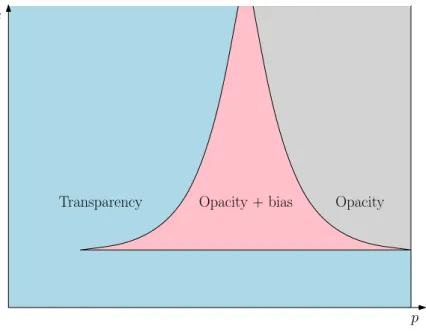
In short, the relationship between the level of credibility and the range of states in which there is transparency in equilibrium is non-monotonic. Figure1.1 illustrates the comparative statics with respect to cwhen the equilibrium being played is the one with ˆz =z∗ (if in the
equilibrium investors play some convex combination of z∗ and ¯z, the qualitative results are
the same).
p c
Transparency Opacity + bias Opacity
Figure 1.1: Comparative statics
As cdecreases, the range of p for which the regulator’s optimal strategy is to introduce a bias on aggregate information to avoid runs increases, while the transparency region decreases, 12Whenc is exactlyθ
as well as the region where there is opacity but no bias. However, there is a discontinuity in the relationship between credibility and the amount of transparency. If c is too low, the equilibrium features transparency in all states.
Discussion
It is interesting to understand the mechanism through which information manipulation in this setting can be effective in boosting coordination. Consider the case with c > θ−η(as in Proposition 1.2, item 1). In a range of intermediate states, the manipulation policy is such that for all states in that range the report issued by the regulator is the same, as can be seen in the left panel of Figure 1.2. By pulling together all those states, the regulator causes a signal-jamming that boosts investors’ beliefs in a region where beliefs would be otherwise too pessimistic, and deteriorates beliefs in a region where there would be optimism to spare. The cyan area in the right panel of Figure 1.2 represents the gain in beliefs due to information manipulation, while the pink area represents the damage in beliefs.
For any p > p, if information manipulation was not a possibility, there would be no runs¯ under opacity and a truthful aggregate report. When manipulation is possible, anticipating the regulator’s incentive to inflate the report, investors only rollover if the report is at least ˆ
z > p. That is because they know all intermediate states are pulled together: in any state¯ p∈hpb,zˆi, the issued report is ˆz. This implies a twist in beliefs in an intermediate range ofp
that makes it possible to avoid runs not only to the right of ¯p, but also in a range to the left of ¯p.
When p < p, under a truthful report there would be a systemic run, but by manipulating¯ information the regulator can improve confidence in the state of the economy in this region at the cost of worsening beliefs in states where there is more than enough optimism to avoid any runs. Hence, lowering investors’ expectations of p in higher states down to ¯p may pay off. The size of the range where there is information manipulation in equilibrium depends on the cost cfor two reasons: the higher the cost, the less profitable it is for the regulator to use manipulation as a tool, but on the other hand, anticipating that the regulator is less prone to use it, the more effective manipulation is in increasing investors confidence.
ˆ
z
pb p
z(p)
45o
¯
p zˆ
pb p
E[p|z(p)]
45o
Figure 1.2: Aggregate report for a given ˆz ∈[0,1] and investors’ beliefs
because it would be too cheap to pretend this is the case if it was not. The only option left for the regulator is then to disclose bank-specific information and save the most solid banks at least.
1.4
Optimal credibility
The way credibility affects optimal information disclosure policies and investors’ rollover decisions may have important implications for institutional design. When deciding which authority will be responsible for regulating the financial system and what will be its incentives, a social planner should consider how the credibility level affects the outcome of the coordination game among investors. Imagine the social planner can choose c, that is, the cost the financial regulator faces to manipulate aggregate reports, what can be thought of as the expected punishment or consequences imposed to a regulator for masking the situation of the banking system. A welfare analysis can tell us what would be the socially optimal level of cfrom an ex ante perspective.
Assuming a given equilibrium nz, pˆ bo is being played, welfare in this economy can be
written as
W =
ˆ min{pb,1}
0
p(θ+η)dp+
ˆ 1
min{pb,1}
[θ+ (2p−1)η]dp, (1.9) which is the expected aggregate return of the banking system (which equals total output or total consumption).
It is easy to see that the best equilibrium in terms of efficiency is the one with smaller pb,
that is, with ˆz =z∗ and pb =pb∗ if c≥ θ−η (for smaller levels of c the unique equilibrium
features full transparency in all states). This equilibrium is the one where the regulator is able to avoid undesirable runs in more states.
Consider the case in which agents always play according to the best equilibrium. In the next subsection I discuss the issue of optimal credibility when this is not the case.13
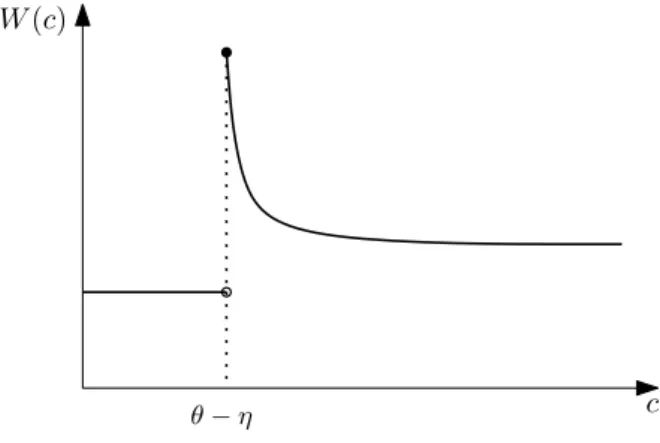
Proposition1.4determines the optimal credibility level from an ex ante perspective. It shows the planner would not opt for full credibility. An interior level of credibility allows the regulator to help agents coordinate by inflating the proportion of good banks, and it is good for society that the regulator has this prerogative. Hence, regulators’ (expected) punishment for lying about the health of the banking sector should not be too harsh as to completely avoid information manipulation nor too low as to make opacity impractical. Figure1.3 depicts the welfare as a function of the credibility level in this case.
Proposition 1.4 (Optimal credibility). Suppose agents always play according to the best equilibrium. The socially optimal credibility level is c∗ =θ−η.
Proof. See Appendix 1.A.5.
13For instance, as long as the worst equilibrium is not played with probability one for allc > θ
c W(c)
θ−η
Figure 1.3: Welfare
Proposition 1.4 can help explain why some financial regulators choose to delegate the responsibility for the performance of stress tests to independent consultants. One possibility is that the regulator lacks credibility and would have to disclose very detailed bank-specific information, while a more credible party – such as an international consultancy firm that probably would not jeopardize its credibility to avoid a run in some country’s banks – may be able to only release aggregate results. Furthermore, one can also interpret the recent change in financial regulation in Europe – that put the European Central Bank in charge of all stress tests procedures from 2014 on – as an attempt to raise credibility in financial regulators in the Eurozone, since national regulators as well as some authorities such as the EBA did not enjoy sufficiently credibility to be able to have discretion over how much information to disclose.
1.4.1
Optimal credibility and multiple equilibria
Now, consider the case where agents can play according to any equilibrium nz, pˆ bo. Figure
1.4 depicts the range of welfare that can be achieved for each value of c depending on which equilibrium is selected.
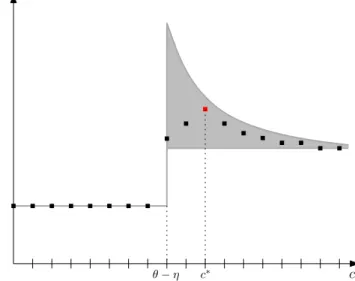
Suppose there is a sunspot variable that determines which equilibrium will be played. Denote the implied distribution function over all possible equilibrium values of pb for each c
byF(pb;c). Also, assumecmust be chosen from a setC that is a discretization ofR+.14 In this
case, there is always an interior c that is optimal. Figure 1.5 exemplifies this case. Squares represent the expected welfare for each level of c ∈ C, that is, ´
Wpb′
dF(pb′
;c), where W(pb′
) is the welfare when the the equilibrium value of pb is pb′
. The red square represents 14Without requiring
C to be a countable set, the planner’s choice ofc could have no solution. For example, if the worst equilibrium happens with probability one when c = θ−η and the best one happens with probability one whenc > θ−η, the planner would want to set c as close as possible toθ−η, satisfying
c W
θ−η
Figure 1.4: Welfare range
the maximum welfare.
Notice it can be the case that the maximum is not strict. For instance, if F (.) assigns probability one to the worst equilibrium for all c, the planner would be indifferent between any c ∈ C satisfying c > θ −η. Moreover, as long as the worst equilibrium happens with probability smaller than one for some c > θ−η, the optimal clies in a bounded set, i.e., full credibility is not optimal.
c W
θ−η c∗
1.5
Final remarks
This paper studies information manipulation and disclosure in financial crises. It shows that a regulator that has the possibility of inflating the proportion of good banks as an attempt to avoid a systemic run will often do so. As long as the regulator has sufficient credibility, it pays off to incur in costly information manipulation, since it is very effective in boosting the stability of the financial sector. However, if the regulator’s credibility is too low, it completely loses the ability to enhance confidence by releasing only aggregate information about the banking sector, so full transparency is the only option – and it causes part of the banks to fail.
These results have implications for institutional design. A social planner would choose an interior level of credibility, giving regulators room for maneuver in a crisis situation, but setting credibility in a high enough level so that opacity is still feasible. The results presented here are in line with evidence from recent stress test disclosure episodes.
1.A
Proofs
1.A.1
Proof of Lemma
1.1
Conjecture a threshold equilibrium in which investors run on bank i at the end of period t = 1 if their expectation of ˜θ is smaller than a threshold ρ∗
i, and do not run if it is larger.
Investorj’s expectation of ˜θ given her private information is given by
ρj =E
h
˜ θ|xj
i
= βθθ+βεxj βθ+βε
.
The threshold ρ∗
i is given by the indifference condition
E[ri|ρ∗i] =ρ∗i +E[ηi−γli|ρ∗i] = 0,
which is equivalent to
ρ∗i +E[ηi] =γΦ
√
α(ρ∗
i −θ)
, (1.10)
where Φ (.) is the standard normal distribution function andα= βθ2(βθ+βε)
βε(βθ+2βε).Following Morris and Shin (2000), condition αγ2 ≤ 2π guarantees equation (1.10) to have a unique solution.
have that ρj →θ˜for all j, and since α→0,
ρ∗
i →
γ
2 −E[ηi].
If we also assume βθ → ∞, as long as we make α →0 by assuming β 2
θ
βε → 0 to guarantee
uniqueness, we haveρ∗
i →θ, so in equilibrium investors run on bankiwheneverθ+E[ηi]< γ/2
and roll over whenever θ+E[ηi]> γ/2.
1.A.2
Proof of Proposition
1.1
Consider z(p) = pfor all p. Given ˆz, the optimal policy for the regulator is to set
t(p) =
1 ifp <z,ˆ 0 ifp≥z.ˆ
Since the report is always truthful, Lemma 1.1 implies investors run on all banks whenever E1[p|z] =z >p, and do not run otherwise. Hence, ˆ¯ z = ¯p.
1.A.3
Proof of Proposition
1.2
Regulator’s decision
Suppose investors run under opacity wheneverz <zˆand roll over otherwise. It is easy to see that ˆz <0 is never an equilibrium. If agents never run under opacity, the optimal strategy for the regulator would be opacity (and no manipulation) for all p. But when observing any z =p <p¯, agents would want to deviate and run (given Lemma1.1). If ˆz >1, that is, if agents always run under opacity, the optimal policy for the regulator is to choose transparency for all p, that is,pb >1. It is still to be determined the regulator’s solution for a given ˆz ∈[0,1]. The
regulator’s problem in (2) boils down to choosing, in each state p, between (i) transparency and b(p) = 0; (ii) opacity with b(p) = 0; or (iii) opacity with b(p) = ˆz−p(for p <z), that is,ˆ setting a bias just large enough to avoid a run.15 Let Uo denote the regulator’s payoff under
opacity and no manipulation,Ub denote its utility under opacity and manipulation (b = ˆz−p)
15Notice no other value ofb is rationalizable. Ifb
∈(0,ˆz−p), the regulator pays a positive cost of lyingcb
and Ut denote its utility under transparency (for simplicity, I subtract the constant 1 from
all expressions):
Uo(p) = [θ+ (2p−1)η]I{p≥zˆ},
Ub(p) = [θ+ (2p−1)η−c(ˆz−p)]I{p<zˆ}+Uo(p)I{p≥zˆ},
Ut(p) =p(θ+η).
The maximized utility of the regulator will be the upper contour of these three functions, which are depicted in Figure 1.6.
ˆ
z pb
Uo
Ut
Ub
θ−η−czˆ
p
Case with ˆz >θ−η c
ˆ
z pb
Uo
Ut
Ub
θ−η−czˆ
p
Case with ˆz <θ−η c
Figure 1.6: Regulator’s payoffs for a given ˆz ∈[0,1]
b(p) = 0 for all p; if ˆz ∈[0,1],
t(p) =
1 ifp < pb,
0 ifp∈hpb,1i,
b(p) =
0 if p∈[0, pb)∪(ˆz,1],
ˆ
z−p if p∈hpb,zˆi,
where
pb(ˆz) =
cˆz−θ+η
c−θ+η if ˆz ≥ θ−η
c ,
0 if ˆz < θ−cη. (1.11) Notice if c < θ−η,pb(ˆz) = 0 for all ˆz ∈[0,1].
Investors’ decision
In equilibrium, investors must prefer to roll over whenever z ≥z, and to run whenˆ z <z.ˆ Thus, given Lemma 1.1, ˆz is such that E[p|z, t= 0] ≥ p¯for z ≥ zˆand E[p|z, t= 0] < p¯for z < z. Given the regulator’s disclosure and manipulation policies, an agent receiving theˆ threshold message ˆz and no bank-specific information expects p to be uniformly distributed onhpb,zˆi.
Consider the case with c < θ−η. Since pb(ˆz) = 0 for any ˆz ∈ [0,1], the posterior of an
investor observing the threshold message ˆzand opacity is thatp|zˆ∼U(0,z). Her expectationˆ of p is then ˆz/2, which is smaller than ¯p for any ˆz ≤ 1. Hence, there is no equilibrium with ˆ
z ∈[0,1], and the unique equilibrium features ˆz >1, transparency for allpand no information manipulation. This proves Proposition 1.2, item (ii).
Now, consider the case with c ≥ θ −η. One equilibrium can be constructed using the indifference condition:
E[p|z, tˆ = 0] = p
b+ ˆz
2 = ¯p, which yields
ˆ
z =z∗ ≡ γ(c−θ+2η(2cη)−2(θ−η)(c−θ)
−θ+η) ≤1.
When investors observe the report z∗ and opacity, they are indifferent between running
on banks or not. So for z > z∗, they roll over. However, receiving a signal below z∗ is off the
pb(z∗) =pb∗
≡ cγ−2η(2c2(θ−η)(c+η) −θ+η) >0.
Hence, there is an equilibrium in which investors run under opacity whenever z < z∗,
the regulator chooses transparency for p < pb∗, opacity and information manipulation (with
b(p) = z∗−p) for p∈hpb∗, z∗i and opacity withb(p) = 0 forp > z∗.
This is not the only equilibrium, though. Suppose investors play according to a cutoff ˆ
z ∈ (z∗,1]. Given that pb(ˆz) > pb∗ for all ˆz > z∗, investors receiving the threshold message ˆz
and observing opacity expect p to be higher than ¯p, so this is also an equilibrium as long as off-the-equilibrium beliefs satisfy µ(p|z,0)< p¯for z <z. Hence, there is an equilibrium forˆ each cutoff ˆz ∈ (z∗,1], where the regulator chooses transparency for p < pb(ˆz), opacity with
manipulation for p∈hpb(ˆz),zˆi and opacity with no manipulation for p >z. Moreover, ˆˆ z >1
and pb >1, that is, transparency for all p, is also an equilibrium.
Finally, notice when c=θ−η, we have z∗ = 1. In this case, the curves Ub(p) and Ut(p)
coincide, so the regulator is indifferent between transparency and opacity for all p. As long as the regulator’s strategy features apb ≥pb∗, investors observing z = 1 and opacity expects
p≥p. Thus, any pair¯ nz, pˆ bowith pb ∈hpb∗,1i constitutes an equilibrium.
Ruling out some equilibria
In the case with c > θ −η, there are equilibria that does not survive Cho and Kreps
(1987)’s intuitive criterion.
Suppose an equilibrium in which investors play according to a cutoff ˆz ∈ [0,1] under opacity and pb(ˆz) > p. Consider an agent observing a report¯ z′ = ˆz −ξ, for some ξ > 0,
and opacity. The regulator’s payoff from sending a reportz′ under the most optimistic belief possible about investors response (i.e., investors roll over) isUb(p) =θ+ (2p−1)η−c(z′−p),
so the maximum benefit of deviating from the equilibrium strategy is
B(p) =
cξ if p∈hpb(ˆz), z′i,
(1−p) (θ−η)−c(ˆz−ξ−p) if p < pb(ˆz). (1.12)
Since B(p) is negative for all p < pb(z′), the intuitive criterion imposes investors cannot
assign positive probability for p being smaller than pb(z′). But if pb(ˆz)>p, for¯ ξ sufficiently
small we have that pb(z′) > p¯as well. Hence, investors cannot expect p to be smaller than
¯
![Figure 1.2: Aggregate report for a given ˆ z ∈ [0, 1] and investors’ beliefs](https://thumb-eu.123doks.com/thumbv2/123dok_br/15701251.119591/29.892.168.763.104.350/figure-aggregate-report-given-ˆ-z-investors-beliefs.webp)
![Figure 1.6: Regulator’s payoffs for a given ˆ z ∈ [0, 1]](https://thumb-eu.123doks.com/thumbv2/123dok_br/15701251.119591/35.892.261.670.417.889/figure-regulator-s-payoffs-for-given-ˆ-z.webp)