ARLAN CALDAS PEREIRA SILVEIRA
THERMODYNAMIC AND HYDRODYNAMIC CHARACTERIZATION OF THE
VACUUM EVAPORATION PROCESS DURING CONCENTRATION OF
DAIRY PRODUCTS IN A FALLING FILM EVAPORATOR
Dissertation thesis presented to the
Universidade Federal de Viçosa as
part of the requirements of the
PostGraduate Program in Food
Science and Technology, to obtain
the title of
Doctor Scientiae.
VIÇOSA
Fichi citilográfici prepiridi peli Biblioteci Centril di Universidide Federil de Viçosi - Câmpus Viçosi
T
STlveTra, Arlan Caldas PereTra, 1987-S587t
2015 the vacuum evaporatTon process durTng concentratTon ofThermodynamTc and hTdrodynamTc characterTzatTon of daTry products Tn fallTng fTlm evaporator / Arlan Caldas PereTra STlveTra. - VTçosa, MG, 2015.
xxTv, 179f. : Tl. (algumas color.) ; 29 cm.
OrTentador : AntônTo Fernandes de Carvalho. Tese (doutorado) - UnTversTdade Federal de VTçosa. ReferêncTas bTblTográfTcas: f.170-179.
1. TecnologTa de alTmentos. 2. LatTcínTos
-Processamento. 3. DerTvados do leTte - -Processamento. 4. TermodTnâmTca. 5. HTdrodTnâmTca. I. UnTversTdade Federal de VTçosa. Departamento de TecnologTa de AlTmentos. Programa de Pós-graduação em CTêncTa e TecnologTa de AlTmentos. II. Título.
ARLAN CALDAS PEREIRA SILVEIRA
THERMODYNAMIC AND HYDRODYNAMIC CHARACTERIZATION OF THE
VACUUM EVAPORATION PROCESS DURING CONCENTRATION OF
DAIRY PRODUCTS IN A FALLING FILM EVAPORATOR
Dissertation thesis presented to the
Universidade Federal de Viçosa as
part of the requirements of the
PostGraduate Program in Food
Science and Technology, to obtain
the title of
Doctor Scientiae.
APROVED: October 12
th, 2015.
___________________________ ________________________
Martine Esteban-Decloux Bernard Cuq
__________________________ ________________________
Romain Jeantet Bernard Rémond
__________________________ ________________________
ii
AGRADECIMENTOS
A l'issue de mon doctorat, je suis convaincu que la thèse est loin d'être un
travail solitaire. En effet, je n'aurais jamais pu réaliser ce travail doctoral sans le
soutien d'un grand nombre de personnes dont la générosité, la bonne humeur et
l'intérêt manifestés à l'égard de ma recherche m'ont permis de progresser dans cette
phase délicate de « l'apprenti-chercheur ».
J’exprime toute ma reconnaissance à Jöelle Léonil et à Sylvie Lortal pour
m’avoir accueilli au sein du STLτ et permis
de mener bien ce projet dans
d’excellentes conditions humaines et professionnelles.
Je voudrais remercier mon jury de thèse, Dr. Martine Decloux, Dr. Joël Scher,
Dr. Guillaume Delaplace, Dr. Bernard Cuq, Dr. Antônio Fernandes de Carvalho, Dr.
Romain Jeantet, et Dr. Bernard Rémond. Votre présence le jour de ma soutenance
ainsi que le temps dédié à l’appréciation de mon manuscrit de thèse ont été un grand
honneur pour moi.
Je remercie mon encadrant et chef, Pierre Schuck, que je considère plutôt
comme un ami. Pour moi Pierre est un exemple de professionnalisme et de
gentillesse. Il était gratifiant de travailler en sachant qu'en cas de doute ou de
problème, Pierre me conseillerait avec le sourire. Merci Pierre pour ta patience, tes
conseils, tes enseignements
, pour ton exemple d’engagement sérieux, et pour ta
façon positive de voir les problèmes. Merci beaucoup papa Schuck.
S'il y a une personne qui m'a toujours soutenu, cru en moi et aidé avec tout
ce dont j'avais besoin, c'est sans doute le Professor Antônio Fernandes de Carvalho.
Merci pour l’encouragement, la confiance et le soutien qui n’ont jamais cessé dès
lors que nous avons commencé à travailler ensemble.
iii
Je suis heureux d'avoir eu la chance de travailler et d'être officieusement
encadré par Gaëlle Tanguy. Merci pour ta relecture enrichissante de toutes mes
publications, pour la relecture scrupuleuse de mon manuscrit de thèse et tes
suggestions toujours avisées. Tu m’as permis Gaëlle de clarifier mes pensées
parfois embrouillées. Tes remarques très pertinentes ont fait avancer ma réflexion
d'un point de vue scientifique.
Je tiens à remercier deux messieurs sans qui les résultats de mes travaux
scientifiques ne seraient jamais arrivés à la moitié d'où ils en sont aujourd'hui. Merci
Serge Méjean
et Laurent Fromont, j’ai appris beaucoup, beaucoup avec vous. Vous
m’avez aidé non seulement avec la partie technique de mon sujet de doctorat, mais
aussi appris à ne jamais laisser tomber, à persévérer, à toujours trouver une solution
aux problèmes insolubles. Merci Laurent d'avoir partagé tes connaissances de 15
ans de marine et d'avoir toujours été disponible pour me dépanner quand j’avais
besoin. Merci Serge pour le partage de tes connaissances sans fin dans le domaine
de la concentration et du séchage
. Merci d’être toujours prêt à m'aider et souriant.
Merci à tous les gens qui travaillent sur la plateforme Lait. Merci de m’avoir
supporté pendant ces années de travail à vos côtés. Merci pour la superbe ambiance
et pour toute l’aide et la compréhension d
ont vous avez fait preuve avec moi. Merci
à vous σadine, Gilles et Bénédicte. Merci Benoit (Benolé) pour l’amitié et les
moments drôles partagés pendant ces années.
Merci Rachel Boutrou, d’avoir aidé tous les jeunes chercheurs du STLτ avec
ton merveilleux
travail. Merci d’avoir élargi le champ de ma vision scientifique. Merci
de t'être préoccupée et de m'avoir aidé avec la vulgarisation scientifique.
iv
Merci à toi Anne Dolivet, pour toute la compagnie, les partages, les
discussions, les renseignements, les bonnes idées, les sourires, le soutien et pleins
d’autres choses que tu m’as offertes pendant nos trois ans de partage de bureau.
Tu es quelqu’un de très important pour moi, et l’amitié que j'ai pour toi et pour toute
la famille Dolivet durera toute la vie. Merci d
e m’avoir pris comme ton fils adoptif ici
en France. Tu fais partie de ma vie.
Merci à Paulette Amet, Jéssica Musseaut, et Michel Ravailler pour le
chaleureux « Bonjour
» et le sourire quotidien. Merci Paulette d’avoir organisé les
pauses de 16h et de t'être toujours préoccupée des nouveaux arrivants.
Merci à ma chère amie Lélia Lacou, tu es une amie que je garderai toujours.
Merci à ma sœur Chinoise, Lina.
Merci a mon chouchou, Gérardine (Gérard). Merci pour ta bonne humeur
Gérard. J’espère que tu viendras
me visiter au Brésil.
Merci à mes amis bichonas, Naaman Nogueira, Federico Casanova et Xavier
Thomas. Vous trois mes potes sont des cadeaux que j’ai eu la chance d’avoir. J'en
profite également pour remercier la famille Thomas, qui a été à plusieurs reprises
comme ma famille française.
Merci à l’équipe Carinhosos. Je tiens à vous vraiment très très fort. Marilia,
Samira et Gui, les soirées, voyages et le temps passé avec vous sont inoubliables
et épiques. Merci Samira pour les câlins, le respect et les conseils. Merci Marilia
d’être toujours sympa et réceptive, tu donnes envie de rester à tes côtés, avec toute
ton énergie très captivante. Merci à Gui d’être présent dans ma vie depuis si
longtemps et d’être mon compagnon de trajet scientifique.
v
Pereira Silveira et Artur Caldas Pereira Silveira et à ma petite sœur Ana Carolina
Varoto Pereira.
Je remercie toutes les
personnes avec qui j’ai partagé mes études et
notamment ces années de thèse : Marta Rezende, Bruno Nunes, Daniel, Jeferson
Geis, José, Raquel, Gustavo, Bia Oliveira, Natalia, Lize Desmaricaux, Estelle,
Michele Pinto, Renam Moreira, Flavia figueira, Wendiao Shao, Bruno Gamba,
Rosangela Faria, Andreza, Léticia Carmargos, Odeir Filho, João Carneiro, Marciano,
Laura Sanchez, Marina, Natalia, Luiza Las, Mariana, Elise Schong, Song, Linda,
Matheus, Guillaume, André, Clarisse Lebel, Carlos, Aude, Maude, Gaëtan, Perrine,
Andreas, Andreza, Xavier, Adèle, Juliana, Rachid, Rigoberto, Rozenn, Livia etc., et
pleins d’autres bons amis qui ne font malheureusement plus partie de ma vie mais
qui ont participé à faire de moi ce que je suis aujourd'hui.
J’en oublie certainement encore et je m’en excuse.
Encore un grand merci à tous pour m’avoir conduit à ce jour mémorable.
vi
THESIS OUTPUTS
Publications
Silveira, A.C.P., Carvalho, A.F., Perrone, Í.T., Fromont, L., Méjean, S., Tanguy, G., Jeantet, R., Schuck, P., 2013. Pilot-scale investigation of effectiveness of evaporation of skim milk compared to water. Dairy Sci. Technol. 93, 537–549. doi:10.1007/s13594-013-0138-1
Silveira, A.C.P., Tanguy, G., Perrone, Í.T., Jeantet, R., Ducept, F., de Carvalho, A.F., Schuck, P., 2015. Flow regime assessment in falling film evaporators using residence time distribution functions. J. Food Eng. 160, 65–76. doi:10.1016/j.jfoodeng.2015.03.016
Silveira, A.C.P., Tanguy, G., Perrone, Í.T., Jeantet, R., Laurent, F., Floch-Fouéré, C., de Carvalho, A.F., Schuck, P., 2015. Application of residence time distribution functions at different dairy products to indicate fouling during concentration in a falling film evaporator. To submitted in October 2015 at Journal of Dairy Science.
Oral presentations
Inauguration de la plateforme lait - STLO, Rennes (France), 2013. Caractérisation du procédé d'évaporation sous vide: démarche et intérêts.
2° Simpósio de Leites Concentrados e Desidratados, Juiz de Fora (Brazil), 2014. Concentração por evaporação à vácuo. Balanço de massa, de energia e tempo de retenção: importância da instrumentação.
Journée technique séchage, Surgères (France), 2014. Caractérisation du procédé de concentration par évaporation sous vide. Bilan énergétique, massique et temps de séjour.
EMChIE-2015, the 7th European Meeting on Chemical Industry and Environment, Terragona (Spain). Flow regime assessment in falling film evaporators using residence time distribution (presented by Gaëlle Tanguy).
ICEF12, 12th International Congress on Engineering and Food, Québec (Canada). Residence time distribution functions applied to skim milk concentration in falling film evaporators.
Poster
vii
TABLE OF CONTENTS
Table of figures ... xi
Table of tables ... xvii
List of abreviations and nomenclature ... xvii
Abstract ... xxi
Resumo ... xxiii
General introduction ... 1
PART 1: Economic and scientific contexts ... 3
Chapter 1: Trade development of dried dairy products and research trends .. 4
1.1. Key dairy market statistics ... 7
1.1.1. Milk Production ... 7
1.1.2. World market for dairy powders ... 9
1.1.3. French and Brazilian dried dairy product markets ... 11
1.1.4. Developments and investments involving concentrated and dried dairy
products ... 12
1.2.
Worldwide research involving “falling film vacuum evaporators”
... 15
Chapter 2: Literature review ... 17
2.1. Transformation of milk to concentrated dairy products ... 20
2.1.1. Classification, composition and structure of milk ... 20
2.1.2. Cracking of milk ... 23
2.2. Vacuum evaporation ... 28
2.2.1. Evaporators ... 29
2.2.1.1. Rising film evaporators ... 31
2.2.1.2. Forced circulation evaporator ... 32
viii
2.2.2. Energy efficiency ... 35
2.2.2.1. Heat transfer coefficient ... 37
2.3. Thermo-physical properties of dairy concentrates... 40
2.3.1. Viscosity of dairy concentrates ... 40
2.3.2. Thermal properties of dairy concentrates ... 41
2.4. Flow in falling film evaporators ... 43
2.4.1. Residence time distribution functions ... 45
2.4.2. Residence time distribution models ... 47
2.4.2.1. Axial dispersion ... 48
2.4.2.2. Extended tanks in series ... 49
2.5. Fouling in falling film evaporators ... 50
Chapter 3: Aims and strategy of the phd project ... 53
3.1. Context of the PhD project ... 56
3.2. Aims, objectives and strategy ... 58
3.3. Originality of the research project... 59
PART 2: Materials and methods, results and discussion ... 61
Chapter 4: Materials and methods ... 62
4.1. Pilot vacuum evaporator ... 65
4.2. Pilot instrumentation ... 68
4.2.1. Acquisition ... 69
4.2.2. Additional instrumentation ... 71
4.3. Calibration of the vacuum evaporator sensors ... 73
4.3. Experimental runs ... 73
4.4. Physicochemical analyses ... 75
4.4.1. Total solids ... 75
4.4.2. Viscosity measurement... 75
4.4.3. Density measurements ... 76
4.4.4. Conductivity ... 77
4.4.5. Protein composition ... 77
4.4.6. Ash content ... 77
ix
4.5. Mass and enthalpy balance ... 77
4.6. Overall heat transfer coefficient... 80
4.7. Assessment of process efficiency ... 81
4.8. Characterization of the flow ... 81
4.9. Residence time distribution functions ... 82
4.9.1. Measurement of residence time distribution ... 82
4.9.2. Model of the residence time distribution functions ... 86
Chapter 5 Pilot scale investigation of effectiveness of evaporation of skim milk,
whole milk and water ... 88
5.1. Introduction ... 93
5.2. Materials and methods ... 94
5.2.1. Pilot vacuum evaporator and experiments... 94
5.2.2. Experimental runs ... 94
5.2.3. Physicochemical analyses ... 96
5.2.4. Enthalpy characterization ... 96
5.2.5. Statistical analysis ... 96
5.3. Results and discussion ... 96
5.3.1. Mass balance ... 96
5.3.2. Enthalpy balance ... 97
5.3.3. Overall heat transfer coefficient ... 99
5.4. Additional information ... 102
5.4.1. Distributor system ... 102
5.4.2. Water level sensor of the heating tubes ... 103
5.4.3. Investigation of the effectiveness of evaporation after improvement of
the pilot vacuum evaporator ... 105
5.5. Conclusion ... 111
Chapter 6 Flow regime assessment in falling film evaporators using residence
time distribution functions ... 113
6.1. Introduction ... 116
6.2. Materials and Methods ... 118
6.2.1. Pilot vacuum evaporator ... 119
x
6.2.3. Physicochemical analyses ... 122
6.2.4. Characterization of the flow ... 122
6.2.5. Measurement of residence time distribution ... 122
6.3. Results and Discussion ... 122
6.3.1. Product and flow characterization ... 122
6.3.2. RTD characterization ... 126
6.4. Additional information ... 135
6.5. Conclusion ... 136
Chapter 7 Application of residence time distribution approach to different
dairy products to indicate fouling during concentration in a falling film
evaporator ... 138
7.1. Introduction ... 142
7.2. Materials and Methods ... 143
7.2.1. Pilot vacuum evaporator ... 143
7.2.2. Experimental runs ... 144
7.2.3. Chemical composition ... 144
7.2.4. Enthalpy characterization ... 144
7.2.5. Measurement of residence time distribution ... 145
7.3. Results and Discussion ... 145
7.4. Additional information ... 153
7.5. Conclusions ... 159
General conclusion ... 160
Future outlook ... 165
xi
TABLE OF FIGURES
xii
Figure 2.9. Falling film evaporator (Jeantet et al., 2011). ... 34
Figure 2.10. Multi-effect evaporator (Jeantet et al., 2011). ... 35
Figure 2.11. Diagram of the cost components of an evaporator as a function of the
numbers of effects. IC = investment cost; CC = cost of consumption; SC = staff costs
and TC = total cost = IC + CC + SC. ... 36
Figure 2.12.
Temperature profile between the heating steam ( s) and the boiling
product ( p) at a steady regime in a falling film evaporator.
... 38
Figure 2.13. Newtonian and non-Newtonian fluids. ... 41
Figure 2.14. Film breakdown (Hartley and Murgatroyd, 1964; Morison et al., 2006). 43
Figure 2.15. Plan and elevation views of a typical distribution system (Morison et al.,
2006). ... 44
Figure 2.16. Diagram of measurement of tracer for calculation of residence time
distribution. ... 46
Figure 2.17. Dimensionless E-curves for the axial residence time distribution
model. ... 49
Figure 2.18. Dimensionless E-curves for the tanks in series residence time distribution
model. ... 50
Figure 4.1. Flowsheet of the evaporator. ... 65
Figure 4.2. Evaporation tube with independent electrical heating system. ... 67
Figure 4.3. Separator integrated with indirect condenser. ... 68
Figure 4.4. Initial configuration of the evaporator. ... 69
Figure 4.5. Plate distributor. ... 70
Figure 4.6. Cone-shaped concave distributor. ... 71
Figure 4.7. Instrumentation of the first evaporator tube. ... 72
Figure 4.8. Sampling points for determination of local and overall RTD.
:
measurement from inlet to outlet of tube 1;
: measurement from outlet of tube 1 to
outlet of tube 2;
measurement from outlet of tube 2 to outlet of tube 3;
: overall
RTD measurement from inlet to outlet of the falling film evaporator. ... 75
Figure 4.9.
Skim milk apparent viscosity (
100) measured at 60°C in function of totalsolids contents. ... 76
xv
TABLE OF TABLES
xvii
LIST OF ABREVIATIONS AND NOMENCLATURE
Abreviations
1R: first run
2R: second run
3R: third run
α –
lg:
α
-lactoglobumin
β
-lg:
β
-lactoglobulin
CC: consumption costs
CCP: Colloidal calcium phosphate
FFE: Falling film evaporator
IC: Investments costs
LAW: Lactic acid whey
P
c: Condenseur pressure
P
ev: Evaporation pressure
R: Roughness
RTD: Residence time distribution
SC: Staff costs
xviii
T3: evaporation tube 3
TC: Total costs
WM: Whole milk
Nomenclatures
A: heating surface (m
2)
A: fraction of feed flow rate going into the reactor set A (-)
Cp: Specific heat (kJ·kg
-1·°C
-1)
C: concentration (g·kg
-1)
D: tube diameter (m)
D
ax: axial diffusion coefficient (-)
e
m: wall thickness (m)
E
i(t): residence time distribution of section i (s)
EE: energy efficiency (% - w·w
-1)
g: gravity acceleration (m·s
-2)
H: enthalpy (kJ·kg
-1)
h: heat transfer coefficient (kW·m
-2·°C
-1)
∆�
�: latent heat of vaporization (kJ·kg
-1)
L: length (m)
�̇
: mass flow rate (kg·h
-1)
N: number of tanks in series (-)
N
u: Nusselt number
P: Pressure (MPa)
Pe: Peclet number (-)
̇
: heating power (kW)
̇
:
heat loss (kJ∙h
-1)
xix
R
ef: film Reynolds number (-)
SEC: specific energy consumption (kJ kg
-1)
t: time (s)
t
min: minimum residence time (s)
TS: total solids (% - w/w)
U: overall heat transfer coefficient (kW·m
-2·°C
-1)
ν
max: maximum flow velocity (m·s
-1)
x(t): tracer injection (g·kg
-1)
y
Ti(t): tracer concentration at the bottom of Ti (g·kg
-1)
Greek symbols
:
viscosity (Pa∙s
-1)
:
temperature (°C)
λ
m: thermal conductivity of the wall (kW·m
-1·°C
-1)
ν:
velocity (m·s
-1)
ρ:
density (kg·m
-3)
: surface tension (N·m
-1)
Γ:
mass flow rate per unit circumference (kg·s
-1·m
-1)
:
mean residence time (s)
Τ:
shear stress (Pa)
Ф:
heat flux (kW·m
-2)
�̇
: velocity gradient (s
-1)
Subscript
abs: absolute
xx
cw
out: outlet cooling water
ev: evaporation
p
in: inlet product
p: product
v
-1: steam
xxi
ABSTRACT
SILVEIRA, Arlan Caldas Pereira, D.S., Universidade Federal de Viçosa, October,
2015.
Thermodynamic and hydrodynamic characterization of the vacuum
evaporation process during concentration of dairy products in a falling film
evaporator. Adviser: Antônio Fernandes de Carvalho. Co-advisers: Ítalo Tuler
Perrone and Pierre Schuck.
xxiii
RESUMO
SILVEIRA, Arlan Caldas Pereira, D.S., Universidade Federal de Viçosa, outubro de
2015.
Caracterização termodinâmica e hidrodinâmica do processo de
evaporação a vácuo durante a concentração de produtos lácteos em um
evaporador de película descendente. Orientador: Antônio Fernandes de Carvalho.
Coorientadores: Ítalo Tuler Perrone e Pierre Schuck.
1
GEσERAL IσTRτDUCTIτσ
Overall cow’s milk production and consumption grew by approximately 15% from 2005 to 2014. With the uneven distribution of milk production at the global level, the expected growth in the world population and the rise in standards of living (in particular in developing countries), the dairy market will be confronted with even more massive changes in the next decade. The world market for dairy powders is expanding considerably. The investment in new vacuum evaporators and spray driers is therefore being reported throughout the world to secure outlets. The vacuum evaporation process is mainly used in the dairy industry prior to drying. Moreover the quality of the concentrates influences the final powder quality.
This context clearly drives researches in order to improve the efficiency and control of the vacuum evaporation process. However, few research groups are interested in this topic. The dairy industry has acquired empirical expertise in the vacuum evaporation process, and the research centers in dairy powder are interested, until then, in drying technology (spray dryer). Study of vacuum concentration of dairy products is therefore a challenging for research in food processing engineering.
2 This work was therefore divided into three research parts: one on the instrumentation and characterization of a pilot-scale falling film evaporator, another part on the hydrodynamic profile of the vacuum evaporation process, and a third part on the application of the approaches previously developed to other dairy products.
3
PART 1
4
Chapter 1
TRADE DEVELOPMENT OF DRIED DAIRY PRODUCTS AND
RESEARCH TRENDS
This chapter introduces the economic background of dairy products, from milk production to powder manufacture. In addition, it provides key statistics concerning dairy powder markets and certain socioeconomic criteria needed to understand the current context. This information is used to draw conclusions regarding the future trends of dairy powders. These include the evolution of the dairy product trade and the socio-economic context. Faced with all these challenges, dairy industries are developing and innovating in order to increase the added value of milk products and to be competitive in the future.
The main aims of this chapter are to:
- provide key statistics on the dairy market (Brazilian, French and global) - situate dairy powders in the current socio-economic context
5
Capítulo 1
DESENVOLVIMENTO DO MERCADO DE PRODUTOS LÁCTEOS
DESIDRATADOS E TENDÊNCIAS DE PESQUISAS
Este capítulo apresenta o contexto econômico dos produtos lácteos, desde a
produção do leite à fabricação dos pós. Além disso, ele fornece estatísticas importantes
relativas ao mercado de lácteos desidratados e certos critérios socioeconômicos
necessários para compreender o atual contexto. Estas informações são usadas para prever
futuras tendências da evolução do mercado de produtos lácteos e do contexto
sócio-econômico deste. Diante de todos esses desafios, a indústria de laticínios está se inovando
e desenvolvendo a fim de aumentar o valor agregado de seus produtos visando se tornar
mais competitiva no futuro.
Os principais objetivos deste capítulo são:
- fornecer importantes estatísticas sobre o mercado dos produtos lácteos (brasileiro, francês e global)
6
Table of contents
1.1. Key dairy market statistics ...7 1.1.1. Milk Production ...7 1.1.2. World market for dairy powders ...9 1.1.3. French and Brazilian markets for dried dairy products ... 11 1.1.4. Developments and investments involving concentrated and dried dairy products
12
7
1.1.
Key dairy market statistics
1.1.1.
Milk Production
The worldwide production of milk is forecast to grow by as much as 2% in 2015, a rate similar to previous years, and should reach 805 million tons. Asia is expected to account for most of the increase, but production is projected to rise in all regions (FAO, 2015). The main milk producers are Europe, India, The United States of America, China and Brazil, which have had high production rates over the last 5 years (Fig. 1.1).
Figure 1.1. Main milk producers (USDA NASS, 2015).
Note: 2015: forecast.
The worldwide production of milk should continue to grow in coming years, reaching a level of 880 million tons in 2020 (Fig. 1.2) (OECD-FAO, 2015).
0 20 40 60 80 100 120 140 160 180
EU India US China Brazil
8
Figure 1.2. Evolution of worldwide production of milk from 2013 to 2020. (2015 to
2020: forecast) (OECD/FAO, 2015).
France is the second highest producer of milk in Europe and the seventh in the world, with 25.3 million tons of milk per year. In France, about 40% of the milk produced is processed and exported (CNIEL, 2015), product manufacture representing a turnover of 27.2 billion euros and generating about 250,000 jobs (CNIEL, 2015). Dairy products to the value of 6.9 billion euros were exported in 2013, with a trade surplus of 3.6 billion euros, an increase of 71% in 10 years.
Brazil is among the five largest producers of milk in the world and has achieved a significant role in the global dairy market. Brazil came from production of 7.3 million tons of milk in the 70s to 35 million tons in 2014 (IBGE, 2015). This year the country is expected to reach the third place as worldwide producer of milk, surpassing Chinese production (FAO, 2015).
700 720 740 760 780 800 820 840 860 880 900
Milk world production
m
il
li
o
n
t
o
n
s
9
1.1.2. World market for dairy powders
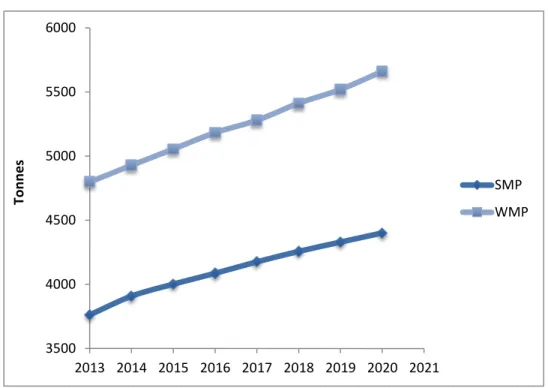
The popularity and increasing range of dairy products and the westernization of diets continue to be key factors driving the worldwide dairy market. Among dairy products, the global milk powder market is expanding considerably (Fig. 1.3), e.g. in France around 19% of processed milk volume is transformed into different dairy powders (CNIEL, 2015). This is due to an increasing demand for milk products from countries with milk shortages, in particular emerging countries.
Figure 1.3. Forecasts for worldwide skim milk and whole milk powder production.
2013 and 2014 (estimate), 2015 to 2020 (forecasts) (OECD-FAO, 2015).
Legend: SMP = skim milk powder; WMP = whole milk powder
With a large domestic market and high levels of milk production, Brazil has a different dairy market behavior to that in France. Traditionally, Brazil has always been a major
3500 4000 4500 5000 5500 6000
2013 2014 2015 2016 2017 2018 2019 2020 2021
T
o
n
n
e
s
SMP
10 importer of dairy products, with a negative balance of nearly 0.3 million tons in the 90s. From 2004 to 2008, it was an exporter of dairy products (Fig. 1.4). However, with a growing consumption of dairy products, large world supply and depreciation of the dollar, since 2008 Brazil has again become an importer of dairy products.
Figure 1.4. Trade balance of Brazilian dairy products from 2001 to 2014 (in milk equivalent) (EMBRAPA, 2010; Milkpoint, 2014).
Due to the country's economic issues and lower GDP growth rate, the consumption of dairy products in Brazil was slowing in 2014. However, in 2014 Brazil increased its turnover of dairy exports by 254.3% compared to 2013 (MDCI, 2014) (Table 1.1). The Brazilian export of dairy products had a favorable scenario in this year.
-1200 -1000 -800 -600 -400 -200 0 200 400 600 800
2001 2002 2003 2004 2005 2006 2007 2008 2009 2010 2011 2012 2013 2014
M
il
li
o
n
l
it
e
rs
o
f
m
il
11
Table 1.1. Dairy export by Brazil, 2010 to 2014 (MDCI, 2014).
Year
Value
(US$ FOB)
Net weight
(kg)
2010 131,645,920 53,569,283
2011 97,309,124 37,551,518
2012 92,257,425 38,370,224
2013 93,832,529 38,383,693
2014 332,430,800 83,667,142
With changes in agricultural policy (such as the implementation of a quota system and the dissolution of the price support system), the dairy industry has improved the use of surplus milk production and by-products resulting from cheese and butter production (whey, buttermilk). The development of filtration technology (microfiltration, ultrafiltration, nanofiltration and reverse osmosis) has allowed the production of valuable milk protein fractions (Schuck et al., 2013). Used either as nutritional or functional ingredients, most of these proteins are marketed in dehydrated form. In the last ten years, the nature of dairy powders has changed to more specific intermediate dried products, and powders have been developed as techno-functional ingredients according to their expected functional properties such as gelation, foaming and emulsification. Many new uses of these constituents have appeared with the manufacture of formula products, substitutes and adapted raw material. Dairy powders are therefore used in the development of a wide range of products.
1.1.3. French and Brazilian dried dairy product markets
12
Table 1.2. French production of dried dairy products (CNIEL, 2015).
Million Euros 2000 2012 2013 2014
Dried Milk 808,767 1,331,673 1,441,526 1,681,190
Skim milk powder 191,095 511,162 475,474 717,389
Whole Milk powder 490,021 235,107 279,457 313,530
Infant Formulae 113,947 539,753 638,743 600,517
Whey powders 212,816 408,028 471,732 447,200
Lactose 10,069 33,040 31,503 26,923
Dairy powders for animal feed 145,323 111,670 106,169 105,670
Dairy dried products are highly significant in the Brazilian dairy market. The domestic demand for dairy products (mainly milk powders) is expanding, as well as global demand. Dairy powders corresponded to 69.6% of Brazilian dairy imports in 2013, 49.4% being skim and whole milk powders, 19.6% whey powder and 0.6% infant formulae (MDCI, 2014).
1.1.4. Developments and investments involving concentrated and dried dairy
products
13
Denmark:
Arla Foods lactose factory 150 million US$
Arla Foods Group investments 325 million US$ Germany: Milei whey factory 100 million US$
France:
Sodiall Synutra infant formula factory
130 million US$
Laïta 2-year plan 130 million US$ Bongrain World industrial investiments
190 million US$ Ireland:
Glambia milk powder factory 230 million US$ Dairygold milk powder factory 165 million US$ Kerry R&D centre 100 million US$
14
Figure 1.5. Investments of more than 100 million US$ announced and/or finalized in
Europe (A) and America (B) (CNIEL, 2015; IDF, 2013).
A combination of newly developing markets for dairy products, particularly in South-East Asia, and the emergence of new entrant countries with rapidly expanding milk production are changing the dynamics of the world dairy industry. With a projected increase in world milk production, it is to be expected that dairy powders will continue to play an important role in facilitating trade of milk solids on an international scale. Vacuum evaporation and spray drying along with existing and novel techniques will continue to be important contributors to ingredient innovation. Increasing intellectual property protection covering novel dried ingredients and processes will be adopted by companies both for
Chile: Nestlé milk powder factory140 million US$
Argentina: SanCor – Mead Johnson (US) Infant formula factory245 million US$
Brazil: Vigor milk powder factory230 million US$
Uruguay:
Estancias del Lago milk powder factory
225 million US$ United States:
Agropur whey factory 200 million US$ Southwest Cheese whey factory 100 million USD
15 defense purposes, and also to exploit commercial opportunities on international markets (Kelly, 2006).
1.2. Worldwide research involving “falling film vacuum evaporators”
Evaporation is the most often used technique in the food industry for concentrating solutions or crystallizing solids from solutions. Of all the existing technology for evaporation of a solution in dairy industries, the falling film evaporator is currently the most frequently used, mainly due to its ability to treat heat-sensitive products.
16
Figure 1.6. Overview of main research teams focusing on vacuum evaporation of
dairy products, since 2010.
Brazil:
University Federal of Viçosa Residence time; heat transfer;
fouling
Argentine:
PLAPIQUI
Heat transfer
Australia:
Dairy Australia Heat transfer
France:
INRA, AgroCampusOuest AgroParisTech
Polytech'Lille
Université de Toulouse
Residence time; heat transfer; fouling; design
New Zeland:
University of Canterbury Dispersion system;
Wetting tubes
China:
Soochow University Heat transfer; design
Netherlands:
NIZO food research Heat transfer; design; flow
Ireland:
Teagasc
17
Chapter 2
LITERATURE REVIEW
This chapter aims to provide a literature background on the use of falling film evaporators in the dairy industry, and the characteristics of this process (energy consumption, product flow, fouling etc.). Many factors contribute to the dynamics of the vacuum evaporation process. In general this process involves heat and mass transfer. Other factors are related to the design of the evaporator (falling film, rising film, plate evaporators, etc.) and to product characteristics (viscosity, composition, surface tension, etc.). The physicochemical characteristics of milk and different designs of evaporators used in the dairy industry are described. The characteristics of dairy concentrates (viscosity, specific heat, enthalpy, etc.) and their flow during concentration in a falling film evaporator are also reported. Finally, the factors influencing fouling during vacuum evaporation are described.
The main aims of this chapter are to:
- summarize the main characteristics of milk and dairy concentrates - introduce falling film evaporator equipment
18
Capítulo 2
REVISÃO DE LITERATURA
Este capítulo tem como objetivo proporcionar o contexto literário sobre o uso de
evaporadores de película descendente na indústria de laticínios e as características deste
processo (consumo de energia, vazão de produto, fouling, etc.). Em geral, este processo
envolve a transferência de calor e massa. Muitos fatores contribuem para a dinâmica do
processo de evaporação a vácuo, sendo estes relacionados ao design do evaporador (filme
descendente, filme ascendente, evaporadores de placas, etc.) e as características do
produto (viscosidade, tensão superficial, composição, etc.). As características
físico-químicas do leite e de diferentes designs de evaporadores utilizados na indústria de laticínios são descritos. As características dos concentrados lácteos (viscosidade, calor
específico, entalpia, etc.) e seu regime de escoamento durante a concentração em um
evaporador de película descendente são também relatados. Finalmente, os fatores que
influenciam o fouling durante a evaporação a vácuo são descritos.
Os principais objetivos deste capítulo são:
- resumir as principais características do leite e dos produtos lácteos concentrados - descrever os evaporadores de película descendente
19
Table of contents
20
2.1.
Transformation of milk to concentrated dairy products
2.1.1.
Classification, composition and structure of milk
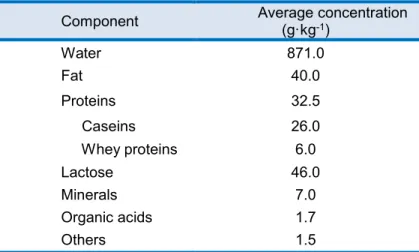
Milk is a fluid secreted by mammalian females in order to satisfy the nutritional requirements of their neonates. It constitutes, therefore, a source of energy provided by lipids, lactose, amino acids, vitamins, minerals and water. It also has an important physiological role as it contains enzymes, hormones, antibacterial compounds, proteins and peptides (Fox and McSweeney, 2003). A wide range of factors can intervene in the composition of milk such as race, stage of lactation, health of the animal, season, animal feeding, etc. (Mahaut et al., 2000). Table 2.1 shows the average composition of bovine milk.
Table 2.1. Average composition of bovine milk (Walstra et al., 1999).
Component Average concentration
(g·kg-1)
Water 871.0
Fat 40.0
Proteins 32.5
Caseins 26.0
Whey proteins 6.0
Lactose 46.0
Minerals 7.0
Organic acids 1.7
Others 1.5
21 The nitrogen content of milk is about 34.0 g·kg-1, divided into three groups: caseins,
whey proteins and non-protein nitrogen. Casein and whey proteins differ according to their solubility at pH 4.6 (Croguennec et al., 2008).
Casein represents 80%of the total milk proteins (Cayot and Lorient, 1998; Fox and Brodkorb, 2008; Horne, 2003). Casein in milk exists as large colloidal particles called “casein
micelles” (Fox and Brodkorb, 2008). Casein micelles have a relatively wide size distribution,
from less than 50 nm to more than 500 nm, with an average diameter of approximately 200 nm (Horne, 2003). In their native state, casein micelles are hydrated particles containing
several thousand αS1-, αS2-, β- and -casein molecules as well as minerals, mainly colloidal
calcium phosphate (CCP) (de Kruif, 1999; Panouillé et al., 2005). In milk at pH 6.7, casein micelles are electronegative, with an isoelectric point (pI) of 4.7. Caseins in the micelle structure are held together by hydrophobic interactions and by the presence of CCP. In physiological conditions, a “hairy layer” of the hydrophilic parts of -casein (about 10 nm thick and located at the surface of casein micelles) is responsible for steric and electro-repulsive stabilization of casein micelles, thus producing a balanced colloidal system (Panouillé et al., 2005).
In contrast to caseins, whey proteins are soluble at pH 4.6 in their native form. These proteins are heat-sensitive. The major whey protein constituents are β-lactoglobulin (β-lg)
and α-lactoglobulin (α -lg). β-lg is a globular protein with a molecular mass of 18.3 kDa that
22 Whitehead, 1989). Other minor whey proteins are also present in the soluble phase of milk, in particular bovine serum albumin, immunoglobulins and lactoferrin.
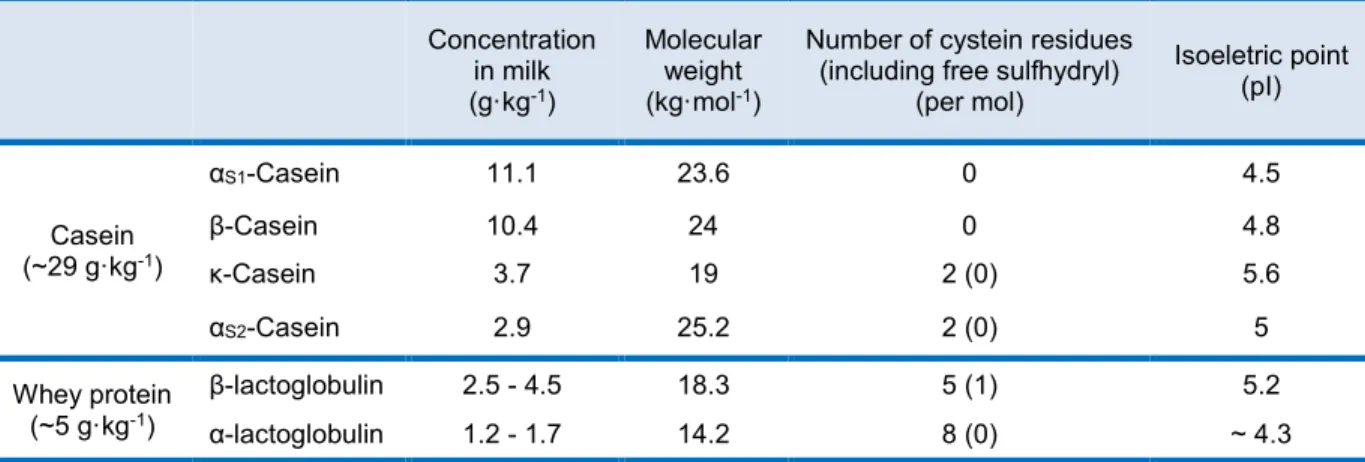
Table 2.2. Composition and properties of milk proteins (Cayot and Lorient, 1998; Walstra et al., 2006).
Concentration in milk
(g·kg-1)
Molecular weight
(kg·mol-1)
Number of cystein residues (including free sulfhydryl)
(per mol)
Isoeletric point (pI)
Casein
(~29 g·kg-1)
αS1-Casein 11.1 23.6 0 4.5
β-Casein 10.4 24 0 4.8
-Casein 3.7 19 2 (0) 5.6
αS2-Casein 2.9 25.2 2 (0) 5
Whey protein
(~5 g·kg-1)
β-lactoglobulin 2.5 - 4.5 18.3 5 (1) 5.2
α-lactoglobulin 1.2 - 1.7 14.2 8 (0) ~ 4.3
23
Figure 2.1. Raw milk at ambient temperature observed by transmission electron microscopy, (a) where fat is present and (b) in the absence of fat (Tamine et al., 2007).
The ability of milk to be processed into a variety of products is mainly due to the physicochemical characteristics of its proteins that confer various tecnofunctional properties (gelling, foaming, emulsifying, etc.) (Croguennec et al., 2008). Finally, milk is a system under dynamic equilibrium and several changes may occur on modifying its composition and structure. These changes may be physical (foaming), chemical (oxidation, lipolysis, proteolysis) and microbial (production of acid lactic).
2.1.2.
Cracking of milk
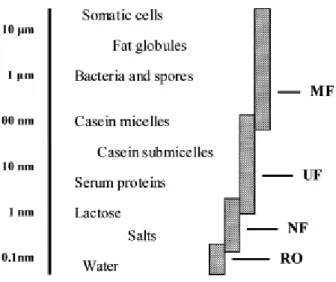
24 for the fractionation of milk, because many milk components can be separated on size (Fig. 2.2). Membranes are already well established for the processing of whey and are gaining popularity in other dairy applications (Daufin et al., 2001). These processes lead to the fractionation of dairy components, i.e. the “cracking” of milk (Fig. 2.3) and whey (Fig. 2.4). Progress is still being made on the extent of fractionation of milk and whey using more specific combinations of membrane filtration and other separation techniques (electrodialysis, ion exchange, and chromatography) and/or chemical treatments (such as acidification or hydrolysis).
25
Figure 2.3. “Cracking” of milk featuring the vacuum evaporation and spray drying
processes (Schuck, 2002).
MANTEIGA
VE
NF, ED, IE UF
Spray drying VE
WPC
[WPC]
WPC / I POWDER ULTRAFILTRATE [ULTRAFILTRATE] ULTRAFILTRATE POWDER VE Spray drying DEMINERALIZED WHEY / MFat
[DEMINERALIZED WHEY / MFat]
DEMIRALIZED WHEY/MFat POWDER
+ Alkalis Coagulation CASEINATE CASEINATE POWDER CASEIN Spray drying VE [MILK] MILK POWDER VE WHEY/MICROFILTRATE
[WHEY]/[MFat]
WHEY/ MFAT
POWDER
Spray drying VE
+ Fat (option) MF/DF
MCC / I POWDER [MCC]
VE
UF/DF
MPC
MPC / I POWDER Spray drying [MPC] VE Spray drying BUTTERMILK [BUTTERMILK] BUTTERMILK POWDER STANDARDIZED MILK WHOLE MILK SKIM MILK
Standardization
Cream separation CREAM
26
Figure 2.4. Whey cracking. Modified from Lortal and Boudier (2011).
Once the component of interest has been extracted, the solution is very often concentrated and spray dried. The vacuum evaporation process is widely applied in the food industry for the concentration of solutions (Fig. 2.5). Although more energy expensive than membrane concentration processes (Table 2.3), this process yields more viscous products, which is not possible with membrane techniques.
SPRAY DRYING Protein slightly soluble concentrate Protein concentrate without lipids Purified proteins
Peptides WPI/WPC Whey without minerals &
lactose
β-lactoglobulin α-lactalbumin lactoferrin Lactoperoxydase Lysozyme WHEY
Thermic and acid (pH 4.6) precipitation Albumins and globulins Clarification Ultrafiltration Phospholip oproteins Albumins and globulins Diafiltration Ultrafiltration Whey proteins
Chromato Hydrolysis Diafiltration
27
Table 2.3. Energy consumption for various water removal processes.
Processes Energy Consumption
(kWh·t-1 removed water or permeate)
Membrane processes
Ultrafiltration 3 to 4
Nanofiltration 5 to 7
Reverse osmosis 9 to 10
Vacuum evaporation* 100 to 300
Spray drying 1,000 to 2,000
Freeze drying 5,000 to 10,000
* Vacuum evaporator without mechanical vapor re-compression
The vacuum evaporation process is currently used before drying for production of dairy products (Gray, 1981) (Fig.2.5). According to Jebson and Iyer (1991), the cost of the energy required for the evaporation of milk is a major factor determining the production cost of milk powder.
Figure 2.5. Flow diagram of the production of skim milk powder. Skim milk
Heat treatment
Vacuum evaporation
28
2.2.
Vacuum evaporation
Evaporation is a process used to remove a liquid from a solution, suspension, or emulsion by boiling off some of the liquid. It is thus a thermal separation or thermal concentration process. The evaporation process is defined as one that starts with a liquid product and ends up with a more concentrated, but still liquid and still pumped concentrate as the main product from the process (Kessler, 1981). There are in fact a few instances where the evaporated, volatile component, is the main product, but these are not discussed in this work. In the food domain evaporation is used for product concentration, volume reduction, water / solvent recovery and crystallization (Bimbenet et al., 2007).
In the field of thermal separation / concentration technology, evaporation plants are widely used for concentration of liquids in the form of solutions, suspensions, and emulsions. The major requirement in the field of evaporation technology is to maintain the quality of the liquid during evaporation and to avoid damage to the product. This may require the liquid to be exposed to the lowest possible boiling temperature for the shortest period of time. In the food industry evaporation is performed at absolute pressures in the order of 0.02 MPa to 0.09 MPa (pressures below atmospheric pressure). The term "vacuum" is therefore used to classify this process.
29
2.2.1.
Evaporators
An evaporator is the device or set of devices used to achieve evaporation. The destination of the vapor emitted is essential in the study of an evaporator. Even if there is no potential use, it is necessary to condense such vapor. The vapor to be condensed is generally used to heat the incoming products. This preheating serves to improve the energy use, and the functional operation of the evaporator, since the liquid enters the evaporator at a temperature close to its boiling temperature (Jeantet et al., 2011).
For vacuum evaporators, the vapor emitted is aspirated into the condenser by a condenser pressure (Pc) lower than the evaporation pressure (Pev). Pc is controlled by the
liquid-vapor equilibrium that exists within the condenser. This means that the lowest pressure that can be obtained in an evaporator is imposed by the temperature of the condensation of the product vapor in the condenser. The vacuum pump connected to the condenser is only responsible for evacuating the air out of the plant and for removing the incondensable gases. The amount of gases to be evacuated depends on the amount of gas dissolved in the product and especially of the quality of the vacuum tightness of the system (including pipes, pump seals, etc.) (Bimbenet et al., 2007).
30
Figure 2.6. Diagram of: (A) mixture condensers, and (B) wall exchange condenser.
While the design criteria for evaporators are the same regardless of the industry involved, two questions always exist: is this equipment best suited for the purpose and is the equipment arranged in the most efficient and economical way? As a result, many types of evaporator and many variations in processing techniques have been developed to take into account different product characteristics and operating parameters. The most common types of evaporators used currently are:
Rising film evaporators
Forced circulation evaporators Plate evaporators
Falling film evaporators
Other types of evaporator, include the inclined tube evaporator, forced-circulation evaporator, wiped film evaporator, etc. (Leleu, 1992).
Incondensable gases
Condensates Cooling water
A B
Inlet water
Outlet water Vapeur
Condensates
31
2.2.1.1.
Rising film evaporators
These evaporators operate on a "thermo-siphon" principle. Feed enters at the bottom of the heating tubes and as it heats, vapor begins to form (Fig. 2.7). The ascending force of this vapor produced during boiling causes liquid to flow upwards. At the same time vapor production increases and the product is pressed as a thin film on the walls of the tubes (Smith and Hui, 2008).
Figure 2.7. Rising Film Evaporator (www.niroinc.com).
This co-current upward movement has the beneficial effect of creating a high degree of turbulence in the liquid. This is advantageous during evaporation of highly viscous products. A large temperature difference is need between the heating and boiling sides of this type of evaporator, otherwise the energy of the vapor flow is not sufficient to convey the liquid and to produce the rising film. The length of the boiling tubes will typically not exceed 7 meters. This type of evaporator is often used with product recirculation, where some of the
32 concentrate formed is reintroduced back to the feed inlet in order to produce sufficient liquid loading inside the boiling tubes.
2.2.1.2.
Forced circulation evaporator
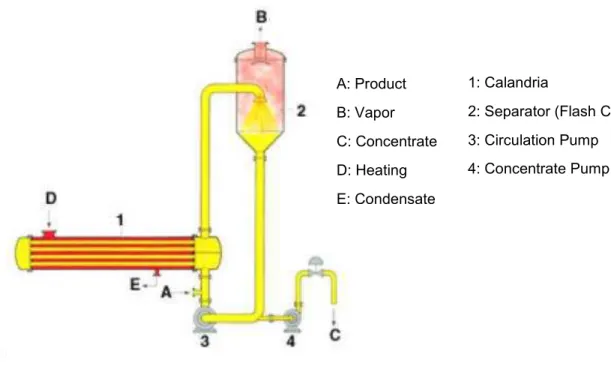
Forced circulation evaporators (Fig. 2.8) are used if boiling of the product on the heating surfaces is to be avoided due to fouling or crystallization. The flow velocity in the tubes must be high, and high-capacity pumps are required. The circulating liquid is heated when it flows through the heat exchanger and then partially evaporated when the pressure is reduced in the separator, cooling the liquid to the boiling temperature (Smith and Hui, 2008).
Figure 2.8. Forced circulation evaporator (www.niroinc.com).
The liquid is typically only heated a few degrees for each pass through the heat exchanger, which means the recirculation flow rate has to be high. This type of evaporator is also used for crystallizing applications because no evaporation and concentration take place on the heat transfer surface. Evaporation occurs as the liquid is flash evaporated in
A: Product
B: Vapor
C: Concentrate
D: Heating
E: Condensate
1: Calandria
2: Separator (Flash Cooler)
3: Circulation Pump
33 the separator / flash vessel. In crystallizing applications this is then where the crystals form, and special separator designs are used to separate crystals from the recirculated crystal slurry. The heat exchanger can be arranged either horizontally or vertically depending on the specific requirements in each case.
2.2.1.3.
Falling film evaporators
The need, for an evaporator capable of functioning with a very small temperature difference between heat steam and product, imposed by shorter process times and operating economy led to the application of the falling film evaporation principle (Gray, 1981). With this arrangement the product is made to flow downwards in a film over the heating surface. The principal driving force is gravity. In contrast to the climbing film evaporators, high heat fluxes and temperature differences are not required to establish the desired flow conditions. The heat transfer surface may be in the form of either tubes or plates, but capacity limitations of the falling film plate evaporator have led to the tubular version being much more widely applied (Gray, 1981). The falling film tubular evaporator is currently the standard type used in the dairy industry.
34
Figure 2.9. Falling film evaporator. Addapted from Jeantet et al. (2011).
However, falling film evaporators must be designed very carefully for each operating condition; sufficient wetting of the heating surface by liquid is extremely important for trouble-free operation of the plant (Morison et al., 2006). Due the low liquid holding volume in this type of unit, the falling film evaporator can be started up quickly and changed to cleaning mode or another product easily. The fact that falling film evaporators can be operated with small temperature differences makes it possible to use them in multiple effect configurations with very low energy consumption.
Evaporation tubes
Cooling water
Incondensible gases
Condenser
Steam
Condensates
Concentrate Separator Secondary
vapor Condensates
Vacuum pump
35
2.2.2.
Energy efficiency
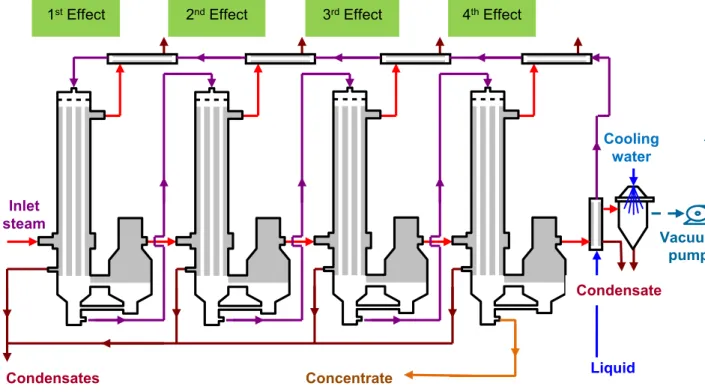
To become even more energy efficient the vapor produced in one falling film evaporator can be used to heat another evaporator operating at a lower pressure and temperature. The first evaporator thus acts as a "boiler" for the second. Similarly, the second serves as a condenser for the first (Fig. 2.10). This way of recycling the water vapor continuously in series is often termed multi-effect evaporation. With n evaporators added in series to recycle the water vapor for use in the next evaporator, the energy usage can be decreased by approximately 1/neffects.
Figure 2.10. Multi-effect evaporator (Jeantet et al., 2011).
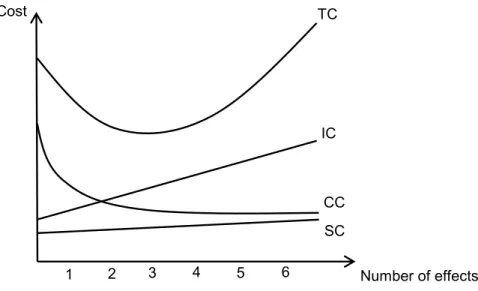
The economic optimization of the number of effects is chosen for a minimum total cost of the evaporation process. The main elements of the total cost (TC) are the investment
Inlet steam
Condensates Liquid
Cooling water
Concentrate
1st Effect 2nd Effect 3rd Effect 4th Effect
Condensate
Incondens
36 costs (IC); the consumption costs (CC) of heating steam, water, electricity, etc.; and the staff cost (SC). These various costs vary with the number of effects n (Fig. 2.11).
Figure 2.11. Diagram of the cost components of an evaporator as a function of the
numbers of effects. IC = investment cost; CC = cost of consumption; SC = staff costs and TC = total cost = IC + CC + SC (Jeantet et al., 2011).
The curve of the total cost (Fig. 2.11) passes through a minimum for a given n value. This number rounded to the nearest whole number, is the optimum number of technical and economic effects.
In order to reduce the energy consumption and environmental impact, it is important that evaporators operate at their maximum capacity, which is highly dependent on the overall heat transfer coefficient. This parameter cannot be considered as an intrinsic characteristic of the evaporator, since it also depends on the nature of the product and on their flow conditions (Mafart, 1991). The factors that control heat transfer in the evaporator tubes are important for close monitoring of the evaporation process and for the calculation of the evaporators dimensions (Bouman et al., 1993; Jebson and Iyer, 1991).
Number of effects Cost
SC CC IC TC
37
2.2.2.1.
Heat transfer coefficient
Knowing the heat transfer coefficient is essential to monitor the evaporation process closely. In most dairy factories the total energy usage is known, but often information on the quantities of energy used for individual processes is lacking (Jebson and Chen, 1997).
For all types of evaporator, the evaporation rate depends on the heating power (Q̇), which depends on the overall heat transfer coefficient (U), the heat exchange area (A), and the temperature difference between the heating steam and the boiling liquid, Δ , Eq. 2.1:
Q̇ = � · A · ∆
Eq. 2.1The design, optimization and investment costs of the unit are thus strongly dependent on the predicted value of this variable (Prost et al., 2006).
The inverse overall heat transfer coefficient (1/U) for a given effect is resistance resulting from four resistances in series: the resistance of the heating steam side (1/hv), the
resistance of conduction through the wall (em/ m), the resistance of an eventual fouling layer
38
Figure 2.12. Temperature profile between the heating steam ( s) and the boiling
product ( p) at a steady regime in a falling film evaporator (Adib, 2008).
Legend: Ѵv: vapor velocity and Δ : temperature difference between steam and
product
=
−
+
λ+ R
+
Eq. 2.2where hv-1 is the steam heat transfer coefficient (kW·m-2·°C-1), m the thermal
conductivity of the wall (kW·m-1·°C-1), e
m the wall thickness (m), Rfouling the thermal resistance
of the fouling layer (kW·m-2·°C-1) and h
p the product heat transfer coefficient (kW·m-2·°C-1)
The heating steam condenses to form a film condensate along the external wall of the evaporator tube. The steam heat transfer coefficient is in the order of 5,000 W·m-2·°C-1
to 15,000 W·m-2·°C-1. h
V-1 can be calculated by equations based on the Nusselt number (Eq.
Ѵv
p
Wall
Fouling
Vapor emitted
Trickling condensate film
Trickling liquid film
Δ
s
39 2.3) (Adib et al., 2009), eventually adjusted to take into account of the shape and arrangement of the heating surfaces, the speed of the heat steam, the presence of non-condensable gas, the surface condition of the wall, etc. (Bouman et al., 1993).
N = .6 ∙ R − Eq. 2.3
where
N = −
λ η
∙ Eq. 2.4
where hv is the heat transfer coefficient of the condensing steam (kW·m-2·°C-1), Re
the Reynolds number (-), the viscosity of the condensate steam (Pa∙s), ρ the density of the condensate steam (kg·m-3), and g the gravity acceleration (m·s-2)
The heat transfer coefficient through the wall, (λ ), is easier to calculate, because the thermal conductivity coefficients of the materials constituting the exchange surfaces are known, as well the wall thickness. These coefficients are generally high, in the order of 10 kW·m-2·°C-1 to 20 kW·m-2·°C-1, which corresponds to a low thermal resistance, that can often
be disregarded.
The potential fouling layer must be taken into account in the calculation of the overall heat transfer coefficient. Fouling of heat transfer surfaces is one of greater problems in heat transfer equipment.
Generally the product heat transfer coefficient, hp, is the most difficult to predict, and
often it is the limiting factor for the heat transfer, especially for viscous concentrates. The heat transfer coefficient for pure water evaporated at Δ = 10°C is in the order of 6 kW·m -2·°C-1 to 15 kW·m-2·°C-1. According to many authors (Bimbenet et al., 2007; Miranda and
40
treated product (viscosity p, surface tension p, density ρp, etc.); process conditions (heat
flux, temperature difference Δ , boiling temperature p); and nature and geometry of the
heating surface, (roughness R, etc.). These factors are summarized in Eq. 2.5.
h = f ρ , σ , , C … ∆ , R, etc. Eq. 2.5
where p is the product surface tension (N·m-1) and Cpp the product specific heat
(kJ·kg-1·°C-1)In this work, only the overall heat transfer coefficient U (kW·m-2·C-1) (Eq. 2.1) is
discussed. For falling film evaporators this coefficient are in order of 1 kW·m-2·°C-1 to 8 kW·m -2·°C-1 (Bimbenet et al., 2007).
2.3.
Thermo-physical properties of dairy concentrates
Estimation of U in all chemical engineering formulas currently available in the literature is connected to thermo-physical properties of products. These thermo-physical
properties ( p, ρp, p ...) generally vary with the concentration and temperature of the product,
and possibly also as a function of shear rate in the case of a non-Newtonian fluid.
2.3.1.
Viscosity of dairy concentrates
The rheological behavior of dairy concentrates changes during the evaporation process due the changes in the product concentration and temperature. It can be modified by the shear rate, expressed by the velocity gradient, γ̇ (s-1):
γ̇ = Eq. 2.6
Therefore the apparent viscosity, a, is used to represent and classify the flow profile
of dairy concentrates. This defined as:
41 where Τ is the shear stress (Pa)
According to the relationship between the shear stress and the shear rate presented in Eq. 2.7, two types of rheological behavior can be distinguished (Fig. 2.13).
Figure 2.13. Newtonian and non-Newtonian fluids.
For Newtonian fluid the viscosity only depends on the temperature and concentration. On the other hand for the Non-Newtonian fluids the viscosity depends on the shear rate in addition to the temperature and concentration.
2.3.2.
Thermal properties of dairy concentrates
Some thermal properties of dairy concentrates can be used for the estimation of heat transfer coefficients and enthalpy balances for an evaporator. These properties are:
• Specific heat Cp (kJ·kg-1·°C-1)
Shear thinning
Newtonian
Dilatants