DOI: 10.5562/cca2725
Metal-Binding Ability of Leu-Enkephalin, Related
Glycoconjugates and Peptidomimetics
Zsuzsa Majer,1 Elemér Vass,1 Maja Roščić,2 Miklós Hollósi,1 Štefica Horvat,2 Andreja Jakas2,*
1 Eötvös Loránd University, Institute of Chemistry, Laboratory for Chiroptical Structure Analysis, Pázmány Péter sétány 1/A, H-1117, Budapest, Hungary 2 Ruđer Bošković Institute, Division of Organic Chemistry and Biochemistry, Bijenička c. 54, HR-10000 Zagreb, Croatia
* Corresponding author’s e-mail address: [email protected]
RECEIVED: August 26, 2015 REVISED: October 20, 2015 ACCEPTED: October 26, 2015
Abstract: Both the chemistry and consequences of the nonenzymatic reaction between reducing sugars and reactive amino groups of amino acids, peptides and proteins (known as the Maillard reaction), have received considerable attention in food and health science fields. This initial reaction results in Amadori and similar products formation, followed by degradation to advanced glycation end products (AGEs). It is well established that AGEs are associated with color and odor of thermally processed or stored food, as well as with pathogen products in a number of diseases. The model systems of early stage Maillard reaction products (MRP) were prepared between endogenous opioid peptide leucine enkephalin (1) and D-glucose / D-glucuronic acid. The complexation ability of prepared MRP with metal ions (Ca2+, Zn2+, Al3+, Pb2+ and Cu2+) was investigated and compared to the complexation ability of parent peptide using ECD and FTIR spectroscopic measurements.
Keywords: Amadori compound, hydroxypyridinium, imidazolidinone, Maillard reaction, metal complex.
INTRODUCTION
RANSITION metal ions are found in living organisms, coordinated to different biomolecules and participat-ing in many biochemical reactions where they play a crucial role. Carbohydrates, although involved in many biochemi-cal processes, immunologibiochemi-cal events, and pathologibiochemi-cal conditions, exhibit relatively poor coordinating properties and form weak complexes with metal ions, however, an increased metal-binding ability has been linked to the glycated proteins formed in Maillard reaction.[1–4] In such
reversible reaction, reducing sugars react with amino acids, peptides or proteins, producing Amadori, Heyns, and other similar compounds, which can further form irreversible AGE (Advanced Glycation End) products. There is accumulating evidence for the ability of Maillard reaction products (MRP) to complex metal ions.[5] It is well known that metal ions can
form complexes of various properties with MRPs, oxidize Amadori compounds as well as their derivatives, and catalyze further interactions of these compounds.[5–7] In
addition, transition elements accelerate the formation of Amadori compounds, as well as their polymerization pro-ducts during the final stage of the Maillard reaction.[6–14]
Nevertheless, the information about MRP complexes and whether complexations of individual MRPs are likely to influence internal metabolism in vivo is not currently available. We know that the type of cation is important for the chelating ability of MRPs, as well as its role in the stability of the complexes formed, and the accumulation of chromophores in reaction systems.[5,15,16] Moreover, the
browning reaction rate studied in heated solutions of Amadori compounds depends not only on the amounts of metal salts added, but also on the valence of the cations,[6,17] and pH of the solution.[18]
Since formations of metal complexes are associated with different but unknown MRP ligands, we have explored the ability of several MRPs with known structures to complex with several biologically relevant metal ions.[19] For
instance, the importance of copper in human metabolism is its involvement in oxidative processes.[20–25] Aluminum was
chosen due to its high presence in the environment and extensive use in modern daily life (diets and medication). However, there is no known physiological role for alumi-num within the body and hence this metal may strongly alter normal cellular metabolic pathways and produce adverse physiological effects.[26] Calcium is important for
282 Z. MAJER et al.: Metal-Binding Ability of Leu-Enkephalin …
Croat. Chem. Acta2015, 88(3), 281–287 DOI: 10.5562/cca2725
healthy bones, but the question is if it is responsible for kidney stones formation, and calcification of blood vessels. The strong and selective binding of calcium(II) ions to proteins is related to the regulation of many physiological functions.[27] Zinc is known to be essential for all highly
proliferating cells in the human body, especially the immune system, but high dosage of zinc evokes the same negative effects as those observed with zinc deficiency.[28]
The toxicological effects of lead include neurotoxicity, carcinogenicity, reproductive toxicity, and neurobeha-vioral/developmental effects.[29] Thus, investigation
con-cerning difference in complexation ability for these metal ions of natural peptides and their MRPs is of essential importance. The ability of complexation of Zn2+, Al3+, Ca2+,
Pb2+ and Cu2+ multivalent cations with endogenous opioid
peptide Leu-enkephalin (1)[30,31] and four different
Leu-enkephalin MRPs 2–5 was investigated. Electronic circular dichroism (ECD) and Fourier transform infrared (FTIR) spectroscopy, as complex spectroscopic methods, were used to characterize the conformation and the cation-induced conformational changes of peptides 1–5.
EXPERIMENTAL
Leu-enkephalin (1) was purchased from Bachem. Amadori compounds, N-(1-deoxy-D-fructos-1-yl)-L-tyrosylglycylgly-cyl-L-phenylalanyl-L-leucine (2) and N-(1-deoxy-D-fructo-furanos-1-yl-uronic acid)-L-tyrosyl-glycylglycyl-L-phenylala-nyl-L-leucine (4) were synthesized under the conditions described by Horvat et al. (1998)[32] and Horvat et al.
(2007).[33] Imidazolidinone derivative,
N-{[2-(D-gluco-penti-tol-1-yl)-4-(4-hydroxybenzyl)-5- oxoimidazolidin-1-yl]ace-tyl}glycyl-L-phenylalanyl-L-leucine (3) was obtained as described by Roščić and Horvat (2006).[34]
N-[2-(4-hy-droxybenzyl)-2-(3-hydroxypyridin-1- ium)ethanoyl]glycylgly-cyl-L-phenylalanyl-L-leucine (5) was obtained as described by Horvat et al. (2007).[33] All compounds were desalted
using an octadecylsilica solid-phase extraction (SPE) cartridge (500 mg, 2.8 mL). The following compounds all purchased from Sigma-Aldrich were used as metal ions source: Al(ClO4)3 ×10H2O, Ca(ClO4)2 ×4H2O, Cu(ClO4)2 ×6H2O,
Zn(ClO4)2 ×6H2O and Pb(ClO4)2 ×3H2O. ECD titrations were
performed at peptide : metal ratios ranging from 1 : 0.25 to 1 : 5, by adequately mixing stock solutions of peptides (0.4 mM) and different metal ions (25 mM). The concentrations of peptides were between 0.2–0.4 mg mL–1 and concentrations of
metal salts between 1–6 mg mL–1. The solvents for the
spec-troscopic studies were 2,2,2-trifluoroethanol (TFE; Aldrich, NMR grade), and double distilled water.
ECD Measurements
Electronic circular dichroism (ECD) spectra were recorded on a Jasco J-810 spectropolarimeter at room temperature
in a quartz cell with 0.2 mm path length in the 185–280 nm (far UV) and with 10.0 mm path length in the 250–320 nm (near-UV) region. The peptide:metal ratio is expressed with rcat = cation / peptide and titration was running at rcat =
0.25–5. ECD band intensities are expressed in mean residue ellipcity ([Θ]MR; deg cm2 dmol–1).
FTIR Measurements
FTIR spectra of 2 cm–1 resolution were recorded on a Bruker
Equinox 55 spectrometer equipped with liquid N2-cooled
MCT detector. The spectra were obtained at room temperature in a CaF2 cell of 0.2 mm path length. The sample
concentration in TFE (or a TFE solution containing 2, 8 or 12 mM Ca perchlorate) was 4 mM in each measurement. The spectra were corrected with the background.
RESULTS AND DISCUSSION
ECD Spectroscopic Characterization of
Compounds and Their Metal Complexes
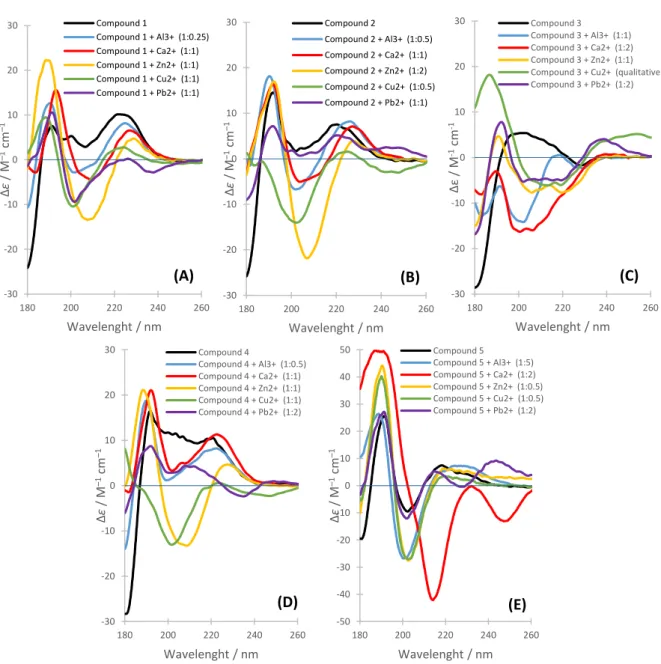
Investigation of the endogenous opioid peptide Leu-enkephalin under Maillard reaction conditions (nonenzy-matic glycation) lead to the chemical transformations of Leu-enkephalin (1) (Figure 1). Two glycation products resulted from the reaction of D-glucose (Glc) and Leu-enkephalin (1) as early glycation products. The first product is Amadori compound 2 in which the linear peptide is alkylated at the N-terminal position by a 1-deoxy-D-fructose unit. The second product in the reaction is compound 3 which has characteristic rigid 5-membered imidazolidinone ring. In this adduct an imidazolidinone moiety connects the acyclic sugar residue with the linear peptide chain. Early glycation products in the reaction of D-glucuronic acid (GlcA) and Leu-enkephalin are Amadori compound 4 and aromatic 3-hydroxypyridine derivative 5.In aim to determine the complexation potential of compounds 1–5 first of all ECD spectra of these synthetic peptides were recorded (Figure 2). According to the spectrum and previous investigationit was concluded that Leu-enkephalin 1 is present in TFE as a mixture of conformers with no dominant recognizable conforma-tion.[35,36] The ECD spectra of Amadori compounds 2 and 4
do not differ significantly from that of 1 which suggests no strong difference in distribution of backbone conformers from peptide 1. The ECD spectrum of the imidazolidinone-derivative 3 shows a broad positive band centered at λ ~ 206 nm suggesting the influence of imidazolidinone ring on the conformation of Leu-enkephalin. The 3-hydroxy-pyridinium derivative 5 shows a markedly different ECD spectrum featuring with a weak positive band centered at
DOI: 10.5562/cca2725 Croat. Chem. Acta2015, 88(3), 281–287 obvious that different MRPs of Leu-enkephalin have
different effect on the structure of peptide 1, which can produce difference in peptide stability and activity.[7] ECD
spectra in TFE of MRP peptides 2–5 were measured in the presence of different types of cations and at their different ratio to study the conformational effect / binding type of multivalent cations Zn2+, Al3+, Ca2+, Pb2+, and Cu2+.
There have been many attempts to categorize various metal ions and anions to predict reactivity, solubility, etc. According to Pearson (1963)[37] Al3+ and Ca2+ are hard
Lewis acids, Zn2+ is strong Lewis acid, Cu2+ and Pb2+ soft
Lewis acidsare in borderline; while carboxyl, amide and hydroxyl groups belong to the hard Lewis bases. Hard acids and bases are small, compact, and non-polarizable. Hard acids tend to bind to hard bases to form adducts with ionic character while soft acids tend to bind to soft bases and theirs adducts are more covalent in nature. In oligopeptides both terminal groups, the amide and carboxyl group and the functional side chain groups (carboxyl-, amino-, thioether-, thiyl-, imidazolyl group) are potential binding sites for cations. If the amino terminal group is free, the side chain primarily serves as anchor of
metal ion. Since Al3+ and Ca2+ are strong Lewis acids
and hard metals, they are expected to react with the O-donors, such as e.g. carboxylate ion (C-terminal or side chain COO– of peptides), phenolate (Tyr(O–)) and also
deprotonated hydroxyl group from carbohydrates to form glycopeptide-metal complexes. Zn2+ and Cu2+ ions can
bind to the terminal amino and/or carboxyl groups (mostly they are labile). More stable complex (chelate-type) is expected to form involving the terminal amino and either the neighboring amide carbonyl groups (in the case of Zn2+) or deprotonated amide nitrogen atom. The
formation of complexes through peptide backbone will affect the character of the ECD spectra.
The aim of the present study was twofold: i) studying the ability of complexation of each compound 1–5 with various cations; ii) comparison of the complexation ability of MRPs 2–5 with the ability of complexation of peptide 1. The cation-induced ECD spectral changes in spectra of peptides 1–5 were measured from “stable complexes” at rcat where increasing cation concentration caused no more
ECD-changes. Compounds 2–5 as Amadori, imidazolidinone and 3-hydroxypyridinium derivatives of Leu-enkephalin (1)
284 Z. MAJER et al.: Metal-Binding Ability of Leu-Enkephalin …
Croat. Chem. Acta2015, 88(3), 281–287 DOI: 10.5562/cca2725
can give more potential cation-binding places then the corresponding parent peptide 1.
Leu-enkephalin 1 with the cations Pb2+, Cu2+ and Al3+
shows the adoption of more folded conformers stabilized by free carboxyl and/or side chain binding at rcat ≤ 1. These
ECD spectra are characterized by a negative band near 205 nm and positive bands near ~ 190 nm and 230 nm, suggesting βI/III turn-type (for a classification and ECD spectroscopic features of different types of turns see ref. 38), while with Cu2+ an extra negative peak with weak
intensity around 240 nm appeared. In the presence of Ca2+
all extremes are red shifted with ~ 5–10 nm (βII turn-type, Figure 2a), while with Zn2+ all peaks are more intense and
broader indicating a lot of different turn-types.
Amadori compound 2 (Figure 2b) gave βI/III turn-type, C-like spectrum with Ca2+ at rCa = 1 as a stable
complex, with two negative bands above 205 and 218 nm and a positive band at ~ 195 nm.[37,38] With Zn2+ compound
2 shows a spectrum marked by a strong positive band at
~ 195 nm, a weaker one at ~ 225 nm and a strong, broad negative band centered at 208 nm. This spectral feature indicates the presence of a mixture of folded conformers,
Figure 2. CD spectra of (A) Compound 1; (B) Compound 2; (C) Compound 3; (D)Compound 4; (E) Compound 5; and their
complexes with Al3+, Ca2+, Zn2+, Cu2+ and Pb2+ ions.
-30 -20 -10 0 10 20 30
180 200 220 240 260
Δ
ε
/ M
–1cm
–1
Wavelenght / nm
Compound 1
Compound 1 + Al3+ (1:0.25) Compound 1 + Ca2+ (1:1) Compound 1 + Zn2+ (1:1) Compound 1 + Cu2+ (1:1) Compound 1 + Pb2+ (1:1)
-30 -20 -10 0 10 20 30
180 200 220 240 260
Δ
ε
/ M
–1cm
–1
Wavelenght / nm
Compound 2
Compound 2 + Al3+ (1:0.5) Compound 2 + Ca2+ (1:1) Compound 2 + Zn2+ (1:2) Compound 2 + Cu2+ (1:0.5) Compound 2 + Pb2+ (1:1)
(B)
-30 -20 -10 0 10 20 30180 200 220 240 260
Δε
/ M
-1cm
-1
Wavelenght / nm
Compound 3 Compound 3 + Al3+ (1:1) Compound 3 + Ca2+ (1:2) Compound 3 + Zn2+ (1:1) Compound 3 + Cu2+ (qualitative) Compound 3 + Pb2+ (1:2)
(C)
-30 -20 -10 0 10 20 30
180 200 220 240 260
Δ
ε
/ M
–1cm
–1
Wavelenght / nm
Compound 4
Compound 4 + Al3+ (1:0.5) Compound 4 + Ca2+ (1:1) Compound 4 + Zn2+ (1:1) Compound 4 + Cu2+ (1:1) Compound 4 + Pb2+ (1:2)
-50 -40 -30 -20 -10 0 10 20 30 40 50
180 200 220 240 260
Δ
ε
/ M
–1cm
–1
Wavelenght / nm
Compound 5 Compound 5 + Al3+ (1:5) Compound 5 + Ca2+ (1:2) Compound 5 + Zn2+ (1:0.5) Compound 5 + Cu2+ (1:0.5) Compound 5 + Pb2+ (1:2)
(E)
(A)
DOI: 10.5562/cca2725 Croat. Chem. Acta2015, 88(3), 281–287 mainly β- and γ- turn.[38] In the presence of Cu2+ the ECD
spectrum shows a strong, very broad negative band centered at ~ 200 nm and a weaker one at ~ 240 nm.
Imidazolidinone compound 3 (Figure 2c) gave more or less βI/III turn-type C-like spectra with all cations except Al3+. The cation-induced ECD spectra of compound 3 (Figure
2c) are generally marked by a very broad negative band between 200–230 nm with more overlapping extremes. Al3+
gave an unusual ECD shape which can suggest different complexation with the various functional groups.
In Amadori compound 4 (Figure 2d) free carboxylic acid can contribute to the complex formation but only subtle spectral effect with Ca2+ (rcat = 1), Al3+ (rcat = 0.5) and
Pb2+ (rcat = 2) were observed. With Zn2+ and Cu2+ ions
compound 4 shows the same spectral behavior as in the case of compound 2 which canbe attributed to the Amadori structure but they have also similarity with compound 1.
In the solution of 3-hydroxypyridinium derivative 5 (Figure 2e), all cations, except Ca2+, induce the same
spectral character and the observed β-turn-type C-like spectra differ only in the relative band intensities which means that there is no complex formation with backbone
amide carbonyl groups so there are no significant conformational changes. The only exception is Ca2+ which
with 5 gave a broad and strong positive band at 190 nm, a strong negative band at ~ 215 nm and an additional weaker one at ~ 248 nm. This spectrum shows -sheet like features and it is not a typical “Ca-induced spectrum”, characteristic for many peptide-Ca2+ complexes, where the main features
would be a weak positive band above 210 nm and a strong negative one at ~ 195 nm. [39]
FTIR Spectroscopic Characterization of
Compounds and Their Metal Complexes
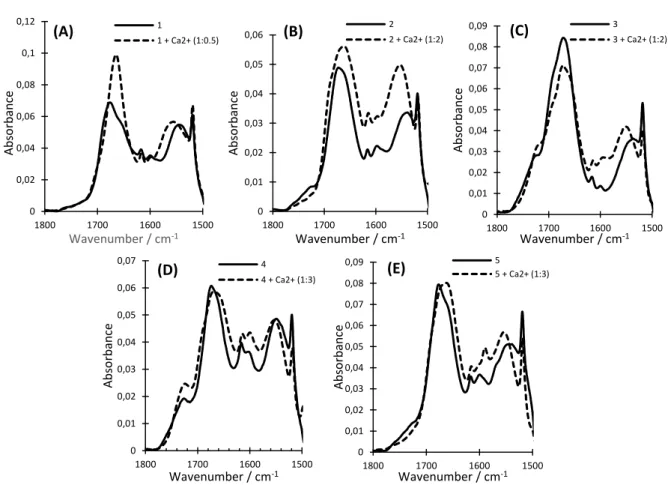
The infrared spectra of compounds 1–5 (Figure 3) were taken in TFE in the 1800–1500 cm–1 spectral region, whichis mainly composed of bands due to νC=O(COOH), amide I,
amide II and νas(COO–) vibrations. Absorption by the
aromatic Tyr and Phe side chains also give contribution in this spectral region. The sharp component bends near 1519, 1600 and 1616 cm–1 in the infrared spectra of all
analyzed compounds are assigned to the ring vibrations of Tyr and Phe. Since FTIR measurements require much higher sample concentrations than ECD, which may induce
Figure 3. FTIR spectra of (A) Compound 1; (B) Compound 2; (C) Compound 3; (D)Compound 4; (E) Compound 5; and their
complexes with Ca2+ ion.
0 0,02 0,04 0,06 0,08 0,1 0,12 1500 1600 1700 1800 Ab so rb an ce
Wavenumber / cm-1
1
1 + Ca2+ (1:0.5)
(A)
0 0,01 0,02 0,03 0,04 0,05 0,06 1500 1600 1700 1800 Ab so rb an ceWavenumber / cm-1 2 2 + Ca2+ (1:2)
(B)
0 0,01 0,02 0,03 0,04 0,05 0,06 0,07 0,08 0,09 1500 1600 1700 1800 Ab so rb an ceWavenumber / cm-1 3 3 + Ca2+ (1:2)
(C)
0 0,01 0,02 0,03 0,04 0,05 0,06 0,07 1500 1600 1700 1800 Ab so rb an ceWavenumber / cm-1 4 4 + Ca2+ (1:3)
(D)
0 0,01 0,02 0,03 0,04 0,05 0,06 0,07 0,08 0,09 1500 1600 1700 1800 Ab so rb an ceWavenumber / cm-1 5 5 + Ca2+ (1:3)
286 Z. MAJER et al.: Metal-Binding Ability of Leu-Enkephalin …
Croat. Chem. Acta2015, 88(3), 281–287 DOI: 10.5562/cca2725
precipitation in the presence of certain metal ions (especially Al3+), a systematic study with all the metal ions
was not possible. Based on its high biological relevance and considering the characteristic changes observed in the ECD spectrum, the FTIR based complexation studies were restricted to the Ca2+ ion. The infrared spectra of
compounds 1–5 with Ca were taken at peptide-metal ratios for which the stable complexes were observed (Figure 3) according to the ECD spectra. Main difference observed in complex spectra compared to compounds alone were shifts from 1542 cm–1 to 1552 cm–1 in the amide II spectral region
of compounds 1–3 and 5, while compound 4 does not show shift of this extreme which is in agreement with ECD spectrum of compound 4 with Ca2+ where no significant
changes of spectrum shape was observed. The Ca2+-induced
changes observed in the FTIR spectra of compounds 1–5 are more subtle than those in ECD and do not provide sufficient information for a more detailed conformational interpretation in terms of possible types of folded structures.
CONCLUSION
In the case of short chain peptides containing aromatic amino acid residue, as Leu-enkephalin, ECD spectroscopy can give a good diagnostic of conformational changes (e.g. cations, solvent, temperature), but cannot discriminate well the aromatic contribution from the conformational effect.[40,41] Binding of the cation to the free carboxylic
group or OH-group of side chain of Tyr can stabilize the backbone conformation of the peptide, but cation-bindings to the backbone amide carbonyl groups can have higher influence to the conformational changes. It is known that the hard metals such as Ca2+ and Al3+ ions bind to the
carboxyl group, phenolic side chain of Tyr and backbone amide carbonyl group. In TFE the cation-binding involves deprotonation of the C-terminus carboxyl group or hydroxyl Tyr side chain, or sugar hydroxyl group. The zwitter-ion formation enables this reaction. Appearance of the stronger spectral feature of π → π* at 195 nm may be attributed to folded structures stabilized by the cation.
The slight changes of the ECD shapes are similar in the case of Ca2+and Al3+ with compounds 1, 2, and 4 at the
same ratio. We suppose that these changes are only due to the modified distribution of the conformers. The ECD curves of compounds 3 and 5 with Ca2+ ion show
characteristic conformational changes toward ordered structures. Complexation of compound 3 with Al3+ and Ca2+
results in ECD changes which might be interpreted as binding of both cations to the side chains and also to amide carbonyl(s) of the peptide backbone which results in appearance of different types of turns. Compound 5 with Al3+ shows only difference in the intensity of ECD spectra at
higher Al3+ (1 : 5) concentration, while with Ca2+ion (1 : 1)
the ECD spectrum shows a typical β-sheet-like spectrum (conformational changes involving backbone amide carbonyls) with an additional band at 248 nm.
Compounds 1, 2 and 4 gave the same ECD shape but at different peptide / Zn2+ ratios. Primarily binding of Zn2+
to the OH-group of side chains (Tyr) and C-terminus carboxyl group is responsible for stabilizing the structure, leading to higher distribution of ordered structures. The C-like spectrum in the case of compound 3 can reflect a mixture of the different turn types, e.g. βI/III.
ECD spectra of compounds 2, 4 and 5 show no changes during titration with Pb2+. The ECD spectrum of
compound 1 with Pb2+ shows conformational changes,
mainly formation of βI/III type turns and also a positive band at ~ 240 nm. Compound 3 with Pb2+ gave βI/III
turn-type ECD shape, similar to that with Zn2+.
Complexation of compounds 1 and 5 with Cu2+
results in an increase of the population of ordered structures. In the case of compounds 2 and 4 the changes in the ECD spectra reflect the increase of the ordered structures and appearance of the band at ~ 245 nm. The measured ECD spectra of compound 3-Cu2+ complexes
show typical features of a mixture of βI/III- and γ-turns which correlate with the changes produced by Pb2+ and Zn2+
upon complexation with compound 3.
The conformational changes of compounds 1–5 can include self-aggregation and consequently alterations in physicochemical properties and biostability of natural compounds having interesting biological activities from the medicinal chemistry viewpoint.
Acknowledgment. We gratefully acknowledge the
contribution by the Ministry of Science, Education and Sports of Croatia grant No. 098-0982933-2936, the Central Hungarian Operational Program KMOP-4.2.1/B-10-2011-0002, the Hungarian Scientific Research Fund (OTKA) grant
No K100720 and by financial support from the bilateral
Hungarian/Croatian project No. CRO-5/2006. The authors thank Prof. M. Cudic and Dr. M. C. Rodriguez for useful suggestions and comments, and Mrs M. Perc for technical assistance.
REFERENCES
[1] K. S. Kasprzak in Cytotoxic, mutagenic and carcino-genic potential of heavy metals related to human environment (Ed.: N. D. Hadjiliadis), NATO ASI Series, Dordrecht, 1997, pp. 73–92.
[2] B. Gyurcsik, L. Nagy, Coord. Chem. Rev. 2000, 203, 81.
DOI: 10.5562/cca2725 Croat. Chem. Acta2015, 88(3), 281–287 [4] S. P. Wolff, Z. Y. Jiang, J. V. Hunt, Free Radical Biol.
Med. 1991, 10, 339.
[5] D. T. Ramonaityté, M. Keršiené, A. Adams, K. A. Tehrani, N. De Kimpe, Food Res. Int. 2009, 42, 331. [6] J. A. Randleman, G. E. Inglett, Carbohydr. Res. 1990,
201, 311.
[7] A. Jakas, Š. Horvat, Bioorg. Chem. 2004, 32, 516. [8] F. Hayase, T. Shibuya, J. Sato, M. Yamamoto, Biosci.
Biotechnol. Biochem. 1996, 60, 820.
[9] I. Birlouez-Arragon, V. Moreaux, M. Nicolas, C. J. Ducanze, Food Addit. Contam. 1997, 14, 381. [10] R. W. Hay, D. R. Williams in Amino acids, peptides
and proteins, Vol. 9 (Ed.: R. C. Sheppard), The Chemical Society, London, 1978, pp. 494–520. [11] T. Ookawara, N. Kawamura, Y. Kitagawa, N.
Taniguchi, J. Biol. Chem. 1992, 267, 18505.
[12] K. N. Islam, M. Takahashi, S. Hagashiyama, T. Myint, N. Uozumi, J. Kayanoki, H. Kaneto, N. Taniguchi, J. Biochem. 1995, 118, 1054.
[13] S. Fujimoto, N. Kayakami, A. Ohara, Biol. Pharm. Bull. 1995, 18, 396.
[14] B. Sarria, M. P. Vaquero, J. Nutr. Biochem. 2001, 12, 268. [15] J. Pokorny, Trends Food Sci. Technol. 1991, 2, 223. [16] J. Leclere, I. Birlouez-Arragon, M. Meli, Food Chem.
2002, 76, 491.
[17] L. Bertelli, D. Torregiani, G. Bertolo, Food Chem. 1996, 55, 353.
[18] J. Pokorny, L. Pilkova, J. Davidek, H. Valentova, Nahrung 1988, 32, 767.
[19] J. O’Brien, P. A. Morrissey, Food Chem. 1997, 58, 17. [20] R. Z. Cheng, S. Kawakishi, J. Agric. Food Chem. 1993,
41, 361.
[21] H. Horikawa, M., Okada, Y., Nikamura, A. Sato, N. Iwamoto, Free Radical Res. 2002, 36, 1059. [22] T. Nakayama, K. Terazawa, S. Kawakishi, J. Agric.
Food Chem. 1992, 40, 830.
[23] G. B. Sajithlal, P. Chithra, G. Chandrakasan, Mol. Cell. Biochem. 1999, 194, 257.
[24] R. Cheng, S. Kawakishi, J. Agric. Food Chem. 1994, 42, 700.
[25] G. Cerchiaro, G. A. Micke, M. F. M. Tavares, A. M. D. C. Ferreira, J. Mol. Catal. A: Chem. 2004, 221, 29. [26] R. B. Martin in: Aluminium in biology and medicine
(Eds.: D. J. Chadwick, J. Whelan), Wiley, Chichester, 1992, pp. 5–25.
[27] M. J. Kronman, Crit. Rev. Biochem. Mol. Biol. 1989, 24,565.
[28] K.-H. Ibsand L. Rink, J. Nutr. 2003, 133, 1452S. [29] D. R. Juberg in Lead and human health, ACSH, New
York, 2000, pp. 11–20
[30] F. Wieberneit, A. Korste, H.B. Albada, N. Metzler-Nolte, R. Stoll, Dalton Trans. 2013, 42, 9799. [31] I. Efremenko, R. H. Fish, Organometallics 2015, 34,
4117.
[32] Š. Horvat, M. Roščić, L. Varga-Defterdarović, J. Horvat, J. Chem. Soc. Perkin Trans. 1 1998, 909. [33] Š. Horvat, M. Roščić, C. Lemieux, T. M.-D. Nguyen, P.
W. Schiller, Chem. Biol. Drug Des. 2007, 70,30. [34] M. Roščić, Š. Horvat, Bioorg. Med. Chem. 2006, 4,
4933.
[35] E. Vass, M. Hollósi, Š. Horvat, M. Roščić, Croat. Chem. Acta 2008, 81,647.
[36] M. Hollósi, E. Vass, G. Szilvágyi, A. Jakas, I. Laczkó, ARKIVOC 2012, 291.
[37] R. G. Pearson, J. Am. Chem. Soc. 1963, 85, 3533. [38] A. Perczel, M. Hollósi in Circular dichroism and the
conformational analysis of biomolecules (Ed.: G. D. Fasman), Plenum, New York, 1996, pp 285–380. [39] Z.M. Shen, A. Perczel, M. Hollósi, I. Nagypál, G. D.
Fasman, Biochemistry 1994, 33, 9627.
[40] R. W Woody, A. K. Dunker in Circular dichroism and the conformational analysis of biomolecules (Ed. G. D. Fasman), Plenum, New York, 1996, pp. 109–157.