BGD
7, 5011–5045, 2010TheDinaspecies flock in Lake Ohrid
S. Trajanovski et al.
Title Page
Abstract Introduction
Conclusions References
Tables Figures
◭ ◮
◭ ◮
Back Close
Full Screen / Esc
Printer-friendly Version
Interactive Discussion
Discussion
P
a
per
|
Dis
cussion
P
a
per
|
Discussion
P
a
per
|
Discussio
n
P
a
per
|
Biogeosciences Discuss., 7, 5011–5045, 2010 www.biogeosciences-discuss.net/7/5011/2010/ doi:10.5194/bgd-7-5011-2010
© Author(s) 2010. CC Attribution 3.0 License.
Biogeosciences Discussions
This discussion paper is/has been under review for the journal Biogeosciences (BG). Please refer to the corresponding final paper in BG if available.
Testing the spatial and temporal
framework of speciation in an ancient lake
species flock: the leech genus
Dina
(Hirudinea: Erpobdellidae) in Lake Ohrid
S. Trajanovski1, C. Albrecht2, K. Schreiber2, R. Schultheiß2, T. Stadler3, M. Benke2, and T. Wilke2
1
Hydrobiological Institute Ohrid, Naum Ohridski 50, 6000 Ohrid, Republic of Macedonia
2
Department of Animal Ecology & Systematics, Justus Liebig University, Heinrich-Buff-Ring 26-32 IFZ, 35392 Giessen, Germany
3
Institute of Integrative Biology, Swiss Federal Institute of Technology, Universit ¨atsstrasse 16, 8092 Z ¨urich, Switzerland
Received: 21 May 2010 – Accepted: 7 June 2010 – Published: 1 July 2010 Correspondence to: T. Wilke ([email protected])
BGD
7, 5011–5045, 2010TheDinaspecies flock in Lake Ohrid
S. Trajanovski et al.
Title Page
Abstract Introduction
Conclusions References
Tables Figures
◭ ◮
◭ ◮
Back Close
Full Screen / Esc
Printer-friendly Version
Interactive Discussion
Discussion
P
a
per
|
Dis
cussion
P
a
per
|
Discussion
P
a
per
|
Discussio
n
P
a
per
Abstract
Ancient Lake Ohrid on the Balkan Peninsula is considered to be the oldest ancient lake in Europe with a suggested Plio-Pleistocene age. Its exact geological age, however, remains unknown. Therefore, molecular clock data of Lake Ohrid biota may serve as an independent constraint of available geological data, and may thus also help to 5
refine age estimates. Such evolutionary data may also help unravel potential biotic and abiotic factors that promote speciation events.
Here, mitochondrial sequencing data of one of the largest groups of endemic taxa in Lake Ohrid, the leech genusDina, is used to test whether it represents an ancient lake species flock, to study the role of horizontal and vertical barriers in Lake Ohrid for 10
evolutionary events, to estimate the onset of intralacustrine diversification in this group based on molecular clock analyses, and to compare this data with data from other endemic species for providing an approximate time frame for the origin of Lake Ohrid.
Based on the criteria speciosity, monophyly and endemicity, it can be concluded that Lake OhridDina, indeed, represents an ancient lake species flock. Lineage sorting of 15
its species, however, does not seem to be complete. Analyses of population structures ofDinaspp. in the Ohrid watershed indicate a horizontal zonation of haplotypes from spring and lake populations, corroborating the role of lake-side springs, particularly the southern feeder springs, for evolutionary processes in endemic Ohrid taxa. Vertical differentiation of lake taxa, however, appears to be limited, though differences between 20
populations from the littoral and the profundal are apparent. Molecular clock analyses indicate that the most recent common ancestor of extant species of this flock is approx-imately 1.99±0.83 Ma old, whereas the split of the Lake OhridDinaflock from a poten-tial sister taxon outside the lake is estimated at 8.30±3.60 Ma. Comparisons with other groups of endemic Ohrid species indicated that in all cases, intralacustrine diversifica-25
BGD
7, 5011–5045, 2010TheDinaspecies flock in Lake Ohrid
S. Trajanovski et al.
Title Page
Abstract Introduction
Conclusions References
Tables Figures
◭ ◮
◭ ◮
Back Close
Full Screen / Esc
Printer-friendly Version
Interactive Discussion
Discussion
P
a
per
|
Dis
cussion
P
a
per
|
Discussion
P
a
per
|
Discussio
n
P
a
per
|
frame of approximately 2–3 Ma for the origin of Lake Ohrid, generated based solely on evolutionary data, well fits the time frame most often used in the literature by geologists. Future studies must show whether this concurrence holds true.
1 Introduction
Analyses of major diversification events in ancient lakes, that is, lakes that have con-5
tinuously existed for a hundred thousand or even million years, play a major role in studies of speciation and radiation patterns (e.g., Brooks, 1950; Martens et al., 1994; Martens, 1997; Rossiter and Kawanabe, 2000). From a temporal point of view, ancient lakes constitute prime systems for studying evolutionary events over geological time scales. Due to their prolonged existence, for example 35 million years (Ma) for Lake 10
Baikal, they have accumulated thick sedimentary layers, which often provide an excel-lent paleoenvironmental record (e.g., Cohen, 2003). Moreover, since these lake basins typically constitute relatively closed systems, they are ideal for documenting the effects of environmental events on endemic lake faunas. Examples for such events acting on local and regional scales include lake-level fluctuations (e.g., Cohen, 1994; Cohen et 15
al., 2007; Schultheiß et al., 2009), salinity changes (Cohen, 2003), and volcanic erup-tions (Degens et al., 1973; Wagner et al., 2008; Sulpizio et al., 2010). On a global scale, tectonic and oceanic events, climate change, anoxia, and meteoric impact are among the most influential physical disturbances that are thought to have triggered biotic changes (e.g., Benton, 2009).
20
The deep drilling programs in Lake Baikal, for example, have revealed cyclicities of 20 000, 40 000, and 100 000 years in physical parameters, all of which are related to the three Milankovich orbital parameters (e.g., Kashiwa et al., 1999). In fact, continental deep drilling programs have been conducted in several ancient lakes, opening a new era of exploration of lake histories (e.g., Scholz et al., 2007).
BGD
7, 5011–5045, 2010TheDinaspecies flock in Lake Ohrid
S. Trajanovski et al.
Title Page
Abstract Introduction
Conclusions References
Tables Figures
◭ ◮
◭ ◮
Back Close
Full Screen / Esc
Printer-friendly Version
Interactive Discussion
Discussion
P
a
per
|
Dis
cussion
P
a
per
|
Discussion
P
a
per
|
Discussio
n
P
a
per
Comparisons of drilling core and other geological data with dated molecular phyloge-nies of extant endemic species, however, often indicate severe discrepancies between old lakes with a long limnological history on the one hand and young endemic faunal elements on the other. This is because catastrophic environmental events may have repeatedly wiped out or at least depleted ancient lakes faunas. Examples include Lake 5
Malawi (e.g., Sturmbauer et al., 2001; Schultheiß et al., 2009; Genner et al., 2010), Lake Kivu (e.g., Degens et al., 1973), and Lake Titicaca (e.g., Mourguiart and Mon-tenegro, 2002). Even for the oldest lake in the world, Lake Baikal, researchers have shown that endemic faunal elements are often one order of magnitude younger than the lake itself (e.g., Sherbakov, 1999; Wilke, 2004). One of the few ancient lakes for 10
which no such discrepancy has been reported so far, is the European ancient Lake Ohrid situated on the Balkan Peninsula (for a review of the limnology and biodiversity of Lake Ohrid see Albrecht and Wilke, 2008). Several ancient lake species flocks, that is, relatively species-rich monophyletic groups of endemic species (Greenwood, 1984), have been reported for Lake Ohrid that very likely evolved within the lake and that are 15
up to 2 Ma old. At the same time, many researchers suggest a lake age of 2–3 Ma (see Discussion for details). The problem, however, is that the latter estimate is largely based on preliminary geological data that is about 100 years old (i.e., Cviji´c, 1911; also see the Discussion for details). Therefore, these estimates have to be treated with cau-tion pending further investigacau-tion. In fact, evolucau-tionary data on Lake Ohrid biota may 20
serve as an independent constraint to available geological data, and may thus help refining age estimates.
The second dimension of speciation events in Lake Ohrid besides time – the spatial one – might also be closely linked to geological and environmental events such as lake-level fluctuations and major earthquakes. Within the Ohrid watershed, different 25
spatial scales of endemicity have been proposed by Albrecht and Wilke (2008):
BGD
7, 5011–5045, 2010TheDinaspecies flock in Lake Ohrid
S. Trajanovski et al.
Title Page
Abstract Introduction
Conclusions References
Tables Figures
◭ ◮
◭ ◮
Back Close
Full Screen / Esc
Printer-friendly Version
Interactive Discussion
Discussion
P
a
per
|
Dis
cussion
P
a
per
|
Discussion
P
a
per
|
Discussio
n
P
a
per
|
– species endemic to the lake proper, and
– species endemic to parts of the lake separated by horizontal and vertical barriers.
Previous studies of selected species flocks in Lake Ohrid (e.g., Albrecht et al., 2006; Wilke et al., 2007; Wysocka et al., 2008) have provided first insights into patterns of allopatric and parapatric speciation in Lake Ohrid. Two of the most interesting findings 5
are that i) adjacent springs of Lake Ohrid (particularly the southern feeder springs around Sv. Naum on the Macedonian side and Zagorican/Tushemisht on the Albanian side) harbour endemic species, some of them being regarded as sister species to lake taxa, and ii) there are distinct vertical zones within the lake presumably promoting either parapatric speciation along geographical/ecological gradients or even “micro-allopatric” 10
speciation due to bathymetrical barriers (reviewed in Albrecht and Wilke, 2008). A comprehensive picture of patterns and processes of speciation in Lake Ohrid, how-ever, is still missing and the role of vertical and horizontal differentiation is still subject to controversial discussions. This is partly due to the facts that i) only a limited number of species flocks have been studied so far within a rigorous phylogenetic framework, ii) 15
most flocks are relatively small, typically comprising only a handful of species, and iii) there are only very few groups that inhabit all key habitats in Lake Ohrid ranging from the littoral to the deepest parts of the profundal.
A group that fulfils the latter two criteria is the leeches (Hirudinea) of Lake Ohrid (Sket and ˇSapkarev, 1992). According to these authors, Lake Ohrid and its surround-20
ing springs are inhabited by 26 species (12 of them being endemic), which belong to 5 families: Piscicolidae (2); Glossiphoniidae (9); Hirudinidae (1), Haemopidae (1), and Erpobdellidae (13). Sket (1989) first drew attention to a potentially endemic radiation in Lake Ohrid hirudinids, describing the intralacustrine speciation within the genusDina
(family Erpobdellidae). The putative species flock is characterized by a high degree 25
BGD
7, 5011–5045, 2010TheDinaspecies flock in Lake Ohrid
S. Trajanovski et al.
Title Page
Abstract Introduction
Conclusions References
Tables Figures
◭ ◮
◭ ◮
Back Close
Full Screen / Esc
Printer-friendly Version
Interactive Discussion
Discussion
P
a
per
|
Dis
cussion
P
a
per
|
Discussion
P
a
per
|
Discussio
n
P
a
per
suggests both a vertical and horizontal separation of taxa within the lake (e.g., Sket, 1989).
Phylogenetic relationships of worldwide Hirudinea have recently been investigated (e.g., Trontelj et al., 1996; Siddall and Burreson, 1998; Apakupakul et al., 1999; Pfeiffer et al., 2004, 2005; Utevsky and Trontelj, 2004; Phillips and Siddall, 2009). Some 5
studies also included the Erpobdellidae (Trontelj and Sket, 2000; Sket et al., 2001; Siddall, 2002; Borda and Siddall, 2004). However, no similar analyses exist as yet for the putativeDinaflock in Lake Ohrid. This is very unfortunate because this flock is not only one of the very few presumed hirudinid ancient lake species flocks in the world, it also includes a sufficient number of species for testing patterns and processes of 10
speciation in Lake Ohrid.
Here we used DNA sequences from the mitochondrial cytochromecoxidase subunit
I (COI) gene from Lake OhridDinaspp. and related taxa in order to:
1. test whetherDinaspp., do indeed, represent an ancient lake species flock,
2. study the role of horizontal and vertical barriers in Lake Ohrid for speciation in this 15
group,
3. estimate the onset of intralacustrine diversification in this group based on molec-ular clock analyses, and
4. compare this data with data from other endemic species groups to provide an approximate time frame for the origin of Lake Ohrid solely based on evolutionary 20
BGD
7, 5011–5045, 2010TheDinaspecies flock in Lake Ohrid
S. Trajanovski et al.
Title Page
Abstract Introduction
Conclusions References
Tables Figures
◭ ◮
◭ ◮
Back Close
Full Screen / Esc
Printer-friendly Version
Interactive Discussion
Discussion
P
a
per
|
Dis
cussion
P
a
per
|
Discussion
P
a
per
|
Discussio
n
P
a
per
|
2 Materials and methods
2.1 Specimens studied
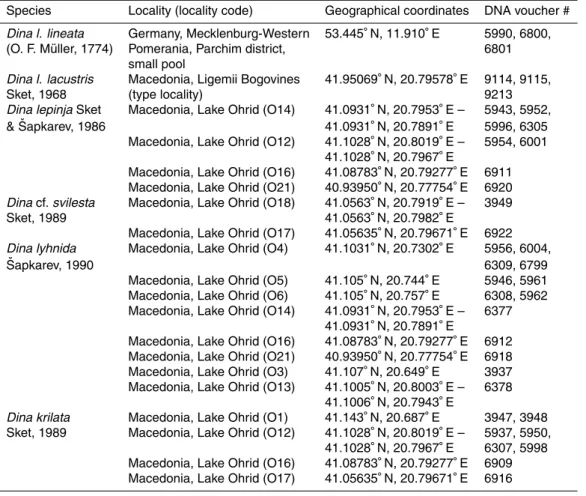
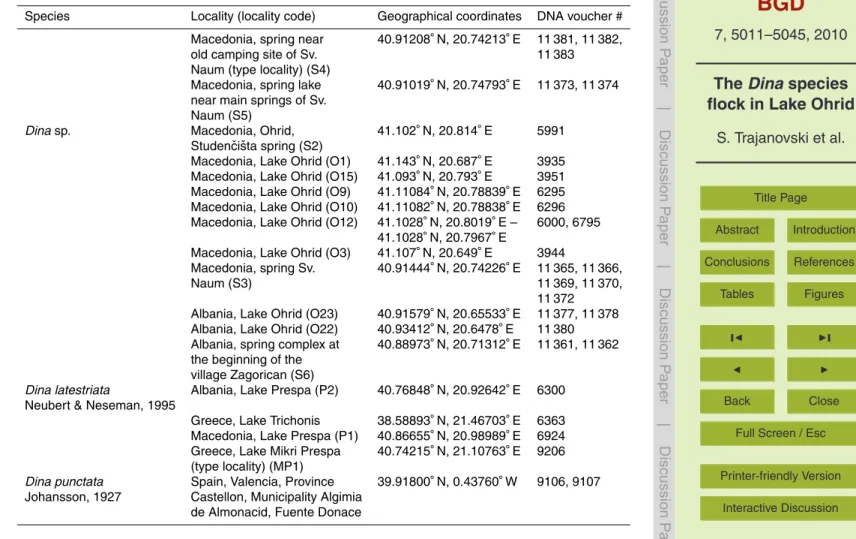
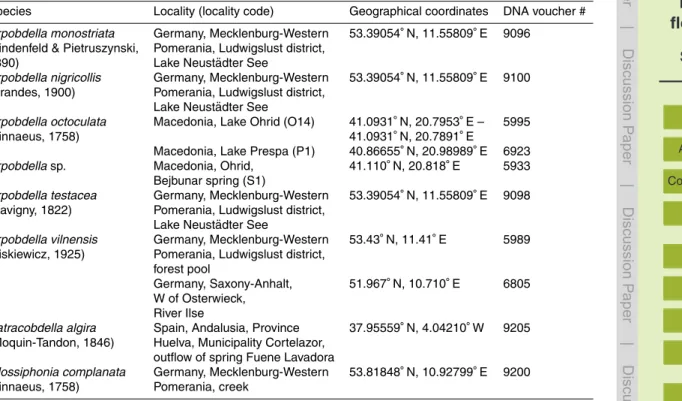
Specimens of nominalDinaspp. were collected from the Lake Ohrid area (lakes Ohrid, Prespa, and Mikri Prespa, including adjacent springs) between 2004 and 2009 (Fig. 1). Where possible, we included topotypical materials (Table 1). In addition, we obtained 5
specimens of the type species of the genus Dina, D. lineata, from Germany as well as topotypes ofD. lineata lacustrisfrom a small glacial lake some 34 km north of Lake Ohrid. For comparison, we also studied nominalDinaspecies from Greece and Spain as well as representatives of the closely related genusErpobdella. Specimens of Glos-siphonia complanataandBatracobdella algira(both family Glossiphoniidae) were used 10
for outgroup comparison. Genetic information of additional taxa (includingErpobdella
spp., Trocheta spp., and Mooreobdella melanostoma) were obtained from GenBank (Fig. 2).
Most of the specimens, especially from the littoral, were collected using a rectangu-lar dredge (frame dimension 400×200 mm) with a mesh size of 0.5 mm. A van Veen 15
grab (225 cm2) was utilized for collecting samples from the profundal of Lake Ohrid (depths 120, 130, 180, and 200 m). Additionally, traps were prepared in Lake Ohrid using plastic bottles filled with fish bait. Specimens from springs were gathered by hand picking from stones. If possible, taxa were identified in the field by ST with a field stereomicroscope based on the morphological (e.g., size, colour, suckers) and anatom-20
ical (e.g., atrium, cornea, testes) characteristics suggested by ˇSapkarev (1975, 1990), Lukin (1976), Sket (1981), Sket and ˇSapkarev (1986), and Nesemann and Neubert (1999). After identification, specimens were preserved in 80% ethanol for DNA work.
2.2 DNA isolation and sequencing
The method described in Wilke et al. (2006) was used for isolating DNA from individual 25
BGD
7, 5011–5045, 2010TheDinaspecies flock in Lake Ohrid
S. Trajanovski et al.
Title Page
Abstract Introduction
Conclusions References
Tables Figures
◭ ◮
◭ ◮
Back Close
Full Screen / Esc
Printer-friendly Version
Interactive Discussion
Discussion
P
a
per
|
Dis
cussion
P
a
per
|
Discussion
P
a
per
|
Discussio
n
P
a
per
of 658 base pairs (excluding 51 bp primer sequence) were LCO1490 and HCO2198 as described by Folmer et al. (1994). It should be noted that COI is the mitochondrial marker most often used in annelid molecular studies (Halanych and Janosik, 2006). Sequences (forward and reverse) were determined using the LI-COR (Lincoln, NE) DNA sequencer Long ReadIR 4200 and the Thermo Sequenase Fluorescent Labeled 5
Primer Cycle Sequencing kit (Amersham Pharmacia Biotech, Piscataway, NJ). The protein-coding COI sequences were unambiguously aligned in BioEdit 7.0.4.1 (Hall, 1999).
The first base pairs behind the 3′ end of each primer were difficult to read. We therefore uniformly cut off these parts, leaving a 592 bp-long completely overlapping 10
fragment for the COI gene. The 109 newly created sequences (GenBank accession numbers HM246525–HM246633) were used for a hierarchical set of phylogenetic and phylogeographical analyses, together with 12 sequences obtained from GenBank (for GenBank accession numbers see Fig. 2).
2.3 Phylogenetic and phylogeographical analyses
15
2.3.1 Phylogenetic analyses
A family-level phylogenetic analysis was performed using a dataset of 47 sequences from representatives ofDinaspp., Erpobdella spp.,Trocheta spp., andMooreobdella
sp., with Glossiphonia complanata and Batracobdella algira as outgroup taxa. The purpose of this analysis was to infer the position ofDina spp. from the Ohrid water-20
shed within the family Erpobdellidae and to test whether they represent an ancient lake species flock sensu Greenwood (1984) and Sch ¨on and Martens (2004). Based on preliminary phylogenetic analyses, we included only 16 taxa from Lake Ohrid in this analysis in order to avoid a possible shift of the performance of the model selection, and thus the actual phylogenetic analysis, towards intraspecific relationships. These 25
BGD
7, 5011–5045, 2010TheDinaspecies flock in Lake Ohrid
S. Trajanovski et al.
Title Page
Abstract Introduction
Conclusions References
Tables Figures
◭ ◮
◭ ◮
Back Close
Full Screen / Esc
Printer-friendly Version
Interactive Discussion
Discussion
P
a
per
|
Dis
cussion
P
a
per
|
Discussion
P
a
per
|
Discussio
n
P
a
per
|
First, we ran MrModeltest 2.0 (Nylander, 2004) in order to obtain an estimate for the general model of sequence evolution to be used in the phylogenetic analysis and to estimate the ratio of invariable sites for a test of substitutional saturation. The entropy-based test in DAMBE (Xia et al., 2003) did not reveal a substantial degree of satu-ration with the Iss for asymmetrical trees (IssAsym=0.763) being significantly lower 5
(P <0.0001) than theIss.c for symmetrical trees (IssSym=0.798).
For phylogenetic reconstruction of our family-level dataset, we conducted a Bayesian analysis in MrBayes 3.1.2 (Ronquist and Huelsenbeck, 2003) with the general GTR+I+G model suggested by the Akaike criterion of MrModeltest and a flat Dirichlet prior probability density. We performed two simultaneous independent runs, each start-10
ing with a different random tree; each run with one cold and three heated chains. The mixing of the MCMC chains of the two runs was monitored with Tracer 1.4.1 (Drum-mond and Rambaut, 2007) and the analysis was terminated after the average standard deviation of the split frequencies was smaller than 0.01. The first 25% of the sampled ∼3 million generations were discarded as burn-in.
15
2.3.2 Molecular clock analysis
Our molecular clock analysis aims at estimating the minimum age of onset of intrala-custrine speciation ofDinaspp. in Lake Ohrid (this estimate can be regarded as a po-tential minimum age of the lake; see Discussion for details) and the age of the spilt with the sister group outside Lake Ohrid (which can be potentially used to establish the 20
maximum age of the lake).
To do this, we further reduced the dataset (from hereon called molecular clock dataset) to a total of 22 specimens. They belonged to Dina spp. from Lake Ohrid, the sister taxonDina lineata, and the outgroup taxonErpobdella octoculata.
The clock analyses were conducted closely following the flowchart provided by Wilke 25
BGD
7, 5011–5045, 2010TheDinaspecies flock in Lake Ohrid
S. Trajanovski et al.
Title Page
Abstract Introduction
Conclusions References
Tables Figures
◭ ◮
◭ ◮
Back Close
Full Screen / Esc
Printer-friendly Version
Interactive Discussion
Discussion
P
a
per
|
Dis
cussion
P
a
per
|
Discussion
P
a
per
|
Discussio
n
P
a
per
is, whether a strict molecular clock can be assumed (recall that the larger family-level dataset did not show signs of saturation). As model-choice criterion, we used the Bayes factor (see Ronquist and Deans, 2010, for a review). The Bayes factorB is the
ratio of the marginal likelihoods of two given modelsM0 and M1. If the models differ
by a factor of 2 lnB>10, then modelM0 is strongly favoured (Kass and Raftery, 1995). 5
The marginal likelihood can be approximated by the harmonic mean of the likelihood values from an MCMC sample. According to Hipsley et al. (2009), an advantage of the Bayes factor compared to likelihood ratio tests is that it automatically penalizes complex models, thus guarding against overfitting.
With harmonic means of−ln=2091.07 and−ln=2095.27 for the clock and no-clock 10
models and a Bayes factor of−8.4, the more complex model (i.e., the one without clock assumption) was not favoured. The less parameter-rich strict-clock model therefore appears to be appropriate.
In the absence of a Dina-specific substitution rate, we then estimated divergence times from all clock-enforced trees of both Bayesian runs (except burn-in), utilizing the 15
trait specific COI Protostomia molecular clock rate of 1.24%±0.22% Ma for the HKY model suggested by Wilke et al. (2009). This rate has been shown to be robust among invertebrate taxa with similar biological and life-history characteristics (i.e., dioeceous subtropical or tropical taxa with a generation time of∼1 year and a body size of ap-proximately 2–50 mm). All these criteria are met byDinaspp. from the Ohrid area. 20
BGD
7, 5011–5045, 2010TheDinaspecies flock in Lake Ohrid
S. Trajanovski et al.
Title Page
Abstract Introduction
Conclusions References
Tables Figures
◭ ◮
◭ ◮
Back Close
Full Screen / Esc
Printer-friendly Version
Interactive Discussion
Discussion
P
a
per
|
Dis
cussion
P
a
per
|
Discussion
P
a
per
|
Discussio
n
P
a
per
|
It should be noted that we did not correct our clock estimates for ancestral polymor-phism since the universal Protostomia COI clock applied here is also not corrected (see Wilke et al., 2009). As the Protostomia clock, however, is based on phylogenetic events that are, on average, 3 Ma old, there might be a small bias towards the overesti-mation of divergence times for events younger than 3 Ma and towards underestioveresti-mation 5
for events older than that.
2.3.3 Network analysis
For phylogeographical analyses (both network analyses and tests for genetic structure) ofDinaspp. within the Ohrid watershed, we used sequences from a total of 87 spec-imens (from hereon called theDina dataset). First, a statistical parsimony haplotype 10
network was constructed utilizing the program TCS 1.21 (Clement et al., 2000), with the connection limit set to 95% and gaps being treated as fifth state. Then, we ran a sec-ond analysis, reducing the connection limit to 90% in an attempt to infer connections among sub-networks.
2.3.4 Test for genetic structure
15
We used the Dina dataset to perform an exact test as suggested by Raymond and Rousset (1995) and implemented in Arlequin 3.5.1.2 (Excoffier et al., 2005) to study possible genetic differentiations among taxa inhabiting different habitats (i.e., springs, littoral, sublittoral, profundal) and the role of horizontal and vertical barriers in Lake Ohrid. We feel that this test is appropriate as lineage sorting does not seem to be 20
BGD
7, 5011–5045, 2010TheDinaspecies flock in Lake Ohrid
S. Trajanovski et al.
Title Page
Abstract Introduction
Conclusions References
Tables Figures
◭ ◮
◭ ◮
Back Close
Full Screen / Esc
Printer-friendly Version
Interactive Discussion
Discussion
P
a
per
|
Dis
cussion
P
a
per
|
Discussion
P
a
per
|
Discussio
n
P
a
per
3 Results
3.1 Phylogenetic analyses
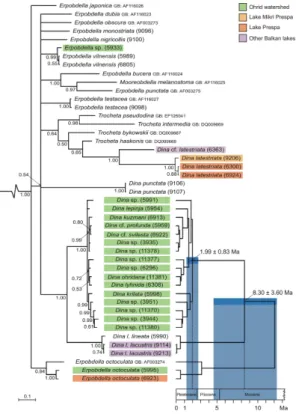
The family-level phylogenetic analysis utilizing 47 sequences from representatives of Dina spp., Erpobdella spp., Trocheta spp. and Mooreobdella sp. resulted in the majority-rule consensus tree shown in Fig. 2. In this tree, basal relationships are poorly 5
resolved, resulting in a large polytomy of several non-Ohrid taxa. All clades harbouring specimens ofDinaspp., however, are extremely well resolved, all with Bayesian pos-terior probabilities (BPP) of 1.00. Accordingly, nominalDinaspp. are not monophyletic but cluster in four different clades. The first “Dina” clade comprises specimens ofD. latestriata from Lake Mikri Prespa (topotypes) and Lake Prespa as well as a closely 10
related taxon (here calledD. cf.latestriata) from the Southern Balkan Lake Trichonis.
The second “Dina” clade consists of the two specimens of D. punctata studied from Spain. The third clade is made up of specimens of the type species of Dina, D. lin-eata, comprising representatives of nominal D. l. lineatafrom Germany and topotypes ofD. l. lacustris from a small glacial lake north of Lake Ohrid. The fourth and largest 15
Dinaclade in our study contains all and only Dina specimens from Lake Ohrid (incl. feeder springs). Thus, Lake OhridDinaforms a monophyletic group. This fourth clade is sister to theDinaclade comprising the type species of the genus. The sister-group relationship is supported by a BPP of 1.00. TheDina clade from Lake Ohrid shows a very shallow phylogenetic structure and nominal taxa are, in part, not well resolved. 20
BGD
7, 5011–5045, 2010TheDinaspecies flock in Lake Ohrid
S. Trajanovski et al.
Title Page
Abstract Introduction
Conclusions References
Tables Figures
◭ ◮
◭ ◮
Back Close
Full Screen / Esc
Printer-friendly Version
Interactive Discussion
Discussion
P
a
per
|
Dis
cussion
P
a
per
|
Discussion
P
a
per
|
Discussio
n
P
a
per
|
3.2 Molecular clock analyses
The molecular clock analyses (Fig. 2) indicate that the monophyletic group of endemic
Dinaspecies from the Lake Ohrid watershed (hence called Lake Ohrid Dinaflock) is relatively young. The most recent common ancestor (MRCA) of extant species of this flock is estimated to be 1.99 Ma old with a 95% confidence interval of ±0.83 Ma. 5
This estimate is based on an average node depth of 0.0246±0.0093 and a clock rate of 0.0124±0.0022 Ma−1for the HKY model (see Materials and methods section). The split of the Lake OhridDinaflock from its presumed sister taxon outside the lake (i.e.,Dina lineata) is estimated to have occurred 8.30 Ma ago with a confidence interval of ±3.60 Ma (average node depth 0.129±0.041).
10
3.3 Network analyses
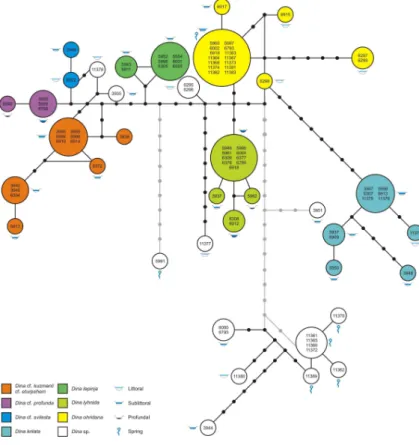
The network analysis applying a 95% connection limit resulted in four distinct sub-networks (Fig. 3). The first and by far the largest sub-network consists of all specimens belonging toD. cf.kuzmani/cf.eturpshem,D. cf.profunda,D. cf.svilesta,D. krilata,D.
lepinja,D. lyhnida, D. ohridanaas well as four undetermined haplotypes (Dinaspp.). 15
The second sub-network comprises eleven undetermined specimens with a total of seven haplotypes, whereas sub-networks three and four comprise only one undeter-mined haplotype. If the connection limit is lowered to 90%, all sub-networks became interconnected (see grey lines in Fig. 2).
On the one hand, a number of specimens could not be unambiguously assigned to 20
nominal species and substitutional differences among species are generally low. On the other hand, specimens of most morphologically distinct taxa share haplotypes or cluster together. This observed pattern, together with a number of reticulations seen in the networks, indicates that lineage sorting in Lake OhridDinaspp. is still not fully complete.
25
BGD
7, 5011–5045, 2010TheDinaspecies flock in Lake Ohrid
S. Trajanovski et al.
Title Page
Abstract Introduction
Conclusions References
Tables Figures
◭ ◮
◭ ◮
Back Close
Full Screen / Esc
Printer-friendly Version
Interactive Discussion
Discussion
P
a
per
|
Dis
cussion
P
a
per
|
Discussion
P
a
per
|
Discussio
n
P
a
per
shared by specimens collected from different vertical zones such as littoral/sublittoral as well as sublittoral/profundal. There are, however, no haplotypes shared by spec-imens from all three vertical zones and there are no clusters of specspec-imens from the littoral and profundal. As for the horizontal distribution (i.e., springs vs. lake proper), all spring haplotypes are highly distinct from lake haplotypes except for the most common 5
haplotype in our dataset, which is shared by a total of 14 specimens from springs and the lake itself.
3.4 Test for genetic structure
The exact test for pairwise sample differences based on haplotype frequencies did not reject the global null hypothesis of panmixia of population from different vertical zones 10
(Table 2). However, there are significant pairwise differences between haplotypes from springs and all lake habitats.
4 Discussion
4.1 Phylogenetic position of the Lake OhridDina flock
In Europe, the Erpobdellidae is the predominant leech family with three species-rich 15
nominal genera,ErpobdellaBlainville, 1918,TrochetaDutrochet, 1817, andDina Blan-chard, 1892. The latter genus comprises at least 24 species and subspecies (Nese-mann and Neubert, 1999; Grosser et al., 2007; Grosser and Eiseler, 2008).
Systematics and phylogeny of the family, however, are still discussed controversially. Siddall (2002), for example, has argued that the morphological and anatomical char-20
BGD
7, 5011–5045, 2010TheDinaspecies flock in Lake Ohrid
S. Trajanovski et al.
Title Page
Abstract Introduction
Conclusions References
Tables Figures
◭ ◮
◭ ◮
Back Close
Full Screen / Esc
Printer-friendly Version
Interactive Discussion
Discussion
P
a
per
|
Dis
cussion
P
a
per
|
Discussion
P
a
per
|
Discussio
n
P
a
per
|
and Siddall, 2004; Oceguera-Figueroa et al., 2005), other workers argued that there are morphological characters that can be used to distinguish at least some of the above genera (e.g., Hovingh, 2004) and continued to treatDinaand Trochetaas valid (e.g., Pfeiffer et al., 2005; Grosser et al., 2007; Grosser and Eiseler, 2008).
Whereas we did find EuropeanDinato be paraphyletic in our dataset as previously 5
suggested by Siddall (2002), we also foundDinaspecimens from Lake Ohrid to form a monophyletic clade with the type species of Dina, D. lineata, as its sister taxon. Moreover,Dinaspp. from Lake Ohrid could be unambiguously distinguished from Er-pobdella, sympatrically occurring in the lake (see Fig. 1). Pending a comprehensive revision of the family Erpobdellidae, we therefore prefer to retain the genus nameDina
10
for the clade comprising the endemic Lake Ohrid taxa and the type species of the genus.
Our phylogenetic analysis not only showed the Ohrid Dina species to be mono-phyletic, it also revealed a number of genetically (and morphologically) distinct taxa that may represent new species. Sket (1989) and Sket and ˇSapkarev (1992) had al-15
ready suspected the existence of at least two undescribed species. The occurrence of cryptic species is not unusual in leeches as demonstrated recently for the medicinal leeches (Trontelj and Utevsky, 2005; Siddall et al., 2007). Overall, the total number of species within the Lake OhridDinaflock remains unknown, largely because of a conflict between morphological and molecular data (which, in turn, could be due to incomplete 20
lineage sorting). Thus future studies based on detailed anatomical analyses and fast-evolving nuclear markers would have to address this problem.
Interestingly, we also found one taxon, “Dina” latestriata, which had been described from Lake Mikri Prespa, not to belong to the Ohrid group (Fig. 2), corroborating the faunal distinctness of Lake Ohrid. Such distinctness has been suggested before based 25
BGD
7, 5011–5045, 2010TheDinaspecies flock in Lake Ohrid
S. Trajanovski et al.
Title Page
Abstract Introduction
Conclusions References
Tables Figures
◭ ◮
◭ ◮
Back Close
Full Screen / Esc
Printer-friendly Version
Interactive Discussion
Discussion
P
a
per
|
Dis
cussion
P
a
per
|
Discussion
P
a
per
|
Discussio
n
P
a
per
As to the question whether the Ohrid group, indeed, represents an ancient lake species flock, the conservative species flock definition by Greenwood (1984) is based on the following criteria: speciosity, monophyly and endemicity. All these criteria are met by theDinaspecies in Lake Ohrid. For this reasoning, we fully support Sket (1989) in that the endemic species of Lake Ohrid represent an ancient lake species flock. 5
It should be noted thatD. lineata, the presumably widespread type species, is also mentioned in the literature for Lake Ohrid (e.g., Sket and ˇSapkarev, 1992), though the researchers state that they are not certain as to the species identification because only juvenile specimens were studied. Our sampling indicates thatD. lineataoccurs in the vicinity of Lake Ohrid, but we were unable to find it in the actual lake.
10
4.2 Horizontal and vertical zonation ofDinaspp. in Lake Ohrid
The relatively high rate of intralacustrine speciation within the Lake OhridDina flock raises questions about whether there are distinct horizontal and vertical barriers or gradients in the lake that may have promoted evolutionary events. The role of such barriers has been discussed in the literature for more than 50 years (e.g., Hadˇziˇsˇce, 15
1956; Hubendick, 1960; Radoman, 1985). Two of the most prominently considered barriers in the Ohrid watershed are the horizontal differentiation of species occurring in springs and the lake proper and the vertical differentiation of taxa (species and sub-species) occurring above and below theCharabelt (i.e., an almost continuous belt of
Charaalgae in the lower littoral, impeding migration of benthic invertebrates; for details 20
see Albrecht and Wilke, 2008).
Whereas several cases of horizontal zonations between springs and the lake proper have been reported (e.g., Radoman, 1983; Albrecht et al., 2006, 2008; Albrecht and Wilke, 2008; Wysocka et al., 2008; also see Hauffe et al., 2010), strong vertical bar-riers or gradients within the lake remain mostly hypothetical (e.g., Hadˇziˇsˇce, 1956; 25
BGD
7, 5011–5045, 2010TheDinaspecies flock in Lake Ohrid
S. Trajanovski et al.
Title Page
Abstract Introduction
Conclusions References
Tables Figures
◭ ◮
◭ ◮
Back Close
Full Screen / Esc
Printer-friendly Version
Interactive Discussion
Discussion
P
a
per
|
Dis
cussion
P
a
per
|
Discussion
P
a
per
|
Discussio
n
P
a
per
|
few groups that inhabit all vertical zones of Lake Ohrid, ranging from the littoral to the profundal.
Our findings for the horizontal zonation of haplotypes from spring and lake popu-lations corroborate the role of lake-side springs, particularly of the southern feeder springs, for evolutionary processes in endemic Lake Ohrid taxa. This, in turn, 5
raises questions as to the role of isolation of lake and spring populations for al-lopatric/parapatric speciation, and why these springs, which probably were repeatedly inundated by the lake during evolutionary times (for lake-level fluctuations see Lezine et al., 2010; Lindhorst et al., 2010), continue to harbor highly distinct haplotypes. Some researchers have even raised the question as to whether the feeder springs of Lake 10
Ohrid are possibly older than the actual lake, and whether these spring populations may be the ancestors of the respective lake faunas (e.g., Albrecht et al., 2006; Al-brecht and Wilke, 2008). While we see no good evidence for a common spring origin of lake taxa in our dataset, we would like to raise awareness about some of the old haplotypes or groups of haplotypes in spring populations of Dina spp. and advocate 15
future detailed population genetic studies of these highly interesting populations. Regarding a vertical differentiation of lake taxa, population differences among the vertical zones studied appear to be small (Table 2). Nonetheless, some structure is ob-vious from the vertical (littoral, sublittoral, profundal) distribution of haplotypes plotted in Fig. 3. Accordingly, specimens from the littoral and profundal never share haplo-20
types, whereas specimens from adjacent depth zones do. However, haplotypes from profundal specimens are much less distinct than haplotypes from spring specimens (see above). Therefore, we have some doubts whether these specimens from greater depths have significantly contributed to the Dina-diversity seen in Lake Ohrid today, and we see no evidence that these specimens hold a reservoir function within Lake 25
BGD
7, 5011–5045, 2010TheDinaspecies flock in Lake Ohrid
S. Trajanovski et al.
Title Page
Abstract Introduction
Conclusions References
Tables Figures
◭ ◮
◭ ◮
Back Close
Full Screen / Esc
Printer-friendly Version
Interactive Discussion
Discussion
P
a
per
|
Dis
cussion
P
a
per
|
Discussion
P
a
per
|
Discussio
n
P
a
per
4.3 Evolutionary evidence and the time frame for the origin of Lake Ohrid
As stated in the Introduction, the exact age of Lake Ohrid is unknown (for a review of available data see Albrecht and Wilke, 2008). Whereas there is newer geological data for the time frame for the formation of the Ohrid Graben (i.e., 5–8 Ma; Dumurdzanov et al., 2004), most information about the limnological age of the actual lake is directly or 5
indirectly based on geological studies of Cviji´c (1911: 716), who wrote that “the Ohrid valley probably originated during the Pliocene”. Later, Stankovi´c (1960) referred to Cviji´c (1911) and suggested that the Ohrid Basin was formed at the end of the Pliocene. Other researchers (e.g., Spirkovski et al., 2001) even considered an age of Lake Ohrid of up to 10 Ma, but without stating on which evidence this information is based. There 10
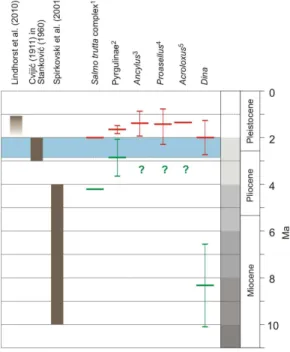
is, however, new data for the limnological age of Lake Ohrid from Lindhorst et al. (2010). Based on sediment thickness and estimated sedimentation rates, the authors suggest a minimum age of 1.1 Ma (Fig. 4).
Given the conflicting geological information on the age of Lake Ohrid, molecular clock estimates of major evolutionary events in Lake Ohrid species flocks may help to refine 15
these dates by establishing lower and upper constraints.
The upper constraint could come from the onset of speciation in those species flocks. If we assume that speciation occurred intralacustrine, the first divergence event in the respective flock would constitute the minimum age of Lake Ohrid because at this time, the lake must have already existed. In contrast, if we calculate the divergence time of 20
the MRCA of lake taxa with the presumed sister taxon from outside the lake then we would receive a potential maximum age for the lake. Of course, to do so, we would have to assume that the divergence event happened outside the lake and that the lake did not already exist at that time. Whereas data on, for example, the population structure and ecology of the taxa involved may help to provide some evidence for that, these 25
BGD
7, 5011–5045, 2010TheDinaspecies flock in Lake Ohrid
S. Trajanovski et al.
Title Page
Abstract Introduction
Conclusions References
Tables Figures
◭ ◮
◭ ◮
Back Close
Full Screen / Esc
Printer-friendly Version
Interactive Discussion
Discussion
P
a
per
|
Dis
cussion
P
a
per
|
Discussion
P
a
per
|
Discussio
n
P
a
per
|
statistic suggested here is highly conservative. If, for example, a particular species flock is not completely sampled, then this could lead to an underestimation of divergence times and therefore of the minimum age of Lake Ohrid, but never to an overestimation (for details of potential sampling biases in molecular clock estimations see Fig. 5 in Wilke et al., 2009). In contrast, if the actual sister species of a particular species flock 5
is not sampled but only a more distantly related taxon instead, then this could lead to an overestimation (but not underestimation) of divergence times and therefore the maximum age of Lake Ohrid (see Wilke, 2004 and Wilke et al., 2009 for details).
The molecular clock analyses conducted here for Lake OhridDina(Fig. 2) indicate that the MRCA of extant species of this flock is approximately 1.99 Ma old with a confi-10
dence interval of ±0.83 Ma. The age of the split of the OhridDinaflock from its sister taxon outside the lake (i.e.,Dina lineata) is estimated at 8.30±3.60 Ma. The upper limit shows good concordance with the minimum ages for other endemic taxa available in the literature (Fig. 4) ranging from approximately 1.3 Ma for the limpet genusAcroloxus
in Lake Ohrid (Albrecht and Wilke, 2006) to some 2 Ma for the endemicSalmo trutta
15
complex (Suˇsnik et al., 2006).
Considerably less data is available for the lower constraint, which also shows a higher variability. Estimates for the split of endemic Ohrid taxa to taxa outside the lake range from approximately 2.85±1.29 Ma for the pyrgulinid gastropod species flock (Wilke et al., 2007) to 8.30±3.60 Ma calculated here for theDinaflock.
20
Overall, the data summarized in Fig. 4 provides good support that the minimum age of Lake Ohrid is some 2 Ma. For the reasons outlined above, support for the maximum age estimation is weaker and approximately 3 Ma is a rough estimate. Interestingly, this time frame of approximately 2–3 Ma for the origin of Lake Ohrid, generated solely based on evolutionary data, almost exactly fits the time frame most often used in the literature 25
BGD
7, 5011–5045, 2010TheDinaspecies flock in Lake Ohrid
S. Trajanovski et al.
Title Page
Abstract Introduction
Conclusions References
Tables Figures
◭ ◮
◭ ◮
Back Close
Full Screen / Esc
Printer-friendly Version
Interactive Discussion
Discussion
P
a
per
|
Dis
cussion
P
a
per
|
Discussion
P
a
per
|
Discussio
n
P
a
per
Acknowledgements. The work was supported by German Research Foundation grants Wi1901/8-1, AL 1076/3-1, and MAK 17/1/06 to TW, CA, and ST, respectively. We thank Jonce A. ˇSapkarev for sharing his expert knowledge onDinaspp. Uwe Jueg provided valuable out-group samples. Silvia Nachtigall is gratefully acknowledged for helping with the molecular lab work.
5
References
Albrecht, C., Hauffe, T., Schreiber, K., and Wilke, T.: Mollusc biodiversity and endemism in the putative ancient Lake Trichonis (Greece), Malacologia, 51, 357–375, 2009.
Albrecht, C. and Wilke, T.: Testing the “old lakes – old taxa assumption”: freshwater limpets (Gastropoda: Acroloxidae) in the European ancient lakes, Berl. Pal ¨aobiol. Abh., 9, 7, 2006.
10
Albrecht, C., Trajanovski, S., Kuhn, K., Streit, B., and Wilke, T.: Rapid evolution of an ancient lake species flock: freshwater limpets (Gastropoda: Ancylidae) in the Balkan Lake Ohrid, Org. Divers. Evol., 6, 294–307, 2006.
Albrecht, C. and Wilke, T.: Lake Ohrid: biodiversity and evolution, Hydrobiologia, 615, 103–140, 2008.
15
Albrecht, C., Wolff, C., Gl ¨oer, P., and Wilke, T.: Concurrent evolution of ancient sister lakes and sister species: the freshwater gastropod genusRadix in lakes Ohrid and Prespa, Hydrobi-ologia, 615, 157–167, 2008.
Apakupakul, K., Siddall, M. E., and Burreson, E. M.: Higher-level relationships of leeches (An-nelida: Clitellata: Euhirudinea) based on morphology and gene sequences, Mol. Phylogenet.
20
Evol., 12, 350–359, 1999.
Benton, M. J.: The Red Queen and the Court Jester: species diversity and the role of biotic and abiotic factors through time, Science, 323(5915), 728–732, 2009.
Borda, E. and Siddall, M. E: Arhynchobdellida (Annelida: Oligochaeta: Hirudinidae): phyloge-netic relationships and evolution, Mol. Phylogenet. Evol., 30, 213–225, 2004.
25
Brooks, J. L.: Speciation in ancient lakes, Q. Rev. Biol., 25, 30–60, 131–176, 1950.
BGD
7, 5011–5045, 2010TheDinaspecies flock in Lake Ohrid
S. Trajanovski et al.
Title Page
Abstract Introduction
Conclusions References
Tables Figures
◭ ◮
◭ ◮
Back Close
Full Screen / Esc
Printer-friendly Version
Interactive Discussion
Discussion
P
a
per
|
Dis
cussion
P
a
per
|
Discussion
P
a
per
|
Discussio
n
P
a
per
|
Cohen, A.: Extinction in ancient lakes: biodiversity crises and conservation 40 yr after J. L. Brooks, in: Speciation in Ancient Lakes, edited by: Martens, K., Gooderis, B., and Coul-ter, G., Arch. Hydrobiol. – Ergebnisse der Limnologie, 44, 451–479, 1994.
Cohen, A.: Paleolimnology. The history and evolution of lake systems, Oxford University Press, New York, 2003.
5
Cohen, A. S., Stone, J. R., Beuning, K. R. M., Park, L. E., Reinthal, P. N., Dettman, D., Scholz, C. A., Johnson, T. C., King, J. W., Talbot, M. R., Brown, E. T., and Ivory, S. J.: Ecological consequences of early Late Pleistocene megadroughts in tropical Africa, P. Natl. Acad. Sci. USA, 104, 16422–16427, 2007.
Cviji´c, J.: Fundamentals of geography and geology of Macedonia and Old Serbia, Book III,
10
Serbian Academy of Sciences, Special Edition, Beograd (in Serbian), 1911.
Degens, E. T., von Herzen, R. P., Wong, M. K., Deuser, W. G., and Jannasch, H. W.: Lake Kivu: structure, chemistry and biology of an East African rift lake, Geol. Rundsch., 62, 245–277, 1973.
Drummond, A. J. and Rambaut, A.: BEAST: bayesian evolutionary analysis by sampling trees,
15
BMC Evol. Biol., 7, 214, doi:10.1186/1471-2148-7-214, 2007.
Dumurdzanov, N., Serofimovski, T., and Burchfield, B. C.: Evolution of the neogene-pleistocene basins of Macedonia, Geol. Soc. Am. Digital Map Chart Series 1, 1–20, 2004.
Excoffier, L., Laval, G., and Schneider, S.: Arlequin (version 3.0): an integrated software pack-age for population genetics data analysis, Evol. Bioinform., 1, 47–50, 2005.
20
Folmer, O., Black, M., Hoeh, W., Lutz, R. A., and Vrijenhoek, R. C.: DNA primers for amplifi-cation of mitochondrial cytochrome c oxidase subunit I from diverse metazoan invertebrates, Mol. Mar. Biol. Biotech., 3, 294–299, 1994.
Genner, M. J., Knight, M. E., Haesler, M. P., and Turner, G. F.: Establishment and expansion of Lake Malawi rock fish populations after a dramatic Late Pleistocene lake level rise, Mol.
25
Ecol., 19, 170–182, 2010.
Greenwood, P. H.: What is a species flock? in: Evolution of fish species flocks, edited by: Echelle, A. A. and Kornfield, I., Orono Press, Maine, 13–19, 1984.
Grosser, C. and Eiseler, B.: Beschreibung vonDina pseudotrochetasp. nov. (Hirudinea: Er-pobdellidae) aus dem deutsch-belgischen Grenzgebiet, Lauterbornia, 65, 27–41, 2008.
30
BGD
7, 5011–5045, 2010TheDinaspecies flock in Lake Ohrid
S. Trajanovski et al.
Title Page
Abstract Introduction
Conclusions References
Tables Figures
◭ ◮
◭ ◮
Back Close
Full Screen / Esc
Printer-friendly Version
Interactive Discussion
Discussion
P
a
per
|
Dis
cussion
P
a
per
|
Discussion
P
a
per
|
Discussio
n
P
a
per
Hadˇziˇsˇce, S.: III. Beitrag zur Kenntnis der Gastropodenfauna des Ohridsees, Beschreibung der bis jetzt unbekannten Schnecken und Beispiele der Speciation bei den Gastropoden des Ohridsees, Recl. Trav. Station Hydrobiol. Ohrid, 4, 57–107, 1956.
Halanych, K. M. and Janosik, A. M.: A review of molecular markers used for Annelid phyloge-netics, Integr. Comp. Biol., 46, 533–543, 2006.
5
Hall, T. A.: BioEdit: a user-friendly biological sequence alignment editor and analysis program for Windows 95/98/NT, Nucl. Acids S., 41, 95–98, 1999.
Hauffe, T., Albrecht, C., Schreiber, K., Trajanovski, S., and Wilke, T.: Spatially explicit analyses of gastropod compositions in ancient Lake Ohrid reveal a hierarchical distribution of endemic taxa and distinct biodiversity hotspots, Biogeosciences Discuss., submitted, 2010.
10
Hauswald, A.-K., Albrecht, C., and Wilke, T.: Testing two contrasting evolutionary patterns in ancient lakes: species flock vs. species scatter in valvatid gastropods of Lake Ohrid, Hydro-biologia, 615, 169–179, 2008.
Hipsley, C. A., Himmelmann, L., Metzler, D., and M ¨uller, J.: Integration of Bayesian molecular clock methods and fossil-based soft bounds reveals early Cenozoic origin of African lacertid
15
lizards, BMC Evol. Biol., 9, 151, 2009.
Hovingh, P.: Erpobdella (Dina) parva complex (Annelida: Hirudinea: Arhynchobdellida: Er-pobdellidae): additional description of Erpobdella parva, E. dubia, and E. lahontana and taxonomic revision, Hydrobiologia, 517, 89–105, 2004.
Hubendick, B.: The Ancylidae of Lake Ochrid and their bearing on intralacustrine speciation, P.
20
Zool. Soc. Lond., 133, 497–529, 1960.
Kass, R. E. and Raftery, A. E.: Bayes factors, J. Am. Stat. Assoc, 90, 773–795, 1995.
Kashiwaya, K., Ryugo, M., Horii, M., Sakai, H., Nakamura, T., and Kawai, T.: Climato-limnological signals during the past 260 000 yr in physical properties of bottom sediments from Lake Baikal, J. Paleolimnol., 21, 143–150, 1999.
25
L ´ezine, A.-M., von Grafenstein, U., Andersen, N., Belmecheri, S., Bordon, A., Caron, B., Cazet, J.-P., Erlenkeuser, H., Fouache, E., Grenier, C., Huntsman-Mapila, P., Hureau-Mazaudier, D., Manelli, D., Mazaud, A., Robert, C., Sulpizio, R., Tiercelin, J.-J., Zanchetta, G., and Zeqollari, Z.: Lake Ohrid, Albania, provides an exceptional multi-proxy record of envi-ronmental changes during the last glacial–interglacial cycle, Palaeogeogr. Palaeoclimatol.
30
BGD
7, 5011–5045, 2010TheDinaspecies flock in Lake Ohrid
S. Trajanovski et al.
Title Page
Abstract Introduction
Conclusions References
Tables Figures
◭ ◮
◭ ◮
Back Close
Full Screen / Esc
Printer-friendly Version
Interactive Discussion
Discussion
P
a
per
|
Dis
cussion
P
a
per
|
Discussion
P
a
per
|
Discussio
n
P
a
per
|
Lindhorst, K., Vogel, H., Krastel, S., Wagner, B., Hilgers, A., Zander, A., Schwenk, T., Wessels, M., and Daut, G.: Stratigraphic analysis of lake level fluctuations in Lake Ohrid: an integra-tion of high resoluintegra-tion hydro-acoustic data and sediment cores, Biogeosciences Discuss., 7, 3651–3689, doi:10.5194/bgd-7-3651-2010, 2010.
Lukin, E. I.: Fauna SSSR. Pijavki, T. 1. Izd. Nauka, Leningrad, 1976.
5
Martens, K.: Speciation in ancient lakes (review), Trends Ecol. Evol., 12, 177–182, 1997. Martens, K., Coulter, G., and Goddeeris, B.: Speciation in ancient lakes – 40 yr after Brooks,
in: Speciation in Ancient Lakes, edited by: Martens, K., Gooderis, B., and Coulter, G., Arch. Hydrobiol., 44, 75–96, 1994.
Mourguiart, P. and Montenegro, M. E.: Climate changes in the Lake Titicaca area: evidence
10
from ostracod ecology, Geophys. Monograph., 131, 151–165, 2002.
Nesemann, H. and Neubert, E.: Annelida, Clitellata: Branchiobdellida, Acanthobdellea, Hirudinea, S ¨ußwasserfauna von Mitteleuropa IX, Spektrum Verlag, Heidelberg, 1999. Nylander, J. A. A.: MrModeltest v2. Program distributed by the author. Evolutionary Biology
Centre, Uppsala University, 2004.
15
Oceguera-Figueroa, A., Le ´on-R `egagnon, V., and Siddall M. E.: Phylogeny and revision of Er-pobdelliformes (Annelida, Arhynchobdellida) from Mexico based on nuclear and mithochon-drial gene sequences, Rev. Mex. Biodiv., 76, 191–198, 2005.
Pfeiffer, I., Brenig, B., and Kutschera, U.: The occurrence of an Australian leech species (genus
Helobdella) in German freshwater habitats as revealed by mitochondria DNA sequences,
20
Mol. Phylogenet. Evol., 33, 214–219, 2004.
Pfeiffer, I., Brenig, B., and Kutschera, U.: Molecular phylogeny of selected predaceous leeches with reference to the evolution of body size and terrestrialism, Theor. Biosci., 124, 55–64, 2005.
Phillips, A. J. and Siddall, M. E.: Poly-paraphyly of Hirudinidae: many lineages of medicinal
25
leeches, BMC Evol. Biol., 9, 246, doi:10.1186/1471-2148-9-246, 2009.
Radoman, P.: Hydrobioidea, a superfamily of Prosobranchia (Gastropoda), I. Systematics, Ser-bian Academy of Sciences and Arts, Belgrade, 1–256, 1983.
Radoman, P.: Hydrobiodea, a superfamily of Prosobranchia, Faculty of Science – Department of Biology, Beograd, 1985.
30
BGD
7, 5011–5045, 2010TheDinaspecies flock in Lake Ohrid
S. Trajanovski et al.
Title Page
Abstract Introduction
Conclusions References
Tables Figures
◭ ◮
◭ ◮
Back Close
Full Screen / Esc
Printer-friendly Version
Interactive Discussion
Discussion
P
a
per
|
Dis
cussion
P
a
per
|
Discussion
P
a
per
|
Discussio
n
P
a
per
Ronquist, F. and Deans, A. R.: Bayesian phylogenetics and its influence on insect systematics, Annu. Rev. Entomol., 55, 189–206, 2010.
Ronquist, F. and Huelsenbeck, J. P.: MrBayes 3: Bayesian phylogenetic inference under mixed models, Bioinformatics, 19, 1572–1574, 2003.
Rossiter, A. and Kawanabe, H.: Ancient lakes: biodiversity, ecology and evolution, Advances in
5
ecological research, Vol. 31, Academic Press, London New York, 1–624, 2000. ˇ
Sapkarev, J. A.: Sistematika i rasprostranjenje pijavica (Hirudinea) Makedonije (Taxonomy and distribution of leeches (Hirudinea) from Macedonia), Biosistematika, 1, 87–99, 1975. ˇ
Sapkarev, J.: New leeches (Hirudinea) of the ancient Lake Ohrid, Fragmenta Balcanica, 14, 155–162, 1990.
10
Scholz, C. A., Johnson, T. C., Cohen, A. S., King, J. W., Peck, J. A., Overpeck, J. T., Tal-bot, M. R., Brown, E. T., Kalindekafe, L., Amoako, P. Y. O., Lyons, R. P., Shanahan, T. M., Casta ˜neda, I. S., Heil, C. W., Forman, S. L., McHargue, L. R., Beuning, K. R., Gomez, J., and Pierson, J.: East African megadroughts between 135 and 75 thousand years ago and bearing on early-modern human origins, P. Natl. Acad. Sci. USA, 104(42), 16416–16421,
15
2007.
Sch ¨on, I. and Martens, K.: Adaptive, pre-adaptive and non-adaptive components of radiations in ancient lakes, a review, Org. Div. Evol., 4, 137–156, 2004.
Schultheiß, R., Albrecht, C., B ¨oßneck, U., and Wilke, T.: The neglected side of speciation in ancient lakes: phylogeography of an inconspicuous mollusc taxon in lakes Ohrid and Prespa,
20
Hydrobiologia, 615, 141–156, 2008.
Schultheiß, R., Van Bocxlaer, B., Wilke, T., and Albrecht, C.: Old fossils-young species: on the evolutionary history of an endemic gastropod assemblage in Lake Malawi, P. Roy. Soc. Lond. B Bio., 276, 2837–2846, 2009.
Sherbakov, D. Y.: Molecular phylogenetic studies on the origin of biodiversity in Lake Baikal,
25
Trends Ecol. Evol., 14, 92–95, 1999.
Siddall, M. E.: Phylogeny of the leech family Erpobdellidae (Hirudinida: Oligochaeta), Invertebr. Syst., 16, 1–6, 2002.
Siddall, M. E. and Burreson, E. M.: Phylogeny of leeches (Hirudinea) based on mitochondrial cytochrome c oxidase subunit I, Mol. Phylogenet. Evol., 9, 156–162, 1998.
30
medici-BGD
7, 5011–5045, 2010TheDinaspecies flock in Lake Ohrid
S. Trajanovski et al.
Title Page
Abstract Introduction
Conclusions References
Tables Figures
◭ ◮
◭ ◮
Back Close
Full Screen / Esc
Printer-friendly Version
Interactive Discussion
Discussion
P
a
per
|
Dis
cussion
P
a
per
|
Discussion
P
a
per
|
Discussio
n
P
a
per
|
Sket, B.: Rhynchobdellid leeches (Hirudinea, Rhynchobdellae) in the relic Ohrid Lake region, Biol. Vestnik, 29, 67–90, 1981.
Sket, B.: Intralacustrine speciation in the genusDina(Hirudinea, Erpobdellidae) in Lake Ohrid (Yugoslavia), Hydrobiologia, 18, 4–58, 1989.
Sket, B., Dov `e, P., Jalˇziˇc, B., Kerovec, M., Kuˇcini´c, M., and Trontelj, P.: A cave leech (Hirudinea,
5
Erpobdellidae) from Croatia with unique morphological features, Zool. Scr., 30, 223–229, 2001.
Sket, B. and ˇSapkarev, J.:Dina lepinjasp. n. (Hirudinea, Erpobdellidae), a new endemic leech from the ancient Lake Ohridsko Ezero, Biol. Vestnik, 34, 89–92, 1986.
Sket, B. and ˇSapkarev, J.: Distribution of Hirudinea (Annelida) in the ancient Ohrid Lake region,
10
Arch. Hydrobiol., 124, 225–237, 1992.
Spirkovski, Z., Avramovski, O., and Kodzoman, A.: Watershed management in the Lake Ohrid region of Albania and Macedonia, Lake Reserv. Manage., 6, 237–242, 2001.
Stankovi´c, S.: The Balkan Lake Ohrid and is Living World. Monographiae Biologicae Vol. IX. Uitgeverij Dr. W. Junk, Den Haag, 1960.
15
Sturmbauer, C., Baric, S., Salzburger, W., Ruber, L., and Verheyen, E.: Lake level fluctuations synchronize genetic divergences of cichlid fishes in African lakes, Mol. Biol. Evol., 18, 144– 154, 2001.
Sulpizio, R., Zanchetta, G., D’Orazio, M., Vogel, H., and Wagner, B.: Tephrostratigraphy and tephrochronology of lakes Ohrid and Prespa, Balkans, Biogeosciences Discuss., 7, 3931–
20
3967, doi:10.5194/bgd-7-3931-2010, 2010.
Suˇsnik, S., Knizhin, I., Snoj, A., and Weiss, S.: Genetic and morphological characterization of a Lake Ohrid endemic,Salmo(Acantholingua)ohridanuswith a comparison to sympatric
Salmo trutta, J. Fish Biol., 68, Supplement A, 2–23, 2006.
Trontelj, P. and Sket, B.: Molecular re-assessment of some phylogenetic, taxonomic and
bio-25
geographic relationships between the leech generaDinaandTrocheta (Hirudinea: Erpob-dellidae), Hydrobiologia, 438, 227–235, 2000.
Trontelj, P., Sket, B., Dovˇc, P., and Steinbr ¨uck, G.: Phylogenetic relationships in European erpobdellid leeches (Hirudinea: Erpobdellidae) inferred from restriction-site data of the 18S ribosomal gene and ITS2 region, J. Zool. Syst. Evol. Res., 34, 85–93, 1996.
30
BGD
7, 5011–5045, 2010TheDinaspecies flock in Lake Ohrid
S. Trajanovski et al.
Title Page
Abstract Introduction
Conclusions References
Tables Figures
◭ ◮
◭ ◮
Back Close
Full Screen / Esc
Printer-friendly Version
Interactive Discussion
Discussion
P
a
per
|
Dis
cussion
P
a
per
|
Discussion
P
a
per
|
Discussio
n
P
a
per
Utevsky, Y. S. and Trontelj, P.: Phylogenetic relationships of fish leeches (Hirudinea, Pisci-colidae) based on mitochondrial DNA sequences and morphological data, Zool. Scr., 33, 375–385, 2004.
Wagner, B., Reicherter, K., Daut, G., Wessels, M., Matzinger, A., Schwalb, A., Spirkovski, Z., and Sanxha, M.: The potential of Lake Ohrid for long-term palaeoenvironmental
reconstruc-5
tions, Palaeogeogr. Palaeoclimatol. Palaeoecol., 259, 341–356, 2008.
Wilke, T.: How dependable is a non-local molecular clock? A reply to Hausdorf et al. (2003), Mol. Phylogenet. Evol., 30, 835–840, 2004.
Wilke, T., Albrecht, C., Anistratenko, V. V., Sahin, S. K., and Yildirim, M. Z.: Testing biogeo-graphical hypotheses in space and time: faunal relationships of the putative ancient lake
10
Egirdir in Asia Minor, J. Biogeogr., 34, 1807–1821, 2007.
Wilke, T., Davis, G. M., Qiu, D., and Spear, R. C.: Extreme mitochondrial sequence diversity in the intermediate schistosomiasis hostOncomelania hupensis robertsoni: another case of ancestral polymorphism?, Malacologia, 48, 143–157, 2006.
Wilke, T., Schultheiß, R., and Albrecht, C.: As time goes by: a simple fool’s guide to molecular
15
clock approaches in invertebrates, from the symposium “Molluscs as models in evolution-ary biology: from local speciation to global radiation” presented at the World Congress of Malacology, held from 15 to 20 Jul 2007 in Antwerp, Belgium, Am. Malacol. Bull., 27, 25–45, 2009.
Wilke, T., Schultheiß, R., Albrecht, C., Bornmann, N., Trajanovski, S., and Kevrekidis, T.: Native
20
Dreissenafreshwater mussels in the Balkans: in and out of ancient lakes, Biogeosciences Discuss., 7, 4425–4461, doi:10.5194/bgd-7-4425-2010, 2010.
Wysocka, A., Kostoski, G., Kilikowska, A., Wr ´obel, B., and Sell, J.: Proasellus (Crustacea, Isopoda) species group endemic to the Balkan Lake Ohrid: a case of ecological diversifica-tion?, Fund. Appl. Limnol., 172, 301–313, 2008.
25
BGD
7, 5011–5045, 2010TheDinaspecies flock in Lake Ohrid
S. Trajanovski et al.
Title Page Abstract Introduction Conclusions References Tables Figures ◭ ◮ ◭ ◮ Back Close
Full Screen / Esc
Printer-friendly Version Interactive Discussion Discussion P a per | Dis cussion P a per | Discussion P a per | Discussio n P a per |
Table 1.Specimens of Hirudinea studied, including locality information, locality codes accord-ing to Fig. 1, and DNA voucher numbers. Nomenclature follows Nesemann and Neubert (1999). For GenBank accession numbers and information on sequences obtained from GenBank see text.
Species Locality (locality code) Geographical coordinates DNA voucher #
Dina l. lineata Germany, Mecklenburg-Western 53.445◦
N, 11.910◦
E 5990, 6800, (O. F. M ¨uller, 1774) Pomerania, Parchim district, 6801
small pool
Dina l. lacustris Macedonia, Ligemii Bogovines 41.95069◦
N, 20.79578◦
E 9114, 9115,
Sket, 1968 (type locality) 9213
Dina lepinjaSket Macedonia, Lake Ohrid (O14) 41.0931◦
N, 20.7953◦
E – 5943, 5952, & ˇSapkarev, 1986 41.0931◦
N, 20.7891◦
E 5996, 6305 Macedonia, Lake Ohrid (O12) 41.1028◦
N, 20.8019◦
E – 5954, 6001 41.1028◦N, 20.7967◦E
Macedonia, Lake Ohrid (O16) 41.08783◦
N, 20.79277◦
E 6911 Macedonia, Lake Ohrid (O21) 40.93950◦
N, 20.77754◦
E 6920
Dinacf.svilesta Macedonia, Lake Ohrid (O18) 41.0563◦
N, 20.7919◦
E – 3949 Sket, 1989 41.0563◦N, 20.7982◦E
Macedonia, Lake Ohrid (O17) 41.05635◦
N, 20.79671◦
E 6922
Dina lyhnida Macedonia, Lake Ohrid (O4) 41.1031◦
N, 20.7302◦
E 5956, 6004, ˇ
Sapkarev, 1990 6309, 6799
Macedonia, Lake Ohrid (O5) 41.105◦
N, 20.744◦
E 5946, 5961 Macedonia, Lake Ohrid (O6) 41.105◦N, 20.757◦E 6308, 5962 Macedonia, Lake Ohrid (O14) 41.0931◦
N, 20.7953◦
E – 6377 41.0931◦
N, 20.7891◦
E Macedonia, Lake Ohrid (O16) 41.08783◦
N, 20.79277◦
E 6912 Macedonia, Lake Ohrid (O21) 40.93950◦
N, 20.77754◦
E 6918 Macedonia, Lake Ohrid (O3) 41.107◦
N, 20.649◦
E 3937 Macedonia, Lake Ohrid (O13) 41.1005◦
N, 20.8003◦
E – 6378 41.1006◦
N, 20.7943◦
E
Dina krilata Macedonia, Lake Ohrid (O1) 41.143◦
N, 20.687◦
E 3947, 3948 Sket, 1989 Macedonia, Lake Ohrid (O12) 41.1028◦N, 20.8019◦E – 5937, 5950,
41.1028◦
N, 20.7967◦
E 6307, 5998 Macedonia, Lake Ohrid (O16) 41.08783◦
N, 20.79277◦
E 6909 Macedonia, Lake Ohrid (O17) 41.05635◦
N, 20.79671◦