
by Philippe Gaillot, Tim Brewer, Philippe Pezard, and En-Chao Yeh
Introduction
The Integrated Ocean Drilling Program (IODP) and the International Continental Drilling Program (ICDP) use many new technologies to increase the quality of core data. A problem with drilling deep oceanic or continental crust, as well as shallow fractured rock or karstic formations, is that core recovery can be low, and much of the recovered mate-rial often consists of small, disrupted core pieces that are frequently biased toward particular types of rocks (litholo-gies). Even when core recovery is high (in the case of sedi-mentary formation), recovered cores are not always oriented; as a result, detailed structural and paleomagnetic studies are impaired.
In contrast, logging provides nearly continuous records of the in situ chemical and physical properties of the penetrated formation, which can be used to extrapolate the various litho-logies in areas of reduced core recovery (Brewer et al., 1998).
With the advent of modern imaging tools, a fundamentally new concept has been introduced (Serra, 1989; Lovell et al., 1998). Formations are no longer scanned by a single sensors creating a single scalar log, but can be sampled multiple times horizontally and at a high rate vertically to form a dense matrix of measurements being displayed as an image. Since the mid-eighties there has been an explosive develop-ment in imaging technology, principally in terms of tools but also in terms of producing the image. The progress has been linked with the availability of downhole digitization of signals and the possibility of transmitting large data volume in real time. Where the standard logs are sampled every ~15 cm (6"), image logs may be sampled every ~0.25 cm (0.1") or less; where the standard logs have one measurement per depth point, image logs may have 360 or more.
So, digital borehole images (mm-scale) can potentially bridge the scale gap between the (dm-scale) standard logs and (µm to dm-scale) core measurements. Indeed, continuous and oriented borehole wall images provide high resolution lithologic, textural, and struc-tural information, filling infor-mation gaps where core reco-very is low and allowing orientation of cores when core recovery and undoubted fea-tures are recognized on both core and logging images. In turn, continuous and quantita-tive information extracted from these images can help in bridging the scale gap bet-ween log and the large scale (macroscopic, >100 m) proper-ties of the penetrated forma-tion. While physical principles and applications of electrical, acoustic, and optical borehole imaging tools are easily sche-matized in Fig. 1 (see http:// publications.iodp.org/sd/05/ suppl/ for details), the present paper shows some examples of quantitative analyses of electrical images that illu-strate various contributions of borehole images to a fully
inte-Figure 1. Sketch of electrical, acoustic and optical imaging tools. [A] Schlumberger Formation MicroScanner (FMS) with four pads, 16 buttons per pad, covering 25%–40% of hole diameter, and Schlumberger Fullbore Formation MicroImager (FMI) with 4 pads, 4 hinged flaps, and 24 buttons on each pad and flap. The hinged flap is able to increase coverage by up to 80% (modified from Ekstrom et al., 1987). The buttons are aligned in two rows; processes for depth corrections shift the recorded resistivity to one row. Each button consists of an electrode surrounded by insulation. [B] The Ultrasonic Borehole Imager features a high resolution transducer that provides acoustic images of the borehole wall. The transducer emits ultrasonic pulses at a frequency of 250 kHz or 500 kHz (low and high resolution, respectively), which are reflected by the borehole wall and then received by the same transducer. Amplitude and travel time of the reflected signal are then determined. [C] Optical televiewers generate a continuous oriented 360° image of the borehole wall unwrapped using an optical imaging system (downhole CCD camera which views a reflection of the borehole wall in a conic mirror- sketch of advanced logic technology ALT OBI40). Like electrical imaging tools and acoustic televiewers, the optical televiewers include a full orientation device consisting of a precision 3-axis magnetometer and 2 accelerometers, thus allowing for accurate borehole deviation data to be obtained during the same logging run and for accurate and precise orientation of the image.
Contribution of Borehole Digital Imagery in
Core-Log-Seismic Integration
doi:10.0/iodp.sd.5.07.007
Technical Developments
50
Scientific Drilling, No. 5, September 2007types) in the core. Assuming that the core recovery is high enough and features on core and borehole wall images are distinctive enough, such structural features on the core and logging FMS images can be matched and so allow the accu-rate location and orientation of individual core pieces, a key step in structural and paleomagnetic studies (MacLeod et al., 1995; Harvey and Lovell, 1998; Haggas et al., 2001). In the San Andreas Fault zone, Iturino et al (2001) used a com-bination Logging While Drilling (LWD) Resistivity At the Bit (R AB) image and core x-ray computed tomography ima-ges.
Formation scale information deduced from borehole images: Any paleoenvironmental reconstruction or investigation of large-scale geological bodies (through, upper oceanic crust, reservoir) requires the extension of the 1-D view of the bore-hole to a regional-formation scale view. The first step invol-ves a classification of the core and downhole log responses into relatively homogeneous sub-groups (units) based on (1) a lithofacies determination relying on visual core description and measurement (core units) and (2) a visual or statistical analysis of available logging data (log units). Due to the in situ and continuous nature of downhole data in respect to expensive and discontinuous nature of core data, methods based on multivariate statistics of downhole log response (electro-facies-based classification; See Ravenne, 2002 for a review.) have been developed to estimate spatial distribution of heterogeneous subsurfaces (e.g., regionalized classifica-tion relying on statistical relaclassifica-tionships between laboratory-determined hydrologic properties and field-measured geo-physical properties to estimate spatial distributions of porosity, permeability, and diagenetic characteristics; Moline and Bahr, 1995). Such methods aim to predict the lithology grated core-log-seismic
inte-gration workflow.
Case Studies
Borehole images filling lithostratigraphic core gaps: Electrical borehole wall images acquired with the Schlumberger
Formation MicroScanner
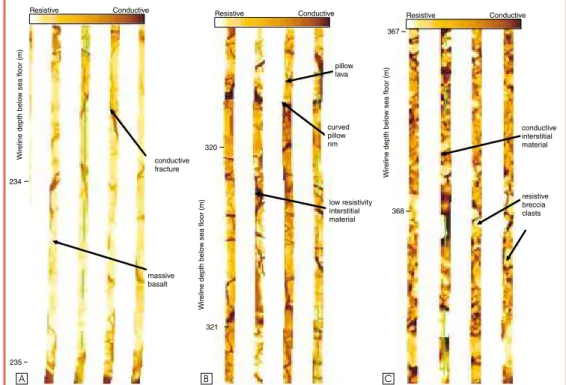
(FMS) in Ocean Drilling Program (ODP) Hole 896A are a good example of the contribu-tion of borehole images to reconstruct the lithostratigra-phy when core recovery is low (<30%) (ODP Leg 148 Shipboard Scientific Party, 1993; Alt et al., 1996). The alternative lithostra-tigraphy that is constructed by combining standard scalar log-ging data and FMS images con-tains considerably more brec-ciated units (~30%) than
suggested by the shipboard core descriptions (10%). This disparity, explained as the reflection of preferential recovery of less fractured massive flows, emphasized the necessity to fully integrate core and logging results in boreholes with reduced core recovery. In Hole 896A, different volcanic litho-logies can be identified on the FMS image data by variations in electrical conductivity (Fig. 2). Massive units appear on the FMS images as extensive areas with a uniformly low con-ductivity and predominantly straight, branching fracture patterns (Fig. 2A). Pillow lavas show variable conductivity within a small area, but this is less variable than for brec-ciated units. Individual pillow lavas can often be distin-guished on the FMS data owing to the curved nature of the pillow boundaries (Fig. 2B). Interstitial material usually has high conductivity. Breccias are characterized on the FMS image data by high conductivity, which is highly variable within a small area. The presence of small high-resistivity clasts can often be noted (Fig. 2C).
Orientation of cores using borehole images: In a more general manner, although cores obtained through ocean and continental drilling provide valuable information, recovered core pieces are often initially inaccurately located and unori-ented in a geographical reference frame. In these situations, logging image data are essential to supplement and enhance structural data from the recovered core. One core imaging tool used by ODP during ODP Leg 176 was a digital core scan device that produces 360° images of the outside of the core (Dick et al., 1999). These digital photographs can be unwrapped and displayed as 2-D images showing the core’s entire outer surface (Fig. 3). The images can then be used to locate and measure the dip and orientation of structural fea-tures (veins, fracfea-tures, boundaries between different rock
Scientific Drilling, No. 5, September 2007
51
Technical Developments
5
Scientific Drilling, No. 5, September 2007Technical Developments
Technical Developments
References
Alt, J.C., Kinoshita, H., Stokking, L.B., and Michael, P.J. (Eds.), 1996.
Proc. ODP, Sci. Results, 148. College Station, Texas (Ocean
Drilling Program).
Brewer, T.S., Harvey, P.K., Lovell, M.A., Haggas, S., Williamson, G., and Pezard, P., 1998. Ocean floor volcanism: constraints from the integration of core and downhole logging measure-ments. Geol. Soc. Lond., Spec. Publ., 136:341–362.
Dick, H.J.B., Natland, J.H., Miller, D.J., et al., 1999. Proc. ODP, Init.
Repts., 176 [Online]. Available from http://www-odp.tamu.
edu/publications/176_IR/176TOC.HTM.
Ekstrom, M. P., Dahan, C. A. Chen, M. Lloyd, P. M. and Rossi, D. J., 1987. Formation imaging with microelectrical scanning arrays. Log Analyst, 28, 294–306.Haggas, S., Brewer, T.S., Harvey, P.K., and Iturrino, G., 2001. Relocating and orient-ing cores by the integration of electrical and optical images: a case study from Ocean Drilling Program Hole 735B. J.
Geol. Soc. (London, U.K.), 158:615–623.
Haggas, S., Brewer, T.S., Harvey, P.K., and Iturrino, G., 2001. Relocating and orienting cores by the integration of electri-cal and optielectri-cal images: a case study from Ocean Drilling Program Hole 735B. J. Geol. Soc. (London, U.K.), 158:615–623.
Harvey, P.K., and Lovell, M.A., (Eds.), 1998. Core-Log Integration.
Geol. Soc. Spec. Publ., 136, 400 pp.
Iturino, G.J., Goldberg, D., and Ketcham, R., 2001. Integration of core and downhole images in the San Andreas fault zone.
EarthScope Workshop: Making and Breaking a Continent,
Snowbird, Utah, 10–12 October 2001. Abstract online at http://www.scec.org/instanet/01news/es_abstracts/Iturrino_et_al.pdf. Leg 148 Shipboard Scientific Party, 1993. Site 504. In Alt, J.C.,
Kinoshita, H., Stokking, L.B., et al., Proc. ODP, Init. Repts., 148. College Station, Texas (Ocean Drilling Program), 27– 121. Available online at http://www-odp.tamu.edu/publica-tions/148_IR/VOLUME/CHAPTERS/ir148_02.pdf. Lovell, M.A., Harvey, P.K., Brewer, T.S., Williams, C., Jackson, P.D.,
and Williamson, G., 1998. Application of FMS images in the Ocean Drilling Program: an overview. In Cramp, A., of the penetrated formation, but more widely
attempt to provide additional formation-scale hydrologic (flow unit, reservoir permeability) or geologic (structural, environmental) infor-mation. Taking into account the increase in computational power and the higher resolution and coverage of the borehole images in respect to standard logs, such methods have been gene-ralized to include borehole images information (e.g., texture) and have been coupled to mode-ling tools.
Core, borehole image, log, and formation-scale integration: Log data and digital borehole ima-ges collected from the Hole-B of the ICDP Taiwan Chelungpu-fault Drilling Project have been analyzed to establish the relationships bet-ween deformation structures and in situ stress, and to identify the rupture zone of the 7.6 Mw 1999 Chi-Chi earthquake. Based on standard scalar logs, three log units and five subunits are
recognized as consistent with lithological units defined from visual core description (Fig. 4). Analysis of the Schlumberger Fullbore Formation MicroImager (FMI) resistivity data has also been automatically performed. This analysis, relying on the local and multi-scale properties of the wavelet transform formalism, consists in measuring the number and characte-ristics (size and electrical contrast) of each electric feature recorded in the high resolution logs, and so provides new high resolution “quantitative and integrative” logs—namely, the density of electrical features (Npm), the average size (wavelength, W) and average electrical contrast (C) of the detected features. In turn, combined with visual interpreta-tion of sedimentary and structural features recognized on borehole images, these logs can be correlated to large-scale formation units and fault zones independently defined from the scalar logs and core data providing extra small-scale information on the nature of the downhole variations in natu-ral gamma radiation (NGR), electrical resistivity, and sonic velocity (Vp) (Fig. 4).
Conclusion
Digital borehole images have the same depth coverage of scalar logs, with a resolution higher than these logs and often higher than standard core logging measurements. Relying on different physical bases, imaging tools provide a palette of high resolution, continuous, and oriented 360° views of the borehole wall from which the character, relation, and orientation of lithologic and structural planar features, as well as texture, can be defined to support detailed core analyses. Analyzed with specific methods relying on multi-variate statistics or automatic extraction of quantitative attri-butes, these images and high resolution information derived from them allow filling the scale gap between core/sample measurements and large-scale formation properties, thus opening an avenue in addressing scientific challenges rela-ted to formation characterization.
Technical Developments
Scientific Drilling, No. 5, September 2007
5
Technical Developments
MacLeod, C.J., Lee, S.V., and Jones, E.J.W. (Eds.), Geological Evolution of Ocean Basins: Results from the Ocean Drilling
Program. Geol. Soc. Spec. Publ., 131:287–303.
MacLeod, C.J., Célérier, B., and Harvey, P.K., 1995. Further tech-niques for core reorientation by core-log integration: appli-cation to structural studies of lower oceanic crust in Hess Deep, eastern Pacific. Sci. Drill., 5:77–86.
Moline, G.R., and Bahr, J-M., 1995. Estimating spatial distributions of heterogeneous subsurface characteristics by regionalized classification of electrofacies. Mathemat. Geol., 27(1):3–22. Ravenne, Ch., 2002. Stratigraphy and oil: a review, part 2
characterization of reservoirs and sequence stratigraphy: quantification and modeling. Oil Gas Sci. Technol. Rev. IFP, 57:(4):311–340.
Serra, O., 1989. Formation MicroScanner Image Interpretation.
Houston, Texas (Schlumberger Educational Services), SMP-7028.
Authors
Philippe Gaillot, CDEX-IFREE, Japan Agency for Marine-Earth Science and Technology, Yokohama Institute for Marine-Earth Science, 3173-25 Showa-machi, Kanazawa-ku, Yokohama, Kanagawa, 236-0001 Japan, e-mail: [email protected]. Tim Brewer, Department of Geology – Geophysics and Borehole Research, University of Leicester, University Road, Leicester, LE1 7RH, U.K.
Philippe Pezard, Laboratoire de Géophysique et d’Hydro-dynamique en Forage, Geosciences Montpellier, University of Montpellier 2, France.
En-Chao Yeh, Department of Geosciences, National Taiwan University, No.1, Sec. 4, Roosevelt Road, Taipei 106, Taiwan.
Related Web Links
http://dx.doi.org/10.2204/iodp.proc.310.2007 http://dx.doi.org/10.2973/odp.proc.ir.176.1999
ht t p://w w w.scec.org/inst a net/01news/es _ abst racts/ Iturrino_et_al.pdf
Figure 4. ICDP Taiwan Continental Drilling Project Hole B. [A] log units; [B] core units and lithology inferred from core data; [C] standard scalar logs: natural gamma radiation (NGR), thorium (Th), uranium (U), potassium (K), mud temperature (Tmud), spontaneous potential (SP), sonic velocity (Vp), shallow and deep electrical resistivities; [D] one button Fullbore Formation MicroImager (FMI) microresistivity log; [E] averaged density (Npm), size (W), electrical contrast (C) of detected features (singularities in microresistivity log) and product P (P = Npm x W x C); [F] density of sedimentary beds and structural features and orientation of breakouts recognized from visual analysis of the FMI images.
*
**
*** -PH
B
C
D
E
F 6OJU
$PSF -JUIPMPHZ
8JSFMJOFEFQUI CFMPXHSPVOE GMPPS N
&MFDUSJDBM3FT æN
'.*CVUUPO 4IBMMPX
%FFQ
'FBUVSFTEFOTJUZ 7Q
NT
5NVE
41 6
, 5I
/(3
5FDUPOJD GFBUVSFT EFOTJUZ 1
$
8 #FEEJOH #SFBLPVU
"
/QN "VUPNBUJD.BOVBM
$ & '
# %
Co-author Dr. Tim Brewer collapsed and died on Saturday morning, 14th July, 2007, while attending a confe-rence in Barcelona. This is obviously shocking and very sad news and came as a complete surprise to everyone.
Tim was a senior member of staff in the Department of Geology at the University of Leicester but also the lead coordinator in the European Petrophysical Consortium, part of the ECORD Science Operator for the Integrated Ocean Drilling Program.

![Figure 4. ICDP Taiwan Continental Drilling Project Hole B. [A] log units; [B] core units and lithology inferred from core data; [C] standard scalar logs: natural gamma radiation (NGR), thorium (Th), uranium (U), potassium (K), mud temperature](https://thumb-eu.123doks.com/thumbv2/123dok_br/17152845.240213/4.892.70.827.109.627/continental-drilling-project-lithology-inferred-radiation-potassium-temperature.webp)
