Transcriptome
Cristian O. Rohr1, Laura N. Levin2, Alejandro N. Mentaberry3, Sonia A. Wirth3*
1Instituto de Ecologı´a, Gene´tica y Evolucio´n, Consejo Nacional de Investigaciones Cientı´ficas y Te´cnicas, Ciudad de Buenos Aires, Buenos Aires, Argentina,2Laboratorio de Micologı´a Experimental, Departamento de Biodiversidad y Biologı´a Experimental, Universidad de Buenos Aires, Ciudad de Buenos Aires, Buenos Aires, Argentina,
3Laboratorio de Agrobiotecnologı´a, Universidad de Buenos Aires, Ciudad de Buenos Aires, Buenos Aires, Argentina
Abstract
Fungi of the genusPycnoporus are white-rot basidiomycetes widely studied because of their ability to synthesize high added-value compounds and enzymes of industrial interest. Here we report the sequencing, assembly and analysis of the transcriptome ofPycnoporus sanguineusBAFC 2126 grown at stationary phase, in media supplemented with copper sulfate. Using the 454 pyrosequencing platform we obtained a total of 226,336 reads (88,779,843 bases) that were filtered andde novo assembled to generate a reference transcriptome of 7,303 transcripts. Putative functions were assigned for 4,732 transcripts by searching similarities of six-frame translated sequences against a customized protein database and by the presence of conserved protein domains. Through the analysis of translated sequences we identified transcripts encoding 178 putative carbohydrate active enzymes, including representatives of 15 families with roles in lignocellulose degradation. Furthermore, we found many transcripts encoding enzymes related to lignin hydrolysis and modification, including laccases and peroxidases, as well as GMC oxidoreductases, copper radical oxidases and other enzymes involved in the generation of extracellular hydrogen peroxide and iron homeostasis. Finally, we identified the transcripts encoding all of the enzymes involved in terpenoid backbone biosynthesis pathway, various terpene synthases related to the biosynthesis of sesquiterpenoids and triterpenoids precursors, and also cytochrome P450 monooxygenases, glutathione S-transferases and epoxide hydrolases with potential functions in the biodegradation of xenobiotics and the enantioselective biosynthesis of biologically active drugs. To our knowledge this is the first report of a transcriptome of genusPycnoporusand a resource for future molecular studies inP. sanguineus.
Citation:Rohr CO, Levin LN, Mentaberry AN, Wirth SA (2013) A First Insight intoPycnoporus sanguineusBAFC 2126 Transcriptome. PLoS ONE 8(12): e81033. doi:10.1371/journal.pone.0081033
Editor:Monika Schmoll, AIT Austrian Institute of Technology GmbH, Austria
ReceivedJune 4, 2013;AcceptedOctober 9, 2013;PublishedDecember 2, 2013
Copyright:ß2013 Rohr et al. This is an open-access article distributed under the terms of the Creative Commons Attribution License, which permits unrestricted use, distribution, and reproduction in any medium, provided the original author and source are credited.
Funding:This work was supported by Grant BID PICT2010-00394 from the Agencia Nacional para la Promocio´n de la Ciencia y la Tecnologı´a, ANPCyT (http:// www.agencia.mincyt.gob.ar/) and Grant PIP2011-2013 N 0092 from the Consejo Nacional de Investigaciones Cientı´ficas y Te´cnicas, CONICET (http://www.conicet. gov.ar/). CR is a PhD Fellow of CONICET, LL, AM and SW are Research Scientists of CONICET, Argentina. The funders had no role in study design, data collection and analysis, decision to publish, or preparation of the manuscript.
Competing Interests:The authors have declared that no competing interests exist.
* E-mail: [email protected]
Introduction
Plant cell walls are mainly composed of cellulose, hemicellulose and lignin and constitute the most abundant source of organic carbon on Earth. Though lignocellulose is highly recalcitrant to degradation, there are many organisms capable of hydrolyzing it, including members of the intestinal microflora of ruminants and the insects and fungi responsible for wood decay. Among the latter, the basidiomycetes causing white rot are particularly effective in using the lignocellulose of plant cell walls as carbon source through the synthesis of a considerable number of hydrolytic enzymes, including cellulases, hemicellulases, pectinases and also lignin-modifying enzymes and other accessory enzymes, which can be employed in a wide range of industrial processes [1]. One of the most promising applications of these enzymes is their use to process plant biomass into fermentable sugars for the production of second-generation biofuels. Additionally, many lignocellulolytic enzymes are used in the bleaching of paper and pulp, the processing of food and textiles, as additives for soaps and detergents and also as animal feed supplements [2–4]. Further-more, several lignin-modifying enzymes are non-specific phenol
oxidases and peroxidases capable of oxidizing xenobiotics such as nitroaminotoluens, chlorophenols, polycyclic aromatic hydrocar-bons, organophosphates, aromatic phenols and textile dyes, thus showing large potential as bioremediation agents [5–7]. Meeting of these demands requires bioprospecting of new enzyme sources, development of more stable biocatalysts through protein engi-neering and availability of new systems for massive enzyme production.
High-throughput sequencing facilitated the access to genomic and transcriptomic data and accelerated the process of enzyme discovering. Since the sequencing of the first white-rot fungus genome, Phanerochaete chrysosporium [8], an increasing number of genomes and transcriptomes of wood decay basidiomycetes have been reported. Except for the genomes of Schizophyllum commune
[9], Postia placenta [10] and Serpula lacrymans [11] most of the remaining were reported in 2012, including those ofCeriporiopsis subvermispora[12],Ganoderma lucidum [13]Fibroporia radiculosa[14],
Phanerochaete carnosa [15] Heterobasidion irregulare [16] Auricularia delicata, Coniophora puteana, Dacryopinax sp, Dichomitus squalens,
Trametes versicolor, Punctularia strigosozonata, Stereum hirsutum and
Wolfiporia cocos[17].
Fungi of the genus Pycnoporus are basidiomycetes that cause wood decay by white rot. There are four widely distributed species, Pycnoporus cinnabarinus, Pycnoporus puniceus, Pycnoporus sanguineus and Pycnoporus coccineus. Strains of Pycnoporus were described by their ability to synthesize compounds of high added-value, including flavors, antioxidants, antibiotics and antivirals [18–22] and as efficient producers of laccases and other enzymes of industrial interest [23–31]. Although many of these enzymes -showing high thermal stability, broad pH range, and potential in biotechnological applications-, have been purified and characterized, there is a lack of exhaustive molecular studies and no genomic or transcriptomic data is so far available for this genus. The ability ofP. sanguineus BAFC 2126, to selectively delignify loblolly pine (Pinus taeda) chips was already proven [32]. Fungal pretreatment caused changes in wood chemical composition as well as in physical structure. Experimental results showed thatP. sanguineuswas able to reduce lignin content in 11% in 14 days of treatment, and that P. taeda wood suffered notable structural changes of lignin and hemicelluloses, as revealed from 13C CP-MAS NMR spectra. An increase of 15% in porosity of decayed wood confirmed physical changes due to fungal attack. Thus, this strain is potentially a candidate for use in softwoods biopulping processes.
In this work we sequenced and analyzed the transcriptome ofP. sanguineusBAFC 2126. Since it was reported that the addition of Cu2+in culture media induces the transcription of laccase genes in white-rot fungi [33,34] and also the expression of other enzymes such as glyoxal oxidase and manganese peroxidase [35], we evaluated the transcriptome of P. sanguineus growing in media supplemented with copper sulfate. Our results provide the first reference transcriptome of the genusPycnoporusand a resource for future molecular studies inP. sanguineus.
Materials and Methods
Organism and culture conditions
P. sanguineus strain BAFC 2126 (BAFC: Mycological Culture Collection of the Department of Biological Sciences, Faculty of Exact and Natural Sciences, University of Buenos Aires) (Poly-poraceae, Aphyllophorales, Basidiomycetes) was used in this study. Stock cultures were maintained on malt extract agar slants at 4uC. Medium for fungal culture (GA medium) contained 20 g glucose, 3 g asparagine monohydrate, 0.5 g MgSO4?7H2O, 0.5 g KH2PO4, 0.6 g K2HPO4, 0.09 mg MnCl2?4H2O, 0.07 mg H3BO3, 0.02 mg Na2MoO4?H2O, 1 mg FeCl3, 3.5 mg ZnCl2, 0.1 mg thiamine hydrochloride in 1 L of distilled water and supplemented with 1 mM CuSO4. Initial pH of the medium was adjusted to 6.5 with 1 N NaOH. Erlenmeyer flasks (500 ml size) containing 50 ml of medium were inoculated with four 25-mm2 surface agar plugs from a 7-day-old culture grown on malt agar (1.3% malt extract, 1% glucose, 2% agar). Incubation was carried out statically at 28
61uC. Cultures were harvested at stationary phase at day 21.
RNA extraction, cDNA synthesis and 454 pyrosequencing Fungal mycelium was filtered and immediately ground into fine powder using liquid nitrogen. Total RNA was extracted using the RNAzol RT reagent (Molecular Research Center Inc., Cincinnati, USA) according to the manufacturers instructions. The quantity of RNA was estimated in a Nanodrop ND-1000 spectrophotometer (Nanodrop Technologies) and RNA quality was determined by formaldehyde RNA gel electrophoresis. Poly (A) RNA was purified from total RNA using Dynabeads oligo (dT) magnetic beads
(Invitrogen Life Technologies, Carlsbad, USA) and mRNA was broken into fragments of 50 to 2000 nucleotides by treatment with RNA fragmentation buffer (0.1 M Tris-HCl, pH 7.0 and 0.1 M ZnCl2) and heating at 70uC for 30 s. Fragmented mRNA quality was assessed by Agilent 2100 Bioanalyzer (Agilent Technologies, CA, USA). Short mRNA sequences were used for double strand cDNA synthesis using the cDNA Synthesis System Kit (Roche) and random primers, followed by purification by QIAQuick PCR Purification kit (Qiagen Inc., CA, USA). The final cDNA library was constructed using the GS FLX Titanium Rapid Library Preparation Kit (Roche). Sequencing was carried out using the Roche 454 GS FLX pyrosequencing platform (INDEAR/CON-ICET, Rosario, Argentina).
Assembly and functional annotation
Reads were assembled using the Newbler v2.6 software (Roche). Similarities BLAST search for the transcripts were done against the NCBI non-redundant (nr) (ftp://ftp.ncbi.nih.gov/blast/db/ FASTA/nr.gz) and UniProt (http://www.uniprot.org/) protein databases using BLASTx algorithm with a cutoff e-value of 1025. House-made perl scripts were used to parse the results. Blast2GO suite was used to annotate the transcripts with Gene Ontology (GO) information [36]. KEGG pathways were annotated using KEGG Automatic Annotation Server (KAAS) [37]. Enzyme commission numbers (EC number; http://enzyme.expasy.org/) were assigned from the blast top hits.
Best open reading frames (ORFs) were predicted using OrfPredictor and blasted versus the NCBI nr database. ORFs were analyzed using SignalP for the presence and location of signal peptide cleavage sites and TargetP to predict the subcellular location. HMMSEARCH from the HMMER package was used to scan the transcripts against the PFAM and TIGRFAM protein domain databases.
Carbohydrate Active Enzymes family prediction was done using the CAZYmes Analysis Toolkit (CAT) [38] and manually curated by searching homologies to previously annotated CAZymes in the NCBI nr protein database.
Data availability
The raw sequencing data ofP. sanguineuswas submitted to the NCBI Sequence Read Archive under the accession number SRA082106. The Transcriptome Shotgun Assembly project has been deposited at DDBJ/EMBL/GenBank under the accession GAKI00000000. The version described in this paper is the first version, GAKI01000000, and consists of sequences GAKI01000001-GAKI01007303.
Results
Sequencing andde novotranscriptome assembly The cDNA libraries were synthesized using RNA extracted from 3-weeks-old stationary-phaseP. sanguineus cultures grown in presence of Cu2+, and sequenced using a Roche 454 GS FLX pyrosequencing platform. The shotgun sequencing yielded 226,336 raw reads (88,779,843 bases) with an average length of 395.45 6 148.24 bp that were filtered for adaptor sequences, primers and trimming of low-quality bases. The sequences werede novoassembled using the Newbler software v2.6 (Roche), resulting in 7,986 contigs. The overlapping contigs were assembled in 7,952 isotigs (equivalent to unique RNA transcripts) (Table 1).
removed. After filtering, a reference transcriptome of 7,303 transcripts was generated (Table S1).
The assembly was also validated by testing the homology to the
Pycnoporus genus sequences already annotated in the NCBI database (encoding a total of 135 proteins). To this end, a tBLASTn algorithm with an E-value cut off threshold of 10210 was run against our assembled transcripts (Table S2). Significant hits (.77% identity) were observed to 116 redundant sequences (85.9%), including transcripts for beta-tubulin, translation elonga-tion factor 1-alpha, RNA polymerase II subunits, glyceraldehyde-3-phosphate dehydrogenase, laccase, manganese peroxidase and lignin peroxidase. Conversely, no hits were observed for tyrosinase (GenBank AAX46018 and AAX44240), cellobiose dehydrogenase (GenBank AAC32197) and mitochondrial ATP synthase subunit 6 (GenBank ACA63368).
Functional annotation ofP. sanguineustranscriptome Potential protein-coding transcripts were identified employing the BLASTx algorithm with a cutoff E-value threshold of 1025 against the NCBI nr peptide database. This search yielded 6,109 transcripts (83.6%) similar to known proteins or conserved hypothetical proteins. We also performed a blast against the dbEST database of NCBI using BLASTn with an E-value cutoff of 1025
, obtaining a total of 5,734 transcripts (78.5%) with a match. From transcripts no matching against the NCBI nr database, 320 (4.4%) did match against the dbEST database and from the remaining transcripts, 549 (7.5%) had ORFs.= 80 amino acids that could represent putative P. sanguineus-specific protein-coding genes. As over half of the hits versus the NCBI nr database, are predicted or hypothetical proteins, we decided to create a customized database, including the sequences corresponding to basidiomycetes from the UniProt database (Swiss-Prot and TrEMBL) and the T. versicolor and P. chrysosporium sequences present in the NCBI database. A BLASTx search was performed against this database with a cutoff E-value threshold of 1025
, and a house-made Perl script was used to filter the hits, leaving only those that did not contain the words ‘‘hypothetical’’, ‘‘predicted’’ or ‘‘uncharacterized’’ (Table S1). Top blast hits belong to T. versicolor (44.9%), followed by Coprinopsis cinerea (7.7%) and S. commune(2.4%) (Figure 1).
The high similarity found betweenT. versicolorandP. sanguineus
can be mainly explained by the fact that they are closely related species. Trametes and Pycnoporus were grouped in one clade in previous studies examining DNA sequences of genomic and mitochondrial ribosomal DNA [40,41]. Although the only morphological feature delimiting these genera is the conspicuous bright reddish-orange color of the basidiocarp, the black KOH reaction on all parts of the basidiomes clearly separatesPycnoporus
from Trametes [42,43]. Phylogenetic analysis based on the combination of ITS and RPB2 sequences confirmed the close relationship between the two genera; nevertheless the Trametes
clade was proposed to be divided in four branches: 1) Trametes, corresponding to the species with pubescent/hirsute upper surface, including most temperate species fitting the traditional definition of the genus, in addition to ‘‘Lenzites’’ betulinus and ‘‘Coriolopsis’’
polyzona; 2) Pycnoporus, including species with red basidiomes, blackening with KOH; 3) Artolenzites, including the tropical ‘‘Lenzites’’elegans; 4)Leiotrametesgen. nov., comprising three tropical species: ‘‘Trametes’’menziesii,Trametes lactinea, ‘‘Leiotrametessp.’’[44]. In a large phylogenic study ofPycnoporus, Lesage-Meessenet al. [45] clearly separated four species within the genus (P. sanguineus, P. puniceus, P. coccineus and P. cinnabarinus) and defined the genetic intraspecific variability of each of them according to their geographic distribution.
Gene ontology terms were annotated using Blast2GO, which assigned 10,114 GO terms to 3,240 transcripts (44.4%) (Table S3). Most abundant GO slim terms for molecular functions include catalytic and hydrolase activities, ion binding, nucleotide binding, oxidoreductase activity and transferase activity, reflecting the ability of P. sanguineus to degrade diverse organic compounds through the production of hydrolytic enzymes and redox processes. The WEGO server [46] was used to compare the annotations fromP. sanguineusto two related organisms,T. versicolor
and P. chrysosporium. An overview analysis showed a similar distribution of transcripts among different functional categories, as it was expected due to the taxonomic proximity between these three species (Figure 2).
EC numbers were assigned to 1,400 (19.2%) transcripts from the top BLAST hits (Table S1). The EC number with the highest occurrence frequency is 2.7.11.1 (non-specific serine/threonine protein kinase; 80 occurrences), followed by 3.6.4.13 (RNA helicase; 46 occurrences) and 3.4.19.12 (ubiquitinyl hydrolase 1; 23 occurrences).
Also theP. sanguineustranscriptome was annotated by mapping the transcripts onto the pathways reported in the Kyoto Encyclopedia of Genes and Genomes (KEGG) using the KAAS server. A total of 2,554 transcripts (34.9%) were annotated (Table S4).
Additionally, theP. sanguineussequences were searched against the Cluster of Orthologous Groups of proteins (COG) database of the NCBI. A total of 2,468 (33.8%) transcripts were assigned to COG functional categories using the BLASTx algorithm with an E-value cutoff threshold of 10210
. Among 25 categories, the "General function prediction only" was the one receiving more hits (616), followed by "Amino acid transport and metabolism" (294), ‘‘Transcription (241), ‘‘Translation’’ (236) and "Carbohydrate transport and metabolism" (232) (Table S5).
The HMMSearch function from the HMMER package was used to compare theP. sanguineustranslated transcriptome against the PFAM and TIGRFAM protein databases (Table S1). As previously observed in other basidiomycetes [12], most abundant matches included families associated to transmembrane transport (MFS transporter, ABC transporter and sugar transporter), oxidoreductase (Cytochrome P450, GMC oxidoreductase), hydro-lase, signal transduction and nucleotide binding proteins (Table S6).
Finally, putative functions were manually assigned for 4,732 (64.8%) transcripts taking into consideration similarities of translated sequences against our customized database -including basidiomycetes protein sequences from the UniProt database and
T. versicolorand P. chrysosporiumsequences present in NCBI non-redundant protein database- and the presence of conserved Table 1.Summary ofP. sanguineustranscriptome assembly.
Number of contigs 7,986
Total size of contigs (bp) 5,802,922
Longest contig (bp) 4,764
Number of contigs.1K nt 1,513 (18.9%)
Mean contig size (bp) 727
Median contig size (bp) 609
N50 contig length (bp) 822
L50 contig count 2,330
protein domains, as well as EC number, GO terms, KEGG and COG assignations. All the remaining transcripts (2,551) showing no significant hits or inconsistent assignations were annotated as encoding hypothetical proteins (Table S1).
Overview of gene expression with biotechnological relevance
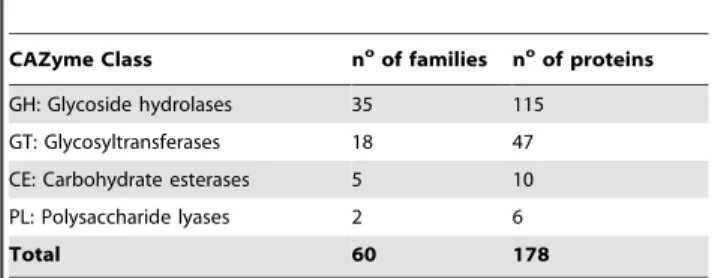
Enzymes related to carbohydrate metabolism.Analysis of P. sanguineus transcriptome revealed 178 ORFs encoding
predicted carbohydrate active enzymes (CAZy) distributed in 60 CAZy families. From these families, 35 were glycoside hydrolases (GH, 115 proteins), 18 glycosyltransferases (GT, 47 proteins), 5 carbohydrate esterases (CE, 10 proteins) and 2 polysaccharide lyases (PL, 6 proteins) (Table 2). Most of the identified transcripts encoded proteins belonging to CAZy families with predicted functions related to the synthesis and hydrolysis ofb-1,3-glucans and chitin, thus reflecting the dynamism of cell wall biogenesis and remodeling in filamentous fungi, and their putative role in the
Figure 1. Top hits distribution of BLASTx against custom database.
doi:10.1371/journal.pone.0081033.g001
Figure 2. Comparative GO annotation of theP. sanguineus transcriptome.GO terms assigned to 3,240P. sanguineustranscripts were grouped into GO slim terms (x-axis) in the three main categories (Biological process, Cellular component, Molecular function) and compared to annotations forT. versicolor(6,464 genes) andP. chrysosporium(4,923 genes). The percentage of genes represents the number of genes of each category in reference to total genes.
initiation of autophagy processes triggered by nutrient starvation (Figure 3 and Table S7).
Despite the absence of any lignocellulosic substrate in the culture media, it was possible to detect transcripts encoding putative glycoside hydrolases involved in plant cell wall degrada-tion, including cellulases (GH9 and GH61 families),b-glucosidases (GH1 and GH3 families), hemicellulases and pectinases (GH2b -1,4-mannosidase, GH3 xylan 1,4-b-xylosidase, GH10 b -1,4-endoxylanase, GH27 a-galactosidase, GH28 rhamnogalacturo-nase, GH43 arabinarhamnogalacturo-nase, GH53b-1,4-endogalactanase, GH79b -glucuronidase, GH88 glucuronyl hydrolase, GH95 a-fucosidase,
GH115 a-glucuronidase). Although their presence in all of the sequenced white-rot fungi genomes, no transcripts encoding any of the canonical endoglucanases (GH5 and GH12 families) or cellobiohydrolases (GH6 and GH7 families), were detected inP. sanguineussuggesting that their expression in this fungus is subjected to a tighter regulation than hemicellulases. As extensively shown in filamentous fungi [47,48], transcripts of cellulases in white-rot fungi are upregulated in absence of glucose, by the release of carbon catabolite repression mechanisms [49], and also by the presence of a lignocellulosic substrate. Endoglucanase and cellobiohydrolase transcripts from P. chrysosporium and P. carnosa
and to a lesser extent fromC. subvermispora were demonstrated to be induced by the presence of a cellulosic or wood substrates [50,51,12], however many of them were also moderately upregulated in ligninolytic media. Thus, the apparent absence of transcripts encoding typical cellulases in the P. sanguineus
transcriptome could be the result of the carbon catabolite repression due to the presence of traces of glucose at the time of harvesting, and the lack of a lignocellulosic inductor. As a consequence, a higher sequencing coverage than used in this study might be necessary to detect these low expressed transcripts in the conditions tested.
Enzymes related to lignin hydrolysis and modifica-tion. Multicopper oxidases. Four transcripts encoding enzymes belonging to multicopper oxidase (MCO) family were identified Table 2.Summary of predicted CAZymes inP. sanguineus
transcriptome.
CAZyme Class noof families noof proteins
GH: Glycoside hydrolases 35 115
GT: Glycosyltransferases 18 47
CE: Carbohydrate esterases 5 10
PL: Polysaccharide lyases 2 6
Total 60 178
doi:10.1371/journal.pone.0081033.t002
Figure 3. Distribution ofP. sanguineuspredicted CAZymes.Transcripts encoding putative carbohydrate active enzymes were assigned to seven functional categories according to their predicted function. GH: glycoside hydrolase, GT: glycosyltransferase, CE: carbohydrate esterase, PL: polysaccharide lyase.
(Table 3). Both Psang02645 and Psang01483 translated ORFs corresponded to laccases (EC 1.10.3.2) previously characterized in
P. sanguineus (GenBank ACZ37083, [52]; GenBank ACO51010, [53]). Although our assembly retrieved only partial sequences, amino acid identities were up to 99% and both included the conserved L3 and L4 signatures for HXH motifs [12,54]. Since our fungal culture was supplemented with Cu2+to induce laccase expression, and previous studies inP. sanguineusandP. cinnabarinus
described only two different laccases [31], we assumed that these isoenzymes could be the only ones highly expressed inP. sanguineus. Psang02736 partial sequence encoded a putative protein showing an L2 signature different from the signature found in laccases and more similar to other polyporales MCOs, while Psang00791 corresponded to a canonical Fet3 ferroxidase related to iron homeostasis (Figure S1).
Peroxidases and related enzymes. Five P. sanguineus transcripts encoded protein sequences homologous to known class II heme-peroxidases related to lignin degradation. Translated sequence alignment and identification of characteristic amino acid residues [55,56] were used to classify them as manganese-dependent peroxidases (MnP, EC 1.11.1.13), lignin peroxidases (LiP, EC 1.11.1.14) or versatile peroxidases (VP, EC 1.11.1.16) (Table 4). Sequence Psang05490 was annotated as encoding a putative MnP since its translated ORF showed high amino acid identity (91%) with Lenzites gibbosa manganese peroxidase 3 (GenBank AEX01147) including a conserved E210 residue, which is part of the Mn(II) oxidation site. Psang05937 translated sequence, was classified as a putative LiP because of its homology with P. cinnabarinus lignin peroxidase 2 (GenBank ADK60911) and the presence of the conserved W171 catalytic residue. Sequences Psang06299, Psang05248 and Psang07066 encode proteins showing homologies with two different T. versicolor manganese-repressed peroxidases, (GenBank AAB63460, CAG32981) and to
T. versicolor lignin peroxidase isoenzyme LP7 (GenBank CAA83147), respectively. Since the three proteins were recently described as probable versatile peroxidases [17,55], P. sanguineus
orthologues were annotated as such; however further studies will be necessary to characterize their function.
Other transcripts encoding predicted peroxidases included a cytochrome-c peroxidase (Psang01533), three heme-thiolate per-oxidases (Psang00188, Psang01942, Psang06212), and two puta-tive linoleate 8R-lipoxygenases sequences showing a conserved animal heme-peroxidase protein domain (Psang00278 and Psang00411).
Since hydrolysis of non-phenolic structures of lignin by MnPs has been demonstrated to be coupled to linoleic acid peroxidation [57] we investigated the possible expression of enzymes related to fatty acid metabolism. Three P. sanguineus translated sequences matched with fatty acid desaturases involved in the biosynthesis of linoleic acid. Psang00112 translated ORF showed 70% and 73%
amino acid identity with the D12-fatty acid desaturases (EC 1.14.19.6) FAD2 identified in P. chrysosporium (GenBank ACJ26016) [58] andC. subvermispora (GenBank BAJ04705) [59], respectively. Psang01003 and Psang03572 both encoded putative
D9-fatty acid desaturases (EC 1.14.19.1) and Psang01003 trans-lated ORF showed 79% and 82% identities withP. chrysosporium
and C. subvermispora D9-fatty acid desaturases ole1, respectively (GenBank BAJ04706 and GenBank BAJ04704) [59], while Psang03572 encoded a protein with 58% identity with a second
D9-fatty acid desaturase identified in C. subvermispora (GenBank EMD32546) [12]. In the three cases the highest amino acid identity was observed to T. versicolor orthologues (GenBank EIW59140, EIW55447 and EIW64164): 83%, 89% and 67% for Psang00112, Psang01003 and Psang03572, respectively (Table S8).
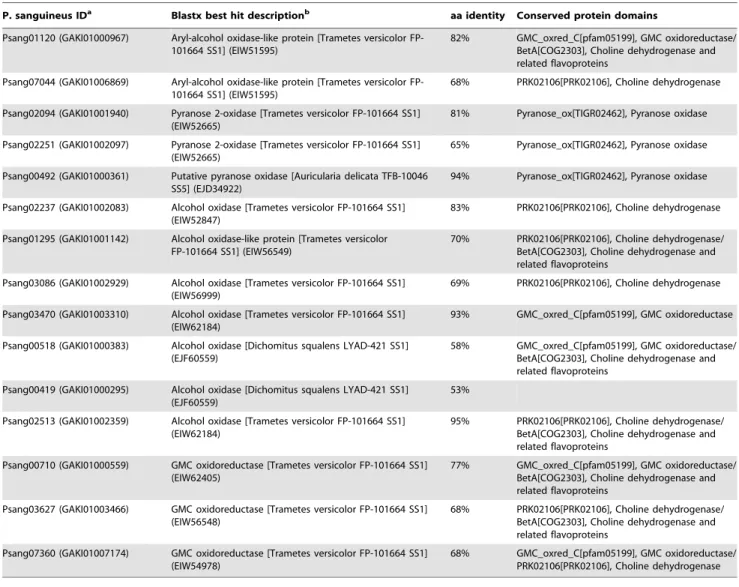
Extracellular hydrogen peroxide generation and iron homeostasis. Process-es involving the production of hydrogen peroxide are particularly important for lignin degradation, since it is required for the catalytic activity of peroxidases and the initial attack of lignin by hydroxyl radicals, generated through the Fenton reaction [60]. Analysis ofP. sanguineustranscriptome revealed multiple transcripts encoding glucose-methanol-choline (GMC) oxidoreductases and copper radical oxidases potentially involved in generation of extracellular hydrogen peroxide, as well as enzymes involved in the generation of reduced iron. Fifteen P. sanguineus translated transcripts matched with reported GMC oxidoreductases and showed conserved related protein domains (Table 5). Both, Psang07044 and Psang01120 translated ORFs showed homologies (68% and 82%, respectively) with an aryl-alcohol oxidase-like protein (EC 1.1.3.7) fromT. versicolor(GenBank EIW51595). Since there is no superposition between Psang07044 and Psang01120 sequences, they could represent parts of the same transcript, in which Psang0744 encodes the first 107 amino acids from the N-terminal region, including a putative signal secretion sequence, and Psang01120 encodes the 473 amino acids of C-terminal region. The ORF encoded by Psang01120 also included the conserved H502 and H546 residues involved in substrate binding and oxidation in aryl-alcohol oxidases [61]. Regarding the three aromatic residues involved in the regulation of substrate access to the binding site, Y92 and F397 are present in Psang01120 and in theT. versicolor orthologue; however the F501 is replaced by an arginine in both. Since substitutions at position 501 have shown to alter oxygen kinetics [62], further cloning and characterization of this enzyme will be necessary to confirm its biological function.
Additionally, the three different ORFs encoded by Psang02094, Psang00492 and Psang02251 showed homologies with pyranose 2-oxidases (EC 1.1.3.10) fromT. versicolorand T. hirsuta (Table 5). Psang02094 translated sequence showed the conserved H548 and N593 residues part of the active site, as well as the D452/F454/ Y456 residues form the substrate recognition loop found in
Table 3.P. sanguineusputative multicopper oxidases.
P. sanguineus IDa Putative function Blastx best hit descriptionb aa identity
Psang01483 (GAKI01001330) Laccase Laccase [Trametes sanguinea], (ACO51010) 98%
Psang02645 (GAKI01002490) Laccase Laccase [Trametes sanguinea], (ACZ37083) 99%
Psang02736 (GAKI01002581) Multicopper oxidase Multicopper oxidase [Dichomitus squalens LYAD-421 SS1], (EJF61736) 77%
Psang00791 (GAKI01000639) Fet3 ferroxidase Fet3 protein [Dichomitus squalens LYAD-421 SS1], (EJF63922) 86%
aNumbers in parentheses correspond to GenBank accession numbers for nucleotide sequences. bNumbers in parentheses correspond to GenBank accession numbers for amino acid sequences.
pyranose 2-oxidases [63]. Psang00492, encoding the N-terminal region of a putative pyranose 2-oxidase, showed the conserved H167 involved in the flavin cofactor covalent linkage [64] and T169 capable of forming H-bonds near the productive enzyme-substrate complex needed for efficient flavin reduction [65]. Finally, Psang02251, although encoding a partial sequence with homology (65%) to a pyranose 2-oxidase fromT. versicolor, showed a H167R mutation. Cloning of the corresponding cDNA will be necessary to determine if it represents a real mutation or just a sequence error, since this could be due to a single base substitution (CAC x CGC).
Among the ten remaining sequences encoding ORFs with conserved domains related to GMC oxidoreductases, none of them showed conserved amino acids that could be used to classify them. Although seven of them showed high homology with sequences encoding putative alcohol (methanol) oxidases (EC 1.1.3.13) of T. versicolor and D. squalens, further analysis will be necessary to assign a proper function.
Although previously characterized in P. cinnabarinus [66], transcripts encoding cellobiose dehydrogenase (CDH, EC 1.1.99.18), a protein involved in Fe (III) reduction and cellulose degradation, were not detected in the conditions we tested. As postulated for cellulases and hemicellulases, the absence of CDH could be explained by the presence of traces of glucose, since the expression of theT. versicolororthologue is also strongly regulated at transcriptional level by carbon catabolite repression mecha-nisms [67].
The sustained production of hydrogen peroxide by extracellular aryl-alcohol oxidases is achieved by a cyclic redox reaction involving the reduction by aryl-alcohol dehydrogenases (EC 1.1.1.90) of aryl-aldehydes to the corresponding alcohols [68]. Supporting the existence of aromatic aldehyde redox cycling inP. sanguineus, 26 transcripts encoding proteins of the aldo/keto reductase family were found, of which at least four were putative aryl-alcohol dehydrogenases. Thus, Psang01767 and Psang03332 translated sequences showed high amino acid identity (67% and 75%, respectively) with a previously characterizedP. chrysosporium
aryl-alcohol dehydrogenase (GenBank Q01752) [69] whereas Psang06157 and Psang04221-encoded proteins have T. versicolor
orthologues annotated as aryl-alcohol dehydrogenases (GenBank EIW61065 and EIW61070).
An additional source of extracellular hydrogen peroxide is glyoxal oxidase, a copper radical oxidase (CRO). Putative P. sanguineusCROs were classified according to their identity degree with P. chrysosporium reported sequences [70] (Table 6). Psang00738 and Psang00288 translated sequences showed 60% and 65% amino acid identity withP. chrysosporiumCro1 and Cro2, respectively and conserved residues, part of the Cu-coordinating active site found in glyoxal oxidase (Y135, Y377, H378, and H471) and the cysteine (C70) conforming the radical redox site, were identified in both sequences. Psang00289 encodes an ORF of 196 amino acids showing 100% identity with translated Psang00288, except for a 61-amino acids region, suggesting a splicing variant, similar to the observed for the Cro2 splicing variant A, described inP. chrysosporium(GenBank ABD97059). Also, both Psang00288 and Psang00289 encode a 49-amino acid C-terminal extension, not present in P. chrysosporium orthologues but in a related T. versicolor DUF1929 domain-containing protein (GenBank EIW56122). Furthermore, Psang01858 and Psang06824 translat-ed sequences matchtranslat-ed with P. chrysosporium Cro3 and Cro4, respectively and only the protein encoded by Psang03463, showed high amino acid identity (71%) with a glyoxal oxidase, previously characterized inP. chrysosporium(GenBank AAA87594) [71].
An extra supply of Fenton reagents, involving the quinone redox-cycling has been postulated in wood decay fungi [72]. Quinones that derive of breakdown of lignin orde novosynthesized by the fungus can then be converted to hydroquinones by quinone reductases, oxidized to semiquinones by laccases and auto-oxidized back to quinone to generate superoxide anion radical (O22). Although O22cannot degrade lignin by itself, it can oxidize Mn (II) to Mn (III), generate H2O2by dismutation, and reduce Fe (III) to Fe (II). The analysis ofP. sanguineustranscriptome, revealed a transcript encoding a putative quinone reductase (Psang02478) which showed 73% amino acid identity with the 1,4-benzoqui-none reductase characterized in P. chrysosporium (GenBank AAD21025) [73] and 67% amino acid identity with a NADH:-quinone oxidoreductase reported in G. trabeum (GenBank AAL67859) [74], thus supporting the existence of a quinone Table 4.P. sanguineusputative peroxidases.
P. sanguineus IDa Putative function Blastx best hit descriptionb aa identity
Psang05490 (GAKI01005323) Manganese peroxidase Manganese peroxidase 3 [Lenzites gibbosa], (AEX01147) 91%
Psang05937 (GAKI01005768) Lignin peroxidase Lignin peroxidase-like 2 [Trametes cinnabarina], (ADK60911) 97%
Psang06299 (GAKI01006130) Versatile peroxidase Manganese-repressed peroxidase [Trametes versicolor], (AAB63460) 83%
Psang05248 (GAKI01005082) Versatile peroxidase Manganese-repressed peroxidase [Trametes versicolor FP-101664 SS1], (EIW62513)
93%
Psang07066 (GAKI01006891) Versatile peroxidase Lignin peroxidase isozyme LP7 [Trametes versicolor], (CAA83147) 94%
Psang01533 (GAKI01001380) Cytochrome c peroxidase Cytochrome c peroxidase [Trametes versicolor FP-101664 SS1], (EIW63252)
84%
Psang00188 (GAKI01000131) Chloroperoxidase Chloroperoxidase [Trametes versicolor FP-101664 SS1], (EIW53420) 64%
Psang01942 (GAKI01001788) Chloroperoxidase Chloroperoxidase [Trametes versicolor FP-101664 SS1], (EIW61336) 71%
Psang06212 (GAKI01006043) Chloroperoxidase Chloroperoxidase-like protein [Dichomitus squalens LYAD-421 SS1], (EJF56466)
77%
Psang00278 (GAKI01000192) Linoleate 8R-lipoxygenase Linoleate diol synthase [Trametes versicolor FP-101664 SS1], (EIW58238) 74%
Psang00411 (GAKI01000287) Linoleate 8R-lipoxygenase Heme peroxidase [Trametes versicolor FP-101664 SS1], (EIW63895) 86%
aNumbers in parentheses correspond to GenBank accession numbers for nucleotide sequences. bNumbers in parentheses correspond to GenBank accession numbers for amino acid sequences.
Table 5.P. sanguineusputative GMC oxidoreductases.
P. sanguineus IDa Blastx best hit descriptionb aa identity Conserved protein domains
Psang01120 (GAKI01000967) Aryl-alcohol oxidase-like protein [Trametes versicolor FP-101664 SS1] (EIW51595)
82% GMC_oxred_C[pfam05199], GMC oxidoreductase/
BetA[COG2303], Choline dehydrogenase and related flavoproteins
Psang07044 (GAKI01006869) Aryl-alcohol oxidase-like protein [Trametes versicolor FP-101664 SS1] (EIW51595)
68% PRK02106[PRK02106], Choline dehydrogenase
Psang02094 (GAKI01001940) Pyranose 2-oxidase [Trametes versicolor FP-101664 SS1] (EIW52665)
81% Pyranose_ox[TIGR02462], Pyranose oxidase
Psang02251 (GAKI01002097) Pyranose 2-oxidase [Trametes versicolor FP-101664 SS1] (EIW52665)
65% Pyranose_ox[TIGR02462], Pyranose oxidase
Psang00492 (GAKI01000361) Putative pyranose oxidase [Auricularia delicata TFB-10046 SS5] (EJD34922)
94% Pyranose_ox[TIGR02462], Pyranose oxidase
Psang02237 (GAKI01002083) Alcohol oxidase [Trametes versicolor FP-101664 SS1] (EIW52847)
83% PRK02106[PRK02106], Choline dehydrogenase
Psang01295 (GAKI01001142) Alcohol oxidase-like protein [Trametes versicolor FP-101664 SS1] (EIW56549)
70% PRK02106[PRK02106], Choline dehydrogenase/ BetA[COG2303], Choline dehydrogenase and related flavoproteins
Psang03086 (GAKI01002929) Alcohol oxidase [Trametes versicolor FP-101664 SS1] (EIW56999)
69% PRK02106[PRK02106], Choline dehydrogenase
Psang03470 (GAKI01003310) Alcohol oxidase [Trametes versicolor FP-101664 SS1] (EIW62184)
93% GMC_oxred_C[pfam05199], GMC oxidoreductase
Psang00518 (GAKI01000383) Alcohol oxidase [Dichomitus squalens LYAD-421 SS1] (EJF60559)
58% GMC_oxred_C[pfam05199], GMC oxidoreductase/
BetA[COG2303], Choline dehydrogenase and related flavoproteins
Psang00419 (GAKI01000295) Alcohol oxidase [Dichomitus squalens LYAD-421 SS1] (EJF60559)
53%
Psang02513 (GAKI01002359) Alcohol oxidase [Trametes versicolor FP-101664 SS1] (EIW62184)
95% PRK02106[PRK02106], Choline dehydrogenase/ BetA[COG2303], Choline dehydrogenase and related flavoproteins
Psang00710 (GAKI01000559) GMC oxidoreductase [Trametes versicolor FP-101664 SS1] (EIW62405)
77% GMC_oxred_C[pfam05199], GMC oxidoreductase/
BetA[COG2303], Choline dehydrogenase and related flavoproteins
Psang03627 (GAKI01003466) GMC oxidoreductase [Trametes versicolor FP-101664 SS1] (EIW56548)
68% PRK02106[PRK02106], Choline dehydrogenase/ BetA[COG2303], Choline dehydrogenase and related flavoproteins
Psang07360 (GAKI01007174) GMC oxidoreductase [Trametes versicolor FP-101664 SS1] (EIW54978)
68% GMC_oxred_C[pfam05199], GMC oxidoreductase/
PRK02106[PRK02106], Choline dehydrogenase
aNumbers in parentheses correspond to GenBank accession numbers for nucleotide sequences. bNumbers in parentheses correspond to GenBank accession numbers for amino acid sequences.
doi:10.1371/journal.pone.0081033.t005
Table 6.P. sanguineusputative copper radical oxidases.
P. sanguineus IDa P. chrysosporium best hitb aa identity Conserved protein domains
Psang03463 (GAKI01003303) Glyoxal oxidase (AAA87594) 71% Glyoxal oxidase N-terminus[pfam07250]
Psang00738 (GAKI01000586) Copper-radical oxidase 1 (ABD61572) 63% DUF1929[pfam09118]/Glyoxal oxidase
N-terminus[pfam07250]
Psang00288 (GAKI01000200) Copper-radical oxidase 2 (ABD61573) 65% DUF1929[pfam09118]/Glyoxal oxidase
N-terminus[pfam07250]
Psang00289 (GAKI01000201) Copper-radical oxidase 2 (variant A), (ABD97059) 56%
-Psang01858 (GAKI01001704) Copper-radical oxidase 3 (ABD61574) 85% DUF1929[pfam09118]
Psang06824 (GAKI01006651) Copper-radical oxidase 4 (ABD61575) 82%
-aNumbers in parentheses correspond to GenBank accession numbers for nucleotide sequences. bNumbers in parentheses correspond to GenBank accession numbers for amino acid sequences.
redox-cycling inP. sanguineussimilar to that already demonstrated inP. cinnabarinus[75].
Additional transcripts encoding proteins potentially involved in iron homeostasis were identified in P. sanguineus transcriptome. These include 5 iron reductases (Psang01201, Psang01840, Psang04167, Psang00819, and Psang00992), 9 iron permeases (Psang00836, Psang00862, Psang01172, Psang03545, Psang07406, Psang07480, Psang07518, Psang07523 and Psang07526), 2 CTR copper transporters (Psang01990 and Psang03439), and an ATX1-type copper chaperone, a key protein for copper acquisition by Fet3 (Psang06297) (Table S1).
Terpenoid biosynthesis. Fungi are important sources of bioactive secondary metabolites including various sesquiterpenes and triterpenes. Among these latter, ganoderic acids, showing anticancer, antiviral and hepatoprotective activity, were charac-terized inG. lucidum [76,77]. All of the enzymes involved in the terpenoid backbone biosynthesis via the mevalonate pathway that were previously identified inG. lucidum [78,79] have orthologues encoded byP. sanguineustranscripts (Table 7, Figure 4). We also identified transcripts encoding a putative squalene synthase (Psang01499), a putative squalene monooxygenase (Psang00994) and a putative lanosterol synthase (Psang01574), responsible for the biosynthesis of sesquiterpenoids and triterpenoids precursors and lanosterol, the precursor of steroids and ganoderic acids. Psang01106 encoded a fusion protein between an N-terminal cystathione beta-lyase (metC) and C-terminal mevalonate kinase (MVK). Though similar fusions have been previously observed in other basidiomycetes [79], their biological relevance remains unknown.
Additionally, transcripts encoding another 6 terpene synthases were found inP. sanguineus. Three of these showed homologies with terpene synthases described in C. cinerea [80]. Psang02278 translated ORF showed 73% identity with C. cinerea Cop3 (GenBank XP_001832925), characterized as an alfa-muurolene synthase (EC 4.2.3.125) and Psang02180 encodes a protein showing 60% identity with C. cinerea Cop2 (GenBank XP_001836556), and Cop1 (GenBank XP_001832573), both characterized as germacrene A synthases; whereas Psang01395 translated ORF showed a 46 to 47% identity with Cop1, Cop2 and Cop3. The other 3 translated sequences encoding putative
terpene synthases, Psang04116, Psang02169 and Psang01353 have identities of 33% or less withC. cinereaenzymes, although all of them contained the conserved isoprenoid biosynthesis enzyme class 1 protein domain.
Also related to the biosynthesis of triterpenes and the metabolism of xenobiotics and lignin substructures, transcripts encoding 67 putative cytochrome P450 monooxygenases (EC 1.14.13.x, EC 1.14.14.x) are present inP. sanguineustranscriptome. Additionally, we identified sequences encoding 8 putative gluta-thione S-transferases (EC 2.5.1.18) and 3 epoxide hydrolases (EC 3.3.2.10) belonging to alpha/beta hydrolase protein family (Table S1), with potential in the biodegradation of many organic compounds by cytochrome P450 monoxygenases and the enan-tioselective biosynthesis of biologically active drugs [81].
Discussion and Conclusions
Wood decay basidiomycetes are characterized by its ability to degrade lignocellulose through the biosynthesis of a complex set of extracellular hydrolases and oxidative enzymes. They are broadly divided into three groups according to their strategy to degrade lignin in order to allow the access of hydrolytic enzymes to plant cell wall polysaccharides. While brown-rot fungi and the less studied soft-rot fungi perform partial depolymerization of lignin, white-rot fungi are the only microorganisms described to date capable of its complete mineralization. In white-rot fungi the expression of ligninolytic enzymes is generally triggered by nutrient depletion during secondary metabolism, although differ-ential responses to C/N ratios and even to the presence of a lignocellulosic substrate have been observed among individual enzymes and fungal species [12,50,82–86]. Additionally, expres-sion of laccases and MnPs have been shown to be induced by the presence of copper and/or manganese in P. ostreatus [33], T. versicolor[34],T. trogii[35]Phlebia radiata[86],C. subvermispora[87], andCoriolopsis rigida[88]. Furthermore, cis-acting elements related to metals and xenobiotics response mechanisms, and temperature shock or oxidative stress responses have been identified in the promoter regions of fungal laccases and class II heme-peroxidases (reviewed in [89]), supporting their putative role not only in wood decomposition but as detoxifying enzymes in response to environmental stresses.
Table 7.P. sanguineuspredicted genes involved in terpenoid biosynthesis.
P. sanguineus IDa Predicted enzyme EC number G. lucidum orthologb
Psang01366 (GAKI01001213) Acetyl-CoA acetyltransferase (thiolase), AACT 2.3.1.9 G_lucidum_10003032
Psang00932 (GAKI01000780) 3-Hydroxy-3-methylglutaryl-CoA synthase, HMGS 2.3.3.10 G_lucidum_10008701
Psang00720 (GAKI01000569) 3-Hydroxy-3-methylglutaryl CoA reductase, HMGR 1.1.1.34 G_lucidum_10003589
Psang01106 (GAKI01000953) Mevalonate kinase, MVK 2.7.1.36 G_lucidum_10009892
Psang03846 (GAKI01003685) Phosphomevalonate kinase, MPK 2.7.4.2 G_lucidum_10010135
Psang01679 (GAKI01001525) Diphosphomevalonate decarboxylase, MDV 4.1.1.33 G_lucidum_10005090
Psang02952 (GAKI01002796) Isopentenyl-diphosphate isomerase, IDI 5.3.3.2 G_lucidum_10001705
Psang04498 (GAKI01004336) (2E,6E)-Farnesyl diphosphate synthase, FPP 2.5.1.10 G_lucidum_10002724G_lucidum_
10008471G_lucidum_10004225
Psang01499 (GAKI01001346) Squalene syntase, SQS 2.5.1.21 G_lucidum_10005172
Psang00994 (GAKI01000842) Squalene monooxygenase, SE 1.14.13.132 G_lucidum_10007072
Psang01574 (GAKI01001420) Lanosterol synthase, LS 5.4.99.7 G_lucidum_10008645G_
lucidum_10008646
aNumbers in parentheses correspond to GenBank accession numbers for nucleotide sequences. b
In order to identify the transcripts encoding enzymes involved in lignin degradation inP. sanguineus, we performed the sequence of the transcriptome of this fungus grown at stationary phase, and in presence of CuSO4. According to this, we detected two transcripts encoding previously characterized laccases, five encod-ing putative class II heme-peroxidases and many transcripts encoding enzymes related to the generation of peroxide and free radicals involved in the initial attack of lignin. Although our study was not designed to perform a differential expression analysis, comparison with previous transcriptomic and extracellular pro-teomic studies performed in white-rot fungi showed this pattern of expression is consisting with the observed in nutrient-limiting conditions. Extracellular proteomic analysis by mass spectrometry (LC-MS/MS) of P. chrysosporium grown in ligninolytic media (carbon and nitrogen-limited) showed the expression of a glyoxal oxidase and from 5 to 8 class II peroxidases of the 15 genes predicted by genomic analysis [50,84,90,91]. Proteomic studies in
T. versicolorgrown in tomato juice supplemented with CuSO4and MnCl2 [92] and in T. trogii grown in a minimal media [93] detected peptides corresponding to 2 to 8 class II heme-peroxidases, 2 laccases and a glyoxal oxidase but also for GMC oxidoreductases including one pyranose 2-oxidase and one aryl-alcohol oxidase in bothT.versicolorandT. trogii, and two methanol oxidases in the latter. Additional micro array-based transcriptional analysis performed in P. chrysosporiumhave shown that the genes encoding enzymes related to lignin depolymerization are mainly upregulated in nutrient-limited media and generally not highly induced by the presence of lignocellulosic substrates [50,85]. However, comparative transcriptional studies in C. subvermispora
andP. carnosashowed the upregulation of genes encoding class II heme-peroxidases and enzymes related to redox cycling processes when these fungi are grown in wood substrates relative to glucose [12,51].
As extensively shown in ascomycetes [47,48] expression of cellulases in wood decay basidiomycetes seem to be strongly regulated by carbon catabolite repression mechanisms mediated by CreA (cAMP mediated glucose repression) and also by the presence of a wood or cellulosic substrate. Most of the genes encoding endoglucanases (GH5, GH12), cellobiohydrolases (GH6, GH7), and GH61 cellulases have been shown to be strongly upregulated inP. crhysosporiumand inP. carnosagrown in wood as sole carbon source relative to glucose, whereas only three canonical cellulases of eight gene models were significantly upregulated in C. subvermispora in presence of lignocellulosic substrates [12,50,51,85]. Corresponding peptides were detected by LC-MS/MS in similar culture conditions for these fungi [12,50,94] and also forA. delicata,T. versicolor,S. squalens,S. hirsutum, andP.strigosozonatagrown in aspen [17]. In our present study ofP. sanguineustranscriptome we failed to detect the expression of any of the canonical cellulases, and only transcripts encoding two families of GHs with potential celullolytic activity were detected (GH9 and GH61). However, only the predicted GH9 endo-1,4-b-glucanase could be strictly assigned as a cellulase, since GH61 members has been recently redefined as copper-dependent lytic polysaccharide monooxygenases, implied in the oxidative cleavage of cellulose [95]. This apparent absence of transcripts encoding cellulases inP. sanguineus could be explained by the fact that no lignocellulosic substrate was used for fungal grown and also by the presence of traces of glucose at time of harvesting. This is also supported because we were unable to detect transcripts for cellobiose dehydrogenase, a flavooxidase that is proposed to contribute to peroxide generation, but mainly to enhance oxidative cellulose depolymerization and whose expression has been shown to be induced by lignocellulosic substrates [12,50] and strongly re-pressed by glucose [67].
Another component of plant cell walls, hemicellulose, is a branched polymer consisting of a more heterogeneous assembly of
monosaccharides and linkages than cellulose, thus a more complex set of enzymes is necessary for its hydrolysis. Although hemicel-lulose composition and structure depends on the plant source, studies performed inP. carnosaandP. chrysosporiumgrown in diverse wood and lignocellulosic substrates have shown similar pools of expressed hemicellulases and pectinases [50,51,90,91,94], suggest-ing that differential hydrolysis is regulated by modifysuggest-ing the relative abundance of the essentially equal profile of enzymes. Extracellular proteomic studies have commonly found peptides corresponding to b-1,4-mannosidases (GH2 family), b-xylanases (GH10 family), polygalacturonases (GH28 family),a -galactosidas-es (GH27 family), b-mannanases (GH5 families), arabinosidases (GH43 family) and acetyl xylan esterases (CE1 family) in the presence of a lignocellulosic substrate [50,90,94], but also for GH10, GH28 families in ligninolytic conditions [84,90,91].
Transcripts potentially encoding many of these hemicellulases were detected in our analysis of P. sanguineus transcriptome including members of mentioned common families (GH2, GH10, GH27, GH28, GH43) and also GH3 b-xylosidase, GH53 b-1,4-endogalactanase, GH79 b-glucuronidase, GH88 glucuronyl hydrolase, GH95 a-fucosidase, GH115 a -glucuroni-dase and CE15, CE16 debranching esterases, showing that this fungus expresses a basal set of hemicellulases even in the absence of a lignocellulosic inductor.
This pattern of expression in which hemicellulases, pectinases and enzymes related to the hydrolysis of lignin are constitutively expressed or induced under nutrient starvation while cellulases are differentially expressed and subjected to a more tight regulation, suggests a selective strategy for lignin and hemicellulose degrada-tion in advance to cellulose; in contraposidegrada-tion to the second pattern of wood decay found in white-rot fungi in which all the components of plant cell walls are degraded simultaneously. This is consistent with previous delignification studies performed inP. taedawood chips, in which treatment withP. sanguineusBAFC 2126 resulted in notable structural changes of lignin and hemicellulose over cellulose, as revealed from13C CP-MAS NMR spectra [32]. On the other hand, studies on delignification ofEucalyptus grandis
using a different strain, P. sanguineus UEC2050, have shown a simultaneous pattern of wood decay [96]. Although these results suggest thatP. sanguineusmay shift between delignification patterns depending on the wood it grows on, it can also be a consequence of different incubation times evaluated in each study (14 days for the first study and 2 to 4 months for the second), since selective degradation could slowly progress to a simultaneous-like pattern as wood hydrolysis progress.
Selective strategies in which lignin is removed preferentially to cellulose are important for applications in pulping industry and consequently there is great interest in understanding how they are achieved at molecular level. Although further studies will be necessary, our gene expression analysis inP. sanguineussuggests an increase in the ligninolytic potential relative to the cellulolytic capability. This is similar to the observed in comparative genomic and transcriptomic studies in the selectiveC. subvermisporaandP. carnosaagainst the simultaneous degraderP. chrysosporium, support-ing the potential of P. sanguineus for its evaluation in biopulping processes.
A striking characteristic of the basidiomycetes, especially of polyporales, is their ability to synthesize secondary metabolites of medical and industrial interest, including compounds with antiviral, anti-inflammatory, antimicrobial or anticancer activities, as well as antioxidants, aromas and flavors [97]. Pharmacologi-cally active triterpenoids and sterols have been identified in
Piptoporus betulinus [98], Inonotus obliquus [99], Fomitopsis pinicola
[100], W. cocos [101], Antrodia camphorata [102], Daedalea dickisii
[103], Ganoderma applanatum [104], and G. lucidum [76,77,105] among many others, however the detailed biosynthesis pathways in fungi are still under study. As previously reported inG. lucidum
genomic studies [78,79] exploration ofP. sanguineustranscriptome allowed the identification of the transcripts encoding all the enzymes involved in terpenoid backbone biosynthesis pathway and also various terpene synthases related to the biosynthesis of important sesquiterpenoids, triterpenoids and sterols precursors.
Additionally we identified many transcripts encoding cyto-chrome P450 monooxygenases and glutathione S-transferases with potential in the biodegradation of xenobiotics and detoxification of lignin degradation products, as well as transcripts encoding putative epoxide hydrolases with potential for the enantioselective biosynthesis of biologically active drugs; showing the potential ofP. sanguineusas a source of bioactive compounds and enzymes for the industry.
This paper presents the first sequencing and analysis of the transcriptome of P. sanguineus grown at stationary phase in presence of Cu2+. From the assembled 7,303 transcripts, putative functions were manually assigned for 4,732 by assessing translated sequences homologies and presence of conserved protein domains, allowing the identification of many transcripts encoding enzymes with biotechnological potential no previously reported in P. sanguineus. Due to the complexity of the wood decay process, which involves many enzymes with diverse activities, further studies are needed to fully understand the biochemical mecha-nisms that control this process in order to facilitate the selection of enzymes and fungal strains for specific industrial applications. Additionally, the metabolic pathways and enzymes involved in the biosynthesis of secondary metabolites in basidiomycetes are poorly studied and much work is necessary to identify and characterize the activities with potential application for organic synthesis and production of high added-value compounds.
The availability of this first version of the transcriptome of P. sanguineusmay facilitate the analysis and annotation of additional sequencing projects and provide a tool for the study of metabolic pathways and the cloning and characterization of enzymes of biotechnological interest.
Supporting Information
Figure S1 Analysis of signatures for HXH motifs inP. sanguineusputative MCOs. Tv:T. versicolor, Ds:D. squalens, Cs: C. subvermispora, Pc: P. chrysosporium, Pp: P. placenta. Fet3 proteins: Tv GenBank EIW55589, Ds GenBank EJF63922, Cs GenBank EMD34889, Pc GenBank ABE60664, Pp GenBank XP_002469890. MCOs: Tv GenBank EIW53804, Ds GenBank EJF61736, Cs GenBank EMD36964, Pp GenBank XP_002473277, Pc mco1: GenBank AAO42609, Pc mco2: GenBank AAS21659, Pc mco3: AAS21662, GenBank, Pc mco4: GenBank AAS21669. Shadowed letters indicates differences from the laccase consensus signature on top. Colored letters denotes differences in MCOs (blue) and Fet3 proteins (red) with P. sanguineus predicted sequences Psang02736 and Psang00791, respectively. An X in the signature represents an undefined residue while the multiple letters within brackets represent a partially conserved residue.
(PDF)
Table S1 P. sanguineus transcripts. List of IDs and functional annotation for the 7,303 transcripts identified in P. sanguineusgrown in Cu2+.
Table S2 Homologies of P. sanguineus assembly with Pycnoporussequences annotated at NCBI database.
(XLS)
Table S3 Gene Ontology annotation. List of GO terms assigned to 3,240P. sanguineustranscripts using Blast2GO. (XLS)
Table S4 KEEG orthologies annotation. List of KEEG orthology numbers assigned to 2,554P. sanguineustranscripts using KAAS server.
(XLS)
Table S5 COG annotation.List of COG functional categories assigned to 2,468P. sanguineustranscripts.
(XLS)
Table S6 List of 50 most frequent PFAM domains inP. sanguineustranscriptome.
(PDF)
Table S7 Assignation of putative functions to predicted P. sanguineusCAZy families.
(XLSX)
Table S8 P. sanguineusputative fatty acid desaturases involved in the biosynthesis of linoleic acid.
(PDF)
Acknowledgments
We are especially grateful to Dr Flavia Forchiassin for her guidance and example.
Author Contributions
Conceived and designed the experiments: SAW. Performed the experi-ments: LNL SAW. Analyzed the data: COR LNL SAW. Contributed reagents/materials/analysis tools: COR LNL SAW. Wrote the paper: COR LNL ANM SAW.
References
1. Martı´nez AT, Speranza M, Ruiz-Duen˜as FJ, Ferreira P, Camarero S, et al. (2005) Biodegradation of lignocellulosics: microbiological, chemical and enzymatic aspects of fungal attack to lignin. Int Microbiol 8: 195–204. 2. Ferraz A, Guerra A, Mendonca R, Masarin F, Vicentim MP, et al. (2008)
Technological advances and mechanistic basis for fungal biopulping. Enzyme Microb Technol 43: 178–185.
3. Bhat MK (2000) Cellulases and related enzymes in biotechnology. Biotechnol Adv 18: 355–383.
4. Mtui G (2012) Lignocellulolytic enzymes from tropical fungi: Types, substrates and applications Sci Res Essays 7: 1544–1555.
5. Singh H (2006) Mycoremediation: Fungal Bioremediation. New Jersey: John Wiley & Sons, Hoboken. 592p.
6. Pointing SB (2001) Feasibility of bioremediation by white-rot fungi. Appl Microbiol Biotechnol 57: 20–33.
7. Wesenberg D, Kyriakides I, Agathos S (2003) White-rot fungi and their enzymes for the treatment of industrial dye effluents. Biotechnol Adv 22: 161– 187.
8. Martinez D, Larrondo LF, Putnam N, Gelpke MDS, Huang K, et al. (2004) Genome sequence of the lignocelluloses degrading fungus Phanerochaete chrysosporiumstrain RP78. Nat Biotechnol 22: 695–700.
9. Ohm RA, de Jong JF, Lugones LG, Aerts A, Kothe E, et al. (2010) Genome sequence of the model mushroomSchizophyllum commune. Nat Biotechnol 28: 957–963.
10. Martinez D, Challacombe J, Morgenstern I, Hibbett D, Schmoll M, et al. (2009) Genome, transcriptome, and secretome analysis of wood decay fungus Postia placentasupports unique mechanisms of lignocellulose conversion. Proc Natl Acad Sci USA 106: 1954–1959.
11. Eastwood DC, Floudas D, Binder M, Majcherczyk A, Schneider P, et al. (2011) The plant cell wall-decomposing machinery underlies the functional diversity of forest fungi. Science 333: 762–765.
12. Fernandez-Fueyo E, Ruiz-Duen˜as FJ, Ferreira P, Floudas D, Hibbett DS, et al. (2012) A Comparative genomics ofCeriporiopsis subvermisporaandPhanerochaete chrysosporiumprovide insight into selective ligninolysis. Proc Natl Acad Sci USA 109: 5458–5463.
13. Chen S, Xu J, Liu C, Zhu Y, Nelson DR, et al. (2012) Genome sequence of the model medicinal mushroomGanoderma lucidum. Nat Commun 3: 913 14. Tang JD, Perkins AD, Sonstegard TS, Schroeder SG, Burgess SC, Diehl SV
(2012) Short-read sequencing for genomic analysis of the brown rot fungus Fibroporia radiculosa. Appl Environ Microbiol 78: 2272–2281.
15. Suzuki H, MacDonald J, Syed K, Salamov A, Hori C, et al. (2012) Comparative genomics of the white-rot fungi, Phanerochaete carnosa and P. chrysosporium, to elucidate the genetic basis of the distinct wood types they colonize. BMC Genomics 13: 444
16. Olson A, Aerts A, Asiegbu F, Belbahri L, Bouzid O, et al. (2012) Insight into trade-off between wood decay and parasitism from the genome of a fungal forest pathogen New Phytol. 194: 1001–1013.
17. Floudas D, Binder M, Riley R, Barry K, Blanchette RA, et al. (2012) The Paleozoic origin of enzymatic lignin decomposition reconstructed from 31 fungal genomes. Science 336: 1715–1719.
18. Asther M, Lomascolo A, Mi A, Moukha S, Lesage-Meessen L (1998) Metabolic pathways of biotransformation and biosynthesis of aromatic compounds for the flavour industry by the basidiomycetePycnoporus cinnabarinus. Micol Neotrop Apl 11: 69–76.
19. Falconnier B, Lapierre C, Lesage-Meessen L, Yonnet G, Brunerie P, Colonna Ceccaldi B, Corrieu G, Asther M (1994) Vanillin as a product of ferulic acid biotransformation by the white-rot fungus Pycnoporus cinnabarinus I-937: identification of metabolic pathways. J Biotechnol 37: 123–132.
20. Estrada Alvarado I, Navarro D, Record E, Mi A, Asther M (2003) Fungal biotransformation of p-coumaric acid into caffeic acid byPycnoporus cinnabarinus: an alternative for producing a strong natural antioxidant. World J Microbiol Biotechnol 19: 157–160.
21. Smaˆnia A, Delle Monache F, Smaˆnia EFA, Gil ML, Benchetrit LC, Cruz FS (1995) Antibacterial activity of a substance produced by the fungusPycnoporus sanguineus(Fr.) Murr. J Ethnopharmacol 45: 177–181.
22. Smaˆnia A, Marques CJS, Smaˆnia EFA, Zanetti CR, Carobrez SG, Tramonte R, Loguercio-Leite C (2003) Toxicity and antiviral activity of cinnabarin obtained fromPycnoporus sanguineus(Fr.) Murr. Phytother Res 17: 1069–1072. 23. Esposito E, Innocentini-Mei LH, Ferraz A, Canhos VP, Duran N (1993)
Phenoloxidases and hydrolases fromPycnoporus sanguineus(UEC-2050 strain): applications. J Biotechnol 29: 219–228.
24. Quiroga EN, Vattuone MA, Sampietro AR (1995) Purification and characterization of the invertase fromPycnoporus sanguineus. Biochim Biophys Acta 1251: 75–80.
25. De Almeida Siqueira EM, Mizuta K, Giglio JR (1997)Pycnoporus sanguineus: a novel source ofa-amylase. Mycol Res 2: 188–190.
26. Eggert C, Temp U, Eriksson KE (1996) The ligninolytic system of the white rot fungusPycnoporus cinnabarinus: purification and characterization of the laccase. Appl Environ Microbiol 62: 1151–1158.
27. Sigoillot C, Lomascolo A, Record E, Robert JL, Asther M, Sigoillot JC (2002) Lignocellulolytic and hemicellulolytic system ofPycnoporus cinnabarinus: isolation and characterization of a cellobiose dehydrogenase and a new xylanase. Enzyme Microb Technol 31: 876–883.
28. Lomascolo A, Record E, Herpoe¨l-Gimbert I, Delattre M, Robert JL, Georis J, Dauvrin T, Sigoillot JC, Asther M (2003) Overproduction of laccase by a monokaryotic strain ofPycnoporus cinnabarinususing ethanol as inducer. J Appl Microbiol 94: 618–624.
29. Uzan E, Portet B, Lubrano C, Milesi S, Favel A, Lesage-Meessen L, Lomascolo A (2011) Pycnoporus laccase-mediated bioconversion of rutin to oligomers suitable for biotechnology applications. Appl Microbiol Biotechnol 90: 97–105. 30. Litthauer D, van Vuuren MJ, van Tonder A, Wolfaardt FW (2007) Purification and kinetics of a thermostable laccase fromPycnoporus sanguineus(SCC108). Enzyme Microb Technol 40: 563–568.
31. Lomascolo A, Uzan-Boukhris E, Herpoe¨l-Gimbert I, Sigoillot JC, Lesage-Meessen L (2011) Peculiarities of Pycnoporus species for applications in biotechnology. Appl Microbiol Biotechnol 92: 1129–1149.
32. Levin L, Villalba L, Da Re V, Forchiassin F, Papinutti L (2007) Comparative studies of loblolly pine biodegradation and enzyme production by Argentinean white rot fungi focused on biopulping processes. Process Biochem 42: 995– 1002.
33. Palmieri G, Giardina P, Bianco C, Fontanella B, Sannia G (2000) Copper induction of laccase isoenzymes in the ligninolytic fungusPleurotus ostreatus. Appl Environ Microbiol 66: 920–924.
34. Collins PJ, Dobson ADW (1997) Regulation of laccase gene transcription in Trametes versicolor. Appl Environ Microbiol 63: 3444–3450.
35. Levin L, Forchiassin F, Ramos AM (2002) Copper induction of lignin-modifying enzymes in the white-rot fungusTrametes trogii.Mycologia 94: 377– 383.
36. Conesa A, Go¨tz S, Garcia-Gomez JM, Terol J, Talon M, Robles M. (2005) Blast2GO: a universal tool for annotation, visualization and analysis in functional genomics research. Bioinformatics 21: 3674–3676.