In silico
analysis of
Eucalyptus
thioredoxins
Aulus Estevão Barbosa and Paulo Marinho
Universidade Federal do Rio Grande do Norte, Departamento de Biologia Celular e Genética,
Natal, RN, Brazil.
Abstract
The Eucalyptus Genome Sequencing Project (FORESTs), an initiative from the Brazilian ONSA consortium (Organization for Nucleotide Sequencing and Analysis), has achieved the sequencing of 123.889 EST clones from 18 different cDNA libraries. We have investigated the FORESTs data set to identify EST clusters potentially encoding thioredoxins (TRX). Two types of thioredoxin families described in plants, chloroplastic (TRXm/f/x/y) and cytosolic (TRXh), have been found in the transcriptome. Putative typical TRXs have been identified in fifteen clusters, fourm-type, seven h-type, two f-type, one cluster for each x/y-types and one putative homologue of the TDX gene fromArabidopsis thaliana. One cluster presents an atypical active site WCMPS, different from the conserved WCGPC present in the other 15 clusters, and corresponds to a subgroup of cytosolic thioredoxins. Except in specific libraries from callus, roots, seedlings and wood tissues, thioredoxin deduced ESTs are found in all remaining libraries. According to the calculated frequencies of ESTs, chloroplastic thioredoxins are preferentially present in green tissues such as leaves whilst cytoplasmic thioredoxins are more general but demonstrate elevated frequencies in seedlings and flower tissues. TRX frequency patterns in theEucalyptus transcriptome seem to indicate a good coherence with data fromArabidopsis thaliana gene expression.
Key words: Eucalyptus, transcriptome, thioredoxin.
Received: May 28, 2004; Accepted: February 22, 2005.
Introduction
Thioredoxins (TRXs) are ubiquitous disulfide reduc-tases (14kDa average) possessing a characteristic active site WCGPC. The cysteine pair in the active center enables reversible thiol-disulfide exchange reactions and makes the enzyme activity in these proteins. TRX was discovered in E. coliand identified as the hydrogen donor for Ribonu-cleotide reductase (Laurentet al., 1964). Since this discov-ery, many functions have been attributed to thioredoxins. They are considered to be the major factor responsible for maintaining proteins in their reduced state inside cells and are important agents in transcription factor activation, sig-naling, apoptosis and reduction of peroxiredoxins, among other processes (Arner and Holmgren, 2000). In plants, in contrast to animals, where a reduced number of genes exist, thioredoxins have been characterized as multigenic fami-lies, all encoded by nuclear genes, and classified according to their multigenic compartmentation. Chloroplastic, cyto-solic and mitochondrial thioredoxins have been identified (for reviews see Meyeret al., 1999; Schumann and Jacquot, 2000; Meyer et al., 2002). Chloroplastic thioredoxins m
and f were the first characterized and constitute active agents in photosynthesis reactions. They are reduced by a ferredoxin-dependent thioredoxin reductase (FTR) and ac-tivate NADP-malate dehydrogenase (NADP-MDH) and fructose-1,6-biphosphatase (FBPase) respectively (Bucha-nan, 1980; Jacquotet al., 1997). Also in the chloroplast, two other thioredoxins have been described, TRXx (Mestres-Ortega and Meyer, 1999), and TRXy (Lemaireet al., 2003a). TRXx,demonstrating similarity to TRXm,is equally activated by FTR and is the most efficient reductant of 2-Cys Peroxiredoxin (Collinet al., 2003). The recently characterized TRXy, which was discovered in the green alga Chlamydomonas reinhardtii and also identified in Arabidopsis, is a highly conserved protein in photosyn-thetic organisms with no specific target described up to now (Lemaire et al., 2003a). Cytosolic thioredoxins (TRXh, hstands for heterotrophic) are highly homologous to animal thioredoxins and constitute a system in which NADPH-thioredoxin reductases (NTR) are acting as reductants of thioredoxins (Jacquotet al., 1994). They were characterized inArabidopsis thalianaas a multigenic fam-ily (Rivera-Madridet al., 1995) and after the completion of the genome sequencing, comprise 8 genes in that plant (Gelhayeet al., 2004a; Meyeret al., 2002). Functional tests for TRXhindicate specific roles for these genes in response
www.sbg.org.br
Send correspondence to Paulo Marinho. Universidade Federal do Rio Grande do Norte, Departamento de Biologia Celular e Gené-tica, 59078-970 Natal, RN, Brazil. E-mail: [email protected].
to oxidative stress (Netto, 2001), sulfate assimilation, and cell cycle progression (Mouahebet al., 1998). Protein tar-gets for this group of thioredoxins have been recently in-vestigated both by biochemical and proteomic approaches (Verdoucqet al., 1999; Yamazakiet al., 2004; Marchandet al.,2004). These studies have confirmed the versatility of these proteins as reductant agents in plant cells. Mitochon-drial plant thioredoxins (TRXo, o stands for organelle) have also been characterized inArabidopsis thaliana (Laloi et al., 2001) and constitute a complete thioredoxin system composed of TRXo and the NADPH-dependent thiore-doxin reductase NTRA. Recently, a specific form of TRXh has also been described in mitochondria (Gelhayeet al., 2004b).
The genetic characterization of plant thioredoxins in the last decade could be seen as a consequence of the Arabidopsis thaliana genome-sequencing program (ArabidopsisGenome Initiative, 2000). The establishment of plant transcriptomes and the massive sequence data gen-erated in those systematic genomic approaches can also provide useful information on the levels of expression, structure and evolution of genes. In this paper we investi-gate the Eucalyptus transcriptome for the presence of thioredoxin gene families. The diversity of thioredoxin genes potentially encoded by the Eucalyptus genome is presented and the frequency of ESTs in the different librar-ies is discussed.
Material and Methods
Gene identification and sequence analysis
In this work we have investigated the FORESTs data-base (https://forests.esalq.usp.br/) to identify clusters po-tentially encoding thioredoxins. Analysis of the sequences (clusters) encoding putative thioredoxins has been per-formed in two ways. First, we have employed the BLAST (Altschulet al., 1997) service available on the FORESTs web page to align the Arabidopsis thaliana thioredoxins protein sequences againstEucalyptusclusters. The nucleo-tide clusters, representing the best hits after TBLASTN searches, were then analyzed for putative coding sequences using the ORF Finder program from NCBI (http://www. ncbi.nlm.nih.gov/). The putative amino acid sequences ob-tained have been formatted by the Translate tool from Infobiogen sequence analysis resources on the web (http:// www.infobiogen.fr). These deduced sequences were then used for BLASTP alignments to identify the genes. Multi-ple sequence alignments using the CLUSTALW (Thomp-son et al., 1994) program from NPSA (http://npsa-pbil. ibcp.fr/cgi-bin/align_clustalw.pl) were then performed. The second method employed to obtain sequences, or just to confirm an analysis, was a direct search on the FORESTs web site using “thioredoxin” as the search keyword. This search gives a general view of the clusters related to the
thioredoxins in the FORESTs data and the best hits result-ing from automatic BLASTX alignment.
The number of reads encoding each specific thio-redoxin cluster was then used to calculate the frequencies of reads in the libraries.
A Phylogenetic tree has been generated using CLUSTALX (Thompsonet al., 1994) to create an align-ment in phylip format; the amino acid sequences were then analyzed using the NEIGHBOR program from the PHYLIP package. PFAM distances were obtained using the PROTDIST program from the same interface. Boot-strap assessment of the tree in neighbor-joining analysis was performed with the SEQBOOT program and the tree was displayed using TREEVIEW.
Prediction of subcellular localization of proteins has been made using PREDOTAR program from http://genoplante-info.infobiogen.fr/predotar/ site.
cDNA libraries
Full description of cDNA libraries used in the FOR-ESTs project can be found on the web site referenced above. It comprises 13 libraries made from different tissues ofEucalyptus grandisincluding the major organs (leaves, flowers, roots, stem) and five seedling libraries from E. grandis, E. globulus, E. saligna, E. urophyllaand fromE. camaldulensisgrown in the dark. The cluster names con-tain information about the tissue, where the cDNAs were prepared, the laboratory responsible for the sequence sub-mission and the plate and clone numbers.
Results and Discussion
The Arabidopsis thaliana genome-sequencing pro-gram has revealed the diversity of thioredoxin genes defin-ing different families for these enzymes in plants. Over 20 genes have been identified inArabidopsisand classified as chloroplastic, cytosolic and mytochondrial thioredoxins.
Ourin silicoanalysis of theEucalyptustranscriptome con-firms that diversity of gene families allows the identifica-tion of clusters that encode putative genes for chloroplastic and cytosolic thioredoxins. The transcriptome includes at least 15 clusters that encode putative typical thioredoxins and one partial clone that encodes a putative thioredoxin like protein homologous to the Arabidopsis thaliana Tetratricoredoxin (TDX) gene (Vignolset al., 2003).
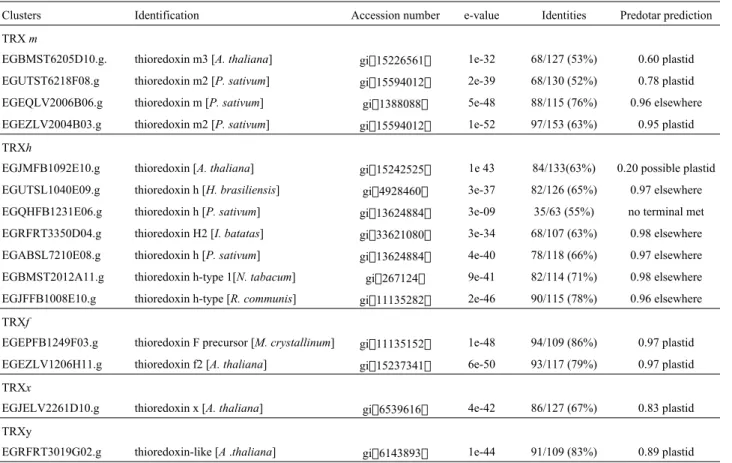
respec-tively. Putative TRXs m clusters demonstrate the best homology with thioredoxins from Pisum sativum and Arabidopsis thaliana, ranging from 53 to 76%. TRXs h clusters show homology with proteins from different plants coding sequence identities ranging from 55 to 78%. TRXsf clusters demonstrate the highest percentages of identity, 86% and 79%, tofthioredoxins fromMesembryanthemum crystallinum and Arabidopsis thaliana respectively. The identity of the TRXx cluster to the Arabidopsis thaliana TRXx was 67%. The cluster encoding TRXy, EGRFR T3019G02.g, was identified as a thioredoxin-like protein in Arabidopsis thaliana but may in fact correspond to a homologue of the AtTRXy1 (Lemaireet al., 2003a).
Subcellular localization predictions are also shown in Table 1. In general, the predictions agree with the type of thioredoxin found by the best homologies using BLASTP. This is the case in the defined chloroplastic thioredoxins, TRXf, TRXx and TRXy, here composed of the EGEPFB1 249F03.g, EGEZLV1206H11.g, EGJELV2261D10.g, and EGRFRT3019G02.g clusters respectively. The same can be confirmed for the m thioredoxins predicted as plastidial proteins. For these clusters, high percentages are obtained using the Predotar program that predicts a plastidial local-ization. Cluster EGEQLV2006B06.g, here kept in Table 1 in the m type group because of the homology to m thiore-doxin, is actually predicted by TargetP (Emanuelsson et al,
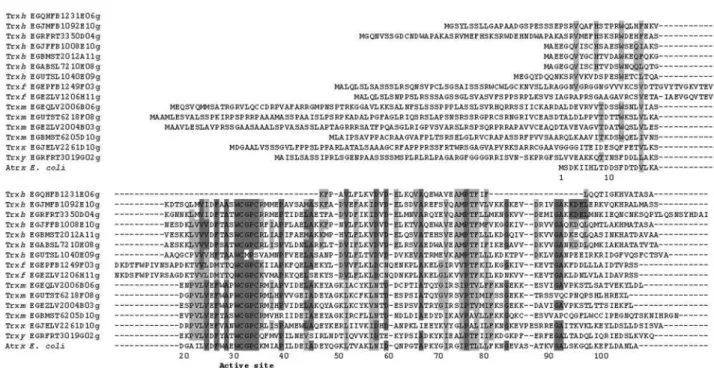
2000) as a mitochodrial protein. Those clusters that have been predicted “elsewhere” by Predotar have also been submitted to TargetP program. This analysis (data not shown) indicates a cytoplasmic localization for the clusters encoding h type thioredoxins EGUTSL1040E09.g, EGR FRT3350D04.g, EGABSL7210E08.g, EGBMST2012A 11.g, EGJFFB1008E10.g. Preliminary analysis of the FORESTs data has shown that most of the ESTs potentially encoding thioredoxins contain the coding sequence of the genes covering the ORF regions except for two clusters, EGEZFB1116E11.g and EGQHFB1231E06.g. If the in silicoidentification is compared with theArabidopsisset of genes, we can say that a similar situation in terms of num-ber and types of TRXs is observed, confirming the com-plexity of thioredoxin families also inEucalyptus(Meyeret al., 2002). We show in Figure 1 a sequence alignment of the 15 Eucalyptus putative thioredoxins and the E. coli thioredoxin (Atrx). We can identify two conserved regions characteristic of thioredoxins, the active site WCGPC and the region corresponding to a hydrophobic surface of amino acids at different locations in the primary structure (Gly33, Pro34, Pro76, Gly92, and Ala93). This second region is implicated in the interaction of thioredoxins with other pro-teins (Rivera-Madrid et al., 1995). Specific domains or conserved amino acids can be also observed, for example,
Table 1- Identification of thioredoxin clusters.
Clusters Identification Accession number e-value Identities Predotar prediction
TRXm
EGBMST6205D10.g. thioredoxin m3 [A. thaliana] gi15226561 1e-32 68/127 (53%) 0.60 plastid EGUTST6218F08.g thioredoxin m2 [P. sativum] gi15594012 2e-39 68/130 (52%) 0.78 plastid EGEQLV2006B06.g thioredoxin m [P. sativum] gi1388088 5e-48 88/115 (76%) 0.96 elsewhere EGEZLV2004B03.g thioredoxin m2 [P. sativum] gi15594012 1e-52 97/153 (63%) 0.95 plastid TRXh
EGJMFB1092E10.g thioredoxin [A. thaliana] gi15242525 1e 43 84/133(63%) 0.20 possible plastid EGUTSL1040E09.g thioredoxin h [H. brasiliensis] gi4928460 3e-37 82/126 (65%) 0.97 elsewhere EGQHFB1231E06.g thioredoxin h [P. sativum] gi13624884 3e-09 35/63 (55%) no terminal met EGRFRT3350D04.g thioredoxin H2 [I. batatas] gi33621080 3e-34 68/107 (63%) 0.98 elsewhere EGABSL7210E08.g thioredoxin h [P. sativum] gi13624884 4e-40 78/118 (66%) 0.97 elsewhere EGBMST2012A11.g thioredoxin h-type 1[N. tabacum] gi267124 9e-41 82/114 (71%) 0.98 elsewhere EGJFFB1008E10.g thioredoxin h-type [R. communis] gi11135282 2e-46 90/115 (78%) 0.96 elsewhere TRXf
EGEPFB1249F03.g thioredoxin F precursor [M. crystallinum] gi11135152 1e-48 94/109 (86%) 0.97 plastid EGEZLV1206H11.g thioredoxin f2 [A. thaliana] gi15237341 6e-50 93/117 (79%) 0.97 plastid TRXx
EGJELV2261D10.g thioredoxin x [A. thaliana] gi6539616 4e-42 86/127 (67%) 0.83 plastid TRXy
the KDEL motif or the Trp residue (W13 inEucalyptus), both characteristic ofhthioredoxins.
Concerning the cytosolic TRXs, the variant of the ac-tive center WCPPC identified by Rivera-Madrid et al. (1995) in three TRXh ofArabidopsis(AtTRX3, AtTRX4, AtTRX5) has not been detected in our analysis. This is sur-prising because of the considerable level of expression of these genes inArabidopsiscompared to the other members of thioredoxin h family (Reichheldet al., 2002).
An atypical WCMPS active site has been found in the Cluster EGUTSL1040 (Figure 1). This cluster comprises 8 reads from 6 different libraries and demonstrates the high-est homology score to a putative thioredoxin pseudogene described in Hevea brasiliensis harboring an active site WCIPS (Chow, 1999). It may in fact constitute a member of TRXh-like subgroup of thioredoxins described in poplar that share the same active site and that have been biochemi-cally characterized (Gelhaye et al., 2003a). Also in the Arabidopsis thalianagenome, two genes present the active site CxxS, AtCxxS1 and AtCxxS2 which have WCLPS and WCIPS sites respectively (Gelhayeet al., 2003a) We have decided to keep the inferred protein sequence of this EST in our phylogenetic tree (Figure 2) where we can observe that it roots in the thioredoxinshgroup.
The phylogenetic tree also suggests the distribution of thioredoxins according to their gene families. We can ob-serve that all the inferred ORFs encoding Eucalyptus thioredoxins are rooted in the tree beside their counterparts inArabidopsis thaliana.
Expression of thioredoxins clusters
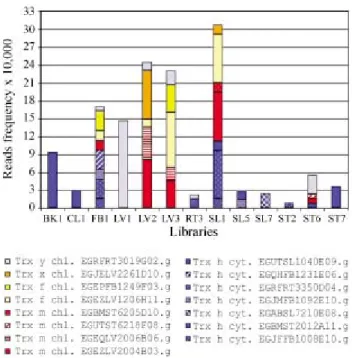
Putative thioredoxin genes ofEucalyptus,according to their calculated EST frequencies, are expressed differ-ently in 13 of the 18 cDNA libraries from FORESTs data (Figure 3). No read encoding thioredoxin has been found in the CL2, RT6, SL8 and WD2 libraries. The other libraries demonstrate that thioredoxin reads vary according to the type of thioredoxin and the individual cluster. When we globally analyze the expression frequencies of TRXs clus-ters inEucalyptusand compare these with published results using Northern blotting or RT-PCR techniques in other plants, we observe that the transcriptome can represent a deduced coherent overview of thioredoxin expression. This means that the tissue specificity of expression according to the group of TRXs seems to be in accord with the results de-scribed in literature. For example, the expression of puta-tive chloroplastic thioredoxins in green tissues or the presence of TRXs transcripts preferentially in non-green tissues for the cytosolic group seems to coincide. Another interesting example is the important expression of TRXs in early seedling development, which is well documented in the literature (Kobrehel et al., 1992; Wong et al., 2002; Marxet al., 2003). Here we have observed high level of ex-pression of thioredoxins genes in seedling libraries (Figure 3).
Chloroplastic thioredoxins
Chloroplastic TRXm is present in the Eucalyptus transcriptome with at least four putative clusters. The
ence of their correspondent reads is observed in five librar-ies (Figure 3) composed mostly from green tissues (FB1, LV2, LV3, SL1, ST6). This result may be expected due to the function of TRXsmin the photosynthesis process. The read frequencies restricted to the leaves, flowers and seed-lings correspond to the major tissues where the expression ofTRXmhas been reported inArabidopsis(Mestre-Ortega and Meyer, 1999). These authors have found, by Northern blotting, an expression profile of TRXm genes (Athm1, Athm2, Athm4) and TRXx (Athx) in seeds, roots, stem, leaves, flowers and callus tissues but with high RNA levels restricted to leaves, flower buds and seedlings. These tis-sues have allowed the cloning of cDNAs encoding TRXm in Eucalyptus. In the same way, TRXx cluster (EGJEL
V2261D10.g) demonstrates reads with elevated frequen-cies in the libraries from leaves (LV2) and seedlings (SL1).
The two clusters of TRXf(EGEPFB1249F03.g, EGE ZLV1206H11.g) present read frequencies and deduced ex-pression following the TRXmreads. They have been de-tected in flower buds, leaves and seedling tissues in FB1, LV2, LV3 and SL1 libraries. Pagano et al.(2000) have demonstrated the expression of TRXfin pea by RT-PCR and reported the presence of transcripts in leaves and also in non-photosynthetic organs like roots suggesting a role of TRXfother than the FBPase modulation.
Finally we can remark on the specificity of TRXs m/f/xfor the SL1 library. No EST has been found in the other five seedling libraries. The SL1 library differs from the others in that it represents cDNAs from seedlings
vated in the dark but exposed to light 3 h before RNA ex-traction. The other libraries represent cDNAs from seedlings cultivated completely in the dark. This result could be related to the well-established role of chloroplastic thioredoxins as light-dependent enzymes in photosynthesis (Collinet al., 2003, Meyeret al, 2002).
In the case of TRXy, the read frequencies are re-stricted to leaves (LV1, LV2, LV3), flower buds (FB1) and differ from the other chloroplastic TRXs in a stem library (ST6). The expression ofTRXyremains to be established in plants. The expression data available forTRXyis the result of an in silico analysis from ESTs of Chamydomonas reinhardtii presented by Lemaire et al., (2003b). TRXy ESTs are found in the libraries prepared from cultures sub-mitted to nutritional stress conditions and are poorly or un-detected in normal culture conditions. In our case, the libraries that contain TRXyESTs could be also considered a stress library, for example the LV3, which is prepared from leaves attacked byThyrinteinafor 7 days; however,
experimental data has to be made to confirm that assump-tion.
Cytosolic thioredoxins
We have identified seven clusters that, on the basis of the sequences and the phylogenetic analysis, could corre-spond tohthioredoxins. These clusters present an expres-sion profile more distributed than chloroplastic or mitochondrial thioredoxins and are found preferentially in young and proliferating tissues from a wide range of librar-ies (Figure 3). We can note, for example, the presence of TRXh reads in the libraries of seedlings, flower buds, stems, bark and callus. They are absent in leaves. Some considerations can be given to the presence of TRXs tran-scripts in certain libraries. The presence of thioredoxinshin callus, for example, has been reported since the identifica-tion of the first genes in tobacco (Brugidouet al., 1993) and later inArabidopsis(Rivera-Madridet al., 1995). Among the thioredoxins expressed in plants, the cytosolic are the best characterized. Reichheldet al., (2002) have employed multiple approaches (Northern blotting, RT-PCR, GUS-fusion plants) in attempts to obtain information that could be useful to reveal the function of the 8 genes from Arabidopsis. They have shown that the expression occurs in most tissues studied and it seems clear that the expres-sion is divergent depending on the gene studied. If we com-pare these results with the frequencies and tissue specificity of TRXhin the case ofEucalyptus, it is possible to say that it is comparable. However, experimental analysis should be conducted to confirm the data.
Analysis of the TDX cluster
We have identified the Cluster EGEZFB1116E11.g as a homologue of a TDX gene characterized by Vignolset al.(2003) inArabidopsis thaliana. This gene encodes a sin-gular bipartite protein composed by a carboxyl-terminal thioredoxin domain and the amino-terminal domain con-taining three tetratricopeptide repeats similar to those found in the Hip protein of rat and human (Hohfeld Jet al., 1995). The TDX name has been attributed to Tetratrico-peptide domain-containing thioredoxin. Functional charac-terization of this gene reveals a disulfide reduction bothin vivoandin vitroby the thioredoxin domain; whereas, the amino terminus presents an interaction with the yeast Hsp70 Ssb2 chaperone, a member of the heat shock protein family (Nelsonet al, 1992). In this case, the redox domain will be acting as a redox switch that turns the complex with Ssb2 on and off.
Cluster EGEZFB116E11.g found in theEucalyptus transcriptome might be a partial cDNA encoding a homo-logue of TDX inEucalyptus. It shows 69% homology with theArabidopsis thalianaTDX in its thioredoxin domain. Figure 4 presents a multiple sequence alignment of the EGEZFB11E11.g deduced protein and the TDX genes fromArabidopsis thalianaandNicotiana tabacum. We can
Figure 3- Relative abundance ofEucalyptusthioredoxin ESTs in differ-ent cDNA libraries. Clusters with the same colors belong to the same group. TRXm, red; TRXh, blue; TRXf, yellow; TRXx, brown; TRXy, gray. cDNA libraries: BK1 - bark, alburnum, heartwood and pith fromE. grandis8 years old; CL1 - callus ofE. grandisgrown in the presence of light; FB1 - flower buds, flowers and fruits; LV1 - leaves from plantlets; LV2 - leaves from adult trees deficient in phosphorus and boron, sensitive to rust and susceptible to canker; LV3 - leaves colonized byThyrinteina
for 7 days; RT3 - roots from greenhouse plants; SL1-seedings fromE. grandisgrown in the dark and exposed to light for 3 h before RNA extrac-tions; SL4 - seedlings fromE. globulusgrown in the dark; SL5 - seedlings fromE. salignagrown in the dark; SL6 - seedlings fromE. urophylla
observe the very conserved region comprising the thiore-doxin domain in the three proteins. The expression profile observed by the frequency analysis shows the presence of Cluster EGEZFB116E11.g restricted to the libraries from flower buds (FB1) and seedlings (SL4) at low levels.
Conclusions
In this paper we have shown that the Eucalyptus transcriptome encodes at least 15 putative thioredoxin ESTs and one cluster encoding a putative TDX gene. Two families of thioredoxins present in the trascriptome have been described: chloroplastic and cytosolic. The number of
cDNAs and the type of thioredoxins encoded seems to be similar to the total number of genes found inArabidopsis thaliana.Concerning the read frequencies, we can presume that the libraries that compose the Eucalyptus trans-criptome provide an overview and a coherent expression profile of thioredoxins. Nevertheless, other putative thio-redoxins and mainly thioredoxin-like transcripts present in the data bank remain to be studied.
Acknowledgments
We are very grateful to Yves Meyer and Jean-Philippe Reichheld (CNRS/ Université de Perpignan) for
Figure 4- Multiple sequence alignment of TDX proteins. Deduced amino acid sequences ofArabidopsis thaliana (AAL5485),Nicotiana tabacum
reviewing the manuscript. We also thank to Sarra Jamieson (Cambridge Institute for Medical Research) and Marcia Pedrini (UFRN-Brazil) for reading the paper. A.E.B was supported by Capes - Comissão de Aperfeiçoamento de Pessoal de Nível Superior/Brazil.
References
ArabidopsisGenome Initiative (2000) Analysis of the genome se-quence of the flowering plantArabidopsis thaliana. Nature 409:796-815.
Arner ESJ and Holmgren A (2000) Physiological functions of thioredoxin and thioredoxin reductase. Eur J Biochem 267:6102-6109.
Altschul SF, Madden TL, Schäffer AA, Zhang ZZ, Miller W and Lipman DJ (1997) Gapped BLAST and PSI-BLAST: A new generation of protein database search programs. Nucleic Acids Res 25:3389-3402.
Balmer Y, Koller A, del Val G, Manieri W, Schurmann P and Bu-chanan BB (2003) Proteomics gives insight into the regula-tory function of chloroplast thioredoxins. Proc Natl Acad Sci U SA 100:370-5.
Brugidou C, Marty I, Chartier Y and Meyer Y (1993) The Nicotiana tabacum genome encodes two cytoplasmic thioredoxin genes which are differently expressed. Mol Gen Genet 238:285-93.
Buchanan BB (1980) Role of light in the regulation of chloroplast enzymes. Annu Rev Plant Physiol 31: 341-374.
Chow KS (1999) Cloning of a thioredoxins h cDNA fromHevea brasiliensis. Plant Physiol 120:339.
Collin V, Issakidis-Bourguet E, Marchand C, Hirasawa M, Lan-celin JM, Knaff DB and Miginiac-Maslow M (2003) The Arabidopsisplastidial thioredoxins: New functions and new insights into specificity. J Biol Chem 278:23747-23752. Emanuelsson O, Nielsen H, Brunak S and von Heijne G (2000)
Predicting subcellular localization of proteins based on their N-terminal amino acid sequenceJ Mol Biol300:1005-1016. Gelhaye E, Rouhier N and Jacquot JP (2003a) Evidence for a
sub-group of thioredoxins h that requires GSH/Grx for its reduc-tion. FEBS Letters 555:443-448.
Gelhaye E, Rouhier N, Vlamis-Gardikas, Girardet JM, Sautiere PE, Sayzet M, Martin F and Jacquot JP (2003b) Identifica-tion and characterizaIdentifica-tion of a third thioredoxins h in poplar. Plant Physiol Biochem 41:629-635.
Gelhaye E, Rouhier N and Jacquot JP (2004a) The thioredoxins h system of higher plants. Plant Physiol Biochem 42:265-71. Gelhaye E, Rouhier N, Gerard J, Jolivet Y, Gualberto J, Navrot N,
Ohlsson PI, Wingsle G, Hirasawa M, Knaff DB, Wang H, Dizengremel P, Meyer Y and Jacquot JP (2004b) A specific form of thioredoxin h occurs in plant mitochondria and regu-lates the alternative oxidase. Proc Natl Acad Sci USA 101:14545-14550.
Hohfeld J, Minami Y and Hartl FU (1995) Hip, a novel cochaperone involved in the eukaryotic Hsc70/Hsp40 reac-tion cycle. Cell 83:589-98.
Jacquot JP, Rivera-Madrid R, Marinho P, Kollarova M, Le Marechal P, Miginiac-Maslow M and Meyer Y (1994) Arabidopsis thalianaNADPH thioredoxin reductase. cDNA characterization and expression of the recombinant protein inEscherichia coli. J Mol Biol 235:1357-63.
Jaquot JP, Lancelin JM and Meyer Y (1997) Thioredoxin: Struc-ture and function in plant cells. News Phytol 136:543-570. Kobrehel K, Wong JH, Balogh A, Kiss F, Yee BC and Buchanan
B (1992) Specific reduction of wheat storage proteins by thioredoxins h. Plant Physiol 99:919-924.
Laloi C, Rayapuram N, Chartier Y, Grienenberger JM, Bonnard G and Meyer Y (2001) Identification and characterization of a mitochondrial thioredoxin system in plants. Proc Natl Acad Sci U SA 20:14144-14149.
Laurent TC, Moore EC and Reichard P (1964) Enzymatic synthe-sis of deoxyribonucleotides. Isolation and characterization of thioredoxin, the hydrogen donor ofEscherichia coli. J Biol Chem 239:3436-3444.
Lemaire SD, Collin V, Keryer A, Quesada M and Miginiac-Maslow M (2003a) Characterization of thioredoxins y, a new type of thioredoxins identified in the genoma of Chamydomonas reinhardtii.FEBS Letters 543:87-89. Lemaire SD, Collin V, Keryer E, Issakidis-Bourguet, Lavergne D
and Miginiac-Maslow M (2003b) Chamydomonas reinhardtii a model organism for the study of the thioredoxins family. Plant Physiol Biochem 41:513-521. (2004) New targets of Arabidopsis thioredoxins revealed by
proteomic analysis. Proteomics 4:2696-706.
Marx C, Wong JH and Buchanan BB (2003) Thioredoxin and ger-minating barley: Targets and protein redox changes. Planta 216:454-60.
Mestres-Ortega D and Meyer Y (1999) TheArabidopsis thaliana genome encodes at least four thioredoxins m and a new prokaryotic-like thioredoxin. Gene 240:307-16.
Meyer Y, Verdoucq L and Vignols F (1999) Plant thioredoxins and glutaredoxins: Identity and putative roles. Trends Plant Sci 4:388-394.
Meyer Y, Vignols F and Reichheld JP (2002) Classification of plant thioredoxins by sequence similarity and intron posi-tion. Methods Enzymol 347:394-402.
Mouaheb N, Thomas D, Verdoucq L, Monfort P and Meyer Y (1998)In vivofunctional discrimination between plant thio-redoxins by heterologous expression in the yeast Saccharomyces cerevisiae. Proc Natl Acad Sci USA 95:3312-3317.
Nelson RJ, Ziegelhoffer T, Nicolet C, Werner-Washburne M and Craig EA (1992) The translation machinery and 70 kd heat shock protein cooperate in protein synthesis. Cell 71:97-105.
Netto LES (2001) Oxidative stress in sugarcane. Genet and Molec Biol 24:93-102.
Pagano EA, Chueca A and Lopez-Gorge J (2000) Expression of thioredoxins f and m, and of their targets fruc-tose-1,6-biphosphatase and NADP-malate dehydrogenase, in pea plants grown under normal and light/temperature stress conditions. Journal of Experimental Botany 51:1299-1307.
Reichheld JP, Mestres-Ortega D, Laloi C and Meyer Y (2002) The multigenic family of thioredoxin h inArabidopsis thaliana: Specific expression and stress response. Plant Physiol Biochem 40:685-690.
Schumann P and Jacquot JP (2000) Plant thioredoxins systems re-visited. Ann Rev Plant Physiol 51:371-4000.
Thompson LD, Higgins DG and Gibson TJ (1994) CLUSTAWL: Improving the sensitivity of progressive multiple sequence alignment through sequence weighting, positive-specific gap penalties and weight matrix choice. Nucleic Acid Res 22:4673-4680.
Verdoucq L, Vignols F, Jacquot JP, Chartier Y and Meyer Y (1999)In vivocharacterization of a thioredoxin h target pro-tein defines a new peroxiredoxin family. J Biol Chem 274:19714-22.
Vignols F, Mouaheb N, Thomas D and Meyer Y (2003) Redox control of Hsp70-Co-chaperone interaction revealed by
ex-pression of a thioredoxin-likeArabidopsisprotein. J Biol Chem 278:4516-23.
Yamazaki D, Motohashi K, Kasama T, Hara Y and Hisabori T (2004) Target proteins of the cytosolic thioredoxins in Arabidopsis thaliana. Plant Cell Physiol 45:18-27. Wong JH, Kim YB, Ren PH, Cai N, Cho MJ, Hedden P, Lemau
PG and Buchanan BB (2002) Transgenic barley grain overexpressing thioredoxin shows evidence that the starchy endosperm communicates with the embryo and the aleu-rone. Proc Natl Acad Sci USA 99:16325-30.