J. Evid. Based Med. Healthc., pISSN- 2349-2562, eISSN- 2349-2570/ Vol. 3/Issue 79/Oct. 03, 2016 Page 4304
COMPARISON OF UPPER LIP BITE TEST WITH MODIFIED MALLAMPATI TEST AND
THYROMENTAL DISTANCE FOR PREDICTING DIFFICULTY IN ENDOTRACHEAL
INTUBATION: A PROSPECTIVE STUDY
Prakash T. S. N1, Ravi Vasupalli2
1Associate Professor, Department of Anaesthesia, Andhra Medical College, Visakhapatnam, Andhra Pradesh, India.
2Associate Professor, Department of Anaesthesia, A. C. Subba Reddy Government Medical College, Nellore, Andhra Pradesh, India.
ABSTRACT
BACKGROUND
The significance of difficult or failed tracheal intubation was well recognised as a major cause of morbidity and mortality in anaesthetic practice as per ASA closed claim study. The need to predict potentially difficult tracheal intubation has received more importance, but with limited success. Unanticipated difficult intubation is a risk to patient’s life and a challenge to the skill of the anaesthesiologist. Many anatomical and pathological variables have been identified and have been suggested to be useful in anticipating a difficult airway. These factors have limitations because of wide variations in the incidence of difficult intubation, interobserver variability and inadequate statistical power of the currently measured variables.
METHODS
After obtaining institutional ethical committee clearance and written informed consent, the present study was conducted in 200 patients aged between 16 yrs. and 65 yrs. at King George Hospital, Andhra Medical College, Visakhapatnam, in the Department of Anaesthesiology. All the 200 patients undergoing elective surgical procedures under general anaesthesia were enrolled in the study. A thorough preanaesthetic evaluation was carried out in all the patients and the procedure was explained in detail to the patients.
RESULTS
Of the entire two hundred patients, a total of ten patients had difficult intubation, all of them had Cormack-Lehane class III on laryngoscopy. None of them had Cormack-Lehane class IV on laryngoscopy. The incidence of difficult intubation was 5% in the present study. There were no cases of failed intubation. One hundred and eighty seven patients predicted to be easy for intubation by ULBT (i.e. patients who had ULBT class I and II) out of whom, however, we encountered difficult intubation in 5 patients. Out of the eight patients predicted to have difficult airway by ULBT III, only one patient had CL III difficult airway and subsequently difficult intubation.
CONCLUSIONS
MMT has high sensitivity, specificity, PPV and NPV compared to other two tests. So, it can be used as a simple bedside screening test for difficult laryngoscopy/intubation. ULBT is more accurate than TMD and probably 2nd most important test in prediction of difficult airway. MMT has high specificity and moderate sensitivity and should never be used as a single bedside screening test and it should be combined with other airway assessment tests for prediction of difficult laryngoscopy/intubation. In spite of various airway assessment tests, no single test is 100% accurate. So, it is advisable to use combination of different tests or the use of various scoring systems for predicting difficult laryngoscopy/intubation.
KEYWORDS
Intubation, Intratracheal E02.041.500, Airway Management E02.041, Laryngoscopy E01.370.386.460.
HOW TO CITE THIS ARTICLE: Prakash TSN, Ravi V.Comparison of upper lip bite test with modified Mallampati test and thyromental distance for predicting difficulty in endotracheal intubation: A prospective study.J. Evid. Based Med. Healthc. 2016; 3(79), 4304-4309. DOI: 10.18410/jebmh/2016/918
INTRODUCTION: The reported incidence of difficult laryngoscopy and tracheal intubation occurs in 1.5% to 8%
of patients of general anaesthesia.[1] Difficult laryngoscopy and intubation cause increased risk of complications to the patient ranging from sore throat to airway trauma. Of all the deaths caused due to anaesthesia, 30% to 40% are attributed to the inability to manage a difficult airway.[2] Of the overall claims against anaesthetist in closed claims project, 17% involved difficult or impossible intubation.[3] A difficult intubation occurs in approximately one in 2000 patients in the general surgical population, but one in 300 obstetric patients. Unanticipated difficult intubation is a risk
to patient’s life and a challenge to the skill of the
Financial or Other, Competing Interest: None. Submission 06-09-2016, Peer Review 14-09-2016, Acceptance 21-09-2016, Published 03-10-2016. Corresponding Author:
Dr. Ravi Vasupalli,
Associate Professor, Department of Anaesthesia, A. C. Subba Reddy Government Medical College, Nellore. E-mail: [email protected]
J. Evid. Based Med. Healthc., pISSN- 2349-2562, eISSN- 2349-2570/ Vol. 3/Issue 79/Oct. 03, 2016 Page 4305
anaesthesiologist. Many anatomical and pathological variables have been identified and have been suggested to be useful in anticipating a difficult airway. These factors have limitations because of wide variations in the incidence of difficult intubation, interobserver variability and inadequate statistical power of the currently measured variables There are many tests to predict difficult intubation viz. Patil’s measurement of Thyromental distance, the Mallampati test and the Wilson scoring system, but these tests have been shown to have high false positive rates, which detract their usefulness.[4,5] So, predicting a difficult intubation employing a myriad of measurements and observations has not demonstrated itself to be practicable or even reliable.
AIM AND OBJECTIVES: The aim of this study is to evaluate the efficacy of UPPER LIP BITE TEST in predicting difficult intubation.
Objectives are to compare;
1) Sensitivity, 2) Specificity,
3) Positive predictive value, and
4) Negative predictive values of Upper Lip Bite Test with Modified Mallampati.
Test and Thyromental distance to predict difficulty in endotracheal intubation.
MATERIALS AND METHODS: Preoperatively, all the
patient’s airway was evaluated using MMT, TMD and ULBT.
TMD was measured using tape in cm. Classification of oropharyngeal view was done according to MMT wherein the patients were made to be in sitting position with mouth fully open and tongue maximally protruded and patients were asked not to phonate with the examiner sitting in front of patient in line with the face.
Class I - Soft palate, fauces uvula and pillars. Class II - Soft palate, fauces and uvula are seen. Class III - Soft palate and base of uvula. Class IV - Soft palate not visible.
The ULBT was performed according to the following criteria; in this examination, patients were asked to bite their upper lip with lower incisors and were graded accordingly. Class I - lower incisors can bite upper lip above the vermillion line.
Class II - lower incisors can bite upper lip below the vermillion line.
Class III - lower incisors cannot bite the upper lip.
TMD (PATIL’S TEST): Distance is measured from tip of
thyroid cartilage to inside of mentum in a fully extended neck with mouth closed.
Grade 1: >6.5 cm -- No problem with laryngoscopy and intubation.
Grade 2: 6-6.5 cm -- Difficult laryngoscopy, but possible.
Grade 3: <6 cm -- Laryngoscopy maybe impossible.
Patients were premedicated with Inj. Glycopyrrolate 0.005 mg/Kg IV, Inj. Midazolam 0.05 mg/kg IV, Inj. Fentanyl 2 mcg/kg. After preoxygenation with 100% oxygen for 5 minutes, patients were induced with Inj. Thiopentone 5 mg Kg-1IV and the endotracheal intubation was facilitated with Inj. Suxamethonium 1.5 to 2 mg Kg-1IV by a senior anaesthesiologist having minimum five years of experience in clinical anaesthesia. The patients’ head and neck were kept in optimal intubating position with a pillow under the occiput during intubation (sniffing position), laryngoscopy was done using appropriate-sized Macintosh blade and glottic view was graded according to the;
Cormack and Lehane grading:
Grade I: Full view of the glottis.
Grade II: Only posterior commissure visible. Grade III: Only tip of epiglottis visible. Grade IV: No glottic structure visible.
Patients were intubated with appropriate-sized endotracheal tube. Patients vital signs were monitored throughout the procedure. At the end of surgery, patients were adequately reversed with Inj. Glycopyrrolate 0.01 mg/kg and Inj. Neostigmine 0.05 mg/kg. Patients were extubated after thorough oral suctioning. After stabilisation, patients were shifted to postoperative recovery room.
STATISTICAL ANALYSIS: The preoperative airway assessment data and the findings during intubation were used to determine the sensitivity, specificity, positive and negative predictive values for each test. Fisher’s exact test
and McNemar’s test was used to calculate statistically significant difference in sensitivity and specificity between these tests, respectively.
Statistical Terms:
True Positive: A difficult intubation that had been predicted to be difficult.
False Positive: An easy intubation that had been predicted to be difficult.
True Negative: An easy intubation that had been predicted to be easy.
False Negative: A difficult intubation that had been predicted to be easy.
Sensitivity: The percentage of correctly predicted difficult intubations as a proportion of all intubations that were truly difficult, i.e., true positives/(true positive + false negatives).
J. Evid. Based Med. Healthc., pISSN- 2349-2562, eISSN- 2349-2570/ Vol. 3/Issue 79/Oct. 03, 2016 Page 4306 Positive Predictive Value: The percentage of correctly
predicted difficult intubations as a proportion of all predicted difficult intubations, i.e., true positive/(true positive + false positives).
Negative Predictive Value: The percentage of correctly predicted easy intubations as a proportion of all predicted easy intubations, i.e., true negatives/(true negatives +false negatives).
Inclusion Criteria:
1. Patients aged between 16-65 yrs. of either sex. 2. Patients belonging to ASA (American society of
anaesthesiologist) grade I and II physical status. 3. Patients undergoing elective surgery under general
anaesthesia with endotracheal intubation.
Exclusion Criteria:
1. Edentulous patients.
2. Patients unable to open the mouth.
3. Patients with cervical spine fractures and deformities. 4. Patients with upper airway tumours.
5. Patients with loose incisors.
6. Patients who has undergone lip surgeries.
RESULTS: The sex ratio of male and female was found to be 110 and 90 (110:90). Age group between 16 years to 65 years was taken and the mean value was found to be 44.93 yrs. Body Mass Index in the present study was 23.86 kg/m2 (Table1).
1. Sex (M:F) 110:90
2. Age (Mean) 44.93 yrs.
3. BMI (n=200) 23.86 kg/m2
Table 1: Demographic Data
Of the entire two hundred patients, a total of ten patients had difficult intubation, all of them had Cormack-Lehane class III on laryngoscopy. None of them had Cormack.
Lehane class IV on laryngoscopy. The incidence of difficult intubation was 5% in the present study. Out of the 10 cases of MMT grade III, 6 were predicted difficult by Cormack.
Lehane grading. Out of 8 cases of ULBT grade III, 3 cases were predicted difficult by Cormack-Lehane grading. Out of 6 cases of TMD <6.5 cms, 1 case was predicted difficult by Cormack-Lehane grading. There were no cases of failed intubation in our study. In our study, one hundred and ninety had MMT class I and II and ten patients had class III. Of these four of the MMT class I and II and six of the MMT class III had Cormack Lehane grade III. None of the patients had MMT class IV (Table 2).
Cormack-Lehane
Total
Gr I and II Gr III and IV
Modified
Mallampati I, II 186 4 190
Modified
Mallampati III, IV 4 6 10
Table 2: Relation between Modified Mallampati Test and Laryngoscopic View
There were one hundred and eighty seven patients predicted to be easy for intubation by ULBT (i.e. patients who had ULBT class I and II) out of whom, however, it was encountered difficult intubation in 5 patients. Out of the eight patients predicted to have difficult airway by ULBT III only pt. had CL III and subsequently difficult intubation (Table 3).
Cormack-Lehane
Total Gr I and II Gr III and IV
ULBT I, II 187 5 192
ULBT III 5 3 8
Table 3: Relationship between Upper Lip Bite Test (ULBT) and Laryngoscopic View
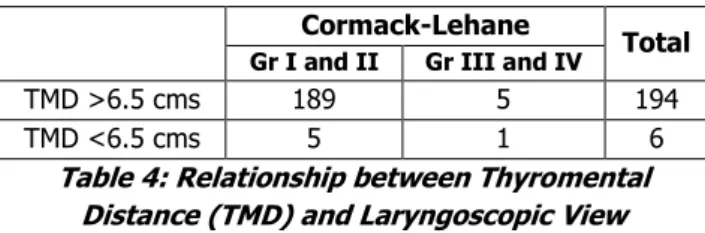
194 patients have TMD >6.5 cms and 6 patients have TMD <6.5 cms out of which only 1 patient had CL III and difficult intubation (Table 4).
Cormack-Lehane
Total
Gr I and II Gr III and IV
TMD >6.5 cms 189 5 194
TMD <6.5 cms 5 1 6
Table 4: Relationship between Thyromental
Distance (TMD) and LaryngoscopicView
In the present study, the sensitivity, specificity, positive predictive value and negative predictive value of modified Mallampati test were 60%, 97.89%, 60%, 96.789%, respectively in that order. In the present study, the sensitivity, specificity, positive predictive value and negative predictive value of Upper Lip Bite Test were 30%, 97.4%, 37.5%, 96.35%, respectively. In the present study, the sensitivity, specificity, positive predictive value and negative predictive value of thyromental distance were 10%, 97.4%, 16.67%, 95.36%, respectively (Table 5).
Statistical Terms MMT ULBT TMD
True positive 06 03 01
False positive 04 05 05
True negative 186 185 185
False negative 04 07 09
Sensitivity 60% 30% 10%
Specificity 97.89% 97.4% 97.4%
Positive predictive value 60% 37.5% 16.67% Negative predictive value 97.89% 96.35% 95.36%
J. Evid. Based Med. Healthc., pISSN- 2349-2562, eISSN- 2349-2570/ Vol. 3/Issue 79/Oct. 03, 2016 Page 4307 DISCUSSION: From the studies of Wilson et al, Mukesh
Tripathi et al, Shiga et al, Patil et al, there is no test, which can be considered fool proof to predict a difficult intubation.[4,6,7,8] So, there is a need for a test, which is quick and easy to perform, which is highly sensitive (so that majority of difficult cases can be identified) and highly specific (so that false positive rate will be low when the test is used routinely). Any test devised should be easy to perform and interpreted at the bedside. Khan and his colleagues introduced Upper Lip Bite Test was such an attempt. The demographic characteristics in the present study was comparable to studies done by Krobbuaban et al and Krishna et al,[9,10] Turkan and his colleagues found that Mallampati grading, degree of neck extension and thyromental distance were all age dependent and all these variables were inversely affected by the age.[11] Broadsky et al and Erzi et al, in their study found that BMI had no role in prediction of difficult airway.[12,13] However, Safavi et al, in their study found significant correlation between old age, obesity, high BMI with the incidence of difficult intubation in contrast to the present study.[14] In the present study, incidence of difficult intubation was found to be 5% (ten cases of difficult intubation out of two hundred patients), which is comparable to the results obtained by Frerk and Savva et al,[15,16] Frerk et al, in his prospective study compared thyromental distance with Mallampati test observed 244 patients and their incidence of difficult intubation was 12 (5%), which was comparable with the present study. A prospective study done by Saava and his colleagues compared different tests for prediction of difficult airway observed 350 cases and their incidence of difficult intubation was 17 (5%).[15,16] In this study, the incidence of difficult intubation was found to be 5%, which was comparable with the present study. A meta-analysis by Shiga et al found that the incidence of the difficult intubation was 5.8%, which was almost equal to the present study.[7] Mohan J and his colleagues in their study found the incidence of difficult intubation was 4.2% (9 cases out of 210 cases), which was less than that of the present study.[17] However, the reported incidence of difficult laryngoscopy or intubation is 1.5% to 8%. This wide variation in incidence is due to the criteria that are used to define the difficult intubation and different anthropometric features among populations.[1] Out of these 10 cases in our study, 3 cases were intubated with the help of stylet and remaining 7 cases were intubated with the help of bougie. Modified Mallampati Test (MMT) has been in use for more than two decades and over the years many limitations have been pointed out by many authors. The absence of definite demarcation between the class II, class III and class IV groups and effect of phonation on the oropharyngeal classification lead to higher interobserver variability and decreased reliability.[18,19] In present study, sensitivity of Modified Mallampati Test was found to be 60%, which was comparable to the study conducted by M. ATIF et al (60.7%).[20] The specificity of Modified Mallampati Test in current study was 97.89%, which is more than of Khan et al (66.8%) and Eberhart et al (61%).[21,22] A higher specificity similar to our study has also
been reported by Cattano et al.[23] The reported sensitivity and specificity of Modified Mallampati Test (60% and 97.89%) in the present study were more compared to that of the study done by Iohom et al, which were 43% and 93%, respectively.[9] Oates et al in 1991 compared two methods of predicting difficult laryngoscopy with Mallampati class and Wilson risk scoring, which were determined before operation and laryngeal view graded in 575 patients. They found the sensitivity of Mallampati to be 42% and specificity to be 84%, which were less compared to the present study (sensitivity - 60% and specificity - 97.89%).[24] The wide variations in reported specificity and sensitivity in various studies maybe because of interobserver variability seen in MMT as was also found by Eberhart et al. The negative predictive value of MMT was 97.89%, which is comparable to the study done by Eberhart et al.[22] The positive predictive value is high in the present study (60%), but it was less when compared to the study done by Singhal et al as the modified Mallampati gradings were given in both sitting and supine position.[19] In the present study, Mallampati grading was given based on only sitting position. The negative predictive value (97.89%) in this present study was comparable to the studies conducted by Khan Z et al (98.4%), Eberhart et al (93.8%) and Atif M et al (96.6%).[21,22,20] This indicates that it was a better indicator of easy intubation rather than that of the difficult intubation. Khan ZH introduced the Upper Lip Bite Test in 2003. The upper lip bite test, a reasonably easy test, evaluates the
J. Evid. Based Med. Healthc., pISSN- 2349-2562, eISSN- 2349-2570/ Vol. 3/Issue 79/Oct. 03, 2016 Page 4308
(94.5%).[22,21,20] Although, ULBT has higher negative predictive value, which is statistically significant (p<0.05), it has a very poor sensitivity making it an unreliable test to screen the patients for difficult intubations. ULBT has also been used as a predictor of difficult intubation with the video laryngoscope (Glidescope). In a case report by khan et al,[25] ULBT predicted easy intubation in a patient suffering from
both Cushing’s and Nelson’s syndromes, which had been predicted difficult by MMT. In the present study, there were three cases, which were predicted difficulty by Mallampati grading and these cases were predicted easy intubation by Upper Lip Bite Test. On laryngoscopy, it was predicted easy by Cormack-Lehane grading, it was found that repeated demonstrations were required for patients to perform ULBT and a few failed to understand the procedure in spite of our efforts. These patients were excluded from this study. Another interesting observation was the reflex movement of the upper lip in the reverse direction over the upper teeth. This movement may alter the point of meeting of vermilion line with the lower incisors. It might be different in different age groups and also in males and females. In the same individual, this may also vary according to the effort applied. Thyromental distance was used for prediction of difficult airway from earlier days, but its value as an indicator was questionable as it varies with body size and body proportions. TMD values also dependent on age and sex. Some investigators used different cut off points for males and females. Nevertheless, the use of different cut off points in men and women did not improve the predictive accuracy of the test.[8,26] Bekar et al found that three fingerbreadth test was most commonly used for measurement of TMD.[27] Tripathi et al (2004) considered the cut off length of TMD <5 cms as a predictor of difficult intubation. The authors hypothesised that a smaller Macintosh curved blade (No. 2 MCB) would improve the predicted difficult laryngoscopy in short-TMD patients over that with a standard Macintosh curved blade (No. 3 MCB).[6] Staikou Chryssoula et al (2011) considered the cut off length of TMD <7 cms as a predictor of difficult intubation.[28] Shiga et al using a pooled data with a cut-off of 6 cm or less for TMD found slightly improved prediction of difficult laryngoscopy.[7] Standard anaesthesia textbooks suggest TMD should be less than 6.5 cm or three large fingerbreadths for predicting difficult intubation. Racial differences also influence TMD as a predictor of difficult laryngoscopy. In Chinese women, high sensitivity and specificity (71.4% and 92.1%, respectively) were found with TMD <5.5 cm.[29] The specificity of TMD in the present study was 97.4%, which was similar to the studies conducted by Salimi A et al (93.3%) and A K Gupta et al (96.5%).[30,31] The positive predictive value of TMD in our study was 16.67%, which was almost comparable to that of Salimi A et al (22%). The negative predictive value of TMD was 95.36%, which is comparable to the study done by Freda Richa et al (94%).[32,33] This can be explained by the fact
that all the patients’ airway was evaluated by a single
resident unlike in other studies where in two or more than two anaesthesiologists were being involved in assessing the
airway. This might have contributed to the interobserver variability in their study leading to variable positivity.
LIMITATIONS OF THE STUDY: Sample size in this study was very small.
This study excludes edentulous patients and patients with limited mouth opening and pregnant women. MMT was done in sitting position. TMD was measured by using tape. As with any clinical or bedside test, the ability of patients to comprehend the instructions and comply with the same might have confounded the observations. TMD, MMT and
ULBT doesn’t assess neck mobility. In this, neck mobility can be a confounding factor in assessing the difficult airway.
CONCLUSION: In conclusion, the ideal risk assessment methods require high sensitivity and specificity and predictive variables should balance the dynamic relationship between sensitivity and the NPV. All these three tests have a negative predictive value more than 90%, thus stressing the fact that all these tests can be good predictors of easy intubation rather as positive predictors of difficult intubation, which has a very low incidence. MMT has high sensitivity, specificity, PPV and NPV compared to other two tests. So, it can be used as a simple bedside screening test for difficult laryngoscopy/intubation. ULBT is more accurate than TMD and probably 2nd most important test in prediction of difficult airway. MMT has high specificity and moderate sensitivity and should never be used as a single bedside screening test and it should be combined with other airway assessment tests for prediction of difficult laryngoscopy/intubation. In spite of various airway assessment tests, no single test is 100% accurate. So, it is advisable to use combination of different tests or the use of various scoring systems for predicting difficult laryngoscopy and intubation. For our daily practice, reducing the incidence of false negative prediction is important, but preparedness for possible difficulty in airway management is absolutely necessary and a difficult-airway cart with selected alternative difficult-airway adjuncts/devices should be readily available.
REFERENCES
1. Crosby ET, Cooper RM, Doyle DJ, et al. The unanticipated difficult airway with recommendations for management. Can J Anaesth 1998;45(8):757-776. 2. Posner KL, Caplan RA, Hagherg CA. Benumof`s airway management principles and practice. 2nd edn. Philadelphia: Mosby Elsevier 2007:1272-1282. 3. Caplan RA, Posner KL, Ward RJ, et al. Adverse
respiratory events in anesthesia: a closed claims analysis. Anesthesiology 1990;72(5):828-833. 4. Wilson ME, Spiegelhalter D, Robertson JA, et al.
Predicting difficult intubation. Br J Anaesth 1988;61(2):211-216.
J. Evid. Based Med. Healthc., pISSN- 2349-2562, eISSN- 2349-2570/ Vol. 3/Issue 79/Oct. 03, 2016 Page 4309
6. Mukesh T, Pandey M. Short thyromental distance: a predictor of difficult intubation or an indicator for
small blade selection? Anesthesiology
2006;104(6):1131-1136.
7. Shiga T, Wajima Z, Inoue T, et al. Predicting difficult intubation in apparently normal patients: a meta-analysis of bedside screening test performance. Anaesthesiology 2005;103(2):429-437.
8. Patil VU, Stehling LC, Zauder HL. Predicting the difficulty of intubation utilizing an intubation gauge. Anesthesiology Review 1983;10:32–33.
9. Krobbuaban B, Diregpoke S, Kumkeaw S, et al. The predictive value of the height ratio and thyromental distance: four predictive tests for difficult laryngoscopy. Anesth Analg 2005;101(5):1542-1545. 10. Krishna HM, Agarwal M, Dali JS, et al. Prediction of difficult laryngoscopy in Indian population: role of
ratio of patient’s height to thyromental distance. J Anaesth Clin Pharmacol 2005;21(3):257-260. 11. Turkan S, Ates Y, Cuhruk H, et al. Should we
reevaluate the variables for predicting the difficult airway in anaesthesiology? Anesth Analg 2002;94(5):1340-1344.
12. Brodsky JB, Lemmens HJ, Brock-Utne JG
,
et al. Morbid obesity and tracheal intubation. Anesth Analg 2002;94(3):732-736.13. Ezri T, Medalion B, Weisenberg M, et al. Increased body mass index per se is not a predictor of difficult laryngoscopy. Can J Anaesth 2003;50(2):179-183. 14. Safavi M, Honarmand A, Zare N. A comparison of the
ratio of patient's height to thyromental distance with the modified Mallampati and the upper lip bite test in predicting difficult laryngoscopy. Saudi J Anaesth 2011;5(3):258-263.
15. Savva D. Prediction of difficult tracheal intubation. Br J Anaesth 1994;73(2):149-153.
16. Ramadhani SAL, Mohamed LA, Rocke DA, et al. Sternomental distance as sole predictor of difficult laryngoscopy in obstetric anaesthesia. Br J Anaesth 1996;77:312-316.
17. Jagannatha M, Prabhudev K. Ratio of patients Height to Thyromental Distance (RHTMD) compared to thyromental distance for prediction of difficult intubation. Journal of Evidence Based Medicine and Healthcare 2015;2(42):7462-7476.
18. Horton WA, Fahy L, Charters P. Defining a standard intubating position using angel finder. Br J Anaesth 1989;62(1):6-12.
19. Singhal V, Sharma M, Prabhakar H, et al. Effect of posture on mouth opening and modified Mallampati classification for airway assessment. J Anesth 2009;23(3):463-546.
20. Atif M, Abdullah M, Yusuf M. Accuracy of upper lip bite test. Professional Medical Journal 2013;20(1):132-138.
21. Khan ZH, Kashfi A, Ebrahimkhani E. A Comparison of the upper lip bite test (a simple new technique) with modified Mallampati classification in predicting difficulty in endotracheal intubation: a prospective blinded study. Anesth Analg 2003;96(2):595-599. 22. Eberhart LHJ, Arndt C, Cierpka T, et al. The reliability
and validity of Upper Lip Bite Test with the Mallampati classification to predict difficult laryngoscopy: an external prospective evaluation. Anesth Analg 2005;101(1):284-289.
23. Cattano D, Panicucci E, Paolichhi A. Risk factors assessment of the difficult airway: an Italian survey of 1956 patients. Anesth Analg 2004;99(6):1774-1779.
24. Oates JDL, Oates PD, Pearsall FJ, et al. Phonation affects Mallampati classification. Anaesth 1990;45(11):984.
25. Khan ZH, Gharabaghian M, Nilli F, et al. Easy endotracheal intubation of a patient suffering from both Cushing's and Nelson's syndromes predicted by the upper lip bite test despite a Mallampati class 4 airway. Anesth Analg 2007;105(3):786-787.
26. Lasinska-Kowara M, Sulkowski B, Wujtewicz M. Thyromental distance as a predictor of difficult intubation. Anestezjol Intens 2007;39:8-12.
27. Baker PA, Depuydt A, Thompso JMD. Thyromental distance measurement - fingers don’t rule. Journal of Association of Anaesthetists of Great Britain and Ireland 2009;64:878-882.
28. Iohom G, Ronayne M, Cunningham AJ, et al. Prediction of difficult intubation. Eur J Anaesthesiol 2003;20(1);31-36.
29. Wong SH, Hung CT. Prevalence and prediction of difficult intubation in Chinese women. Anaesthesia & Intensive care 1999;27(1):49-52.
30. Salimi A, Farzanegan B, Rastegarpour A. Comparison of the upper lip bite test with measurement of thyromental distance for prediction of difficult intubations. Acta Anaesthesiology Taiwan 2008;46(2):61-65.
31. Gupta AK, Ommid M, Nengroo S, et al. Predictors of difficult intubation: study in Kashmiri population. BJMP 2010;3(1):307.
32. Richa F, Yazbeck P, Yazigi A, et al. Value of the association of the upper lip bite test (ULBT) with other tests in predicting difficulty of endotracheal intubation. Anaesthesiology 2005;103:A1418. 33. Tremblay MH, Williams S, Robitaille A, et al. Poor