www.scielo.br/eq
Synthesis, characterization and thermal studies on solid state
3-methoxybenzoate of lighter trivalent lanthanides
P. R. Dametto, A. B. Siqueira, C. T. Carvalho, M. Ionashiro*1
Instituto de Química, UNESP, C. P. 355, CEP 14801 – 970, Araraquara, SP, Brazil. *[email protected]
Abstract:Solid-state Ln -3-MeO-Bz compounds, where Ln stands for lighter trivalent lanthanides (La – Sm) and 3-methoxybenzoate, have been synthesized. Thermogravimetry (TG), differential scanning calorimetry (DSC), X-ray powder diffractometry, infrared spectroscopy, and complexometry were used to characterize and to study the thermal behaviour of these compounds. The results led to information concerning the composition, dehydration, polymorphic transformation, thermal behaviour and thermal decomposition of the synthesized compounds.
Keywords: Ligther lanthanides; 3-Methoxybenzoate; Characterization; Thermal behaviour.
Introduction
Benzoic acid and some of their derivatives have been used as conservant, catalyst precursors, in pharmaceutical industries, beyond other applications. The literature shows that the compounds of rare earth acid d-block elements with benzoic acid and some of its derivatives have been investigated in aqueous and in the solid state.
In aqueous solutions, the works reported the thermodynamics of complexation; spectroscopy study; influence of pH; surfactant and synergic agent on the luminescent properties; crystal structure, photophysical and magnetic properties [1-5].
In the solid state, the works reported the thermal and spectral behaviour on solid compounds of benzoates and its derivatives with rare earth elements [6-12]; the vibrational and electronic spectroscopy study of lanthanides and effect of sodium on the aromatic system of benzoic acid [13-14]; the reaction of divalent cooper, cobalt and nickel with hydroxy-4-methoxy and 3-methoxy-4-hydroxybenzoic acid and a structure for these compounds has been proposed on the basis of spectroscopy and thermogravimetric data [15]. The thermal decomposition of thorium salts of benzoic acid 4-methoxybenzoic acids in air atmosphere [16] and thermal behaviour of solid state 4-methoxy; 3-methoxy; 2-methoxybenzoates
and benzoate of some bivalent transition metal ions have also been described [17-20].
In this work the 3-methoxybenzoates of lighter trivalent lanthanides (La-Sm) were synthesized and characterized by X-ray powder diffractometry, infrared spectroscopy, thermogravimetry (TG), differential scanning calorimetry (DSC) and complexometry.
The 3-methoxybenzoic acid (3-MeO-HBz) 99% was obtained from Aldrich. Aqueous solution of Na-3-MeO-Bz 0.1 mol L-1 was prepared from
aqueous 3-MeO-HBz suspension by adding sodium hydroxide solution 2.5 mol L-1 up to near
total neutralization, followed by NaOH solution 0.1 mol L-1 up to pH = 8.7.
Lanthanide chlorides were prepared from the corresponding metal oxides (except for cerium) by treatment with hydrochloric acid solution. The resulting solutions were evaporated to near dryness, the residues were again dissolved in distilled water, transferred to a volumetric flask and diluted in order to obtain ca. 0.1 mol L-1 solutions,
whose pH were adjusted to 5.5 by adding diluted sodium hydroxide or hydrochloric acid solutions. Cerium (III) was used as its nitrate and ca 0.1 mol L
-Experimental details
1 aqueous solution of this ion was prepared by
direct weighing of the salt.
The solid state compounds were prepared by adding slowly, under continuous stirring, the solution of the ligand to the respective metal chloride or nitrate solutions, until total precipitation of the metal ions. The precipitates were washed with distilled water until elimination of the chloride (or nitrate) ions, filtered through and dried on Whatman nº 42 filter paper, and kept in a desiccator over anhydrous calcium chloride.
In the solid state compounds, ligand and metal ion contents were determined from TG curves. The metal ions were also determined by complexometric titrations with standard EDTA solution, using xylenol orange as indicador [21-22].
X-ray powder patterns were obtained by using a SIEMENS D-5000 X-ray diffractometer employing Cu Ka radiation (l = 1.541 Å) and setting of 40 kV and 20 mA.
Infrared spectra for Na-3-MeO-Bz as well as for its metal ion compounds were run on a Nicolet model Impact 400 FT-IR Instrument, within the 4000-400 cm-1 range. The solid samples were
pressed into KBr pallets.
Results and discussion
The analytical and thermoanalytical (TG) results are shown in Table 1. These results establish the stoichiometry of these compounds, which are in agreement with the general formula, Ln (3-MeO-Bz)3.nH2O, where Ln represents lighter trivalent lanthanides (La-Sm), MeO-Bz is 3-methoxybenzoate and n = 2 (La, Pr, Nd, Sm) , 2.5 (Ce).
The DSC curves were obtained with a thermal analysis system model DSCQ10 from TA Instruments. The purge gas was an air flow of 50 mL min-1. A heating rate was 20 ºC min-1 was
adopted with samples weighing about 5 mg. Aluminium crucibles with perforated cover were used for recording the DSC curves.
The TG curves were obtained by using a Mettler TA-4000 thermal analysis system, with air flowing at 100 mL min-1, a heating rate of 20 ºC min -1 and with samples weighing about 7 mg. An
alumina crucible was used to obtain the TG curve.
Table1.Analytical and thermoanalytical (TG) data of the compounds.
L means 3-metoxybenzoate
Metal (%) Loss (%) Water (%)
Compound
Calcd. TG EDTA Calcd. TG Calcd. TG Residue
La(L)3.2H2O 22.11 21.98 22.67 68.34 68.38 5.74 5.93 La2O3
Ce(L)3.2.5H2O 21.94 21.99 22.05 65.99 66.25 7.05 6.71 CeO2 Pr(L)3.2H2O 22.35 22.30 21.63 67.28 67.02 5.72 6.12 Pr6O11
Nd(L)3.2H2O 22.76 22.76 22.90 67.77 67.63 5.69 5.95 Nd2O3 Sm(L)3.2H2O 23.50 24.10 24.31 67.12 67.07 5.63 5.17 Sm2O3
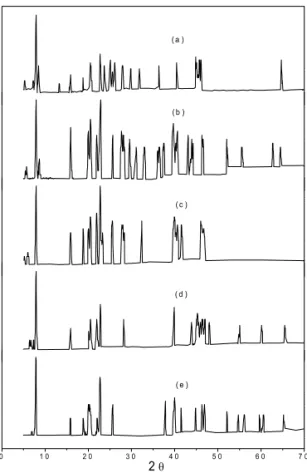
Figure 1: X-ray powder diffraction patterns of the compounds: (a) La(L)3.2H2O, (b)
Ce(L)3.2.5H2O, (c) Pr(L)3.2H2O, (d) Nd(L)3.2H2O and (e) Sm(L)3.2H2O. (L=3-methoxybenzoate).
0 1 0 2 0 3 0 4 0 5 0 6 0 7 0
( a )
2T
( b )
( c )
( d )
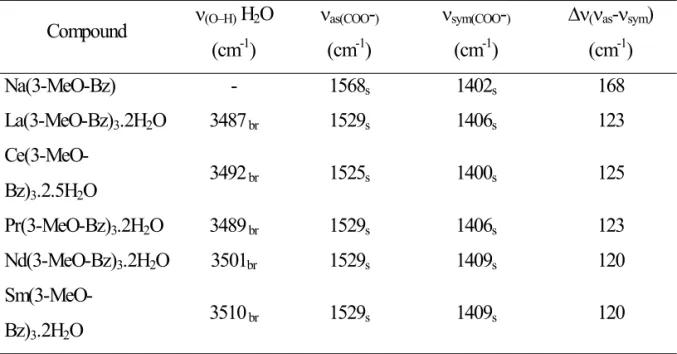
Infrared spectroscopic data on 3-methoxybenzoate sodium salt and its compounds with ligther trivalent lanthanides are shown in Table 2. The investigation was focused mainly within the 1700-1400 cm-1 range, because this region is
potencially most informative to assign coordination sites. In the sodium 3-methoxybenzoate, strong bands located at 1568 cm-1and 1400 cm-1 are attributed to the anti–
symmetrical and symmetrical frequencies of the carboxylate groups, respectively [23,24]. In the compounds considered in this work, analysis of the frequencies of the nas and nsym(COO-) bands
shows that the lanthanides are linked to the carboxylate group by a bidentate bond with an incomplete equalization of bond lengths in the carboxylate anion; this is in agreement with the literature [5,11-13].
Table 2. Spectroscopic data for sodium 3-methoxybenzoate and compounds with lighter
trivalent lanthanides.
Compound
Q
(O–H)H
2O
(cm
-1)
Q
as(COO-
)(cm
-1)
Q
sym(COO-
)(cm
-1)
'Q
(Q
as-
Q
sym)
(cm
-1)
Na(3-MeO-Bz)
-
1568
s1402
s168
La(3-MeO-Bz)
3.2H
2O
3487
br1529
s1406
s123
Ce(3-MeO-Bz)
3.2.5H
2O
3492
br1525
s1400
s125
Pr(3-MeO-Bz)
3.2H
2O
3489
br1529
s1406
s123
Nd(3-MeO-Bz)
3.2H
2O
3501
br1529
s1409
s120
Sm(3-MeO-Bz)
3.2H
2O
3510
br1529
s1409
s120
br: broad; s = strong; 3-MeO-Bz = 3-metoxybenzoate
Q
(O–H): hydroxyl group stretching frequency;
Q
sym(COO-
)and
Q
as(COO-
)= symmetrical and
anti-symmetrical vibrations of the COO
-structure.
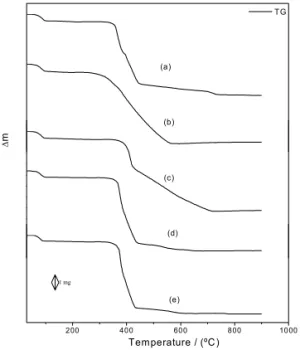
The TG curves of the compounds are shown in Fig. 2. These curves show mass losses in two (Ce), three (Pr, Sm) or four (La, Nd) steps. In all the TG curves, the first mass loss between 50 and 100 ºC is attributed to dehydration, which
occurs in a single step. Once dehydrated, the anhydrous compounds are stable up to 270 ºC (Ce), 330 ºC (La, Nd, Sm) and 355 ºC (Pr) and above these temperatures the TG curves show that the thermal decomposition is characteristic for each compound.
For the lanthanum compound, Fig. 2 (a) the first mass loss is due to dehydration, with loss of 2 H2O (calcd. = 5.74 %, TG = 5.93 %). The thermal decomposition of the anhydrous compound occurs in three steps between 330 and 750 ºC, with the two first ones a fast processes and losses of 29.46 and 28.90 %, respectively. In the last step the mass loss occurs through a slow process with formation of lanthanum oxide, La2O3 as final residue.
reaction that results in the formation of cerium (IV) oxide.
In the praseodymium compound, Fig. 2 (c) the first mass loss is due to the dehydration with loss of 2 H2O (calcd. = 5.72 %, TG = 6.12 %). The thermal decomposition of the anhydrous compound occurs in two steps between 355 ºC and 720 ºC. The mass loss up to 440 ºC occurs through a fast process followed by a slow one with losses of 29.36 and 37.66 %, respectively and with formation of praseodymium oxide, Pr6O11 as final residue.
Figure 2: TG curves of the compounds: (a) La(L)3.2H2O (m = 7.090 mg), (b)
Ce(L)3.2.5H2O (m = 7.020 mg), (c) Pr(L)3.2H2O (m = 6.780 mg), (d) Nd(L)3.2H2O
(m = 6.960 mg) and (e) Sm(L)3.2H2O (m = 7.030 mg). heating rate: 20º min-1; air
flow: 100 mL min-1. L= 3-methoxybenzoate.
200 400 600 800 1000
(a)
TG
(b)
(c)
(d)
(e)
Temperature / (ºC )
'
m
1 mg
In the neodymium compound, Fig. 2 (d) the first mass loss is attributed to dehydration with loss of 2 H2O (calcd. = 5.69 %, TG = 5.95 %). The thermal decomposition of the anhydrous compound occurs in three steps between 330 and 655 ºC. The first mass loss up to 440 ºC, also occurs through a fast process, followed by two slow processes with losses of 60.54, 6.00 and 1.09 %, respectively resulting in the formation of neodymium oxide, Nd2O3, as final residue.
For the samarium compound, Fig. 2 (e) the first mass loss is due to dehydration with loss of 2 H2O (calcd. = 5.63 %, TG = 5.17 %). The thermal decomposition of the anhydrous compound occurs in two steps between 330 and 620 ºC. The first
mass loss up to 435 ºC occurs through a fast process followed by a slow process with losses of 61.70 and 5.37 %, respectively, leading to formation of samarium oxide, Sm2O3 as final residue.
The DSC curves of the compounds are shown in Fig. 3. These curves show endothermic and exothermic events that are in agreement with the mass losses observed in the TG curves and endothermic peaks due to crystalline phase transition. The endothermic peak at 115 ºC (La), 117 ºC (Ce), 107 ºC (Pr), 114 ºC (Nd) and 106 ºC (Sm) is due to dehydration. The dehydration enthalpies found for the lanthanum to samarium compounds were: 112.2, 105.4, 106.8, 95.5 and 93.3 kJ mol-1.
0 100 200 300 400 500 600
DSC
(a)
(b)
(c)
(d)
exo up (e)
Temperature / (ºC)
d
Q
/d
t
Figure 3: DSC curves of the compounds: (a) La(L)3.2H2O (m = 4.906 mg),
(b) Ce(L)3.2.5H2O (m = 5.091 mg), (c) Pr(L)3.2H2O (m = 5.227 mg), (d)
Nd(L)3.2H2O ( m = 5.052 mg) and (e) Sm(L)3.2H2O (m = 5.255 mg). heating rate:
20 º min-1; air flow: 50 mLmin-1. L= 3-methoxybenzoate. 4 W
the oxidation of the organic matter takes place in a single step.
The endothermic peak at 190 ºC (La), 193 ºC (Ce), 193 ºC (Pr), 205 ºC (Nd) and 201 ºC (Sm) are due to crystalline phase transition. The crystalline phase transition enthalpies found for the lanthanum to samarium compounds were: 14.9, 22.1, 23.8, 23.8 and 24.4 kJ mol-1 respectively.
Conclusion
From analytical and thermoanalytical (TG) results a general formula could be established for these compounds in the solid state.
The X-ray powder patterns pointed out that the synthesized compounds have a crystalline structure without evidence for formation of isomorphous compounds.
Acknowledgements
The authors thank FAPESP (Proc. 90/2933-4), CNPq and CAPES Foundations (Brazil) for financial support.
Resumo: Compostos do tipo Ln-3-MeO-Bz foram sintetizados no estado sólido, em que Ln representa os
íons trivalentes La, Ce, Pr, Nd e Sm, e 3-MeO-Bz é o ânion 3-metoxibenzoato. Esses compostos foram caracterizados, utilizando-se as técnicas de difração de raios X pelo método do pó, espectroscopia na região do infravermelho, complexometria, e seu comportamento térmico foi avaliado usando termogravimetria (TG) e calorimetria exploratória diferencial (DSC). Os resultados forneceram informações com respeito a estequiometria, desidratação, transformação polimórfica, comportamento e decomposição térmica desses compostos.
Palavras-chave: lantanídeos leves; 3-metoxibenzoato; caracterização; comportamento térmico. The infrared spectroscopic data suggest that the 3-MeO-Bz acts as a bidentate ligand toward the metal ions considered in this work.
The TG and DSC curves provided previously unreported information about the thermal behaviour and thermal decomposition of these compounds.
Received 11 April 2007 Accepted 16 May 2007
P. R. Dametto, A. B. Siqueira, C. T. Carvalho, M. Ionashiro1.Sintese , caracterizacao e estudo térmico dos
3-metoxibenzoato de lantanídeos mais leves no estado sólido.
[1] S. J. Yun, S. K. Kang, S. S. Yun, Thermochim. Acta 331(1) (1999) 13.
[2] Z. M. Wang, L. J. van de Burgt, G. R. Choppin, Inorg. Chim. Acta 293(2) (1999) 167.
[3] N. Arnaud, J. Georges, Analyst 125(8) (2000) 1487. [4] G. R. Choppin, Q. Liu, E. N. Rizkalla, Inorg. Chim.
Acta 145(2) (1988) 309.
[5] A. W. H. Lam, W. T. Wang, S. Gao, G. Wen, X. X. Zhang, Eu. J. Inorg. Chem. 1 (2003) 149. [6] G. N. Makushova, S. B. Pirkes, E. Y. Levina, Zh.
Neorg. Khim. 30(9) (1985) 2273.
[7] W. Ferenc, B. Bocian, J. Therm. Anal. Cal. 74(2) (2003) 521.
[8] W. Brzyska, W. Ozga, J. Thermal Anal. Cal. 78(3) (2004) 999.
[9] W. Ferenc, A. Walkow-Dziewulska, B. Bocian, J. Therm. Anal. Cal. 79(1) (2005) 145. [10] A. Kula, J. Therm. Anal. Cal. 81(2) (2005) 381. [11] E. C. Rodrigues, A. B. Siqueira, E. Y. Ionashiro, G.
Bannach, M. Ionashiro, Ecl. Quim. 31(1) (2006) 21.
[12] E. C. Rodrigues, A. B. Siqueira, E. Y. Ionashiro, G. Bannach, M. Ionashiro, Thermochim. Acta 451(1-2) (2006) 149.
[13] W. Lewandowski, J. Molec. Struct. 101(1-2) (1983) 93.
[14] W. Lewandowski, H. Barauska, J. Raman Spectroscopy 17(1) (1986) 17.
References
[15] T. Glowiak, H. Koslowski, L. Strinna Erre, B. Gulinati, G. Micera, A. Pozzi, S. Brunni, J. Coord. Chem. 25(1) (1992) 75.
[16] W. Brzyska, S. Karasinshi, J. Therm. Anal. 39(4) (1993) 429.
[17] E. C. Rodrigues, A. B. Siqueira, E. Y. Ionashiro, G. Bannach, M. Ionashiro, J. Therm. Anal. Cal. 79(2) (2005) 323.
[18] A. C. Vallejo, A. B. Siqueira, E. C. Rodrigues, E.Y. Ionashiro, G. Bannach, M. Ionashiro, Ecl. Quim. 30(3) (2005) 7.
[19] C. T. Carvalho, A. B. Siqueira, E. C. Rodrigues, M. Ionashiro, Ecl. Quim. 30(4) (2005) 19. [20] A. B. Siqueira, E. Y. Ionashiro, C. T. Carvalho, G.
Bannach, E. C. Rodrigues, M. Ionashiro, Quim. Nova 30(2) (2007) 318.
[21] H. A. Flaschka, EDTA Titrations, Pergamon Press, Oxford, 1964.
[22] M. Ionashiro, C. A. F. Graner, J. Zuanon Netto, Ecl. Quim. 8 (1983) 29.
[23] G. Sócrates, Infrared Characteristic Group Frequencies, Wiley, New York, 2nd edn., 1994, pp. 91 and 236-237.