Bulletin of Taras Shevchenko National University of Kyiv. Economics, 2015; 1(166): 14-30 UDC 631.1
JEL Q 58
DOI: dx.doi.org/ 10.17721/1728-2667.2015/166-1/2
H. Bachev, Doctor of Sciences (Economics), Professor Institute of Agricultural Economics, Sofia, Bulgaria
ABOUT FORMS, EFFICIENCY AND ASSESSMENT OF ENVIRONMENTAL MANAGEMENT
We suggest a holistic framework for analyzing, assessment and improvement of environmental management using "agrarian sector" as an example. It incorporates an interdisciplinary approach (Economics, Organization, Law, Sociology, Ecology, Tech-nology, Behavioral and Political Sciences) and includes: specification of managerial actors, needs and spectrum of governing modes (institutional environment; private, collective, market, public modes) at different level of decision-making (individual, farm, eco-system, local, regional, national, transnational, global); specification of critical socio-economic, natural, technological, be-havioral etc. factors of managerial choice, and feasible spectrum of managerial forms; defining and assessing comparative and absolute efficiency of eco-management forms and system; improvement of forms of public intervention in eco-management.
Keywords: environmental management; agriculture; mechanisms and forms of governance; eco-managment indicators.
Introduction. Modern economy and agrarian sector in particular significantly affect the state and the sustainable exploitation of natural resources being a major factor for environmental degradation (pollution, destruction, extor-tion) as well an important contributor for the conservation and improvement of natural environment. Consequently, the issues associated with the effective environmental management are among the most topical in public, political, business and academic debates around the globe [Baba et al.; Dugos and Dupaz; Defrancesco et al; EC; Hagedorn; Hart and Latacz; Mitchell; Peerlingsa and Polman; Reed; Scozzari ɚnd Mansouri; UN]. This paper suggests a new holistic framework for assessment and improvement of environmental management in agriculture.
1. Definition and scope of eco-managment
Unlike the literal meaning of the words the environ-mental management means management of activities and behavior of individual agents for preservation and im-provement of natural environment and its individual com-ponents (soils, waters, landscape, atmosphere, biodiver-sity, climate, eco-system services). Environmental man-agement in agriculture (or agro-eco-manman-agement) com-prises environmental management associated with agricul-tural (food, fibber, bio-fuel, raw material, diverse eco-system and related services) production. It (is to) involves management of the activities, relations, and impacts of diverse agrarian (farm managers, resource owners, agricul-tural labor, etc.) and non-agrarian (upstream and down-stream businesses, consumers, residents, interest group, etc.) agents. A significant part of the agricultural production is managed and carried out by different type of farms1 – individual, family, cooperative, corporative, public, hybrid, etc. Therefore, the agro-eco-management is to be studied as an integral part of the system of farm management (along with the management of production, labor, finance, innovation, inputs supply, marketing) and the system of eco-management in the society.
In some instances, the eco-activities constitute a rela-tively independent and/or a specialized part of the farming activity as in the case of environmentally friendly collection, storage and disposal of garbage, organic production, etc. Very often the eco-management is an integral part of the farm and/or its individual functional areas (investment, la-bor, land management, crop production and protection). That necessitates to evaluate the comparative and abso-lute potential (internal incentives, capability, costs, inten-tions) of different type of agricultural farms (subsistent, family, commissioned, cooperatives, corporation, public,
1 there are many instances where agricultural production is
in-tegrated by outside agent (processor, retailer, exporter) and carried as a part of larger (industrial, input supply) activity. "Farmers" are hired labor taking part in "internal" non-agricultural division of labor.
etc.) for eco-friendly production and innovation, conserva-tion and restoraconserva-tion of natural resources, long-term eco-investment, minimization of direct and indirect negative eco-effects, dealing with major eco-challenges, minimizing eco-costs and risks, effective adaptation, etc. For the up-per(farm) levels of management the eco-management is either integrated in the main mechanisms of influence (e.g. requirement for "eco-compliance", "good agricultural prac-tices", etc.) or it is a specialized structure (programs for agro-ecology, mandatory eco-standards, etc.).
The entire "system" of agro-eco-management is to be analyzed including: various agents participating in the agro-eco-management; and diverse mechanisms and forms governing the behaviors and relationships of these agents. The environmental protection, restoration and improvement requires an effective private, collective and public order, which is to govern individual (agrarian) agents behavior and their relations with other agrarian agents (farm manag-ers, resource ownmanag-ers, hired labor) and non-agrarian agents (agrarian and related business, residents of rural areas, consumers of farm products and services, interest groups, state and local authorities, international organizations, etc.). Therefore, a critical moment of the analysis of the agro-eco-management is to identify the personality of agents of agro-eco-management and the specific character of their relations, interests, objectives, power positions, dependence, effects, and conflicts. For instance, Figure 2 presents agents and relations in the agro-eco-management at the ecosystem level.
Individual agrarian agents (farmland owners, farm en-trepreneurs, farm labor, etc.) may have quite diverse inter-ests and strategies in terms of environmental protection. All these interests and strategies are to be carefully analyzed and identified.
According to their ideologies and environmental eth-ics, the awareness of environmental risks, the managerial and technical ability, the financial capability, some indi-vidual agents may have direct natural resources conser-vation goals. Accordingly these "green" individuals will pursue natural resources conservation strategy in their everyday life and activity. For instance, for the natural resource owners the sustainable exploitation (conserva-tion) of owned assets is often a primary concern and of-ten it determines the type of farms they set up, and other ventures they participate (e.g. group or cooperative farms), or lease out contracts they sign. Similarly, a pro-environment farm entrepreneur establishes green (indi-vidual, cooperative, firm) farming structure following own or collective voluntary eco-code of behavior. Finally, farm labor may seek employment in a green cooperative or companies with eco-social responsibility.
Furthermore, in recent years there have been devel-oped a great number of farms and farming enterprises with
a primary or a major mission the environmental conserva-tion and improvement. For instance, in many EU countries the environmental cooperatives have been very popular, there are numerous green agri-firms, etc Nevertheless, most farm structures in the modern world have other goals and pursue other (than natural environment con-servation) strategies – e.g. the agri-firms are "profit-oriented" and their primary strategy is to maximize profits for shareholders; the cooperatives are "member-oriented" and carry out strategy to increase benefits for members, etc. However, there have been increasing consumer de-mands for the environmental conservation, and for the related organic, eco- and specific products from agricul-ture. Consequently, many market-oriented farms change their behavior in order to meet this growing market de-mand while keeping traditional (profit-making) strategy.
Finally, in modern societies there are a great number of formal and informal norms and restrictions related to the exploitation of natural resources. For instance, in the EU there is a huge body of environmental legislation and various environmental conservation programs. These institutional rules impose individual agents and farming structures mandatory norms and/or offer incentive to join voluntary schemes aiming at limiting environmental pres-sure, securing sustainable exploitation of natural re-sources, preservation of biodiversity, reducing pollution and emission of harmful substances, etc. This new public order modifies the individual strategies and behavior, and eventually leads toward conservation of natural environ-ment.Thus achieving the effective natural environment conservation in agriculture will always be result of imple-menting of multiple voluntary or induced by market, com-munity, public policies etc. individuals, farms, businesses, consumers, and public strategies.
The next step in the analysis is to define the "needs" for eco-management. They are associated with the necessity
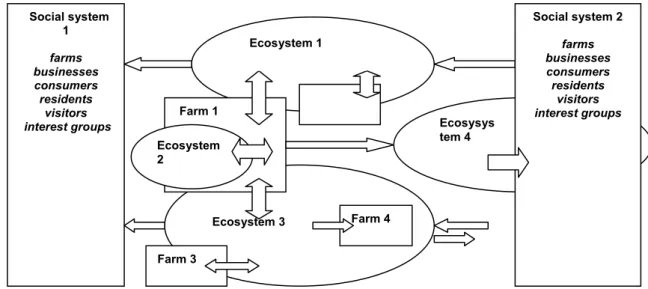
for building mechanisms for reviling the eco-problems and risks, stimulation of appropriate eco-behavior and coopera-tion, exchange of informacoopera-tion, conflict resolucoopera-tion, payback and minimizing eco-costs, etc. of participating agents. Ac-cording to (awareness, symmetry, strength, harmonization costs of) the interests of agents associated with the natural environment there are different needs for management of actions. Figure 1 illustrates diverse managerial needs with an example with the agro-ecosystem services. Here the Farm 1 has to manage its efforts and relations with the Farm 2 since both receive services from the Ecosystem 1 and affect (positively or negatively) the service supply of that ecosystem. Besides, both farms are to manage their relations with the consumers of services from the Ecosys-tem 1 (agents in Social sysEcosys-tem 1) to meet the total demand and compensate costs for the maintaining ecosystem ser-vices to that direction. In addition, the Farms 1 and 2 have to coordinate efforts with the agents in the Social system 1 to mitigate conflicts with the agents in the Social system 2 (affecting negatively services of the Ecosystem 1). Fur-thermore, the Farm 1 is to manage its relations with the Farm 3 for the effective service supply from the Ecosystem 3, and manage its interaction with the Ecosystem 2. More-over, the Farms 1 and 3 have to manage their relations with the Farms 4 and the agents from the Social system 1 (consumers of the services of the Ecosystem 3) and the Social system 2 (consumers and destructors of the Ecosys-tem 3 services). Finally, the Farm 1 affecting adversely the Ecosystem 4 services is to manage relations with the agents in the Social system 2 (consumers of the Ecosys-tem 4 services) to reconcile conflicts and secure effective flow of the ecosystem services. Therefore, the Farm 1 is to be involved in seven systems of governance in order to assure an effective supply of the services from the ecosys-tems of which it belongs or affects.
Ecosystem 3 Farm 1
Ecosystem 2
Farm 3 Social system
1
farms businesses consumers residents
visitors interest groups
Farm 4 Ecosystem 1
Ecosysys tem 4
Social system 2
farms businesses consumers residents
visitors interest groups
Fig. 1. Management needs for effective supply of agro-ecosystem services
Source: composed by authors' calculations
Next, it is to be analyzed the extent in which the man-agement needs for the environmental manman-agement in agri-culture is "satisfied" from the existing governance forms and mechanisms. In certain cases, the eco-management in agriculture is entirely archived through the individual ac-tions of autonomous agents (farms) within the Sector "Ag-riculture". For instance, a good care and sustainable use of privately owned agricultural lands and water sources are typical in a family farm since they are integral part of the
polyvalent forms, which have to be identified and analyzed. For instance, the inclusion of a farmer in the "organic prod-ucts" chain coordinates well relations between the produc-ers and the final consumproduc-ers. Nevertheless, the positive eco-effect could be minor, if simultaneously a form for the coordination of relations (collective action) with other farm-ers in a particular region or eco-system is not established to achieve the minimum (optimal) required scale for posi-tive eco-impact. The effecposi-tive environmental management often necessitates concerted (collective) actions and eco-strategies of a number of farms as it is in the case of sus-tainable use of a common pasture and limited water sup-ply, protection of local biodiversity, effective provision of agro-ecosystem services, etc.
Furthermore, modern farming activity is often profit-oriented and frequently associated with significant positive and/or negative externalities. Implementation of individual strategies of different farmers not always leads to overall conservation of natural resources. That requires a "com-mon" strategy and managing relations (cooperation, recon-ciling conflicts, recovery of costs) between different farms, and increasingly between the farmers and non-farmers. For example, the adverse effects of agricultural activities on water and air quality are often felt by the residents and businesses in neighborhood and/or more remote regions. Similarly, the agricultural contribution to the ecosystem services benefits a large number of residents, visitors, con-sumers, businesses, and interest groups requiring certain collective actions for a sustainable supply. In all these in-stances, the environmental management goes beyond the simple (technical, agronomic, ecological) "relations with the nature" and embraces the governance of relations and collective actions of agents with diverse interests, power positions, awareness, capabilities etc. in large geographi-cal, sectoral, and temporal scales [Bachev 2011a].
What is more, modern environmental management is associated with growing needs for the "additional" actions
(monitoring, coordination, investments, etc.) and integral management of natural resources and eco-risks at national and progressively at transnational scale. The later include the water and garbage management, biodiversity conser-vation, climate change, etc. issues demanding effective regional, nationwide, international, and global governance. For instance, the effective management of the biodiversity "component" of the natural environment includes multilevel (individual, sectoral, national, EU, worldwide) and multilat-eral initiatives of numerous farmers, businesses, consum-ers, residents, interests groups, etc. The same is true for the waters, lands, air, ecosystem services, etc. manage-ment.Thus the effective conservation of natural environ-ment will be achieved by coordinated collective actions and implementation of multisectoral and multilevel strategies of individual, family, partnership, private juridical, public juridi-cal, state, etc. agents with diverse immediate goals, posi-tions, capability and interests.
2. Forms and levels of eco-management
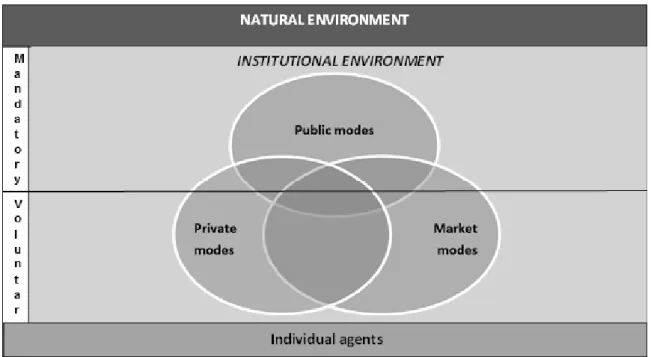
The individuals behavior (actions, restriction of ac-tions) are affected and governed by a number of distinct modes and mechanisms of management which include (Figure 2): First, the institutional environment (or the "rules of the game") – that is the distribution of rights be-tween individuals, groups, and generations, and the sys-tem(s) of enforcement of these rights and rules [Furuboth and Richter; North]. The entire spectrum of rights is to be analyzed embracing material assets, natural resources, intangibles, certain activities, clean environment, food security, intra- and inter-generational justice, etc. A part of the rights and rules is constituted by the formal laws, regulations, standards, court decisions, etc. In addition, there are important informal rules and rights determined by the tradition, culture, religion, ideology, ethical and moral norms, which is to be clarified.
Fig. 2. Modes of environmental management in agriculture
Source: composed by authors' calculations
Furthermore, an analysis is to be made on the system of enforcement of the rights and rules done by the state, community pressure, trust, reputation, private modes, and
improving the natural environment, intensifying eco-exchange and cooperation, increasing eco-productivity, inducing private and collective eco-initiatives, developing new eco- and related rights, decreasing eco-divergence between social groups and regions, responding to ecologi-cal and other challenges, etc. Driving forces and the pros-pects of institutional "development" are to be also speci-fied. The modernization of the institutional environment is initiated by the public (state, community) authority, inter-national actions (agreements, assistance, pressure, etc.), and the private and collective actions of individuals. It is associated with the modernization and/or redistribution of the existing rights; and the evolution of new rights and the emergence of novel (private, public, hybrid) institutions for their enforcement. In modern society a great deal of the individuals' activities and relations are regulated and sanctioned by some (general, specific) formal and infor-mal institutions. However, there is no perfect system of preset "outside rules" that can manage effectively the entire eco-activity of individuals in all possible (and quite specific) circumstances of their life and relations associ-ated with the natural environment.
Second, the market modes (the "invisible hand of mar-ket") – those are various decentralized initiatives governed by the free market price movements and the market com-petition – e.g. spotlight exchanges, classical contracts, production and trade of organic products and origins, etc. It is to be analyzed the extent in which the "free" market con-tributes to coordination (direction, correction) and stimula-tion of the eco-activities and eco-exchanges, and the effec-tive allocation of environmental resources. The individual agents use (adapt to) markets profiting from the specializa-tion and the mutually beneficial exchange (trade) while their voluntary decentralized actions govern the overall distribution of efforts and resources between activities, sectors, regions, eco-systems, countries, etc. There are many instances of lack of individual incentives, choices and/or unwanted exchanges related to natural environment conservation – e.g. "missing" markets, monopoly and power relations, positive or negative externalities, etc. Consequently, the free market "fails" to manage effectively the entire activity, exchanges, and eco-investments of individuals. Therefore, the cases of "failure" of market are to be determined, which lead to lack or insuf-ficient individual incentives and choice and/or unwanted exchange associated with the environmental protection.
Third, the private and collective modes (the "private or collective order") – those are diverse private initiatives, and special contractual and organizational arrangements – e.g. voluntary actions, codes of behavior, eco-contracts, eco-cooperatives, etc. It is to be determined the extent in which the individual agents can take advantage of the economic, market, institutional etc. opportunities and deal with the institutional and market deficiency by select-ing or designselect-ing mutually beneficial private modes (rules) for governing their eco-behavior, relations and exchanges. The private mode negotiates "own rules" or accepts (im-posed) existing private or collective order, transfers existing rights or gives new rights to counterpart(s), and safeguards absolute and/or contracted rights of agents. In modern so-ciety a great part of the agrarian activity is managed by the voluntary initiatives, private negotiations, the "visible hand of the manager", or collective decision-making. Neverthe-less, there are many examples of private sector deficiency ("failures") in governing of socially desirable activity such
as environmental preservation, eco-system services, etc. The later cases have to be identified and analyzed.
Forth, the public modes (the "public order") – these are various forms of public (community, government, interna-tional) intervention in the market and private sectors – e.g. public guidance, public regulation, public taxation, public assistance, public funding, public provision, property right modernization, etc. Analyses is to be made on existing forms for public "involvement" in the agro-eco-management through provision of eco-information and eco-training for private agents, stimulation and (co)funding of their volun-tary actions, enforcement of the obligatory eco-order and sanctioning for non-compliance, direct organization of eco- and related activities (state eco-enterprise, scientific re-search, monitoring, etc.).The role of public (local, national, transnational, etc.) governance has been increasing along with the intensification of activity and exchange, and the growing interdependence of socio-economic and envi-ronmental activities. In many cases, the effective man-agement of individual behavior and/or the organization of certain activity through a market mechanism and/or a private negotiation would take a long period of time, be very costly, could not reach a socially desirable scale, or be impossible at all. Thus a centralized public intervention could achieve the willing state faster, cheaper or more efficiently. Nonetheless, there are a great number of "bad" public involvements (inaction, wrong intervention, over-regulation, mismanagement, corruption, etc.) leading to significant problems of sustainable development around the globe [Bachev, 2010]. All these cases of pub-lic "failure" are to be identified and analyzed.
Fifth, the hybrid forms – some combination of the above three modes like public-private partnership, public licensing and inspection of private organic farms, etc.
All existing and other practically feasible (potential) forms for agro-eco-management is to be identified, ana-lyzed and assessed as well as their complementarities (mutual or multiplication effect) and contradictions between individual forms and mechanisms of agro-eco-management specified. For instance, often the private (eco)initiatives of individual agents are in "conflict" with each other and/or the interests of third parties; usually, public, collective and pri-vate forms are mutually complementary, etc.
"Governance matters" and depending on the (efficiency of) system of management "put in place" the individual communities and societies achieve quite dissimilar results in the eco-conservation and improvement. Consequently, the extend of conservation of natural environment in agri-culture (the type of exploitation of natural resources by agriculture and the agricultural impact on environment) would differ quite substantially in the different stages of development and among the diverse farming structures, eco-systems, regions, and countries.
The analysis of the system and the forms of agro-eco-management is to be done for the system as a whole and/or for the individual components of the natural envi-ronment – soils, waters, atmosphere, biodiversity, land-scape, climate, eco-system services, etc. In the later cases, the analysis of relatively independent (sub)systems of management is concerned – agricultural lands, agricul-tural waters, agriculagricul-tural emissions, agrarian and related biodiversity, rural landscape, agricultural impact on climate, and agro-ecosystem services.
For each of the elements of the nature the analysis fur-ther deepens for sub-components as well. The later are characterized with significant specificity in terms of man-agement forms, factors, and efficiency. For instance, as elements of the component "soils" could be included culti-vated farmland, lands with permanent crops, permanent grasslands and pastures, etc.; for the component "waters" – surface waters, ground waters, waters for irrigation, drinking waters, etc.; for the component "biodiversity" – agro-biodiversity, natural biodiversity, etc.; for the compo-nent "atmosphere" and "climate" – greenhouse gas emis-sions, dust, odors, other pollutants, etc.
It is to bare in mind that a great part of the employed modes of agro-eco-management are integral, and affect two or more relatively independent elements or sub-components of the natural environment. Besides, the im-provement of one aspect of the management through a particular form often is associated with the negative ef-fects for other aspect, component or element. Therefore, in addition to the "private" efficiency always it is to be taken into account the overall efficiency (direct and indi-rect effects and costs) of a particular forms or the system of management as a whole.
According to the specific objective the analysis of the system of agro-eco-management is made at different man-agement levels: farm level (individual farm, farms of a par-ticular type – family, cooperative, crop, livestock, organic, semi-market, etc.); eco-system – individual eco-system (e.g. Danube river basin; Northern Rockies; Dobrudja plain) or type of agro-eco-system (plain, mountainous, semi-mountainous, riverside, coastal, etc.); regional (major ad-ministrative, economic or geographical regions of the coun-try); Industry/sector – major sectors and subsectors of agri-culture (crop production, livestock production, grain produc-tion, horticulture, poultry, dairy cattle, etc.); national (Ukrain, California, Australia); trans-national (Western Bal-kans, European Union, global).
Specification of the individual elements of the system of agro-eco-management in each level is to be done carefully. For instance, at the individual farm level most of the forms of public intervention (mandatory norms and standards, sanction mechanisms, etc.) play a role of "external" envi-ronment, while at the national and/or industry level they are internal mechanisms of management. Similarly, some of the dominant forms and mechanisms of management at a national or sectoral level may not be relevant for the indi-vidual farm or farms of a particular type. For instance, most
of the (eco)instruments of the EU CAP do not impact at all the majority of Bulgarian farms due to the impossibility for participation in public programs (formal restrictions, high costs), low interests, enormous difficulties and costs for detection of non-compliances and for sanction by the au-thority, etc. [Bachev, 2010].
At certain level of analysis (e.g. eco-system, region) there may be no specific (formal) structure of management at all, and the agro-eco-management to be "carried out" by other (main) organizations (e.g. farms and farm organiza-tions) and/or the general system of eco-management in the country. As a rule, the eco-effects and the eco-costs at a particular level and upper management level are not simple sums of those of the composite elements or those at lower levels of management. Therefore, it is to be taken into con-sideration the necessity for "collective actions" for achieving a minimal ecological and technological size for a positive effect, mutual and multiplication effects and spillovers, con-tradictory effects and costs, and externalities in different sub-jects and management levels, in space and time horizon.
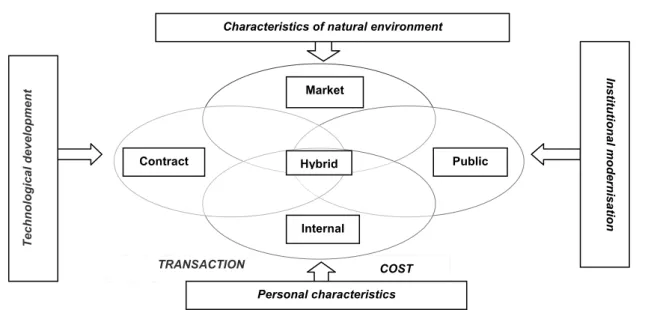
3. Factors and efficiency of eco-management The evolution of the system of agro-eco-management and the choice of one or another form of eco-management by agents depend on diverse natural, economic, political, institutional, behavioral, technological, international, etc. factors (Figure 4). For instance, the type of the develop-ment of agro-eco-managedevelop-ment strongly depends on the (eco)preferences and the experiences of farmers and other participants in the process, the extent of degradation and pollution of the natural environment, the social demands and the pressure for sustainable exploitation of natural resources, the economic development and capabilities for eco-investments, the public policies and the implementa-tion/enforcement of international (eco)conventions, the natural evolution of environment, etc.
Therefore, the specific factors for agro-eco-management is to be identified and their importance and compatibility at the each stage of agricultural development analyzed. The experience demonstrates that the natural environment is "valued" less and the good eco-management is not a priority, when there is no institutional stability (unspecified and/or not enforced agrarian, contrac-tual and eco-rights, restructuring, unsustainable policies, etc.) and when the financial and economic situations of household, farms and the state deteriorate. Likewise, the monitoring, enforcement and disputing of many of the terms of eco-contracts is extremely difficult (costly) or prac-tically impossible, and therefore supporting voluntary eco-initiatives of farmers is often more effective than the man-datory norms and "contracts". Similarly, due to technologi-cal, ecological or socio-economic reasons some of the widely used forms could be impossible for the conditions of a particular subsector, region, eco-system or (type) farm.
Market
Internal
Public Hybrid
TRANSACTION
In
stit
uti
o
n
a
l mo
de
rnisa
tio
n
Technol
ogic
a
l d
evelo
p
me
nt
Contract
Characteristics of natural environment
COST
Personal characteristics
Fig. 4. Factors for managerial and strategy choices for agro-eco-management
Source: composed by authors' calculations
Commonly the natural and the institutional environment evolve very slowly over a long-term periods. Therefore, in the specific natural, socio-economic and institutional envi-ronment, the choice of the management mode would de-pend on a number of key factors including:
the personal characteristics of individual agents – preferences, believes, ideology, knowledge, capability, train-ing, managerial experience, risk-aversion, bounded rational-ity, tendency for opportunism, reputation, trust, power, etc. For instance, benefits for farmers from the eco-management could range from the monetary or non-monetary income; profit; indirect revenue; to pleasure of involvement in envi-ronment and biodiversity preservation activity.
the formal and informal institutions – often the choice of management mode is (pre)determined by the institutional restrictions as some forms for carrying out farming, environmental, etc. activities could be socially unacceptable or illegal. For instance, market trade of farm-land, natural resources, and (some) eco-system services are not allowed in many countries.
Furthermore, the institutional environment considerably affects the level of management costs and thus the choice of one or another form of organization. For instance, in conditions of well-working public system of regulations (quality standards, guarantees) and laws and contract en-forcement, a preference is given to spotlight and classical (standard) contracts. On the other hand, when rights on major agrarian and natural resources are not defined or not well defined, and the absolute and contracted right effec-tively enforced, then the high transaction costs could create difficulties (or block) effective eco-management – costly unsolvable disputes between polluting and affected agents, disregards of interests of certain groups or generations, etc. Consequently, the institutional structures for carrying out the agrarian and environmental activities become an important factor, which eventually determines the outcome of the system (the efficiency) and the type of development (the sustainability).
the natural and technological factors – eco-management strongly depends on the type of the environ-mental challenge (spatial and temporal scale, risks, etc.) and the natural recourses endowment as well as on the development of farming, environmental, monitoring, informa-tion, etc. technologies. For instance, management of water
resources depends on the advancement of water conserva-tion, use, recycling and monitoring technologies, etc.
In a long-term the state of the natural environment and its individual components, and the associated risks, con-flicts and costs, depends on the efficiency of the "estab-lished" system of eco-management in a particular society, community, sector, region, economic organization, etc. However, in each specific moment or a shorter-period of analysis not always could be found adequate data and/or determine direct links between the system of agro-eco-management (and its individual forms) and the state of the natural environment. The later is caused by:
the time period (delay) between the management actions ("improvement" of the system of management), and the changes in the eco-behavior of agents, and the posi-tive, negative or neutral effects on the state of natural envi-ronment and its individual elements;
the "impossibility" for adequate assessment of the natural environment and the associated risks and costs, due to the lack of "full" knowledge on the state and the processes of environmental change, the type of correlation with agrarian activities and the new (nano, genetically-modified, etc.) products and technologies, on future costs associated with the deterioration, restoration and conserva-tion of natural environment, etc.;
insufficient factual data for the extent of eco-degradation and pollution in agriculture due to lack of monitoring, precise measurements, and/or research stud-ies in that area;
"undervaluation" of the natural resources by individ-ual agents, social groups and/or society as a whole and/or the "lack" of any system of agro-eco-management.
Also, it is to be taken into consideration that the state and the changes in the natural environment are conse-quences not only of the system of agro-eco-management in a particular farms, region, subsector, or country, but other factors as well such as: the impacts of other indus-tries in the country and at international scale, the natural evolution of environment, etc. Consequently, the real im-provement or deterioration of the eco-management in a particular farm, group of farms in a region, subsector, or in the country could result in a lack or controversial change in the quality of waters, soils, air, biodiversity and climate.
effective adaptation is the only possible strategy for over-coming the socio-economic consequences for the agricul-ture and other sectors of human activity [Bachev, 2013a]. Therefore, at all levels of analysis the diverse "external" and "internal" factors are to be identified and their impor-tance estimated in order to assess adequately the effi-ciency of the system of agro-eco-management and the farm adaptation.
The proper understanding the efficiency of agro-eco-management greatly depends on the understanding the role of transaction costs and the governance [Bachev, 2004, 2010, 2013b]. The problem of "social costs" does not exist in the conditions of zero transaction costs2 and well-defined private property rights [Coase]. Then the state of maximum efficiency is always achieved independent of initial distribution of rights between individuals and the mode of governance. All information for the effective poten-tial of activity and exchange (optimization of resources, meeting various demands, respecting assigned and trans-ferred rights) would be costlessly available to everybody. Individuals would costlessly coordinate their activities; de-fine, adapt and implement their strategies, define new rights, and protect their (absolute and contracted) rights3, and trade owned resources (and rights over them) in mu-tual benefit with the same (equal) efficiency over the free market (adapting to price movements), and the private modes of different types (contracts, firms), and the collec-tive decision making (cooperacollec-tive, association), and in a nationwide hierarchy (a single private or state company). Then the ecological requirements for sustainability and the technological opportunities for economies of scale and scope (the maximum environmental conserva-tion/enhancement and productivity of resources, "internali-zation of externalities") and the maximum welfare (con-sumption, conservation of natural resources) would be eas-ily/costlestly achieved4. However, when transaction costs are significant, then costless contracting, exchange and protection of individual right is impossible. Therefore, the initial distribution of property rights between individuals and groups, and their good definition and enforcement are criti-cal for the overall efficiency and sustainability. For in-stance, if the "right on clean and conserved natural envi-ronment" is not well-defined, that creates big difficulties for efficient eco-management – costly disputes between pollut-ing and affected agents; not respectpollut-ing interests of certain groups or generations, etc.
What is more, in the conditions of well-defined rights the eco-management is usually associated with significant transaction costs as well. For example, the agents have costs for identification and protection of various rights (un-wanted take overs from others); studying out and comply-ing with diverse institutional restrictions (norms, standards, rules, etc.); collecting needed technological, environmental, etc. information; finding best partners and prices; negotiat-ing conditions of exchange; contract writnegotiat-ing and registra-tion; enforcing negotiated terms through monitoring, con-trolling, measuring and safeguarding; disputing through a
2 The costs for governing relations between individuals – for
protection and exchange of individual rights.
3
When transaction costs are zero then definition (redistribution)
of new rights of individuals, interests groups, and society as well as
effective enforcement of the new rights would be easily achieved.
4 Presently there is a principle agreement ("social contract") for
global sustainable development. Nevertheless, depending on the specific social preferences that "social consensus" not always is expressed in maximum environmental conservation and improve-ment. At certain stages of development a social priority could be given to economic growth at the "price" of certain degradation of natural resources – "over" pollution and emissions, unsustainable exploitation, partial or complete exhaustion.
court system or another way; adjusting or termination along with the evolving conditions of production and exchange, etc. Therefore, in the "real world" with not completely defined and/or enforced rights, and the positive transaction costs, the mode of agro-eco-governance is crucial and eventually (pre)determines the extent of degradation, conservation and improvement of natural environment [Bachev 2010]. That is because the different modes have unequal efficiency (bene-fits, costs) for governing the same eco-activity in the specific socio-economic and natural environment.
Moreover, often the high transaction costs deteriorate and even block organization of otherwise efficient (mutu-ally-beneficial) for all participants' eco-activity and ex-change. It has to be distinguished the transaction from the proper conservation or "production" (agronomic, opportu-nity, etc.) environmental costs. In modern conditions the later are significant economic costs, which are to be recov-ered like other technological costs from the beneficiaries of conserved or improved natural environment. Often that is the farmer, who invests for maintaining productivity of the natural resources (soil fertility, water purity, ecosystem services, etc.), and recover these costs similarly to other investments thought flow of future benefits (productivity, profitability, market position, etc.). More frequently, these are other agents, who pay for used eco-services directly (buying eco-products and services) or indirectly (though collective organizations, taxes and fees, etc.).
The effective modes for agro-eco-management opti-mize the total (transaction and conservation costs) for agrarian activity – minimizing the transaction costs and allowing (otherwise mutual beneficial) eco-exchange to be carried out in a socially desirable scale, and allowing achievement of minimum/optimum environmental require-ment, and/or exploration of pure technological economies of scale and scope of farm, environmental conservation, etc. activities. In very rare cases, there is only one practi-cally possible form for governing of natural resources, eco-activity and eco-exchange5. However, usually there are a number of alternative modes for governing of eco-conservation activity.
Different management modes are alternative but not equally efficient modes for the organization of eco-activities. Each form has distinct advantages and disadvan-tages to protect eco-rights and investment, coordinate and stimulate socially desirable eco-behavior and activities, explore economies of scale and scope, save production and transaction costs, etc. For instance, the free market has a big coordination and incentive advantages ("invisible hand", "power of competition"), and provides "unlimited" opportunities to benefit from the specialization and ex-change. However, market management could be associ-ated with a high uncertainty, risk, and costs due to the lack of (asymmetry) of information, low "appropriability" of some rights ("public or collective goods" character), price instabil-ity, a great possibility for facing an opportunistic behavior, "missing market" situation, etc.
The special contract form ("private ordering") permits a better coordination and intensification of eco-activity, and safeguards agent's eco-rights and eco-investments. How-ever, it may require large costs for specification (and writ-ing) contract provisions, adjustments with constant changes in conditions, enforcement and disputing of nego-tiated terms, etc. The internal organization allows a greater flexibility and control on activity (direct coordination, adap-tation, enforcement, and dispute resolution by a "fiat").
5 E.g. in Japanese agriculture with small paddy fields water
However, the extension of internal mode beyond family and small-partnership boundaries (allowing achievement of "minimum" technological or ecological requirements; explo-ration of technological economies of scale and scope, etc.) may command significant costs for development (initiation, design, formal registration, restructuring) and for current management (collective decision making, control on coali-tion members opportunism, supervision and motivacoali-tion of hired labor). The separation of the ownership from the management (cooperative, corporation, public farm/firm) gives enormous opportunities for growth in productivity, and environmental and management efficiency – "internal" division and specialization of labor; achieving ecosystem's requirements; exploration of economies of scale and scope; introduction of innovation; diversification; risk shar-ing; investing in product promotion, brand names, relations with customers, counterparts and authorities, etc. However, it could be connected with huge transaction costs for de-creasing information asymmetry between management and shareholders, decision-making, controlling opportunism, adaptation, etc. The cooperative and non-for profit form also suffers from a low capability for internal long-term in-vestment due to the for-profit goals and the non-tradable character of shares (so called "horizon problem"). What is more, the evolution and maintenance of large col-lective organizations is usual associated with significant costs – for initiating, informing, "collective| decision-making and internal conflict resolution, controlling opportunism of (current and potential) members, modernization, restructur-ing, liquidation, etc. Finally, the pubic forms also command high internal (internal administration and coordination) and outside (for other private and public agents) costs – for es-tablishment, functioning, coordination, controlling, misman-agement, misuse by private and other agents, reorganiza-tion, and liquidation. What is more, unlike market and private modes, for public organizations there is no "automatic" mechanism (such as competition) for the selection of (in)effective forms. Here public "decision making" is neces-sary which is associated with huge costs and time, and often affected by the strong private interests (the power of lobby-ing groups, politicians and their associates, bureaucrats, employees in the public forms) rather than the efficiency.
Principally the "rational" agents tend to use and/or de-sign such modes for governing their diverse activity and relations which are the most efficient in the specific institu-tional, economic and natural environment – forms maximiz-ing their overall (production, ecological, financial, transac-tion, etc.) benefits and minimizing their overall (productransac-tion, environmental, transaction, etc.) costs [Bachev 2010]. However, a result of such private strategies and optimiza-tion of management/activity is not always the most socially effective distribution of resources and the socially desirable (maximum possible) conservation of natural environment. It is well known that the agricultural activity is often associ-ated with significant undesirable negative environmental effects such as soils degradation, waters pollution, biodi-versity termination, air pollution, considerable green-house gases emissions, etc.
Therefore, the system of agro-eco-management is to be improved, and that frequently necessitates a public (state) involvement in the agrarian and environmental management. Nevertheless, the public intervention in (eco)management is not always more effective, since pub-lic failure is practically possible. Around the globe there are many examples for inappropriate, over, under, delay, or too expensive public intervention at all levels. Often the public intervention either does not correct the market and private sector failures, or "correct| them with higher overall costs.
Thus the criterion for assessing the efficiency of agro-eco-management and strategies is to be whether socially desirable and practically possible environmental goals are realized with the minimum possible overall costs (direct, indirect, private, public, production, environmental, transac-tion, etc.). Accordingly, inefficiency is expressed either in failure to achieve the feasible (technically, politically, eco-nomically, etc.) environmental goals (conservation of natu-ral resources, overcoming certain eco-problems, diminish-ing existdiminish-ing eco-risks, decreasdiminish-ing eco-losses, recovery and improvement of natural environment, etc.) or achieving of set up goals with more costs comparing to another feasible form of management. Contemporary socio-economic, insti-tutional and (more often) natural environment are changing very fast and often unpredictably6. Consequently, any strategy for the effective environmental management is to be an adaptive strategy. Accordingly, dominating and other feasible (market, private, public, hybrid, etc.) forms are to be assessed in terms of their absolute and comparative (adap-tation) potential to protect eco-rights and investments of agents, assure socially desirable level of environmental con-servation (enhancement), minimize overall costs, coordinate and stimulate eco-activities, reconcile conflicts, and recover long-term costs for organizational development in the spe-cific economic, institutional and natural environment.
4. (The most) effective forms for eco-management Usually "evolution" of the natural and the institutional environment is quite slow and in long periods of time. Therefore, to a great extent the efficiency of the system of agro-eco-management depends on the level of transaction costs. The transaction costs have behavioral origin: namely individual's bounded rationality and tendency for opportun-ism [Williamson]. The agrarian agents do not possess full information about the system (eco-benefits and costs, ef-fects on others, formal requirements, development trends, etc.) since collection and processing of such information would be either very expensive or impossible (multiple spillover effects and costs in a large geographical and tem-poral scale, future events, partners intention for cheating, etc.). In order to optimize the decision-making and the ac-tivity the agents have to spent costs for "increasing their imperfect rationality" – for monitoring, data collection, analysis, forecasting, training, consulting, etc.
Besides, the economic agents are given to (pre-contractual, post-(pre-contractual, and non-contractual) oppor-tunism. Accordingly, if there is opportunity for some of the transacting sides to get non-punishably an extra bene-fit/rent from voluntary or unwanted exchange, he will likely take advantage of that. Usually it is very costly or impossi-ble to distinguish the opportunistic from non-opportunistic behavior because of the bounded rationality of agents. What is more, in the real life there is widespread non-contractual opportunism7, namely unwanted "exchange" or stealing of rights from a private and/or public agents with-out any contracting process (because of the lack or asym-metry of information, capability for detection and protection, weak negotiating positions, etc.). Therefore, individual agents have to protect their rights, investments and transac-tions from the hazard of opportunism through: ex ante efforts to find a reliable counterpart and to design efficient mode for partners credible commitments; ex post investments for overcoming (through monitoring, controlling, stimulating
6
There have been many financial, economic, food, environ-mental crisis in recent years inducing fundaenviron-mental changes in economic structure and institutional rules at local, national, trans-national and global scales.
7 Most economic analysis focused on pre-contractual ("adverse
operation) of possible opportunism during the contract exe-cution stage; and permanent efforts/costs for protection from unwanted non-contractual exchange though safe-guarding, diversification, cooperation, court suits, etc.
The eco-opportunism is also widespread in agricul-ture. For instance, the farmer knows or eventually recog-nizes that his activity is harmful for the environment, but in order to save additional costs continues to execute risk operations when the negative effects are for other agents (the owners of natural resources, other farms, non-agrarian agents, society as a whole). Similarly, farmer sells conven-tional products as "organic" and profit price premium from the unaware buyers; or he joins the public agro-eco-programs to get subsidies, but does not comply with the "contracted" eco-obligations8.
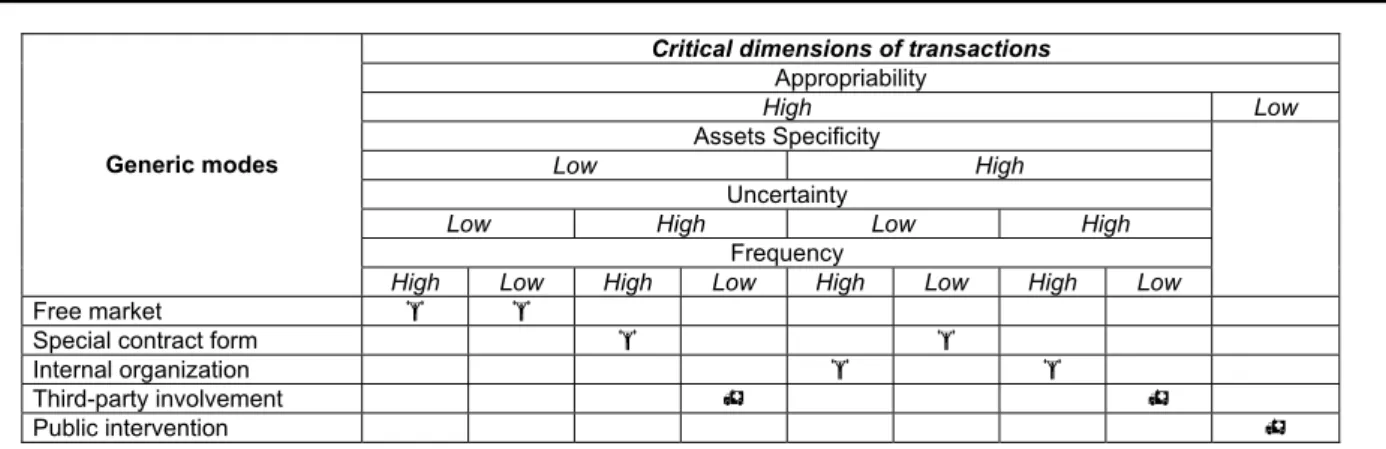
Part of the transaction costs for the eco-management could be determined relatively easily – e.g. costs for licens-ing, certifications, tests, purchase of information, hiring consultants, payments for guards and lawyers, bribes, etc. However, the assessment of another (a significant) part of the transaction costs in eco-activity is often impossible or very expensive [Bachev, 2011a]. That is why the Compara-tive Structural Analysis is to be employed [Williamson]. This analysis would align eco-activities/transactions (which differ in their attributes) with the governance structures (which differ in their costs and competence) in discriminat-ing (mainly transaction cost economizdiscriminat-ing) way. Frequency, uncertainty, assets specificity, and appropriability are iden-tified as critical dimensions of the eco-activity and transac-tion9 – the factors responsible to the variation of transacting costs between alternative modes of management. In the specific socio-economic and natural environment, depend-ing to the combination of the critical factors of eco-activities and eco-transactions, there will be different the most-effective forms of their management (Figure 5).
The eco-activity and transactions with good appropriabil-ity of rights, high certainty, and universal character of in-vestments could be effectively managed by the free market through spotlight or classical contracts. For instance, there are widespread market modes for selling diverse ecosystem services and eco-products – eco-visits, organic, fair-trade, origins, self-production or self-pick up of yields from cus-tomer, eco-education, eco-tourism, eco-restaurants, etc.
The frequent transactions with high appropriability could be effectively managed through a special contract. For example, eco-contracts and cooperative agreements between farmers and interested businesses or communi-ties are widely used including a payment for ecosystem services, and leading to production methods (enhanced pasture management, reduced use of agrochemicals, wet-land preservation, etc.) protecting water from pollution, mitigating floods and wild fires, etc.
When the uncertainty is high and the assets depend-ency (specificity) is symmetrical the relational ("neoclassi-cal") contract could be used. Since detailed terms of trans-acting and results are not known at outset (a high uncer-tainty), a framework (mutual expectations) rather than the specification of obligations of partners is practiced (oppor-tunisms is (self)restricted due to the symmetrical depend-ency of investments of the partners). A special contract forms is also efficient for the rare transactions with a low uncertainty, high specificity and appropriability. The de-pendent investment could be successfully safeguarded through contract provisions since it is easy to define and
8
Not compliance with the terms of public eco-contracts by farmers is widespread even in some of old member states of EU.
9Frequency, uncertainty", and asset specificity are identified as
critical factors of transaction costs by Williamson [Williamson] while
appropriability added by Bachev and Labonne [Bachev and Labonne].
enforce the relevant obligations of partners in all possible contingencies (no uncertainty exist).
The transactions and activity with a high frequency, big uncertainty, and great assets specificity have to be man-aged within internal organization. For instance, a good por-tion of the eco-investments are strongly specific to (certain land plots, eco-systems, etc.) a farm and they can be effec-tively implemented and "paid-back" within the borders of the particular farm. The high interdependency (specificity) of the eco-investments with other farm's assets and activity is the reason that a great part of the agro-eco-management to be executed by the different type of farms – family, co-operative, agri-firms, public, hybrid, etc. There are also cases when the farms and other agents are specialized in eco-management and entirely engaged in (aimed at) "keeping natural environment in a good condition" or "re-covery or amelioration of natural environment". Here the agricultural activity either "does not exist" (e.g. prolonged follow up) or it is practiced as far as it is required by the purely agronomic, ecological and other (e.g. educational, rehabilitation, etc.) needs. According to the extent of ap-propriability of the results and the "universal" character of the investments, these type of farms could be market-oriented (selling eco-services to landlords or other buyers), community10 (funded by communities, interests groups) or public (e.g. for conservation of important eco-systems like national parks, natural phenomenon, etc.). Very often the effective scale of the specific investment in agro-ecosystem services exceeds the borders of the traditional agrarian organizations (family farm, small partnership, etc.). For instance, much of the eco-investments, which are done in one farm (protection of waters and air, biodiversity, etc.) benefit other farms or non-agrarian agents. Often, the de-pendency of eco-investments of a farm is unilateral from the agent benefiting from the positive result.
Besides, the positive impact of the eco-investment often depends on the minimum scale of activity and frequently requires collective action (co-investment). Consequently, the eco-activity/assets of many farms happen to be in a high mutual-dependency with the eco-activity/assets of other farms and/or non-agrarian agents in a large spacial and of-ten temporal scale. Thus, if the specific capital (knowledge, technology, equipment, funding, etc.) cannot be effectively organized within a single organization11, then effective ex-ternal form(s) is to be used – e.g. joint ownership, interlinks, cooperative, joint investment in labels and origins, lobbying for public intervention, etc. For instance, the environmental cooperatives are very successful in some European coun-tries (like, Finland, Germany, Holland, etc.) where there are strong incentives for cooperation due to the mutual-dependency of farms activity, evolving "market" for eco-services, and widespread application of long-term public eco-contracts for eco-coalition. There is also rapid develop-ment of diverse associations of producers around the spe-cific capital invested in eco-products and services, trade-marks, advertisement, marketing channels, etc.
Nevertheless, the costs for initiation and maintaining of the collective organization for overcoming the unilateral dependency are usually great (a big number of coalition, different interests of members, opportunism of "free-riding" type) and it is unsustainable or does not evolve at all. That strongly necessitates a third-party involvement (non-governmental or state organization) to make such organi-zation possible or more efficient.
10
In response to the unprecedented decrease in number of farms in Japan a "third sector" has developed – in many places community farms are established aiming at conservation of natural environment rather than farming.
11
Critical dimensions of transactions Appropriability
High Low Assets Specificity
Low High Uncertainty
Low High Low High Frequency
Generic modes
High Low High Low High Low High Low
Free market
Special contract form
Internal organization
Third-party involvement
Public intervention
– the most effective mode; – necessity for a third party involvement
Fig. 5. Principle modes for environmental management in agriculture
Source: composed by authors' calculations
The transaction costs analysis let us identify the situa-tions of market and private sector failures. For instance, serious problems usually arise when the condition of as-sets specificity is combined with the high uncertainty and the low frequency, and when the appropriability is low. In all these cases, a third part (private agent, NGO, public authority, etc.) involvement in the transactions is neces-sary (through assistance, arbitration, regulation, funding, etc.) in order to make them more efficient or possible at all. The emergence and the unprecedented development of special origins, organic farming and system of fair-trade, are all good examples in that respect. There is in-creasing consumer's demand (price premium) for these products but their supply could not be met unless an ef-fective trilateral management (including independent cer-tification and control) is put in place.
The respect of others rights or granting out additional rights could be managed by "good will" or charity actions. For instance, a great number of voluntary environmental initiatives ("codes of behavior", etc.) have emerged driven by farmers' preferences for eco-production, competition in industries, and responds to the public pressure for a sound environmental management. However, the volun-tary and charity initiatives could hardly satisfy the entire social demand especially if they require considerable costs. Besides, the environmental standards are usually "process-based", and the "environmental audit" is not conducted by independent party, which does not guaran-tee a "performance outcome" 12.
Most environmental management requires large or-ganizations with diversified interests of agents (providers, consumers, destructors, interest groups, etc.). The emer-gence of special large-members organizations for dealing with the low appropriability is slow and expensive, and they are not sustainable in a long run ("free riding" problem). Therefore, there is a strong need for a third-party public (Government, local authority, international assistance) in-tervention to make such eco-activity possible or more ef-fective [Bachev 2010].
For example, the supply of "environmental goods" by farmers could hardly be governed through private contracts with the individual consumers because of the low appropri-ability, high uncertainty, and rare character of transacting (high costs for negotiating, contracting, charging all poten-tial consumers, disputing, etc.). At the same time, the sup-ply of additional environmental protection service is very
12 Food safety and environmental scandals proves private
schemes often fail (high information asymmetry, opportunism possibility).
costly (in terms of production and organization costs) and would unlikely be carried out on a voluntary basis. Besides, the financial compensation of farmers by willing consumers through a pure market mode (eco-fee, eco-premium to price, etc.) is also ineffective due to the high information asymmetry, and the massive costs for enforcement, disput-ing and excluddisput-ing of "dishonest" users, etc. A third-party mode with a direct public involvement would make that type of transaction effective: on behalf of the consumers the State agency negotiates with the individual farmers a public contract for the "environment conservation service", coordinates activities of various agents, provides public payments for compensation of farmers, and controls the implementation of negotiated terms13.
5. Assessing and designing public modes for envi-ronmental management
In modern agriculture there are a great variety in forms and efficiency of public intervention in agri-eco-management. In assessment of the public modes for agro-eco-management it has to be taken into account the overall (public and private) costs for the implementation and transaction for achievement of the social eco-goals in com-parison with another practically possible form of interven-tion. The Discrete Structural Analysis is to be applied which would assist the assessment of the efficiency and the de-sign of forms of public intervention. Depending on the un-certainty, frequency, and necessity for specific investment of public involvement different form of public intervention will be the most efficient (Figure 6).
Interventions with a low uncertainty and assets specific-ity would normally require a smaller public organization – more regulatory modes, improvement of the general laws and contract enforcement, etc. When the uncertainty and assets specificity of transactions increases a special con-tract mode would be necessary – e.g. employment of public contracts for provision of private services, public funding (subsidies) of private activities, temporary labor contract for carrying out special public programs, leasing out public assets for private management, etc. And when the transactions are characterized with the high assets specificity, uncertainty and frequency, then an internal mode and a bigger public organization would be neces-sary – e.g. permanent public employment contracts, in-house integration of crucial assets in a specialized state agency or public company, etc.
13
Public eco-contracts are the most widely used instrument for
Level of Uncertainty, Frequency, and Assets specificity Low --- High
New property rights and enforcements Public regulations Public taxation Public assistance Public funding Public provision
Fig. 6. Principle modes for public intervention in environmental management
Source: composed by authors' calculations
Initially, it is necessary to specify the ways to correct existing and emerging eco-problems in market and pri-vate sector (difficulties, costs, risks, failures, etc.). The appropriate public involvement would be to create an en-vironment for: decreasing uncertainty surrounding market and private transactions, increasing intensity of exchange and cooperation, protecting private rights and invest-ments, and making private investments less dependent. For instance, the State establishes and enforces quality, safety and eco-standards for the farm inputs and pro-duces, certifies producers and users of natural resources, transfers water management rights to farms associations, sets up minimum farm-gate prices, etc. (Table 1). All these facilitate and intensify private eco-initiatives and (market and private) eco-transactions, and increase effi-ciency of the economic organizations.
Next, practically possible modes for increasing appro-priability of rights, results of activity, and investment have to be considered. The low appropriability is often caused by the unspecified or badly specified private rights [Bachev, 2004]. In that case, the most effective government inter-vention would be to introduce and enforce new private property rights – e.g. rights on natural, biological, and envi-ronmental resources; rights on issuing and trading eco-bonds and shares; tradable quotas for polluting; private rights on intellectual agrarian property and origins, etc. That would be efficient when the privatization of resources or the introduction and enforcement of new rights is not associated with significant costs (the uncertainty, recur-rence, and level of specific investment are low). Such pub-lic intervention effectively transfers the organization of transactions into the market and private management, lib-eralizes market competition and induces private incentives
(and investments) in certain eco-activities. For instance, the tradable permits (quotas) are used to control the overall use of certain resources or level of a particular type of pol-lution. They give flexibility allowing farmers to trade permits and meet their own requirements according to their ad-justment costs, specific conditions of production, etc. That form is efficient when a particular target must be met, and the progressive reduction is dictated through permits while trading allows the compliance to be achieved at least costs (through a private management). Tradable rights could be also used a market for environmental quality to develop. The later let private agents to realize new eco-strategy purchasing permits from market and taking them out of market turnover and utilization. In that way environmental quality could be practically raised above initially "planned" (by Government) level, and would not have been achieved without these additional private eco-initiatives.
In other instances, it would be more efficient to put in place regulations for trade and utilization of resources, products and services – e.g. standards for labor safety, product quality, environmental performance, animal wel-fare; norms for using natural resources, introduction of for-eign species and GM crops, and (water, soil, air, comfort) contamination; a ban on application of certain chemicals or technologies; regulations for trading ecosystem service protection; foreign trade regimes; mandatory eco-training and licensing of farm operators, etc. The large body of en-vironmental regulations in the European Union and other developed countries aim changing farmer's behavior, and directing toward new strategies, which restrict the negative impact on environment. It makes producers responsible for the "environmental effects" (externalities) of their products or the management of products uses (e.g. waste).
T a b l e 1. Effective modes for public intervention in environmental management in agriculture
New property rights and enforcement
Public regulations Public taxation Public assistance and support
Public provision
Rights for clean, beauti-ful environment, biodi-versity;
Private rights on natural, biological, and environ-mental resources; Private rights for (non) profit management of natural
Tradable quotas (per-mits) for polluting; Private rights on intel-lectual property, origins, (protecting) ecosystem services;
Rights to issue eco-bonds, shares; Private liability for polluting
Regulations for organic farming; Regula-tions for trading of protection of ecosys-tem services;
Quotas for emissions and use of prod-ucts, resources;
Regulations for introduction of foreign species, GM crops;
Bans for certain activity, use of inputs, technologies;
Norms for nutrition and pest manage-ment; Regulations for water protection against nitrates pollution; Regulations for biodiversity, landscape management; Licensing for water or agro-system use; Quality, food safely standards; Stan-dards for good farming practices; Man-datory eco-training; Certifications, li-censing; Compulsory eco-labeling; Designating environmental vulnerable, reserve zones; Set-aside measures; Inspections, fines, ceasing activities
Tax rebates, excep-tion, breaks; Eco-taxation on emissions, products; Levies on manure surplus;
Levies on farming or export for innovation funding;
Waste tax
Recommenda-tion,information, dem-onstration;
Direct payments, grants for eco-actions of farms, businesses, communi-ties;
Preferential credit; Public eco-contracts; Government purchases (water, other limited resources); Price, farm support for organic production, special origins;
Funding eco-training; Assistance in farm, eco-associations; Collecting fees for paying ecosys-tem service contributors
Research, extension; Market information; Agro-meteorological forecasts;
Sanitary and veteri-nary control, vaccina-tion, prevention measures; Public agency (com-pany) for important ecosystems;
Pertaining "precaution principle";
Eco-monitoring; Eco-foresight; Risk assessment
This mode is effective when a general improvement of the performance is desired but it is not possible to dictate what changes (in activities, technologies) is appropriate for a wide range of operators and environmental conditions (a high uncertainty and information asymmetry). When the