A New Species of the Bay Goby Genus
Eucyclogobius
, Endemic to Southern
California: Evolution, Conservation, and
Decline
Camm C. Swift1¤, Brenton Spies2, Ryan A. Ellingson2,3, David K. Jacobs2
*
1Emeritus, Natural History Museum of Los Angeles County, 900 Exposition Boulevard, Los Angeles, California 90007, United States of America,2Department of Ecology and Evolutionary Biology, University of California, Los Angeles, California 90095, United States of America,3Department of Biological Sciences, California State University, Los Angeles, California 90032, United States of America
¤ Current address: 6465 Elmo Road, Cumming, Georgia 30028–4720, United States of America *[email protected]
Abstract
A geographically isolated set of southern localities of the formerly monotypic goby genus
Eucyclogobiusis known to be reciprocally monophyletic and substantially divergent in mito-chondrial sequence and nuclear microsatellite-based phylogenies relative to populations to the north along the California coast. To clarify taxonomic and conservation status, we con-ducted a suite of analyses on a comprehensive set of morphological counts and measures from across the range ofEucyclogobiusand describe the southern populations as a new species, the Southern Tidewater Goby,Eucyclogobius kristinae, now separate from the Northern Tidewater GobyEucyclogobius newberryi(Girard 1856). In addition to molecular distinction, adults ofE.kristinaeare diagnosed by: 1) loss of the anterior supratemporal lat-eral-line canals resulting in higher neuromast counts, 2) lower pectoral and branched caudal ray counts, and 3) sets of measurements identified via discriminant analysis. These differ-ences suggest ecological distinction of the two species. Previous studies estimated lineage separation at 2–4 million years ago, and mitochondrial sequence divergence exceeds that of other recognized fish species. Fish from Santa Monica Artesian Springs (Los Angeles County) northward belong toE.newberryi; those from Aliso Creek (Orange County) south-ward constituteE.kristinae. The lagoonal habitat ofEucyclogobiushas been diminished or degraded, leading to special conservation status at state and federal levels beginning in 1980. Habitat of the newly described species has been impacted by a range of anthropo-genic activities, including the conversion of closing lagoons to open tidal systems in the name of restoration. In the last 30 years,E.kristinaehas only been observed in nine inter-mittently occupied lagoonal systems in northern San Diego County; it currently persists in only three sites. Thus, the new species is in imminent danger of extinction and will require ongoing active management.
a11111
OPEN ACCESS
Citation:Swift CC, Spies B, Ellingson RA, Jacobs DK (2016) A New Species of the Bay Goby Genus
Eucyclogobius, Endemic to Southern California: Evolution, Conservation, and Decline. PLoS ONE 11(7): e0158543. doi:10.1371/journal.pone.0158543
Editor:Tzen-Yuh Chiang, National Cheng-Kung University, TAIWAN
Received:August 26, 2015
Accepted:June 18, 2016
Published:July 27, 2016
Copyright:© 2016 Swift et al. This is an open access article distributed under the terms of the Creative Commons Attribution License, which permits unrestricted use, distribution, and reproduction in any medium, provided the original author and source are credited.
Data Availability Statement:All relevant data are within the paper and its Supporting Information files.
Funding:The authors received no specific funding for this work.
Introduction
General
The monotypic goby genusEucyclogobiusGill, 1862, typeGobius newberryiGirard, 1856[1],
was described based on specimens from northern California, in or near Walker Creek in
Tomales Bay [1–4].Eucyclogobiuswas known exclusively from central and northern California
prior to 1939, the year it was first collected from coastal California south of the Los Angeles
plain [5,6]. These small fish inhabit coastal stream-mouth lagoons and bay-margin ponded
water habitats of variable, but often low, salinity. In these habitatsEucyclogobiusexhibits local
persistence in isolation in some areas, but local extirpation and recolonization with limited
local marine dispersal [7,8] in others. Additional salient features ofEucyclogobiusinclude
reversal of typical sex roles and sexual dimorphism. The males dig burrows where they guard fertilized eggs. Females engage in competition for males where they conduct colorful display
rituals at the entrance of the male-occupied burrow prior to egg laying and fertilization [9].
The range ofEucyclogobiusextends the length of California from Del Norte to San Diego
coun-ties. Gaps in this distribution occur in central and northern California where steep, rocky coasts preclude coastal lagoon formation. Such rocky shores separate distinct phylogeographic clades
that are evident in both mitochondrial and microsatellite analyses [10–12]. These clades served
as the basis for management units in the U.S. Fish and Wildlife Service Recovery Plan [13,14].
In addition, variable reduction of the sensory canals of the head is known to closely parallel
these phylogeographic units [15].
Observation of habitat loss through the 1970s and 80s in the face of coastal development
and drought, combined with natural history studies [9,13,14,16] suggesting the possibility of
genetic subdivision, led to state listing as a species of concern in 1980 and ultimately to federal
listing as an endangered species in 1994 [13]. Subsequent work has confirmed deep genetic
subdivision [10–12]. Sites are genetically distinct from one another at very short distances
along the coast [17,18,19], making this the most locally genetically subdivided vertebrate on
the North American Pacific Coast [12]. Multiple lines of evidence support the role of ecology
and closed lagoon habitat preference in the generation of this remarkable local genetic differen-tiation: 1) Recolonization of formerly uninhabited sites coincides with high winter runoff
events [7,8] and occurs over distances that are generally less than 10 km, primarily along sandy
coasts. 2) Adults tolerate high salinity levels [16] yet larvae and small juveniles are intolerant of
marine salinity [20,21]. 3) Deep genetic divergence occurs across headlands and rocky
sub-strate [10–12,18]. In combination, these factors suggest that larvae remain isolated in closed
lagoons or fresher water settings, and that adults disperse over soft-sediment substrates near the shore following flood opening of lagoons to the sea. This very limited mode of intermittent dispersal contributes to genetic differentiation and endangerment. Genetic divergence between southern populations and those to the north is much higher than that among still substantially subdivided units of the northern species. In addition, despite challenges presented by sexual dimorphism, allometric growth, and low degree of morphological differentiation, morphologi-cal characters reveal consistent differences in both counted and measured characters. These distinctions and their implications for historical ecology, conservation, and recovery are out-lined here.
Taxonomy and Phylogenetic Placement of the Genus
Eucyclogobius
The genusEucyclogobiushas been recognized as monotypic or included as a subgenus with
other genera of North Pacific Bay Gobies of the North American coast in an expanded genus
synonymy below). They share morphological and molecular characters (synapomorphies) with other genera of North Pacific Bay Gobies in Asia. In combination, these form a North Pacific
temperate group of gobies that was initially subdivided by Birdsong et al. [22] into two
ecolog-ically distinct informal groupings;“Chasmichthys,”(normally proportioned benthic or
demer-sal gobies) and“Astrabe”(elongate infaunal/interstitial gobies with reduced eyes), based on
the northwestern Pacific generaChasmichthysandAstrabe. Birdsong et al. [22] supported the
overall monophyly of the North Pacific Bay Gobies on the pattern of dorsal fin pterygiophore
placement in relation to the vertebrae. Thacker [23,24] provided molecular support for this
combined“Chasmichthys + Astrabe”group based on a limited number of taxa. Genera
sam-pled from this group fall within the subfamily Gobionellinae [25–27], family Gobionellidae
[23,24], or as gobionelline-like gobiids [28] largely based on DNA sequence data. Ellingson
et al. [29] and Ellingson [30] provided a comprehensive multi-locus phylogenetic analysis of
this North Pacific group, demonstrating its monophyly and that the clade is subdivided into eastern and western temperate North Pacific sister clades. This demonstrated that the elongate Astrabe morphology present in multiple genera on both coasts is a product of convergent
evo-lution. Ellingson et al. [29] confirmed the placement ofEucyclogobiuswithin the eastern Pacific
Bay Gobies, and that the genusEucyclogobiusis sister to the wide-ranging monotypic East
Pacific genusClevelandiaas first reported by Dawson et al. [11].
Prior Phylogeographic and Morphologic Evidence of Species-level
Distinction of
Eucyclogobius
in Southern California
Dawson et al. [10] documented 4% mitochondrial sequence divergence of the southernmost
clade that historically occupied San Diego and Orange County, California, and inferred a diver-gence time of 2 to 4 million years ago (Mya). This phylogeny, based on DNA sequence data from the mitochondrial control region (D-loop) and cytochrome b gene, placed northern and southern samples into deeply divergent reciprocally monophyletic clades with high bootstrap
support (see Figure 3 in reference [10]). Earl et al. [12] used 24 microsatellite loci to generate a
nuclear phylogeography ofEucyclogobiusand recovered a very similar tree topology to the
Dawson et al. [10] mitochondrial tree, with comparable reciprocal monophyly between north
and south. The southernmost clade was the most distinct based on branch length, as well as
dramatic differentiation of allele repeat number at the microsatellite loci themselves [12]. Earl
et al. [12] also highlighted the greater divergence ofE.kristinaerelative to other canonical
endangered species such as Desert Pupfish. Recent work [31] confirms that named pupfish
spe-cies are orders of magnitude more recent in their divergence than theEucyclogobiusspecies
described here. Ahnelt et al. [15] determined that the southern branch of theEucyclogobius
phylogeographic tree was morphologically divergent and diagnostically distinct based on char-acters associated with reduction of sensory canal features of the head. Thus, deeply divergent nuclear and mitochondrial molecular features as well as morphological distinctions have already been established in the literature. Genetic markers also reveal substantially less
varia-tion withinE.kristinaerelative toE.newberryi, suggesting small effective population size and
underscoring the importance of recognition and conservation of the geographically restricted southern species described here.
Challenges for the Morphologic Analysis
selection of adult fish for the analysis), 4) inter clade and population variation, especially inE.
newberryi(where we have samples across the range and from all distinct clades), and 5) the modest morphologic differences between the species. After exploring a range of approaches, including principal components analysis, to examine the numerous measured characters, we settled on two analytical schemes, each is distinct in approach and purpose: a multivariate dis-criminate function analysis (DFA), and an appraisal of each character using generalized linear models (GLMs). In combination, they provide a comprehensive assessment of the measured character differences between species. In our view, even in the absence of morphological
differ-ences,E.kristinaewould merit species designation due to the nuclear and mitochondrial
recip-rocal monophyly combined with temporal divergence of the lineages (11–12). Here, we use this combination of tools to identify characters that are distinct and provide the capacity to morphologically diagnose the species, while we also explore the morphologic variation associ-ated with size, sex, and species.
We employed discriminate function analysis (DFA) to identify variables that efficiently dis-criminate between the two species. In preparation for this analysis, we performed a global transformation of all measured variables that normalized for body size. Thus, this approach was not dependent on any particular measure to determine size (e.g. standard length), effec-tively dealing with the issue of size in an unbiased way. Our second analytical scheme involved treating each measured character independently in a generalized linear model (GLM). The detailed models for each measurement, as well as visualization of the data, revealed association of each character with standard length, species, and sex as well as their interactions. This approach provided a good understanding of how each measured variable was behaving, and permitted a better understanding of distinctions between species as well as preliminary infer-ences about ecological differinfer-ences.
Assessment of statistical significance for both morphometric and meristic differences
between species was restricted toalphalevel (p0.001), and no other adjustments for multiple
sampling were made. Both classes of variables were inspected to determine whether inter-pop-ulation variation rendered them imperfectly diagnostic between species.
Materials and Methods
Counts and Measurements
Forty-seven morphometric measurements (Figs1and2), thirteen fin ray counts (Fig 3),
twenty-eight cephalic neuromast line counts (Fig 4), and one count each of gill rakers,
verte-brae, and shoulder papillae were analyzed on upwards of 145 specimens from throughout the
range ofEucyclogobius(seeS1 Tablefor all counts and measures). No animal care protocols
were required as all measurements were taken on preserved museum material. Meristic
counts were taken on an additional 88 specimens and 23 of the original syntypes ofE.
new-berryi. Count protocols follow Hubbs and Lagler [32] unless otherwise noted. Counts of the second dorsal and anal fins include the first flexible unsegmented and unbranched spine as well as the following segmented and branched rays. We counted procurrent caudal rays (not segmented), segmented unbranched rays, and segmented branched caudal rays both dorsally and ventrally. Many vertebral and fin ray counts (except pectoral and pelvic rays) were taken from X-rays, and the last half-centrum bearing the urostyle is included in the vertebral counts. Both free neuromasts and presumptive canal neuromasts, where canals were not developed, were counted. Lines or groups of neuromasts reflect a history of annotation from
symbols of Sanzo [33], Wongrat and Miller [34], and Anhelt et al. [15]. Our number (which
corresponds with the illustration inFig 4A) is followed here by a letter in parentheses
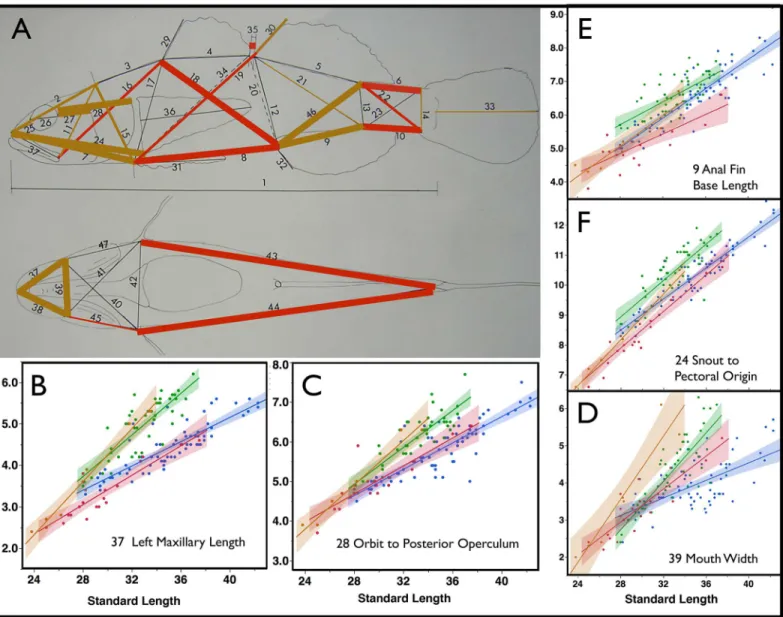
Fig 1. Measured Characters and Species Discrimination.A) Measured characters are numbered on a lateral view (top) and ventral view (bottom), see key below. Colored lines indicate measured characters that statistically differentiate species via a generalized linear model (Table 1). The thickest lines indicate characters that differentiate species at p<0.001, colored lines of intermediate thickness 0.001p<0.01, and the thinnest lines indicate
0.01p<0.05. Blue lines indicate characters that are larger inE.newberryi, while red lines indicate characters that are larger inE.kristinae. B–F graphically present the 5 measures that best differentiate the two species as determined by the discriminant analysis. These variables in combination serve to identify 99% of individuals to species. Colored envelopes around the line form 95% confidence intervals of a least-squares linear model for each species. Data points, regression line, and envelope are in blue forE.newberryiand in red forE.kristinae. All measurements are in millimeters. Key to Measured Characters Numbered in Panel A: 1 Standard Length, STANL; 2 Snout tip to occiput (transition of body to head), SNOCC; 3 Occiput to origin (anterior base) of spinous dorsal fin, OCCSP; 4 Length of spinous dorsal fin base, SPNDB; 5 Length of soft dorsal fin base, SFTDB; 6 Soft dorsal fin insertion (posterior end base) to upper caudal fin base, SFTDUCB; 7 Snout tip to pelvic fin origin (to anterior edge of fin), SNOPELO; 8 Pelvic fin origin to anal fin origin, PELOANO; 9 Length of anal fin base, ANALBL; 10 Anal fin insertion (posterior end of fin base) to lower caudal fin origin, ANFILCO; 11 Posterior end maxillary bone to occiput (left side), OCCMAX; 12 Soft dorsal fin origin to anal fin origin, SFTOANO; 13 Soft dorsal insertion to soft anal insertion, SFTDIANI; 14 Depth of caudal peduncle at caudal origin (anterior edge procurrent rays), DEPCAO; 15 Occiput to pelvic origin, OCCPELO; 16 Posterior end of left maxillary bone to spinous (1st) dorsal origin, POMXSPDO; 17 Spinous (1st) dorsal origin to pelvic fin origin (anterior edge),
SPDOPEO; 18 Spinous dorsal fin origin to anal fin origin, SPDOANO; 19 Pelvic fin origin to soft (2nd) dorsal fin origin, PELOSFDC; 20 Spinous dorsal fin
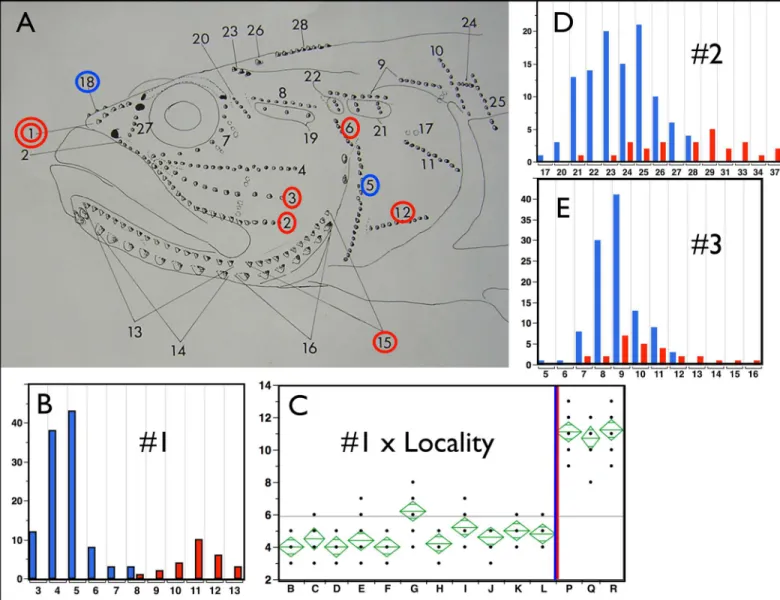
4(b); 5(ot); 6(z); 7(a); 8(x1); 9(x2); 10(as1); 11(os); 12(oi); 13(NL); 14(NL); 15(NL); 16(NL);
17(NL); 18(r); 19(u1); 20(tra); 21(u2); 22(q); 23(n); 24(la2); 25(la2); 26(o); 27(c2); 28(g). The
two large organs (one above the other) along the upper edge of the preopercle were constant
and not counted (i3).
(lower), RMAXLPE; 42 Between lower pectoral fin bases, BETPECO; 43 Lower left pectoral origin to lower caudal fin base, LPECLCAU; 44 Lower right pectoral fin origin (or base) to lower caudal origin, RPECLCAU; 45 Posterior end of right maxillary to lower right pectoral fin, RMAXRPE; 46 Soft Dorsal fin insertion to anal origin, SFDIANO; 47 Posterior end left maxillary bone to lower left pectoral origin, LMAXLPE; 48 (not on figure) Distance between fleshy orbits across top of head, INTORBW.
doi:10.1371/journal.pone.0158543.g001
Fig 2. Sexually Dimorphic Characters.In panel A, colored lines indicate measured characters that statistically differentiate sexes in both speciesviaa generalized linear model (Table 1). The thickest lines indicate characters that differentiate gender at p<0.001, colored lines of intermediate thickness 0.001p<0.01, and the thinnest lines 0.01p<0.05. Brown lines indicate characters that are larger in males, while red lines indicate characters that are larger in females. Mandible length and mouth width, as well as some other characters of the head and the anal fin base length are substantially larger in the male than the female. Panels B–D show least squared regression plots for both sexes of each species:E.newberryifemale = blue, male = green;E.
kristinaefemale = red, male = brown. Mouth characters (B and D) and some head characters (C) are dramatically sexually dimorphic and show allometric differences between males and females as males develop substantially larger mouths toward maturity. E (9 ANALBL) and F (24 SNOLPECO) show characters that are strongly influenced by both sex and species (seetable 1); males andE.newberryiare larger for these characters.
We did not determine patterns of nervous innervation nor utilize the innervations-based
terminology of Wongrat and Miller [34]. Extent of scale investment was assessed without
counting the small, imbedded, and non-overlapping scales. Measurements were taken with dial calipers to the nearest 0.1 mm under a dissecting microscope and most fish were above 30 mm standard length (SL), with 15% being between 25 and 30 mm SL. Differences in pigmentary features could not be discerned in the fixed material examined and were not compared. Simi-larities as well as morphological and genetic differences between the species are discussed
underE.kristinae.
Nomenclatural Acts
Museum acronyms follow Sabaj Perez [35]. The electronic edition of this article conforms to
the requirements of the amended International Code of Zoological Nomenclature, and hence the new names contained herein are available under that code from the electronic edition of this article. This published work and the nomenclatural acts it contains have been registered in ZooBank, the online registration system for the ICZN. The ZooBank LSIDs (Life Science Iden-tifiers) can be resolved and the associated information viewed through any standard web
browser by appending the LSID to the prefix "http://zoobank.org/". The LSID for this
publica-tion is: urn:lsid:zoobank.org:pub:F610F99F-347F-447E-A240-92AA29495215. The electronic edition of this work was published in a journal with an ISSN, and has been archived and is available from the following digital repositories: PubMed Central, LOCKSS.
Material Examined
Localities utilized for meristics and morphometrics listed north to south along the coast includ-ing types; LACM numbers unless otherwise specified; M = male; F = female:
E.newberryi: Del Norte County: Smith River, 42683-2(15, counts only); Lake Earl, 42668–1, F: 10(31.8–37.9); Humboldt County; Humboldt Bay, 35334–1, M: 3(34.3–35.6); F: 2(34.9– 36.5), 35335–5, M: 1(30.3); 42667–1, M: 1(33.1); F: 1(31.6); Mendocino County: Manchester State Beach/Brush Creek, 35322–1, M:2(28.6–35.3), 35134–4, M: 1(34.3); F: 3(36.4–38.5); 42666–1, M: 2(28.0–28.1); F: 1(28.2); Sonoma/Marin County line: Estero Americano, 37380–1, M: 4(29.6–35.8); F: 6(29.4–42.3); Santa Cruz County: Rodeo Gulch/Corcoran Lagoon, 42658– 4, M: 5(30.9–33.8); F: 5(33.6–37.3); San Luis Obispo County: Arroyo de Corral, 42349–1, M: 5
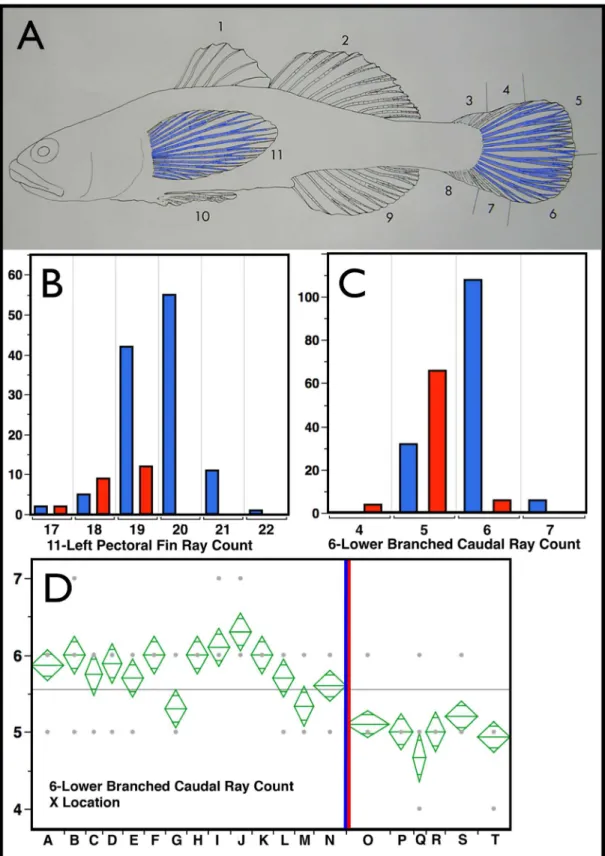
determined using the non-parametric Wilcoxon Summed Rank Test (implemented in JMP), p<0.0001 in the three
cases (well within oura prioricriteria of p<0.001). Counts related to them and combined with them (Right Pectoral,
11-Left + Right Pectoral; 5-Upper Branched Caudal Rays, Total Branched Caudal Rays (5+6) were also significant at this level. Panel D presents an ANOVA analysis of means for sampling locality for, 6-Lower Branched Caudal Ray count for heuristic comparison. Localities are displayed from north to south with theE.newberryi/E.kristinae
geographic split shown by the blue red vertical bar. As can be seen,E.kristinaeby site are consistently lower in this variable. Total branched Caudal Ray Count (5+6 not shown) provides a similarly consistent result. Thus, these counts appear to have modest utility in species diagnosis. Key to localities: A-Smith River, B-Lake Earl, C-Humboldt Bay, D-Brush Creek, E-Estero Americano, F-Rodeo Lagoon, G-Arroyo de Corral, H-Morro Bay†, I-Santa Inez River, J-Jalama Creek, K-Agua Caliente, L-Winchester Canyon†, M-Ventura River, N-Malibu Lagoon†, O-Aliso Creek†, P-San Mateo Creek†, Q-San Onofre Creek, R-Las Pulgas/Las Flores Creek†, S-San Luis Rey River†, T-Buena Vista Lagoon†(most of these habitats are lagoonal in nature,†= currently extirpated, based on absence in recent surveys). Key to fin spine and ray counts: 1-Number of dorsal fin spines, DSPINES; 2-Number of second dorsal fin ray elements, DRAYS; 3-Upper procurrent caudal fin rays, UPRORAY; 4-Upper unbranched primary caudal rays, UUNBRC; 5-Upper branched primary caudal rays, UBRCAR; 6-Lower branched primary caudal rays, LBRCAR; 7-Lower unbranched primary caudal rays, LUNBRCR; 8-Lower procurrent caudal rays, LPRORAY; 9-Number of Anal fin ray elements, ARAYS; 10-Pelvic fin rays, PELELEM; 11-Left pectoral fin rays, LPECRAYS; Right pectoral fin rays, RPECRAYS (not shown); Number of pre-caudal or abdominal vertebrae, PRECAUD (not shown); Number of post-caudal vertebrae (including last half centrum as one), POSTCAUD; (not shown) Total vertebrae, TOTVERT, (not shown). Counts of Fin Rays and Spines are tabulated and averaged by locality inS3 Table.
(31.7–35.8); F: 5(29.2–32.8); Morro Bay, 42348–2, M: 1(36.4); F: 3(29.4–36.1); 35573–1, M: 3 (30.3–35.8); F: 5(30.4–34.3); Santa Barbara County: Santa Ynez River lagoon, 42343–1, M: 5 (33.4–36.4); F: 5(35.5–42.3); Jalama Creek, 31425–2, M: 5(30.0–33.9); F: 5(31.0–37.2); Agua Caliente Canyon, 42340–1, M: 5(30.1–32.8); F: 5(29.7–38.2); Winchester/Bell Canyon, 42339– 1, M: 2(33.6–35.1); F: 8(31.8–38.9); Ventura County: Ventura River, 35597–4, M: 2(34.4–37.0); F: 7(38.5–41.5); Los Angeles County: Malibu Creek, W55-273(15, counts only).
E.kristinae: Orange County: Aliso Creek, 42370–1 (20 counts only); San Diego County: San Mateo Creek, 57333–1, M: 1(28.3); F: 10(26.8–30.8)[paratypes]; San Onofre, 42692–2, M:
Fig 4. Neuromast Counts.In panel A, circled neuromast counts that are significant at p<0.0001 using the non-parametric Wilcoxon Summed Rank Test (implemented in JMP). Blue circles indicate larger counts forE.newberryi, red circles larger counts forE.kristinae. The double circle identifies count #1, which is uniformly diagnostic for all populations and approaches complete diagnosis of individuals. Bar graphs in B, D and E chart the number of individuals ofE.newberryiin blue andE.kristinaein red that have a particular number of counted neuromasts (x axis) for neuromast counts 1, 2 and 3 respectively. D and E are typical of results that meet our significance criteria but are not necessarily diagnostic at the population or individual level. Panel B, shows a bar graph of count 1 that provides a high level of diagnosis. Panel C presents an ANOVA analysis of means by sampling locality for the neuromast count #1, for heuristic comparison. Localities are displayed from north to south with theE.newberryi/E.kristinaegeographic split shown by the blue red vertical bar. Adult fish from these populations are readily identified to species by this count and the absence of the canal over this location (key to localities as inFig 3caption). Neuromast Counts are tabulated and averaged by locality inS4 Table.
3(28.2–33.5); F: 4(32.7–37.5)[paratypes]; Las Flores/Las Pulgas, 57334–1, M: 3(23.8–26.2); F: 5 (25.0–29.3)[paratypes]; 57334–2, F: 1 [Holotype] (29.3); one additional specimen, counts only [paratype]; San Luis Rey, 50478-1(15, counts only); Buena Vista, W53-235(15, counts only).
Mapping
Verified records for both species are mapped based on museum specimens or other reliable
documentation. SeeS1 Textfor treatment of each locality mapped.
Four localities reported once but not documented by specimen records, or other information to provide definitive confirmation, are not plotted on the maps. They may be valid historical sites lacking Tidewater Gobies today: San Pedro, Los Angeles County reported by Eigenmann
and Eigenmann in 1892 [36]; San Elijo Lagoon, San Diego County [37]; Carquinez Straits,
upper San Francisco Bay [38], and Lake Merritt, Alameda County (visual records“. . .in the last
few years. . .”by Jim Carlson as related verbally to Peter Moyle, in lit. 21 April 1975).
Synonymies
Prior to observations ofEucyclogobiussouth of the Los Angeles Basin in 1939 and 1940
men-tion of Tidewater Gobies refer to the Northern Tidewater GobyE.newberryas delimited here.
The synonymy in the main text includes, primary systematic treatments, misidentifications,
and the synonymy ofE.kristinaeonly. A more comprehensive compilation of synonymy and
valid literature references for the genus and both species is appended (S2 Text).
Analyses
Counts and measurements were analyzed with approaches mitigating the influence of size,
sex-ual dimorphism [9], sampling limitations, as well as the local variation in morphology already
known to exist [15] between the multiple lesser genetic subdivisions withinEucyclogobius
new-berryi. In the multivariate approach, discriminant function analysis (DFA), all measurements were globally transformed to eliminate the overall effect of size, and eliminate the specific reli-ance on a single measure to assess size. Separate DFAs were performed for species, sex, and species for each sex. Measured characters were then assessed individually without transforma-tion using generalized linear models (GLMs) to understand the influence of effects of standard length, species, sex, and interactive terms for each character. This permitted identification of allometric relationships, not revealed in the discriminant approach and permitted identifica-tion of addiidentifica-tional covariates excluded as redundant in species discriminaidentifica-tion, but of interest in a more wholistic understanding of species difference.
Counts included fin spines and rays, vertebrae, and neuromast lines on the head and were treated independently from one another. Each was assessed for statistical difference between species using a non-parametric approach. Counted characters determined to be distinct at the
0.001p level between species was then further assessed to determine if all sampled localities
were diagnosed effectively to species.
Finally, previous efforts to reconstruct the phylogeny and timing of divergence within East
Pacific Bay Gobies [29,30] were analyzed to generate specific estimates of the divergence time
ofEucyclogobius newberryiandEucyclogobius kristinae.
Discriminant Analysis. To assess morphologic distinction between taxa, 45 measured
characters from 142 individuals [115E.newberryi(48 male, 69 female); 27E.kristinae(7 male,
20 female)] were analyzed in a DFA. All characters in the matrix were first log10transformed
to standardize for variance, and then size corrected (S2 Table) using methods from Darroch
and Mosimann [39], Jungers et al. [40] and Plogar et al. [41]. This consisted of calculating the
that value from each variable to create scale-free, or size corrected variables [41]. Mean value substitution, calculated from all individuals from the same geographical grouping (i.e. northern or southern species), was used in the few instances where data were missing from the matrix [42].
A linear DFA was implemented in SYSTAT 13.1 in order to determine which measured characters most effectively distinguished between these two species, and to test if these discrim-inating characters vary between sexes. Three analyses were conducted relative to species using
the 45 morphological predictor variables andE.newberryiandE.kristinaeas the categorical
variable: 1) all individuals of both sexes pooled together, 2) females only, and 3) males only. A
fourth analysis with sex as the categorical variable was also performed on pooledE.newberryi
andE.kristinaesamples. Prior probabilities were computed and assigned proportionally to the sample size of the group, due to unequal sample sizes for the two species. Stepwise selection was used to identify the subset of quantitative variables that most efficiently discriminates the two species among the designated samples. This method alternates between forward selection (based on F-to-enter criterion) and backwards elimination (based on F-to-remove criterion) by removing non-significant variables from the analysis before the next forward-selection step
[43]. Stepwise discriminant analysis has been commonly used to analyze fish morphometrics
and meristics [44–46] in addition to performing well with small sample sizes [43]
Generalized Linear Model Character Assessment. To provide a more comprehensive assessment of individual characters and compliment the DFA, GLM analysis was performed for each of the 45 measured characters except standard length. Standard length, species, sex, and the interaction terms species×length, sex×length, species×sex, and species×sex×length
were included in the initial models as effects/predictors in the program JMP Version pro12
(SAS Institute Inc). Each model was adjusted for false discovery rate. Subsequently, variables were removed in succession from the analysis and the model rerun proceeding from higher to
lower order interactions following Winer et al. [47] until only effects that met a standardalpha
(p<0.05) were retained. Exceptions were made in cases where an interactive effect included the
variable that did not meetalpha(p<0.05). For example, sex would be retained if sex×length
met the criterion and sex alone did not. Except for one case, 35 BETDFINS, residuals suggested normal distribution and the data were run without transformation (normal, identity) in JMP. Chi-squared values for effects in each model were tabulated by type of result found and
catego-rized by standardalphalevels (p<0.001, 0.001p<0.01, 0.01p<0.05). It should be noted
that the false discovery rate used in the analysis only pertains to multiplicity of tests within
each model. In light of multiple tests, and the 45 models run, analphalevel of p<0.001 was
employed for significance. Measured characters were plotted versus standard length (in JMP) such that the linear fits and confidence of the fit could to be compared for the two species and/ or sexes.
Treatment of Counted Characters. Each counted character was examined using a bar chart and distinctions between species were assessed using a nonparametric test of central ten-dency (Wilcoxon Ranked Sums Test) appropriate for discrete data with potentially non-normal
distributions. In light of multiple tests, ana priori alphalevel of p<0.001 was employed. To
determine whether meristic variables were diagnostic, or whether local variation interfered with diagnosis, a one-way ANOVA plot was generated for sampling sites for statistically significant counted characters. This was an expedient way of determining whether statistically significant results were consistently diagnostic for all samples. That is whether statistically sig-nificant results were also consistently diagnostic for all samples. No differences in meristic counts between sexes were observed.
divergences (p-distance) in MEGA v.6.06 [48], and to tally the number of fixed substitutions
betweenE.newberryiandE.kristinae.
Results
Measured Characters
Discriminant Analysis. The discriminant analysis for species with sexes considered
together properly classified 99% (115/116) ofEucyclogobius newberryiand 96% (26/27) ofE.
kristinaeindividuals using five characters (36 PECTLE, 16 POMXSPDO, 46 SFDIANO, 32
ANALLE, 42 BETPECO–seeFig 1caption for character description) for a 99% classification
rate of individuals to species. Three variables (38 SNMAXR, 18 SPDOANO, 9 ANALBL) were sufficient to classify 90% of individuals of both species to sex. Classification between species
within sexes was also efficient. For females 96% (66/69) ofE.newberryi, and 95% (19/20) ofE.
kristinaeindividuals were properly classified on the basis of 5 variables (24 SNOLPECO, 16
POMXSPDO, 32 ANALLE, 36 PECTLE, 47 MAXPECOL), and for males 98% (47/48) ofE.
newberryi, and 100% (7/7) ofE.kristinaeindividuals were properly classified with 3 variables (36 PECTL, 26 ORBDIA, 38 SNMAXR) albeit with limited sample size.
Generalized Linear Models. The GLMs examined the suite of measured characters rela-tive to predictors/effects: standard length, species, sex, and interaction terms species×length, sex×length, species×sex, and length×species×sex. Effects of models for species, species×length,
sex and sex×length are reported in columns 1–4 respectively inTable 1. Results of GLMs for
species and for sex are illustrated in Figs1and2, respectively. Standard length was a critical
term in the GLMs. However, it was not tabulated, as it was relatively and uniformly significant
and was always included in final models where other effects met thealphacriterion for
inclu-sion. In contrast, the interactive term length×species×sex did not meet thealphalevel criterion
for inclusion in any case and thus was not included in any final model and is also not reported
inTable 1. The interactive term species×sex was significant in models for three characters.
These results are not in the table, but are discussed further below.
Species had an effect at p<0.05 on 23 measured characters, and 10 of these were at the
p<0.001 level (Table 1). This included the 5 characters that best differentiate species in the
dis-criminate analysis (Fig 1). As is to be expected, additional characters that incorporated
redun-dant discriminatory information that were excluded in the discriminant analysis are revealed as significant here. These include characters that reinforce an interpretation of greater height
and girth inE.kristinae, and longer fins inE.newberryi(Fig 1). Species×length had effects on
19 measured characters (3 of these at the p<0.001 level). These species×length differences in
the model can be interpreted as differences in allometry between species. The greater increase
with size inE.kristinaeof character 30, the initial ray of the 2nddorsal fin, may be the most
noteworthy of these allometric characters.
Sex had an effect at p<0.05 for 28 characters, 16 of these at the p<0.001 level. Sex×length
was an effect for 13 characters, 5 of these at the p<0.001 level. It is noteworthy that of the
char-acters that are distinct between sexes, a suite of jaw and head charchar-acters are larger in the male,
and grow allometrically (Table 1). These are presumably involved in the burrowing behavior of
the adult males. Sexually distinctive characters that don't appear as allometric include the gap between the two dorsal fins, and the space between the caudal fin and the dorsal and anal fins.
Three characters not shown inTable 1reveal effects of species×sex interactions (30 SAFTDRA
7.82, 41 RMAXLPE 4.27, 39 MOUWIDE 11.3- notation ofX2and asterisks foralpha
leveland underlining as inTable 1). ThusE.kristinaeshows larger dimorphism in mouth
width (Fig 2D) with substantially greater mouth-width in males. Otherwise,E.kristinaeandE.
Table 1. Results of Generalized Linear Models.
1) Sp—X2 2) Sp*L—X2 3) Sex—X2 4) Sex*L—X2
SPECIES EFFECTS
32 ANALLE 30.33*** 7.93** – –
16 POMXSPDO 27.06*** 9.10** 10.24** –
42 BETPECO 20.32*** 6.31** – –
19 PELOSFDO 22.14*** 3.90** 10.10** 6.07*
3 OCCSP 14.86*** 11.78*** – –
17 SPDOPEO 12.60*** 4.30* – –
36 PECTLE 12.15*** 5.07** # –
25 SNORB # 37.41*** 6.78* –
30 SAFTDRA 10.56* 17.16*** 9.14** –
40 LMAXRPE 11.40** 4.87* – –
41 RMAXLPE 11.52** 5.25* # 4.39*
33 CAUDLE 10.98** – 4.39* –
5 SFTDB 10.22** – – –
47 MAXPECOL 6.19* – – –
23 ANIDC 5.06* – – –
26 ORBDIA 4.51* – – –
SPECIES and SEX EFFECTS (similar inX2)
9 ANALBL 16.27*** – 25.17*** –
46 SFDIANO 19.13*** – 17.65*** –
15 OCCPELO # 4.98* 8.96** –
21 SFTOANI 6.70* – 4.79* –
PREDOMINANTLY SEX EFFECTS with Allometry
38 SNMAXR # 5.41* 142.13*** 32.63***
37 SNMAXL 5.12* – 137.68*** 29.08***
39 MOUWIDE 21.07*** 8.64** 60.02*** 37.21***
27 POSTORB – – 74.42*** 13.92***
28 POSTOPER – – 51.59*** 12.31***
24 SNOLPECO 7.24** 4.33* 64.52*** 7.20**
7 SNOPELO – – 28.01*** 5.66*
11 OCCMAX # 4.87* 5.85* 11.74**
PREDOMINANTLY SEX EFFECTS with minimal Allometry
44 RPECLCAU 4.83** 6.56* 28.40*** 6.37*
43 LPECLCAU 10.63** 7.24** 23.68*** 9.81**
10 ANFILCO – – 22.77*** –
8 PELOANO 3.90* 4.20* 17.68*** –
18 SPDOANO – – 12.31*** –
35 BETDFINS1 – – 26.57
*** –
6 SFTDUCB – – 11.35*** –
2 SNOCC – – 9.48** –
22 SFTDIVC – – 7.46** 5.55*
14 DEPCAO – – 6.53* –
45 RMAXRPEC – – 4.43* –
Chi-square statistic for effects in the model are tabulated. Standardalphalevels are shown by asterisks (***p0.001,**0.001<p0.01,*0.01<p0.05 and–
0.05<p-removed from model). When the measure is larger inE.newberryior males, the effect reported is in bold type; when measures are larger inE.kristinae
or females, the effects are underlined. Column 1, effect of species; column 2, effect of species×length interaction (allometric difference between species); Column 3, effect of sex; Column 4, effect of sex×length interaction (allometric difference between sexes). The interaction of sex and species (differences in dimorphism between species) is reported in the text. The effects of length are not shown as there is always a strong relationship between the measured standard length and the other measured characters. The measures are grouped by the most dominant effects as determined byX2of the effect (nis nearly identical between models). Species, species×sex, sex, and sex×length (allometry) and sex alone were the emergent sets of explanatory effects.1Character
ofE.kristinaemales in the analysis may limit the statistical power to identify this class of interaction.
Counted Characters
Mitochondrial Sequence Divergence. In addition to tree reconstruction based on D-loop
and cytochrome b sequences Dawson at al. [10] estimated divergence times based on
cyto-chrome b. As it was not reported previously, we calculated minimum pairwise sequence
divergence (p-distance) betweenE.newberryiandE.kristinaein a 401-bp fragment of
mito-chondrial cytochrome b to be 4.1% [48]. Mean divergence between the two groups was 4.7%.
Assuming a 0.5–1% mitochondrial divergence per million years, a conservative estimate for
vertebrates, Dawson et al. [10] inferred the two lineages diverged ~2–4 million years ago
(Mya), numbers consistent with our sequence divergence calculations. The 401-bp fragment also contains 11 fixed substitutions between the two lineages. A DNA barcode based on these differences may be used to distinguish the two species as follows, where the first nucleotide is
E.newberryiand the number is the nucleotide position relative to the complete mtDNA
genome ofE.newberryi(Accession no. KP013101.1); C:T–14443, C:A–14479, G:A–14575, C:
T–14644, G:A–14686, C:T–14689, G:A–14702, A:G–14725, T:C–14759, G:A–14785, T:C–
14806.
Taxonomy
Synonymy
Genus Eucyclogobius Gill, 1862. EucyclogobiusGill, 1862:[49]: 279, 330, 332, brief
origi-nal description, type speciesGobius newberriiGirard 1856:[1]: 136, by original designation and
also monotypic; Gill, 1863:[50]: 264, 265, list; Bleeker 1874:[51]: 298, 319, classification, type
Gobius newberrii; Jordan and Gilbert, 1882:[52]: 331, squamation compared toMicrogobius emblematicus; Jordan and Gilbert 1883:[53]: 637–638, subgenus ofLepidogobius;Jordan, 1887:
[54]: 894, list, subgenus ofLepidogobius; Jordan and Eigenmann 1887:[55]: 517, subgenus of
Lepidogobius; Eigenmann and Eigenmann 1888:[56]: 69, listed, subgenus ofLepidogobius;
Jor-dan and Evermann 1896:[57]: 459, list; Jordan and Evermann 1898:[58]: 2248, description,
comparison withLepiogobius; Jordan 1923:[59]: 225, classification; Hubbs 1926:[60]: 3,
charac-teristics, distinct fromLepidogobius; Barlow 1961:[61]: 424, related to other northeastern
Pacific estuarine gobies; Norman 1966:[62]: 405, 415, key to world goby genera, characters, list;
Birdsong et al. 1988:[22]: 187, axial skeleton, gobiid classification; Eschmeyer and Bailey 1990:
[63]: 144–145, catalogue of genera of recent fishes; Eschmeyer 1990:[64]: 488, list in
classifica-tion; Burr and Mayden 1992:[65]: 23, list of North American freshwater genera; Pezold 1993:
[66]: 640, classified in subfamily Gobionellinae of family Gobiidae; Nelson 1994:[67]: 416, in
subfamily Gobionellinae of Gobiidae; Larson 2001:[68], phylogenetic relationships; Thacker
2003:[69]: 357, 359, 360–362, molecular phylogeny; Nelson et al. 2004:[70]: 171, list; Nelson
2006:[71]: 423, in subfamily Gobionellinae of Gobiidae; Kindermann et al. 2007:[72]: 13–56,
osteology; Thacker 2009:[23]: 96, molecular phylogeny, in family Gobionellidae; Ruber and
Agorreta 2011:[73]: 31, 40–41, microsatellite studies, gobiid molecular phylogenies; Pezold
2011:[25]: 94, list, North Pacific gobionellid genera; Van Tassell 2011:[26] 143, list,
Gobii-formes of the Americas; Thacker 2013:[24]: 371, member of North Pacific group; Tornabene
et al. 2013:[27]: 4, 11, relationships; Agoretta et al. 2013:[28]: 627, phylogenetic relationships;
Ellingson et al. 2014:[29]: 465, 467, 472–475; phylogeny, morphological convergence with
western Pacific species.
Diagnosis. The genusEucyclogobiusis diagnosed morphologically from other genera in
Evermannia; see Ellingson et al. [29] by: adult supraorbital canals separated across dorsal mid-line vs. connected with or without a pore; gill opening ends below upper pectoral fin origin; dorsal fins closely approximated or confluent vs. distinctly separated; second dorsal and anal fin elements fewer, usually 10–12 vs. 13 or more; maxillaries not prolonged posteriorly vs. pro-longed; cleithral shoulder papillae low and rounded vs. elongate; squamation lacking on belly, nape, isthmus and head vs. present in one or more of these areas in addition to the body; scales cycloid and largely non-overlapping vs. scales overlapping on body; specifically adapted to brackish lagoonal or microtidal habitats vs. more saline and tidal estuarine and marine envi-ronments; female dominant reproductive behavior vs. male dominant in other eastern Pacific
species known [9,16].
Eucyclogobius newberryi (Girard, 1856)
Northern Tidewater Goby. Synonymy and Valid Literature References:Gobius newberryi
Girard, 1856:[1]: 136, original description as“. . .a brief account, extracted from final
reports. . .”; Girard 1857:[2]: 539–541, figures 5–8, plate 25, misspelled as“newberrii,”
descrip-tion, illustradescrip-tion, specimens from Tomales Bay; Girard 1858:[3], 1859:[4]: 128, [repeated]
descriptions in editions of the western railroad surveys, types USNM 360, 24 specimens from
Tomales Bay; Gunther 1861:[74]:77, list, description from Girard, as“newberrii”; Steindachner
1879:[75]: 135–137, description of specimens from artesian springs, Santa Monica, California,
as“newberrii”.
Lepidogobius newberryi, Gill 1859:[76]: 14, list; Lockington 1880:[77]: 18, list of California
fishes; Jordan and Gilbert 1881:[78]: 455, list, table of Pacific coast fishes; Jordan and Gilbert
1883:[53]: 637–638, description, range, comparisons; Jordan 1887:[79]: 894, list, included
within subdivision or subgenusEucyclogobius; Jordan and Eigenmann 1887:[55]: 502–503,
515, 517, keys, description, list; Eigenmann and Eigenmann 1888:[56]: 69, list, as“newberrii”;
Eigenmann and Eigenmann 1892:[36]: California list, footnote record for San Pedro, no extant
specimens known; Ginsburg 1945:[80]: 134–137, 139, caudal fin ray counts.
Eucyclogobius newberryi, Gill 1863:[50]: 264–265, synonymy; Bleeker 1874:[51]: 298, 319,
classification; Jordan and Gilbert 1881:[78]: 53, listed; Jordan and Gilbert 1882:[52]: 331,
squa-mation compared toGobius(nowMicrogobius)emblematicus; Jordan and Evermann 1898:
[58]: 2248, description, range, confined to freshwater; Evermann and Clark 1931:[81]: 58, 63,
California habitat, list; Shapovalov and Dill 1950:[82]: 387, California list; Shapovalov et al.
1959:[83]: 174, California list; Kimsey and Fisk 1960:[84]: 474, key California freshwater fishes;
Norman 1966:[62]: 405, 415, type species of genus; Miller and Lea 1972:[85]: 186–187, key,
characters, range; Miller and Lea 1976:[86]: 240, range extended; Moyle 1976:[87]: 85, 344–
346, key, biology, distribution; Hubbs et al. 1979:[88]: 44, California list; Eschmeyer et. al. 1983:
[89]: 262, pl. 19, illustration, characters, range; Swenson 1999:[9]: biology, conservation,
behav-ior, distribution; Anhelt et al. 2004:[15]: 385, 398, variation in head canal development;
Kinder-mann, et al. 2007:[72]: 13–56, osteology, possible relationships; Earl et al. 2010:[12]: 103–114,
phylogeography, distinctness of southern population.
Gillichthys mirabilis, Starks and Morris 1907:[90]: misidentification, Mendocino County
record described as“Specimens examined from Mendocino County, 1¾”in length, contained
mature eggs.”; Snyder 1938:[91]: 358, misidentification, Waddell Creek lagoon.
Eucyclogobius(N), Ellingson et al. 2014:[29]: 472, morphological convergence with western
Pacific species ofGymnogobius.
Type Specimens ofEucyclogobius newberryi: Girard’s original description of the species was
abbreviated [1], and subsequent descriptions in 1857 [2] and in two editions of the Pacific
hisGobius newberryicollected by E. Samuels in Tomales Bay, or adjacent coast. Girard described several other California coastal marine fishes taken by Samuels in Tomales Bay and in or near Petaluma, northern San Francisco Bay (also called San Pablo Bay). By July of 1984
USNM 360 consisted of three gauze-wrapped groups of fish with the data:“California,
Peta-luma. Samuels”(Richard Vari, Smithsonian Institution, letter July 10, 1984). In 1991 Helen
Larson found these three wrapped lots of 20, 20, and 23 specimens, respectively (personal
com-munication, 2013), to all beEucyclogobius newberryi. These lots are accompanied by small
numbered paper labels that are now disassociated from individual specimens. Without evi-dence to the contrary (Jeffrey Williams, USNM, personal communication), the lot of 23 are presumed to be the types mentioned by Girard and the missing specimen may be the one
illus-trated by Girard [2] and not reunited with the rest of the type lot. The other two lots were
pos-sibly added as part of the 185 caudal ray counts taken later by Ginsburg [80] who then worked
at the Smithsonian.
The 23 type specimens have faded to a uniform medium tan color and are very flattened from being wrapped tightly with impressions of cheesecloth on their sides and pectoral fins
adherent to the body. All have two distinguishing characteristics ofEucyclogobius, namely a
distinct depigmented distal one-quarter to one-third of the spinous dorsal fin and the upper limit of the gill opening ending below the upper edge of the pectoral fin base. The USNM cata-logue number 360 is retained for the lectotype selected, a 39.2 mm SL female, with measure-ments and counts as follows: head length (L) 10.4; predorsal L 14.8; prepelvic L 10.7; preanal L 25.6; body depth at second dorsal origin 6.8; caudal peduncle depth 4.3; head depth 6.3; snout L 2.3; horizontal eye diameter 2.3; Posterior margin of eye to posterior end of opercle 6.1; Pos-terior margin of eye to posPos-terior edge of preopercle 3.5; interorbital width 1.6; mouth width 3.9; Snout to posterior end left maxillary 4.9; first dorsal base 7.4; space between dorsal fins 0.2; second dorsal base 9.8; anal base 10.7; Right pectoral fin L 7.0 (left disfigured from wrapping); pelvic L 7.5; caudal fin L 8.4. Dorsal spines 7, second dorsal fin and anal fin elements each 11, precaudal 16 and caudal 18 for a total of 34 vertebrae. Maxillary extends back to below the eye but not beyond a vertical line through the posterior margin of the orbit. The dorsal and anal fins are darkly pigmented with melanophores and the head and body have scattered melano-phores. Four small saddle-like groups of melanophores lie along the dorsal midline from the back of the head to the first dorsal fin. The upper 6–7 pectoral rays are pigmented and the cau-dal, left pectoral, and pelvic appear unpigmented. The slender conical teeth are in two to three rows anteriorly with the outer slightly larger. The remaining 22 specimens are designated para-lectotypes and catalogued as USNM 408102, 23.6 to 39.7 mm SL. They are all very pale brown with darkened dorsal and anal fins. The top of the skull of two specimens has been dissected
open. Counts from X-rays (excluding pectoral rays) from all 23 fish are summarized inS1
Table.
Eucyclogobius kristinae
new species, Swift, Spies, Ellingson and Jacobs
Southern Tidewater Goby. Eucyclogobius kristinae, Swift, Spies, Ellingson, and Jacobs, new species, urn:lsid:zoobank.org:act:CC641CE5-7DAE-466E-BA3F-D23994068F2B.
Gillichthys mirabilis, Metz 1912:[92]: 41, misidentification, record from Aliso Creek, Laguna Beach, Orange County.
Eucyclogobius newberryi, Miller 1939:[5], 1943:[6], records from San Juan Creek, Orange
County; Swift et al. 1989:[16]: 1–19, in part, biology, distribution, illustration; Earl et al. 2010:
[12]: 103–114, phylogeography, distinctness of southern population; Ruber and Agoretta 2011:
[73]: 31–41, in part, reanalysis of gobiid molecular phylogeny; Van Tassell 2011:[26]: 143, in
Eucyclogobius(S), Ellingson et al. 2014:[29]: 472, convergence with western Pacific species. Holotype. LACM 57334–2, female, 29.3 mm SL (Fig 5), California, San Diego County, coastal lagoon at mouth of Las Flores Canyon (Las Pulgas Canyon on some maps), about 15
km northwest of Oceanside, centered on 32° 17’25.29”N; 117° 27’51.40”W, 29 July 2011, by
Kevin Lafferty, Mike Rouse, Cary Galst Cavalcante, and Brenton Spies. Dorsal fin VI, 12; Anal
10, Pectoral 19, 19; Pelvic I, 10, I; Caudal rays 10 + 2 + 6 + 5 + 2 + 9 (seemethods), total
branched 11, total caudal rays 34; vertebrae 16 + 18 = 34; gill rakers 3 + 6, 9 total; anterior exposed left supraorbital neuromasts 11. Fixed originally and maintained in ethyl alcohol.
Paratypes: LACM 57334–1, 8 (23.8–28.3), data as holotype; LACM 57333–1, 11 (26.4–30.8), CA, San Diego County, San Mateo Creek lagoon, just south of Orange County line, 29 July 2011, date and collectors as holotype; LACM 42692–2, 7 (28.2–37.5), CA, San Diego County, San Onofre Creek lagoon, about 2 km south of Orange County line, 3 December 1981, Camm C. Swift. No other types are designated but LACM, SIO, CAS, and UMMZ, have several series of non-types from earlier samples from these southern populations that have been examined.
Diagnosis:Eucyclogobius kristinaeis distinguished morphologically from the only other
spe-cies in the genus,E.newberryi, by reduction (in fish over about 25 mm SL) of the anterior
supraorbital canal and concomitant increase in number of exposed neuromasts (see analyses
above), 8–12 in adultE.kristinaevs. 5–8 inE.newberryi(Fig 4B). The Southern Tidewater
Goby averages about one fewer pectoral fin ray (18–19 vs. 19–21) and branched caudal rays 10–11 (9–12) vs. 12–13 (11–14) due to reduction in this count on the lower half of the caudal
fin (Fig 3B). Morphologic measures proved efficiently diagnostic in combination (Fig 1B–1F).
These include a longer anal spine and measures that contribute to greater girth, more anterior
placement of pelvic fins and a more upturned mouth inE.kristinae, whileE.newberryihas a
more elongate snout with a more terminal mouth, longer pectoral fins and somewhat more elongate dorsal, anal, and caudal fins. Numerous fixed molecular characters have been
identi-fied between the two species, both in mitochondrial sequence [10], as well as in dramatic length
difference and amplification of microsatellite loci [12]. Thus, there are many means of efficient
molecular diagnosis via PCR amplification assay.
Description. Measurements for holotype and paratypes ofE.kristinaeon (S1 Table). Body elongate with width and depth greatest about one-third of the standard length back from tip of snout; body rounded, only slightly deeper than wide, more compressed after preservation; up to 45 mm SL or 55 TL; head 25–30% of SL, snout and eye subequal; interorbital width less than eye diameter. Mouth slightly upturned, maxillary extending back to vertical through middle of
eye, not prolonged but mouth larger in males (Fig 2). First and second dorsal and anal fins
sub-equal in height, caudal fin length about 18% of standard length. First and second dorsal fins narrowly separate to slightly confluent, when separate space less than 20% of length of first dorsal base. In 13 of 30 specimens (31–36.6 mm SL) from the San Luis Rey River lagoon from 1958 (LACM 50478–1 [ex. UCLA W58-1]) the last fifth or so of the first dorsal fin base and insertion was deflected to the left (5) or the right (8) of the midline, a condition not observed otherwise among hundreds of specimens of both species. Pelvic fin an elongated oval extending posteriorly about half the distance to the anal origin, anterior margin of disc a thin translucent membrane with smooth, continuous slightly concave edge. Anterolateral edge of lower limb of cleithrum with 0–4 low rounded fleshy papillae. Nasal capsule slightly bulbous and each nostril slightly raised on cone shaped elevations, occasionally slightly tubular. Upper end of gill open-ing ends just below the upper edge of pectoral fin, lower gill cover broadly attached to isthmus, slightly in front of lower pectoral base.
groove along the inner edge of the lips extending for 70–80% of the mouth margin. Gill rakers low and rounded. Scales thin and cycloid, mostly non-overlapping and on sides of body and caudal peduncle in adults, usually absent mid-dorsally, mid-ventrally near median fins and absent from belly, isthmus, nape, and head. Scales lacking until about 25 mm SL.
Meristics for both species are summarized in Supplementary Information (S3andS4
Tables). First dorsal spines 4–8 (usually 6 or 7); second dorsal 9–13 elements usually 10–11 in
E.kristinae, 11–12 inE.newberryi; anal fin 9–12 (10–11); pectoral fin rays 17–21, usually 18–
19 inE.kristinae, 19–-21 inE.newberryi; pelvic elements 12 including a small slender spine on
the anterior edge of each side; one specimen had one less branched ray; branched caudal rays
9–14, usually 11–12 inE.kristinae, 12–13 inE.newberryi; total caudal rays (procurrent plus
unbranched plus branched) 30–39 (usually 33–36). A few total caudal ray counts below 30 are likely anomalous. Vertebrae 32–36, usually 34–35; precaudal or abdominal 15–16; caudal 17–
19 (usually 19). Branchiostegal rays 5; gill rakers 9–11 inE.kristinae, 8–12 inE.newberryiand
usually a count of 9 or 10 in both species, 3 upper and 6 or 7 lower limb rakers.
Fig 5. Panel A, Photograph of holotype ofEucyclogobius kristinae, n. sp., LACM 57334–2, 29.3 mm Standard Length from Las Flores Canyon lagoon on Marine Corps Base Camp Pendleton on 29 July 2011. See text for other data. Panel B, Illustration of pigment patterns and some neuromast lines on the head and body ofEucyclogobius kristinae n.sp., LACM 42639–1, 33 mm SL, Aliso Creek, Orange County, CA [16].
Only the posterior segment of each supraorbital canal develops in this species [15] and then only in adults. The two supraorbital canals also do not meet in the dorsal midline between the
eyes. AdultE.newberryiusually have both supratemporal canals developed anteriorly and can
have an interorbital connection or commissure with one pore in the middle if joined but usu-ally with two pores opposite each other without a complete commissure. Fish less than about 25 mm SL usually lack canal development. No other lateral line canals developed.
Free neuromast organs largely in longitudinal rows on the head (Fig 4); on the body (Fig
5B) in a series of vertical rows, one per myotome, down the mid-sides of the body, a few short
rows extending up the lower abdomen between the pelvic origin and cloaca, and in two lines extending on to membranes of the upper half of the caudal fin, separated by two branched rays. A few vertical rows also occur on the operculum and head above the operculum. The larg-est of these organs is about three times the diameter and size of the smalllarg-est. The larglarg-est on the inner row of the lower jaw and preopercle, under the eye, and on the snout presumably repre-sent or are homologues of the lateral line organs enclosed in canals in other gobies. The
varia-tion in number of these organs is shown for some rows that could be reliably tabulated (S4
Table). One pair of larger organs along the upper edge of the preopercle and another pair
between the anterior ends of the mandibles and just behind the symphysis are illustrated (Fig
4) but not tabulated since they were invariant. A pair of larger organs on the upper opercle
were inconsistently present (No. 17). Neuromast lines were similar to those illustrated by
Ahnelt et al. [15] and they show one set not counted here, a paired longitudinal series in the
predorsal area.
Pigmentation in preserved material of larval and early juvenile fish is very similar in both
species and was described in Swift et al. [16] and Watson [93] from material ofE.kristinaeand
by Spies et al. [94] forE.newberryifrom San Gregorio Creek lagoon, San Mateo County. Nine
to eleven large stellate melanophores uniformly spaced mid-dorsally from nape to caudal base in late larvae and small juveniles form 7–9 dorsal saddles or blotches in larger juveniles and adults. Adult preserved specimens with pale white or slightly grayish or yellowish ground color with a wash of very fine punctuate melanophores (individual cells concentrated). The clusters or concentrations of expanded melanophores mid-dorsally usually lie: 1) between occiput and first dorsal fin, 2) at origin of first dorsal fin, 3) under the middle of the base of the first dorsal, 4) between the dorsal fin bases, 5) two equally spaced along second (soft) dorsal base, 6) one at the second dorsal insertion, 7) one between second dorsal insertion and dorsal caudal origin, and 8) one at caudal origin. The saddles under the dorsal fins are larger and better defined than those posterior and anterior. Five to ten pairs of diffuse blotches evenly distributed mid-lat-erally on the body; a third horizontal row of indistinct blotches lies between the mid-dorsal saddles and the mid-lateral blotches. In larger fish, the three longitudinal rows of blotches on the body (mid-dorsal, mid-lateral, and dorsolateral) loosely to densely coalesce leaving one or two irregular longitudinal rows of intervening clear or whitish areas appearing as spots some-times elongated into vertically oriented pale vermiculations. A ventral saddle, posterior to the insertion of the anal fin, overlies the narrow midventral line of melanophores from anal origin to caudal base. This ventral line occasionally has one or two clear unpigmented breaks in the adult. The ventral procurrent caudal rays largely unpigmented with a patch of melanophores just above them. Caudal base with two additional concentrations of melanophores oriented vertically and just under the dorsal procurrent rays, the latter largely unpigmented also. Unpig-mented spaces or windows lie in front of the three caudal blotches as well as behind them over the proximal ends of the caudal rays.
dorsal one-third to one- half of the outer fleshy pectoral fin base. The second dorsal and anal fins are dusky with a more or less uniform covering of melanophores but with a narrow
unpig-mented distal edge (Fig 5). The second dorsal with one or two longitudinal and parallel rows of
clear or pale spots, one per inter-radial membrane beginning in the middle of the anterior edge, descending to near its base posteriorly. The first dorsal is usually darker, has a wider distal unpigmented area equaling one quarter to one third the height of the fin, and sometimes with one or rarely two horizontal rows of clear spots also descending posteriorly. The marginal one to three rays of the pelvic fin can have some melanophores.
Head uniformly covered with dark melanophores, area over the brain slightly darker; cheeks and upper one third or so of opercle also dark along with margins of upper and lower jaws and anterior one-third or so of the ventral surface of the lower jaw. Vascularization (veins and/or arteries) on the roof of the mouth darkly pigmented and the testes enclosed in layer of dark melanophores.
In life males and females are similar in color and pattern as described above, but the back-ground color is translucent grey, tan, or olive. The pale spots and vermiculations on the body and narrow unpigmented areas (lacking melanophores) on the median fins are white, cream, or pale orange. Sometimes they appear bluish or iridescent, probably due to the reflection of
the sky commonly occurring during field examination of live fishes [95]. In breeding
individu-als these colors are intensified in the males and females. In addition, in courting females the dorsal and anal fins and the body between them can become solid black with the fins retaining the pale or colored edges. Males do not develop the very black condition as far as is known, and both sexes often show a whitish, cream, or light orange pigmentation on the marginal pelvic fin rays.
On 24 June 1989 a large adult individualE.newberryitaken and released at the mouth of
the Santa Maria River that was partly xanthochroic. Most of the head, body and first dorsal fin were bright yellow. The very top of the head and eye was black. The anterior two thirds of the second dorsal was yellow with the posterior one-third black. Most of the anal fin was black except for a yellow anterior edge. The caudal peduncle was black along with the body between the posterior quarter of the second dorsal and anal fin bases. The caudal fin was yellowish-orange with a narrow black dorsal edge.
Distribution. Until the mid-20th century the Tidewater Goby was recognized from Santa Monica, Los Angeles County northward to the northwest corner of California. In 1939 and
1940, fish taken south of the Los Angeles area were recognized asEucyclogobius newberryiby
Miller [5,6] and new collections expanded the range south into San Diego County by the 1950s
(UMMZ, UCLA, SIO, CAS). These southern fish are recognized here asE.kristinae. Metz’s
1915 record [92] of the Longjaw Mudsucker,Gillichthys mirabilis, from Aliso Creek, Orange
County, was based on misidentifiedE.kristinae. A 1950 study purportedly ofEucyclogobius
biology in Peñasquitos Lagoon, San Diego County [96] was based on the Longjaw Mudsucker
[16]. Rechnitzer [37] referred to Tidewater Gobies at San Elijo Lagoon, but no confirmatory
samples are known. In 1892 Eigenmann and Eigenmann [36] listed a San Pedro locality (as
Lepidogobius newberryi) but specimens to support this record have not been found. Thus,
veri-fied records ofEucyclogobius newberryiextend from the mouth of the Smith River, Del Norte
County, south to Santa Monica, Los Angeles County (Fig 6;S1 Text;S1–S3Figs) and those for
E.kristinaeextend from Aliso Creek, Orange County south to Agua Hedionda Lagoon, San
Diego County (Fig 6). Data are current as of October 1, 2015.
Over the last 30 years,Eucyclogobius kristinaehas been restricted to 9 localities in northern
December 21, 2015, sampling in the last 3 years has documented the presence of the species in
only three small sites limited to Camp Pendleton (Fig 6).
Many localities for both species have been extirpated with some naturally recolonized, and artificial reintroductions have been attempted in a few instances. Most of the losses have been
in southern California and the San Francisco Bay area [13]. Several natural gaps also occur in
stretches of coastline with steep shores where coastal lagoons do not develop, such as the Big Sur area from the Salinas River, Monterey County south to and including Arroyo de la Cruz in northern San Luis Obispo County. The smaller streams in this area are often too steep and lack fine substrates to develop barrier sand berms and stable coastal lagoons. The Northern Tidewa-ter Goby also has never been recorded from several larger streams north of San Francisco Bay, the Russian, Gualala, Garcia, Navarro, Albion, Big, Noyo, and Mattole rivers, nor in Oregon just a few miles north of the northernmost locality in the Smith River. Until recently this list of
absences included the Mad and Klamath rivers (S1 Text;S1 Fig) where the species has been
recorded in the last year. It is not known if these are permanent populations or dispersing indi-viduals. Occurrences throughout the range of both species often correspond to coastal littoral
cells of sediment movement as described by Habel and Armstrong [97], where sediment is
suf-ficient for berm formation and lagoon closure at the mouths of streams.
Etymology. The species name is feminine in honor of Kristina D. Y. Louie whose untimely death in 2004 cut short a promising career dedicated to conservation genetics. Her Ph.D. dis-sertation and associated work contributed greatly to our studies of eastern Pacific
phylogeogra-phy [11,12,98,99], as well as to a novel re-interpretation of the placement of Wallace’s Line
across the islands of Indonesia [100].
Discussion
Phylogenetic Placement, Distinction, and Antiquity
Phylogeny of the Group. The two species of Tidewater Goby are part of a larger group of
temperate North Pacific Bay Goby genera disjunctly distributed across the North Pacific [29].
One genus,Evermannia, ranges southward into the tropics in the eastern Pacific [101] and no
western Pacific species does so [102]. Birdsong et al. [22] included many of these genera in
their informal“Chasmichthys”and“Astrabe”groups based on the posterior placement and
arrangement of the dorsal fin pterygiophores. Additional morphological synapomorphies for this North Pacific, largely temperate group of gobies including the northeastern Pacific genera
Eucyclogobius,Clevelandia,Evermannia,Ilypnus,Quietula,Lepidogobius,Gillichthys,
Typhlogo-bius, andLethops, and the northwestern Pacific generaGymnogobius,Chaenogobius,Astrabe,
ClarigerandLuciogobius have been identified [29]. Thus, synapomorphies of the Bay Goby clade are: 1) a creased or grooved upper and lower lip making the lip appear double with an infolding or groove on its inside edge; 2) one to five small dorsal bony processes or projections proximally on the inner half of the second (or more) upper pectoral ray(s); 3) glandular mounds, papillae, or raised fleshy edge on the upper and outer surface of the lower limb of the
cleithrum under the operculum (possibly present inAwaous[62]); 4) lack of ossified teeth on
the low rounded intra gill bar rakers posteriorly directed opposite the anteriorly directed gill
demarcates the historic range ofE.kristinaefrom Aliso Creek (Orange County) to Agua Hedionda (San Diego County). Red dots indicate the three localities whereE.kristinaewas recovered in recent surveys,
highlighting the precarious status of this species.*Not sampled last two years.†Not recovered in recent sampling.††Habitats that appear no longer viable due to anthropogenic modification.aSites of attempted
reintroduction. Maps coveringE.newberryidistribution in northern and central California are presented in supporting information (S1–S3Figs).