Technology Innovation Management Review February 2012
32
www.timreview.ca
Q&A
Aparna Shanker
A.
Delivering value to customers is important to managers, leaders, and entrepreneurs alike. To be willing to pay, a customer must derive value from a market offer. However, what is customer value? How does a supplier deliver customer value?What is customer value?
There are various interpretations of what is meant by customer value. The term may mean low price, receiving what is desired, receiving quality for what is paid, or receiving something in return for what is given (Zeithaml, 1988; tinyurl.com/7kjz6nf). Woodruff’s (1997;
tinyurl.com/825pdwn) definition of customer value is widely cited and encompasses most interpretations of customer value. Woodruff defines customer value as: “a customer perceived preference for and evaluation of those products attributes, attribute performances, and consequences arising from use that facilitate (or block) achieving the customer’s goals and purposes in use situations”.
The definition above suggests that there are two aspects to customer value: desired value and perceived value. Desired value refers to what customers desire in a product or service. Perceived value is the benefit that a customer believes he or she received from a product after it was purchased.
Customer value can be examined at different levels. At a low level, customer value can be viewed as the attributes of a product that a customer perceives to receive value from. At a higher level, customer value can be viewed as the emotional payoff and achievement of a goal or desire. When customers derive value from a product, they derive value from the attributes of the product as well as from the attribute performance and the consequence of achieving desired goals from the use of the product (Woodruff, 1997;
tinyurl.com/825pdwn).
How does a supplier deliver customer value?
An entrepreneurial firm must deliver value along the dimensions that matter most to its customers. For example, from a customer's perspective, the value of a
cup of coffee enjoyed with a friend at a coffee shop might be greater than the value of a take-out cup of coffee. While the monetary cost of the cup of coffee in both cases might be the same, the value the customer extracts is different.
To develop compelling customer value propositions, a supplier needs to keep in mind the following:
1. There are two stages at which customers assess value: before and after they purchase a product or service.
2. Value is perceived at various levels; therefore, value needs be delivered at various levels.
3. Understanding what customers value is the first step in delivering customer value.
For a complete view on the customer value creation strategies that managers, entrepreneurs, and leaders can implement to help distinguish themselves from competitors, Smith and Colgate (2007;
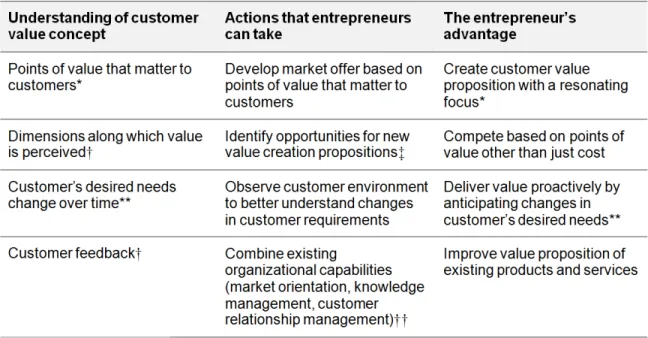
tinyurl.com/759o9j3) provide a comprehensive framework. However, the challenge for suppliers is not just recognizing what value to create or what the benefits are, but to operationalize customer-facing processes to deliver value to customers. Table 1 synthesizes views from the extant literature pool on customer value creation and delivery; it shows how entrepreneurs can use their understanding of customer value to their advantage.
As an example application of the concepts in Table 1, consider an entrepreneur that has developed a new user interface for a point-of-sales system that can be used in a coffee shop. Although the entrepreneur might think that the software solution provides value to the customer (i.e., the coffee shop owner) in terms of cost or ease of use, the customer might consider the greatest point of value to be 24/7 technical support because the coffee shop is open overnight during examination periods on a university campus. In this particular case, processes relating to the first and second row of Table 1
Technology Innovation Management Review February 2012
33
www.timreview.ca
Q&A: What Is Customer Value and How Do You Deliver It?
Aparna Shanker
could be implemented by an entrepreneur and they could showcase the technical support plan as a point of value that would resonate with the customer; instead of focusing on advantages that other competitors could also potentially deliver. Similarly, the third and fourth row of Table 1 could be used by entrepreneurs as a guideline to process customer value knowledge and anticipate changes in customer needs and improve existing value propositions.
Conclusion
Entrepreneurial firms focus their scarce resources on the dimensions of value (e.g., cost, use value, emotional value, social value) (Smith and Colgate, 2007;
tinyurl.com/759o9j3) that most matter to customers and market their capabilities in terms that their customers can associate with and are known to value. However, delivering customer value is not a one-off event. Firms must continuously strive to better understand and anticipate what their customers will value and then keep delivering it. As Steve Jobs once said: “You can't just ask customers what they want and then try to give that to them. By the time you get it built, they'll want something new.” (tinyurl.com/c5n27g)
Table 1. The customer value delivery process
* Anderson et al. (2006; tinyurl.com/6tmrqvv) † Woodruff (1997; tinyurl.com/825pdwn) ‡ Smith and Colgate (2007; tinyurl.com/759o9j3) ** Flint et al. (2002; tinyurl.com/7xm8dvr) †† Landroguez et al. (2011; tinyurl.com/6pxej39)
About the Author
Aparna Shanker is a customer applications engineer with Alcatel-Lucent in Ottawa, where her job focus is on IP networks and the 4G LTE Evolved Packet Core. She is also currently a graduate student in the Tech-nology Innovation Management program at Car-leton University. Her research interests include open source businesses and customer value management. She holds an undergraduate degree in Computer En-gineering from Queen's University, Kingston.