FUNDAÇÃO GETULIO VARGAS
ESCOLA DE ADMINISTRAÇÃO DE EMPRESAS DE SÃO PAULO
CLÉMENCE VIGNAL LAMBRET
SOCIAL MEDIA CRISES IN THE ORGANIZATION: EXPLORING
MANAGEMENT STRATEGIES THROUGH CASES FROM FRANCE AND BRAZIL
FUNDAÇÃO GETULIO VARGAS
ESCOLA DE ADMINISTRAÇÃO DE EMPRESAS DE SÃO PAULO
CLÉMENCE VIGNAL LAMBRET
SOCIAL MEDIA CRISES IN THE ORGANIZATION: EXPLORING
MANAGEMENT STRATEGIES THROUGH CASES FROM FRANCE AND BRAZIL
Dissertation presented to Escola de Administração de Empresas de São Paulo of Fundação Getulio Vargas, as a requirement to obtain the title of Master in International Management (MPGI).
Knowledge Field: Corporate Management
Adviser: Prof. Dr. Edgard Barki
Clémence Vignal Lambret.
Social Media Crises in the Organization: Exploring Management Strategies through Cases from France and Brazil / Clémence Vignal Lambret. - 2016 106 f.
Orientador: Edgard Elie Roger Barki
Dissertação (MPGI) - Escola de Administração de Empresas de São Paulo.
1. Administração de crise. 2. Mídia social. 3.Imagem corporativa. 3. Emoções. 4. Estratégia. I. Barki, Edgard Elie Roger. II. Dissertação (MPGI) - Escola de
Administração de Empresas de São Paulo. III. Social Media Crises in the Organization: Exploring Management Strategies through Cases from France and Brazil
CLÉMENCE VIGNAL LAMBRET
SOCIAL MEDIA CRISES IN THE ORGANIZATION: EXPLORING
MANAGEMENT STRATEGIES THROUGH CASES FROM FRANCE AND BRAZIL
Thesis presented to Escola de Administração de Empresas de São Paulo of Fundação Getulio Vargas, as a requirement to obtain the title of Master in International Management (MPGI).
Knowledge Field: Corporate management
Approval Date:
18/02/2016
Committee members:
________________________________ Prof. Dr. Edgard Barki
________________________________ Prof. Dr. Benjamin Rosenthal
ACKNOWLEDGEMENTS
“O caminho da sabedoria é não ter medo de errar” Paulo Coelho Engaging in the process of a Master thesis is an experience both exciting and challenging, for it brings closure to the first chapter of your life while propelling you into the next one at a phenomenal speed, or so it seems after at least 17 years spent in the school system. Hence, in no way has it been a lonely journey, and I would like to extend my deep gratitude to the different people who have travelled with me until now.
Firstly, I would like to sincerely thank my advisor, Prof. Dr. Edgard Barki, for his strong support since the beginning, his openness towards a topic whose dimensions are yet to be fully grasped, and for the inspiration he allowed me to express through this work: Merci! Second, I am grateful for all the professors I have had during my five (almost six) years of higher level study whether in France, the US or Brazil. Having the opportunity to read, study, learn and exchange with so many diverse people in such diverse environments has been an incredible experience, and the foundation on which I was able to start and finish my thesis project. In particular, I wish to thank Dr. Dong Liu, from the Georgia Institute of Technology, who was a very inspirational figure and taught me one valuable lesson: that much can be achieved with “knowledge and fun”.
Additionally, I would like to pay tribute to some of my precious friends who have directly and indirectly taken part in my project, may it be when patiently analyzing hundreds of comments, bearing to hear me think out loud over and over about what title to choose, or simply being wise and comforting travel partners. In particular, Florian, Juliana, Julie, Katie, Mascha and Quentin, you have been such inspiring friends. Thank you for your patience, your unfailing sense of humor, your radiant kindness and your words of wisdom. I would not have made it here without you.
ABSTRACT
The aim of this Master’s thesis has been to shed light on the response strategies that organizations are implementing when facing a crisis created on or amplified by social media. Since the development of social media in the late 1990s, the interplay between the online and the offline spheres has become more complex, and characterized by dynamics of a new magnitude, as exemplified by the wave of “Twitter” Revolutions or the Wikileaks scandal in the mid 2000s, where online behaviors deeply affected an offline reality.
The corporate world does not escape to this worldwide phenomenon, and there are more and more examples of organizational reputations destroyed by social media “fireballs”. As such, this research aims to investigate, through the analysis of six recent cases of corporate crises (2013-2015) from France and Brazil, different strategies currently in use in order to identify examples of good and bad practices for companies to adopt or avoid when facing a social media crisis.
The first part of this research is dedicated to a review of the literature on crisis management and social media. From that review, we were able to design a matrix model, the Social Media Crisis Management Matrix, with which we analyzed the response strategies of the six companies we selected. This model allows the conceptualization of social media crises in a multidimensional matrix built to allow the choice, according to four parameters, of the most efficient (that is: which will limit the reputational damage) response strategy. Attribution of responsibility for the crisis to the company by stakeholders, the origin of the crisis (internal or external), the degree of reputational threat, and the emotions conveyed online by stakeholders help companies determining whether to adopt a defensive response, or an accommodative response.
The results of the analysis suggest that social media crises are rather manichean objects for they are, unlike their traditional offline counterparts, characterized by emotional involvement and irrationality, and cannot be dealt with traditionally. Thus analyzing the emotions of stakeholders proved to be, in these cases, an accurate thermometer of the seriousness of the crisis, and as such, a better rudder to follow when selecting a response strategy. Consequently, in the cases, companies minimized their reputational damage when responding to their stakeholders in an accommodative way, regardless of the “objective” situation, which might be a change of paradigm in crisis management.
RESUMO
O objetivo desta dissertação de mestrado é de esclarecer as estratégias que as organizações estão implementando quando enfrentam uma crise criada ou amplificada pelas mídias sociais. Desde o desenvolvimento das mídias sociais no final dos anos 1990, a interação entre as esferas off-line e on-line tornou-se mais complexa, e caracteriza-se por dinâmicas de uma nova magnitude, como exemplificado pela onda de revoluções "Twitter" ou o escândalo Wikileaks em meados da década de 2000, onde os comportamentos on-line afetaram profundamente a realidade off-line.
O mundo corporativo não escapa a este fenômeno mundial, e há cada vez mais exemplos de reputações corporativas destruídas por movimentos nas mídias sociais. Assim sendo, esta pesquisa tem como objetivo investigar, por meio da análise de seis casos recentes de crises corporativas (2013-2015) da França e do Brasil, diferentes estratégias atualmente em uso. Busca-se identificar exemplos de boas e más práticas para as empresas adotarem ou evitarem ao enfrentarem uma crise nas mídias sociais.
A primeira parte deste trabalho é dedicada a uma revisão da literatura sobre gestão de crises e mídias sociais. A partir dessa revisão, eu desenvolvi um modelo matricial, a Matriz de Gerenciamento de crise em Mídias Sociais, com o qual eu analisei as estratégias de resposta das seis empresas que selecionei. Este modelo permitiu a conceituação de crises nas mídias sociais em uma matriz multidimensional construída para permitir a escolha, de acordo com quatro parâmetros, da estratégia de resposta mais eficiente (isto é: o que irá limitar o dano à reputação). Atribuição de responsabilidade pela crise para a empresa pelos stakeholders, a origem da crise (interna ou externa), o grau de ameaça à reputação, e as emoções transmitidas on-line pelos interessados ajudam as empresas a determinar a adoção de uma resposta defensiva ou acomodativa.
Os resultados da análise sugerem que as crises de mídia social são, ao contrário de suas contrapartes off-line tradicionais, caracterizadas por envolvimento emocional e irracionalidade, e não podem ser tratadas tradicionalmente. Assim, analisar as emoções do stakeholders mostrou-se, nos casos analisados, um bom termômetro da gravidade da crise, e como tal, um melhor direcionador para selecionar uma estratégia de resposta. Por conseguinte, nos casos, as empresas minimizaram os danos à reputação ao responder aos seus stakeholders de forma acomodativa, independentemente da situação "objetiva", o que pode ser uma mudança de paradigma no gerenciamento de crise.
LIST OF FIGURES
Figure 1: Internet and Social Media profile of the French and Brazilian populations p. 15
Figure 2: Percentage of the global population claiming activity in December 2014, p. 16 per type of social media.
Figure 3: Social media use by companies in Brazil by type of medium p.18
Figure 4: Objectives pursued by French companies on social media in 2015 p. 20
Figure 5: Proportion of use per type of social media p. 20
Figure 6: Profile of social media use in both France and Brazil p. 22
Figure 7: The Social Media Crisis Management Matrix p. 39
Figure 8: The RATP Crisis Management Matrix p. 53
Figure 9: The Skol Crisis Management Matrix p. 57
Figure 10: The SNCF Crisis Management Matrix p. 61
Figure 11: The Samarco Crisis Management Matrix p. 69
Figure 12: The Air France Crisis Management Matrix p. 75
Figure 13: The Coca Cola Crisis Management Matrix p. 78
Figure 14: The Social Media Crisis Management Matrix applied to the six cases p. 81
LIST OF TABLES
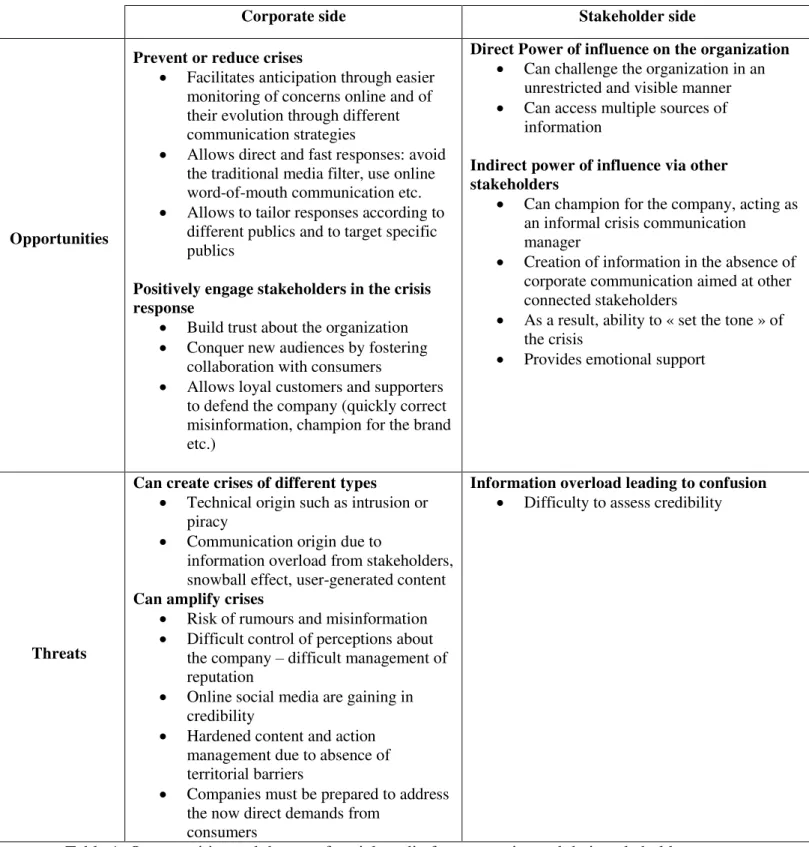
Table 1: Opportunities and threats of social media for companies p. 27 and their stakeholders
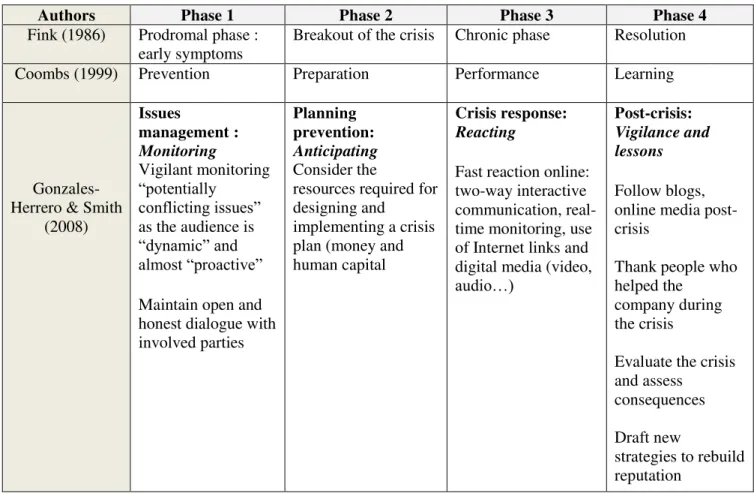
Table 2: Summary of different crisis management frameworks p. 29
Table 3: Main organizational responses to crisis situations p. 30
Table 4: Basic principles of corporate social media presence p. 31
Table 5: Summary of the emotion-based analysis of crisis communication p. 33 in the ICM Model
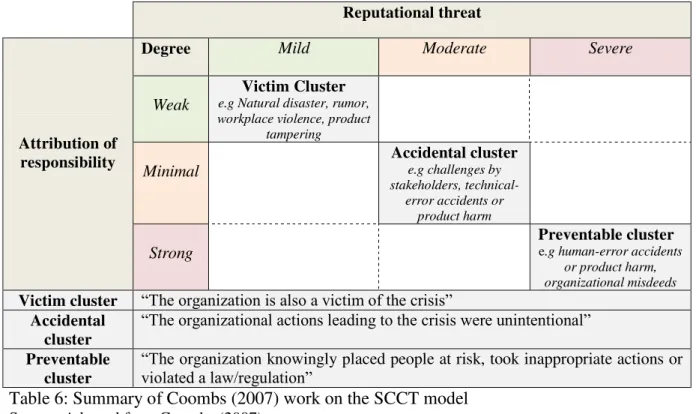
Table 6: Summary of Coombs (2007) work on the SCCT model p. 34
Table 7: Response strategies according to the crisis cluster p. 35
Table 8: Emotional analysis of stakeholders according to the origin of the crisis p. 37
Table 9: Summary of the cases according to their Coombs’type of crisis p. 42
Table 10: Origin of the crises of the selected cases p. 43
Table 11: Summary of selected samples p. 46
1 Introduction ... 11
2 Context: Social Media Outlook ... 15
2.1 Social Media Use in Brazil and France ... 15
2.2 Social Media use by Companies ... 17
2.2.1 Brazil ... 17
2.2.2 France... 19
2.2.3 Brazil and France ... 22
3 Literature Review ... 23
3.1 Typology of crises ... 23
3.1.1 Social media: the new parameter of the interactive web ... 24
3.2 Crisis management ... 28
3.2.1 Frameworks of management: prevention and analysis ... 28
3.2.2 Frameworks of communication ... 30
3.2.3 Social Media in crisis management literature ... 31
4 Methodology ... 41
4.1 Case analysis through secondary data ... 41
4.2 Selecting cases ... 42
4.2.1 Preventable crises ... 43
4.2.2 Accidental crises ... 44
4.2.3 Victim crises ... 45
4.3 Sources of data: ... 46
5 Analysis ... 47
5.1 The RATP crisis ... 47
5.2 The Skol crisis ... 53
5.3 The SNCF crisis ... 57
5.4 The Samarco mudslide crisis ... 61
5.5 The Air France crisis ... 70
5.6 The Coca Cola “rat” crisis ... 75
5.7 Concluding remarks on case-analysis ... 79
6 Final Considerations ... 82
6.1 On social media crisis management ... 82
6.2 Managerial implications ... 84
6.3 Limitations and future research ... 86
“It takes 20 years to build a reputation, and 5 minutes to ruin it. If you think about this, you’ll do things differently.” Warren Buffet 1 Introduction
On Friday, 18 of September 2015, the Environmental Protection Agency revealed that German car manufacturer Volkswagen had been superficially hiding the gas performance of its cars in order to circumvent gas emissions tests. 53,000 tweets about the revelation were posted that same day. It was followed by 1.3 million more tweets over the following week, averaging 8,000 tweets per hour, against 10,000 Volkswagen-related tweets on a usual day (Marketingtechnews.net ). Within one week after the revelation, Volkswagen had lost its CEO, Martin Winterkorn, 35% of its market value, and its reputation. Early November 2015, a “Diesel emissions violation” subchapter was added to the “Environmental Record” chapter of the English-speaking Wikipedia page of Volkswagen, and a whole new page entitled “Volkswagen emissions scandal” was created. By the end of December, the new CEO of Volkswagen, Matthias Müller, threw on scrapheap their famous 2007-slogan “Das Auto” (“The Car”) to the profit of a more sober mention of “Volkswagen” (“the people’s car”), embodiment of a desire to focus on a more humble communication and to keep a low profile.
The infamous case of Volkswagen well illustrates Aula (2010) understanding of reputation risk: “the loss of reputation affects competitiveness, local positioning, the trust and loyalty of stakeholders, media relations, and the legitimacy of operations” (p.44).
The complex interplay of social media and organizations is, more than ever, a very newsworthy topic and seems to be the logical outcome of the trend identified in 2006 by the Time when it designated “You” (the internet user) as “Person of the year”, “for seizing the reins of the global media [and] for founding and framing the new digital democracy”.
The ability to freely and instantly add one’s voice to the Internet conversation probably allowed, indeed, some salutary democratic impetuses. But it also proved the extensive power of influence held by social media users continuously reacting (as opposed to reasoning) to anything happening on and offline. In a socio-political context, social media has seemed to appear as the advent of a postmodern “government of the people, by the people, to the people” (Abraham Lincoln) where online communities can shake offline governments. What, then, can we expect the impact to be on companies?
The massive use of social media is a phenomenon that can be traced back to the late 1990s and early 2000s, when newspapers worldwide started developing their own online edition, hereby multiplying sources of immediate information: for instance, French newspaper Le Monde launched its first online version in 1995 followed in 1996 by The New York Times (US) and O Globo (Brazil), and in 1999 by The Times (UK). In the meantime, social networks such as MySpace, Facebook and YouTube, appeared almost simultaneously (2002, 2004 & 2005) and, within ten years, a multitude of other user-generated content platforms emerged, on themes as varied as professional networking (e.g Linkedin, 2003), music sharing (e.g Spotify, 2006, Deezer, 2007), image sharing (e.g Instagram or Pinterest in 2010, Snapchat in 2011), instant messaging (e.g from Skype in 2003 to Whatsapp in 2010) or microblogging (Twitter in 2006, Tumblr in 2007).
The resulting very competitive market for “news” has been strengthening the dynamics of corporate crises, because crises are “an excellent opportunity of audience” (Libaert, 2015, p.28-32). Social media, because they are free from the time and space-constraint of traditional media, present new risks for the corporate environment as they help
“disseminating information to as many people as possible” (Veil, Buechner and Palenchar,
2011, p.115). In addition, they allow an “afterglow effect” of any event relating to a company, as information remain available online and the company’s name can still be referenced long after the end of the crisis (Libaert, 2015). Consequently, “traces” of crises are “eternal” online, which makes the Internet inseparable from crisis management.
universality of social media make it an extremely powerful tool: strategic risk “strikes more quickly” and social media embody a “rapid-fire […] technological innovation” (p.3). Indeed, the inherently public nature of online content will impact the reputation of organizations as other people’ voices add to the “organization’s voice to communicate” (Coombs & Holladay, 2014, p.42). The reputational risk faced by organizations is therefore permanent, and the challenge today is less about preventing this risk than to manage it when it “manifests” (Heath, 2006) and hereby becomes a crisis.
Therefore, some authors saw in social media new opportunities, such as Veil, Buehner and Palenchar (2011) who explored the potential of social media tools in risk and crisis management, and drew from their literature review a series of best practices to optimize the integration of social media into crisis communication.
Others focused on the interplay between social media and corporate reputation. Aula (2010), for example, argued that social media “expands the spectrum of reputation risks and boost risk dynamics” (p.45) because it is a space where users become active and influential stakeholders of the organizations. Organizations are scrutinized (everything they do is “profoundly public” (p. 45)) and they are bound to irreproachable behaviors - “looking good” is no longer enough. In the meantime, stakeholders massively sharing “unverified information, true or false” (p. 48) participate in shaping a somewhat artificial “collective truth” also binding organizations to respond to new expectations or beliefs about what they are or should be. Eventually, Aula (2010) developed the concept of “ambient publicity” to suggest that reputation is the aggregation of stakeholders’ shared interpretations of the organization (e.g anecdotes and other “discursive elements”) and should, as a result, be managed within this understanding and aimed at “participating in the social process of creating meaning” (p. 48).
(p.123) as well as “be[ing] proactive and create fan networks” (p. 125) were two of the authors’ recommendations.
The following year, Hövener (2015) attempted to create an integrated model, which he called The Social Media Matrix to suggest social media crisis communication strategies that companies could use to mitigate reputational exposure in a social media context. The model was derived from the analysis of several authors and based on two factors: internal capabilities, or the degree of available internal experience and know-how regarding crisis communication, and content attractiveness, the degree to which users will perceive sharing as interesting for a particular piece of information. Based on the respective level of both these factors, companies were advised four different strategies, namely “reactive”, “secure value”, “exploit content” and “proactive”.
It is possible to notice that overall, the researches mentioned above have accounted for the tight relationship between corporate reputation and social media, and in particular the risk as well as the opportunity that social media embodied for companies. However, crises generated and/or enhanced by social media are a recent phenomenon which calls for a deeper understanding of companies’ reactions face to online crises. In addition, the researches that are herein cited focus principally on the companies themselves and seem to leave out their stakeholders. Stakeholders are often portrayed as a cause of reputation crises and a static object: many researches deal with social media without ever really pondering over what lies behind “social”: people, who are dynamic agents.
Therefore, the objective of this research has been to shed light on how organizations react and attempt to mitigate these crises today by putting into perspective two different realities and contexts. I did not consider social media as an inert object but as a multifaceted platform where dynamic agents meet and communicate. In order to analyze these different reactions and strategies, I selected six cases from France and Brazil and designed a model resulting from the analysis of other frameworks from the literature.
2 Context: Social Media Outlook
2.1 Social Media Use in Brazil and France
As preliminary notes to the analysis of the dynamics between social media and organizations, it appears necessary to look at the use of social media by the general population, which we can regard as potential stakeholders, and by the companies of each country.
In 2015, there were approximately 67 million inhabitants in France, against around 204 million in Brazil.
Figure 1: Internet and Social Media profile of the French and Brazilian populations Source: We Are Social – Global Digital Statistics, January 2014 and January 20151.
Although the internet penetration and the social media penetration in the general population are higher in France (respectively 84% and 68%) than in Brazil (respectively, 54% and 49%), Brazilians are on average more active users of social media: in January 2014, 72% of the people with a social media account had used it in the last month, against 55% for the French users. Furthermore, the 2015-report also shows that Brazilians spent an average of 3.8 hours per day on social media, against 2 hours for the French.
1 The 2015 report by We Are Social did not include some of the figures which were present in the
2014 edition. As I deemed the figures from 2014 relevant, I chose to include them in the figure. 84%
68%
55%
45% 54%
49%
72%
47%
Active internet users in the population (January
2015)
Social Media Penetration (January 2014)
Proportion of the population with a social media account who used
it in the last month (January 2014)
Penetration of the largest active social network (
Figure 2: Percentage of the global population claiming activity in December 2014, per type of social media.
Source: We Are Social Agency – Digital, Social & Mobile in 2015, Compendium of Global Digital Statistics (January 2015)
When looking at the types of social media used, Facebook (counted with Facebook Messenger) is the biggest platform used in both countries with a similar penetration rate (Figure 1: 45% in France and 47% in Brazil).
However, as illustrated by Figure 2, outside Facebook and Facebook Messenger, Brazilians seem to appreciate instant messaging applications as 24% of the population claimed activity on Whatsapp in December 2014 and 14% for Skype. These two social media are the most used platforms after Facebook (counted with Facebook Messenger). In France, 10% of the population claimed activity on Google+, and 9% on Twitter, which both come after Facebook. Whatsapp was only used by 6% of the population in December 2014. Consequently, although the most popular social media platform (Facebook) is the same in both France and Brazil (32% and 25% of the French and the Brazilians claimed activity in December 2014), Brazilians seem to prefer very interactive platforms more (Whatsapp, Skype) while the French are overall less active.
It is difficult to find reliable data on social media habits and behaviors. However, Brazil’s preference for overall more interactive platforms seem to indicate that Brazilians are on average more active users, who easily post and react to content, whereas the French, preferring less interactive platforms, are more passive, and mostly engaged as observers. Such intuition would actually be in line with the respective culture of each country, Brazil being seen as a naturally more social and open country. For example, according to Geert Hofstede, Brazil scores 38 on the individualism scale, making it a very collective country
32% 25%
10% 13%
9% 11%
13% 22%
5% 9%
6% 24%
4% 10%
4% 14%
3% 6%
France Brazil
where the communication style is context-rich, whereas France scores 71, which makes it a highly individualistic society where the Cartesian culture usually excludes the display of strong emotions.
Such social media profile of the connected populations of both France and Brazil will help contextualize the dynamics that we will observe between companies in situations of crisis and their stakeholders. We may expect Brazilian companies to be particularly in touch with their stakeholders online while French companies may react to critical situations online in a way that is more uncorrelated to their stakeholders.
2.2 Social Media use by Companies
2.2.1 Brazil
In a study published in June 2015, Tracto Content Marketing investigated the use of social media by Brazilian companies. They found that in 2013, around 48% of Brazilian companies used social media in their brand content strategy, against 71% in 2015, Facebook being the most used platform: 97% companies using social media also used Facebook.
Brazilian companies also used more varied media: 80% used four or more different social media platforms and nearly half (47%) used six or more. In 2013, only 6% of the companies were present on six or more platforms. In other words, there are nearly eight times more companies using more than 6 different media in 2015 than there were in 2013, and twice as more using at least four different media (35% in 2013). Such pattern is coherent with the general population’s active use of social media in Brazil.
Figure 3: Social media proportions of use by companies in Brazil and by type of medium Source: Tracto Content Marketing, “Pesquisa sobre as redes sociais na empresas brasileiras”, 2015
More particularly, the research shows that lead generation and brand recognition have been adopted as two main indicators of performance on social media by respectively 83% and 88% of the companies (Tracto Content Marketing, 2015). Besides, five indicators out of the nine cited by companies deal with measuring quantitatively the « success » of the company online. The top four most adopted indicators are thus the quantity of « shares » (89.3% of the companies adopted it), the reach of Facebook posts (88.3%), the quantity of fans or followers (88.3%) and the quantity of comments (88.1%). The quantity of views comes 7th, with 85.1% of adoption.
The prominence of quantitative indicators can reveal two things. Firstly, Brazilian companies seem to correlate positively quantity and performance, hereby neglecting situations of viral phenomena where an organization’s post may be widely shared on social media without actually being supported (bad buzz phenomenon). By focusing on quantitative metrics, Brazilian companies look at the reach of a conversation yet overlook the reception of its content, which would be more representative of performance.
Second, the absence of qualitative metrics may well be the result of the companies’ inability to envision social media as anything else than an additional top-down marketing tool: in 2015, 49% of Brazilian companies monthly funded advertisements on social media (Tracto Content Marketing, 2015). More precisely, 74% allocated up to 1.000 BRL per month, and 18% allocated more than 10.000 BRL. (Tracto, 2015).
0% 10% 20% 30% 40% 50% 60% 70% 80% 90% 100% Facebook
Youtube/Vimeo Twitter Corporate blog Linkedin Instagram Whatsapp Google+ Pinterest
Brazilian companies considering the social medium as important for communication strategy
Yet, the increase of digital interaction is meant to have the biggest impact on organizations’ communication in the years to come (Aberje, 2015). In 2014, 69% of Brazilian companies claimed to have used social media to monitor online conversations about them (Aberje, 2014) and in 2015, companies claimed that reputation crises have influenced their communication actions the most in 42% of the cases (Aberje, 2015, pp.11-12).
In other words, Brazilian companies seem well aware of, and are already well operating the marketing possibilities offered by social media. They also have the intuition of the challenges social media comes with as they are giving evidence of the growing importance of digital communication. However, although the prominence of Facebook and YouTube may reveal a desire to engage in more interactive relationships with their stakeholders, their use remains centered on quantitative metrics and falls within a logic of marketing strategy.
2.2.2 France
French companies have rather similar behaviors towards social media, although the penetration rate is higher, reaching 93% in 2015 (Hootsuite, 2015).
Figure 4: Objectives pursued by French companies on social media in 2015 Source: Hootsuite, 2015
French companies however differ in the type of social media favored, as Linkedin (81%) and Twitter (79%) are the two most used ones, against Facebook (97%) and YouTube/Vimeo (85%) in Brazil (Figure 3). Once again, it highlights French companies’ preference for less « interactive » and somewhat more institutional behaviors. Indeed, Linkedin is a platform purely oriented towards professional networking, more built as a « showcase » of personal or organizational branding while Twitter is a microblogging site based on very short, informational messages. Facebook and YouTube come third and fourth, with respectively 60% and 58% of adoption by French companies.
Figure 5: Proportion of use per type of social media Source: Hootsuite, 2015
89% 65%
62% 43%
23%
Brand recognition Reputation management Lead generation Foster client recommandation CRM
81% 79%
60% 58%
42% 42%
27%
24%
The Hootsuite study also revealed that 52% of French companies have a team dedicated to the management of social media, showing that the phenomenon is acknowledged by the corporate world, but only 30% of companies have a social media “code of conduct” for the use of employees. In addition, that proportion is heterogeneous across different sectors and sizes. Indeed, 25% of companies in the sector of information, communication and media have such a code while only 8% of industrial companies claim to do. Likewise, 52% of companies that have a code of conduct on social media have more than 1,000 employees, which may imply that companies begin to value the social media question only once a certain size has been reached.
2.2.3 Brazil and France
Figure 6: Profile of social media use in both France and Brazil Source: Hootsuite and Tracto Content, 2015
Although the penetration is higher in France than in Brazil, both countries seem to use social media in rather similar ways. Both French and Brazilian companies acknowledge the importance of social media in business. French and Brazilian companies use Twitter in the same proportions, and concentrate mostly on marketing strategy, understood here as brand recognition and lead generation. They also focus on monitoring reputation fairly in the same proportions (65% in France and 69% in Brazil). Yet, France lags behind a little as it still favors a traditional push marketing approach and is slightly timorous with regard to direct interaction, whereas Brazil seems to have a better understanding of immediate social media challenges and already clearly engages on very interactive platforms such as Facebook and YouTube. Brazilian companies are hereby more active users than French companies, which is in line with the behavior of the Brazilian population.
Yet, overviewing the use of social media by companies in Brazil and France informs us on their still partial vision of the stakes attached to social media. Although the marketing opportunity has been well identified and is well used, the importance of the reputation component is a clearly secondary objective and both countries seem to be groping for the way to successfully tackle it. Although 65% and 69% of French and Brazilian companies claim to monitor their online reputation, it remains well behind marketing objectives. Understanding more precisely the way organizations deal with and react to social media once a crisis breaks out is therefore the main objective pursued in this thesis.
93%
60%
79% 76%
65%
30% 71%
97%
80% 85%
69%
52%
Social Media
penetration Facebook use Twitter use Social media used for marketing
purposes
Social Media used for Reputation management
Have a Social Media code of conduct or
3 Literature Review
In order to reach my objective, relevant literature on corporate crises, crisis management, crisis communication and social media in a corporate environment has been analyzed and served as a basis for the design of my analytical model.
The purpose of this literature review is to draw the main trends in the analysis of corporate crisis management with a particular focus on social media.
There is a variety of definitions of a crisis. In 1986, Steven Fink argued that the two defining features of a crisis where growing intensity and strong media attention. Weiner (2006) also emphasized public attention exposure, and added a reputational threat. Similarly, Coombs (2007, p. 164) argued that crises were “a sudden and unexpected event that (…) poses both a financial and a reputational threat” to the organization. Libaert (2015, p. 9) slightly differs as he acknowledged crises as “the last phase of a sequence of malfunctions” (as opposed to an isolated event), which nonetheless “endangers the reputation and the stability of a company”. Two common, seemingly intertwined traits of those different definitions are therefore the importance of media, and reputational exposure. Reputation is “an aggregate evaluation stakeholders make about how well an organization is meeting stakeholder expectations based on its past behavior” (Coombs, 2007, p. 164), a definition in line with Aula’s (2010) who talked about shared meaning, and it is rather straightforward to see how crises can damage reputations. Crises are visible signs of failures, which “give people a reason to think badly of the organization” (Coombs, 2007 p. 164).
Consequently, the crisis amplitude depends on the width of the public knowledge of its existence, and the resulting perceptions of the company. As such, what is being believed, perceived and said outside the corporate environment about the crisis has a performative effect on corporate reputation: the crisis is the impression of the crisis.
3.1 Typology of crises
2007; Jin, Liu & Austin, 2014; Libaert 2015) as well as intensity (length and force of impact) (Vanderbiest, 2014).
These typologies well encompass the multidimensional character of crises. However, they do not fully factor in the newest component: social media.
The development of the Internet has made the risks faced by companies, as well as the type of crises they can undergo, more complex and threatening. Owyang (2011) defined a social media crisis as “an issue that arises in or is amplified by social media, and results in negative mainstream media coverage, a change in business process, or financial loss”.
Social media embody as many “public places” where a wide array of stakeholders can and will add their voice(s) to the organization’s voice, especially during crises (Coombs; Holladay, 2014, p.42). As such, social media crisis can emerge online and they are not restricted to the denunciation of real life, concrete, corporate actions (e.g a massive layoffs plan or technical accidents). Social media crises can arise from issues whose nature is much more subjective, uncertain or hazy (Bloch, 2012a) such as perceptions of corporate behaviors. Organizations no longer control the agenda of communication, and the crisis is an asymmetric conflict with varied stakeholders (Bloch, 2012b). Consequently, the very challenge of social media crises is their unpredictability, fueled by instantaneity and universal reach: “anyone can instantly have a megaphone and access to millions of people” (Wigley and Zhang, 2011, p.3)
3.1.1 Social media: the new parameter of the interactive web
3.1.1.1 Defining the Web 2.0 and Social Media
As previously said, the millennial turn saw the emergence of the “interactive” web, or Web 2.0, which is considered as the cradle of social media. Kaplan and Haenlein (2010, p.61) defined the terms Web 2.0 and social media as a “platform whereby content and applications […] are continuously modified by all users in a participatory and collaborative fashion”. Furthering their definition, they explained that social media could be described as “a group of Internet-based applications that […] allow the creation and exchange of User Generated Content”.
networking sites (e.g Facebook), virtual game worlds (e.g World of Warcraft) and virtual social worlds (e.g Second Life). The basic defining feature is the Internet user, at the core of social media dynamics.
3.1.1.2 The new powers of consumers
In 2015, the five main social media networks in terms of number of users (Facebook, Twitter, Tumblr, Instagram and Snapchat) together gathered around 2.4 billion users2. This is nearly 33% of the world population and 80% of the connected world3. It suggests modified dynamics of dialogue between organizations and consumers, and well illustrates the new power now lying into the virtual hands of customers and potential customers.
Indeed, social media has made the chain of information among consumers-users more complex. Several authors have developed and detailed typologies of Internet users’ roles in the chain of information. User generated content is inherent to social media and can, in time of crises, set the tone for the communication management. Bloch (2012) differentiated the
“suns” users who create and forward information, from “centers” users (“centroïdes”) who
disseminate information to the mass, and from “leaf” users (“feuilles”) who passively receive information. In times of crises, and in the absence of information provided by the organizations themselves, users (external stakeholders) can thus become creators of information disseminated by followers and consumed by inactives (Brummette and Sisco, 2015; Booz Allen Hamilton Report, 2009). Bystanders can now provide context, “initial information” and shape the “public narrative” in the immediate aftermath of a crisis breakout (Whigley and Zhang 2011, p.3; Aggergaard 2015, p.11). It is what Jin, Liu and Austin (2012, p. 201) called “issue-fit opinion leadership”, which fulfills “followers’ […] informational and emotional needs related to the crisis”. They further added that social media embodied a “new informal communication channel” in the form of “online word-of-mouth communication” about products, services or organizations’ information for example (p.190).
Second, although the chain of information among users becomes denser, it also flows better between users and organizations.
Social media “allows dialogue with the public without the interference of public authorities” (Wendling, Radisch and Jacobzone, 2013, p.31). Stakeholders can challenge organizations in
a much more visible way (Brummette and Sisco, 2015). Indeed, Vanderbiest (2014) found that social media allows customers to efficiently voice either criticism (rational “calls to order” on possible corporate contradictions) or outrage (emotional reaction following a perceived attack on particular values) vis-à-vis a company. Vanderbiest further argued that in 2014, 64% of all corporate crises were online crises, 60% of which stemmed from criticism voiced about the company: social media offer a permanent complaints bureau, which organizations would be well advised to take into account.
In addition, some of Kaplan and Haenlein’s (2010) categories directly impact companies. Collaborative projects such as Wikipedia tend to become the “main source of information for many consumers” (p. 62). Users increasingly use social media to get both “immediate and in-depth crisis information” as well as emotional support and recovery (Austin et al, 2012 pp.189-191). Social media offers unfiltered communication and in certain conditions, users appear to trust the social media coverage of an event (e.g a crisis) more than traditional media coverage (Austin et al, 2014, p.76; Sweetser and Metzgar, 2007). The immensity of instantly available information dramatically amplifies the potential magnitude of crises.
Corporate side Stakeholder side
Opportunities
Prevent or reduce crises
Facilitates anticipation through easier monitoring of concerns online and of their evolution through different communication strategies
Allows direct and fast responses: avoid the traditional media filter, use online word-of-mouth communication etc.
Allows to tailor responses according to different publics and to target specific publics
Positively engage stakeholders in the crisis response
Build trust about the organization
Conquer new audiences by fostering collaboration with consumers
Allows loyal customers and supporters to defend the company (quickly correct misinformation, champion for the brand etc.)
Direct Power of influence on the organization
Can challenge the organization in an unrestricted and visible manner
Can access multiple sources of information
Indirect power of influence via other stakeholders
Can champion for the company, acting as an informal crisis communication
manager
Creation of information in the absence of corporate communication aimed at other connected stakeholders
As a result, ability to « set the tone » of the crisis
Provides emotional support
Threats
Can create crises of different types
Technical origin such as intrusion or piracy
Communication origin due to
information overload from stakeholders, snowball effect, user-generated content Can amplify crises
Risk of rumours and misinformation
Difficult control of perceptions about the company – difficult management of reputation
Online social media are gaining in credibility
Hardened content and action management due to absence of territorial barriers
Companies must be prepared to address the now direct demands from
consumers
Information overload leading to confusion
Difficulty to assess credibility
3.2 Crisis management
The risk mapping of social media in a corporate context justifies the attention that has been given to the development of communication tactics in critical times. Literature on the topic either focuses on ways to anticipate crises, or on crisis communication strategies during and in the aftermath of the crisis.
3.2.1 Frameworks of management: prevention and analysis
Fink (1986) developed a 4-stage analysis of crisis cycles with the ambition of helping to “plan for the inevitable”. Fink’s approach advocated for proactivity in the detection of crisis: each phase of the crisis is defined by different demands in terms of information and reactions. As such, crisis management is about anticipating the predictable phases of development of a crisis, and the crisis communication plan should be tailored to each identified phase. Coombs (1999) has also written extensively on the topic and theorized a
4-part crisis management process in line with Fink’s model and organized around prevention,
preparation, performance and learning; a framework that has become rather classical in crisis management studies.
Authors Phase 1 Phase 2 Phase 3 Phase 4 Fink (1986) Prodromal phase :
early symptoms
Breakout of the crisis Chronic phase Resolution
Coombs (1999) Prevention Preparation Performance Learning
Gonzales-Herrero & Smith
(2008) Issues management : Monitoring Vigilant monitoring “potentially conflicting issues” as the audience is “dynamic” and almost “proactive”
Maintain open and honest dialogue with involved parties
Planning prevention:
Anticipating Consider the
resources required for designing and
implementing a crisis plan (money and human capital
Crisis response:
Reacting
Fast reaction online: two-way interactive communication, real-time monitoring, use of Internet links and digital media (video, audio…)
Post-crisis:
Vigilance and lessons
Follow blogs, online media post-crisis
Thank people who helped the
company during the crisis
Evaluate the crisis and assess
consequences
Draft new
strategies to rebuild reputation
Table 2: Different crisis management frameworks
Source: Elaborated by the author from the work of Fink (1986), Coombs (1999) and Gonzales Herrero and Smith (2008)
As such, crisis management in a social media context cannot merely focus on predicting the development of the crisis, as social media crises are, by essence, unpredictable (Bloch, 2012). Crisis management in a digital context requires new tools adding to, and going beyond, classical prevention plans.
3.2.2 Frameworks of communication
As “business planning horizons change from years into hour” (Weiner, 2006), a common businesses’ reaction to crises is a loss of perspective. The loss of perspective results in a loss of control, triggering a “siege mentality” which eventually translates into panic and silence (Weiner, 2006). Hence, to prevent panic, crisis communication should be part of a broader communication plan by the company (Libaert, 2015). Various authors have, across the years, analyzed the different responses given by companies during crises. The observed or recommended reactions vary along a spectrum that goes from denying the crisis and responsibility to acknowledging the crisis and responsibility. For instance, Lagadec (1986) argued that companies could choose between transparency, discretion or dissimulation. Piotet (1991) listed refusal (“front du refus”, equates to denial), silence (“abonné absent”), scapegoat (“bouc émissaire”, the company blames a third pary), conflation (“amalgame”, the company claims to not be the only culprit) and acknowledgement (“acceptation”); a typology also adopted by Westphalen (1997) with a different lexicon (silence, attack, transfer, acknowledgement and discretion). Lastly, aggregating most of prior research, Libaert (2015) identified three main responses: acknowledgement, lateral project and refusal, each strategy responding to different objectives.
Acknowledgement Lateral project Refusal
Total acknowledgement of responsibility
Partial acknowledgement: responsible but not guilty
Conflation: guilty with others
Dissociation of the organization from the individual culprits
Transfer of debate to another theme outshining the crisis
Pleading conspiracy
Blaming a third party: minimizing role, victimization, divert media attention by suggesting “it could
have been worse”
Denial: reject accusations
Silence: refusal to communicate
Scapegoat: sacrifice a clearly identified individual to protect the
corporate reputation
Missing link: absence of information clears responsibility
Table 3: Main organizational responses to crisis situations Source: Thierry Libaert (2015)
Eventually, the different models developed between the 80s and early 2000s incorporate two intertwined but equally important aspects of crisis management: preparation and tailored
information and reactions, has made these dimensions both absolutely necessary and much more complex to master.
Indeed, even outside any critical situation, corporate social media communication answers to new principles, which Westphalen and Libaert (2014, pp. 48-52) briefly listed.
Basic principles of corporate social media presence
Fix objectives
The quantity of followers or fans does not assess success because social media is defined by dialogue.
Be responsive Social media conversations never stop, the organization should be on the watch, and available
Be professional
The community manager should be able to grasp the relevance of criticisms and their importance for the organization before answering
Adapt your internal organization
There is a reputational and commercial risk as employees communicate on social media both personally and in the organization’s name.
Act in a consistent and complementary way
Each social media platform has different advantages, downsides and codes. The organization should adapt the communication to the platform.
Table 4: Basic principles of corporate social media presence Source: Adapted from Libaert and Westphalen (2014)
Interestingly, the work of Libaert and Westphalen is pretty representative of the overall existing literature on social media communication: companies are advised to follow broad and general sets of guidelines and principles that are not attached to a particular context.
3.2.3 Social Media in crisis management literature
Eriksson (2012) attempted, in a case study, to identify a new “descriptive” model approach for online strategic crisis communication. Eriksson posited that most models of communication are rigid because they are governed by the need to control and assign responsibility in organizations that are considered as a mechanical system and where internal and external environments are clearly separated. The new “action-net strategy”, however, envisions the organization as a more dynamic and flexible entity, and considers new technologies as informal fast channels of customer data and communication. It is built on the need to be pragmatic and focused on finding “what needs to be done and how […], in relation to the nature of the crisis”, through careful online monitoring of stakeholders’ discourse. (Eriksson, 2012, p.13).
Social media can therefore be instrumental in crisis communication, as showed by the findings of Eriksson (2012), Sweetser and Metzgar (2007) on blogs’ impact on crisis perception, and Schultz, Utz and Göritz (2011) on the prevalence of information channel (e.g Twitter) over information content (e.g apology, sympathy, information): according to them, the medium matters more than the message. As we will see, this distinction hardly holds in a social media ecosystem.
Research by Sweetser and Metzgar (2007), and Schultz et al. (2011) however began to suggest the relevance of a cognitive and emotional analysis of stakeholders’ online behaviors.
Among the different models that have subsequently been developed as attempts to draft effective communication strategies, three were particularly relevant for my analysis:
Type of crisis Common interpretation of the situation Stakeholder’s emotions Primary level emotion Secondary level emotion Internal public unnatural
e.g Regulation, labor unrest, technology breakdown
The organization is responsible and not doing enough
Anger Sadness
External public natural/unnatural
e.g Natural disasters, accidents, economic situation
The organization is not responsible but the loss is irrevocable and little can be
done.
Sadness/Fright Anger
External personal unnatural (e.g psychotic acts/terrorism)
There are existential threats / high level of uncertainty)
Fright Anger
Internal personal unnatural (e.g security issues, transport failure)
The organization is responsible but not doing enough/little can be done about it. The loss is
irrevocable
Anger Sadness
Table 5: Summary of the emotion-based analysis of crisis communication in the ICM Model Source: Adapted from Jin et al. (2007, 2009, 2012) work on the ICM model
As such, for example, when the organization and their stakeholders are impacted by a natural disaster (external-public-natural type of crisis), stakeholders’ first reaction (“primary level emotion”) is to feel sad or frightened because what has been lost in the crisis cannot be recovered (e.g human casualties) and the organization cannot really do anything concrete to make up for it.
Coombs’ research is further pondered by two other dimensions, crisis history (prior experience of a similar crisis) and prior relational reputation (how well an organization is perceived to have treated stakeholders in other contexts). Although both factors are relevant in assessing the global situation faced by the organization and should be kept in mind, they were not directly incorporated into my model.
Reputational threat
Attribution of responsibility
Degree Mild Moderate Severe
Weak
Victim Cluster
e.g Natural disaster, rumor, workplace violence, product
tampering
Minimal
Accidental cluster
e.g challenges by stakeholders,
technical-error accidents or product harm
Strong
Preventable cluster e.g human-error accidents
or product harm, organizational misdeeds
Victim cluster “The organization is also a victim of the crisis” Accidental
cluster
“The organizational actions leading to the crisis were unintentional”
Preventable cluster
“The organization knowingly placed people at risk, took inappropriate actions or violated a law/regulation”
Table 6: Summary of Coombs (2007) work on the SCCT model Source: Adapted from Coombs (2007)
The table 6 reads as follow: the weaker the responsibility attributed to the organization by stakeholders, the milder the reputational threat faced by the organization. Identifying the adequate cluster serve to design the adequate strategy.
Reputation and emotions are closely related through the attribution of responsibility (Coombs, 2007). Therefore, the stronger the attribution of responsibility, the stronger the anger of stakeholders, and the less likely are stakeholders to behave in a supportive way.
Victim crises are theoretically the least threatening for the reputation of an organization because the organization is also considered to be a victim of the crisis. As such it tends to bring about less harmful feelings (attribution-independent emotions) such as sadness and even sympathy for the organization. For instance, rumors and workplace violence create, in Coombs’opinion, victim crises.
it. Stakeholders usually do not fully blame the organization, as the crisis is deemed “unintentional”. Yet, such crises are usually shocking and often trigger feelings of sadness and fright that embody a risk for the organization’s reputation if no appropriate response is brought to stakeholders. For example, technical-error accidents or product harm are common situations of accidental crises. Interestingly enough, my analyses revealed that the crises we chose that would have been considered “accidental” in Coombs typology actually turned out to be “preventable” or treated as such.
Preventable crises are the most dangerous ones for organizations as the reputational risk is at its highest. Situations of organizational misdeed, human-error accidents or labor unrest are concrete examples of origins for preventable crises. In Coombs’ analysis, the origin is thus always internal: the organization is fully held responsible for the crisis as it intentionally did whatever sparked the crisis off. It brings on the most attribution-dependent emotions, anger and fright (Jin & Al., 2007-2012 and 2014), which are particularly dangerous for an organization reputation. The grid of analysis designed by Coombs allows drafting different responses strategies aimed at “framing” the crisis. By selecting the messages that will “shape how people define problems, causes of problems, attributions of responsibility and solutions to problems” (Coombs 2007, p.167), organizations can try to make stakeholders focus only on certain aspects of the crisis to influence their perception of the crisis.
The different strategies identified by Coombs (2007) are summed up in the table below:
Victim cluster Accidental cluster Preventable cluster
Primary response
Informing and adjusting information
Deny strategies (attack the accuser, denial, scapegoat) in particular
case of rumors
Diminish strategies (Excuse, justification)
Diminish strategies (Excuse, lack of intent,
volition, justification)
Rebuild strategies (compensation,
apology) Deny strategies in
particular case of challenges
Rebuild strategies (compensation,
apology)
Secondary response Bolstering strategies (victimage)
Bolstering strategies Bolstering strategies (ingratiation) Deny strategies
(Defensive approach)
Detach the organization from the crisis and inspire sympathy
Diminish strategies (Defensive approach)
Minimize the responsibility of the organization by pleading lack of control or asserting it could have been worse
Rebuild strategies (Accommodative
approach)
Generate or improve reputational assets by offering aid to stakeholders, whether material or symbolic
Bolstering strategies Complement rebuild strategies to further develop reputational assets Table 7: Response strategies according to the crisis cluster
c) Lastly, Jin, Liu and Austin (2010, 2014) developed the Social Mediated Crisis Communication Model (SMCC). The SMCC model aims to help crisis managers draft their response according to the crisis origin (internal or external), the crisis information form (social media, traditional media or word-of-mouth) and source (third party or organization). It posited that the multiple relationship dynamics between these factors affect how publics anticipate the organization’s responses as well as their emotions face to different crisis information. Jin et al.’s model furthers Coombs’ finding on the link between reactions and crisis types, and Jin et al. (2007, 2009, 2012) previous work on emotions. The originality resides in the importance given to the form and source of information, giving social media a leading role in crisis communication.
The main takeaways of Jin et al. (2010, 2014) analysis regarding crisis communication strategies are three-fold.
Firstly, the crisis origin influences the emotions felt by stakeholders: internal crises foster stronger emotions in general, and mainly attribution dependent emotions (anger, contempt or disgust) because these crises are seen as more controllable, which makes stakeholders attribute a higher responsibility to the organization. On the other hand, external crises are seen as less predictable and less controllable. Less responsibility is attributed to the organization and stakeholders are likely to feel attribution independent emotions such as anxiety, apprehension and fear, and weaker negative emotions such as anger.
Secondly, the response strategy should be consistent with the crisis origin and the emotions it triggers. As internal crises cause stronger (negative) emotions, stakeholders tend to expect more accommodative responses from the organization. On the other hand, in the case of external crises, stakeholders tolerate defensive responses.
The table below summarizes the main findings.
Origin of the crisis
Internal External
Emotions
Strong attribution-dependent emotions (e.g anger)
Attribution-independent emotions (e.g fear)
Attribution-independent emotions
Milder attribution-dependent emotions
Favored response strategy Accommodative Defensive Favored information source Organization Organization
Favored information form Social media or traditional media Traditional media Aggravating factors Information sent by third-party
via social media
Information sent by third-party
Table 8: Emotional analysis of stakeholders according to the origin of the crisis Source: Adapted from Jin et al (2010; 2014)
All three models are as many tools to comprehend the stakes of corporate crises today. The ICM (Integrated Crisis Mapping) model (Jin, Pang & Cameron, 2007, 2009, 2012) showed that determining the origin of the crisis (external/internal and public/internal) allows determining and anticipating the emotions that stakeholders are likely to feel when facing the crisis. The SCCT (Situational Crisis Communication Theory) model (Coombs, 2007) analyzed that the degree of responsibility for the crisis attributed by stakeholders to the organization allows determining the type (“cluster”) of the crisis and is positively correlated to the width of reputational threat. Lastly, the SMCC (Social Mediated Crisis Communication) model (Jin, Liu and Austin, 2010 and 2014) concluded that the response strategy should be consistent with the crisis type and the emotions it triggers.
All in all, these models are conceptually intertwined and deepen one another: the ICM model and the SCCT model lay the ground for the SMCC model by identifying crisis origin and emotions as two foundational parameters of crisis management, while the SMCC model partly derives from the crisis origin the crisis type (or cluster), which is at the core of Coombs’analysis of response strategies. In other words, a corporate crisis is defined by multiple, interconnected parameters among which the stakeholder has a place of choice.
nature of corporate crises. However, it was not until the 2000s that the necessity to move away from the static, non-interactive approach of crisis management was diagnosed to the profit of more flexible frameworks. The traditional paradigm had until then been based on an asymmetric relationship between the company and its stakeholders, and governed by prevention. The emergence of social media has restored, not to say reversed, balance and latest research has shown that anticipation was more appropriate to tackle corporate crises that had now become unpreventable. In addition, individuals that were consumers have turned into influential stakeholders. Companies can no longer afford to ignore discontent and must really incorporate the “social” part of social media into their strategies and approach to stakeholders.
Jin, Pang and Cameron (2007, 2009, 2012), Coombs (2007) and Jin, Liu and Austin (2010, 2014) have helped to map the multiple stakes and challenges posed by social media in a corporate environment. Their researches are key to understand modern corporate crises, but do not offer applicable tools to mitigate crises outside general guidelines. My intention has been to test their own research through the proposition of a new model, inspired by their work, and aimed at contextualizing social media crises.
In order to draw my model, the previously detailed models of ICM (Jin, Pang and Cameron, table 5), SCCT (Coombs, tables 6 and 7), and SMCC (Jin, Liu and Austin, table 8) were aggregated.
Figure 7: The Social Media Crisis Management Matrix
Source: Elaborated by the author from the work of Jin, Pang and Cameron (2007, 2009, 2012), Coombs (2007) and Jin, Liu and Austin (2010, 2014)
The different crisis clusters (or types) exported from Coombs are placed on the matrix according to this spectrum and read as follow: the victim cluster’s origin is mostly external and sometimes internal, which leads to the weakest attribution of responsibility; the accidental cluster’s origin is mostly internal, which leads to a mild attribution of responsibility; lastly, the preventable cluster’s origin is always internal and leads to the strongest attribution of responsibility.
according to the recommendations of the authors of the three overarching models. The matrix can therefore be read in several ways: Defensive strategies are best when the reputational threat is low, which means stakeholders’ feelings are less negative because lower levels of responsibility is attributed, which would imply that the crisis is likely to be in the victim or in the accidental cluster.
By placing the crises on this matrix, I believe that the type of the crisis and the most appropriate response strategy can be determined. Therefore, at the end of each case analysis, I will place the company on the matrix according to the type of crisis cluster it fell in. It will show, among other things, the strategy that would have been most adequate to adopt but won’t necessarily show the strategy that the company actually adopted, except if the strategy adopted was the appropriate one.
4 Methodology
4.1 Case analysis through secondary data
The choice of methodology depends on the type of research question (Yin, 2006). In this study, we attempt to investigate more precisely the dynamics between social media and organizations once a corporate crisis breaks out. I am exploring responses from organizations in order to mitigate those crises.
Social media is a contemporary phenomenon where the “boundaries between context and phenomenon are unclear” (Yin, 2006 p. 13). It therefore would call for the use of an exploratory research, in which case studies appear as an appropriate method.
The case study method is subject to numerous criticisms such as lack of rigor, difficult justification for generalization, length and “massive unreadable results” (Yin, 2006). Yin (2006, p. 45) argues that a multiple-case study is preferable to a single case study because it leads to more compelling results. In addition to the necessity to report all evidence fairly, it must follow replication logic. Replication can be claimed when at least 2 cases support the proposition.
Although I believe that the multiple-case study approach is the most appropriate one, lack of means, time and access to the corporations and consumers compelled me to restrict myself to the analysis of cases using secondary data.
The objective of these cases is to understand how some social media crises have been managed, put in perspective with the existing literature on corporate reputation crises: indeed, the existing literature on crisis management and crisis communication was instrumental in building the matrix model of analysis that was used to fulfill the objectives of this analysis.
Following the replication rule, Yin estimates that 2 cases are a minimum for a multiple-case study. Although I have not conducted a multiple-case study, I however respected Yin’s rule in order to ensure a certain level of rigor in my research.