This article analyses the military and tactical training of the members of the Lithuanian Riflemen’s Union for guer-rilla warfare in the interwar period. Small nations, such as Lithuania and other Baltic states, being unable to build up military strength in order to ensure national security, were forced to seek for unconventional methods of warfare, in-cluding guerrilla strategies. The study places emphasis on the development of the guerrilla war concept in the Union periodicals. The author retraces a change in the intensity of the guerrilla warfare concept propagation amongst Lithuanian population and riflemen, in particular, through publications in the Trimitas — a periodical of the Lithua-nian Riflemen’s Union. The author also identifies the narratives associated with the guerrilla matters employed for prop-aganda purposes in order to create an image of a guerrilla as a defender of the Homeland — Lithuania. Additionally, the structure and numbers of the Union are analysed through a comparison with similar organisations of the other «small nations» of the Baltic North-East. The author addresses the issue of military missions planned by the Lithuanian Ar-my, as well as the way riflemen imple-mented them. Since the Union did not only offer military training, but was also engaged in the patriotic propaganda, the article focuses on the network of cultural institutions, homes of riflemen, orches-tras, libraries, choirs, and athletic clubs used by the Union. The article sets out to establish whether the loss of Lithuanian sovereignty could have been possible without giving rise to a protracted guer-rilla war.
Key words: guerrilla warfare, Lithua-nian Riflemen’s Union, paramilitary or-ganisations, military strategy
THE CONCEPT
OF GUERRILLA WARFARE
IN LITHUANIA
IN THE 1920—1930s
V. Jokubauskas
** Klaipėda University 84, Herkaus Manto, Klaipeda, LT-92294, Lithuania
Received on February 12, 2012.
Si vis pacem, para bellum1 — the famous phrase of the Roman histo-rian Cornelius Nepos is relevant to any historical period. Military strate-gists of different countries often ask the question as to what measures should be taken to ensure the victory in the eventual war. The most effi-cient method is to avoid an armed conflict when achieving the goals for-mulated by the government. In the countries, where the geopolitical doc-trine is justified by the aspiration to safeguard sovereignty and territorial unity, the most adequate method of curbing external expansion threats is, of course, the tactic of military intimidation. The doctrine of military in-timidation is the first choice of states that boast vast mobilisation, tactical and technical resources. However, as to small states, it is seldom the case. Naturally, it is sometimes possible to produce an intimidation effect through the synergy of military potential of individual states, but this alter-native requires the establishment of intergovernmental military and de-fence alliances. Moreover, the doctrine of military intimidation can rest on the concept of an “armed nation”, i.e. guerrilla warfare.
The idea itself has been widely known for centuries. As the political phi-losopher Carl Schmitt stressed, as early as in the first decades of the 19th cen-tury, guerrillas fought with the first modern large-scale army — the forces of the first French Empire — in Spain and Russia and, to a lesser extent, in Aus-tria. As we know, the tactics of a guerrilla war made it possible to achieve relatively positive results, and its elements are used up until today [3]. Accord-ing to the historian Martin van Creveld, in case of an armed conflict between countries with different military powers, the defence tactics of the weaker par-ty should rest on the natural obstacles of the fortification which will com-pensate for the military superiority of the opponent. Another possibility is to avoid a decisive battle and use the tactics of ambushes, unexpected attacks, re-treats, trying to seize a military initiative, since a showdown fight would result not in a victory, but a bloodbath. At the same time, the author emphasises that the weakness of a defending party becomes its strength, since a mere ability to survive is a prerequisite for a victory, whereas, for a strong party a war with a weak opponent means a defeat. The longer such a war lasts, the more opportu-nities for a victory there are for the weak party, and the more likely it is that the strong party will suffer a defeat [2].
Hence it follows that one of the most rational decisions is to adopt the concepts of a “small war” and consistent introduction of guerrilla tactics el-ements into the military training. This concept was harmonised with the military doctrine of the Lithuanian army in 1920—1930. This doctrine can be described as follows: Lithuania will be involved in a war in case of a large-scale conflict in Eastern Europe, its army will retreat and intern with the government in a friendly country. At the same time, riflemen will wage a guerrilla war in the occupied territory of Lithuania, waiting for the liberation of the country by victorious allies [1].
This article analyses the issue of security of Lithuania in the 1920s-30s, more precisely, the application of the guerrilla war concept. The study sets
1
out to identify what structures of the Lithuanian forces prepared for guerrilla warfare and how they did it, since the question about the reason behind it — if one is aware of the geopolitical situation of the pre-war Lithuania [11] — does not require a further discussion. This article focuses on the question as to what consequences a guerrilla training brings about in case of an invasion.
There are just a few historiographical works dedicated to the issue of de-velopment of the guerrilla war strategy in Lithuania. They can be divided in-to two groups. The first one brings in-together the works reviewing guerrilla actions of riflemen — members of the Lithuanian Riflemen’s Union (LRU) in the wars for the Lithuanian independence (1919—1920), during border clashes with the Polish forces in 1921—1923 which took place in the vicin-ity of the neutral zone between Lithuania and Poland, especially during the seizure of the Wilno region — a territory also known as Central Lithuania (Pol. Litwa rodkowa) — by Polish troops [9; 12; 14; 24]. The second group is comprised by the works analysing the military functions of the LRU [8; 21; 22]. One must admit that the Lithuanian historiography lacks studies paying special attention to the issue of the influence exerted by the pre-war experience and possible scenarios of guerrilla tactics on the actions of the Lithuanian armed resistance of the 1940s.
The Lithuanian Riflemen’s Union: structure and numbers
The LRU was founded in 1919 to defend the civilian population from the plunder brought by the Workers and Peasants' Red Army, the Polish Army, the West Russian Volunteer Army, and individual looters. The RLU was formed on the basis of self-organised guerrilla units. During the war for the Lithuanian independence, the guerrilla movement involved approximately 0.75% of the Lithuanian population [8]. Until the liquidation of the LRU on July 11, 1940, the principal elements in the structure of the Union were in-dependent platoons and companies, which acted autonomously bringing to-gether LRU members from individual settlements, towns or — in case of big cities — factories, cooperatives, public institutions, and city quarters. Thus, the LRU was a territorial, network-based, and autonomous structure; the membership was voluntary and was encouraged by patriotism. An important feature of the Union was that it could maintain its viability even after the elimination of the headquarters and a formal liquidation of the organisation itself. The platoons and companies of the LRU, which brought together peo-ple who lived nearby, knew each other well, or were even related by kinship, could communicate even if the territory was occupied by the enemy forces.
The LRU followed the territorial principle; riflemen of each district comprised a unit (lit. rinktinė2), which was not a military or tactical, but merely an administrative entity. Thus, combat missions were carried out not by territorial units, but by independent platoons and companies of the LRU. In 1940, there were 22 such units, one of them — the 22nd territorial unit of
2
railway employees was active across the country. Territorial formations in-cluded approximately 1200 platoons; in cities, they were sometimes united into companies. Thus, the number of individual units was smaller — 872. Rural and small town residents accounted for approximately 70% of the LRU [12]; thus, platoons were often located at considerable distances and were not large in numbers.
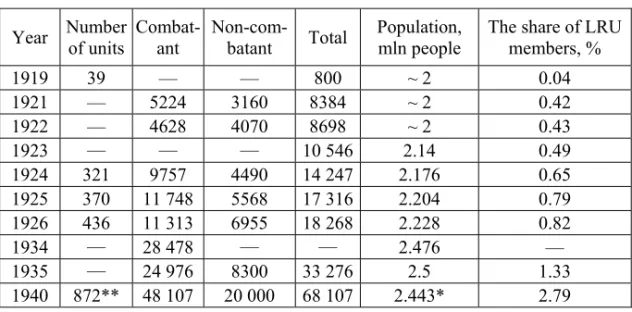
Of course, the scope of resistance could depend on the numbers of the LRU, but there are two additional aspects to consider. The first one is the number of military trained people who could fight and train new recruits of guerrilla units. The second one is the support for combatants provided by local residents which was of great importance for the success and protraction of re-sistance. There is no doubt that the support of local residents plays a decisive role in the success of guerrilla warfare. It is a priori clear that the more mem-bers of the RLU there are, the more support it will receive from the society due to strong social ties, sometimes even without sharing their beliefs. The family circle of each rifleman — in the pre-war Lithuania a family consisted of 4.7 people [23] — included parents, brothers, sisters, and other relatives. Theoretically, it is possible to suppose that a small part of the country’s popu-lation, which was involved in the LRU, could enjoy the support of the major-ity of Lithuanians; 2.79% of LRU members (table 1) through family3 and mostly through other social connections could draw into the organisation ap-proximately 1/8th of the population of the pre-war Lithuania.
Table 1
Trends of the LRU numbers in 1919—1940
Year Number of units
Combat-ant
Non-com-batant Total
Population, mln people
The share of LRU members, %
1919 39 — — 800 ~ 2 0.04
1921 — 5224 3160 8384 ~ 2 0.42 1922 — 4628 4070 8698 ~ 2 0.43 1923 — — — 10 546 2.14 0.49 1924 321 9757 4490 14 247 2.176 0.65 1925 370 11 748 5568 17 316 2.204 0.79 1926 436 11 313 6955 18 268 2.228 0.82
1934 — 28 478 — — 2.476 —
1935 — 24 976 8300 33 276 2.5 1.33 1940 872** 48 107 20 000 68 107 2.443* 2.79
* Including the Wilno region — 2.925 mln people.
** Historiography suggests that in 1940 the LRU consisted of 1200 platoons. Sources: [8, p. 55—56; 23, p. 126; LCVA, f. 929, ap. 3, b. 560, l. 66.; LCVA, f. 929, ap. 5, b. 408, l. 1.; Kardas, 1937, N 13, p. 315].
3
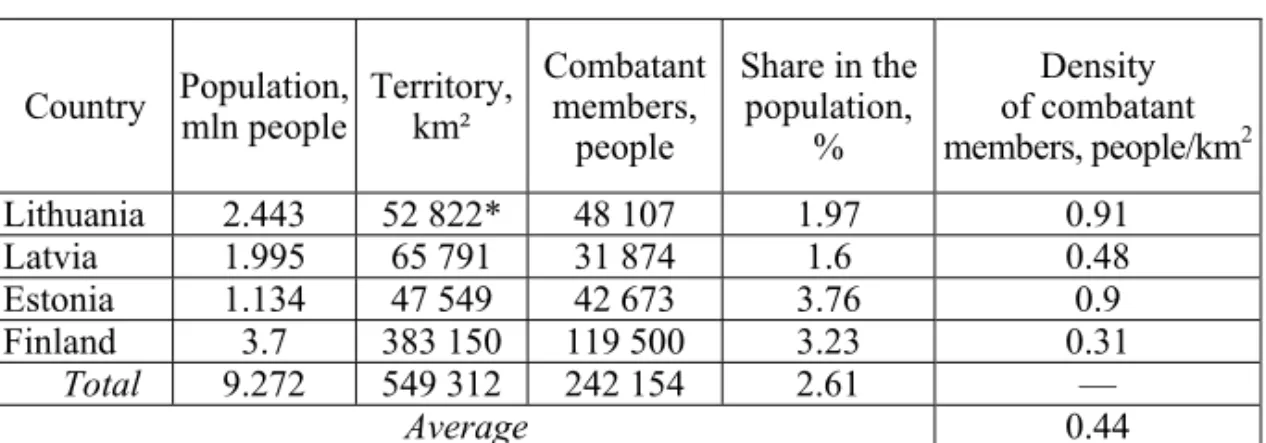
Of course, these data cannot answer the question as to how much the contingent of the LRU could extend. This answer requires an analysis of the data obtained in Lithuania and other similar states of the Baltic region — Latvia, Estonia, and Finland. I will compare the data on paramilitary organi-sations active in these countries in 1939—1940 according to three parame-ters: 1) absolute numbers; 2) the share of the organisation members in the population; 3) the density of combatant members in the country’s territory. Firstly, we will find out what military potential (personnel) the organisations of the north-western part of the Baltic region, which were quite similar and gravitated to the guerrilla movement, had. Secondly, we can answer the question as to how large was the organisation’s support among the popula-tion. Thirdly, we will acquire a better understanding of the density of guer-rilla units that could be mobilised in case of a war.
A comparative analysis shows that Finnish paramilitary organisations were the largest in terms of numbers, followed by the organisations of the smallest of the countries in question — Estonia, whereas Lithuania ranks third (table 2). But having compared the density of combatant members (i.e. the number of potential guerrilla combatants), one can see that Lithuanian and Estonian contingents are two-three times as large as those of the other countries. It means that the number of combatant members of the LRU was sufficient to wage intensive guerrilla warfare across the territory of Lithua-nia, which would also make it possible to exert at least a limited control over the territory and the population. According to the calculations, the optimum number of combatants for guerrilla defence in Lithuania was 30—50 thou-sand people4, i.e. approximately 0.5—0.8 guerrillas per 1 km² of the coun-try’s territory [4], thus, 48 107 combatant riflemen would be enough to com-prise a rather dense guerrilla movement network in 1940.
Table 2
The numbers of paramilitary organisations in 1939—1940
Country Population, mln people
Territory, km²
Combatant members,
people
Share in the population,
%
Density of combatant members, people/km2 Lithuania 2.443 52 822* 48 107 1.97 0.91 Latvia 1.995 65 791 31 874 1.6 0.48 Estonia 1.134 47 549 42 673 3.76 0.9 Finland 3.7 383 150 119 500 3.23 0.31
Total 9.272 549 312 242 154 2.61 —
Average 0.44
* in 1923—1939, the Lithuanian territory, including the Klaipeda region, (2848 km²) was 55 670 km²; since the end of 1939, including the Vilnius region (6909 km²), and excluding the Klaipeda one, it was 59 731 km².
Sources: [8, p. 58]; Pētersons, A. 2007, Krustugunīs : latviešu karotmāka 1940—1945: 60 gadus no tautas slēptais, Riga, p. 114—115.; Raukas, A. (ed.). 2008, Estonija :
4
lopedicheskij spravochnik [Estonia: An Encyclopaedic Reference], Tallin, p. 54.; Jo-wett, P. 2006, Snodgrass B. Finland at War 1939—45, Oxford, p. 18; 25—27; 29.
It is worth noting that approximately one half of combatant riflemen were reservists, and, in case of mobilisation, would be commissioned into regular forces of the Lithuanian Army, which, in 1940, consisted of 125— 150 thousand soldiers divided into five infantry divisions and other cavalry and artillery units [1]. At the end of 1934, 28 478 combatant riflemen, among whom 344 were reservist officers, 10 697 first class reservists (37.56%), other riflemen(17 781 people), who were armed with 7438 rifles and 20 light machine guns [25, l. 1], did not only have to stay within their units and ensure the security of the army’s rear, but also had to wage guer-rilla warfare in the occupied territory. Almost six years later, in 1940, the number of the first class reservists among the riflemen increased to 19067 or 39.63% of the total contingent of combatant riflemen; i.e. it changed only by two percentage points in comparison to 1934. At the time, the LRU had 27 478 rifles, 3160 handguns, and 378 light machine guns [8]. Such an amount of small arms was enough for the rest of 29 040 combatant riflemen.
Moreover, since the LRU was supplied with weapons by the army, which had a surplus of rifles and light machine guns in 19405 [6, l. 11], in case of necessity riflemen could urgently receive extra weapons from the army’s supplies. It is worth adding that the LRU units located in vicinity of the borders were equipped better and earlier.
An important factor affecting the collaboration between the Lithuanian society and the LRU was a large scale of the organisation’s activities, which were not limited to military training only. Over two decades of its function-ing in Lithuania, the LRU created a network of cultural institutions: in 1939, 72 homes of riflemen, 125 choirs, 417 amateur theatre companies, 105 or-chestras, and 350 libraries were operating in Lithuania. There were also a large number of sports teams and different courses. The LRU also included a large network of fire brigades; for example, in 1939, there were 4352 rifle-men in 175 fire-fighting brigades [12]. It is worth noting that, in the pre-war Lithuania, especially in the province, social and cultural life was closely connected to the LRU and the riflemen’s initiatives.
The promotion of the guerrilla warfare concept in the LRU’s Trimitas newspaper
Over 20 years — from 1920 until 1940 — the LRU published a weekly newspaper entitled the Trimitas; in 1939, 25,000 copies were issued week-ly, which made it a rather popular newspaper in comparison to other
5
odicals of the pre-war Lithuania. The newspaper publication made it possi-ble not only to promote patriotic ideas, but also to ingrain the guerrilla war concept in the minds of the riflemen. There are data suggesting that not less than 75% of riflemen in each platoon had a subscription to the Trimi-tas [20].
In 1924—1940, 852 issues of the weekly newspaper were published. An analysis of the available 766 issues (89.9%) makes it possible to state that the notions relating to guerrillas and a guerrilla war are used in differ-ent contexts in 416 issues (54.3%), which shows that this topic is “out-stripped” only by two other subjects — the problem of the Vilnius and Klaipeda regions. One can identify several key topics discussed in the newspaper: the history of guerrilla actions in Lithuania in 1918—1923; propaganda, agitation and tactical recommendations aimed at the prepara-tion for an imminent war; guerrilla training of riflemen; pages of Lithua-nian history. Moreover, the newspaper published some information about successful guerrilla warfare in other countries, namely, in China against Japan, Ethiopia against Italy, and others. It is indicative that these texts presented guerrillas as heroes, defenders of their motherland. It did not on-ly shape the image of guerrillas in different countries (of course, excluding Poland), but also developed the attitude that, despite greater numbers of the enemy force, guerrilla warfare can be successful.
A General Staff Colonel, Stasys Raštikis, the future commander of the Lithuanian Army, in 1933 published an article, which was consistent with the general tone of the newspaper and that stated that each rifleman should be not only a patriot, but also a person always ready to wage guerrilla warfare (even acting on his own). This idea, as S. Raštikis maintained, was supposed to be explained to riflemen in a language that everyone could understand [20, 1933, №5, p. 85]. In 1937, the Lithuanian Minister of Defence, Brigadier General Stasys Dirmantas, said at a LRU meeting, “study military disciplines with zeal, especially the practical aspects of guerrilla warfare” [20, 1937, №10, p. 220]. The concept of a guerrilla war was also supported by the LRU commander, Colonel Pranas Saladžius, who emphasised that guerrillas could hold for a long time in an occupied territory, since they rely not on assailable military bases, but on their home farms, families, and pa-triotism [20, 1937, №25, p. 581].
Fig. The percentage of Trimitas issues (1924—1940) covering the topic of guerrillas and guerrilla warfare, %
Military plans and training
As early as in 1924, i.e. a year after the demobilisation of the Lithuanian Army, the local press published an appeal to form in case of a war guerrilla units consisting of 60 combatants. They were expected to act independently, hiding in the woods during the day, avoiding open hostilities, and setting ambushes at night [20, 1924, №192, p. 19]. There was even a suggestion that, in case of a war, all able-bodied men had to get to the woods and form guerrilla units. In rural areas, which were home to 4/5 of the Lithuanian pop-ulation at the time, the remaining women and children had to provide for themselves, not unlike the guerrilla units consisting of 40—60 men, who had to supply themselves with provisions, arms, and ammunition through acting drastically and robbing the enemy’s transports and warehouses. It would be difficult for the enemy to locate such small groups in the occupied unfamil-iar territory [20, 1924, №195, p. 16].
ex-cellent snipers [20, 1926, №37, p. 1180, 1192]. In view of the above crite-rion, in 1926, the LRU published a collection of lectures on guerrilla war-fare [14, p. 110].
Of course, the Lithuanian top officers did not only develop theoretical concepts, but also made meticulous preparations. In 1926—1936, 2852 se-cond lieutenants graduated from the military college specialising in train-ing reserve officers [7, p. 354]. This college also paid a significant at-tention to guerrilla tactics training, since the Lithuanian borders were of significant length to eventual enemies, the army was small, and consider-able parts of the border had to be defended through guerrilla attacks carried out by small units. This was the focus of training of future officers [10, 1930, №11, p. 166].
In 1928, during autumn manoeuvres in the Kėdainiai district, local riflemen commanded by a retired officer, imitated the formation of a guerrilla unit and "seized" the headquartes of the cavalry regiment that played the part of the enemy — the Polish army [20, 1928, №39, p. 1267]. In a similar way, guerrilla attacks were enacted in the course of manoeu-vres with the participation of several riflemen platoons from the neighbour-ing districts. Such manoeuvres were performed on October 20, 1929 in the Marijampolė district [20, 1929, №45, p. 754]. Similar field training exer-cises were organised in the next few years [20, 1930, №16, p. 318; 1935,
№6, p. 108; №10, p. 182; №14, p. 256; 1939, №18, p. 430; №45, p. 1102]; regular army units also took part in them [20, 1936, №11, p. 260]. Guerrilla riflemen learned in practice the tactics of seizing different settlements. During the manoeuvres performed on No-vember 11, 1934 in the Panevėžys district, the guerrillas “took” the town of Smilgiai [20, 1934, №47, p. 914]. Guerrilla manoeuvres were also per-formed at night, which was extremely important [20, 1934, №40, p. 800]. In 1937 and 1938, riflemen participated as guerrillas in the large-scale au-tumn manoeuvres of the Lithuanian Army [8, p. 56].
Every year, new members joined the LRU, and they had to be trained not only practically but also theoretically. For example, in 1934 70% of combat-ant riflemen took part in manoeuvres, 75% participated in firearms training. In the same year, 4097 new members joined the LRU; all of them underwent military training and passed a test [20, 1935, №7, p. 116]. Riflemen were also given theoretical lectures on guerrilla tactics [20, 1939, №19, p. 453; 1940, №14, p. 342], as well as such lectures as “Guerrilla warfare, disci-pline, and propaganda” [20, 1935, №33, p. 599] which were necessary and yielded positive results.
It was clearly understood that the key to successful guerrilla warfare was the terrain. Forests (especially, coniferous), shrubbery, swamps, and hills were perfect for guerrilla warfare and could help escape the enemy’s avia-tion, motorised or tank units, and artillery bombardment [20, 1939,
trench warfare was feasible. There was a need for each citizen to understand the nuances and importance of guerrilla warfare. Each village, forest, and valley had to be capable of being turned into a “stronghold” [15, p. 191]. The prospect that in the future all Lithuanians would have to sustain a guerrilla war and provide for the combatants was not strange to the society. More-over, there was a general understanding that combatants had to wear a uni-form. Thus, in the eyes of the enemy they would look like an opponent that had to be treated according to the rules of an international humanitarian law [10, 1939, №19, p. 489].
In 1935, a special law was adopted; in 1936, the LRU passed a statute which stipulated that riflemen not only could but also had to take an active part in organising military training, since, in the imminent war, they will be engaged in guerrilla warfare [20, 1936, №31, p. 730]. The military com-manders of riflemen platoons were appointed by the army headquarters; ri-flemen wore the same uniform as soldiers of the regular army. A clear chain of command, discipline and military training were identified as key priorities of the LRU [17, p. 399—406]. In the 1940s, there were 872 commanders of rifleman units in the ranks of the LRU, 404 of them were reserve offi-cers, and 192 were former NCOs. So, more than 2/3 of the LRU command staff had undergone military training in the Lithuanian army. Moreover, many LRU members were police and border force officers and teachers [8, p. 55—56].
A 1938 instruction of the ŠADIR army headquarters specified that, in case of military actions, a part of riflemen had to stay in the enemy’s rear and wage guerrilla warfare [19, l. 12]. In 1940, the headquarters also fol-lowed this scheme. Guerrillas had to act in a familiar territory (woods and swamps), in small groups or individually, being armed with light weapons. These instructions were repeated in the statutes of the Lithuanian infantry and cavalry. Special guidelines were published for riflemen — Guerrilla
tac-tics and The features of riflemen’s tactics [8, p. 58—61]. In case of an
unex-pected attack, the LRU members had to act on their own without further in-structions from the central authorities [18, l. 31].
slogan “Sušaulinti Lietuvą”6, which called upon large masses to join the Un-ion and move closer to the ideal of an armed and patriotic natUn-ion [20, 1933, №16, p. 302].
Conclusion
The experience of guerrilla warfare gained in the wars for the Lithuanian independence was not forgotten in the pre-war period. The concept of a guerrilla war was widely exploited in the public discourse through the press. The Lithuanian Army developed military plans, which gave riflemen unam-biguous instructions on guerrilla warfare. The principal structure that pre-pared the general population for guerrilla warfare was the LRU. However, since 1935 the LRU was subordinate to the army’s supreme commander, one can state that there was a combatant structure preparing for a guerrilla war in Lithuania, which is important from the perspective of an international hu-manitarian law.
An active promotion of the guerrilla warfare concept in the Trimitas
newspaper and preparation of riflemen for such actions in the pre-war years was carried out on a regular basis; however, one can identify peaks of such activities. One of them related to the 1929 Lithuanian-Polish conflict at the League of Nations, another (1934—1940) reflected the changes not only in the command of the Lithuanian army or its re-equipment, but also a change to the general military doctrine, which had included Germany in the ranks of “enemies”. It points to the fact that the high command of the Lithuanian Ar-my responded to increasing military threats with an active preparation of the LRU for guerrilla warfare.
The semi-independent LRU structure ensured that, in case of an invasion riflemen could — and, according to the pre-war plans, were supposed to — wage guerrilla warfare without distorting its internal military structure. It means that in the 1920s-1930s, the general assumption was that, in the fu-ture, any aggressive territorial aspirations of the neighbouring countries could be contained only through protracted guerrilla warfare. Of course, in the pre-war years, all these measures were aimed against the eventual Polish and — since the 1930s — German aggression, i.e. against the countries, on which Lithuania did not, in effect, wage a war.
References
1. Jokubauskas, V. 2011, Issledovaniâ Baltijskogo regiona [Baltic Region Stud-ies], no 2 (8), p. 27—49.
2. Kreveld, van M. 2008, Transformacija vojny [Transformation of War], Moscow.
6
3. Schmitt, C. 2006, Teorija partizana: Promezhutochnoe zamechanie po po-vodu ponjatija politicheskogo [Theory of Partisan: Intermediate remark about the notion of political], Moscow.
4. Adamonis, S. 1997, Partizanų karas (strategija ir taktika), Kaunas, Belovo leidykla.
5. Bulvičius, V. 1994, Karinis valstybės rengimas, Vilnius.
6. Ginklavimo turto stovio žinios 1940 07 01. LCVA, f. 3, ap. 1, b. 256, l. 11. 7. Jasevičius, A. et al. 2003, Lietuvos kariuomenės karininkai 1918—1953, T. 3, Vilnius.
8. Jokubauskas, V. 2011, Žvelgiant į ateitį: partizaninės kovos taktikos sklaida Lietuvoje ir jos įgyvendinimas 1944—1953 m. [Looking to the future: guerrilla tac-tics against the dissemination of Lithuania and its implementation in 1944—1953], Genocidas ir rezistencija, no 1 (29), p. 51—68.
9. Jurevičiūtė, A., Veilentienė, A. 1998, Lietuvos istorijos studijos, no 6, p. 62—71.
10. Kardas, 1924—1940.
11. Laurinavičius, Č., Motieka, E., Statkus, N. 2005, Baltijos valstybių geopolitikos bruožai XX amžiuje, Vilnius.
12. Lietuvos šaulių sąjunga valstybės ir visuomenės tarnyboje 1919—2004, 2005, Sud. V. Kavaliauskas, J. Širvinskas, S. Jegelevičius, Kaunas.
13. LŠS viršininko 1926 05 31 raportas Vyriausiojo štabo viršininkui, LCVA, f. 929, ap. 3, b. 560, l. 14.
14. Matusas, J. 1992, Šaulių Sąjungos istorija. Sud. A. Liekis, Vilnius. 15. Medelis, R. 1939, Tautos mokykla., no 9, p. 191.
16. Nurodymai šauliams priedangai panaudoti 1940 04 16, LCVA, f. 561, ap. 18, b. 187, l. 44—48.
17. Raštikis, S. 1990, Kovose dėl Lietuvos, T. 1, Vilnius.
18. Šauliams mobilizacijos ir operacijų metu panaudoti nurodymai 1939 04 05, LCVA, f. 929, ap. 3, b. 1028, l. 30—36.
19. Šauliams panaudoti direktyva ŠADIR, 1938 10 03, LCVA, f. 929, ap. 3, b. 1028, l. 12—21.
20. Trimitas, 1924—1940.
21. Vaičenonis, J. 2001, Darbai ir dienos, T. 21, p. 131—176.
22. Vaičenonis, J. 2002, Lietuvos šaulių sąjunga Valstybės gynyboje 1935— 1940 m. In: Lietuvos šaulių sąjungos istorijos fragmentai. Red. J. Vaičenonis, S. Dovydaitis. Kaunas, p. 110—119.
23. Vaitiekūnas, S. 2006, Lietuvos gyventojai per du tūkstantmečius, Vilnius. 24. Vareikis, V. 2004, Pasienio incidentai. (Lietuvos šaulių partizaninė veikla) [Border incidents. (Lithuanian Riflemen's guerrilla activities)], Darbai ir dienos, T. 40, p. 109—128.
25. Žinios apie šaulius ir apginklavimą, 1934 m, LCVA, f. 929, ap. 5, b. 408, l. 1.
About the author
Dr Vytautas Jokubauskas, Department of History, Faculty of