Universidade de Aveiro 2015
Secção Autónoma de Ciências da Saúde
ÂNGELA FILIPA
MACHADO FERRÃO
INVESTIGAÇÃO
CLÍNICA
NUMA
INDÚSTRIA
FARMACÊUTICA
Universidade de Aveiro 2015
Secção Autónoma de Ciências da Saúde
ÂNGELA FILIPA
MACHADO FERRÃO
INVESTIGAÇÃO
CLÍNICA
NUMA
INDÚSTRIA
FARMACÊUTICA
Clinical Research in a Pharmaceutical Industry
Relatório de estágio curricular apresentado à Universidade de Aveiro para cumprimento dos requisitos necessários à obtenção do grau de Mestre em Biomedicina Farmacêutica, realizada sob a orientação científica de Ana Patrícia Rei, Gestora de Assuntos Médicos do Departamento de Investigação da Bluepharma Indústria Farmacêutica S.A. e do Doutor Bruno Gago, Professor Assistente convidado da Secção Autónoma de Ciências da Saúde da Universidade de Aveiro.
o júri
presidente Professor Doutor José Luís Almeida Professor Associado Convidado, Universidade de Aveiro
arguente principal Professor Doutor José Carlos Fontes das Neves Lopes Professor Auxiliar, Universidade de Aveiro
orientador Professor Doutor Bruno Miguel Alves Fernandes do Gago Professor Auxiliar Convidado, Universidade de Aveiro
agradecimentos Pela aprendizagem, pelos desafios e por terem tornado, de diferentes formas, este caminho possível, agradeço:
Ao Professor Doutor Sérgio Simões pela oportunidade que me deu em realizar o meu estágio na Bluepharma.
À Ana Patrícia Rei, pela forma como me transmitiu os seus conhecimentos, pela simpatia e pela disponibilidade que teve durante todo o meu estágio.
À Doutora Cláudia Silva, pelo apoio e amizade de sempre.
À equipa da Bluepharma, pela excelente forma como me receberam.
Ao Professor Doutor Bruno Gago e ao Professor Doutor Luís Almeida pela organização do curso e pelos conhecimentos transmitidos.
À minha colega Joana Granja, pelos desafios que superámos juntas.
Aos meus pais, por estarem sempre presentes, pelo apoio e amor incondicionais e por nunca me deixarem desistir dos meus sonhos.
Ao Nuno, por acreditar em mim e nas minhas escolhas difíceis, pela ajuda e por me mostrar as respostas simples para as (minhas) perguntas complicadas.
À minha pequena Joana, que é grande no seu carinho e que nunca me deixa esquecer o que é importante e o que vale a pena na vida.
palavras-chave Ensaios clínicos, promotor, bioequivalência, highly variable drugs, gestão de projectos, inovação.
resumo O presente relatório de estágio propõe-se relatar o conhecimento e a experiência adquirida durante o estágio curricular no setor de Assuntos Médicos do departamento de Investigação da Bluepharma Indústria, S.A..
Nele são abordadas as principais atividades realizadas, inerentes à condução de ensaios clínicos de fase I por parte de um promotor, nomeadamente de ensaios de bioequivalência. Neste contexto é feita uma descrição da legislação aplicável, do processo de gestão de um ensaio clínico e uma reflexão acerca dos principais desafios nesta área.
Para além disso, são também descritas atividades relacionadas com a gestão de projetos de Investigação, Desenvolvimento e Inovação, particularmente na análise de ideias de novos produtos farmacêuticos para as quais contribuí com diversas pesquisas.
Este meu primeiro contacto com a indústria farmacêutica permitiu-me integrar os conhecimentos e competências da licenciatura em Ciências Farmacêuticas com os adquiridos no mestrado de Biomedicina Farmacêutica, cumprindo um dos principais objetivos que estabeleci para mim: o do crescimento e aquisição de competências aliado ao acesso a uma diferente realidade profissional.
keywords Clinical trials, sponsor, bioequivalence, highly variable drug products, project management, innovation.
abstract This training report describes the knowledge and experience gained during the curricular internship at the Medical Affairs unit of the Research Department of Bluepharma Indústria S.A..
The main activities addressed are related with the conduction of phase I clinical trials by a sponsor, namely bioequivalence clinical trials. In this context, is described the main applicable regulations, the management process of a clinical trial and a reflection about the main challenges in the field.
Furthermore, are outlined the activities related with the management of Research, Development and Innovation projects, particularly the analysis of ideas of new pharmaceutical products, where I contribute with several researches.
This first contact with the pharmaceutical industry allowed me to integrate the knowledge and skills gained in the Pharmaceutical Sciences degree with those gained in the master’s course of pharmaceutical medicine, fulfilling one of the main objectives that I define for myself: the growth and acquisition of skills, coupled with the access to a different professional reality.
I
Contents
List of Figures ... III
List of Tables ... V
List of Abbreviations ... VII
1. Introduction... 1
1.1. Internship objectives ... 1
1.2. Overview of the company ... 2
1.3. Bluepharma’s Research Department ... 5
1.3.1. Innovation Strategy ... 7
1.3.2. Medical Affairs ... 9
2. Clinical Trials Requirements: Regulations & Guidelines ... 11
3. Clinical Trials to investigate Bioequivalence ... 19
3.1. Bioequivalence of Highly Variable Drug Products (HVDP) ... 21
4. Managing Clinical Trials at Bluepharma ... 27
4.1. Planning a Clinical Trial ... 30
4.1.1. Selection and qualification of Service Providers ... 32
4.1.2. Risk assessment ... 34
4.1.3. Project plan communication ... 36
4.1.4. Project follow-up ... 37
4.2. Documentation review and approval for Clinical Trial Application ... 38
4.3. Investigational Medicinal Product (IMP) circuit ... 39
4.4. Clinical Phase ... 43
4.5. After clinical phase ... 43
II
5.1. Innovation Strategy: management of new ideas ... 47
5.2. Scientific information ... 51
6. Training courses ... 53
7. Discussion ... 55
8. Conclusion ... 59
III
List of Figures
Figure 1 – Global pharmaceutical sales from 2012 to 2014, sorted by regional submarkets ... 3
Figure 2 - Bluepharma’s Subsidiaries and Value chain... 4
Figure 3 - Organization chart of Research Department ... 6
Figure 4 - The relationship between interfaces management and innovation... 8
Figure 5 – Main steps for the development of a new generic product at Bluepharma ... 10
Figure 6 - The CTD modular format ... 11
Figure 7 – Entities involved in Clinical Trials ... 13
Figure 8- AUC curve ... 20
Figure 9 - 2x2 Crossover Design ... 20
Figure 10 - Biopharmaceutical Classification System (BCS): characterization of drugs based on solubility and permeability measures ... 22
Figure 11 - Limits for accepting BE ... 23
Figure 12 - Full replicate design: four-way crossover ... 23
Figure 13 - Partial replicate design: three-way crossover ... 24
Figure 14 – RDI project management process at Bluepharma. ... 29
Figure 15 – Process of conduction a Clinical Trial Project at Bluepharma and internal and external parties involved ... 30
Figure 16 – Process of planning phase I Clinical Trials at Bluepharma, Step 1: Project Planning Form ... 30
Figure 17 - Process of planning phase I Clinical Trials at Bluepharma, Step 2: Selection and Qualification of Service Providers ... 32
Figure 18- Potential Service Providers at Bluepharma ... 33
Figure 19 - Process of planning phase I Clinical Trials at Bluepharma, Step 3: Risk Assessment Form ... 34
Figure 20 - Process of planning phase I Clinical Trials at Bluepharma, Step 4: Communication Plan Form ... 36
Figure 21 - Process of planning phase I Clinical Trials at Bluepharma, Step 5: Project Follow-up Form ... 37
Figure 22 – Objectives of GMP’s compliance in clinical trials ... 40
IV
Figure 24- Ideas Management at Bluepharma ... 47 Figure 25 - Bluepharma's strategy overview ... 57
V
List of Tables
Table 1 - EMA and FDA outlook on BE clinical trials for HVDP ... 24
Table 2- Bluepharma's usual main responsibilities when sponsoring clinical trials ... 27
Table 3 - Internal key players and their roles in a clinical trial sponsored by Bluepharma ... 31
Table 4 - Examples of Sponsor’s risks in phase I clinical trials and measures to mitigate them ... 35
Table 5 - Documents to be prepared for the submission of a Clinical Trial Application ... 38
VII
List of Abbreviations
AE – Adverse event
ANDA – Abbreviated New Drug Application ASEAN – Association of Southeast Asian Nations
AUC – Area under the curve (pharmacokinetic parameter) B2B – Business-to-business (marketing term)
B2C – Business-to-consumer (marketing term) BCS – Biopharmaceutics Classification System BE – Bioequivalence
CES – Ethics Committee for Health CFR – Code of Federal Regulations
CIS – Commonwealth of Independent States
Cmax – Maximum serum concentration (pharmacokinetic parameter)
CI – Confidence Interval
CNPD – Portuguese Committee for Data Protection CRF – Case Report Form
CRO – Contract Research Organization CSM – Clinical Study Manager
CSR – Clinical Study Report CT – Clinical trial
CTA - Clinical Trial Application CTD – Common Technical Document CTP – Clinical Trial Protocol
DAG – Analytical and Galenic Department
EFPIA – European Federation of Pharmaceutical Industries and Associations EMA – European Medicines Agency
EMAS – Eco- Management and Audit Scheme EU – European Union
FDA – Food and Drug Administration FMEA – Failure Mode Effects Analysis GCPs – Good Clinical Practices
VIII GLPs – Good Laboratory Practices
GMPs – Good Manufacturing Practices HVDP – Highly Variable Drug Product ICF – Informed Consent Form
ICH – International Conference on Harmonization of Technical Requirements for Registration of Pharmaceuticals for Human Use
IMP – Investigational Medicinal Product
IMPD – Investigational Medicinal Product Dossier IMS - integrated management system
IRB/IEC – Institutional Review Board/ Independent Ethics Committee KOLs – Key Opinion Leaders
MA – Medical Affairs
MedDRA – Medical Dictionary for Regulatory Activities MFDS – Ministry of Food and Drug Safety (Korea FDA) PI – Principal Investigator
PK – Pharmacokinetics PM – Project Manager QP – Qualified Person
RA – Regulatory Authority (ies)
RDI – Research, Development and Innovation R&D – Research and development
RNEC – Clinical Trials National Register
RSABE – Reference-Scaled Average Bioequivalence SAE – Serious Adverse Event
SM – Study Monitor
SME- Small and Medium Enterprise
SmPC – Summary of Product Characteristics SOP – Standard Operating Procedure
SUSAR – Suspected Unexpected Serious Adverse Reaction T1/2 – Half- life (pharmacokinetic parameter)
TMF – Trial Master File TPP – Target Product Profile US/USA - United States of America
IX WHO – World Health Organization
1
1. Introduction
The present thesis was elaborated under the scope of the Master’s Degree in Pharmaceutical Medicine and summarizes my experience at Bluepharma Indústria Farmacêutica SA since 5 January until 5 June of the current year. The curricular internship was focused on the collaboration in the Medical Affairs Unit, which is part of the Research Department of the company, mainly in the management of phase I clinical trials sponsored by Bluepharma and scientific research related to the clinical area.
In the introduction below, a brief description of the pharmaceutical industry, the company and the Research Department are presented. Then, the major regulations and requirements for conducting phase I clinical trials are outlined.
In the following two chapters the activities performed during the internship are described. The first chapter refers to the management of phase I clinical trials that was the main activity of the internship: Bluepharma’s clinical trial planning, execution and finalization will be outlined. The second chapter refers to Bluepharma’s management of new pharmaceutical product ideas, which is part of the Innovation Strategy of Bluepharma. The role of research for clinical information as well as its impact on the analysis of ideas of new product development projects is outlined. Before the discussion section, there is brief chapter with the description of the training courses attended at Bluepharma during the internship.
The discussion chapter includes a reflection about the current challenges for clinical trial sponsors and for the pharmaceutical industry.
In the end, a final keynote under the conclusion section highlights the main achievements of the internship.
1.1. Internship objectives
When I decided to enroll myself in the Masters Course of Pharmaceutical Medicine, after ten years of work in a community pharmacy, my objective was to learn and gain new skills that would allow me to change my professional life. An experience through an internship in the
2
pharmaceutical industry seemed to me essential for achieving that goal, and some objectives were outlined.
Understand Research, Development and Innovation in the context of a pharmaceutical industry:
Learn about the activities related with the role and responsibilities of a sponsor of clinical trials;
Learn how clinical trials can be managed by a sponsor;
Learn how innovation can be managed in a pharmaceutical company;
Understand the Integrated Quality management System, and how it is correlated with guidelines and regulations.
Practical knowledge:
Manage Clinical Trials;
Use guidelines and regulations;
Gather scientific information in the clinical area; Use the documental system of the company; Apply the internal procedures.
Develop soft skills:
Professional network; Communication skills; Self-confidence; Teamwork.
1.2. Overview of the company
Bluepharma is a pharmaceutical company, headquartered in Coimbra and founded in 2001 by Portuguese investors connected with the pharmaceutical industry that acquired the facilities of Bayer’s industrial unit and their human resources with more than 30 years of experience in the industry.
3
Producing pharmaceutical drugs for Bluepharma and other companies; Research, development and registration of pharmaceutical drugs; Marketing of generic pharmaceuticals (1).
The company has a manufacturing site dedicated to oral solid dosage forms, approved by the most demanding regulatory authorities worldwide: US-FDA, EU-GMP, Korea FDA (MFDS), Taiwan FDA and Iran TGA.
Bluepharma is inserted in a highly competitive market, with large multinational companies. The global market of pharmaceuticals was worth about 900 billion US dollars in 2014, as it can be seen in Figure 1 (2). Furthermore, ten companies control one third of the market, six of them based in the United States and four in Europe (3).
Figure 1 – Global pharmaceutical sales from 2012 to 2014, sorted by regional submarkets (2)
Bluepharma’s mission is to deliver to the market pharmaceutical products with excellent quality at competitive prices, contributing to the national main objective of reducing the healthcare costs, streamline the expenses and improving the life quality of population.
The company always based its activity in four main principles: Innovation, Quality, Internationalization and Investment and has been building strong relations with major key players of the international pharmaceutical market with whom it established successful partnerships through B2B and B2C models (“Business-to-Business” and “Business-to-Consumer”, respectively). Today, Bluepharma is also known for its R&D capabilities, marketing expertise, lean operational principles, economy of scale, and quality standards. (1) A competitiveness driver of Bluepharma is its internationalization strategy by exporting 82% of the total production to more than 30 countries, mainly US, Europe, Australia, Russia and CIS, ASEAN, South Korea, China and Latin America. Furthermore, the company has offices in Angola and Mozambique and local agents in China, USA, Colombia, Venezuela and Brazil (4).
4
Bluepharma is committed to exceed the costumer’s expectations and to ensure the quality of the manufactured medicinal products, respecting the environment as well as safeguarding the working conditions of its employees. For that reason, Bluepharma implemented an Integrated Quality and Environmental Certification program according to the Norms NP EN ISO 9001, NP EN ISO 14001, OHSAS 18001, and EMAS and complies with EU and FDA GMP guidelines.
Over the time, Bluepharma’s Group has been growing and expanding its research activities and capabilities. Over the years, Bluepharma has been changing from a traditional contract manufacturing organization to a company that promotes innovation, with several projects in its pipeline, both generic and innovative medicines.
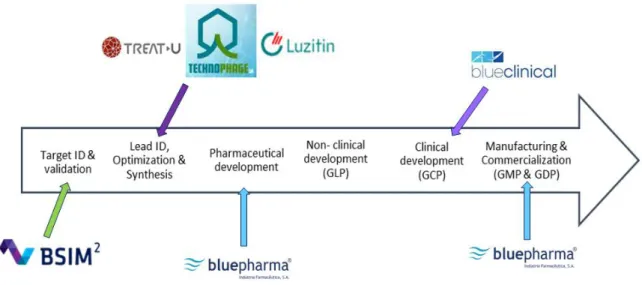
Besides, Bluepharma has ten subsidiaries promoting a robust chain value for the discovery and development of innovative pharmaceutical products and technologies (5) (6). The relation between them is outlined in the figure 2.
Figure 2 - Bluepharma’s Subsidiaries and Value chain. Adapted (7)
Below is a summary description of some of them:
Bluepharma Genéricos: dedicated to the marketing of high quality generic medicines,
with 72 generic medicines in its portfolio.
BSIM2: dedicated to computational methodologies to boost discovery of new drug
candidates and lead optimization.
TreatU: dedicated to the development of targeted nanotechnology-based platforms for
5
Luzitin: focused on the development of new technologies for use in oncology and
dermatology.
Blueclinical: the first Contract Research Organization (CRO) in Portugal who has a unit for
phase I clinical trials. It promotes R&D by supporting institutions and companies in the development of their projects and the activity of clinical research sites that conduct studies with drugs and medical devices. Blueclinical is the partner of choice of Bluepharma for conducting phase I clinical trials (9).
Technophage: dedicated to R&D of new molecules (early-phases) in therapeutic areas like
neurology, metabolic disorders, infections and immunology (10).
1.3. Bluepharma’s Research Department
The Pharmaceutical Industry is one of the industries that spend more in R&D, with a total spent, in the last 10 years, over 1.2 trillion US dollars. Data from EvaluatePharma® shows that only in 2014, the pharmaceutical industry invested about 141 billion US dollars in R&D (11).
Bluepharma’s Research department has a defined mission that consists in fully supporting Bluepharma’s innovation pathway, through the conception, management and execution of research projects with the aim of creating truly unique medicines that are patient-centered, safe and effective, thus supporting the company's competitiveness. It also provides scientific support to other departments and associated companies.
This mission can be achieved using the following values:
Innovation: by continuously asking what can be done differently to create value;
Excellence: through demanding more of ourselves than anyone else and going beyond
what is expected;
Efficiency: by managing resources smartly and focusing on activities that create value;
Teamwork: because the best ideas come from sharing experiences and working together
with others;
Ethics and Integrity: by being honest, reliable and complying with all applicable laws and
6
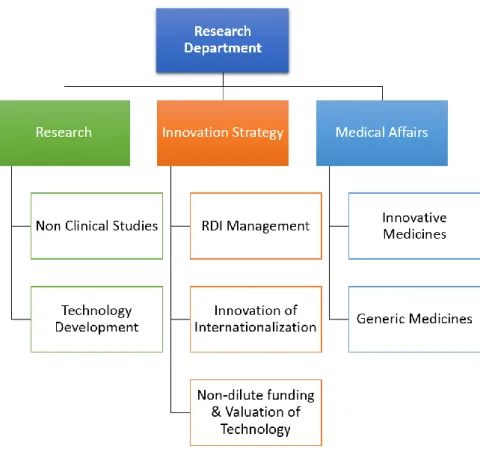
The Department is divided in 3 main units that can be seen in the Figure 3. Their main roles are the following:
1. Research Unit: dedicated to research projects, both for technology development and nonclinical studies;
2. Innovation Strategy Unit: which includes the management of Research, Development and Innovation (RDI), the internationalization strategy and of non-dilutive funding & valuation of technology;
3. Medical Affairs Unit: responsible for the clinical development of innovative and generic medicines.
Figure 3 - Organization chart of Research Department
In the chapters 2 and 3 of this report, the activities of the two last units will be described in more detail.
7
1.3.1. Innovation Strategy
It is known that Pharmaceutical Companies need to find mechanisms to develop and to preserve its competitive advantage, doing more with less. They need to work smarter and innovate faster, which is not a simple task to perform. The vital role of R&D is to sustain and help growing a business through innovation. The R&D activities are an investment in the future of a company because, even in long-term, they create value.
By being inserted in a highly competitive market, Bluepharma considers innovation as one of the pillars of its development strategy. The innovation can be applied in the development of new products, new processes, new organizational and marketing models, bringing a competitive advantage for the company.
In 2012, Bluepharma implemented the Portuguese Norm NP 4457:2007 (Management of RDI
Systems) in order to optimize its innovation strategy, the management of RDI projects and
improving its competitiveness. That year Bluepharma obtained the certification by an accredited organization, APCER.
The NP 4457:2007 defines the requirements for a RDI management system and is based on the management of three main interfaces:
1. Technologic interface; 2. Organizational interface; 3. Market interface.
The management of interfaces allows the collection, through different sources, of information from the external environment, which leads to the gain of knowledge by the company (12). For that purpose several activities can be performed, for example:
Perform scientific and technological monitoring, technological cooperation and technological foresight;
Identifying activities and tools that can enhance the creativity within the company to ensure the production of organizational knowledge;
Analyze the external environment, including potential customers and new markets. Internally, several persons are appointed to perform the monitoring of the external stakeholders. The knowledge gained with these activities can lead to the generation of ideas and identification of opportunities (12).
According to the Portuguese regulation NP 4457:2007, a system for ideas management and opportunities assessment should be implemented in order to select the best projects to be
8
developed, which must be consistent with the innovation strategy of the company. The RDI projects must also be managed in such a way that results can be evaluated with the purpose of understand which was the beneficial impact for the company (12).
One limitation of R&D activity is that it can be managed but its outcomes are not (13) (14). However, when the management is efficient, it leads to a lot of benefits:
Better adaptation face to external/ internal changes;
Close monitoring in order to maximize the investment for a particular risk;
Identification of dependencies between projects, which turns possible the maximization of resources;
Well defined strategies (14).
Below, in Figure 4, is a scheme that represents the relationship between interfaces management and innovation according to the Portuguese regulation NP 4457:2007.
Figure 4 - The relationship between interfaces management and innovation. Adapted (12)
In the second chapter of this report, Bluepharma’s process for managing RDI projects (namely, Bioequivalence Clinical Trials) will be described and in the third chapter a detailed description of how Bluepharma performs the management of ideas and opportunities will be made.
9
1.3.2. Medical Affairs
Recently, Bluepharma gain a new skill, sponsoring phase I clinical trials (CT) for both generic and innovative products. In order to support this new activity, a new dedicated Medical Affairs (MA) unit was created within the Research Department.
The main responsibilities of the MA Unit at Bluepharma are: Manage all Phase I clinical Trials sponsored by Bluepharma; Prepare Clinical Trial applications;
Manage internal and external communications regarding all clinical trials sponsored by Bluepharma;
Ensure the compliance of all the applicable requirements and regulations that need to be fulfilled in order to be a sponsor;
Support scientific research in the clinical research area for internal projects.
At Bluepharma, the development of a new pharmaceutical product is divided in several phases as shown in the Figure 5, below. The conduction of a clinical trial corresponds to the phase III of the overall project. Each Clinical trial is managed as a single RDI project as described in chapter two.
10
Figure 5 – Main steps for the development of a new generic product at Bluepharma
Before explaining how phase I clinical trials are managed at Bluepharma, the main legislation and requirements for conducting CTs as well as some particular features of evaluating bioequivalence (BE) and the special case of High Variable Drug Products (HVDP) will be outlined.
11
2. Clinical Trials Requirements: Regulations & Guidelines
The Pharmaceutical Industry is extremely regulated. It is mandatory that all the legal requirements are fulfilled in order to achieve the marketing authorization from the regulatory authorities for each generic or innovative product.
In order to facilitate the process and harmonize the requirements for the submission of a marketing application of medicinal products in different regions, the regulatory authorities of Europe, Japan and United States met with pharmaceutical industry representatives. The result (in the year of 1990) was the International Conference of Harmonization of Technical Requirements for Registration of Pharmaceuticals for Human Use (ICH), which has been developed guidelines and tools to achieve the harmonization objective. For the ICH regions and for all medicines (in the United States is not mandatory but it is strongly recommended by Food and Drug Administration), the submission of a marketing application is made by submitting a Dossier, the Common Technical Document (CTD), which comprises all the information about quality, efficacy and safety of the product. That information is organized into 5 modules, as shown in the Figure 6.
12
Module 1 has administrative information, which is region specific. Modules 2 to 5 are common to all ICH regions:
Module 2- CTD summaries Module 3- Quality information Module 4- Non clinical study reports Module 5- Clinical study reports
The module 5 contains the clinical information about the medicinal product. In the case of generic medicinal product, the non-clinical and clinical information that supports the safety and effectiveness of the product is not required, as it has already been submitted by the marketing holder of the reference product. The clinical trial (CT) required is the Bioequivalence (BE) clinical trial.
Good Clinical Practices (GCPs)
As stated in the Guideline E6 of ICH, Good Clinical Practices are “an international ethical and scientific quality standard for designing, conducting, recording and reporting trials that involve the participation of human subjects. Compliance with this standard provides public assurance that the rights, safety and well-being of trial subjects are protected, consistent with the principles that have their origin in the Declaration of Helsinki, and that the clinical trial data are credible” (16). The main objective of the guidance is: “...to provide a unified standard for the European Union (EU), Japan, and the United States to facilitate the mutual acceptance of clinical data by the regulatory authorities in these jurisdictions” (16).
Conducting clinical trials requires authorization from the competent authorities and the favorable opinion of an Independent Ethics Committee (IEC). In Portugal, besides the approval from IEC, the conduction of the clinical trial has also to be approved also by the Committee for Data Protection (CNPD) and Infarmed (National Authority of Medicines and Health Products).
According to ICH Guideline E6, for conduction of a clinical trial an experienced team has to be gathered. The different players are schematized in Figure 7.
13
Figure 7 – Entities involved in Clinical Trials
Their main responsibilities, according to the same guideline, are described below.
Sponsor
The Sponsor is the “individual, company or institution which takes the responsibility for the initiation, management, and/or financing of a clinical trial.” (16) As the data resulting of a clinical trial must be generated, recorded and reported in compliance with the protocol, the GCPs and the applicable requirements, the sponsor has to ensure the quality of the CT by implementing measures for its control and assurance. Other main responsibilities of the sponsor are:
- Select the clinical site (which depends on the type of study);
14
- Propose the principal investigator and provide him with all the known data about the Investigational Medicinal Product (IMP) and necessary supplies to the efficient conduct of the trial;
- Ensure that IMP is manufactured according to the Good Manufacturing Practices (GMPs) and labeled in a manner that protects the blinding (if applicable);
- Retain all the specific essential documents pertaining to the trial;
- Notify to regulatory authorities and to Institutional Review Board/Independent Ethics Committee (IRB/IEC) all concerned findings that could adversely affect the safety of subjects.
Although any or all of its roles may be transfer to a CRO, the final responsibility for the CT always relies in the sponsor. All the parties involved in the CT must be aware of their responsibilities. As such, a written agreement where all the responsibilities, and with the parties involved, should be comprehensively defined. The sponsor must maintain a good line of communication to ensure that all the obligations are being met (16).
Principal Investigator
The Principal Investigator is the responsible person, at the clinical site, for the conduct of the CT. He must have the necessary qualifications for performing its duties, which are: - Have the appropriate number of qualified staff and the conditions to conduct the CT
properly and with safety;
- Conduct the clinical trial in compliance with the clinical trial protocol, the GCPs and the applicable regulatory requirements;
- Be responsible for IMP accountability at the trial site (or assign this responsibility to a pharmacist);
- Ensure the accuracy, completeness, legibility and timeless of the data reported to the sponsor in the Case Report Forms (CRFs) and in reports;
- Make directly available, when required, the CT related records;
- Obtain the Informed Consent and provide to participants all the information needed; - Provide medical care to the subjects;
- Report all Serious Adverse Events (SAEs) to sponsor (16).
15
The clinical site is the location where the clinical trial will be conducted. The clinical trial facilities must be suitable for the needs of the trial and must have the adequate resources (16) (17). The associated staff must be trained in GCPs and comply with them.
Monitor
The monitor(s) takes part in quality control. Its activities are appropriate in extent and nature to the features of the CT (purpose, design, complexity, end-points, as well as the risk posed by the IMP), and aim to assess the compliance with the requirements and to identify potential or existing gaps in order to prevent and/or correct them. The monitor works closely with the sponsor for ensuring that the clinical trial has being performed according to the protocol, Standard Operating Procedures (SOPs), GCPs and applicable legislation. Furthermore, the monitor verifies:
- The investigator’s qualifications and experience in GCPs;
- The conditions of the facilities and if they are adequate to the conduct of the study; - If the IMP is supplied according with the clinical study protocol and if the documents
related with the IMP are signed and updated;
- If the CRFs are properly filled and if the collected data is reliable, complete and in accordance with source documents.
After the monitoring visits, the monitor elaborates a monitoring report, containing a summary of what is examined during the visit, the problems detected and the preventive and corrective actions that must be undertaken if needed, and share it with the sponsor (16) (18).
Auditor
The auditor is part of the quality assurance and is an individual independent from the sponsor. The quality assurance activities are systematic and their regularity depends on the risk assessment of the clinical trial. The auditor examines the trial activities to ensure that they are performed according to the clinical trial protocol, SOPs, GCPs and all the regulatory requirements. The audits are focused on the personnel responsibilities, the qualifications and training of the clinical team, the IMP supplies and procedures, the essential documents, computerized systems and, basically, in all the activities that could affect the principles of GCP: subjects welfare and data integrity (16) (18).
16 Bioanalytical Laboratory
The Bioanalytical Laboratory analyzes the biological samples (urine, plasma, etc) collected from patients or healthy volunteers participating in CTs. In a Bioequivalence study the bioanalytical analysis consists in the quantification of the drug product or its metabolites in the biological samples. As the importance of this data, these laboratories must be certified in Good Laboratory Practices (GLPs).
In addition to GCPs and depending on the region, the conduction of clinical trials has to comply with other guidelines: Eudralex Volume 10 published by European Commission or several “Guidance for Industry” published by Food and Drug Administration (FDA).
European Regulations
Portuguese Law No 21/2014, of 16 April
This law was recently approved with the goal of increasing the number of clinical research activities and it is a transposition of the European Directive No 2001/20/EC which regulates clinical research activities on human medicines, EU Directive No 2007/47/CE on medical devices and also GCPs. The main objectives of this law are:
- To simplify the approval procedures for CTs in order to make the legislation more competitive compared with other countries;
- To strengthens the role of ethic committees;
- To clarify the responsibilities of sponsors, principal investigators and monitors; - To create favorable conditions for the disclosure of clinical trials;
- To create the National Registry Platform for Clinical Studies, an internet platform that able the registration of clinical trials, improves the interaction between the stakeholders and advise the general public about what are clinical trials;
- To create conditions in the medical career that encourages professionals to proactively perform clinical research activities;
- To create an investment fund for clinical research (19).
One of the most important measures was the shortening of the deadlines (for 30 days) of the approval of clinical trials for both National Ethics Committee for Clinical Research (CEIC) and Portuguese Committee for Data Protection (CNPD).
17 Regulation EU No 526/2014
In Europe, a new Regulation, the No 536/2014, repeals the Directive 2001/20/EC and aims to:
- Simplify the current rules, maintaining the same high standards of patient’s safety; - Create a positive environment for conducting clinical trials within the EU;
- Increase the transparency on clinical trials information through the use of the “EudraCT” website;
- Regulate the principles for clinical trials performed outside the EU but being included in marketing applications inside the EU;
- Simplify the procedure for safety reporting (20) (21).
“EudraCT” is the EU Portal and Database developed by European Medicines Agency (EMA) that provides several advantages:
- Facilitates the clinical trial application, especially for multinational clinical trials, due to a single Clinical Trial Application (CTA) for all CTs performed in the EU;
- Makes the assessment of CTA by the authorities easier;
- Makes easier the accession to the information about clinical trials by the general public.
The registration in the EudraCT portal is mandatory for the assessment of a CTA. Aiming the increase of transparency, up to one year after the end of a clinical trial, sponsors have the duty to submit a summary of the outcomes of all CTs conducted in EU (21).
The principles and procedures for GCP inspections are another topic that lay down in this regulation. Regulation 536/2014 entered into force on 16 June 2014 but it will only be applied on May, 2016. Then, the Directive 2001/20/EC will be repealed but there is a transition period of three years (21).
Commission Directive 2005/28/EC
The Directive 2005/28/EC lays down the principles of GCPs regarding investigational products for human use and also the requirements for the authorization of the manufacturing and importation of such products.
18
This Directive regulates the main principles of GMPs applicable to human medicines and IMPs.
US Regulations
Title 21 of Code for Federal Regulations (US)
For companies intending to market their products in US, the FDA regulations must be fulfilled. The regulations concerning the conduction of CTs are included in Title 21 of the Code of Federal Regulations (CFR). As these regulations are in some ways different, in a number of points, from those in EU, the pharmaceutical companies have to take into account these discrepancies when they want to market a product in the two regions (22).
19
3. Clinical Trials to investigate Bioequivalence
Bluepharma develops mainly generic medicines and the majority of the clinical trials sponsored by Bluepharma are Bioequivalence trials. A generic medicinal product is a product comparable to an innovator (the reference product) since it has the same qualitative and quantitative composition in terms of the active substance, pharmaceutical form, quality and intended use. In order to be comparable and interchangeable the generic and the reference have to be bioequivalent, that is, according to the EMA Guideline on the Investigation of Bioequivalence, “two medicinal products containing the same active substance are considered bioequivalent if they are pharmaceutically equivalent or pharmaceutical alternatives and their bioavailability (rate and extent) after administration in the same molar dose lie within acceptable predefined limits” (23). Two drug formulations (test and reference) are bioequivalent when they yield, in the same study conditions, equivalent blood levels of active substance. For that, a bioequivalence clinical trial is performed (23) (24).
According to ICH Guideline E8 (General Considerations for Clinical Trials), Clinical trials to assess bioavailability and bioequivalence of medicinal products are a type of phase I clinical trials. They are human pharmacology studies, with a design that allows studying pharmacokinetics (PK) without the interference of internal or external factors (they are highly controlled). In this kind of CTs the PK parameters are the study endpoints (25). They have non-therapeutic objectives and are usually conducted in healthy subjects, except for that cases which is not ethical to include healthy persons (e.g. studies with cytotoxic drugs).
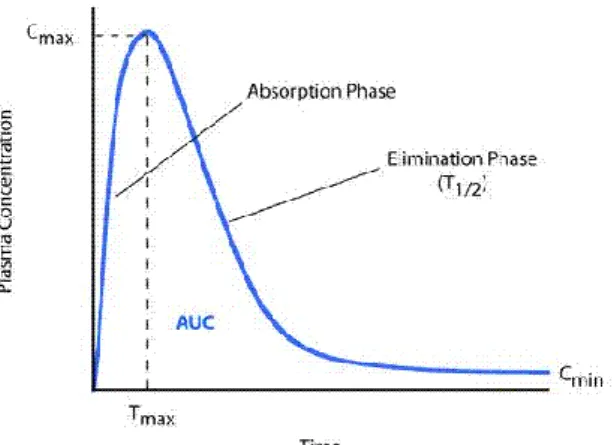
The limits referred in the guideline differ according to the type of product. Usually, they are 80.00 to 125.00 for the geometric mean ratio for Cmax and AUC (outlined in Figure 8) (26), with a 90%
confidence interval (CI). Guidelines and regulations recommend the use of an average bioequivalence statistical approach when investigating bioequivalence (23).
20
Figure 8- AUC curve (26)
There is a standard design for the CT on investigation of bioequivalence: Randomized;
Two-period;
Two-treatment (A and B: one is the reference and the other is the test); Two-sequence single dose crossover.
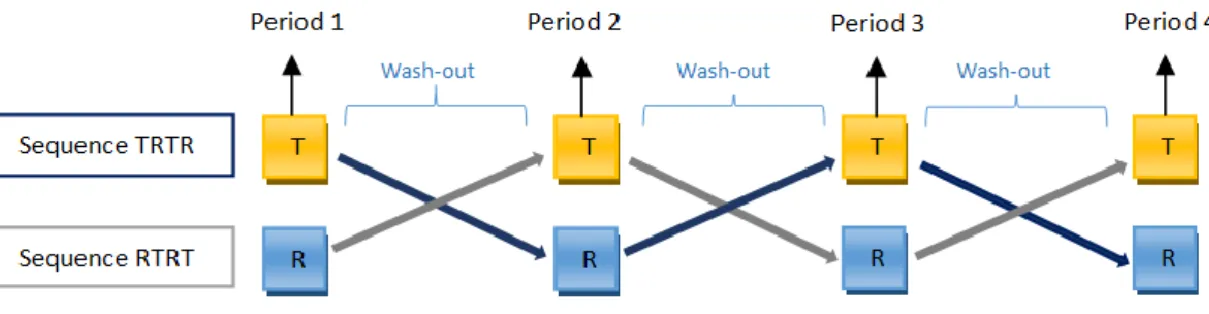
Periods are separated by a wash-out period, normally at least 5 times the t½ (elimination
half-lives) of the substance, in order to eliminate the carryover effect1 (27). This design is called a 2x2 crossover design.
Figure 9 - 2x2 Crossover Design
1
The elimination of the carryover effect certifies that when the second period begins the amount of drug in the blood is not quantifiable (the drug concentration is below the lower limit of quantification of bioanalytical analysis).
21
However, this design is not suitable for drug substances comprising long half-lives and for highly variable drug products. Consequently, BE studies can be performed with other designs. For example, for drug substances with a long elimination half-live, a parallel design may be used; or for highly variable drugs, replicate designs.
Usually, the BE studies are conducted in a fasted state because this is considered the most sensitive condition to detect differences between treatments. However, when the Summary of product Characteristics (SmPC) recommends the use of the drug product only in fed state, then the study must be conducted accordingly. If this is the situation, a high fat meal (50% of the total caloric content of the meal must be fat), with approximately 800 to 1000 kcal, is given to study subjects (23).
Although, in US, the FDA usually recommends the investigation on bioavailability/ bioequivalence to be determined by two studies: one in fed and another in fast state.
When two or more strengths of the product are marketed, the need to perform tests in the additional strengths depends on the linearity of the PK parameters. In the case of PK linearity (when the increase in AUC is proportional with the dose) it is possible to perform only one BE trial (with only one of the strengths – the highest one is the recommended, however other strengths are accepted when justified, e.g. subjects safety) and an in vivo waiver could be used to extrapolate the results to other strengths. In this situation, an in vitro dissolution test is always required for waiving (23).
3.1. Bioequivalence of Highly Variable Drug Products (HVDP)
Drug substances can be categorized by the Biopharmaceutics Classification System (BCS) according to their aqueous solubility and intestinal permeability, as it can be seen in Figure 10. These characteristics have many implications in the PK parameters of the drug, namely in the rate and extent of absorption, when incorporated in oral pharmaceutical forms (28).
22
Figure 10 - Biopharmaceutical Classification System (BCS): characterization of drugs based on solubility and permeability measures (29)
Several pharmaceutical drug products belong to classes II and IV (low aqueous solubility/low permeability and low aqueous solubility/high permeability). These drugs present a high lipophilicity and, usually, an extensive pre-systemic metabolism (fist-pass metabolism) (30) (31), which results in a low bioavailability and high variability on the disposition pattern, leading to a high failure rate in BE studies (32).
By definition, HVDP are drugs whose within-subject variability for AUC or Cmax (the parameters
evaluated in BA studies) is higher than 30% (23). Figure 11 (30) represents the limits of 80% and 125% on the geometric mean ratio in a BE clinical trial between test and reference with 90% CI, and compare the results of a drug presenting a normal variability and one highly variable drug. The green and red bars represent the 90% CIs. As it can be seen, Drug A (normal variability) meets the BE limits, whereas Drug B (highly variable) does not. CI is influenced by the sample size, which must be increased to prove the BE in these cases.
23
Figure 11 - Limits for accepting BE (30)
To solve this problem, other designs may be required, namely replicate designs, in order to decrease the sample size while achieving an acceptable result in the BE clinical trial (30). In these designs, the reference and/or the test product are given twice to the same subject. So, not only the within-subject variability could be evaluated but also the within-subject variability per
treatment (also called subject-by-formulation interaction). Examples of replicate designs are
described below:
a) Full replicate design (four-way crossover): in which test and reference are given twice to the same subject (Figure 12) (33).
Figure 12 - Full replicate design: four-way crossover. Adapted (33)
b) Partial Replicate design (three-way crossover): in which one of the treatments (in the Figure 13 (33) below, the reference) is given twice to the same subject.
24
Figure 13 - Partial replicate design: three-way crossover. Adapted (33)
When using replicate designs in a BE clinical trial, other statistical approach than the average BE can be used: a reference-scaled average bioequivalence approach (RSABE), which adjusts the BE limits by scaling to the within-subject variability of the reference, maintaining the 80% and 125% as limits for BE acceptability (27) (30) (34) (35).
The case of HVDP is not a simple question since EMA and FDA look at it differently, has shown in the Table 1.
Table 1 - EMA and FDA outlook on BE clinical trials for HVDP
EMA FDA
The statistical approach considered is the
average bioequivalence with expanding limits
(33) (23).
The statistical approach should be a
reference-scaled average bioequivalence (36).
Accepts replicate designs. (3-period or 4-period crossover).
Accepts replicate designs (3-period or 4-period crossover).
Accepts a widening of the Cmax limits with a
maximum for interval widening of 69.84 to 143.19 of geometric mean ratio for Cmax . (If
the difference in Cmax does not represent
clinical relevance and if it is not due to outliers) (23).
The interval of acceptance is always 80,00 to 125,00% of the geometric mean to AUC and Cmax (31). However, the RSABE approach
adjusts the BE limits (AUC and/or Cmax)
according to the within-variability of the drug (33).
25 The possibility to widen the acceptance interval is not applicable to AUC. For AUC, the range is the same of the other type of substances: 80.00 to 125.00% (16).
The use of other (secondary) point estimate to being between the limits of 80,00 to 125,00 %, decreases the advantage of using the reference-scaled approach because an increase in the sample size will be required anyway (33).
When submitting an Abbreviated New Drug Application (ANDA) for FDA or a Generic Application for EMA, all these aspects must be taken into account. One of the main risks when developing a generic product resides in the failure of the BE study, as it may compromise the completion of the project. During the internship, I made a report about HVDP regarding the design of BE studies for this type of drugs and the opinion of the regulatory authorities on the matter.
27
4. Managing Clinical Trials at Bluepharma
As mentioned before, at Bluepharma, a clinical trial is a phase III project and its management is performed by the Medical Affairs Unit. As a sponsor of phase I clinical trials, the company must ensure the proper conduct of the CT and that all regulatory requirements are in place and fulfilled. For that reason, the Medical Affairs Unit elaborated all the necessary internal documentation (Standard Operation Procedures – SOPs), which includes a main SOP that defines Bluepharma’s specific responsibilities as a sponsor (Table 2), enumerates the internal human resources needed and the potential outsourced services involved as well as their main functions (37).
Table 2- Bluepharma's usual main responsibilities when sponsoring clinical trials
According to the main SOP, the manager designated for this type of projects is the Clinical Study Manager (CSM), who has the responsibility of ensuring the planning, execution and follow-up of the tasks related to clinical trial projects.
28
According to the Norm NP 4457: 2007, each project has to be managed and for that reason a Project Manager is appointed internally. At Bluepharma, and as can be seen in Figure 14, a CT has three main phases:
1. Start-up & planning
To support the management, Bluepharma implemented several forms, enumerated below, to be completed when planning a project:
The Project Plan Form: that comprises the project main scope and objectives, the
selection of the team, the necessary resources, the measures to ensure intellectual property, etc.
The Communication Plan Form: where the appropriate communication plan between the
several stakeholders of the project is defined;
The Risk assessment Form (Failure Mode Effects Analysis (FMEA) based)2: to perform the
identification and assessment of the risks associated with the project;
The Follow-up plan Form: where the stages of the project are defined (with timelines) in
order to facilitate the management and to check the compliance with the milestones. A Gantt chart can also be used for the management of the milestones, deadlines and resources needs.
2. Execution, monitoring and control
After the planning phase, the execution phase starts with a kick-off meeting, with all the team members in order to explain:
The scope of the project;
The activities and responsibilities of each person; The main timelines;
The main objectives that must be accomplished.
2
FMEA is the most used method to assess the risks of a project in pharmaceutical industry, but it is used in others industries either. According to FMEA, the risks are classified as their severity (if a failure happens, what will be the effect in the overall outcome?), probability of occurrence (how likely is a failure to occur?) and detectability (how detectable is the failure? Which mechanisms does the company have to detect the failure if it occurs?) (47).
29
At each milestone, intermediary results are monitored and assessed and, if applicable, preventive and corrective actions are implemented in order to achieve the final results.
3. Assessment of the results & project close-out
At the end of each project a final report is completed in order to evaluate the overall project accomplishment (e.g. if the timelines and the costs were achieved as expected). With each project new lessons can be learned in order optimize future projects (12).
Figure 14 – RDI project management process at Bluepharma. Adapted (12)
Figure 15 represents the main steps to be managed by the CSM when conducting phase I CTs sponsored by Bluepharma and the internal and external parties involved. In the following sections, they are described, as well as my contributions during the internship.
30
Figure 15 – Process of conduction a Clinical Trial Project at Bluepharma and internal and external parties involved
4.1. Planning a Clinical Trial
When planning the CT, the CSM has to fill the managing forms enumerated in the beginning of this chapter and common to every RDI project at Bluepharma, which are accessible through the EnnovDoc (the company’s documental system). They should be updated during the execution of the CT. I had the opportunity to collaborate in the planning of Bioequivalence clinical trials, helping completing those forms. Below is an explanation of each one and their main purpose.
31
The first form to be filled for the preparation of a clinical trial is the “Project Planning Form”. In this form, the CSM:
Describes the project and its timelines;
Defines the main objectives, the project team and the necessary resources (human resources, costs…);
Defines the type of monitoring activities that must be performed and their frequency. The project planning helps to identify the company’s needs: it clearly identifies all the persons involved on the project and their responsibilities, essential to perform an efficient management. The internal project team or key persons involved in clinical trials at Bluepharma (in addition to the CSM) and their main functions, are enumerated in Table 3, below.
Table 3 - Internal key players and their roles in a clinical trial sponsored by Bluepharma
When external resources are required, they are identified in this first step in order to be selected and subcontracted (Figure 18).
32
4.1.1. Selection and qualification of Service Providers
Bluepharma, as a sponsor, can subcontract part of the activities regarding the preparation and conduction of the CT to qualified service providers. However, the ultimate responsibility for the sponsor-related duties always resides with Bluepharma. As such, outsourced service providers and their personnel must be qualified and commit to comply with the regulatory requirements and with the GCPs.
Figure 17 - Process of planning phase I Clinical Trials at Bluepharma, Step 2: Selection and Qualification of Service Providers
The CSM is responsible for the identification, evaluation and selection of qualified service providers.
The selection of a service provider by the CSM is based on a “Service Provider Evaluation Checklist”, which has several evaluation criteria to demonstrate the ability of the service provider to perform the requested service, such as:
The service status: expertise, geographic location, market reputation, etc.;
The quality of the service provider: regulatory compliance, quality management system,
SOPs, audit and inspection reports from Competent Authorities or other sponsors…; Human resources: availability, qualifications (assessed by CVs and years of experience);
Adequacy of facilities and equipment.
Bluepharma’s Head of Business and Product Development signs the contract agreement between Bluepharma and the service provider, which include, in written, the responsibilities of both
33
parties, confidentiality clauses, timelines for the service, total amount to be paid and payment terms.
Figure 18- Potential Service Providers at Bluepharma
Due to the fact that Bluepharma does not have the facilities nor the clinical team required for conducting clinical trials, a CRO and a clinical site must be subcontracted.
For some projects, Bluepharma or its clients/partner subcontract its subsidiary Blueclinical as CRO. This company has a phase I unit and all the human resources needed to perform the CT, including the investigators, nurses, data managers, pharmacists and medical writers. Blueclinical also performs quality control activities and subcontracts the Bioanalytical laboratory (which must be certified in GLP), offering an integrated service.
A monitor is also subcontracted by Bluepharma to perform the required monitoring visits regarding the quality control of clinical trial. The service providers are audited in a regular basis by Bluepharma.
34
4.1.2. Risk assessment
Figure 19 - Process of planning phase I Clinical Trials at Bluepharma, Step 3: Risk Assessment Form
After the initial project planning (and for each project), a risk analysis must be elaborated in order to identify, assess and mitigate the potential risks.
The Risk Assessment Form, another document to be completed by the CSM, includes: Identification of risks (e.g. related with IMP);
Description of the potential failures associated with the risk;
Evaluation of severity, probability and detection control in order to define the risk level; Measures to mitigate the risks;
The responsible person for the mitigation each risk.
There are intrinsic risks to which a sponsor is exposed as financial risks resultant from the costs involved in the CT and legal risks, related with the lack of compliance with the legal requirements and with the GCPs (38). Other risks are inherent to the product characteristics and to the design of the CT (for example, when the pharmaceutical product is an HVDP) (39). For that reason, when designing a clinical trial, the characteristics of the product should be considered in the protocol in order to minimize the risk or take measures to control it. Some risks that can occur in a clinical trial and possible measures to mitigate them are enumerated in the Table 4.
35
Table 4 - Examples of Sponsor’s risks in phase I clinical trials and measures to mitigate them (40)
Risks Measures to be taken
Before the Clinical Trial starts
Inadequate communication plan for all the stakeholders (sponsor’s personnel, CRO…)
Clinical site does not have the required features for the conduct of the CT
The CRO team does not have the experience required to perform the CT
Design of CT is not adequate for the objective or do not take into account the PK/PD characteristics of the drug (e.g. HVDP)
IMP circuit (storage, shipment) is not adequate according to the product specifications
Delays in shipment of the IMP
Delays in the CTA preparation
Delays in the CT approval
Inadequate contract terms with subcontractors (e.g. CRO)
Inadequate insurance agreement
Communicate the timeline of the project with the team and CRO;
Weekly update of the project to the interested parties
Audit to the clinical site
Audit to the CRO
CT monitoring
Review of CVs of the principal investigator and of the clinical team
Review of protocol and other documents related with the CT
Datalogger during the shipment; records of humidity and temperature during storage
IMP sent with a considerable advance
Communicate deadlines with the team responsible for the CTA preparation
Review of written agreements
Check the insurance policy in order to assure that it covers all the aspects and risks for the clinical trial
During the clinical phase of the trial
CRO does not fulfill with contract, GCPs and legal requirements
Inadequate safety reporting
Inadequate communication between clinical team and sponsor
CT monitoring visits
Weekly update of Adverse Events to the sponsor
After the clinical phase of the trial
Delays regarding the study results
Study outcomes (PK parameters, in the case of a bioequivalence) outside the limits for approval
Inclusion of a sufficient number of participants in the clinical trial
Include in the contract the timings for the delivery of documents for review
Study design should be suitable to the product characteristics
36
4.1.3. Project plan communication
Figure 20 - Process of planning phase I Clinical Trials at Bluepharma, Step 4: Communication Plan Form
Communication between the team is an essential part of the process of project management since failures in communication from one (or more) individuals can lead to inefficiencies. All the team members must know when to communicate and to/from whom they have to disseminate or receive information.
Then, when planning a CT, it is necessary to prepare the communication plan, which includes: the information to be communicated, who is the target of the communication, when to communicate and the responsible person for undertaking that task. This matrix takes into account the risk analysis. As it can be seen in the table 4 “Examples of Sponsor’s risks in phase I clinical trials and measures to mitigate them” there are several examples where an inadequate communication is critical for the performance of the project.
As stated before, at the beginning of the CT project and to guarantee that all the internal team members are informed, a kick-off meeting is schedule. After that, all the members of the team are aware of their responsibilities and then they have the obligation of updating the CSM about their tasks (e.g. production and packing of IMP, conclusion of IMPD, revision of the necessary documentation for the submission of CTA, IMP shipment). Any delay has to be communicated as soon as possible in order to minimize the impact in the activities to be performed by other members of the team or the need to reschedule the timelines.
37
4.1.4. Project follow-up
Figure 21 - Process of planning phase I Clinical Trials at Bluepharma, Step 5: Project Follow-up Form
The CSM needs to follow-up the project’s execution to ensure the achievement of the expected outcomes. For that reason, the CSM must control the possible deviations from the original plan. Then, in the document “Project follow-up”, the CSM states the main CT activities/milestones and their timelines, since the start of the CT until its close-out. During the execution, the CSM updates this document with the status of each activity. If there is any deviation, the CSM has to foresee the impact in the subsequent tasks and disseminate that knowledge, informing the team. Some examples of the activities to be follow-up during a CT project are: revision and approval of the documentation for the clinical trial submission, preparation of the documents for IMP shipment, the subject’s screening and dosing, the results of bioanalytical analysis and the reception of the clinical study report for revision.
These activities are related with the main steps of the project (because there are the critical steps), enumerated in the Figure 17 “Process if conduction a Clinical Trial Project at Bluepharma and internal and external parties involved”. This document is an excellent tool for CTs management.
During the internship I had the opportunity to fill these forms (project plan, communication plan, risk analysis and project follow-up).
38
4.2. Documentation review and approval for Clinical Trial Application
In Portugal, clinical trials must be submitted for approval to Infarmed, CEIC and CNPD. When submitting a clinical trial, a relevant number of documents are necessary. At Bluepharma, some of them are prepared by the company, other by the CRO and then reviewed and approved by Bluepharma. The documents to be prepared are summarized in the Table 5.
Table 5 - Documents to be prepared for the submission of a Clinical Trial Application
Documents
Prepared and/or reviewed by:
To be submitted to:
Bluepharma CRO Infarmed CEIC CNPD
Clinical Trial Protocol (CTP)
IMPs Labels Financial Agreement Letter of authorization (sponsor CRO) Synopsis of protocol
Informed Consent Form (ICF)
CRF (template)
Investigators Brochure
SmPC (reference product) Send by the sponsor to CRO
Investigational Medicinal Product Dossier (IMPD)
EudraCT number
XML File
Insurance Agreement
Cover letter
Proof of fee payment
List of competent
authorities