2018
UNIVERSIDADE DE LISBOA
FACULDADE DE CIÊNCIAS
DEPARTAMENTO DE INFORMÁTICA
Operational Intelligence With GDPR
André Sequeira Borges Lourenço
Mestrado em Segurança Informática
Trabalho de Projeto orientado por:
Prof. Maria Dulce Pedroso Domingos
2
Abstract:
More and more we live in a world that’s powered by data. All kinds of applications, from social networks to business products, produce data just by existing and performing the actions that they’re intended to. Take for example a telco company where thousands of both residential and business customer orders arrive each day, it is expected that at the very moment we buy a product we’re giving away info about what we’re buying and, more important, about who we are. It is of the company’s interest that all data is kept in an interpretable format in order to infer what products interest their customers and analyse the company’s operations to maintain their service as available and efficient as possible. These systems are normally decentralized by nature, meaning that it is not uncommon to have separate sub-systems with well-defined purposes, like Customer Relationship Management (CRM) systems that handle customer orders, backend systems that perform the actions and Enterprise Service Buses (ESB) that serve as the middleware between CRMs and backend systems. This is why most companies are nowadays keen to use Operational Intelligence (OI) as a tool to gather all data into an understandable format.
Nevertheless, this opens a new problem with the arrival of the General Data Protection Regulation (GDPR). Companies are now facing a trade-off that can compromise the processing of personal data. Protecting data with standard encryption methods like the Advanced Encryption Standard (AES) leaves that same data in a non-processable format while not protecting it at all is risking the huge penalties that GDPR enforces. This not only forces these companies to abort the business of personal data processing and, with it, some of its most interested clients, as it also blocks any new solutions that were being prepared in the meantime.
This thesis studies a real-world scenario of a OI application whose intention is to process personal data in the future. This scenario fits in the description of the application whose new functionalities are currently on hold due to GDPR. It also uses a well-known OI platform named Splunk, which also suffers of the same trade-off problem.
The contribution of this thesis is to evaluate whether it is possible to protect data according to GDPR’s requirements and still leave it in a format that is processable in the Splunk platform. For this, different homomorphic encryption algorithms will be tested and compared with the standard symmetric encryption algorithms on different big data scenarios.
I
Keywords
Operational Intelligence; General Data Protection Regulation; Homomorphic Encryption; Big data; Unstructured Data; Splunk; Service Oriented Architecture; Enterprise Service Bus;
II
Resumo
Cada vez mais vivemos num mundo que se move com o poder dos dados. Todo o tipo de aplicações, desde redes sociais a produtos negócio, produzem dados apenas por existir e realizar as ações que se esperam delas. Tome-se como exemplo uma empresa de telecomunicações onde são esperados milhares de clientes novos, quer residenciais quer de negócio. É esperado que, a partir do momento em que compramos algo nós estejamos também a fornecer informação sobre o que estamos a comprar e, acima de tudo, informação sobre o que somos. É do interesse das empresas que este tipo de informação seja mantida num formato que seja fácil de interpretar, de modo a inferir quais são os produtos que os clientes querem comprar e analisar o modo como essas compras são efetuadas para assegurar uma melhor manutenção do serviço. Estes sistemas são normalmente descentralizados o que significa que não é pouco comum a existência de sistemas secundários com propósitos bem definidos, como sistemas de gestão de relações com o cliente (CRM), sistemas de backend que realizam as operações que constituem o serviço e os chamados Enterprise Service Bus (ESB) que servem de middleware entre os CRMs e os sistemas de backend. É devido a esta complexidade de operações que as empresas dão cada vez mais valor ao uso de Inteligência Operacional como uma ferramenta para juntar dados num formato compreensível.
Porém, o uso destes dados abre caminho a um novo problema com a chegada da Regulação Geral de Proteção de Dados (RGPD). As empresas estão agora a enfrentar um trade-off que pode comprometer o processamento de dados pessoais. A sua proteção com métodos de criptografia standard como o Advanced Encryption Standard (AES) deixa os dados num formato não processável, enquanto não os proteger de todo significa arriscar o pagamento das multas impostas pela RGPD, o que não só força as empresas a abortar os seus negócios de processamento de dados como ainda bloqueia a implementação de soluções novas.
Esta tese estuda um cenário real de uma aplicação de Inteligência Operacional cuja intenção é a de processar dados pessoais num futuro próximo. Este cenário assenta na descrição da aplicação cujas novas funcionalidades estão em stand-by devido à RGPD. A aplicação usa uma plataforma de inteligência operacional chamada Splunk, que sofre também do mesmo problema do trade-off.
A contribuição desta tese é a de avaliar se é possível proteger dados em conformidade com os requisitos da RGPD e ainda assim mantê-los num formato processável pela plataforma Splunk. Para este efeito foram testados e comparados diferentes algoritmos de criptografia em diferentes cenários de Big
Data.
Quatro soluções diferentes foram apresentadas: Anonimização, Criptografia Simétrica usando AES, Criptografia Homomorfica usando Paillier e Criptografia Homomorfica usando SEAL.
A solução de anonimização foi usada como modo de destruição de dados que é especialmente eficaz na concretização do direito ao esquecimento imposto pelo GDPR, embora comprometa os direitos de acesso, retificação e portabilidade dos dados da regulação. A anonimização tem também o revés de deixar os dados num formato não processável irreversível.
A solução de criptografia simétrica usando AES satisfez todos os requisitos da RGPD e ainda foi particularmente eficiente em termos de performance, segurança e complexidade, tendo apenas falhado a usabilidade dos dados após a sua proteção.
III
As soluções de criptografia homomorfica provaram ser eficientes quer em requisitos da RGPD quer em segurança, complexidade e usabilidade. No entanto, em termos de performance apenas a solução SEAL demonstrou potencial para ser aplicada numa aplicação de OI real.
Por fim, foram propostas duas soluções finais que usam os pontos mais benéficos de cada uma das soluções acima descritas para atingir objetivos específicos de RGPD, performance, segurança, complexidade e usabilidade. O único fator que distingue estas soluções é o momento em que estas protegem os dados pessoais: antes do armazenamento dos dados ou na leitura dos mesmos.
IV
Palavras-Chave
Inteligência Operacional; Regulação Geral de Proteção de Dados; Criptografia Homomorfica; Big data; Dados não-estruturados; Splunk; Arquitetura Orientada a Serviços; Enterprise Service Bus;
V
Table of contents
1 Introduction ... 1 1.1 Motivation ... 1 1.2 Objectives ... 1 1.3 Contribution ... 2 1.4 Document structure ... 2 2 Background work ... 32.1 General Data Protection Regulation (GDPR) ... 3
2.1.1 Scope ... 3
2.1.2 Principles ... 3
2.1.3 Rights of the data subject ... 5
2.1.4 Controller and processor... 5
2.2 Access control ... 6
2.2.1 Role-Based Access Control (RoBAC) ... 6
2.3 Encryption ... 6
2.3.1 Symmetric encryption ... 6
2.3.2 Asymmetric encryption ... 10
2.3.3 Homomorphic encryption ... 11
2.4 Operational Intelligence Application ... 12
2.5 Splunk ... 13
2.5.1 Splunk data pipeline ... 14
2.5.2 Conversion to structured data ... 15
2.5.3 Data obfuscation and Field Protection ... 16
2.5.4 Access control ... 18 2.6 SOA ... 18 2.6.1 SOA Infrastructure ... 18 2.6.2 Governance ... 19 2.7 ESB ... 21 2.8 Summary ... 22
3 Analysis and Design ... 24
3.1 Solution introduction ... 24
3.1.1 Subjects ... 24
VI 3.1.3 Operations ... 27 3.1.4 Data ... 28 3.2 Personal Data ... 29 3.2.1 Types of data ... 29 3.2.2 Data quantity ... 31 3.3 Scenarios ... 31 3.4 Requirements ... 32 3.4.1 Performance ... 32 3.4.2 Security ... 32 3.4.3 Usability ... 33 3.4.4 Complexity ... 33 3.4.5 Control Access ... 34 3.5 Summary ... 34
4 Protecting OI personal data ... 35
4.1 Business scenario ... 35
4.1.1 Simulated entities ... 35
4.1.2 Splunk Probe simulator ... 36
4.2 Prototypes ... 36
4.2.1 Prototype 1 - Anonymization ... 36
4.2.2 Prototype 2 – AES ... 40
4.2.3 Prototype 3 – Paillier ... 46
4.2.4 Prototype 4 – SEAL library ... 53
4.3 Proposed solutions ... 62
4.3.1 Solution 1 – External Processor based protection ... 62
4.3.2 Solution 2 – Search time protection ... 64
4.4 Summary ... 66
5 Conclusion ... 67
6 References ... 68
VII
Table index
Table 2.1 - Splunk data pipeline tiers ... 14
Table 2.2 – Splunk’s data protection options - Application ... 16
Table 2.3 - Splunk’s data protection options - Modular input/Batch processing ... 16
Table 2.4 - Splunk’s data protection options - External Processor ... 16
Table 2.5 - Splunk’s data protection options - Regex Replace ... 17
Table 2.6 - Splunk’s data protection options - Scheduled Search ... 17
Table 2.7 - Splunk’s data protection options - Result Masking ... 17
Table 2.8 - All Splunk data protection options... 18
Table 2.9 - Splunk's access control roles ... 18
Table 3.1 - Client-side subjects ... 25
Table 3.2 - Internal user subjects ... 26
Table 3.3 - Metric related use cases ... 26
Table 3.4 - Internal user related use cases ... 27
Table 3.5 - OI solution’s read operation types ... 28
Table 3.6 - Data types that are collected by the OI application ... 29
Table 3.7 - Data types analysis according to the OI application ... 30
Table 3.8 - Data types analysis according to GDPR ... 31
Table 3.9 - Performance requirements ... 32
Table 3.10 - Security scenarios to consider in the requirements ... 33
Table 3.11 - Security requirements ... 33
Table 3.12 - Usability requirements ... 33
Table 3.13 - Complexity requirements ... 33
Table 3.14 - Control access requirements ... 34
Table 4.1 - Anonymization's performance metrics... 38
Table 4.2 - AES's client-side access control ... 43
Table 4.3 - AES's internal user access control ... 44
Table 4.4 - AES performance metrics – External processor approach ... 44
Table 4.5 - AES performance metrics – Search time approach ... 45
Table 4.6 - Paillier's concatenation adaptation execution times ... 49
Table 4.7 - Paillier's performance metrics ... 51
Table 4.8 - SEAL integer encoding's parameters ... 57
Table 4.9 - SEAL's data protection metrics ... 58
Table 4.10 - SEAL's string concatenation adaptation execution times ... 59
Table 4.11 - SEAL's performance metrics ... 60
VIII
Figure index
Figure 2.1 - Symmetric encryption scheme ... 7
Figure 2.2 - Feistel Network... 8
Figure 2.3 - Triple DES scheme ... 9
Figure 2.4 - AES scheme ... 10
Figure 2.5 - OI solution architecture diagram ... 13
Figure 2.6 - Splunk data pipeline ... 14
Figure 2.7 - SOA Life Cycle ... 20
Figure 2.8 - Example of a Business Process Management model ... 21
Figure 2.9 - Enterprise Service Bus ... 22
Figure 3.1 - OI solution context diagram ... 24
Figure 4.1 - Entity diagram of the prototypes' simulated data ... 35
Figure 4.2 - Anonymization prototype architecture ... 37
Figure 4.3 - Anonymization data protection... 37
Figure 4.4 - Anonymization prototype's usability ... 39
Figure 4.5 - AES prototype's external processor architecture ... 41
Figure 4.6 - AES prototype's search time architecture ... 41
Figure 4.7 - Data protection of the Paillier prototype ... 42
Figure 4.8 – Field encryption of AES ... 42
Figure 4.9 – Field decryption of AES ... 43
Figure 4.10 - Paillier prototype architecture... 47
Figure 4.11 - Execution of the Paillier concatenation adaptation ... 48
Figure 4.12 - Data protection of the Paillier prototype ... 49
Figure 4.13 - Paillier's field encryption ... 50
Figure 4.14 - Paillier's field decryption ... 50
Figure 4.15 - Paillier's access control ... 51
Figure 4.16 – SEAL’s prototype architecture 1 ... 55
Figure 4.17 - SEAL’s prototype architecture 2 ... 55
Figure 4.18 - SEAL's data protection ... 56
Figure 4.19 – SEAL field decryption ... 57
IX
Acronyms, Abbreviations and Symbols
• GDPR – General Data Protection Regulation; • OI – Operational Intelligence;
• EU – European Union;
• RoBAC – Role-Based Access Control; • XML - eXtensible Markup Language; • API – Application Programming Interface; • DES - Data Encryption Standard;
• AES - Advanced Encryption Standard;
• RSA – Rivest Shamir Adleman (Ron Rivest, Adi Shamir, Leonard Adleman, designers of RSA); • SHA – Secure Hash Algorithm;
• EAI - Enterprise Application Integration; • ESB - Enterprise Service Bus;
• SOA - Service Oriented Architecture;
• CRM – Customer Relationship Management; • ERP - Enterprise Resource Planning;
• B2B – Business-to-Business; • OM – Order Management; • IT – Information Technology; • AM – Application Maintenance; • SM – Service Manager; • CM – Configuration Management; • sed – Stream editor.
1
1 Introduction
In Big Data applications it’s easy to mishandle and/or misuse critical data. This problem becomes even more important with the arrival of the General Data Protection Regulation (GDPR), which entered into force on the 25th of May of 2018 on all EU countries. This regulation was designed to harmonize data
privacy laws across all Europe and its main objective is to empower all EU citizens data privacy. This thesis focuses on a real-world Operational Intelligence solution that is implemented using the Splunk platform. The motivation behind this thesis is followed along with its objectives and contributions.
1.1 Motivation
More and more studies are being made to evaluate how well-prepared companies are for the arrival of GDPR, and basically all of them are concluding that business leaders are still confused about the regulation. Some of these studies go even further and say that roughly 90% of European companies are still not prepared and 40% have not started their preparations for the new regulations as of 20th of
September of 2017 (Symcox, 2017). According to Veritas, 47% of organizations are expected not to meet the compliance guidelines (Stageberg, 2017).
As of today, the company whose project this thesis focuses on is avoiding personal data collection so that it isn’t one of the aforementioned companies. Even though the processing of that same data brings good opportunities among their clients, the costs of not being complaint with GDPR are too immense to even consider such a possibility.
The project in question is an Operational Intelligence application implemented in Splunk whose purpose is to give insight into the ESBs of interested clients, by collecting and analysing its reliability, performance, volume and concurrency metrics. This application is currently being used by clients of the Telecommunications area where the processing of personal data opens good opportunities on the profiling of their customers. This makes it clear that the main gap on this project is that it doesn’t have any way of profiling those customers, even though the customer information that arrives in the ESB of those companies is already sufficient for that matter.
Splunk does already offer the means to protect personal data in order to be compliant with GDPR, nevertheless, none of them offers means of processing that data without decrypting it first (Splunk, 2017). As suggested by Splunk, one could protect the data before it is stored but, with the current standard encryption methods that are considered by Splunk (eg.: AES), the data would be on a format that can no longer be processed, which gets us back to the original problem of not processing the data at all or risking the penalties that are enforced by GDPR.
Nevertheless, a new kind of encryption seems to be increasing in popularity to face this problem. Homomorphic encryption offers the possibility to process data even after it is already encrypted, which seems to be a good way to go.
1.2 Objectives
The objective of this thesis is to build a solution that is both compliant with GDPR and processable by Splunk. This should be done in a manner that the non-functional requirements like performance, security, usability and complexity of the OI application are compromised as little as possible.
2
In order to achieve this, the following secondary objectives need to be accounted on this thesis’ development:
• Establish a simulation scenario that can be used to evaluate this thesis;
• Identify possible encryption solutions, be they homomorphic or not, for different Operational Intelligence scenarios;
• Compare those encryption solutions and identify pros and cons for each one of them; • Understand if these solutions are compliant with the General Data Protection Regulation.
1.3 Contribution
This thesis contributes with a data protection requirement analysis that is compliant with GDPR, while also establishing which data can be processed, which should be protected and which should not be processed at all. Non-functional requirements like performance, security, usability and complexity are also be established.
For this matter, different Splunk architectures were tested along with both symmetric and homomorphic encryption algorithms, thus allowing a direct comparison between multiple prototypes on the aforementioned requirements.
Based on those prototypes, a few solution proposals were made in the end of this report with different trade-offs in the requirements that they comply with.
1.4 Document structure
First, all background work that was found to support the objectives of this thesis is introduced in Section 2. This section highlights the most important articles of the General Data Protection Regulation, some encryption techniques that should be considered and the main concepts that drive the studied OI application, namely SOA, ESB, Operational Intelligence and Splunk.
Section 3 follows with the analysis and design of both the objectives and contribution of this thesis. It makes an introduction of the studied OI application by explaining what are its involved subjects, its use cases, operations and types of data, which lead up to the scenarios and requirements that should be considered on the “04 Prototypes” and “05 Proposed Solutions” sections.
Section 4 starts by introducing the business scenario of the OI solution and, based on that, analyses four possible prototypes, along with the technical decisions that were made. Having in mind these prototypes, two final solution proposals are made using the best qualities of each.
Finally, section 5 builds a conclusion upon all the work that was done on this thesis. The document ends with a full list of references that were made on the text of this document.
3
2 Background work
This thesis addresses the General Data Protection Regulation, along with its main concepts and articles, addresses the most well-known encryption techniques and uses Splunk as its operational intelligence platform to give insight on data of SOA driven ESBs.
2.1 General Data Protection Regulation (GDPR)
The GDPR lays down rules regarding the protection of natural persons’ personal data and the movement of that data within the EU. This regulation applies to any organization that collects or processes any personal data of EU residents, be they inside or outside the Union, which means that most of the worldwide organizations will have to deal with this regulation at some point.
2.1.1 Scope
In regard to operational intelligence applications, the following key concepts are defined on the GDPR:
Personal data:
“’personal data’ means any information relating to an identified or identifiable natural person (‘data subject’); an identifiable natural person is one who can be identified, directly or indirectly, in particular by reference to an identifier such as a name, an identification number, location data, an online identifier or to one or more factors specific to the physical, physiological, genetic, mental, economic, cultural or social identity of that natural person”. (General Data Protection Regulation - Final text neatly arranged, n.d.)
Processing:
“‘processing’ means any operation or set of operations which is performed on personal data or on sets of personal data, whether or not by automated means, such as collection, recording, organisation, structuring, storage, adaptation or alteration, retrieval, consultation, use, disclosure by transmission, dissemination or otherwise making available, alignment or combination, restriction, erasure or destruction”. (General Data Protection Regulation - Final text neatly arranged, n.d.)
Controller:
“‘controller’ means the natural or legal person, public authority, agency or other body which, alone or jointly with others, determines the purposes and means of the processing of personal data; where the purposes and means of such processing are determined by Union or Member State law, the controller or the specific criteria for its nomination may be provided for by Union or Member State law;” (General Data Protection Regulation - Final text neatly arranged, n.d.)
Processor:
“‘processor’ means a natural or legal person, public authority, agency or other body which processes personal data on behalf of the controller;” (General Data Protection Regulation - Final text neatly arranged, n.d.)
2.1.2 Principles
In regard to operational intelligence applications, the following principles from GDPR should be considered.
4
a. Processing of personal data (art. 5)
Personal data should be processed according to the following principles:
• Purpose limitation - “Collected for specified, explicit and legitimate purposes and not further
processed in a manner that is incompatible with those purposes”
• Data minimisation - “Adequate, relevant and limited to what is necessary in relation to the
purposes for which they are processed”.
• Accuracy - “Accurate and, where necessary, kept up to date”, meaning that, when inaccurate, the data should be erased or rectified without delay.
• Storage limitation - “Kept in a form which permits identification of data subjects for no longer
than is necessary for the purposes for which the personal data are processed”.
• Integrity and confidentiality - “Processed in a manner that ensures appropriate security of
the personal data, including protection against unauthorised or unlawful processing and against accidental loss, destruction or damage, using appropriate technical or organisational measures”.
In summary, the controller/processor should have as less personal data as possible, should have accurate data, should get rid of the data when it is no longer needed and should protect the data while it is being used/stored.
b. Processing of special categories of personal data (art. 9)
Processing is prohibited for the following types of personal data: • Racial or ethnic origin;
• Political opinions;
• Religious/philosophical beliefs; • Trade union membership; • Genetic data;
• Biometric data; • Health;
• Sex life;
• Sexual orientation.
The above types of personal data can still be processed if: • “Data subject gives explicit consent”;
• “Processing is necessary for carrying out obligations and exercising specific rights of the controller or of the data subject in the field of employment and social security and social protection law”;
• “Processing relates to personal data which are manifestly made public by the data subject”; • “Processing is necessary for the establishment, exercise or defence of legal claims or
whenever courts are acting in their judicial capacity”;
• “Processing is necessary for archiving purposes in the public interest, scientific or historical research purposes or statistical purposes”;
For operational intelligence purposes, these types of data should be protected right away and can only be used for statistical purposes. Still, the controller/processor should be able to revert the protection using appropriate methods, in case it faces a legal claim.
5
c. Processing which does not require identification (art. 11)
According to the regulation, the controller is not obliged to maintain, acquire or process additional information to identify the data subject if the data in question does not require the data subject’s identification.
This will be essential for data bulks that have no personal data, for which companies can simply use the data without any preoccupation.
2.1.3 Rights of the data subject
According to GDPR, data subjects have the following rights regarding their personal data.
a. Right of access by the data subject (art. 15)
The data subject has the right to obtain confirmation as to which personal data concerning him is being processed and what are its purposes. The following information can be obtained:
• Purposes of the processing; • Categories of the personal data;
• Recipients or categories of recipient to whom the data is or can be disclosed; • Envisaged period for which the personal data will be stored;
• Copy of the personal data currently undergoing processing.
b. Right to rectification (art. 16)
The data subject has the right to have innacurate personal data that concerns him rectified without undue delay.
c. Right to be forgotten (art. 17)
The data subject has the right to erasure of all personal data concearning him or her without undue delay.
d. Right to data portability (art. 20)
The data subject has the right to receive all the personal data concerning him or her in a well-enough structured format that allows that same data to be transmitted to another controller.
2.1.4 Controller and processor
The controller is, according to the GDPR, responsible to determine the purposes and means of the processing of personal data. On the other hand the processor is someone or some entity that works for the controller, processing personal data on his behalf.
This section shows some important articles regarding controllers and processors.
a. Data protection by default and by design (art. 25)
When personal data is not needed for specific purposes, it should be protected using appropriate technical and organisational measures. The regulation refers to pseudonymisation as an example of one of these measures.
6
These measures should take into account the amount of data, extent of their processing, the period of their storage and their accessibility.
b. Records of processing activities (art. 30)
According to the regulation, the controller should maintain a record of its processing activities. This record should contain the following information:
• Name and contact details of the controller; • Purposes of the processing;
• Description of the categories of data subjects and their personal data;
• Categories of recipients to whom the personal data have been or will be disclosed; • Envisaged time limits for erasure, if possible;
• General description of the technical and organisational security measures.
c. Security of processing (art. 32)
The controller and the processor need to ensure a level of security appropriate to the risk, which includes: • Pseudonymisation and encryption of personal data;
• Ability to ensure the ongoing confidentiality, integrity, availability and resilience of processing systems and services;
2.2 Access control
Access control is a security technique that is used to specify what users can do, which resources they can access and what operations they can perform on those resources in a computing environment. For the purposes of this thesis, only the Role Based Access Control will be used, which already comes as part of the Splunk platform.
2.2.1 Role-Based Access Control (RoBAC)
The role-based access control policy assigns permissions to particular roles on an organization. Users are then assigned to a role as appropriate.
2.3 Encryption
For the purposes of this thesis, three types of encryption will be considered: • Symmetric Encryption
• Asymmetric encryption • Homomorphic encryption
Sections 2.3.1 and 2.3.2 were based on the book “Computer Security: Principles and Practice (Stallings & Brown, 2015), while section 2.3.3 was based on the book “Homomorphic Encryption and Applications” (Yi, Paulet, & Bertino, 2014).
2.3.1 Symmetric encryption
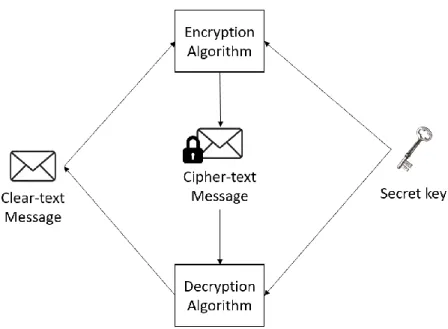
As the name suggests, this type of encryption algorithm uses the same key to both encrypt and decrypt data, which makes the key symmetric in terms of usage. In practical terms, this key represents a secret
7
that is shared between two interested entities. Figure 2.1 illustrates the course of action of this type of encryption.
Figure 2.1 - Symmetric encryption scheme
There are two types of Symmetric Ciphers:
• Stream ciphers - ciphers that process input elements in a continuous fashion, producing output for each element individually.
• Block ciphers – ciphers that process the input in blocks of elements, producing an output for each block individually.
a. DES
The Data Encryption Standard (DES) was implemented in 1977 by the American government with the objective of encrypting/decrypting non-classified data. This algorithm has been criticized ever since due to the low size of the keys it uses, for having that are not clear in terms of purpose and for being easily broken by a lot of already known algorithms.
This algorithm uses a block length of 64 bits and keys of 56 bits. It is a minor variation of the Feistel network, which is illustrated on Figure 2.2, with 16 rounds and 16 subkeys that are generated from the original 56 bit key.
8
Figure 2.2 - Feistel Network
In the Feistel network we start by having a plaintext block with 2w bits of length and a key K. Then, the alogorithm performs the following steps:
1. The plaintext is divided in two halves, L0 and R0, of equal size w.
2. A subkey Ki is generated from the original key K with a subskey generation algorithm. 3. The right half of the data is used on the round funtion F along with a subkey Ki.
4. A substitution is performed on the left half of the data by taking the exclusive-OR (XOR) of itself and the output of the function F.
5. The result of the substitution on the left side goes to the right side while the right side goes to the left side unchanged.
6. Repeat for N rounds.
7. Merge the resulting left and right halves into a final ciphertext with 2w bits.
b. Triple DES
Triple DES (3DES) was standardized with the objective of being used on financial applications in 1985, being also incorporated as part of the Data encryption Standard in 1999.
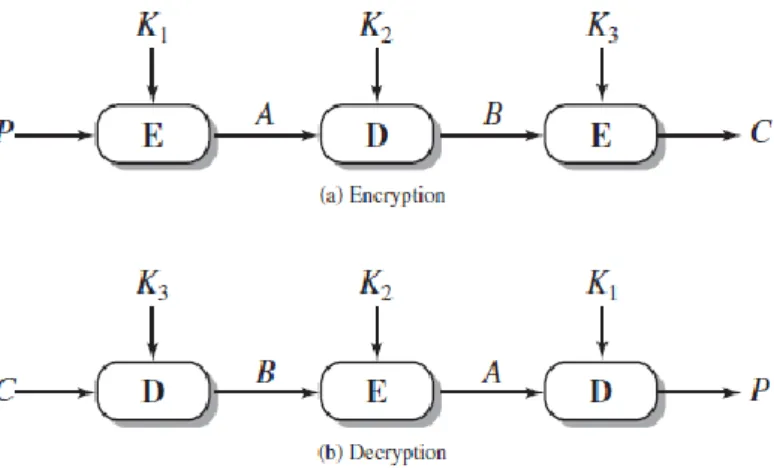
This algorithm uses three keys and three executions of the DES algorithm, following an encrypt-decrypt-encrypt sequence, as shown on Figure 2.3.
9
Figure 2.3 - Triple DES scheme
c. AES
The Advanced Encryption Standard was implemented with the purpose of being the federal information processing standard and replacing the publicly considered weak counterparts DES and Triple DES. This algorithm uses a block length of 128 bits and a key length that can be 128, 192 or 256 bits. It is composed by one permutation stage and three substitution stages:
1. Substitute bytes – Uses a table named “S-box” to perform a byte-by-byte substitution of the block;
2. Shift rows – A simple permutation that is performed row-by-row;
3. Mix columns – A substitution that alters each byte in a column as a function of all its bytes.;
4. Add round key – A simple bitwise XOR of the current block with a portion of the expanded key.
These stages are then repeated for 10 rounds, before reaching the intended cypher-text. Figure 2.4 illustrates the whole process.
10
Figure 2.4 - AES scheme
2.3.2 Asymmetric encryption
Also known as Public-Key Encryption, Asymmetric Encryption is, as the name suggests, the algorithm that uses keys that are asymmetric, meaning that they can only be used for either encryption or decryption, never both at the same time.
Two keys are needed in this algorithm, one which is known as the public key and the other which is the private key. The public key is known by all the involved entities while the private key is supposed to be known only by the entity to which it belongs to. This also means that different results can be achieved when we use one or the other for the encryption:
1. Encrypting with the public key of entity X forces the decryption to be done with the private key of entity X, which is a way of guaranteeing that only entity X is able to read the date in clear-text-
11
2. Encrypting with the private key of entity X can only be done on the entity X’s premises and is a way for entity X to prove its identity.
a. RSA
This algorithm was developed in 1977 and remains to this day as the most widely accepted approach to public-key encryption. RSA is a block cipher in which plaintext and ciphertext are integers between 0 and n-1 for some n. Encryption and decryption are of the following form, for some plaintext block M and ciphertext block C:
C = 𝑀𝑒𝑚𝑜𝑑 𝑛
M = 𝐶𝑑 𝑚𝑜𝑑 𝑛 = (𝑀𝑒)𝑑 𝑚𝑜𝑑 𝑛 = 𝑀𝑒𝑑 𝑚𝑜𝑑 𝑛
It is assumed that both sender and receiver must know the values of n and e, and only the receiver knows the value of d. The public and private keys are here represented on the following form:
Public key: PU = {e,n} Private key: PR = {d,n}
This algorithm is only satisfactory when the following requirements are met:
1. It is possible to find values of e, d, n such that 𝑀𝑒𝑑 𝑚𝑜𝑑 𝑛 = 𝑀, for all M < n.
2. It is relatively easy to calculate 𝑀𝑒 and 𝐶𝑑 for all values of M < n.
3. It is infeasible to determine d given e and n.
2.3.3 Homomorphic encryption
Homomorphic encryption is the category of encryption that allows computation to be performed on encrypted data. The purpose is to have exactly the same result after decrypting the data as if the computation was done on plaintext.
Homomorphic encryption can be either partially homomorphic or fully homomorphic.
a. Fully homomorphic schemes
These homomorphic encryption schemes allow any kind of computation to be performed on the encrypted data, without any limitation. This is by far the most powerful scheme since it allows for any desirable functionality to be implemented.
In practical terms, homomorphic encryption schemes have no clear solution yet, since it wasn’t yet found a formula that can be applied without doubt to any kind of data, be it numeric or alpha-numeric.
b. Partially homomorphic schemes
This homomorphic encryption scheme only allows a subset of operations to be performed on the encrypted data while ensuring that the decryption returns the expected result.
These schemes are usually based on conventional cryptography and, as such, share the same performance and security levels.
12
If the RSA public key is modulus m and exponent e, then the encryption of a message x is given by: ℇ(x)
= 𝑥𝑒mod m. The homomorphic property is then: ℇ(x1). ℇ(x2) = 𝑥1𝑒𝑥
2𝑒mod m = (𝑥1𝑥2)𝑒 mod m = ℇ(x1.x2)
ElGamal
In the ElGamal cryptosystem, in a cyclic group G of order q with generator g, if the public key is (G,q,g,h), where h = 𝑔𝑥, and x is the secret key, then the encryption of a message m is ℇ(m) = (𝑔𝑟,m. ℎ𝑟),
for some random r ∈ {0,…,q-1}. The homomorphic property is then:
ℇ(m1).ℇ(m2) = (𝑔𝑟1,m1. ℎ𝑟1) (𝑔𝑟2,m2. ℎ𝑟2) = (𝑔𝑟1+𝑟2,(m1.m2). ℎ𝑟1+𝑟2) = ℇ(m1.m2)
Goldwasser-Micali
In the Golwasser-Micali cryptosystem, if the public key is the modulus m and quadratic non-residue x, then the encryption of a bit b is ℇ(b) = 𝑥𝑏𝑟2 mod m, for some random r ∈ {0,…,m-1}. The homomorphic
property is then:
ℇ(m1).ℇ(m2) = 𝑥𝑏1 𝑟
12𝑥𝑏2𝑟22 mod m = 𝑥𝑏1+𝑏2(𝑟1 𝑟2)2 mod m = ℇ(b1
⊕
b2)Benaloh
In the Benaloh cryptosystem, if the public key is the modulus m and the base g with blocksize of c, then the encryption of a message x is ℇ(x) = 𝑔𝑥𝑟𝑐 mod m, for some random r ∈ {0,…,m-1}. The homomorphic
property is then:
ℇ(m1).ℇ(m2) mod m = (𝑔𝑥1 𝑟
1𝑐) (𝑔𝑥2 𝑟2𝑐) mod m = 𝑔𝑥1+𝑥2 (𝑟1 𝑟2)𝑐 = ℇ(𝑥1+ 𝑥2)
Paillier
In the Paillier cryptosystem, if the public key is the modulus m and the base g, the encryption of a message x is ℇ(x) = 𝑔𝑥𝑟𝑚 mod 𝑚2, for some random r ∈ {0,…,m-1}. The homomorphic property is
then:
ℇ(x1).ℇ(x2) = (𝑔𝑥1 𝑟
1𝑚) (𝑔𝑥2 𝑟2𝑚) mod 𝑚2 = 𝑔𝑥1+𝑥2(𝑟1𝑟2)𝑚 mod 𝑚2 = ℇ(x1 + x2)
2.4 Operational Intelligence Application
Operational Intelligence is a category of real-time business analytics whose main objective is to give insight into data, be it on the form of streaming events or business operations. This data insight allows users to take conclusions in regard to the system’s performance, threats and process workflow while correlating them together to reveal patterns, detect events, identify anomalies and come up with a solution.
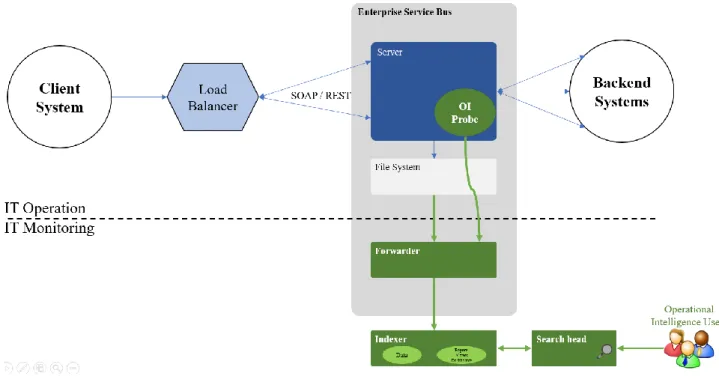
The Operational Intelligence application in study has 4 main components: Probe, Forwarders,
Indexers and Search Heads.
Probe is the component that collects the data from the ESB that the OI application monitors.
Forwarders are the components that consume the data and forward it to Indexers. They reside on the
machines from where the data originates and do little or no work on the data, forwarding it in a raw format.
13
Indexers are the components that process the incoming machine data, converting them from
unstructured data to structured data. This data is stored on indexes as events, which can later on be interpreted in different ways by search heads.
Search heads are the components that allow users to search the already indexed data. The results of
these searches can be returned in the form of field value pairs or consolidated/processed in some way, according to the user’s needs.
Figure 2.5 illustrates of the OI solution showcasing the aforementioned components (in green), the ESB that is being monitored and the surrounding environment.
Figure 2.5 - OI solution architecture diagram
In summary, a probe was installed on the server on which the client application resides, so that all the data that is needed to monitor the environment can be obtained to perform the OI studies. This data is then sent by this probe to a forwarder server that resides on that same machine.
The forwarder sends all the data in raw format to the indexer servers, where it is indexed thus becoming structured.
Finally, the OI users login in to the OI application on the Search Head and use it to consult the events that were collected throughout this process.
2.5 Splunk
The Operational Intelligence solutions that are analysed on this thesis are all implemented in Splunk. Splunk uses the same concepts as shown on section 2.4 regarding the operational intelligence application, meaning that typically it has:
• A target system where a probe should reside; • Forwarders;
14 • Search heads.
Each one of these components handles data that may include personal information. All the concepts that will be introduced on the following sections were taken from Splunk’s documentation pages (Splunk, 2017).
2.5.1 Splunk data pipeline
Splunk has 3 tiers to handle data:
Tier Splunk server that is responsible for this tier
Data input Forwarder
Indexing Indexer
Search management Search Head
Table 2.1 - Splunk data pipeline tiers
Figure 2.6 illustrates the route that data takes through these tiers, which is called data pipeline.
Figure 2.6 - Splunk data pipeline
On the input tier, Splunk acquires raw data from the source and breaks it into equally sized blocks (64K). Metadata like the source type, the specific source and the host is also obtained on this tier. Events are still non-existent on this phase, meaning that the data is still in its original format.
The indexing tier is composed by a parsing phase and an indexing phase. During the parsing phase, Splunk does the following:
• Breaks the data streams into single lines; • Identifies, parses and sets timestamps;
• Adds source-wide keys that were created at input time;
• Transforms event data and metadata based on regular expressions.
During the indexing phase, Splunk writes events on the indexer’s disk and indexes: • Compressed raw data files;
15
The search tier defines how each user accesses, views and uses indexed data. This is basically where users create the analytics that’ll be shown to the end client.
2.5.2 Conversion to structured data
The conversion of incoming unstructured data is done during the indexing tier and is directly related with the way Splunk processes incoming data and stores it in indexes, which are basically repositories for data. As was explained on section 2.5.1, indexing is where raw data is converted into searchable events.
It’s during the parsing phase of the indexing tier that data manipulation is done. Here, Splunk: • Extracts a set of default fields for each event, including host, source, and sourcetype; • Configures character set encoding;
• Identifies line termination using line-breaking rules. While many events are short and only take up a line or two, others can be long;
• Identifies timestamps or creates them if they don't exist. At the same time that it processes timestamps, Splunk identifies event boundaries;
• Masks sensitive event data, if the appropriate configuration was done for that. It can also be configured to apply custom metadata to incoming events.
The masking of sensitive data is the key action here and it’s essential to know how Splunk is able to identify this type of data. Splunk has 2 ways of anonymizing data:
• With regular expression (regex) transformations; • With “sed” scripts.
a. Regex transformations
This type of anonymization requires the user to configure two Splunk configuration files:
• props.conf – where the wanted transformation classes are specified for specific sourcetypes, hosts or sources;
• transforms.conf – where the actual transformation classes are implemented with the regex that matches the data to anonymize.
b. sed Script
This type of anonymization requires the user to create a sed script. Sed is a Unix utility that reads a file and modifies the input as specified by a list of commands. The script needs to be configured first on the props.conf file in a similar way as in regex transformations.
Splunk allows 2 types of sed commands:
• replace – Uses regex to find an expression and replaces that expression by a given string. • character substitution – Searches for a specific set of characters and replaces them by a set of
16
2.5.3 Data obfuscation and Field Protection
As was presented on Splunk’s “.conf17” (Splunk, 2017), we have several options when implementing a solution that protects data on Splunk. This section explains those options having in mind that the data protection on the transport level is already assured by Splunk with safe channels (using TLS).
a. Application
On this option, it is the data source’s responsibility to protect the data before sending it to the Splunk system. This implies that little to no latency is introduced to the system and security is very high but at the same time is a bit complex since this implementation needs to be prepared for each client that will use the Splunk implemented solution (different client, different data). Also, the usability is not the best since this implies that the client needs to protect all data that is thrown to Splunk, even data that was just now introduced, which most likely won’t happen.
Option Layer Latency Security Complexity Usability Application Data source Low Very High Medium Medium
Table 2.2 – Splunk’s data protection options - Application
b. Modular input / Batch processing
This option protects the data on the forwarder with encryption, pseudonymization and anonymization. This offers high usability and security since it allows specific operations to be performed on certain events or types of data which can protect the data while leaving it still usable (eg.: Format preserving encryption). Nevertheless, it is complex to implement such a solution and it induces delay due to the API calls.
Option Layer Latency Security Complexity Usability Modular
Input / Batch processing
Data Medium High High High
Table 2.3 - Splunk’s data protection options - Modular input/Batch processing
c. External Processor
This option requires an external processor, which in itself is an additional solution that should be implemented from scratch, updated each time a new client starts using the Splunk solution an maintained. Obviously, this is the solution with the highest complexity and has still medium latency due to the API calls to the processor. Nevertheless, this solution offers also important advantages in terms of usability and security.
In terms of architecture, the external processor receives the data that needs to be protected from the forwarder and then send it to the indexer.
Option Layer Latency Security Complexity Usability External
Processor
Data Medium High High High
17
d. Regex Replace
This option protects the data on the indexer by replacing it with some other value each time a regular expression is matched. This has a high security and low complexity as the main positive aspects since it anonymizes the data and is quite simple to configure. Nevertheless, it adds latency to the system and is not usable on search time, due to that same anonymization.
Option Layer Latency Security Complexity Usability Regex
Replace
Data Medium High Low Low
Table 2.5 - Splunk’s data protection options - Regex Replace
e. Scheduled Search
This solution protects the data with scheduled searches that are configured to find sensitive data from time to time and run a script that protects them. Of all the options, this is the most expensive one in terms of latency, obviously. It also offers poor security, because between different scheduled searches, the data will remain unprotected. Finally, the complexity and usability of this solution is medium because the searches that find sensitive data are not straightforward and the latency affects the usability.
Option Layer Latency Security Complexity Usability Scheduled
Search
Data Very High Low Medium Medium
Table 2.6 - Splunk’s data protection options - Scheduled Search
f. Result Masking
This option is implemented on the presentation layer instead of the data layer as in the options above. This is the most common solutions since it is “good enough” for approximately 90% of the scenarios, since it offers really high usability and really low complexity. Nevertheless, if offers low security because the data is stored in clear on all components of Splunk and offers a bit of latency as well on the presentation of data, since the protection is done there.
Data can be protected with 3 different methods in Splunk: • Anonymization – uses SHA256 hash.
• Pseudonymization - uses AES256 encryption.
• Format preserving Pseudonymization - Based on AES as well but preserves the original format.
Option Layer Latency Security Complexity Usability Result
Masking
Presentation Medium Low Low High
Table 2.7 - Splunk’s data protection options - Result Masking
g. Options Summary
In the realm of Operational Intelligence, the most desirable solution would be to have as much Usability as possible while having a high level of Security. Table 2.7 already shows that no such solution exists at the moment. In order to have good security, one needs to compromise on Usability, and vice-versa.
18
Application Data source Low Very High Medium Medium
Modular Input / Batch processing
Data Medium High High High
External Processor
Data Medium High High High
Regex Replace
Data Medium High Low Low
Scheduled Search
Data Very High Low Medium Medium
Result Masking
Presentation Medium Low Low High
Table 2.8 - All Splunk data protection options
2.5.4 Access control
Splunk already comes with a built-in Role Based Access Control policy that can be applied at search time. This policy has 3 types of users:
Role Description
User Intended for the common user that edits its own
searches, knowledge objects. This user can only see its own objects or objects that are specifically shared to him.
Power-User Intended for users that can edit all shared objects,
alerts, tag events and other similar tasks.
Administrator Intended for administrators that are able to
manage most of the system’s users. Has the most assigned capabilities (egs.: edit_roles, edit_user, edit_server,…)
Table 2.9 - Splunk's access control roles
New roles with different permissions can be added if needed.
2.6 SOA
Service Oriented Architecture (SOA) is, as the name suggests, a software architecture where all functionalities that are implemented by the applications are available in the form of services. This architecture follows a consumer-provider philosophy, meaning that all functionalities are provided by some entity to another that consumes them.
SOA defines a service as a unit of work representing a specific business function. This unit of work should be accessible through well-defined interfaces. Services are normally implemented using the Simple Object Access Protocol (SOAP) that provides a specification for message exchanging, and Representational State Transfer (REST) which is a set of principles that define how Web Standards should be used (Hurwitz, Bloor, Kaufman, & Halper, 2009).
2.6.1 SOA Infrastructure
19
a. Service Enablement
Service Enablement relates to the service implementation part we use to enable services. If we want to
adopt SOA practices, the first thing we have to do is search for some technology that already implements the service we want. This technology may already exist in our company, it may as well already work the way we want and by doing this we’re accelerating the process and saving funds for future service implementations. Service enablement can be achieved with an Enterprise Service Bus (ESB), which is also a mediator and works well with applications with good interfaces and can be achieved with an
Application Wrapper that provides a way of using services that don’t have a formal interface by exposing
running applications or internal programs as services.
b. Service Mediation
Service Mediation relates to the separation between service consumers and service providers. A service
consumer should never connect directly to the service provider. If it does so, there’s absolutely no flexibility in our SOA practice regarding the changes we can make to our services. This is of extreme importance because services are constantly changing! New features, new requirements, corrections, new message formats, new programming languages, anything we can think of will most likely change in the future. To achieve service mediation, we have to implement virtual service that functions as a translator between services. By doing so, we achieve Loose coupling which is the property where service consumers are independent of the service provider’s location, transport and type of messages. This can be made with Proxies, ESB’s, Gateways and SOA appliances.
2.6.2 Governance
The only way to fight the aforementioned problems is by defining roles, policies and procedures and by enforcing those to all stakeholders. This is called Governance. The enforcement of this roles, policies and procedures can be made in design-time and run-time with checkpoints.
Enforcement in design-time is made with registries, where we publish the available services and related
metadata, SOA related assets, service provider organizations, service consumer systems or applications, service consumer organizations, policies, contracts, agreements and relations between all. What makes this method a checkpoint of policies is that all system artefacts must pass through the registry before being available to service consumers.
Enforcement in run-time is made with Policy Enforcement Points (PEP), also known as Brokers.
PEP’s provide a way of enforcing pre-established agreements between service providers and service consumers. PEP’s are the service-mediation layer of the SOA infrastructure, which we will see next. By enforcing policies in the mediation layer, we can apply policies without worrying about both service consumer and service provider locations and protocols and message differences.
a. SOA Life Cycle
Governance shouldn’t be a burden to workers. In fact it should always be seen as a way of helping the workers do their job. What usually happens is that workers publish a certain service on the registry, wait for the checkpoint and then have to restart all their work again because the service wasn’t compliant with the company policies.
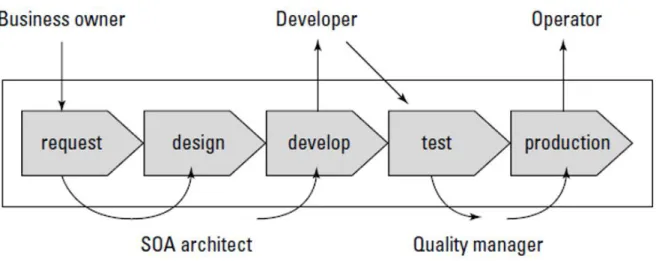
The main objective of life cycles is to fix the above issue by breaking the development process of a service into stages. In each stage, some person, that is responsible for some task, evaluates the work
20
according to the policies of the company. The normal service life cycle has requests made by a Business
Owner, which are analysed and turned into service and process designs by an SOA Architect. These
designs are then implemented by a developer on the develop stage who also makes tests for the same implementations. These tests are used by the Quality Manager to validate quality metrics, side-effects and non-functional requirements such as quality of service. The Operator receives the well-tested and validated solutions and starts the production stage, where he makes the solutions available for service consumers by implementing a virtual service.
All the aforementioned stages of the SOA life cycle are illustrated on Figure 2.7.
Figure 2.7 - SOA Life Cycle
b. Composition
SOA life cycles also imply that the stakeholders mentioned above can communicate with each other. This originates a new problem in that, most of the time, those same stakeholders have different languages and skills. A Business Owner may not know how to design services, an SOA Architect may not know what to implement a design, and so on.
The commonly used solution is Business Process Management (BPM). BPM provides a way of composing and optimizing the SOA process by defining processes in a very graphical fashion, which results in a common language to all stakeholders. Figure 2.8 shows an example of a BPM model.
21
Figure 2.8 - Example of a Business Process Management model
Another way of composing the SOA process is by developing Composite Applications. These technologies provide a new way of creating applications where all that is required is wiring up services into a rich user interface. This makes reuse of services accessible to everyone, since little or no code is required.
c. Agility
Composition and life cycles brings us to one big objective of SOA: Agility. Agility means the capability to rapidly and cost efficiently adapt to changes. To achieve agility, we have to ensure that all stakeholders use shared technical and organizational components and functions as well as good relationships to increase communication and reach a common goal. We need to assure a mindset where everyone understands that the service exists to deliver consumer satisfaction, methodology to cross project boundaries and improve communication, and challenges to the organization by defusing any conflicts between departments. Another way of increasing agility is by defining contracts. Contracts define an agreement between the non-functional requirements of consumers and providers, like performance, security, and so on.
2.7 ESB
The real-world OI solution that will be protected in the scope of this thesis gives insight into the execution of an Enterprise Service Bus (ESB).
An ESB is a form of message-oriented middleware (MOM) system that implements the communication between software applications in a service oriented architecture (SOA) (Chappell, 2009). As illustrated on Figure 2.9, the primary responsibilities of an ESB are the following:
• Routing of messages;
• Monitoring and control message exchange; • Event handling;
• Data transformation and mapping; • Message and event queueing/sequencing; • Protocol conversion;
22 • Security.
Figure 2.9 - Enterprise Service Bus
2.8 Summary
This section addressed GDPR, along with its main concepts and articles, encryption techniques, Splunk Operational Intelligence, SOA and ESB, which are the concepts that drive this thesis.
GDPR focuses on the protection of personal data, empowering common individuals over their own data. This regulation specifies how this type of data should be handled/processed and how it should be protected, making it the main source of requirements for this thesis.
On the other hand, the access control sub-section makes a small introduction into the Role-Based Access Control policy, which is the one that is used by Splunk.
Symmetric, asymmetric and homomorphic encryption algorithms are introduced here as well as a way of protecting data. Both symmetric and asymmetric encryption schemes represent the existing solutions that allow the protection of sensitive data without regard to the operations that were being executed on it. On the other hand, homomorphic encryption schemes represent the possibility of implementing operations that can be executed on encrypted data, to allow users without access to that kind of data to still do some amount of work in the scope of an organisation.
This section also makes a quick introduction to the Operational Intelligence field of work, following immediately with its main platform, Splunk. Since this thesis focuses on the security side of data processing, themes like the different stages that data goes through on this platform are introduced. The different data protection options that are already offered by Splunk for each individual stage were introduced here along with their pros and cons.
Finally, an introduction was made to the Service Oriented Architecture (SOA) and Enterprise Service Bus (ESB) concepts, which are tightly related with the OI application that will be improved in the scope of this thesis.
23
Section 3 introduces the model of current existing OI solution, by explaining its most important concepts, its architecture, the involved subjects, use cases, operations and the types of data that are affected by the solution.
24
3 Analysis and Design
This section introduces the existing OI application, regarding its involved subjects, use cases, possible operations and types of the data. This solution is not yet GDPR compliant, so scenarios are identified for the solution along with performance, security, usability, complexity and control access requirements.
3.1 Solution introduction
The OI solution is used to give real time analytics regarding business events of targeted clients. It focuses on middleware environments, namely:
• Enterprise Application Integration (EAI). • Enterprise Service Bus (ESB);
• Service Oriented Architecture (SOA);
This solution tracks the path from the client system to the backend systems that are invoked by SOA services, giving insight into the operation of the entire system. This insight includes metrics like reliability (percentage of errors), performance (response time), volume/load (number of requests per second) and concurrency (number of parallel requests in any instant). Figure 3.1 shows the context diagram of the OI solution.
Figure 3.1 - OI solution context diagram
The OI solution is implemented in Splunk. All assumptions are made with this platform in mind, even though they’re no different on other platforms. Exceptions are mentioned as needed.
3.1.1 Subjects
25
a. Client-side subjects
Client-side subjects reside on clients and can only have access to certain applications of the overall product, based on the agreement with the client.
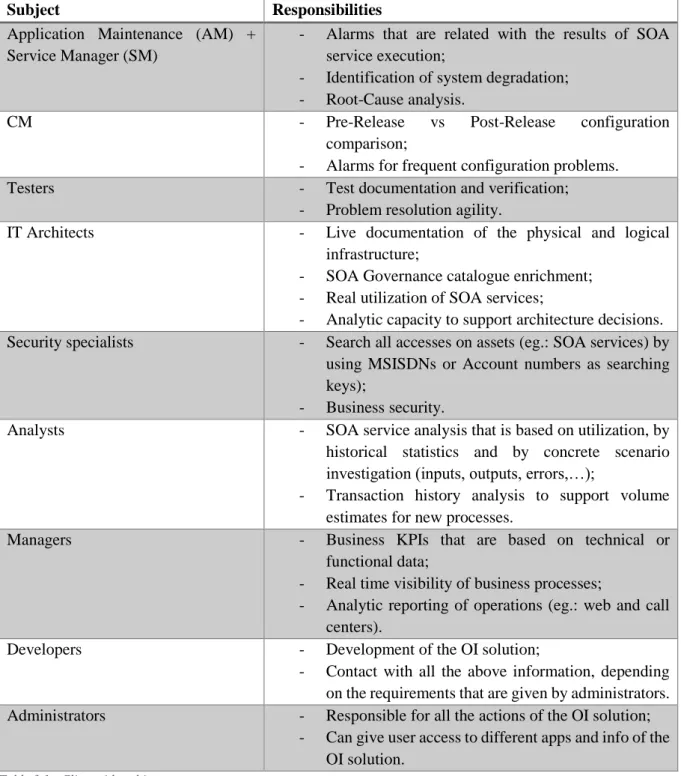
The following subjects are the most common ones on the scope of this OI solution (EAI, ESB and SOA):
Subject Responsibilities
Application Maintenance (AM) + Service Manager (SM)
- Alarms that are related with the results of SOA service execution;
- Identification of system degradation; - Root-Cause analysis.
CM - Pre-Release vs Post-Release configuration
comparison;
- Alarms for frequent configuration problems.
Testers - Test documentation and verification;
- Problem resolution agility.
IT Architects - Live documentation of the physical and logical infrastructure;
- SOA Governance catalogue enrichment; - Real utilization of SOA services;
- Analytic capacity to support architecture decisions. Security specialists - Search all accesses on assets (eg.: SOA services) by
using MSISDNs or Account numbers as searching keys);
- Business security.
Analysts - SOA service analysis that is based on utilization, by
historical statistics and by concrete scenario investigation (inputs, outputs, errors,…);
- Transaction history analysis to support volume estimates for new processes.
Managers - Business KPIs that are based on technical or
functional data;
- Real time visibility of business processes;
- Analytic reporting of operations (eg.: web and call centers).
Developers - Development of the OI solution;
- Contact with all the above information, depending on the requirements that are given by administrators. Administrators - Responsible for all the actions of the OI solution;
- Can give user access to different apps and info of the OI solution.
Table 3.1 - Client-side subjects
b. Internal users
Internal users participate on the design and implementation of the product.
26
Developers - Development of the OI solution;
- Contact with all the above information, depending on the requirements that are given by administrators.
System Administrators - Configuration of the OI solution;
- Contact with all the above information, depending on the requirements that are given by administrators.
Administrators - Responsible for all the actions of the OI solution; - Can give user access to different apps and info of the
OI solution.
Table 3.2 - Internal user subjects
3.1.2 Use cases
Similarly to the types of subjects, the use cases can also be divided into 2 types: • Metrics – used by client-side subjects;
• Internal – used by internal subjects.
a. Metrics
As was mentioned in section 3.1, the OI solution focuses on Reliability, Performance, Volume/Load and Concurrency metrics. These types of use cases are more commonly performed by client-side users. Having this in mind, the following use cases are common:
Metric type Use case Security impact (1-5)
Reliability Find which backend failed. N/A
Check which input originated the failure.
4 – Inputs may contain costumer data (which is personal more usual than not). Check if authentication failed in
some system.
4 - May expose personal info if we’re dealing with a Billing backend system for example.
Performance Compare response times of
distinct clients.
N/A Check if some system is slower than usual.
N/A Evaluate performance evolution.
N/A Volume/Load Find delays in batch processes.
Find duplicate requests. 3 – Requests may contain costumer data, although duplicate requests are not as common.
Concurrency Count the number of parallel requests.
5 – It’s almost certain that costumer data will be found on a system that works entirely in parallel due to its asynchronous nature.