Effect of rejuvenation pruning on the olive yield of
different cultivars in a super-high-density olive orchard
A.B. Dias1, M. Figueira2, A. Pinheiro1 and J.O. Peça11Departamento de Engenharia Rural, Escola de Ciências e Tecnologia, Instituto de Ciências Agrárias e Ambientais
Mediterrânicas, Instituto de Investigação e Formação Avançada, Universidade de Évora, Núcleo da Mitra, Apartado 94, 7002-554 Évora, Portugal; 2Direção Regional de Agricultura e Pescas do Alentejo, Direção de
Serviços de Desenvolvimento Agroalimentar e Rural, Divisão de Apoio à Produção, Quinta da Malagueira, Apartado 83, 7006-553 Évora, Portugal.
Abstract
The adequacy of olive canopy dimensions for over-the-row harvesting machinery is one of the most important management practices in super-high-density (SHD) olive orchards. Manual pruning performed every year can control canopy dimensions and also exposure of the tree to sunlight. An adequate balance is required between the removal of woody non-productive branches and the maintenance of a large quantity of reproductive shoots. When excessive canopy development occurs, a severe pruning intervention can be a solution to recover orchard productivity. This paper presents results obtained after rejuvenation pruning of an SHD orchard with excessive canopy dimensions. The SHD orchard was established in March 2002 in Herdade dos Lameirões, Safara, Moura, Portugal (38°04’N 7°16’W). The orchard was planted according a randomized complete block design with three replications. The
orchard has two densities, 1850 trees ha-1 (4×1.35 m) and 1250 trees ha-1 (4×2 m),
planted with six cultivars (‘Azeiteira’, ‘Cobrançosa’, ‘Cordovil de Serpa’, ‘Galega vulgar’, ‘Redondil’ and ‘Arbequina’), leading to 36 plots each composed of three rows. The pruning was performed in April 2010. It consisted of mechanically topping the canopy parallel to the ground at 2.5 m and hedging of each side close to the central leader of the trees, followed by a manual pruning complement to remove the remaining branches. Olive production was recovered in the second year after pruning. Significant differences were found among results of different years and among the cultivars, with regard to olive yield per hectare. The highest yield was registered in the third year after pruning. Planting density had a significant effect on yield per tree, with higher production in the 4×2 m array.
Keywords: mechanization, olive growing, pruning strategy INTRODUCTION
In super-high-density (SHD) olive orchards, tree dimensions represent a major challenge for the management of the trees, since there is an absolute priority to guarantee that harvesting machinery is able to perform efficiently without causing damage and also to make sure that tree canopies receive enough sunlight (Connor (2006), cited in Tous et al. (2014)).
Camposeo et al. (2008) noted that efficient olive harvesting is obtained in SHD orchards with trees from 2.2 to 2.4 m tall and 1.2 to 1.5 m wide. Bellomo et al. (2011) reported harvesting efficiency of 98% in 2.4-m-tall trees (3rd year after plantation), using a
Pellenc Activ harvester. Giametta and Bernardi (2009) reported a harvesting efficiency between 88 and 95%, according to cultivar, in a full-production SHD orchard with 4-m-tall trees (7th year after plantation). The highest efficiency was obtained with the cultivar
‘Arbequina’ and the lowest with cultivar ‘FS-17’, in correlation to the speed of the harvester. The reduction in yield related to deficient sunlight exposure was addressed by Tous et al. (2010), stating that there are three alternatives to overcome the problem: 1, reducing tree density by half, after removing alternate tree rows; 2, cutting trees near the ground to encourage regrowth, from which new trees will be formed; 3, removing all tree branches,
274
keeping only the central leader. Hidalgo et al. (2012), reporting central leader cuts at different heights, stated that the best results were obtained cutting at 5-10 cm from the bottom.
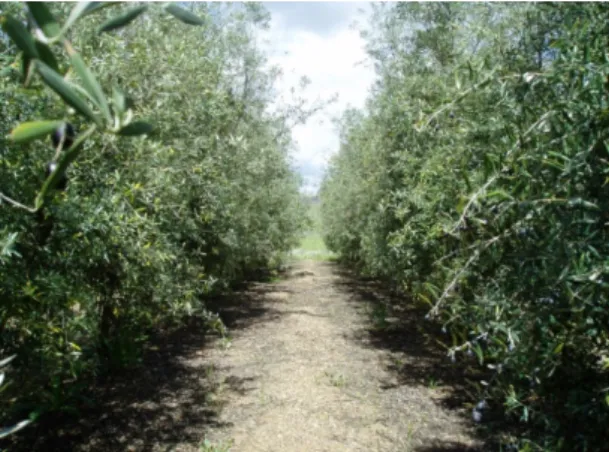
Figure 1 shows an SHD olive orchard that has been kept without any pruning intervention for 5 years. Deficient sunlight exposure and difficult harvesting conditions lead to an urgent regeneration pruning intervention.
Figure 1. Orchard before pruning.
In this work, we present the results of a rejuvenating pruning trial followed for 3 years after the intervention.
MATERIAL AND METHODS Material
The SHD orchard was established in March 2002 in Herdade dos Lameirões, Safara, Moura, Portugal (38°04’N 7°16’W). The orchard was planted according a randomized complete block design with three replications. The orchard has two densities, D1, 1850 trees ha-1 (4×1.35 m), and D2, 1250 trees ha-1 (4×2 m), planted with six cultivars (‘Azeiteira’,
‘Cobrançosa’, ‘Cordovil de Serpa’, ‘Galega vulgar’, ‘Redondil’ and ‘Arbequina’), leading to 36 plots with three rows each. Lines were 40 m long, corresponding to 29 trees per row in D1 and 20 trees per row in D2.
Tree rows are oriented north-south. The orchard is planted on Anthrosol soil (FAO). This region is semi-arid with strong continental influence and an annual mean rainfall of 420 mm concentrated in the winter.
The orchard is drop-irrigated twice a week, from May until October, annually receiving an estimated volume of 1500 m3 ha-1.
In 2011, 2012 and 2013, the orchard was spayed to control olive leaf spot (Spilocaea
oleagina (Castagne) Hughes), olive fly (Bactrocera oleae Gmel.) and olive anthracnose
(Colletotrichum acutatum Simmons or Colletotrichum gloeosporioides Penz.). Glyphosate was used for weed control in the rows and between rows. A foliar fertilizer (urea at 4%) was applied in the spring of 2012 and 2013.
Equipment
Mechanical pruning was performed using an R&O disc-saw pruning machine (Reynolds & Oliveira Ltd.) mounted on the front loader of a 50-kW (DIN) 4WD agricultural tractor (Peça et al., 2002).
The manual pruning complement to the mechanical pruning was executed by manual shears.
In 2012, harvesting was done using an hand-held vibrating comb shaker to a canvas on the ground. In 2013, harvesting was done with a New Holland Braud VX680 grape-harvester.
Methods
Rejuvenation pruning with the disc-saw machine was done in April 2010. The cutting bar was placed vertically, as close as possible to the central leader, to cut both sides of the canopy. A horizontal cut was also performed at approximately 2.5 m.
In June 2010, a manual pruning complement was performed in order to remove thick and deficiently placed branches that had not been removed by the pruning machine. Trees were left leafless. No further pruning action were taken in the subsequent years (2011-2013).
In 2012 and 2013, the yield was measured in terms of mass of olives effectively harvested. In 2013, the working capacity of the harvester and the harvesting efficiency were also evaluated. The olives remaining on the plants after mechanical harvesting were weighed from three trees per plot, chosen at random. Harvesting efficiency was calculated as follows:
× Mass collected by grape harvester
Harvesting efficiency (%) = 100
Total yield
The experimental design was a two-factor randomized complete block design with a 3-year repetition. Duncan’s multiple-range test was applied for treatment comparison only for significant (P<0.05 and P<0.1) effects.
RESULTS AND DISCUSSION Olive yield
In 2010 (pruning year) and in 2011, the orchard did not produce. Significant differences in yield were found between 2012 and 2013 (P<0.01), with yield in 2013 significantly higher (P≤0.05) than in 2012 (Table 1).
Table 1. Influence of the year in olive harvested yield.
Year Harvested yield (kg tree-1) Harvested yield (kg ha-1)
Pruning year (2010) No yield No yield
1st year after pruning (2011) No yield No yield
2nd year after pruning (2012) 1.18b 1713.07b
3rd year after pruning (2013) 4.75a 8138.83a
Values followed by the same letter are not significantly different by Duncan’s multiple-range test at the 5% level.
Significant differences in yield per tree were found between tree densities (P<0.05), with yield per tree in D1 significantly lower (P≤0.05). Trees at D1 have smaller canopy volume, which might influence yield. However, because of the larger number of trees per hectare, there is a compensation that resulted in non-significant differences (P>0.05) in yield per unit area between the two densities (Table 2).
Table 2. Influence of planting density in olive harvested yield.
Planting density Harvested yield (kg tree-1) Harvested yield (kg ha-1)
D1 (1850 trees ha-1) 2.44b 5108.96a
D2 (1250 trees ha-1) 3.49a 4742.93a
Values followed by the same letter are not significantly different by Duncan’s multiple-range test at the 5% level.
Non-significant differences (P>0.05) in yield per tree were found among cultivars (Table 3).
276
Table 3. Average effect of varieties in olive harvested yield.
Cultivar Harvested yield (kg tree-1) Harvested yield (kg ha-1)
Azeiteira 2.8a 4248.4b Cobrançosa 3.4a 5261.7ab Cordovil of Serpa 2.1a 3467.8b Galega 2.9a 5462.7ab Redondil 2.6a 4155.8b Arbequina 3.8a 6959.3a
Values followed by the same letter are not significantly different by Duncan’s multiple-range test at the 5% level.
However significant differences (P<0.05) in yield per hectare was found. ‘Arbequina’ was the most productive, not differing statistically from ‘Cobrançosa’ and ‘Galega’ (Table 3). Yields of ‘Azeiteira’, ‘Cordovil de Serpa’ and ‘Redondil’ were instead significantly lower (P≤0.05) than that of ‘Arbequina’.
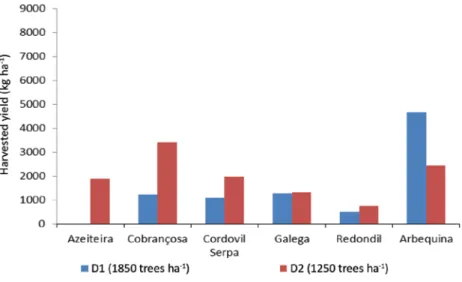
Figure 2 shows the great variability found in yield per hectare, in 2012 (2nd year after
pruning), for each cultivar and planting density. The highest yield in D1 was scored by ‘Arbequina’. All the other cultivars had lower yield, and even absence of production (‘Azeiteira’). At density D2, with exception of ‘Arbequina’, all the cultivars performed better than at D1.
Figure 2. Average harvested yield per hectare in 2012, by cultivar and planting density. ANOVA did not reveal significant differences in the interaction between planting density and cultivar (P>0.1).
Figure 3 shows the average yield per hectare, in 2013 (3rd year after pruning), for each
cultivar and planting density. In contrast with 2012, almost all the cultivars presented better results in terms of yield per hectare at density D1 with exception of ‘Cordovil de Serpa’.
Grape-harvester performance
Regarding the time required to perform the harvest, ‘Arbequina’ and ‘Galega’ needed significantly more time (P≤0.1) than ‘Cordovil de Serpa’ and ‘Redondil’ (Table 4).
Harvesting efficiency was significantly higher (P≤0.05) in ‘Azeiteira’, ‘Cobrançosa’ and ‘Redondil’ compared with the other cultivars (Table 5). The lowest efficiency was registered in ‘Arbequina’ and ‘Galega’.
Figure 3. Average harvested yield per hectare in 2013, by cultivar and planting density. ANOVA did not reveal significant differences in the interaction between planting density and cultivar (P>0.1).
Table 4. Average effect of cultivars on time of detachment.
Cultivar Time of detachment (min per 100 trees)
Azeiteira 13.6ab Cobrançosa 12.1ab Cordovil de Serpa 10.3b Galega 15.5a Redondil 11.1b Arbequina 14.8a
Values followed by the same letter are not significantly different by Duncan’s multiple-range test at the 10% level.
Table 5. Average effect of cultivars on harvest efficiency.
Cultivar Harvest efficiency (%)
Azeiteira 100.0a Cobrançosa 97.1a Cordovil de Serpa 89.7b Galega 83.7bc Redondil 97.5a Arbequina 82.5c
Values followed by the same letter are not significantly different by Duncan’s multiple-range test at the 5% level.
Many different factors influence harvest efficiency. One of them is the fruit mass. The lighter the fruits, the more difficult is the detachment. ‘Arbequina’ and ‘Galega’, with a fruit weight around 2 g (Cordeiro et al., 2013), are lighter than ‘Azeiteira’, ‘Cobrançosa’ and ‘Redondil’, which have an average fruit weight of 4 g (Cordeiro et al., 2013). This may partially explain the low performance in ‘Arbequina’ and ‘Galega’. Another factor is related to the setting of the harvester. It was observed that, for tall trees like those of ‘Galega’, which often exceeded 3 m, the upper part was bent by the harvester, affecting olive detachment and sometimes causing tree damage. In other cases, the number of shaking rods mounted in the harvester should have been increased to provide better shaking performance. These aspects
278
are not easy to address, since harvesting is contractor work where is not practical to impose machine alterations for such a small number of trees to be harvested.
Mechanical pruning followed by a manual complement intervention can be an alternative for the regeneration of SHD olive orchards to the more drastic options referred to by Tous et al. (2010) and Hidalgo et al. (2012). This option may have better acceptance by olive producers, justifying the pursuit of these studies.
ACKNOWLEDGEMENTS
This work is funded by National Funds through FCT – Foundation for Science and Technology under Project UID/AGR/00115/2013 and co-funded by the University of Evora. This work was made possible due to the collaboration of Direção Regional de Agricultura do Alentejo at olive orchard management.
Literature cited
Bellomo, F., D’António, P., and Camposeo, S. (2011). Meccanizzazione e costi della raccolta meccanica dell’oliveto superintensivo. Acta Italus Hortus 1, 224–227.
Camposeo, S., Ferrara, G., Palasciano, M., and Godini, A. (2008). Varietal behaviour according to the superintensive oliveculture training system. Acta Hortic. 791, 271–274 https://doi.org/10.17660/ActaHortic.2008.791.38. Cordeiro, A.M., dos Santos, M.L.C., and de Morais, N.C. (2013). As variedades de oliveira. In Grande Livro da Oliveira e do Azeite. Portugal Oleícola, J. Bohm, ed. (Lisbon, Portugal: Dinalivro Editora), p.174–220.
Giametta, G., and Bernardi, B. (2009). Mechanized harvesting tests performed by grape harvesters in super intensive olive orchard cultivation in Spain. J. Agric. Eng. 2, 19–26.
Hidalgo, J., Vega, V., and Hidalgo, J.C. (2012). Experiencias sobre la renovación de plantaciones en seto en el cultivo del olivar. Vida Rural 341, 42–48.
Peça, J., Dias, A., and Pinheiro, A. (2002). Influence of trunk or bough shaking on the performance and costs of mechanical harvesting of olives. Acta Hortic. 586, 357–360 https://doi.org/10.17660/ActaHortic.2002.586.71. Tous, J., Romero, A., and Hermoso, J.F. (2010). New trends in olive orchard design for continuous mechanical harvesting. Adv. Hortic. Sci. 24 (1), 43–52.
Tous, J., Romero, A., Hermoso, J.F., Msallem, M., and Larbi, A. (2014). Olive orchard design and mechanization: present and future. Acta Hortic. 1057, 231–246 https://doi.org/10.17660/ActaHortic.2014.1057.27.