PRINCIPAL COMPONENT ANALYSIS AS A TOOL TO CORRELATE
PROPERTIES OF DIFFERENT LABORATORIAL PAPERS
António Santos1, Rogério Simões1 e Ofélia Anjos2
1
Unidade de Materiais Têxteis e Papeleiros, Universidade da Beira Interior, 6201-001 Covilhã, Portugal.
2
Unidade Departamental de Silvicultura e Recursos Naturais, Escola Superior Agrária de Castelo Branco, 6001 - 909 Castelo Branco, Portugal.
ABSTRACT
We measured fibre morphological properties and corresponding handsheet paper properties in pulps obtained from Eucalyptus globulus, Acacia dealbata and Acacia
melanoxylon wood samples. The three wood samples were chipped, cooked, and
bleached according to standard procedures. The basic chip densities of the samples obtained from the three species studied were 0.351g/cm3, 0.387g/cm3 and 0.536g/cm3, respectively for A. dealbata, A. melanoxylon and E. globulus. All species were submitted to cooking with the following reaction conditions: active alkali charge = 22% (as NaOH); sulfidity index = 30%; liquor/wood ratio = 4/1; time to temperature = 90 min; time at temperature (160 ºC) = 120 min.
Acacia species show higher pulp yield than the E. globulus sample used as a reference and cooking selectivity is higher in the Acacia species investigated.
The three pulps were beaten in a PFI mill at 500, 2500 and 4500 revolutions under a refining intensity of 3.33 N/mm, and laboratory paper sheets were produced, including the unbeaten pulps, which made up 4 samples per species. The corresponding fibre characteristics in suspension were also determined.
We used principal components analysis to investigate the differences in fibre characteristics and paper properties, as well as their interaction. Each value of these variables represents a mean of 10 tests, for the paper sheets. This methodology allowed us to determine how close, or how independent, the study variables were. We conclude there is a group of paper characteristics which depend strongly on each other - paper density, smoothness, tensile index, stretch, burst index, Schopper Riegler degree, internal cohesion and WRV – and are negatively correlated with the light scattering coefficient,opacity and brightness.
On the other hand, intrinsic paper fibre resistance is strongly affected by fibre length and coarseness.
On the basis of the properties we studied, it is clear that paper produced from Eucalyptus fibre has different properties from that produced from Acacia fibre. Papers produced from both species of Acacia are similar.
Key words: Principal component analysis, Eucalyptus, Acacia, fibres characteristics,
handsheet properties.
INTRODUCTION
Bleached Eucalyptus globulus kraft pulp has a very good position in the world pulp market for production of writing and printing papers due to its singular characteristics. However, pulp produced from Acacia species, namely Acacia mangium, is emerging as a strong competitor in the world market of hardwood pulps. The increasing number of commercial plantations for industrial uses in Asia, good ecological
conditions of this region (Balodis and Clark, 1998; Matheson et al., 1998) and fibre quality (Paavilainen, 2000; Fuping ad Elias, 2003) are key factors promoting the use of this wood for pulp production. The very high light scattering potential of the fibres, due to a high number of fibres per gram, and good smoothness and paper formation are the key parameters (Paavilainen, 2000; Fuping ad Elias, 2003).
Portugal also has good ecological conditions for some Acacia species, although they are introduced species, there are stands of A. dealbata and A. melanoxylon. However, information on the paper making potential of Acacia species existing in Portugal is scarce. Gil et al. (1999), using the stem close to the butt of A.
melanoxylon and A. dealbata, showed that cooking yield, residual lignin content in
the unbleached pulp and alkali consumption in the kraft process compare very well with those exhibited by an E. globulus sample used as a reference. Santos et al. (2005) worked with the top part of the same A. melanoxylon and A. dealbata trees used by Gil et al, (1999) showed that Acacia species with their relatively short, flexible and collapsible fibres, have potential to produce papers with good relationships light scattering/tensile strength and smoothness/tensile strength, at low energy consumption in refining. In consequence, the authors concluded that the Acacia fibres have high potential, at least for use in combination with E. globulus in writing and printing paper production. The pulping and paper making potential of other Acacia species have also been studied by others authors (Paavilainen, 2000; Clark et al., 1991; Guigan et al., 1991).
In this work we used principal components analysis to investigate the differences in fibre characteristics and paper properties, as well as their interaction for the papers produced with E. globulus, A. dealbata and A. melanoxylon fibre.
MATERIAL AND METHODS
To evaluate the relationship between the pulps produced with Eucalyptus globulus,
Acacia dealbata and Acacia melanoxylon wood samples it was measured fibre
morphological properties and corresponding handsheet paper properties in pulps obtained from that species. The three wood samples were chipped, cooked, and bleached according to standard procedures. The basic chip densities of the samples obtained from the three species studied were 0.351g/cm3, 0.387g/cm3 and 0.536g/cm3, respectively for A. dealbata, A. melanoxylon and E. globulus. All species were submitted to cooking with the following reaction conditions: active alkali charge = 22% (as NaOH); sulfidity index = 30%; liquor/wood ratio = 4/1; time to temperature = 90 min; time at temperature (160 ºC) = 120 min.
The three pulps were beaten in a PFI mill at 500, 2500 and 4500 revolutions under a refining intensity of 3.33 N/mm, and laboratory paper sheets were produced, including the unbeaten pulps, which made up 4 samples per specie. The corresponding fibre characteristics in suspension were also determined.
We used principal components analysis to investigate the differences in fibre characteristics and paper properties, as well as their interaction. Each value of these variables represents a mean of 10 tests, for the paper sheets. This methodology allowed us to determine how close, or how independent, the study variables were.
RESULTS AND DISCUTION
Table 1 shows the results for pulp yield, rejects, effective alkali consumption (as NaOH), kappa number and pulp viscosity before and after bleaching (D0E1D1E2D2)
Table 1 – Cooking and bleaching results (UB=unbleached; B=bleached).
A. dealbata A. melanoxylon E. globulus
Pulp yield (%) 51.2 53.2 50.5
Rejects (%) 0.3 0.4 0.3
Alkali consumption (%) 15.6 15.1 15.2
Kappa number 12.4 10.9 14.1
Pulp viscosity (cm3/g) (UB) 996 980 956
Pulp viscosity (cm3/g) (B) 800 800 800
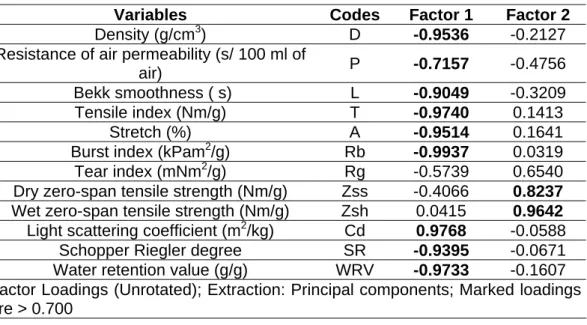
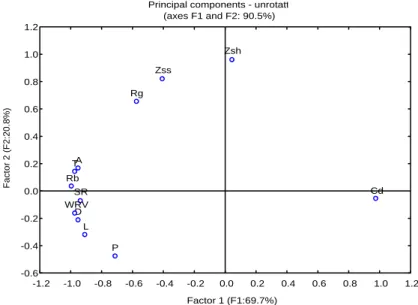
Once we had more variables than cases, we chose to carry out a first analysis with part of the variables, and a second analysis using the remaining ones, as well as some of the first ones that explained a certain group. The analysis for the first group of variables is presented in Table 2 and Figure 1. In this figure, each point represents the mean of a given property, for the twelve pulp samples. The first component explains 69.7% of the total variation and the second explains 20.8%.
Table 2 – Factor analysis results F1 vs F2, of principal components determined by the first group of handsheet properties.
Variables Codes Factor 1 Factor 2
Density (g/cm3) D -0.9536 -0.2127
Resistance of air permeability (s/ 100 ml of
air) P -0.7157 -0.4756
Bekk smoothness ( s) L -0.9049 -0.3209
Tensile index (Nm/g) T -0.9740 0.1413
Stretch (%) A -0.9514 0.1641
Burst index (kPam2/g) Rb -0.9937 0.0319
Tear index (mNm2/g) Rg -0.5739 0.6540
Dry zero-span tensile strength (Nm/g) Zss -0.4066 0.8237
Wet zero-span tensile strength (Nm/g) Zsh 0.0415 0.9642
Light scattering coefficient (m2/kg) Cd 0.9768 -0.0588
Schopper Riegler degree SR -0.9395 -0.0671
Water retention value (g/g) WRV -0.9733 -0.1607
Factor Loadings (Unrotated); Extraction: Principal components; Marked loadings are > 0.700
Vector 1, which defines the first component of paper properties, includes a series of properties, which are significantly correlated amongst themselves: paper density, resistance of air permeability, smoothness, tensile index, stretch, burst index, Schopper Riegler degree and WRV. The light scattering coefficient is also strongly correlated with the previous group but in inverse order. In fact, all the first variables showed a strong correlation with paper density and the way fibres connect to form papers with higher mechanical resistance.
In vector 2, components zero span tensile index, wet and dry have positive coefficients.
Principal components - unrotatt (axes F1 and F2: 90.5%) D P L TA Rb Rg Zss Zsh Cd SR WRV -1.2 -1.0 -0.8 -0.6 -0.4 -0.2 0.0 0.2 0.4 0.6 0.8 1.0 1.2 Factor 1 (F1:69.7%) -0.6 -0.4 -0.2 0.0 0.2 0.4 0.6 0.8 1.0 1.2 Factor 2 ( F 2:20.8%)
Figure 1 – Relative distribution of paper characteristics according to the factors resulting form multi-varied analysis components, for the first group of variables.
For the second analysis, we used the variables that defined each axis (tensile zero span dry and light scattering coefficient) and the remaining variables, so there was a correct link between both outputs. The second analysis is presented in Table 3 and Figure 2: the first component explains 51.6 % of total variation, while the second explains 32.7%.
Table 3 - Factor analysis results F1 vs F2, of principal components determined by the second group of handsheet and fibre properties.
Variables Codes Factor 1 Factor 2
Wet zero-span tensile strength
(Nm/g) Zsh 0.2495 -0.8873
Internal cohesion (Jm2) Ci -0.9840 -0.1324
Opacity (%) O 0.9679 0.2156
Brightness (ºISO) B 0.9821 -0.0169
Light scattering coefficient (m2/kg) Cd 0.9472 0.3088
Schopper Riegler degree SR -0.9286 -0.2022
Fibre width (μm) W -0.0285 0.9407
Length weighted in length (mm) LL 0.5398 -0.7303
Coarseness (mg/m) C 0.2891 -0.8759
Curl (%) Cr 0.3053 0.3048
Factor Loadings (Unrotated); Extraction: Principal components; Marked loadings are > 0.700
Principal components - unrotat (axes F1 and F2: 84.3%) Zsh Ci O B Cd SR W LL C Cr -1.2 -1.0 -0.8 -0.6 -0.4 -0.2 0.0 0.2 0.4 0.6 0.8 1.0 1.2 Factor 1 (F1:51.6%) -1.0 -0.8 -0.6 -0.4 -0.2 0.0 0.2 0.4 0.6 0.8 1.0 1.2 Factor 2 ( F 2:32.7%)
Figure 2 – Relative distribution of paper characteristics according to the factors resulting form multi-varied analysis components, for the second group of variables. The variables that had previously been explained by vector 1 and correlated with ºSR also have significant positive correlations with internal cohesion and negative correlations with opacity and brightness.
Intrinsic fibre resistance, expressed as their tensile zero-span strength wet and dry, depends on morphological fibre characteristics, namely length and coarseness.
The fibre width and curl, is clearly independent of the other properties; none of these variables can be explained by the other ones.
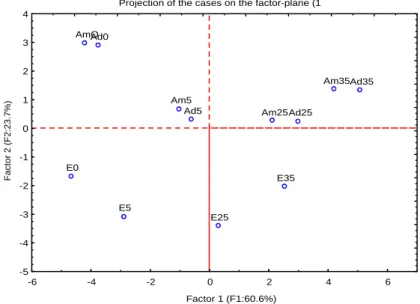
We projected the cases onto the same system of vectors; Figure 3 shows how the values of different variables for each Acacia refinement group are highly correlated amongst them, but that there is a marked difference between each refinement group.
E. globulus sheets also exhibit highly significant paper quality differences for each
refinement level, and quality is very different from that of Acacia paper.
Projection of the cases on the factor-plane (1
Ad0 Ad5 Ad25 Ad35 AmO Am5 Am25 Am35 E0 E5 E25 E35 -6 -4 -2 0 2 4 6 Factor 1 (F1:60.6%) -5 -4 -3 -2 -1 0 1 2 3 4 Factor 2 ( F 2:23.7%)
Figure 3 – Projection diagram of the cases on the factor plane (Am – A. melanoxylon; Ad – A. dealbata; E – E. globulus; 0 – no refining; 5 – 500 revolutions; 25 – 2500 revolutions and 35 – 4500 revolutions.
We also intend to repeat this analysis using median values instead of average ones, despite standard deviations being low for each group of 10 sheets we studied.
CONCLUSION
We conclude there is a group of paper characteristics which depend strongly on each other - paper density, smoothness, tensile index, stretch, burst index, Schopper Riegler degree, internal cohesion and WRV – and are negatively correlated with the light scattering coefficient,opacity and brightness.
On the other hand, intrinsic paper fibre resistance is strongly affected by fibre length and coarseness.
On the basis of the properties we studied, it is clear that paper produced from Eucalyptus fibre has different properties from that produced from Acacia fibre. Papers produced from both species of Acacia are similar.
REFERENCES
Balodis, V. and Clark, N.B. - Tropical acacia – the new pulpwood, Appita J. 51(19): 179 (1998).
Matheson, A. C., Harwood, C. E. and Michell, A. J. - Tropical Australian Acacias,
Appita J. 51(7): 261 (1998).
Paavilainen, L. - Quality-competitiveness of Asian short-fibre raw materials in different paper grades, Paperi já Puu – Paper and Timber, 82 (3): 156 (2000). Fuping, L. and Elias, R. - Suitability of Acacia pulp for wood-free coating base
papers, Proc. 57th Appita Ann. Conf., Melbourne, p. 69, (2003).
Gil, C., Amaral, M. E., Tavares, M. and Simões, R. - “Estudo do potencial papeleiro da Acacia spp”. Proc. 1º Encontro sobre Invasoras lenhosas, Gerés, Portugal, p. 171 (1999).
Clark, N.B., Balodis, V., Guigan, F. and Jingxia, W. – Pulping properties of tropical acacias, Proc. Int. Workshop on Advances in tropical acacia research, Bangkok, p.138 (1991).
Guigan, F., Balodis, V., Jingxia, W. and Clark, N.B – Kraft pulping properties of
Acacia mearnsii and A. silvestris, Proc. Int. Workshop on Advances in tropical acacia research, Bangkok, p.145 (1991).
Santos, A., Ofélia, A., Simões, R. - Paper making potential of Acacia – Appita