A randomized, double-blind, and
placebo-controlled study with
tranexamic acid of bleeding and
fibrinolytic activity after primary
coronary artery bypass grafting
Instituto de Cardiologia do Rio Grande do Sul,
Fundação Universitária de Cardiologia, Porto Alegre, RS, Brasil A.T.L. Santos, R.A.K. Kalil,
C. Bauemann, J.B. Pereira†
and I.A. Nesralla
Abstract
Cardiopulmonary bypass is frequently associated with excessive blood loss. Platelet dysfunction is the main cause of non-surgical bleeding after open-heart surgery. We randomized 65 patients in a double-blind fashion to receive tranexamic acid or placebo in order to determine whether antifibrinolytic therapy reduces chest tube drainage. The tranexamic acid group received an intravenous loading dose of 10 mg/ kg, before the skin incision, followed by a continuous infusion of 1 mg kg-1 h-1 for 5 h. The placebo group received a bolus of normal saline
solution and continuous infusion of normal saline for 5 h. Postopera-tive bleeding and fibrinolytic activity were assessed. Hematologic data, convulsive seizures, allogeneic transfusion, occurrence of myo-cardial infarction, mortality, allergic reactions, postoperative renal insufficiency, and reopening rate were also evaluated. The placebo group had a greater postoperative blood loss (median (25th to 75th percentile) 12 h after surgery (540 (350-750) vs 300 (250-455) mL, P
= 0.001). The placebo group also had greater blood loss 24 h after surgery (800 (520-1050) vs 500 (415-725) mL, P = 0.008). There was
a significant increase in plasma D-dimer levels after coronary artery bypass grafting only in patients of the placebo group, whereas no significant changes were observed in the group treated with tranexamic acid. The D-dimer levels were 1057 (1025-1100) µg/L in the placebo group and 520 (435-837) µg/L in the tranexamic acid group (P = 0.01). We conclude that tranexamic acid effectively reduces postoperative bleeding and fibrinolysis in patients undergoing first-time coronary artery bypass grafting compared to placebo.
Correspondence
A.T.L. Santos Unidade de Pesquisa Instituto de Cardiologia do Rio Grande do Sul Av. Princesa Isabel, 395 90620-001 Porto Alegre, RS, Brasil Fax: +55-51-3230-3600 E-mail: [email protected]
†In memoriam
Research supported in part by FAPERGS and Fundo de Apoio à Pesquisa do Instituto de Cardiologia do Rio Grande do Sul - Fundação Universitária de Cardiologia.
Received June 24, 2004 Accepted August 16, 2005
Key words •Tranexamic acid •Coronary artery bypass •Postoperative bleeding •Clinical trial
Introduction
In 1953, John Gibbon performed the first successful open-heart operation on a human patient using a heart-lung machine, starting the age of open-heart surgery. Blood
postoperative morbidity (2).
Pericardial blood activates the extrinsic coagulation pathway and nonendothelialized materials in the extracorporeal circuit acti-vate the intrinsic coagulation pathway dur-ing CPB. Despite systemic doses of heparin, thrombin generation is observed during CPB (3). Thrombin not only converts fibrinogen to fibrin, but is also the most powerful plate-let activator. It activates the endothelium and fibrinolysis via the release of tissue plas-minogen activator from the endothelium. Consequently, generalized fibrinolysis oc-curs during and immediately after CPB, as reflected by increased plasmin concentra-tions and fibrin degradation products, both of which have deleterious effects on platelet function (4-6). Increased fibrinolytic activ-ity and platelet dysfunction have been iden-tified as important factors of postoperative bleeding (7).
Antifibrinolytic drugs are used to pre-vent platelet dysfunction and to decrease perioperative bleeding. Recently, there has been increased interest in tranexamic acid (TA) as an alternative to the more expensive drug aprotinin. TA acts by forming a revers-ible complex with plasminogen and plasmin through the lysine-binding sites, thus block-ing interaction with the specific lysine resi-dues of fibrin. This process retards fibrinoly-sis because, although plasmin is still formed, it is unable to bind to fibrin (8). TA also preserves platelet function by reducing the effect of plasmin on platelet glycoprotein 1b receptors (9).
The aim of the present study was to de-termine the hemostatic and antifibrinolytic effect of TA in primary coronary artery by-pass grafting (CABG).
Material and Methods
A prospective, randomized, placebo-con-trolled, double-blind trial was designed to determine the antifibrinolytic and hemostatic effect of TA in CABG. After approval of the
study by the Hospital Ethics Committee, 65 patients undergoing primary non-emergent CABG who gave written informed consent to participate were enrolled. The groups were randomized by means of sequentially num-bered sealed envelopes opened by a nurse in the operating room. This method ensured that only the nurse, who prepared the infu-sions, knew whether a patient received drug or placebo. Criteria for preoperative exclu-sion included cardiac surgery reoperation, renal insufficiency (plasma creatinine con-centration higher than 2 mg/kg), and a his-tory of hematological disorders, hepatic dys-function or antiplatelet therapy within seven days of surgery.
The enrolled patients were assigned ran-domly to the TA or placebo group. The TA group received an intravenous loading dose of 10 mg/kg TA (Transamin; Química e Farmacêutica Nikkho do Brasil, Rio de Ja-neiro, RJ, Brazil) before the skin incision, followed by a continuous infusion of 1 mg kg-1 h-1 for 5 h. The placebo group received
a bolus of normal saline solution in an iden-tical syringe and continuous infusion of nor-mal saline for 5 h. The drugs were delivered in identical volumes. The staff in the operat-ing room and in the intensive care unit were not aware of the treatment.
The anesthetic protocol consisted of in-travenous thiopental, fentanyl citrate and pancuronium bromide. Maintenance of an-esthesia was obtained with fentanyl citrate and halothane or isoflurane. Exposure was provided by a median sternotomy. CPB was performed with an Oxim II-34 Ultra mem-brane oxygenator (Edwards Lifesciences, Irvine, CA, USA) and a Sarns CPB machine (Sarns, Ann Arbor, MI, USA) at a flow of 2.6 L min-1 m-2, under moderate systemic
CPB with protamine (Protamina 1000, 10 mg/mL; Produtos Roche Químicos e Farma-cêuticos) at the dose of 4 mg/kg. During CPB the activated coagulation time (ACT) was maintained higher than 600 s.
The mass of blood collected via medias-tinal and pleural drains for a period begin-ning with chest closure and lasting 24 h represented blood loss. The total volume of mediastinal blood shed after the operation was measured hourly, without knowledge of the study group. Bleeding was defined as excessive if greater than 750 mL/24 h. Ad-ministration of blood depended on bleeding, hemodynamic and laboratory data. Red blood cell (RBC) concentrates were transfused when hemoglobin (Hb) concentration was less than 7 g/dL. Old patients (more than 70 years old) were transfused when Hb concen-tration was less than 10 g/dL. The amount of RBC given to each patient was recorded. A cell salvage device was not used during the operation and postoperative period.
To assess the fibrinolytic activity in the two groups, quantitative D-dimer concen-trations were measured in the first 41 pa-tients after induction of anesthesia and 3 h after termination of CPB (serum D-dimer levels were measured in 41 patients because we only had one kit). Blood samples were collected into citrate-containing vacutainer tubes and centrifuged and plasma was fro-zen until the time of assay for D-dimer con-centration using the Asserachrom D-Di kit (normal 400 µg/L; Diagnostica Stago, Ashieres-Sour-Seine, France).
Preoperative laboratory tests included Hb, hematocrit (Ht), platelet count, prothrombin time (PT), activated partial thromboplastin time (aPTT), and plasma creatinine levels. ACT was recorded before and after heparin administration, every 60 min during CPB and after protamine infusion. Before heparin administration and after protamine infusion, coagulation assessment included PT, aPTT, plasma fibrinogen, and thrombin time. Hb and Ht levels were determined before and
after CPB and 24 h after the operation. Other clinical outcomes were also ana-lyzed, such as reopening rates, myocardial infarction (new persistent Q-wave and creat-ine kinase myocardial-band levels more than 30 U/mL), acute renal insufficiency (plasma creatinine concentration higher than 2 mg/ kg), number of RBC transfusions, allergic reactions, convulsive seizures, mortality, and stroke (stroke as neurologic complication was defined by hemiparesis, hemiplegia, aphasia, or confusion and disorientation).
The sample size calculation was based on retrospective data from our institution showing that 10 consecutive patients under-going primary, non-emergent CABG had an average postoperative blood loss of 840 mL. On the basis of a clinically relevant blood loss difference of 250 mL (30%) and an standard deviation of 300 mL, we deter-mined a sample size of 24 patients in each group with a power of 80% and a type 1 error of 5%.
Analysis was performed following the “on treatment” rule, by accepting that non-compliance and protocol deviations were unlikely to occur in this kind of trial.
The Kolmogorov-Smirnov test was used to test the normality of the distribution of the continuous variables. Nonparametric as well as non-normally distributed data are reported as median and 25th to 75th percentiles and were evaluated by the Mann-Whitney U-test. Normally distributed data were ana-lyzed by the Student t-test or by analysis of variance for repeated measures (ANOVA) and are reported as means ± SD. Categorical data were analyzed by the chi-square test. A P value less than 0.05 was considered to be statistically significant.
Data were analyzed using the commer-cial statistical package SPSS for Windows®,
Version 11.0 (SPSS Inc., Chicago, IL, USA).
Results
65 patients were enrolled into the two groups and 60 patients completed the study accord-ing to protocol and were considered for sta-tistical analysis. Five patients were excluded from the sample before analysis due to pro-tocol violation. Two patients in the TA group and 2 patients in the placebo group were excluded from the study because they had received the loading dose after heparin ad-ministration. One patient in the TA group was excluded because he underwent com-bined intervention of coronary revasculari-zation and aortic valve replacement and the blood samples were taken at irregular inter-vals.
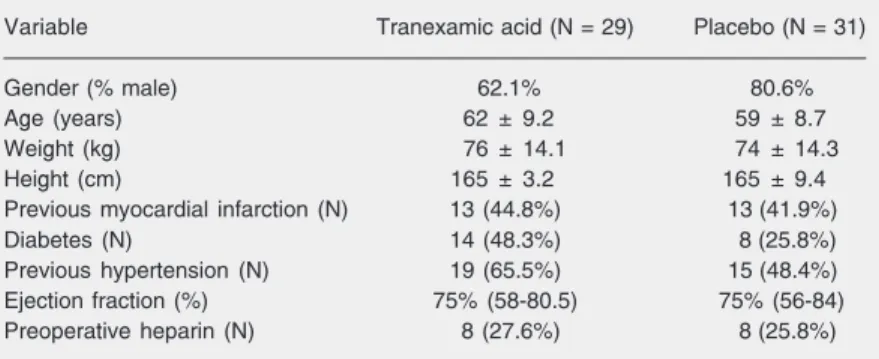
The study groups were comparable with respect to demographic and baseline charac-teristics (Table 1). The two groups were also homogeneous with respect to preoperative laboratory data including Ht, Hb, PT, aPTT, platelets, and creatinine and there were no significant differences between groups in
any coagulation variable (PT, aPTT, ACT, thrombin time, and fibrinogen) at any time point during the study. Plasma Ht levels in both groups decreased after CPB (P = 0.04). The aortic cross clamping, CPB time, anes-thesia time, number and type of graft used were very similar in both groups.
Patients in the TA group had a signifi-cantly lower postoperative blood loss than the placebo group (Table 2). The placebo group had a greater median blood loss in the first 12 h (540 (350-750) mL) than the TA group (300 (250-455) mL), P = 0.001. The placebo group also had greater blood loss at
24 h after surgery (800 (520-1050) vs 500
(415-725) mL, P = 0.008). Fourteen patients (54.8%) in the placebo group lost more than
750 mL of blood postoperatively, vs 7
(24.1%) in the TA group.
D-dimer levels were measured in 41 pa-tients (22 in the placebo group and 19 in the TA group). Before CPB, the median concen-tration of D-dimer in both groups was within the laboratory’s normal range, i.e., 190 (122-306) µg/L in the placebo group and 280 (160-490) µg/L in the TA group. Three hours after completion of CPB, the median D-dimer levels were 1057 (1025-1100) µg/L in the placebo group and 520 (435-837) µg/L in the TA group (P = 0.01).
Postoperative transfusion details are shown in Table 2. No patient received plate-lets throughout the study and one patient in the placebo group received two units of fresh frozen plasma. Two patients were re-ex-plored for excessive bleeding (one each in the placebo group and TA group). These patients were not excluded from the study. The patient in the TA group lost 2100 mL of blood and the other patient had no obvious bleeding point and lost 2700 mL. There were 2 perioperative (postoperative) deaths in the placebo group, as opposed to none in the TA group. One of these two patients developed cardiogenic shock on the 2nd postoperative day and the other had ventricular fibrillation on the 5th postoperative day. There were no Table 1. Demographic and baseline characteristics of the patients studied.
Variable Tranexamic acid (N = 29) Placebo (N = 31)
Gender (% male) 62.1% 80.6%
Age (years) 62 ± 9.2 59 ± 8.7
Weight (kg) 76 ± 14.1 74 ± 14.3
Height (cm) 165 ± 3.2 165 ± 9.4
Previous myocardial infarction (N) 13 (44.8%) 13 (41.9%)
Diabetes (N) 14 (48.3%) 8 (25.8%)
Previous hypertension (N) 19 (65.5%) 15 (48.4%)
Ejection fraction (%) 75% (58-80.5) 75% (56-84)
Preoperative heparin (N) 8 (27.6%) 8 (25.8%)
Data are reported as means ± SD or median (25th-75th percentile) and number (%).
Table 2. Postoperative bleeding and transfusion data.
Tranexamic acid (N = 29) Placebo (N = 31)
Total blood loss (mL) 500 (415-725)* 800 (520-1050)
RBC (units/patient) 0.48 0.71
Patients transfused with RBC (%) 24 39
Data are reported as median (25th-75th percentile), number (%) or as indicated. RBC = red blood cells.
allergic reactions in either group. There were 2 perioperative myocardial infarctions in the placebo group, as opposed to none in the TA group. No patients in the TA group devel-oped renal dysfunction and one patient in the placebo group had renal dysfunction, with death occurring after cardiogenic shock on the 2nd postoperative day. No patients in the placebo group developed stroke, while there were two cases in the TA group.
Discussion
Three antifibrinolytic drugs, two synthetic
ones, the lysine analogues ε-aminocaproic
acid (EACA) and TA, and a natural one (aprotinin), are available for use in cardiac surgery. Administration of antifibrinolytics can reduce postoperative bleeding and mini-mize transfusion requirements. We chose a population of patients submitted to primary coronary artery grafting in order to deter-mine if antifibrinolytic therapy is effective in a setting that usually does not involve excessive blood losses. Patients at particu-larly high risk of postoperative bleeding (his-tory of hematological disorders, cardiac reoperation, antiplatelet therapy) were ex-cluded from the study.
The efficacy of aprotinin is supported by numerous studies but the treatment for one patient is expensive and can be associated with anaphylactic reactions on reexposure, thus making the compound unsuitable for routine use in first-time procedures associ-ated with the smallest risk of excessive post-operative blood loss. TA and EACA may be useful blood-sparing drugs in cardiac sur-gery. TA has greater efficacy, a longer half-life, stronger plasminogen binding, and a more sustained antifibrinolytic effect than EACA (10).
We administered TA before incision be-cause of the rapid release of tissue plasmin-ogen activator with subsequent fibrinolysis after skin incision (11). However, a study by Pleym et al. (12) showed that TA given over
5 min immediately before the start of CPB reduces postoperative bleeding in first-time CABG patients. The ideal dosage of TA remains controversial. The literature does not give precise indications. TA has been used in a wide range of doses. In the present study, the dose of 10 mg/kg followed by a continuous infusion of 1 mg kg-1 h-1 for 5 h
was that used by Horrow et al. (13). Fiechtner et al. (14) reported that the dosing regimen of 10 mg/kg followed by a continuous infu-sion of 1 mg kg-1 h-1 results in adequate
plasma concentrations to prevent fibrinoly-sis, with relatively stable drug levels through-out CPB. A recent study showed that the dose of 10 mg/kg followed by a continuous infusion of 1 mg kg-1 h-1 during the operation
reduces postoperative bleeding (15). Antifi-brinolytic treatment during the postopera-tive period does not reduce postoperapostopera-tive bleeding and routine prolongation of antifi-brinolytic treatment is not indicated (16).
In the present prospective, double-blind, placebo-controlled study, we demonstrated that patients who were treated with TA had a 38% lower postoperative blood loss com-pared with patients who received placebo. The findings of the present study are consist-ent with other reports that illustrate the effi-cacy of TA in reducing blood loss after primary cardiac surgery (17,18).
Although a trend was noted, the study was not sufficiently powered to show a sig-nificant difference in the likelihood of RBC transfusion.
pa-tients undergoing CABG with CPB and in those undergoing CABG without CPB (20). Strategies with antifibrinolytics to im-prove hemostasis during cardiac surgery may result in an increased risk of myocardial infarction. Dunn and Goa (8) did not report any study showing a greater incidence of thrombotic events in patients receiving TA. The low risk for intravascular thrombosis with TA may be important in patients under-going CABG with a newly vascularized myocardium (21). Levi et al. (22), in a meta-analysis, showed that treatment with lysine analogues such as TA and EACA was not associated with an increased risk of periop-erative myocardial infarction, but was asso-ciated with a trend towards a decrease in the frequency of this complication.
Laupacis and Ferguson (23), in a meta-analysis, reported that the use of aprotinin was associated with a non-significant in-crease in perioperative myocardial infarc-tion (8 vs 5.6%). Another meta-analysis has shown that, although there was an almost identical overall myocardial infarction rate, the occurrence of infarction was 8.1% in patients treated with the conventional (high) doses of aprotinin compared with 3.9% in patients treated with lower doses (OR =
2.15, 95% CI = 1.12-4.11) (22).A
multicen-ter study for analysis of coronary graft pa-tency after aprotinin reported that the use of aprotinin in patients having primary CABG,
in whom the primary distal target vessel was less than 1.5 mm in diameter or of poor quality, may adversely affect the vessel pa-tency (24). This is important because the surgical patient is changing with the rise in interventional cardiology, and most patients have worse vessels. The inhibition of
pro-tein C and increase in thromboxane A2
pro-duction by aprotinin may be responsible for the potential increase in thrombotic compli-cations related to aprotinin administration (21,25).
Even with pooling, the number of ran-domized patients is insufficient to detect a significant difference in myocardial infarc-tion with the use of antifibrinolytics. A large prospective controlled trial with myocardial infarction as the primary outcome will pro-vide definitive epro-vidence.
There were no statistical differences be-tween TA and placebo treatment in terms of postoperative mortality and other complica-tions such as allergic reaction, stroke, post-operative renal insufficiency, reopening rate, and convulsive seizures in the present study. In conclusion, the study indicates that intraoperative use of tranexamic acid in pa-tients undergoing coronary artery bypass grafting with cardiopulmonary bypass is ef-fective in reducing postoperative blood loss and fibrinolysis. A large prospective ran-domized clinical trial is needed to confirm the safety of tranexamic acid.
References
1. Estafanous FG (1991). Bleeding hearts. Journal of Cardiothoracic and Vascular Anesthesia,5 (Suppl 1): 2-3.
2. Moulton MJ, Creswell LL, Mackey ME et al. (1996). Reexploration for bleeding is a risk factor for adverse outcomes after cardiac operation. Journal of Thoracic and Cardiovascular Surgery, 111: 1037-1046.
3. Kojima T, Gando S, Kemmotsu O et al. (2001). Another point of view on the mechanism of thrombin generation during cardiopulmonary bypass: role of tissue factor pathway inhibitor. Journal of Cardiotho-racic and Vascular Anesthesia, 15: 60-64.
4. Adelman B, Rizk A & Hanners E (1988). Plasminogen interactions with platelets in plasma. Blood, 72: 1530-1535.
5. Spiess BD (1991). The contribution of fibrinolysis to bypass bleed-ing. Journal of Cardiothoracic and Vascular Anesthesia, 5 (Suppl): 13-17.
6. Boyle EM, Verrier ED & Spiess BD (1997). The procoagulant re-sponse to injury. Annals of Thoracic Surgery, 64 (Suppl): 16-23. 7. Holloway DS, Summaria L, Sandesara J et al. (1988). Decreased
platelet number and function and increased fibrinolysis contribute to postoperative bleeding in cardiopulmonary bypass patients. Throm-bosis and Haemostasis, 59: 62-67.
8. Dunn CJ & Goa KL (1999). Tranexamic acid. A review of its use in surgery and other indications. Drugs, 57: 1005-1032.
antifibrinolyt-ics in cardiac surgery. Canadian Journal of Anaesthesia, 39: 353-365.
10. Verstraete M (1985). Clinical application of inhibitors of fibrinolysis.
Drugs, 29: 236-261.
11. Mellbring G, Dahlgren S & Wiman B (1985). Plasma fibrinolytic activity in patients undergoing major abdominal surgery. Acta Chirurgica Scandinavica, 151: 109-114.
12. Pleym H, Stenseth R, Wahba A et al. (2003). Single-dose tranexamic acid reduces postoperative bleeding after coronary surgery in pa-tients treated with aspirin until surgery. Anesthesia and Analgesia, 96: 923-928.
13. Horrow JC, Van Riper DF, Strong MD et al. (1995). The dose response relationship of tranexamic acid. Anesthesiology, 82: 383-392.
14. Fiechtner BK, Nuttall GA, Johnson ME et al. (2001). Plasma tranexamic acid concentrations during cardiopulmonary bypass.
Anesthesia and Analgesia, 92: 1131-1136.
15. Zabeeda D, Medalion B, SverdLov M et al. (2002). Tranexamic acid reduces bleeding and the need for blood transfusion in primary myocardial revascularization. Annals of Thoracic Surgery, 74: 733-738.
16. Casati V, Bellotti F, Gerli C et al. (2001). Tranexamic acid adminis-tration after cardiac surgery: a prospective, randomized, double blind, placebo controlled study. Anesthesiology, 94: 8-14. 17. Brown RS, Thwaites BK & Mongan PD (1997). Tranexamic acid is
effective in decreasing postoperative bleeding and transfusions in primary coronary artery bypass operations: a double-blind, random-ized, placebo-controlled trial. Anesthesia and Analgesia, 85: 963-970.
18. Casati V, Guzzon D, Oppizzi M et al. (1999). Hemostatic effects of aprotinin, tranexamic acid and ε-aminocaproic acid in primary
car-diac surgery. Annals of Thoracic Surgery, 68: 2252-2257. 19. Horrow JC, Hlavacek J, Strong MD et al. (1990). Prophylactic
tranexamic acid decreases bleeding after cardiac operations. Jour-nal of Thoracic and Cardiovascular Surgery, 99: 70-74.
20. Casati V, Gerli C, Franco A et al. (2004). Effects of tranexamic acid on postoperative bleeding and related hematochemical variables in coronary surgery: comparison between on-pump and off-pump tech-niques. Journal of Thoracic and Cardiovascular Surgery, 128: 83-91.
21. Pinosky ML, Kennedy DJ, Fishman RL et al. (1997). Tranexamic acid reduces bleeding after cardiopulmonary bypass when com-pared to epsilon aminocaproic acid and placebo. Journal of Cardio-vascular Surgery, 12: 330-338.
22. Levi M, Cromheecke ME, de Jonge E et al. (1999). Pharmacological strategies to decrease excessive blood loss in cardiac surgery: a meta-analysis of clinically relevant endpoints. Lancet, 354: 1940-1947.
23. Laupacis A & Ferguson D (1997). Drugs to minimize blood loss in cardiac surgery: a meta-analysis using perioperative blood transfu-sion as the outcome. Anesthesia and Analgesia, 85: 1258-1267. 24. Alderman EL, Levy JH, Rich JB et al. (1998). Analyses of coronary
graft patency after aprotinin use: results from the international multi-center aprotinin graft patency experience (IMAGE) trial. Journal of Thoracic and Cardiovascular Surgery, 116: 716-730.