Changes in the accumulation of shikimic
acid in mycorrhized
Capsicum annuum
L.
grown with application of glyphosate
and phosphorus
José Beltrano
1,2*, Marcela Ruscitti
1, Cecilia Arango
1, Marta Ronco
1,21 Instituto de Fisiología Vegetal, Facultad de Ciencias Agrarias y Forestales, CCT CONICET La Plata Universidad Nacional de La Plata, La Plata, Argentina.
2CICBA,ComisióndeInvestigacionesCientíficasdelaProvinciadeBuenosAires,Argentina. *Corresponding author: [email protected]
Received: 22 February 2013; Accepted: 29 May 2013
ABSTRACT: When glyphosate is added to the soil, it is absorbed by roots and transported by xylem causing growth inhibition in
plants.Mycorrhizaisthebeneficialassociationbetweenrootsofmostplantsandsoilfungi.Themethylphosphonicgroupofthe glyphosatecouldcompetewithinorganicphosphatesforsorptionsitesinthesoil.Theaimofthisworkwastostudytheeffectof
phosphorus availability and glyphosate residues in soil on pepper plant growth, and on physiological parameters, in plants non-inoculated or non-inoculated with Glomus mosseae or G. intraradices .Thephytotoxiceffectsoftheglyphosatewereassessedbyabio-indicatorasshikimicacid.Athighdoses,glyphosate(6.32μM)reducedrootcolonization,andthiseffectwasincreasedbyhigher levelsofphosphorusinthesoil.Theeffectsofherbicideonshikimicacidaccumulationandonshootgrowthbegan24hoursafter glyphosatetreatments(HAT).At24,48,and72HAT,inoculatedplantsgrownwithoutglyphosateshowedhighergrowthcompared
tothenon-inoculatedones.Athighglyphosate(6.32μM)and96HAT,thegrowthwascompletelyinhibited.Theshikimicacidaccu
-mulatedintheupperleavesofnon-inoculatedplants,treatedat3.16μMglyphosate,wassignificantlyhigherathighPlevel,related toinoculatedones.Theseresultssuggestthattheremobilizationofglyphosateresiduesinthesoilbytheadditionofphosphate shouldbeconsideredaseriousproblemforcropsintreatedsoils.Themycorrhizationincreasesthepepperplant’stolerancetohigh
glyphosate concentration in the substrate, and may allow support to this stress condition.
KEYWORDS:Capsicum annuumL,glyphosate-phosphorusinteraction,pepper,shikimicacid.
INTRODUCTION
Glyphosate (GL), the most widely used herbicide, has become the leading post-emergence, systemic, non- selective, broad-spectrum herbicide, for controlling both annual and perennial weeds. GL is widely used for weed control in plantation crops as no-tillage systems, transgenic crops, and cover crops (Cruz-Hipolito et al. 2009). GL interferes with the shikimic acid pathway by competitive inhibition of 5-enolpyruvyl-shikimate-3-phosphate synthase (EPSPS) (EC 2.5.1.19), a chloroplast-localized enzyme in plants, and thereby blocking the synthesis of the essential aromatic amino acids phenylalanine, tyrosine, and tryptophan. The inhibition of EPSPS results in shikimate accumulation, which has been related to diminution of photosynthesis, in aromatic amino acid synthesis and in the plant growth (Duke et al. 2003). Therefore, the intracellular accumulation of shikimate can be used as a sensitive physiological indicator for GL toxicity (Henry et al. 2007).
GL is a systemic herbicide that is first absorbed by foliage and then translocated throughout the plant to metabolic sinks such as meristems of shoots and roots. Inhibition of growth occurs almost immediately, followed by chlorosis at the newest growing points and necrosis throughout the plant within 1–2 weeks (Shaner 2000, Henry et al. 2007). When GL is added to the soil, it is absorbed by the roots and transported by xylem, as has been shown in tomato (Cornish 1992), pepper (Ronco et al. 2008), and birdsfoot trefoil (Clua et al. 2012). Neumann et al. (2006) have shown that GL can be exuded from the roots of senescing weeds into the soil, stunting growth of adjacent plants and seedlings. Salazar and Appleby (1982) showed that GL could cause injury in some species through intake from the soil if the herbicide remained available there for a certain period of time. Moreover, Cornish (1992) found injury in tomato plants, when they were transplanted into a soil previously treated with GL and phosphorus (P) and Ronco et al. (2008) found similar results in pepper plants.
Besides, the relationship between the GL sorption and the soil capacity to adsorb phosphates is clear from the literature of Hance (1976). Since the methylphosphonic group of the GL could compete with inorganic phosphates for adsorption sites in the soil, giving rise to a GL-P interaction in soils (Dion et al. 2001, Gimsing and Boggaard 2002, Bott et al. 2011, Clua et al. 2012). The dissipation of GL from soils, expressed as its half-life in soils, is variable with the soil type with a half-life from less than a week to two months (Roy et al. 1989).
Considering these findings, it seems that GL can persist for a certain period of time in the soil solution through being available by root absorption in the successive crops. The ability to absorb the soil particles and its mobility through the soil
profile contributes to the accumulation of herbicides in soil. The GL adsorption to soil matrix increases its persistence; it becomes less bio-available, and its biodegradation is retarded (Sorensen et al. 2006). A part of the adsorbed herbicide can be desorbed in the soil, whereas the other part remains strong bound and, consequently, low-available biologically. In such form, the GL can be preserved in soil for at least 2 years. Once bound to soil, particles of GL are metabolized by microorganisms to aminomethylphosphonic acid and eventually degraded to produce the phosphoric acid, ammonia, and carbon dioxide. GL adsorption in soils seems to be mediated by ligand exchange via the phosphonate group of the molecule, in a way similar to the adsorption of phosphate (Hance 1976, Dion et al. 2001, Gimsing and Borggaard 2002). Therefore, it has been frequently demonstrated that phosphate and GL compete for adsorption sites (Borggaard and Gimsing 2008, Clua et al. 2012). Depending on the soil conditions, phosphate concentration is the most important factor determining the amount of GL adsorbed (Borggaard and Gimsing 2008), and plays an important role in determining the bioavailability of GL in soils (Laitinen et al. 2007). Borggaard (2011) reported that the influence of phosphate on GL fate in soils seems very complex, and despite many useful studies with selected soils/sites and individual soil components, the precise picture is still not clear as indicated by recent overviews on GL (Borggaard and Gimsing 2008). Sprankle et al. (1975) found that the main factor in determining the amount of GL adsorbed on soil particles is the soil phosphate level.
Herbicide residues in soil can modify the growth and development of plants. Once absorbed by roots, GL is translocated throughout the parts of the plant. Laitinen et al. (2007) demonstrated that in very young plants (herbicide spraying at 6–8 leaf stage), about 1% of the applied GL was
found in 0–10 mm soil layer within 1 hour after the application. In the older plants (application at 12–14 leaf stage), 8 days after
the application, GL was detected both in soil and roots, but soil concentration was lower than that observed in younger plants, authors concluded that the residues found are derived from translocation via shoots to roots and further exudation from roots to soil. These results support the hypothesis that GL translocation from plants to soil constitutes detectable GL residues in soil (Laitinen et al. 2007, Neumann et al. 2006). The translocated amounts of GL may vary significantly. Rapid release via roots into the rhizosphere, may result in high concentrations of GL in soil, and can cause negative effects in non-resistant plants (Neumann et al. 2006, Ronco et al. 2008).
association allows plants to explore larger volumes of soil to absorb more water and nutrients, provides resistance to soil pathogens and to drought stress, and improves water-use efficiency. Also, mycorrhizal symbiosis delays senescence, increases leaf area, modifies root architecture (Beltrano et al. 2003), and enhances phosphorus P absorption, especially when P-availability is limited.
The rate of absorption of phosphate by growing roots is much higher than the rate of soil phosphate diffusion, which results in the formation of a depletion zone at the root system level and, consequently, limits the supply of P to the plant (Cruz-Hipolito et al. 2009). De Jonge et al. (2001) demonstrated that different levels of phosphate in soils affect the GL adsorption. GL adsorption was reduced in soils with higher phosphate content, enhancing GL mobility and crop growth. The plants have evolved elaborating mechanisms to facilitate phosphate uptake, including the formation of symbiotic associations with soil fungi (mycorrhizal), resulting in the acquisition of new sources of soluble phosphate.
Pepper (Capsicum annuum L.) is one of the most common crops grown in temperate latitudes, and one of the most important in the horticultural belt of Argentina (Ronco et al. 2008). However, little information is available regarding the effects of GL-P interaction in soil on pepper plant growth. The present study was initiated to test the hypothesis that P fertilization can increase the bioavailability of GL residues in soil, and this would negatively affect the growth of pepper plants and the AM symbiosis. The aim of the present work is to study the effect of P availability and GL residues in soil on pepper plant growth, shikimic acid partition, and physiological parameters, in AM inoculated and non-inoculated plants. The phytotoxic effects were assessed through biochemical and physiological parameters. The potential mobilization of GL by phosphate in soil and its subsequent uptake by pepper plants grown in soil, with or without GL and at two P levels, were evaluated by a bio-indicator as shikimic acid (SHA).
MATERIAL AND METHODS
Growth conditions: Seeds of pepper (C. annuum L., ‘California Wonder 300’) were sown in 0.5 L plastic pots, filled with a mix of the vermiculite, perlite and soil (1:1:1). The soil used was a Vertic Argiudoll (pH 5.5, 10 mg kg-1 total
P, 3.5% organic matter, 2.0% total C, 0.24% total N), which was tyndallized at 100°C for 60 min for three alternate days,
for eliminating native AM propagules. The experiments were conducted in La Plata (34° SL, 54’WL), Argentina. Pepper plants were grown in a greenhouse between October and December, under natural conditions.
The inoculums (10% of the substrate weight), added to the “inoculated” pots at sowing time, were a mix of soil, spores (50 spores g-1 inoculum), mycorrhizal root fragments, and
mycelium of Glomus mosseae (SB1 isolation; GM) and Glomus intraradices (GI) Glomus intraradices (GI) Schenck & Smith (recently reassigned to G. irregulare and then Rhizophagus irregularis (Błaszk, Wubet, Renker & Buscot) C. Walker & A. Schüßler comb. Nov. (Stockinger et al. 2009). The same amount of sterilized inoculum was added to non-inoculated pots in order to provide the same soil conditions.
The plants were cultivated, during the experiment, under two levels of P: 10 mg kg-1 soil (-P) (soil content) or 100 mg kg-1
soil (+P) as (KH2PO4); that was added at the beginning of the experiment.
When root colonization was approximately 50%, GL (RoundUpTM; 360 g isopropylamine salt of GL L-1) was added
to the soil as solution, to reach concentrations of 0 (G0); 0.5 (G5: 3.16 μM); and 1.0 (G10: 6.32 μM) of the recommended dose to be applied in the field (equivalent to 4 L commercial product containing 36% a.i. ha-1).
Estimation of AM colonization: Fungal colonization was evaluated according to Trouvelot et al. (1986) and expressed as rate of mycorrhization (M%). The M% was calculated as the proportion of infected roots relative to the total number of root fragments. The viability of the hyphae was determined by measuring succinate dehydrogenase (SDH) activity (Schaffer and Peterson 1993). Roots were stained with acid Fuchsin and 1 mg mL-1 nitro-blue tetrazolium chloride (NTB) solution.
Three replicates of 30 randomly chosen root fragments (10 mm long) were mounted on slides and examined microscopically.
Growth parameters: Shoot height was measured daily on ten plants per treatment and the growth was expressed as percentage of increase compared to non-inoculated plants without GL treatments and with -P level. The measuring process started 44 days after sowing (DAS).
according to Moran and Porath (1980). The total proteins extraction was carried out by homogenizing the material in 0.1 M Tris HCL buffer pH 7.5. The proteins were determined by Bradford’s method (Bradford 1976), using bovine albumin as standard. Absorption spectra were recorded in a Shimadzu UV-160 spectrophotometer (Kyoto, Japan). Results were expressed as μg chlorophyll or μg protein cm-2.
Cell membrane stability (CMS): CMS in leaves and roots was determined in 500 mg of leaves or roots per treatment, according to Sullivan and Ross (1979). The conductivity was determined using a Conductivity meter (DIGICOND IV, Luftman Co., Argentina). CMS was determined according to the following equation:
%CMS = (1–(T1/T2))/(1–(C1/C2))100
where T and C refer to conductivity of treated and control sampled. T1 and C1 represent the electrolyte leakage (dS m-1) after incubating the sample in de-ionized water
at 25°C for 4 h. T2 and C2 represent the total electrolyte concentration measured after heating the samples in boiling water for 60 min and cooled at room temperature. T1 and T2 correspond to the first and second solution conductivity determinations of treated samples, and C1 and C2 are the respective values for the controls.
Quantification of shikimic acid (SHA): SHA quantification was determined in 200 mg of upper leaves, lower leaves, cotyledons or roots samples per treatment. The samples were immediately treated with HCl 0.25 N and stored at -20°C until SHA determination. The amount of SHA was determined according to Singh and Shaner (1998). Samples were measured in a spectrophotometer at 380 nm. Values were compared to a standard curve for SHA. Results were expressed as µL g-1 FW.
Statistical analysis: The experiment was a 3×3×2 factorial, in completely randomized design, with three mycorrhizal levels (non-inoculated plants (NM); inoculated plants with GM and inoculated plants with GI), three levels of GL: 0 (G0); 0.5 (G5: 3.16 μM); and 1.0 (G10: 6.32 μM)) and two P levels (-P: 10 and +P: 100 mg kg-1 soil), with 10 replicates
(one plant/pot) per treatment in a completely randomized design. All data were analyzed using Analysis of Variance (ANOVA). Tukey’s test (p<0.05) was used to evaluate the differences between treatments and interaction means, using
SigmaStat 3.5 software (Systat Sofware, Inc., San Jose, CA, USA). For statistical analysis, all percentage values were arcsine transformed to improve homogeneity. The number of replicates was: for growth data (n=10), for mycorrhizal observations (n=3 replicates of 30 root fragments).
RESULTS
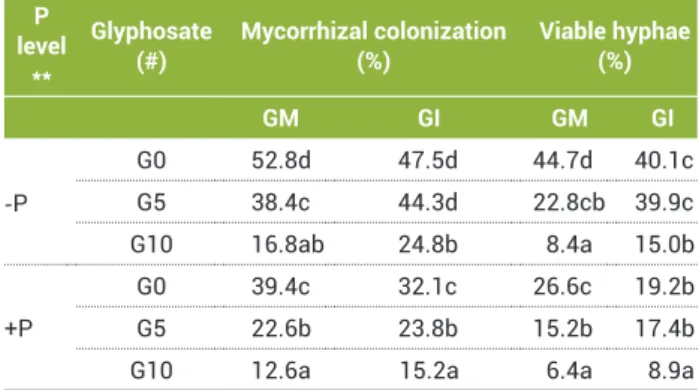
Mycorrhization: AM fungal colonization of pepper roots was observed for all inoculated (M) plants, while none of the non-inoculated (NM) plants was colonized by GM or GI. Forty-eight DAS, at low P level and non GL added to soil (MG0-P), the level of root colonization and the viability of hyphae, assessed by SDH activity, was high (Table 1).
Mycorrhizal plants declined with an increase in GL content in the soil. With low P level and 3.16 µM GL in soil (G5), root colonization by GM and GI was reduced by 27% and 7%, respectively, compared to G0 treatment (Table 1). When GL in soil was 6.32 µM (G10), the colonization reduction was by 68% for GM and by 48% for GI. At high P and high GL levels, the root colonization by GM and GI was reduced by 68% and 52% respectively, compared to G0+P treatment. The viability of hyphae, assessed by SDH activity at low GL concentration, was only affected in GM, regardless of phosphorus treatments, and decreased significantly (more than 50%) with high GL (G10) concentration, regardless of P and mycorrhizal fungi (Table 1).
Table 1.Effectsofglyphosateandphosphorusconcentrationson
mycorrhizal colonization and viable hyphae in Capsicum annuum
L. plants, inoculated with Glomus mosseae (GM) orGlomus intraradices(GI),48daysaftersowing
P level
**
Glyphosate (#)
Mycorrhizal colonization (%)
Viable hyphae (%)
GM GI GM GI
-P
G0 52.8d 47.5d 44.7d 40.1c
G5 38.4c 44.3d 22.8cb 39.9c
G10 16.8ab 24.8b 8.4a 15.0b
+P
G0 39.4c 32.1c 26.6c 19.2b
G5 22.6b 23.8b 15.2b 17.4b
G10 12.6a 15.2a 6.4a 8.9a
Growth: The effects of GL on inoculated or non- inoculated pepper plants were assessed by shoot growth, electrolyte leakage, shikimic acid content, and chlorophyll and protein contents. Six and twelve hours after GL treatments (HAT). the growth of shoots and biochemical parameters did not show significant differences in spite of mycorrhizal, GL, or P treatments (data not shown). The effects of herbicide on the biochemical parameters (shikimic acid) and on the shoot growth began 24 HAT.
All growth results were compared with the control treatment (NMG0-P); in GL treatment and high P level (+P), the results also were compared with NMG0+P. During the assessed period (24, 48, 72 and 96 HAT), the plants that grew without GL and inoculated with GM or GI showed higher growth compared to the non-inoculated plants, regardless of the P level (Figure 1).
Twenty-four HAT, the shoot growth was higher in the GL untreated plants (G0) and declined with increasing GL rate, regardless of inoculation treatment. At G5 treatment and low P level (G5-P), shoot growth was significantly reduced both in non-inoculated and inoculated plants, compared with
NMG0-P. While, G5+P treatment showed a reduction of 3% for GM, and an increment of 4% for GI, compared to NMG0-P, but when compared with NMG0+P the reduction percentage were 38% for NM, and less than 10% for GM and GI. High GL concentration (6.32 μM), affected significantly the plant growth. At low P level (G10-P), growth reduction was higher than 50% for GM and GI mycorrhizal treatments and approximately 70% for NM, compared with NMG0-P. At high P level (G10+P), shoot growth was significantly reduced in NM whereas, in mycorrhizal plants was nearly 17%, regardless the inoculum incorporated, respect to NMG0-P (Figure 1), and by 54% for NM and 20% for GM and GI, compared with NMG0+P.
At 48 HAT, the growth rate in inoculated plants, at G0 treatment, was lower than that of 24 HAT. At G5, regardless P level, the shoot growth reduction in NM was higher than in inoculated plants, and GI plants showed high reduction percentages than GM (Figure 1). At G10-P, the growth reduction was higher than 70% for NM and more than 50% for inoculated plants, respect to NMG0-P and, as in G5 treatment, GI plants had higher percentage than GM. At G10+P the
NM GM GI
-P +P +P +P
G0 G5 G10
48 HAT
NM GM GI
G0 G5 G10
72 HAT
Treatments Treatments
NM GM GI
-P +P
G0
-P
-P -P +P
G5 -P +P G10 96 HAT -100 -80 -60 -40 -20 0 20 40 60 80 100 Gro wt h (% )
NM GM GI 24 HAT
G0 G5 G10
-P +P -P +P -P +P
-P +P -P +P -P +P
-100 -80 -60 -40 -20 0 20 40 60 80 100 -100 -80 -60 -40 -20 0 20 40 60 80 100 -100 -80 -60 -40 -20 0 20 40 60 80 100 Gro wt h (% ) Gro wt h (% ) Gro wt h (% ) Treatments Treatments Figure 1.Effectsofglyphosateandphosphorusconcentrationsonpercentageshootsgrowth(24,48,72and96hoursafterglyphosate
treatments (HAT) in Capsicum annuum L. plants, non-inoculated (NM) or inoculated with Glomus mosseae(GM)orGlomus intraradices
(GI).-P:10mgPkg––1soil;+P:100mgPkg––1soil;G0,withoutglyphosate;G5,3.16μMglyphosate;G10,6.32μMglyphosate.(n=10).
reduction was similar to G10-P, respect to NMG0-P. Similar results were found when compared to NMG0+P.
At 72 HAT, the GL-treated plants showed significantly lower growth than non-treated ones, and inoculated plants showed higher growth than non- inoculated ones (Figure 1). At G5 there were no significant difference between -P and +P treatments, the growth reduction was approximately 60% for non-inoculated plants, and by 43–50% for inoculated plants, respect to NMG0-P whereas, when the growth was compared with NMG0+P, this reduction was higher. The higher GL concentration significantly reduced the growth respect to NMG0-P. At -P level, in non-inoculated plants the reduction was higher than 75%, whereas, in inoculated plants the percentages were about 60% for GM and GI. In G10+P treatments the percentages were higher than -P (Figure 1). The reduction was by 88%, 68%, and 77% for NM, GM, and GI, respectively when compared with NMG0+P.
At 96 HAT, the growth was completely inhibited in all GL treatments, regardless of P level and mycorrhizal treatments (Figure 1).
Shikimic acid: At sixth and twelfth HAT, the SHA content was lower than the basal level (<100 μL g-1 FW) and did not
show significant differences regardless of mycorrhiza, GL, and P treatments (data not shown). The effects of herbicide on SHA content began 24 HAT.
The SHA content was lower than the basal level in all untreated plant fraction at 24, 48 and 72 HATs, regardless of mycorrhizal and P treatments, either in upper and lower leaves, or cotyledons and roots (Figures 2–5). The non-inoculated or inoculated pepper plants exhibited significant differences in herbicide absorption and translocation, assessed by SHA content.
At 24 HAT, in GL treatments, the upper leaves showed a difference in SHA content between NM and mycorrhizal plants (Figure 2). At G5, the inoculated plants had a delayed response, and the SHA content was lower than in non-inoculated ones, and at +P level (Figure 1B) than at -P level (Figure 2A). At G10, no significant differences were observed between NM and GM, regardless of P treatments, while the SHA content in GI decreased significantly, regardless of P treatment related to NMG0. At 48 HAT and at -P level, the SHA content was significantly higher in G5 than in G10 concentration, regardless of inoculated treatments (Figure 1A). At 72 HAT, the SHA accumulated in the upper leaves, treated with the low concentration of herbicide (G5), was significantly higher in NM plants than in inoculated ones, and in GI than in GM (Figure 2A and B), in both P levels. With high concentration of GL, in
non-inoculated plants the SHA content was 50% higher at +P level compared to -P level. In inoculated plants, there were no significant differences between +P and -P level. The interactions between MxP, MxG, PxG, and MxPxG were significant at 48 and 72 HAT, in non-mycorrhizal and mycorrhizal plants by GM and GI.
In lower leaves, the SHA content was lower than in upper leaves and increased over time. Only at 72 HAT and in G10, and at -P level, the SHA content in mycorrhizal plants showed an increment by 51% in GM and by 28% in GI; and at +P level this increase was 38%, regardless of mycorrhizal fungi treatments (Figure 3A and B), except non-inoculated plants.
In the cotyledons fractions, the SHA content was close to basal level (100 μL g-1 FW) regardless, GL inoculation
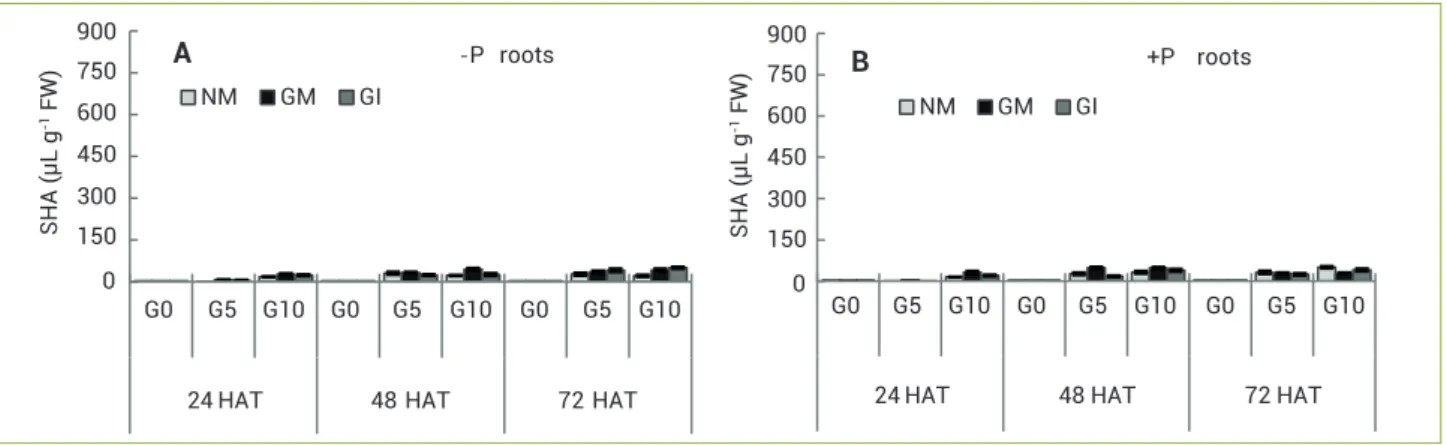
or P treatments (Figure 4). Meanwhile, in the roots the shikimic acid content was lower than the basal level irrespective of treatments (Figure 5).
24 HAT 48 HAT 72 HAT
+P upper leaves
NM GM GI
B
0 150 300 450 600 750 900
0 150 300 450 600 750 900
G0 G5 G10 G0 G5 G10 G0 G5 G10
G0 G5 G10 G0 G5 G10 G0 G5 G10
24 HAT 48 HAT 72 HAT
-P upper leaves
NM GM GI
A
SHA(μLg
-1 FW)
SHA(μLg
-1 FW)
Figure 2.Effectsofglyphosateandphosphorusconcentrationson
shikimicacidcontent(SHA)inupperleavesofCapsicum annuum
L. plants, non-inoculated (NM) or inoculated with Glomus mosseae
(GM) orGlomus intraradices (GI). (A) -P: 10 mg P kg––1soil; (B)
+P: 100 mg P kg––1 soil. G0, without glyphosate; G5, 3.16 μM
0 150 300 450 600 750 900
0 150 300 450 600 750 900
24 HAT 48 HAT 72 HAT
-P lower leaves
NM GM GI
A
24 HAT 48 HAT 72 HAT
+P lower leaves
NM GM GI
B
G0 G5 G10 G0 G5 G10 G0 G5 G10
G0 G5 G10 G0 G5 G10 G0 G5 G10
SHA(μL
g--1 FW)
SHA(μL
g--1 FW)
Figure 3.Effectsofglyphosateandphosphorusconcentrations
on shikimic acid content (SHA) in lower leaves ofCapsicum
annuum L. plants, non-inoculated (NM) or inoculated with
Glomus mosseae(GM)orGlomus intraradices(GI).(A)-P:10mg
Pkg-1soil;(B)+P:100mgPkg-1soil.G0,withoutglyphosate;G5,
3.16μMglyphosate;G10,6.32μMglyphosate.HAT,hoursafter glyphosatetreatments.(n=10).
G0 G5 G10 G0 G5 G10 G0 G5 G10
24 HAT 48 HAT 72 HAT -P cotyledons
NM GM GI
A
G0 G5 G10 G0 G5 G10 G0 G5 G10
24 HAT 48 HAT 72 HAT
NM GM GI
B -P cotyledons
0 150 300 450 600 750 900
0 150 300 450 600 750 900
SHA(μLg
-1 FW)
SHA(μL
g
-1 FW)
Figure 4.Effectsofglyphosateandphosphorusconcentrations
on shikimic acid content (SHA) in cotyledons ofCapsicum
annuum L. plants, non-inoculated (NM) or inoculated with
Glomus mosseae(GM)orGlomus intraradices(GI).(A)-P:10mg
Pkg-1soil;(B)+P:100mgPkg-1soil.G0,withoutglyphosate;G5,
3.16μMglyphosate;G10,6.32μMglyphosate.HAT,hoursafter glyphosatetreatments.(n=10).
Chlorophyll and leaf total protein content: In NM plants, the chlorophyll content decreased significantly in both higher GL concentration and high P level (NMG10+P) (Table 2). In inoculated plants and at low P level, the chlorophyll content was not affected by GL treatments, whereas, at high P level this decreased significantly with the higher GL concentration (Table 2). The protein contents did not show differences in both non-inoculated and inoculated plants, regardless, GL and P availability (Table 2).
Cell membranes stability (CMS): The cell membranes stability was affected by GL treatments (Table 2). In G0 treatment there was no significant difference in CMS of roots and leaves cell membrane in both inoculated and non-inoculated plants, regardless of the P level.
The leaves of CMS of inoculated plants were significantly greater than non-inoculated ones at high P level (+P). In G5 and G10 concentrations, the non-inoculated plants had lower CMS than inoculated ones. With low P availability, there were no significant differences between non-inoculated and inoculated plants (Table 2).
Table 2.Effectsofglyphosateandphosphorusconcentrationsonchlorophyll,leafprotein,leafcellmembranesstability(CMS)androot
CMS in Capsicum annuum L. plants, non-inoculated (NM) or inoculated with Glomus mosseae(GM)orGlomus intraradices(GI),48days aftersowing
Mycorrhization
P level
**
Glyphosate (#)
Chlorophyll
(µg cm-2)
Leaf protein
(µg cm-2)
Leaf CMS (%)
Root CMS (%)
NM
-P G0 38.9c 15.9a 90c 80c
G5 36.0c 15.4a 81c 77c
G10 35.6c 17.1a 77bc 69b
+P G0 42.0c 15.0a 93c 78c
G5 42.1c 16.6a 69b 56b
G10 20.9a 16.3a 55a 40a
GM
-P G0 42.3c 16.1a 92c 81c
G5 37.5c 16.2a 84c 77c
G10 37.3c 15.9a 82c 75c
+P G0 47.0d 17.0a 93c 78c
G5 42.9c 16.8a 81c 75c
G10 30.1b 14.9a 69b 59b
GI
-P G0 42.1c 16.2a 94c 81c
G5 39.6c 16.1a 85c 78c
G10 38.0c 15.4a 84c 77c
+P G0 48.6d 16.9a 90c 79c
G5 44.1c 16.1a 82c 76c
G10 32.0b 14.6a 70b 60b
Meanvaluesfollowed bythesamelower-caseletterwithineachcolumn arenotsignificantlydifferent(p>0.05).**-P:10mg Pkg-1 soil; +P: 100mgPkg-1 soil. #G0:withoutglyphosate;G5,3.16μMglyphosate;G10,6.32μMglyphosate,(n=10).
G0 G5 G10 G0 G5 G10 G0 G5 G10
24 HAT 48 HAT 72 HAT - P roots
NM GM GI
A
G0 G5 G10 G0 G5 G10 G0 G5 G10
24 HAT 48 HAT 72 HAT +P roots
NM GM GI
B
0 150 300 450 600 750 900
SHA(μL
g
-1 FW)
0 150 300 450 600 750 900
SH
A(μLg
-1 FW)
Figure 5.Effectsofglyphosateandphosphorusconcentrationsonshikimicacidcontent(SHA)inrootsofCapsicum annuum L. plants, non-inoculated (NM) or non-inoculated with Glomus mosseae(GM)orGlomus intraradices(GI).(A)-P:10mgPkg-1soil;(B)+P:100mgPkg-1 soil;
G0,withoutglyphosate;G5,3.16μMglyphosate;G10,6.32μMglyphosate.HAT:hoursafterglyphosatetreatments.(n=10).
DISCUSSION
After spraying, GL is strongly adsorbed by soil particles (Mamy and Barriuso 2007) causing a very limited mobility in soils. If added to soil, GL is absorbed by the roots, as in tomato (Cornish 1992), pepper (Ronco et al. 2008), or birdsfoot
trefoil (Clua et al. 2012), and is incorporated into the xylem flow to reach the aerial parts of the plant.
The information regarding the effect of GL on mycorrhization remains limited and contradictory. The EPSPS synthase is found not only in plants but also in bacteria and fungi (Padgette et al. 1995). Therefore, the inhibition of this enzyme may explain, at least partially, the decreased AM spore viability when exposed to GL (Druille et al. 2013). In the present study, our results show that pepper grown without GL behaved as a mycotrophic species; with a high level of colonization, in agreement with Ronco et al. (2008) and that the hyphae had a high percentage of viability, regardless of mycorrhizal fungi. When P was added to substrate, these percentages were reduced significantly and the presence of GL, decreased mycorrhization and hyphae viability, as pointed out by Grant et al. (2005). Our results did not agree with those of Malty et al. (2006), who reported that soybean root colonization increased with GL applications or with studies that have found no effect of GL on mycorrhizae (Savin et al. 2009).
In our study, non-inoculated and inoculated plants were both affected by the herbicide incorporated to the substrate, reducing all the parameters measured, except total leaf protein content. The mechanism by which GL reduces the growth of plants is still unclear and does not seem to be the same in all cases. In our experiments, the inoculated pepper plants that were grown without GL and 100 mg P kg-1 substrate, showed
higher growth than non-inoculated plants. Shaner (2000) and Henry et al. (2007) observed that the growth inhibitor effect of GL was expressed by chlorosis at the growing points and necrosis throughout the plant within 1–2 weeks. Our results showed that at 6–12 hours after GL treatments, the shoot growth did not show any difference between treatments (data not shown). Twenty-four hours after GL treatments, the plants showed significantly lower growth with respect to the non-treated ones and that the values of M plants were higher than that of NM ones, as observed by Ronco et al. (2008). At 48–72 HAT, these differences increased at 96 HAT and the growth was completely inhibited in all GL treatments, regardless of P and mycorrhizal treatments. These results are consistent with that of Cruz–Hipolito et al. (2009). High P level affected plant growth only at 72 HAT.
Individual species differ in their response to GL due to differences in interception, retention, penetration, movement and activity of the herbicide. Toxic effects of GL may be attributed to (i) the inability of the organism to synthesize aromatic amino acids; (ii) an energy drain on the organism resulting from adenosine triphosphate and phosphoenolpyruvate (PEP) spent in the accumulation of shikimate, 3-deoxy- D-arabino-heptulose-7-phosphate (DAHP), and hydroxybenzoicacids; and (iii) toxicity of accumulated intermediates of the shikimic acid pathway (Fisher et al. 1986). When the application of the herbicide is via the leaf, the effect is almost immediate (Shaner
2000, Henry et al. 2007) increasing SHA levels (Duke et al. 2003), which can be used as a sensitive physiological indicator for GL toxicity (Henry et al. 2007). Laitinen et al. (2007) have shown that GL adsorption decreases and desorption increases with increasing soil P status. Applications of P-fertilizer showed the significantly impaired seedling growth on soils pre- incubated with GL. This expression of plant damage was associated with increased accumulation of shikimate in tissue.
Our results confirm that the effects of GL are proportional to the substrate capacity of adsorbing inorganic phosphate, as pointed out by Hance (1976) and Glass (1987). In foliar application, GL has a more rapid effect, increasing SHA levels, which has been related to diminish the photosynthesis (Duke et al. 2003). In this case, the effects began in SHA content and in growth, 24 hours after GL treatment. We found that, before treatment with GL, the SHA content was detected in trace amounts in the roots, cotyledons and in the upper and lower leaves. These levels of SHA were similar, regardless of the P and mycorrhizal treatments. The shikimate levels in the control plants were negligible, and similar results were obtained by Bott et al. (2011) in different soils.
Shikimic acid increased in all fractions 24 hours after treatment with GL. Two days after treatment, all the plant parts studied had approximately doubled the SHA content, while the roots and cotyledons had the smaller increase. Three days after treatment the higher content of shikimic acid was found in the upper leaves. The variability in SHA accumulation could be due to relative ability of tissue to metabolize and/or translocate SHA. In our experiments, analysis of shikimate accumulation in the root tissue of pepper plants, as physiological indicator for GL toxicity, revealed no effects. Fertilisation in GL-treated substrate did not enhance shikimate accumulation in the root tissue, in agreement with Bott et al. (2011), or cotyledons or lower leaves of pepper plants. The higher SHA content was determined at 48–72 HAT, in upper leaves, when the plants were treated with 3.16 µM of GL, in agreement with the level observed by Wan Kim and Amrhein (1995) 2–5 days after application of GL to leaves of 6- week-old tomato plants. Our results showed that the shikimate accumulated in the upper leaves of plants treated with 3.16 μM of GL at the end of the experiments (72 HAT) was higher in NM plants with +P compared to inoculated ones, and was lower than at G5, regardless of the P and mycorrhizal treatment, possibly because the roots were severely affected (necrosed) by the high concentration of herbicide, as described by Ronco et al. (2008).
binding sites (Sprankle et al. 1975), then the application of P-fertilizer, impaired the growth in plants. Damage symptoms comprised stunted root and shoot growth, leaf deformation, decrease in CMS in roots and leaves and acceleration of leaf senescence, assessed by chlorophyll content. Twenty-four HAT at G5, in inoculated plants, the upper leaves showed a dilate in the response, while there was an increase in SHA content, confirming that the herbicide was absorbed by pepper roots and translocated to the aerial fractions. Regarding the distribution of GL, the highest level of shikimic was accumulated in the more active aerial parts (young upper leaves) which contained 2–3 times more shikimic acid than the other aerial plant fractions (lower leaves, cotyledons, and roots), regardless of the mycorrhizal and P treatments.
Although GL also appears to have detrimental effects on other variables such as chlorophyll content and cell CMS, the information on the effect of GL on the cell membranes is limited (Clua et al. 2012), and the mechanism is not known. Our results showed that the cell membrane damage by GL was significantly higher in NM plants and at high P level in both leaves and roots. The inoculation decreased the combined effect of GL and high P level, increasing the cell membrane stability.
The membranes damaged by GL in pepper appear similar to other abiotic stress effects (Beltrano et al. 2003) and may constitute another deleterious mechanism of the GL.
Chlorosis is usually one of the first toxicity symptoms after foliar GL applications. Our data showed that chlorophyll content was significantly diminished by high application of GL (G10) and P (+P) to non-inoculated pepper plants , compared with inoculated ones.
In our study, in substrate without P fertilization, the GL incorporated was not associated with any damage of pepper plants (chlorophyll, proteins contents and CMS) (Table 2), although, the plant damage increased with P fertilisation. The induction of plant damage by P fertilization, on GL-treated
substrate, as determined in the present study, indicates that the P induces a competitive desorption from GL by the phosphate in the binding sites. These findings suggest that a significant proportion of GL may be adsorbed by fractions of the soils (Barja and Dos Santos 2005). Bott et al. (2011) determined that in soils without P fertilization, the GL application was not associated with any damage of soybean plants. However, on GL treated soils, the plant damage increased with raising levels of P fertilization.
The results of the present study suggest that remobilization of GL residues in substrate by addition of P fertilizers should be considered as additional potential pathway for GL toxicity, which is strongly influenced by soil characteristics. Soils with low or moderate fixation capacity for GL and phosphate, with low potential for GL degradation, plus frequent applications of GL and P fertilizers are potential soils to increase the risk of crop damage due to GL remobilization. More intense use of GL can be expected in the future, with increased potential risks of detrimental effects to plants. The competitive desorption of the GL with P fertilisers, may be of particular relevance, because both compounds are concentrated in the uppermost soil layers. Management practices, such as phosphate fertilization, generate a remobilization of GL residues in soils (Bott et al. 2011), and it should be considered as an additional potential pathway for GL toxicity to AM spores (Druille et al. 2013).
The phenomenon of the GL mobilization by application of P fertilizers is currently investigated, but more field studies are necessary to evaluate potential dangers in agricultural systems. In conclusion, in accordance with Bott et al. (2011) and Clua et al. (2012), the results of this study suggest that the remobilization of GL residues through the addition of phosphate fertilizers should be considered a serious problem. The inoculated pepper plants tolerate high GL concentrations in the substrate and may allow this stress condition.
REFERENCES
BarjaBC,dosSantosAfonsoM(2005)Aminomethylphosphonic
acid and glyphosate adsorption onto goethite. Environmental
ScienceandTechnology39:585-592.
BeltranoJ,RoncoMG,SalernoMI,RuscittiM,PelusoO(2003)
Respuesta de plantas de trigo (Triticum aestivum L.) micorrizadas
en situaciones de déficit hídrico y de rehidratación del suelo. RevistaCienciayTecnologia8:1-7.
Borggaard OK (2011) Does phosphate affect soil sorption and degradation of glyphosate? - A Review. Trends in Soil Science andPlantNutrition2:16-27.
BorggaardOK,GimsingAL(2008)Fateofglyphosateinsoiland thepossibilityofleachingtogroundandsurfacewaters:areview. PestManagementScience64:441-456.
BottS,TesfamariamT,KaniaA,Eman,B,AslanN,RoemheldV, NeumannG(2011)Phytotoxicityofglyphosatesoilresiduesre-mobilisedbyphosphatefertilization.PlantandSoil342:249-263.
CluaA,ContiM,BeltranoJ(2012)Theeffectsofglyphosate
onthegrowthofbirdsfoottrefoil(Lotus corniculatus) and its
interactionwithdifferentphosphoruscontentsinsoil.Journal ofAgriculturalScience4:208-218.
Cornish PS (1992) Glyphosate residues in sandy soil affect tomato transplants. Australian Journal of Experimental
Agriculture 32:395-399.
Cruz-Hipolito H, Osuna MD, Heredia A, Ruiz-Santaella JP, De Prado R (2009) Nontarget mechanism involved in glyphosate
tolerance found inCanavalia ensiformis plants. Journal of
AgriculturalandFoodChemistry57:4844-4848.
de Jonge HL, de Jonge W, Jacobsen, OH, Yamaguchi T,
MoldrupP(2001)GlyphosatesorptioninsoilsofdifferentpH andphosphoruscontent.SoilScience166:230-238.
Dion HM, Harsh JB, Hill HH (2001) Competitive sorption between glyphosate and inorganic phosphate on clay minerals
andloworganicmattersoils.JournalofRadioanalyticaland NuclearChemistry249:385-390.
Druille M, Cabello MN, Omacinia M, Golluscioa RA (2013) Glyphosate reduces spore viability and root colonisation of arbuscular mycorrhizal fungi. Applied Soil Ecology 64:99-103.
Duke SO, Baerson RS, Rimnado AM (2003) Herbicides: Glyphosate. In: Plimmer JR, Gammon DW, Ragsdale N,
editors. Encyclopedia of Agrochemicals, New York: John
Wiley & Sons.
FisherRS,BerryA,GainesCG,JensenRA(1986)Comparative actionofglyphosateasatriggerofenergydrainineubacteria. JournalofBacteriology168:1147-1154.
Gimsing AL, Borggaard OK (2002) Effect of phosphate on the adsorption of glyphosate on soils, clay minerals and oxides.InternationalJournalofEnvironmentalandAnalytical Chemistry82:545-552.
Glass RL (1987) Adsorption of glyphosate by soils and clay minerals.JournalofAgriculturalandFoodChemistry35:497-500.
GrantC,BittmanS,MontrealM,PlenchetteC,MorelC(2005)Soil andfertilizerphosphorus:EffectsonplantPsupplyandmycorrhizal development.CanadianJournalofPlantScience85:3-14.
HanceRJ(1976)Adsorptionofglyphosatebysoils.Pesticide Science7:363-366.
HenryWB,ShanerDL,WestMS(2007)Shikimateaccumulation in sunflower, wheat, and proso millet after glyphosate
application. Weed Science 55:1-5.
LaitinenP,RämöS,SiimesK(2007)Glyphosatetranslocation from plants to soil-Does this constitute a significant proportionofresiduesinsoil?PlantandSoil300:51-60.
Mamy L, Barriuso E (2007) Desorption and time-dependent sorption of herbicides in soils. European Journal of Soil Science58:174-187.
Malty JS, Siqueira JO, Moreira FMS (2006) Efeitos do glifosato sobre microrganismos simbiotróficos de soja, em
meio de cultura e casa de vegetação. Pesquisa Agropecuária
Brasileira41:285-291.
MoranR,PorathD(1980)Chlorophylldeterminationinintact tissues using N,N-dimethylformamide. Plant Physiology 65:478-479.
Neumann G, Kohl S, Landsberg K, Stock-Oliveira Souza K, Yamada T, Romeheld V (2006) Relevance of glyphosate
transfertonon-targetplantsviatherhizosphere.Journalof
PlantDiseaseProtection20:963-970.
Padgette SR, Kolacz KH, Delannay X, Re DB, LaVallee BJ,
TiniusCN,RhodesWK(1995)Development,identification,and characterizationofaglyphosatetolerantsoybeanline.Crop Science35:1451-1461.
Ronco MG, Beltrano J, Ruscitti M, Arango MC (2008) Glyphosate and mycorrhization induce changes in plant
growth and in root morphology and architecture in pepper plants (Capsicum annuum L.). The Journal of Horticultural ScienceandBiotechnology83:497-505.
Roy DN, Konar SK, Banerjee S, Charles DA, Thompson DG, PrasadRP(1989)Uptakeandpersistenceoftheherbicidein fruit of wild blue-berry and raspberry. Canadian Journal of ForestryResearch19:842-847.
SalazarL,ApplebyA(1982)Herbicidalactivityofglyphosate insoil.WeedScience30:463-466.
SavinMC,PurcellLC,DaighA,ManfrediniA(2009)Response of mycorrhizal infection to glyphosate applications and P fertilization in glyphosate-tolerant soybean, maize and cotton.JournalofPlantNutrition32:1702-1717.
Schaffer GF, Peterson RL (1993) Modifications to clearing methods used in combination with vital staining of roots colonized with vesicular-arbuscular mycorrhizal fungi. Mycorrhiza4:29-35.
ShanerDL(2000)Theimpactofglyphosate-tolerantcropson theuseofotherherbicidesandonresistancemanagement.
Pest Management Science 56:320-326.
SinghBK,ShanerDL(1998)Rapiddeterminationofglyphosate injury to plants and identification of glyphosate-resistant plants.WeedTechnology12:527-530.
Sorensen SR, Schultz A, Jacobsen OS, Aamand J (2006) Sorption,
SprankleP,MeggittWF,PennerD(1975)Rapidinactivationof glyphosateinthesoil.WeedScience23:224-229.
StockingerH,WalkerC,SchüßlerA(2009)Glomus intraradices
DAOM197198’, a model fungus in arbuscular mycorrhiza
research, is not Glomus intraradices. New Phytologist
183:1176-1187.
SullivanC,RossWM(1979)Selectingfordroughtandheatresistance
sorghum. In: Mussell H, Taples T, editors. Stress physiology in crops plants.USA:JohnWilleyandSons.pp.264-281.
TrouvelotA,KoughJL,Gianinazzi-PearsonV(1986)Mesuredu tauxdemycorrhizationVAd’unsystèmeradiculaire.Recherche etméthodesd’estimationayantunesignificationfonctionnelle.
In: Gianinazzi-Pearson V, Gianinazzi S, editors. Physiological
and genetical aspects of mycorrhizae.Paris,France :INRA.pp. 217-221.