regional committee
WORLD
HEALTH
ORGANIZATION
PAN AMERICAN
HEALTH
ORGANIZATION
XXXI Meeting
Washington, D.C. September-October 1985
XXXVII Meeting
INDEXED
Provisional Agenda Item 24 CD31/25 (Eng.)
24 July 1985
ORIGINAL: SPANISH
INTERNATIONAL PROGRAM ON CHEMICAL SAFETY
At its 95th Meeting the Executive Committee considered the report on the Regional Program on Chemical Safety (Document CE95/13) but did not adopt a resolution because it was a progress report. This report is annexed for the consideration of the Directing Council.
Annex
executive committee of
the directing council
PAN AMERICAN
HEALTH
ORGANIZATION
CD31/25 (Eng.)
working party of
ANNEXthe regional committee
WORLD
HEALTH
ORGANIZATION
95th Meeting Washington, D.C.
June-July 1985
Provisional Agenda Item 20 CE95/13 (Eng.)
10 May 1985
ORIGINAL: SPANISH
INTERNATIONAL PROGRAM ON CHEMICAL SAFETY
The present document on the Regional Program on Chemical Safety (RPCS) is being presented to the Executive Committee pursuant to Resolution V of the 92nd Meeting of the Executive Committee, June 1984.
The document considers the origins and objectives of the International Program (IPCS) and the Regional Program (RPCS), the resolutions related to chemical safety at the regional level, and regional activities and trends. It then indicates the progress made to date in the development of the RPCS by describing the activities carried out since June 1984 for each of the suggestions with regard to policies, strategies, and activities mentioned in Document CE92/19, presented to the Executive Committee in June 1984.
The document also discusses the strategies and methodologies employed in preparing the evaluation report on the status of chemical safety in the Region requested by the Executive Committee in June 1984, the progress achieved to date, and the activities remaining to be carried out in order to complete the report during the present year. This report will provide the basis for final formulation of the medium-term program, which will also be finalized during 1985.
CE95/13 (Eng.)
TABLE OF CONTENTS
Page
1. BACKGROUND . . . ... I
1.1 Origins and Objectives of the International Program on Chemical Safety. Structure and Evolution of the Program ...
1.2 Resolutions on Chemical Safety at the Regional
Level (AMRO/WHO) . . . 2
2. ANALYSIS OF THE CHEMICAL SAFETY SITUATION IN THE REGION OF THE AMERICAS ... 4
2.1 Chemical Pollution of the Environment . . . 5
2.1.1 Air pollution ... 5
2.1.2 Water pollution . . . 5
2.1.3 Food contamination . . . 6
2.1.4 Soil pollution . . . 6
2.1.5 Chemicals in the home . . . 6
2.1.6 Exposure to chemicals in the workplace . . . 7
2.1.7 Chemical accidents . . . 7
2.2 Principal Operational Problems in the Development of Programs for Chemical Safety in the Region . . . 8
2.2.1 Complexity of the public health problems . . . 8
2.2.2 Knowledge about extent of the problem . . . 8
2.2.3 Lack of coordination . . . 8
2.2.4 Information and perceptions ... . .9.
2.2.5 Shortage of manpower . . . 9
3. EVOLUTION AND PROGRESS IN REGIONAL PROGRAMS FOR CHEMICAL SAFETY ... 9
3.1 Implementation of Suggested Strategies . . . 9
3.2 Areas of Concentration in the Regional Program . . .. 11
3.2.1 Manpower Training in the Field of the Chemical Safety ... .. . . . 11
3.2.2 Evaluation of Risks . . . .. 13
3.2.3 Chemical Emergencies . . . ... 14
3.2.4 Preparation of Methodologies for the Evaluation of Health Risks . . . ... 14
CE95/13 (Eng.)
REGIONAL PROGRAM ON CHEMICAL SAFETY
1. BACKGROUND
1.1 Origins and Objectives of the International Program on Chemical Safety. Structure and Evolution of the Program
The International Program on Chemical Safety was formulated to combat the danger to the health of present anrd future generations deriving from the extensive use and distribution of both new and existing chemicals throughout the world. Such products are essential to the preservation of life and human activity and to the promotion of development. Although it is generally considered that chemical safety mostly concerns the industrialized countries, chemicals are used throughout the world, representing an export trade valued at billions of dollars. The safety of chemicals is therefore a concern of all the Member States. Avoidance of the adverse effects of these products is
essential to health and to the preservation of a sound environment.
The United Nations Conference on the Human Environment, held in Stockholm in 1972, recommended initiating early warning programs and programs to prevent the harmful effects of various environmental elements, acting either alone or in combination, to which mankind is increasingly exposed. It also recommended assessing the potential risks to human health, particularly with regard to mutagenic, teratogenic, and carcinogenic risks.
During the Thirtieth World Health Assembly, held in May 1977, the Member States brought out the fact that the growing use of chemicals in public health, industry, agriculture, food production, and the home--together with the environmental pollution resulting from rapid industrialization and new technologies--should be addressed in the health policies and strategies of all countries. In Resolution WHA30.47, the Thirtieth World Health Assembly requested the Director-General to study long-term strategies for evaluating the effects on health of chemicals in the environment, including possible alternatives for international cooperation.
The Thirty-first World Health Assembly (1978), after considering the report of the Director-General of WHO, approved Resolution WHA3t.28, which supports the proposal to carry out the program through a central planning and coordination unit at WHO Headquarters and a network of
CE95/13 (Eng.) Page 2
The main objectives of IPCS are: a) to make and disseminate assessments of the risks to human health represented by exposure to chemicals, based on existing information and data; b) to promote the use and improvement--and in some cases the validation--of laboratory testing methods and appropriate epidemiological studies for the evaluation of health risks, and to propose appropriate methods for evaluating exposure and also the risks, dangers, and benefits for health; c) to promote effective international cooperation regarding chemical-related emergencies and accidents; d) to promote the manpower training needed in order to test and evaluate the effects of chemicals on health and to monitor and control the dangers that they represent. Other objectives are the coordination of laboratory tests and epidemiological studies, which should be carried out with an international approach, and the promotion of research to improve the scientific bases for evaluating risks to health and for controlling the dangers associated with chemicals.
The seventy-third session of the WHO Executive Board, held in January 1984, approved Resolution EB73.10, which promotes the active participation of the developing countries in IPCS and attaches special importance to: the definition of short- and long-term priorities in accordance with to the needs of the Member States, as well as measures for cooperating with the Member States in implementing the Program; the assurance of close coordination within the Program and with other related WHO programs at the national, regional, and world levels; and the promotion of increasingly active intervention in the Program by all
regional WHO offices with a view toward strengthening technical cooperation with the Member States in the area of chemical safety.
1.2 Resolutions ori Chemical Safety at the Regional Level (AMRO/WHO)
In October 1970 the XXVIII Pan American Sanitary Conference studied the relationship between man and the environment, bearing in mind the resolutions of the Twenty-third World Health Assembly, and it resolved that PAHO should set up systems for the monitoring of environmental pollution and also expand existing systems. In 1972 the XX Meeting of the Directing Council of PAHO considered the need for forecasting .he physiological, toxicological, epidemiological, and sociological effects of rapid environmental change and resolved to
strengthen existing knowledge and the capability for diagnosing and assessing the influence of the environment on health. Under the Program for the Control of Environmental Pollution, PAHO undertook pertinent activities and collaborated with' several of the Member Countries in establishing comprehensive programs for the prevention and control of environmental pollution and in setting up institutions responsible for managing them.
CE95/13 (Eng.) Page 3
changes related to industrial development and those which might have an adverse impact on health. In response to this mandate, PAHO and the Government of Mexico agreed to set up the Center in Mexico. (Functionally, ECO is part of the Environmental Health Program (HPE) of
PAHO.)
In 1981 the XXVIII Meeting of the Directing Council of PAHO adopted the Plan of Action for the Implementation of Regional Strategies for Health for All by the Year 2000. One of its sections points out the need to control physical and chemical pollution, and it gives special attention to the establishment of intersectoral relations with national development planning units and with the industrial and agricultural sectors. The Plan of Action emphasizes the following:
"a) Development of policy and legislation for prevention and control. Analysis and dissemination of information on physical and chemical pollutants, including data on morbidity and mortality. Designation of national focal points to participate in the International Program for Chemical Safety; b) Detection, treatment, and prevention of hazards from intoxicants. Establishment of coordination mechanisms with users of physical and chemical agents for prevention, treatment, and control. Incorporation of environmental, ecological, and biological monitoring in prevention and control programs. Education of health service workers and the population regarding newly introduced toxic chemicals; c) Implementation of policies and plans for prevention and control. Establishment of information systems for management and decisions-making. Preparation of guidelines for the establishment of environmental and biological monitoring in prevention and control programs. Promotion of support from manufacturers and users of physical and chemical substances. Development of guidelines and implementation of emergency response mechanisms. Promotion of education and training programs for professionals and technical staff as well as education of the public."
In 1983 the XXIX Meeting of the Directing Council of ?AHO approved Resolution XXVIII, which calls upon the Director to move toward the consolidation of ECO in order to meet the needs of the Organization's Member Countries and stipulates that ECO's technical program be focused on epidemiological and toxicological aspects of the health effects of the principal chemical pollutants of industrial and agricultural origin.
The 92nd Meeting of the Executive Committee of PAHO, held in 1984, evaluated the Report on the International Program on Chemical Safety and approved Resolution V, which requested the Director to take the measures suggested in the report, including the preparation of a report assessing the status of chemical safety in the Region and the development of a medium-term program (1984-1989). The Director was also asked to present a report on the results of these activities at the meeting of the Executive Committee in June 1985.
CE95/13 (Eng.) Page 4
In September 1984 the XXX Meeting of the Directing Council, upon consideration of Resolution V of the Executive Committee, approved Resolution XIV, International Program on Chemical Safety. This resolution urges the Member Governments to participate in the activities of the Regional Program on Chemical Safety both in support of the policies and strategies to be adopted in the Region and also in the preparation of an evaluative study, especially with regard to intersectoral action. It also requests the Director to take measures for the preparation of an Evaluative Study on Chemical Safety in the Region and for the formulation of proposals for medium-term regional programs in this field.
2. ANALYSIS OF THE CHEMICAL SAFETY SITUATION IN THE REGION OF THE AMERICAS
The general nature of the problem of chemical safety in the Region was well summarized in Document CE92/19, presented to the Executive Committee at its meeting in June 1984. The cause of the problem is the growing concentration of urban population and the expansion of the manufacturing sector. In Latin America the manufacturing sector has quadrupled the volume of its annual operations between 1960, when they amounted to US$37 billion, and 1980, when they came to US$133 billion. Along with the growth of manufacturing, the number of employees in the sector has also increased. Latin America's is one of the fastest-growing work forces in the.world, doubling its size every 25 years. In 1960 the work force in the Region stood at 67 million; by 1980 this figure had risen to 112 million, and by the end of the century will rise to almost 200 million. Growth of the manufacturing sector in turn promotes urban growth. In 1970, 57.2% of the urban population of Latin America lived in 105 cities having a population of 100,000 or more. Of these cities, 17 had more than a million inhabitants, and the population of five of them was over five million. In 1980 the proportion of the population living in cities of 100,000 or larger was 63.5%; 147.6 million people were living in 230 cities, 25 of which had more than a million inhabitants and 5 of which had more than 5 million.
As the manufacturing sector grows, the total volume and number of chemicals produced also increases. The worldwide annual production of synthetic organic chemicals rose from I million tons in 1930 to several hundred million *tons in .recent years. There are more than 60,000 chemicals in use at the present time, and this number continues to grow at a rapid pace. Many of these chemicals pose risks for health and the environment.
CE95/13 (Eng.) Page 5
In the Region, recent events have also borne out the seriousness of the problem of chemical safety. The explosion in November 1984 of a gas storage plant in Mexico City took the lives of some 500 people and destroyed approximately 2,000 homes. Also in Mexico, in July 1984, some 20 children and 2 adults suffered first- and second-degree burns in a garbage dump containing chemical wastes that have not yet been identified.
In Argentina, in March 1985, an explosion took place in the silos in the port city of Ingeniero White, leaving 17 dead and several others with serious burns. In Brazil, also in March 1985, a sudden leak of ammonia made it necessary to evacuate the inhabitants of Vilas Paris in Cubatao, Sao Paulo.
In the United States of America, the Environmental Protection Agency had identified as of October 1984 nearly 800 chemical waste disposal sites that constitute a threat to health and the environment, and it is estimated that the list will grow eventually to some 2,500
sites.
In these circumstances, the protection of human health and the environment against the adverse effects of the vast number of chemicals that are present in the home and the workplace, in foods, and in contaminants in the air, water, and soil is one of the most complex and pressing problems that the governments face. Some of these specific problems are mentioned below.
2.1 Chemical Pollution of the Environment
2.1.1 Epidemiological evidence of the effects of air pollution on man is derived from common urban air pollutants such as sulfur dioxide and solid particulates in suspension, and to a certain extent, carbon monoxide and oxidants. A great number of other chemical pollutants in urban air are also recognized as being harmful to health, especially in the vicinity of certain industries. There have been clinical and epidemiological studies done in some countries of Latin America and the Caribbean that describe the effects on community health of atmospheric pollutants such as lead, mercury, cadmium, arsenic, mercaptans, manganese, hydrosulfuric acid, fluorides, chlorine and hydrogen chloride, asbestos, and organochlorine pesticides. In a highly polluted area of Brazil, previously unobserved congenital deformities are appearing that may be related in some way to pollution.
CE95/13 (Eng.) Page 6
Beyond a certain level, some of the chemical pollutants may constitute a direct risk of toxicity from being ingested with water or other kinds of contact. Studies carried out in Latin America have confirmed that the consumption of water containing high concentrations of nitrate may cause methemoglobinemia in the infant population. In some regions of Argentina, Chile, and Mexico high concentrations of arsenic have been detected in drinking water.. Arsenic is found with increasing
frequency in marine organisms such as mussels and shrimp.
2.1.3 Food contamination. In recent years, the presence of mercury in foods has caused growing concern in Latin America and the Caribbean area. Significant amounts of this metal have been found in fish caught in polluted bays and estuaries, since apparently fish are capable of concentrating the mercury in the water several thousands of times. Mercury is found in fish in the form of methyl mercury, the most dangerous form of all, causing the well-known "Minimata's disease." An epidemic of this disease in Japan caused deaths and numerous cases of irreversible brain damage. This potential risk has been reported in several countries, including Argentina, Brazil, Colombia, Mexico, Nicaragua and Venezuela. Concentrations of cadmium have also been reported in marine animals.
Other chemical pollutants of foods mentioned in several reports from the Region are, inter alia, the N-nitrous compounds (in the case of Chile, for example), the polychlorinated biphenyls (PCBs), pesticides, and food additives. Among the pesticides, organochlorine insecticides are the most important because of their stability and persistence in the environment. In many countries of the Region there have been serious cases of poisoning from Aldrin and Endrin, several of them fatal. The presence of DDT in maternal milk has caused special concern, especially in view of the low levels of detoxicating enzymes in nursing infants. A study carried out in one of the countries demonstrated that nursing infants daily consume between 7 and 244 times the daily maximum levels of DDT tolerated legally in the United States of America and recommended by WHO and FAO. Residues of organochlorine pesticides found in fatty tissue are also much greater than pesticide residues found in the inhabitants of European countries.
2.1.4 Soil pollution is usually related to the use of chemicals such as fertilizers and plant growth regulators in agriculture; the dumping on farmlands of large volumes of. waste materials from coal and mineral mining and from metal foundries; and the dumping on farmlands of domestic and solid wastes resulting from the treatment of industrial effluents and wastes. Problems such as these are increasing in the Region, and recently several serious occurrences have been reported.
CE95/13 (Eng.) Page 7
The magnitude of the problem can be illustrated with data from the United States of America. According to recent estimates, the total annual number of lesions caused by toxic products is approximately 1,600,000, with 3,000 fatal cases. This estimate includes: 25,000 lesions caused by toxicity from equipment used for recreation; 139,000 (not including burns) from flammable fluids; 540,000 from laundry and cleaning products; and 75,000 from pesticides. The ingestion of potentially harmful substances produced between 500,000 and 1,000,000 accidents that caused 2,000 deaths, 350 of them in children under five. Exogenous poisoning in some of the countries is the second or third largest external cause of fatal domestic accidents. Available statistics reflect the activities of poison centers rather than the true situation in the communities. Although it is not possible to compare statistics on accidental poisoning from different countries, there is no doubt that
internally or externally applied chemical products such as cosmetics, cleaning products, paints, solvents, and pesticides are foremost among the principal causes of poisoning.
2.1.6 Exposure to chemicals in the workplace. In numerous occupational activities workers are required to handle potentially toxic chemical substances. Many industrial procedures require chemical reactions in which substances that are toxic or dangerous to man are liberated. Exposure to chemicals in the workplace may cause subclinical or clinical deterioration of health in a direct exposure-response relation. Such exposure may also, for example, indirectly affect the incidence of chronic degenerative diseases "caused" by a variety of endogenous and exogenous factors.
It has been demonstrated that occupational exposure to toxic agents contributes appreciably to the prevalence of chronic diseases in the developed countries. Researchers estimate that in the United States of America 400,000 workers become ill and 100,000 die as a result of work-related diseases. The percentage of cancer mortality that is attributable to occupational exposure is currently being debated in the United States of America; estimates by epidemiologists range from 4 to 20% or more.
It should also be noted that the countries in the Region of the Americas are heavily geared to agroindustrial production. Since 1972, world consumption of pesticides has increased on the average by 5% a year. In some countries of Latin America the increase has been considerably greater. Most of the rural population in Latin America receives little or no training in the proper handling of these dangerous substances. As a result, the incidence of pesticide poisoning among agricultural workers is extremely high. During 1971-1976, in El Salvador and Guatemala alone there were 17,183 reported cases of pesticide poisoning.
CE95/13 (Eng.) Page 8
repercussions for community health and with adverse effects on the environment. The major types of chemical accidents that were reported were as follows:
- Accidents in the transportation and storage of large quantities of chemical substances;
- Improper use of chemical substances, resulting in the contamination of foods, the application of excessive doses of agricultural
chemicals, etc.;
- Disasters/explosions in plants that handle or produce potentially toxic substances;
- Inadequate management of wastes, as for example uncontrolled dumping of toxic chemical substances, as well as defects in waste treatment
systems.
2.2 Principal Operational Problems in the Development of Programs for Chemical Safety in the Region
With the exception of certain localized problems, the impact of chemicals on human health went relatively unnoticed in Latin America and the Caribbean area until the beginning of the 1960s. With rapid industrial development, however, as well as growth of the population, increased urbanization, and the mechanization of agriculture, authorities began to show some concern, and measures began to be taken.
In summary, the principal operational problems in most of the countries of the Region were as follows:
2.2.1 Complexity of the public health problems. For the most part, the countries of the Region are still attempting to overcome health problems associated with the development process such as malnutrition, diarrheal diseases, and parasitic diseases. At the same time, as a result of socioeconomic development, they also have to deal with morbidity and mortality due, among other things, to tumors, cardiovascular diseases, respiratory diseases, and accidents in which chemicals play an important etiological and evolutionary role.
2.2.2 Knowledge about extent of the problem. The growing complexity of the sources of exposure to chemicals and the recentness of the concern for chemical risks have made it difficult to obtain a complete grasp of the dimension of the problem in the Region, especially since much still remains to be known about of the epidemiological effects of chemicals on human health, which in turn prevents adequate diagnosis of the problem and makes it difficult to take proper measures to solve it.
CE95/13 (Eng.) Page 9
the same field. In several countries of the Region it is very common to see that the components of chemical safety programs are scattered throughout many different sectors and administrative units (Health, Environment, Plannings Interior, Agriculture, Labor, Justice, etc.), with resulting dispersion of resources, duplication of efforts, and conflicts that could be avoided through the use of better mechanisms of coordination.
2.2.4 Information and perceptions. These complex circumstances are frequently accompanied by a scarcity of adequate information. Planners and public health administrators do not have access to up-to-date scientific and technological information for defining action programs, while communities are usually exposed to erroneous or exaggerated interpretations transmitted by the mass media. Workers do not usually know of the risks to which they are
exposed.
2.2.5 Shortage of manpower. The protection of human health and the environment against the harmful effects of potentially toxic chemicals calls for research and the establishment of appropriate mechanisms for prevention and control. These essential activities are hindered by the lack of manpower trained in many of the needed disciplines for performing evaluations and controling chemical risks. Manpower must be trained at all levels as soon as possible and in sufficient numbers. At the present time there are very few places in the developing countries of the Region where training is provided in the needed disciplines, including toxicology and environmental epidemiology, at all levels.
3. EVOLUTION AND PROGRESS IN REGIONAL PROGRAMS FOR CHEMICAL SAFETY
3.1 Implementation of Suggested Strategies
Document CE92/19 on the International Chemical Safety Program, presented to the Executive Committee at its meeting last year, suggests a
series of strategies for guiding the development of the regional program. Below is a review of progress achieved and of future plans for the
implementation of activities within each of the strategies.
CE95/13 (Eng.) Page 10
b) Stimulation of interest and desire to participate within the Member Countries. The basic strategy of PAHO has been aimed at fostering interest in participation in the Program within the countries. The most evident example of this interest has been the active participation in preparing the Evaluation Study on chemicals and their relation to health which is currently being carried out pursuant to the mandates of the Governing Bodies. Also, at meetings held both in ECO and CEPIS for preparing the evaluation study and carrying out specific activities related to the RPCS, special attention was given to the participation of national personnel. In this regard the countries look upon the RPCS as a cooperative program, which undoubtedly stimulates their interest and their desire to participate. This approach is in keeping with promoting the use of national resources.
c) Identification of "participating institutions". PAHO encourages the interdisciplinary focus of the RPCS. One aspect that has been emphasized with the countries is the need for participation by institutions belonging to sectors not customarily included in what is commonly regarded as the health sector. For the evaluation study the Ministries of Health will act as focal points and will coordinate the participation of other sectors such as agriculture, commerce, transportation, environment, and labor.
d) Establishment of a regional network. Steps has been taken to establish a. network of participating institutions in the regional program. An exchange of information and experiencies has been promoted among the various institutions both within and among the countries, and to this end information is being gathered and disseminated by ECO. The meetings and regional courses organized by PAHO have served as a basis for establishing this kind of relationship. As a result of these activities, two informal networks have been set up that have already begun operations, one on pesticides and health, and another that links up toxicology and poison control centers.
e) Establishment of an "Advisory Committee". In the meeting of the RCPS Program Coordination Group held on 21 October 1984, certain specific points were discussed and decisions were made regarding the functions that the Advisory Committee should have, the number of members it should have, aid how they should be rotated. The members of the "Advisory Committee" will be named by October 1985.
CE95/13 (Eng.) Page 11
IRRIJ, also participated. The working group is chaired by the director of the area of Health Program Development (HPD), and the HPE program acts as Secretariat. The purpose of the Group is to
coordinate the activities carried out by the different PAHO programs in the area of chemical safety.
g) Preparation of an evaluation report on the status of chemical safety in the Region. HPE/ECO is currently preparing an assessment of the chemical safety situation in the countries of the Region as background for decisions on program content. It is expected that this task will be finished by the end of 1985. Specific details are included in Chapter 4.
h) Preparation of the regional program of medium-term activities for 1984-1989. The Medium-Term Program (MTP)' will identify regional priorities, in addition to the activities to be undertaken and their financial implications, especially those to be financed by PAHO. The Medium-Term Program should be compatible with the overall IPCS and reflect the needs of the countries. Although the fundamental basis for formulation of the Medium-Term Program is the evaluation report, which will not be ready until the end of 1985, progress has been made in the development of specific aspects of the program for which adequate information is available. In particular, ECO continues to work on and develop the pesticide control component, while CEPIS continues to work on and develop the components for the control of chemical pollution of underground and surface water.
3.2 Areas of Concentration in the Regional Program
With regard to the areas of concentration in the Regional Program (Document CE92/19), the activities that have already been programmed and carried out are listed below.
3.2.1 Manpower Training in the Field of the Chemical Safety
a) Training of personnel in several categories, particularly in the fields of epidemiology and environmental toxicology. Approximately 480 participants at different levels, from 4 countries of the Region, have received training through 9 workshops on environmental epidemiology. Twenty additional workshops are planned to be held
in 8 Latin American countries (Table 1).
Seven workshops on toxicology have been organized in 4 countries, with approximately 240 participants. It is estimated that 27 workshops will be held in 10 countries of the Region (Table 1).
CE95/13 (Eng.) Page 12
With regard to the problem of exposure to asbestos fibers, 5 workshops have been organized in 3 countries, with 90 participants
to be held in 1985. Seven additional workshops will also be held in the same 3 countries of the Region (Table 1).
For the above-mentioned workshops, teaching materials were prepared by ECO in close collaboration with national institutions. These materials have either been distributed directly by ECO or duplicated in the respective countries.
b) Technical and financial assistance. Through its Country Representative Offices, PAHO has helped the countries in the
procurement of materials and the financing of fellowships.
Initiatives are under way with various foundations for the negotiation of financial assistance, especially for
intermediate-level courses in the field of toxicology.
c) Preparation of teaching materials. ECO, with the support of national institutions, has prepared the following materials:
1. On methodological aspects:
i) Epidemiological evaluation of Chemical Risks in the Environment (80 hours)
ii) Basic notions of Toxicology (40 hours) iii) Environmental Toxicology (40 hours)
iv) Food Toxicology (40 hours)
v) Methods for Rapid Assessment of Environmental Pollution Sources (40 hours)
2. On the prevention and control of specific risks:
i) Pesticides and Health (2-24 hours depending on the type of audience)
ii) Asbestos and Health (2-8 hours depending on the type of audience)
3. Courses in preparation:
i) Occupational Toxicology (80 hours) ii) Analytical Toxicology (80 hours)
iii) Quick tests for the Identification of Pesticide Wastes (8 hours)
iv) Cancer and exposure to chemicals (2-24 hours depending on the audience)
CE95/13 (Eng.) Page 13
An agreement has been made with the Latin American Textbooks Program (PALTEX), which will partially finance production and distribution of the materials.
3.2.2 Evaluation of Risks
a) Dissemination of documents on environmental health criteria. To date IPCS has prepared 39 documents in English on Environmental Health Criteria, and 92 others are in
preparation. A total of 16 have been translated into Spanish.
In the future, the RPCS plans to produce shorter documents in technical language that will be accessible to personnel not specialized in toxicology.
To support the dissemination of technical information, ECO has substantially improved its consultation services. It currently has a collection of approximately 10,000 books and monographs; it receives 120 periodical technical journals and has access to the various computerized data banks that contain bibliographical information in this field. A total of 250 requests were handled in 1984, and in 1985 the monthly average increased by 20%.
In 1985, ECO will automate the recovery of its own bibliographical data, which will facilitate the collective distribution of information to the users identified. With regard to "nonconventional" publications and documents, ECO will serve as collaborating center in the Pan American Network of Sanitary Engineering and Environmental Sciences, REPIDISCA, which operates with support from CEPIS.
The publication program of ECO has been expanded. Twenty-four titles were published in 1984 on topics related to the RPCS, 18 of them as joint publications with national agencies. It is estimated that 26 titles will be published in 1985, most of which will also be in joint publications with concerned institutions.
b) Rapid assessment of chemical agents. Starting with Publication 62 of WHO, ECO worked on and adapted a methodology for the rapid assessment of sources of environmental pollution (water, air and soil). The document has already been widely distributed in Spanish throughout the Region.
CE95/13 (Eng.) Page 14
c) Exposure levels. Various scientists of countries of the Region have participated in the meetings organized by WHO/FAO based on the Acceptable Daily Intake (ADI) of food additives and pesticide wastes in foods. It should also be noted that several countries of the Region are in the process of updating their own national standards. HPE/ECO has collaborated extensively in this process.
3.2.3 Chemical Emergencies
a) Information. Negotiations are under way with the Governments of Canada and the United States of America for cooperation with the countries of the Region, through their respective information programs and data banks, in cases of chemical emergencies. Although this kind of service has been provided sporadically, steps have been initiated with the countries to systematize the process through the identification of national focal groups to serve as information depositaries. Particular advances have been made in Brazil in the State of Sgo Paulo through CETESB.
b) Consciousness-raising about chemical emergencies. So far, Mexico and Brazil have organized seminars designed to establish mechanisms for evaluating conditions that may lead to chemical accidents as a first step toward the formulation of preventive and contingency plans. Similar seminars have been programmed
in Colombia, Venezuela, Argentina, Chile, and Peru.
PAHO has supported these arrangements through ECO and PED with financial support from USAID.
3.2.4 Preparation of Methodologies for the Evaluation of Health Risks
With support from the RPCS and national institutions, there has been collaboration with the countries in the dissemination of information methodologies for more appropriate and reliable toxicological assessment. Various seminars are being programmed in the United States of America, Mexico and Brazil.
4. RPCS EVALUATION STUDY
The main purpose of the RPCS Evaluation Study is to determine the general nature of chemical safety problems in the Region, particularly their effects on health and the environment. This information will then be used as a basis for continued development and implementation of the Regional Program in this field. The study will also yield the following benefits:
CE95/13 (Eng.) Page 15
b) Through intersectoral participation in national intersectoral studies, it will promote intersectoral collaboration at the national level.
c) It will help the countries to evaluate the effectiveness of existing control programs and, consequently, to improve them as needed.
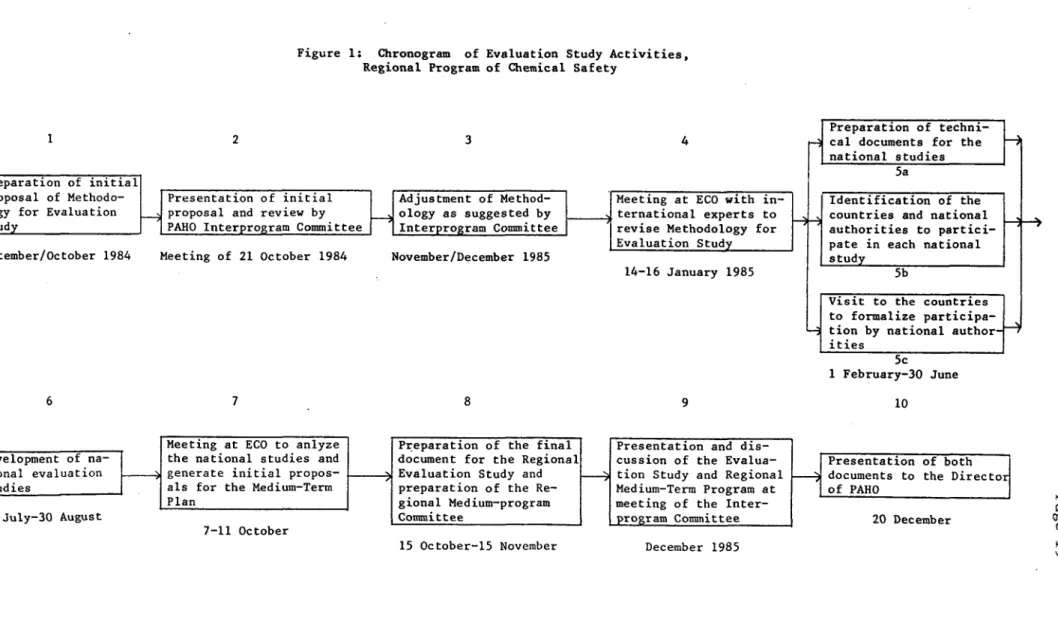
Development of the Evaluation Study is the responsibility of the Environmental Health Program in consultation with the PAHO Interprogram Group. Figure I provides a chronogram for the activities that will be
required in order to carry out the study. A summary of the activities carried out to date is also provided below. During the months of September and October work was performed on the methodology for the Study. This methodology was presented and discussed at a meeting of the Group on 21 October 1984. On the basis of the Group's recommendations and observations, adjustments were made in the methodology in November and December 1984, and it was developed in greater detail. From 14 to 16 January 1985 a meeting was held at ECO headquarters with the participation of experts from the United States of America, Mexico, Argentina, and Brazil, as well as with personnel from PAHO, during which the final version of the methodology for the study was reviewed and the points of view of the national participants were discussed regarding implementation of the Study.
The technical bases for the Study are contained in a guide that PAHO has been preparing in consultation with international experts from the Region. This guide covers essentially the following information:
a) A list of chemicals to be considered in national studies. One of the basic problems in chemical safety is that often chemicals are manufactured, imported, and used without awareness of the dangers that they pose for health and the environment. A total of 74 chemical substances have been selected for the purposes of this study; these are substances that have been given high priority by WHO because of their effects on health and the environment and their widespread use in the world. For each substance information has been provided regarding its specific effects on health and the environment and regarding the economic activities that are normally involved in its production.
Table 1
Workshops, courses, and seminars organized by the countries of the American Region using teaching
materials prepared by ECO
COUNTRIES EPIDEMIOLOGY TOXICOLOGY1 ENVIRON. ASSESSMENT2 PESTICIDES AND HEALTH ASBESTOS AND HEALTH
Held Programmed Held Programmed Held Programmed Held Programmed Held Programmed
ARGENTINA 3 3 1 1
BRAZIL 2 5 1 3 2 12 15 1 2
COLOMBIA 1 3 1 7 10 1 2
COSTA RICA 1 1 1 1
CUBA 1 1 1
CHILE 1 2 1 2 2
DOMINICAN
REPUBLIC 1 1 2
ECUADOR 1
GUATEMALA 1 1 3 1 5
HONDURAS 1 1
MEXICO 5 5 4 10 4 5 10 8 3 3
NICARAGUA 1
PANAMA 1 2 1
PARAGUAY 1
VENEZUELA 1 2 1 1
CARIBBEAN ISLANDS 2
TOTAL 9 20 6 28 4 15 40 48 5 7
1Includes courses in Basic Notions of Toxicology, Environmental Toxicology, and Food Toxicology.
2Includes courses in Rapid Assessment of Sources of Environmental Contamination, Assessment of Environmental and Health Impacts.
m 0n
as w
tj OQ
CE95/13 (Eng.) Page 17
information will make it possible to identify the groups from the general and the working population that are in danger of exposure to such chemicals. It will also provide insight into the nature of problems associated with the generation and disposal of wastes that contain these chemicals.
b) Normally the responsibility for dealing with problems of chemical safety is divided up among several agencies or governmental sectors, such as health, work, transportation, agriculture, and environment. The distribution of functions, as well as the specific nature of the control programs, is usually stipulated in corresponding laws and regulations. In order to analyze this situation, a questionnaire has been prepared requesting information on these particulars.
It is also planned to collect and analyze legislation and existing regulations in the area of chemical safety. Finally, a guide is provided for analyzing the human resources employed in the field of chemical safety and identifying the number and nature of positions in the government sector.
c) Physical infrastructure, specifically laboratories for the analysis of chemical problems, including toxicological laboratories and environmental analysis, is fundamental for the control of chemicals. A questionnaire on this subject focuses on assessment of the availability and operation of this infrastructure.
d) Another area that the study will address concerns activities related to the training of human resources in areas and disciplines relevant to the control of chemicals. The availability of programs and university courses as well as of specific training in this area will be determined and analyzed.
e) Appropriate access to safety-related information is another element that affects the formulation and implementation of programs for chemical safety. This area will also be analyzed in order to determine whether the main government agencies and institutions of higher education are being appraised of, and receiving, the major publications on the subject, especially international publications such as those prepared by IPCS/WHO and UNEP.
CE95/13 (Eng.) Page 18
Work is currently under way, and will continue until the end of June, on development of the document Guideline for Evaluation Studies; the authorities and specific sectors that will work on the individual studies at the national level are being identified. National studies will be carried out in Argentina, Brazil, Chile, Colombia, Cuba, Mexico, Peru, and Venezuela. The study will be limited to these countries because it is considered that they are representative of the Region and have a greater potential for problems in the area of chemical safety.
i
t.
Figure 1: Chronogram of Evaluation Study Activities, Regional Program of Chemical Safety
1 2 3 4
H
.September/October 1984 Meeting of 21 October 1984 November/December 1985
14-16 January 1985
6 7 8 9
Identification of the countries and national authorities to partici-pate in each national study
study
Preparation of techni- 1 cal documents for the
I national studies 5a
l1
5b
Visit to the countries
to formalize participa-tion by naparticipa-tional author-ities
5c 1 February-30 June
10
Meeting at ECO to anlyze Development of na- the national studies and tional evaluation generate initial
propos-studies als for the Medium-Term
Plan 1 July-30 August
7-11 October
Preparation of the final Presentation and dis-document for the Regional cussion of the Evalua-Evaluation Study and 3 tion Study and Regional preparation of the Re- Medium-Term Program at gional Medium-program meeting of the
Inter-Committee program Committee
15 October-15 November
Presentation of both documents to the Directo of PAHO
20 December
December 1985
rn %.o
(D in
1-I
\xD %A
trj
A_
___
I ·