ISSN 1 5 1 7 - 7 0 7 6
Revista Matéria, v. 15, n. 2, pp. 195-201, 2010. http://www.materia.coppe.ufrj.br/sarra/artigos/artigo11218
Tensile behavior of lignocellulosic fiber reinforced polymer composites:
Part II buriti petiole/polyester
T.G.R. PortelaI; L.L. da CostaI; N.S.S. SantosII; F.P.D. LopesI; S.N. MonteiroI
I
Advanced Materials Laboratory, LAMAV, State University of the Northern Rio de Janeiro, UENF, CEP28013-602, Campos dos Goytacazes, RJ.
e-mail: [email protected], [email protected], [email protected]
II
Department of Mechanical Engineering, University of Campinas, UNICAMP, Brazil e-mail: [email protected]
ABSTRACT
The current interest for natural fibers as an environmentally correct composite reinforcement has motivated the investigation of new possibilities. For instance, the fibers extracted from the petiole of the buriti palm tree were recently found to have adequate mechanical properties to reinforce polymer composites. Therefore, the present work evaluates the tensile properties of polyester composites incorporated with thinner buriti petiole fibers for improved mechanical performance. Composites with up to 40% in volume of buriti petiole fibers embedded in orthophtalic polyester matrix were post-cured and then ruptured in tension. Fracture surfaces were analyzed by scanning electron microscopy. A marked increase in the tensile strength was found with the amount of buriti fibers. The fracture analysis revealed aspects of the bonding condition at the fiber/matrix interface, which could be associated with the composite performance.
Keywords: Buriti fibers, polyester composite, tensile properties, fracture analysis.
1 INTRODUCTION
In recent years the world has been involved with environmental issues related to the continuous use of non-renewable fossil fuels mainly petroleum and coal. Global warming associated with CO2 emission and
long term pollution caused by plastic wastes are among the most serious issues [1]. Proposed solutions involve not only mitigation and reduction but also changes to alternative forms of energy, like solar, wind and biofuels, as well as the use of natural, renewable and recyclable materials. In this respect, the use of natural fibers is a successful example being investigated and industrially applied since the past decade [2-5]. In particular, the lignocellulosic fibers obtained from plants are increasingly being considered as reinforcement of composites for engineering applications, especially in automobile components [6-8]. Some of these composites are totally biodegradable, both in terms of the reinforcing natural fiber and the polymeric matrix [3, 9, 10]. Most natural fiber composites, however, are fabricated with traditional non-degradable polymer matrix but still presenting a recycling advantage over the common glass fiber reinforced polymer composites (fiberglass). In fact, any natural fiber polymer composite, after being discarded as a waste, can be burnt in a thermoelectric plant to generate power. This is not possible with fiberglass [11].
The advantages and drawbacks of lignocellulosic fibers for polymer composite reinforcement have been extensively discussed [2-4, 12, 13] and, it is beyond the scope of this work to review them. One point, however, is worth mentioning. Hundreds of lignocellulosic fibers can be found around the world, mainly in tropical and temperate regions. The most commonly known fibers such as cotton, flax, sisal, jute, hemp, and coir are cultivated. Others such as sugar cane bagasse, piassava, sponge gourde and buriti are obtained as waste or simply extracted from naturally occurring plants [5]. Among these fibers, those extracted from the buriti palm tree (Flexuosa mauritia) are the less known and only recently were investigated as possible composite reinforcement [14-19]. In the buriti palm tree two distinct fibers could be extracted, one from the leaf and the other from the petiole. The petiole fibers were found to be much stronger, with tensile strength reaching 350 MPa [19]. Actually an inverse hyperbolic correlation exists between the tensile strength and the equivalent diameter. This correlation was also obtained for other lignocellulosic fibers [20] and appears to be associated with a more uniform rupture of the thinner fibers with less structure defects.
the tensile properties of polyester composites reinforced with thinner buriti petiole fibers in an attempt to obtain superior mechanical properties.
2 EXPERIMENTAL PROCEDURE
Buriti fibers, which is also known as miriti fibers, cut from the petiole part of the palm tree, Figure 1, were supplied by Dr. Nubia S. S. Santos from her private property in the state of Pará, north of Brazil. For composite matrix, a commercial unsaturated orthophtalic polyester resin added with 0.5% of methyl-ethyl-ketone hardener was used.
Figure 1: Buriti petioles and their fibers used in this investigation.
A statistical evaluation of the equivalent diameter, measured in a model 6 C Nikon profile projector, was carried out in one hundred randomly selected as-cut buriti petiole fibers. For every fiber, the equivalent diameter was considered as the mean value of ten measurements at five points, with 90 rotations at each point, along the fiber length. In this way, the equivalent diameter corresponds to the average between the smaller and the larger cross section dimensions. Figure 2 shows the histogram of the equivalent diameter distribution for the as-cut lot of the buriti petiole fiber.
0.3 0.4 0.5 0.6 0.7 0.8 0.9
0 5 10 15 20 25 30 35
Fr
eq
uen
cy (
%
)
Equivalent Diameter (mm)
The distribution in Figure 2 reveals that the diameter varies from 0.25 to 0.85 mm with an average of 0.58 mm. This diameter dispersion is characteristic of all lignocellulosic fibers [11-13] and justifies the six equally spaced arbitrary intervals of 0.1mm proposed for the histogram.
For composite preparation, only the thinner fibers from the as-cut lot, with diameter in the interval from 0.35 to 0.45 mm, Figure 2, were considered. As shown previously [19], this diameter interval corresponded to the strongest fibers with ultimate tensile stress ranging from 150 to 350 MPa. The fibers were initially dried at 60οC for 24 hours. Tensile specimens were fabricated by laying down the fibers, in a continuous arrangement inside a dog-bone shaped silicone mold with 5.8x4.5 mm of reduced gage dimensions. Separated amounts of fibers up to 40% in volume were aligned along the 35 mm total specimen length, corresponding to its tensile axis. Still fluid polyester resin was poured onto the fibers inside the mold and allowed to cure at room temperature for 24 hours. Following suit, the composite specimen was post-cured at 60οC for 4 hours. Each specimen was then tensile tested at 25±2οC in a model 5582 Instron machine at a strain rate of 3x10⁻³ s-1.
After testing, some representative composite specimens had their fracture observed by scanning electron microscopy (SEM). Fracture samples were first attached by conducting carbon tape to a metallic support and then gold sputtered before being analyzed in a model SSX-550 Shimadzu SEM microscope operating with secondary electrons accelerated at a maximum voltage of 15kV.
3 RESULTS AND DISCUSSION
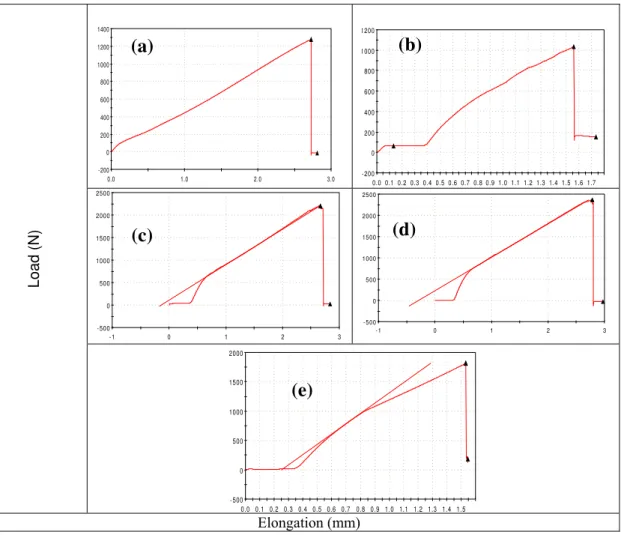
Figure 3 shows representative load vs. elongation curves for the polyester composites reinforced with different volume fraction of thinner buriti petiole fibers. These curves were recorded directly from the data acquisition program of the Instron machine. The first linear elastic part of the curves was followed by some curvature and then a sudden drop, indicating limited plastic strain before an almost brittle rupture.
Load (N) - 200 0 200 400 600 800 1000 1200 1400
0.0 1.0 2.0 3.0 - 200
0 200 400 600 800 1000 1200
0. 0 0.1 0.2 0.3 0. 4 0. 5 0.6 0.7 0. 8 0. 9 1. 0 1.1 1.2 1.3 1. 4 1. 5 1.6 1.7
- 500 0 500 1000 1500 2000 2500
- 1 0 1 2 3
- 5 00 0 5 00 10 00 15 00 20 00 25 00
- 1 0 1 2 3
- 500 0 500 1000 1500 2000
0.00.1 0.20.30.4 0.50.60.7 0.8 0.91.0 1.11.21.3 1.41.5
Elongation (mm)
(b)
(a)
(d)
(c)
(e)
Figure 4 shows the macro aspect of the ruptured specimens representative of each volume fraction of thinner buriti petiole fiber reinforced polyester composites. In this figure it should be noted that the fracture tips are progressively non-uniform with increasing amount of fibers in the composite. In particular, loosen fibers can be observed in association with longitudinal rupture due to crack propagation at the fiber/matrix interface. This fracture mechanism will be further discussed.
0% 10% 20% 30% 40%
Figure 4: Representative tensile-ruptured specimens corresponding to the different volume fraction of thinner buriti petiole fiber in the polyester composites.
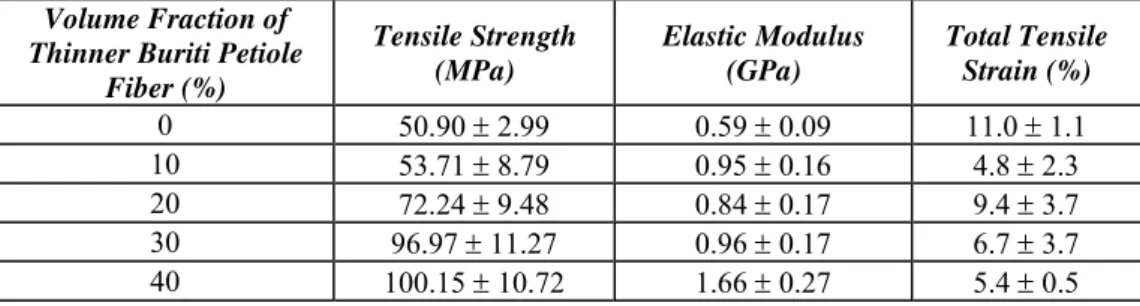
Based on the results from curves such as the ones in Figure 3, the tensile strength (ultimate stress at the maximum load), the elastic modulus and the total tensile strain were calculated. The average values of these mechanical properties are listed in Table 1 for the different volume fraction of thinner buriti petiole fibers reinforced polyester composites.
Table 1: Tensile properties of thinner buriti petiole fiber rein forced polyester composites.
Volume Fraction of Thinner Buriti Petiole
Fiber (%)
Tensile Strength (MPa)
Elastic Modulus (GPa)
Total Tensile Strain (%)
0 50.90 ± 2.99 0.59 ± 0.09 11.0 ± 1.1
10 53.71 ± 8.79 0.95 ± 0.16 4.8 ± 2.3
20 72.24 ± 9.48 0.84 ± 0.17 9.4 ± 3.7
30 96.97 ± 11.27 0.96 ± 0.17 6.7 ± 3.7
40 100.15 ± 10.72 1.66 ± 0.27 5.4 ± 0.5
The average values of the tensile strength and elastic modulus listed in Table 1 for the polyester composites are plotted in Fig 5 as a function of the volume fraction of thinner buriti petiole fibers. In this figure it is important to notice that the introduction of thinner buriti petiole fibers increases both the strength and stiffness of the polyester matrix. In fact, values of strength above 100 MPa were found for 40% of fiber volume fraction, while the elastic modulus that characterizes the stiffness of the composite reached a value above 1.6 GPa. This indicates that the thinner buriti petiole fiber acts as an effective reinforcing phase for polyester composites.
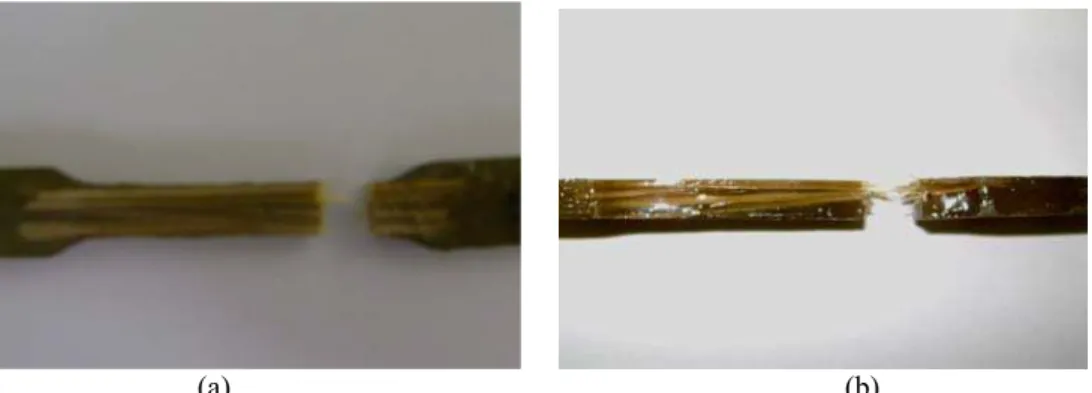
The fracture analysis of the tensile-ruptured composites specimens was performed by both macro (visual) and microscopic (SEM) observations. The macroscopic aspect of ruptured tips of a specimen with 40% of volume fraction of thinner buriti petiole fibers is shown in Figure 6. An important aspect to note is the non-uniform fracture. In general, fracture occurred by transversal crack propagation through the brittle polyester matrix.
Figure 7 shows typical SEM fractographs of a tensile-ruptured specimen of pure polyester (0% fiber). With low magnification, Figure 7(a), one could note the uniform and flat aspect of the fracture surface characteristic of a brittle material. With higher magnification, Figure 7(b), the marks in the surface are evidences of a single crack propagation though defects such as voids and flaws in the polyester structure.
0 10 20 30 40
40 50 60 70 80 90 100 110 120
Tensile St
re
ngth (M
Pa)
Volume Fraction of Buriti Petiole Fiber (%)
0 10 20 30 40
0.0 0.3 0.6 0.9 1.2 1.5 1.8
Elastic M
o
dul
us
(G
Pa)
Volume Fraction of Buriti Petiole Fiber (%)
(a) (b)
(a) (b)
Figure 5: Variation of the tensile strength (a) and the elastic modulus (b) with buriti petiole fiber reinforced polyester composites.
(a) (b)
Figure 6: Macroscopic aspect of the ruptured tip of a polyester composite specimen reinforced with 40% of thinner buriti petiole fibers. (a) front view; (b) side view.
(a) (b)
Figure 7: SEM fractographs of a pure polyester sample with different magnifications: (a) 40x, and (b) 500x.
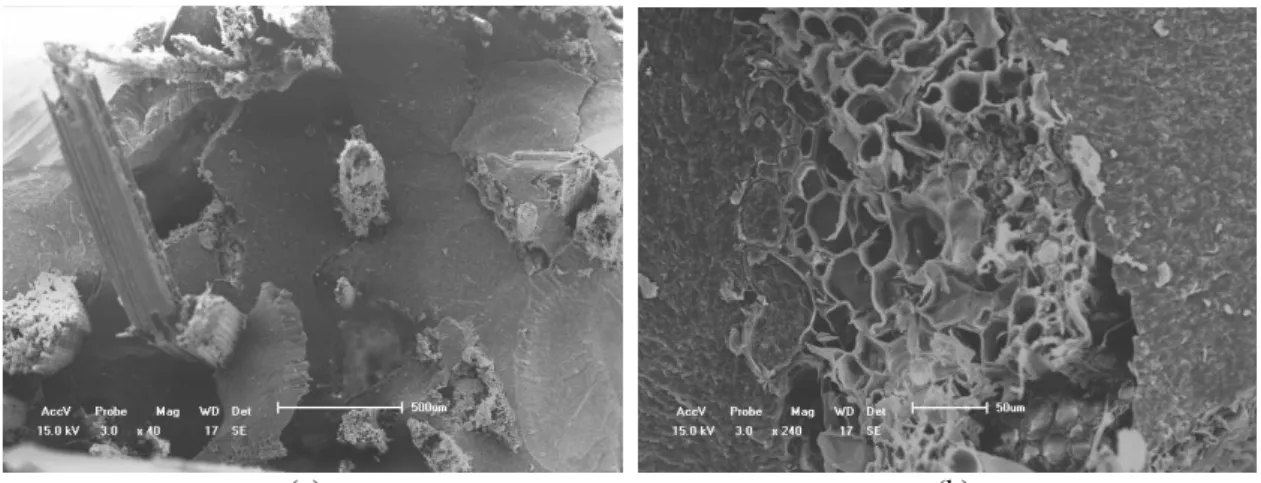
fiber and the polyester matrix. With higher magnification, Figure 8 (b), it is observed a fiber that was fractured near the transversal crack that propagated through the brittle matrix. The separation at the fiber/matrix interface also indicates that longitudinal cracks were nucleated at this interface.
The reason for this behavior is apparently a consequence of the weak fiber/matrix interface resistance. It is well known [2, 5, 11] that one of the drawbacks of a lignocellulosic fiber is the fact that, due to its hydrophilic nature, water is absorbed onto the surface. Thus, a weak bonding is expected to form between the surface of the buriti fiber and the hydrophobic polyester matrix. This weak bonding might be responsible for the fiber decohesion from the matrix causing the longitudinal rupture shown in Figures 6 and 8(b).
(a) (b)
Figure 8: SEM fractographs of a 30% thinner buriti petiole fiber reinforce composite with different magnification: (a) 40x, and (b) 240x.
4 CONCLUSIONS
Thinner buriti fibers that were manually cut from the petiole part of the palm tree are strong enough to reinforce the polyester matrix of tensile- tested composites. In fact, polyester composites reinforced with continuous and aligned thinner buriti petiole fibers significantly improve their tensile strength and elastic modulus.
This effective reinforcement can be attributed to the stronger thinner buriti petiole fiber with smaller diameter acting as a barrier to crack propagation though the brittle matrix.
The weak fiber/matrix interface allows longitudinal cracks to proceed along the interface as a continuation of the transversal cracks initially propagating through the matrix. This causes separation of the fiber from the matrix and represents the main mechanism of composite rupture
5 ACKNOWLEDGEMENTS
The authors thank the support to this investigation by the Brazilian agencies: CNPq, CAPES, FAPERJ and TECNORTE/FENORTE.
6 REFERENCES
[1] GORE, A., An inconvenient truth. the planetary emergency of global warming and what we can do about it, Rodale Press, Emmanaus, Pennsylvania, USA, 2006.
[2] MOHANTY, A.K., MISHRA, M., HINRICHSEN, G., “Biofibers, biodegradable polymers and biocomposites: an overview”, Macromolecular Materials and Engineering, v. 276/277, pp. 1-24, 2000.
[3] WAMBUA, P., IVENS, I., VERPOEST, I., “Natural fibers: can they replace glass and fibre reinforced plastics?”, Composites Science and Technology, v. 63, pp. 1259-1264, 2003.
[5] SATYANARAYANA, K.G., GUIMARÃES, J.L., WYPYCH, F., “Studies on lignocellulosic fibers of Brazil. Part I: Source, production, morphology, properties and applications”, Composites: Part A, v. 38, pp. 1694-1709, 2007.
[6] HILL, S., “Cars that grow on trees”, New Scientists, v. 153, n. 2067, pp. 36-39, 1997.
[7] MARSH, G., “Next step for automotive materials”, Materials Today, v. 6, n. 4, pp. 36-43, 2003.
[8] ZAH, R., HISCHIER, R., LEÃO, A.L., BROWN, I., “Curaua fibers in automobile industry – A sustainability assessment”, Journal Cleaner Production, v. 15, pp. 1032-1040, 2007.
[9] LEE, S.H., OHKITA, T., “Mechanical and thermal flow properties of wood fiber-biodegradable polymer composites”, Journal Applied Polymer Science, v. 90, pp. 1900-1905, 2003.
[10] LEE, S.H., WANG, S., “Biodegradable polymer/bamboo fiber biocomposites with bio-based coupling agent”, Composites: Part A, v. 37, pp. 80-91, 2006.
[11] MONTEIRO, S.N., LOPES, F.P.D., FERREIRA, A.S., NASCIMENTO, D.C.O., “Natural fiber polymer matrix composites: cheaper, tougher and environmentally friendly”, JOM – The Member Journal of TMS, v. 61, n. 1, pp. 17-22, 2009.
[12] BLEDZKI, A.K., GASSAN, J., “Composites reinforced with cellulose-based fibers”, Programming Polymer Science, v. 4, pp. 201-274, 1999.
[13] NABI, D., SAHED, JOG, J.P., “Natural fiber polymer composites: a review”, Advances in Polymer Technology, v.18, pp. 221-274, 1999.
[14] SANTOS, R.S., SILVEIRA, E.L.C., SOUZA, C.M.L., “Study of the mechanical properties of thermoset polymeric matrix composites reinforced with buriti fibers”, In: Proceedings of the 30th Annual Meeting of the Brazilian Chemistry Society, pp. 1, Águas de Lindóia, Brazil, 2007.
[15] SANTOS, N.S.S., DIAS, C.G.B.T., SANCHES, E.M.S., ZAVAGLIA, C.A.C., ALBUQUERQUE, E.L., “Microstuctural and mechanical characterization of miriti fiber for utilization as reinforcement on polymeric composites”, In: Proceedings of the Brazilian Congress on Materials Science and Engineering – 18 CBECIMAT, pp. 3565-3573, Porto de Galinhas, PE, Brazil, 1-12 November, 2008. [16] MONTEIRO, S.N., MARGEM, F.M., SANTOS, L.F.L., “Charpy impact notch toughness of buriti
fibers reinforced polyester matrix composites”, Proceedings of the 18th Brazilian Congress on Materials Science and Engeneering, 18 CBECIMAT, Porto de Galinhas, PE, Brazil, 1-12 November, 2008.
[17] PORTELA, T.G.R., LOPES, F.P.D., LOIOLA, R.L., MONTEIRO, S.N., CARVALHO, E.A., “Evaluation of the diameter influence on the tensile strength of buriti fibers by the Weibull method”,
In: Proceedings of the 64th Annual Meeting of the Brazilian Society for Metallurgy, Materials and Mining, pp. 1-10, Belo Horizonte, MG, Brazil, July 2009.
[18] MONTEIRO, S.N., LOPES, F.P.D., MOTTA, L.C., MARQUES, L.S., PORTELA, T.G.R., “Statistical analysis to characterize the uniformity of mechanical properties of butiti fibers”, In: Proceedings of the Characterization of Mineral, Metals & Materials, TMS 2009, pp. 1-8, San Francisco, CA, USA, March 2009.
[19] PORTELA, T.G.R., COSTA, L.L., LOPES, F.P.D., MONTEIRO, S.N., “Characterization of fibers from different parts of the buriti palm tree”, In: Proceedings of the Characterization of Mineral, Metals & Materials, TMS 2010, pp. 1-8, Seattle, USA, February 2010.