*e-mail: [email protected]
Trabalho apresentado no 1º Congresso da Sociedade Brasileira em Materiais, Rio de Janeiro, Julho de 2002.
Superficial Modifications in TiO
2and Al
2O
3Ceramics
Flávio de Paula Santosa*, Elson de Camposa, Marcelo Costac,
Francisco Cristóvão Lourenço Melob, Roberto Yzumi Hondac, Rogério Pinto Motac
a
Department of Materials and Technology, UNESP “Júlio de Mesquita Filho”, Guaratinguetá campus b
AMR, IAE, Centro Técnico Aeroespacial, São José dos Campos - SP, Brazil c
Department of Physics & Chemistry, Universidade
Estadual Paulista “Júlio de Mesquita Filho”, Guaratinguetá campus,
Av. Ariberto Pereira da Cunha 333, Pedregulho, 12516-410 Guaratinguetá - SP, Brazil
Received:October 10, 2002; Revised: February 02, 2003
The properties of hydrophilicity or hydrophobicity of materials are defined mainly, though not exclusively, by their composition, morphology and surface energy. In this work, titanium di-oxide (TiO2) and aluminum oxide-alumina (Al2O3) ceramics prepared by uniaxial pressing were
studied in terms of surface energy. The surfaces of these ceramics were treated with nitrogen plasma, using a stainless steel reactor excited by a 13,6 MHz radio frequency operating at 50 W input power and 13 Pa nitrogen pressure. The surface morphology was investigated by scanning electron microscopy (SEM) analysis. Surface energy and contact angle measurements were taken using a RAMÉ-HART goniometer. These measurements were taken as function of time, over a 21-day period. The contact angle and surface energy values were found to change by almost 34% in comparison to their initial values immediately following plasma treatment. Nonetheless, the hydrophilic character of the Al2O3 and TiO2 remained constant throughout the test period.
Keywords:titanium dioxide, alumina, surface energy, contact angle
The study of biomaterials involves investigations into the relevant characteristics of these materials, i.e., their mechanical, thermal, electrical and especially their surface properties, for the surface is in contact with living tissue. Thus, the study of these materials’ surfaces is crucial to determine their biocompatibility and to evaluate their
hy-drophobic or hydrophilic character5.
Among the materials that are applicable as biomaterials,
titanium dioxide (TiO2) constitutes an alternative material,
mainly because it is sterilizable when properly stimulated by ultraviolet radiation with a wavelength similar to the Sun’s radiation6.
The use of alumina (Al2O3) as a biomaterial offers the
advantage of bio-inertness7, although it is not as sterilizable
as TiO2. However, when alumina is mixed with titanium
dioxide, it allows the degree of porosity of the ceramic to be controlled, ensuring new potential applications as filters
and selective membranes8.
This work deals with the production of TiO2 and Al2O3
ceramics subjected to plasma treatments in a nitrogen
at-1. Introduction
Kingery1 defined Ceramics as the art, science or
tech-nology of manufacturing and using solid pieces composed essentially and mostly of non-metallic inorganic materials
called ceramicmaterials.
The scientific study of ceramic materials gained greater
momentum from the 1940’s on, with the emergence of
ad-vancedceramics such as barium titanate capacitors (BaTiO3)
and alumina (Al2O3) ignition plugs2 for automobiles. These
ceramics are applied in the high tech electronic, aerospace
and automotive industries3.
Although ceramics have reportedly been employed as
biomaterials for bone repairs since the late 19th century, the
modern era of bioceramics is considered to have begun in
1963 with the study of cerosium, composed of an aluminate
impregnated with epoxy resin, which was also used to
re-place bone parts, starting in 19634. The late 1970’s saw a
mosphere. The materials’ wettability was verified by inves-tigating their surface energies and contact angles before and after the plasma treatments. The mechanical properties, i.e., rupture strain, apparent specific density, porosity levels, percentile of water absorption and superficial roughness, were also verified.
2. Methods and Processes
TiO2 and Al2O3 samples were prepared from powder with
the addition of 0,5% in mass of a polyvinylic alcohol solu-tion (PVal) and 10% in mass of distilled water. The mix-tures were then ball milled for 30 min to homogenize them completely, sifted through a 10-mesh sieve, placed in a non-porous metallic mold and uniaxially pressed under a pres-sure of 40 MPa to shape them into 22 mm diameter, 3 mm thick disk-shaped test specimens. Other samples were shaped into 45 mm long, 4 mm wide, 3 mm thick bars.
Af-ter pressing, the TiO2 samples were sintered for one hour at
1450 °C and the Al2O3 samples at 1650 °C in an electric
EDG7000-EDGCOM3P furnace, using a heating rate of 5 °C/min.
The ceramic’s mechanical strength was evaluated by three-point flexural testing, following the ASTM C1161/94 standard, using an EMIC testing machine at a speed of 0,5 mm/min. The results were analyzed based on Weibull’s statistical method to verify the material’s characteristic
rup-ture strain (σ0) and mean rupture strain (σ50). Apparent
spe-cific density, apparent porosity and water absorption meas-urements were taken by means of an analytical scale test, according to the ASTM C20/87 standard. The mean
rough-ness, Ra parameter, was then measured using a
MITUTOYO-SURFTEST 301 roughness measuring instru-ment.
The microstructure of the two samples was analyzed by SEM (scanning electron microscopy) under a LEO 435 VPI microscope using secondary electrons and a 15 kV voltage. The hydrophilic or hydrophobic characteristics of the alumina and titanium dioxide samples were evaluated
through contact angle (θ) and surface free energy
measure-ments. This material’s wettability is directly associated with its superficial tension and with the behavior of the solid-liquid interface, assuming that the material in question is
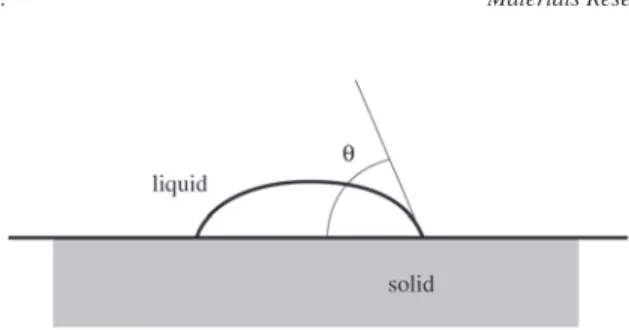
solid11. The contact angle is measured by the tangent
be-tween a drop of the liquid and the solid surface, as shown in Fig. 1.
Considering a drop at rest, i.e., with the variation of the surface free energy per unit area tending to zero, one has:
γ
SL = γSV -γLV cosθ (1),
where γ
LV, γSV and γSL are, respectively, the interfacial
ten-sions between liquid and steam, solid and steam, and solid
and liquid. This expression is called Young’s equation. When the angle is greater than 90°, the absorption is practically zero and the liquid tends to move slowly over the solid without penetrating into it. On the other hand, the liquid tends to flow over the solid when the contact angle tends to zero. Therefore, a dispersal coefficient S must be defined, since there are differences between the tensions and the energies at the solid-steam interface and only in the solid, owing to the types of attractive forces, such as the
van der Waals forces, that act at the intermolecular level12.
Thus, one can write:
(2),
in which
(3),
here γLV and γSL are, respectively, the interfacial liquid-steam
and solid-liquid tensions, R is the universal constant of the
ideal gases, T is the absolute ambient temperature, Γ
repre-sents the superficial concentration of absorbed steam, p0 is
the steam’s equilibrium pressure and p is the local pressure
of the steam.
A liquid will spread spontaneously on a solid surface
when S ≥0, i.e., when the surface free energy of the solid is
greater than the other energies existing at the aforementioned interfaces. It is worth noting that the solid’s wettability will depend on other factors such as the viscosity of the liquid used and the surface roughness of the solid in question.
Contact angle and surface energy measurements of the ceramics were taken as a function of time before and after the plasma treatment, using a RAMÉ-HART model 100 goniometer in a 20 °C controlled temperature environment. Deionized water and di-iodemethane were used specifically
as test liquids for these measurements. The TiO2 and Al2O3
samples were plasma treated for 3 min in a stainless steel reactor excited by radio frequency (13,56 MHz, 50 W), us-ing plasma derived from nitrogen kept under a pressure of 13 Pa.
Figure 1. Contact angle measurement.
S =γ
S - γSL - γLV - ΠS
Π
S =R T
∫
Γd(ln p)p0
3. Results and discussion
Figures 2a and 2b show typical SEM images of TiO2
and Al2O3 samples, revealing, through the better definition
of the grain outlines, that the Al2O3 ceramic (alumina) grains
have a more regular shape than those of the TiO2 ceramics.
This finding may be evidence that, comparatively, the alumina took on a greater density, an assumption that is confirmed by the values listed in Table 1.
Table 1 shows the mechanical properties of the alumina and titanium dioxide samples.
As can be seen, the alumina samples became more densified though less homogeneous than the titanium diox-ide samples, as illustrated in the diagrams of Fig. 3 and in Table 2.
The roughness analysis revealed that the superficial
fin-ish of the Al2O3 samples was slightly superior, which may
have influenced the rupture strain values, increasing them
in comparison to those of the TiO2 samples.
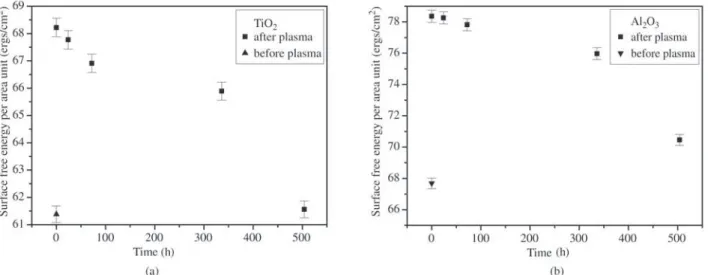
Figures 4 and 5 show the correlation between the con-tact angle and the surface energy as a function of time. The graphs initially show a decrease in the contact angle and an increase in the surface energy, prior to and immediately fol-lowing the plasma treatment. After some time had elapsed,
Table 1. Mechanical properties of TiO2 and Al2O3 samples.
Property TiO2 Al2O3
Densification (%) 94.35 98.19
Apparent porosity (%) 0.26 0.32
Water absorption (%) 0.04 0.08
Apparent specific density (g/cm3) 4.01 3.91
Roughness Ra (µm) 1.67 1.19
Table 2. Results of three-point flexural test using Weibull’s statis-tical method.
Property TiO2 Al2O3
σ0 (MPa) 130.0 260.0
σ50 (MPa) 125.0 239.0
Weibull module 14.6 5.0
there was an increase in the contact angle, accompanied by a reduction in the surface energy. The most significant dif-ference for the two types of ceramic occurred between 336
and 504 h. It was also found that the Al2O3 ceramic
dis-played stronger hydrophilicity than the TiO2 ceramic. This
difference was also associated with other mechanical
char-acteristics of these materials, such as superficial roughness,
which was greater in the TiO2 ceramic.
In the case of the TiO2 samples, the production of
ultra-violet irradiation during the plasma application led to a
re-duction of the Ti+4 to Ti+3 ions and the appearance of
sur-face oxygen vacancies13. Subsequently, the adsorption of
ambient water steam led to the formation of hydroxyl groups on the surface, improving the samples’ hydrophilicity. The
reoxidation of the Ti+3 ions promoted a progressive removal
of the hydroxyl groups, causing the samples to revert to a state of greater hydrophilicity.
According to Tari15, the adsorptive behavior of hydroxyl
groups by alumina (Al2O3) may occur because the aluminum
atoms can share electrons with other atoms or compounds, even after bonding with the oxygen, as is the case of the
Figure 4. Contact angle (degrees) vs. time (h) plots for (a) Al2O3; (b) TiO2 samples produced by uniaxial pressure and sintered,
respec-tively, at 1650and 1450 °C.
Figure 5. Surface free energy per area unit (ergs/cm2) vs. time (h) for (a)TiO
2; (b)Al2O3 samples formed by uniaxial pressure and sintered
oxygen present in the water steam that exists in the atmos-phere. The application of plasma, in this case, may have modified the action of polar forces acting on the sample’s surface, thus altering the nondispersive component of the
superficial tension14 and improving the material’s
hydrophilicity. In time, the inclusion of oxygen on the alumina surface and the rearrangement of superficial charges tend to invert the material’s behavior, repelling electrons and polar liquids, as is the case of water. Therefore, the ap-plication of plasma using gases such as nitrogen can modify the surface energy and contact angle, which are a function of the power applied to the system and of the pressure
in-side the reactor in which the plasma is processed16.
The changes in contact angle and surface free energy
that occurred over time in the TiO2 and Al2O3 samples tended
toward values at which the system’s equilibrium was configured at levels of minimum energy.
4. Conclusions
The TiO2 and Al2O3 samples displayed dissimilar
me-chanical characteristics, with the TiO2 samples showing a
greater degree of homogeneity than the Al2O3 samples,
al-though the latter possessed greater mechanical resistance than the titanium dioxide samples. However, after being plasma treated, both samples showed the same behavior in regard to the contact angle and surface energy measurements. The variation in the hydrophilicity of the titanium dioxide samples was attributed to oxidation and reoxidation proc-esses of the titanium ions, with adsorption and loss of hy-droxyl groups on the samples’ surfaces. With regard to the alumina samples, the adsorption of hydroxyl groups possi-bly originated from bonding of the aluminum atoms and a subsequent reversal to the energy equilibrium of both sam-ples to their minimum values.
Acknowledgments
The authors thank technologists Domingos Hasmann Neto and Manoel Francisco dos Santos Filho, of DMT/FEG/UNESP, for their help in preparing and produc-ing the samples.
References
1. Kingery, W.D.; Bowen, H.K.; Uhlmann, D.R.
Introduc-tion to Ceramics, 2nd ed., Wiley Interscience Publication,
New York, p. 3, 1976.
2. Campos, E. Obtenção e análise de cerâmicas conformadas
com amidos comerciais, Doctoral thesis, UNESP, campus
de Guaratinguetá, São Paulo, p. 31, 2001.
3. Zavaglia, C.A. Introdução à tecnologia de materiais
cerâmicos, textbook, Universidade Estadual de
Campinas, Campinas, p. 54-76, 1991.
4. Shackelford, J.F. Bioceramics – applications of ceramic
and glass materials in Medicine, Materials Science
Fo-rum, v. 293, p. 1-109, 1999.
5. Ratner, B.D.; Johnston, A.B.; Lenk, T.J. Biomaterial
sur-faces, Journal of Biomedical Materials Research: Applied
Biomaterials, v. 21, p. 59-90, 1987.
6. Wei, C.; Wen-Yan L.; Zainal, Z.; Kalzhu, N.E.W.; Kruzic,
A.P.; Smith, R.L.; Rajeshwar, K. Bactericidal Activity of
TiO2 photocatalyst in aqueous media: toward a solar-assisted water disinfection system, Environment Science
Technology, v. 28, p. 934-938, 1994.
7. Cahn, J.C.; Haasen, P.; Kramer, E.J. Material Science
and Technology – a comprehensive treatment, Medical and Dental Materials, 1st ed., New York, v. 14, p. 59-62,
1992.
8. Santos, F.P.; Campos, E.; Mota, R.P.; Hein, L.R.O.; Melo,
F.C.L. Modificações microestruturais em amostras de
dióxido de titânio com adição de dióxido de alumínio prensadas uniaxialmente, Anais do XXIV Encontro
Nacional de Física da Matéria Condensada, São Lourenço, MG, p. 295, 2001.
9. Annual Book of Standards, Standard Test Method for Flexural of Advanced Ceramics at Ambient Temperature, C1161-94, 1994.
10. Annual Book of Standards, Standard Test Methods for Apparent Porosity, Water Absorption, Apparent Specific Gravity and Bulk Density of Burned Refractory Brick and Shapes by Boiling Water, C20-87, 1987.
11. Adamson, A.W.; Gast, A.P. Physical Chemistry of
Sur-faces, Wiley Intersc. Publ., New York, p. 353-355, 1997.
12. Kinloch, A.J. Adhesion and adhesives – science and
technology, Chapman & Hall, 4th ed, London, p. 1-20,
1995.
13. Kamei, M.; Mitsuhashi, T. Hydrophobic drawings on
hydrophilic surfaces of single crystalline titanium diox-ide: surface wettability control by mechanochemical treatment, Surface Science, 463, p. 609-612, 2000.
14. Lawrence, J.; Li, L.; Spencer, J.T. Diode laser
modifi-cation of ceramic material surface properties for im-proved wettability and adhesion, Applied Surface
Sci-ence, v. 138-139, p. 388-393, 1999.
15. Tari, G. Advances in colloidal processing of alumina,
Doctoral thesis, Universidade de Aveiro, Portugal, p. 8-9, 1999.
16. Santos, F.P.; Campos, E.; Honda, R.Y.; Mota, R.P.; Melo,
F.C.L. Contact angle modifications in titanium dioxide,