Abstract
The problem of nonlinear vibrations and stability analysis for the symmetric laminated plates with complex shape, loaded by static or periodic load in-plane is considered. In general case research of stability and parametric vibrations is connected with many mathematical difficulties. For this reason we propose approach based on application of R-functions theory and varia-tional methods (RFM).The developed method takes into ac-count pre-buckle stress state of the plate. The proposed ap-proach is demonstrated on testing problems and applied to laminated plates with cutouts. The effects of geometrical pa-rameters, load, boundary conditions on stability regions and nonlinear vibrations are investigated.
Keywords
Dynamical stability and parametrical vibrations of the laminated
plates with complex shape
1 INTRODUCTION
Laminated composite plates are frequently used in various engineering applications in the aviation, aerospace, marine, mechanical and others industries. The use of composite materials requires com-plex analytical and numerical methods in order to predict accurately their response to external loading. A recent review of current developments in non-linear vibration analysis and dynamic sta-bility of the laminated plates and shells has been presented in references [6,9,11,13,14], ets. From presented review it follows that buckling problems with non-uniform pre-buckle stress state are of special interest. There are few works in which vibration, buckling and parametric instability behav-ior of a laminated plate with internal cutouts were studied [10,12]ets. It should be noted that the finite element method (FEM) remains the only way for dealing with complex structures and the most versatile.
In this work we propose alternative to FEM approach based on using variational methods and R-functions theory (RFM). The developed method takes into account pre-buckle stress-state and allows investigating the laminated plates of an arbitrary form, in particular case with internal free, simply supported and clamped cutouts. Formerly this approach was developed in references [2,3] for isotropic and orthotropic plates. The aim of this paper is extending the theoretical model of this
Lidiya Kurpa, Olga Mazur, Victoria Tka-chenko
Lidiya Kurpa
The Kharkov State Technical University, Department of Applied Mathematics, UKRAINE; [email protected]
Olga Mazur
The Kharkov State Technical University, Department of Applied Mathematics, UKRAINE; [email protected]
Victoria Tkachenko
The Kharkov State Technical University, Department of Applied Mathematics, UKRAINE; [email protected] of Tehran, College of Engineering
Engineering Optimization Research Group, Tehran, Iran
method in order to carry out the nonlinear analysis of laminated plates with an arbitrary shape and different boundary conditions. The dynamic instability and buckling characteristics of the laminated plates with cutouts are discussed.
2 PROBLEM FORMULATION
Geometrically nonlinear vibration of simmetricaly laminated composite plates subjected to in-plane compressive periodic edge loading p p0 ptcos t is studied. It is assumed that the de-lamination of the layers is absent. The mathematical formulation of the problem is made in the framework of the classical laminated plate theory. Neglecting rotatory inertia the equation of equilibrium [1] may be written as:
11,x 12,y 0
N N , (1)
12,x 22,y 0
N N , (2)
11,xx 2 12,xy 22,yy 11 ,xx 2 12 ,xy 22 ,yy ,tt
M M M N w N w N w mw , (3)
where N11,N22,N12 and M11,M22,M12 are stress resultants:
11 11 12 16 11
22 12 22 26 22
12 16 26 66 12
N C C C
N N C C C
N C C C
,
11 12 16 ,
11
22 12 22 26 ,
12 16 26 66 2 ,
xx
yy
xy
D D D w
M
M M D D D w
M D D D w
.
Deformations 11, 22, 12 Tare expressed as [1]
2 11 , 1 , 2 x x
u w , 2
22 ,
1 , 2
y y
v w , 12L v,x u,y w w,x ,y,
where u,v,w are displacements of the plate in directions Ox, Oy and Oz respectively. For convenience we introduce the following notation
L N
, N N L N N ,
where
11 , 22 , 12
T
L L L
L
, 11 , 22 , 12 T
N N N
11 ,
L x
u , 22L v,y, 12L v,x u,y, 11 1 , 2
2 N
x
w , 22 1 , 2
2 N
y
w , 12N w w,x ,y.
Then stress resultants 11 , 22 , 12 T
L L L
L
N N N N and 11 , 22 , 12
T
N N N
N
N N N N may be
presented as follows
( )L ( )L
N C , N( )N C ( )N .
The componentsCij,Dij ij 11,22,12,16,26,66 of the stiffness matrices C and D are defined
as[1]:
1
2 1
, 1, ,
s
s
h N
s
ij ij ij
s h
C D B z dz
where ( )s ij
B are mechanical characteristics of the s-layer.
The system of equations (1)-(3) is supplemented by corresponding boundary conditions.
3. METHOD OF SOLUTION
The proposed method is based on solving a number of auxiliary problems.
1. Solving problem about pre-buckle stress state of the laminated plate.
In order to determine the pre-buckle stress state of the plate let us consider the following system
11, 12, 0
L L
x y
N N ,
12, 22, 0
L L
x y
N N , (4)
supplemented on the loaded part of the border 1 by the following boundary conditions
( ) ( )
1, 1 1, 1, 1 0,
L L
n n
N u v T u v x y, 1 (5)
Operators NnL ,TnL in (5) is defined by formulas
2 2
11 22 2 12
L L L
L n
where l cos( ,n Ox),m cos n Oy, , n is normal vector to border of the domain. Boundary
conditions on the remain part depend on way of fixing.
Solution u1 x y v, , 1 x y, of this system (4)-(5) may be found by RFM (R-functions method). Variational formulation of the problem (4)-(5) is reduced to finding minimum of the functional
1
( ) ( ) ( ) ( )
1 1 11 11 22 22 12 12 1 1 1
1
( , ) ( )
2
L L L L
n
I u v N N N d N u l v m d (6)
We seek the minimum of the functional (6) on the set of basis functions constructed by R-functions theory [7,8].
Forces 0 0 0 0 11 , 22 , 12
T
N N N N are defined after finding solutions u1 and v1 ,
(0)
(0)
1, 1 1, 1 ,
N u v C u v
where
(0) (0) (0) (0)
1, 1 ( 11, 22, 12) ,
T
u v (0)
11 u1,x,
( )
22 1,
L y
v , 12( )L u1,y v1,x.
2. Finding buckling load.
Let us find the critical load provided that compressive load is varied proportionally to some pa-rameter , that is, from the following equation
33 3 , ,
L w Nl u v w . (7)
The critical value of the parameter is found by energy approach. Let us write the appropri-ate functional:
0 2
11 11 22 22 12 12 11 ,
1
( ) [( ) ( ( )
2 x
I w M M M N w
0 2 0
22 ( ,y) 12 ,x ,y)]
N w N w w dxdy.
As before, minimization of the functional is performed on the set of basis functions, construct-ed usin– t—e RFM. As a result of t—e Ritz’s met—od, t—is problem is reduced to t—e ei–envalue problem.
,
I U V (8)
where U is total potential energy taking into account the influence of forces in the median plane:
11 11 22 22 12 12
1 ( )
2
U w M M M
2 2
0 11 ( , )(1 1 , ) 22 ( , )(1 1 , ) 12 ( , )1 1 , , ,
L L L
x y x y
p N u v w N u v w N u v w w d
and V is kinetic energy:
2 2 1
2
L
m
V w d .
Let us denote eigenfunction corresponding to the first mode of free linear vibrations of loaded plate by w1, L is relative natural frequency.
4. Solutions of the auxiliary problem like elasticity problem. Let us consider the following system of the equations:
11, 12, 1 1
L L
x y
N N Nl w ,
12, 22, 2 1
L L
x y
N N Nl w (9)
The right side of the system (9) has the following kind
1 1 11, 12,
N N
x y
Nl w N N , Nl2 w1 N12,Nx N22,Ny
This system is supplemented by the boundary conditions:
( ) ( ) ( ) ( )
1 , 1 ,
L N L N
n n n n
N N w T T w (10)
where
2 2
11 22 2 12
N N N
N n
N N l N m N lm,TnN N12N l2 m2 N11N N22N lm.
2 2 11 11 22 22 12 12 1 1 2 2 1 2
1
( , ) ( 2( ( ) ( ) ))
2
L L L
I u v N N N Nl w u Nl w v d
( ) ( )
1 2 2 1 2 2 1
( )( ) ( )( )
N N
n n
N w u l v m T w u m v l d .
5. Solution of non-linear vibration problem. Let us represent unknown functions u v w, , in the
following way
1
, , ,
w x y t y t w x y ,
2
1 2
, , , ,
u x y t pu x y y t u x y , v x y t, , pv1 x y, y2 t v2 x y, . (11)
Substituting expressions (11) into equation (1)-(3), and using the Bubnov-Galerkin method, we receive ordinary differential equation:
in case of static load
2 3
( ) L ( ) ( ) 0,
y t y t y t (12)
in case of periodic load
2 3
( ) L (1 2 cos( )) ( ) ( ) 0.
y t k t y t y t (13)
Here k and is defined by the following expressions:
, 2 t kr p k p
11 2 2 1 1, 12 2 2 1 1, 22 2 2 1 1,
2 2
1 1
( , , ) 2 ( , , ) ( , , )
.
xx xy yy
L
N u v w w N u v w w N u v w w d
m w
To solve the equation (12) let us present unknown function y t( ) in the formy t( ) Acos Nt. Using the Bubnov-Galerkin method, we receive the dependence between amplitude A and
fre-quency ratio N L : 2 3 1 . 4 A
To identify areas dynamic instability, instead of (13), we use the equation Mathieu:
2 1 2 cos 0
t L
The main area of dynamic instability (near 2 L) is limited by values 1 and 2 [4]:
1 2 L 1 k, 2 2 L 1 k .
For the analysis of nonlinear vibrations after the loss of stability we use nonlinear equation (13). Dependence between the frequency ratio / 2 L and amplitude A are determined as follows [4]:
2
2
2
1 .
4
3 L
A k
4. NUMERICAL RESULTS
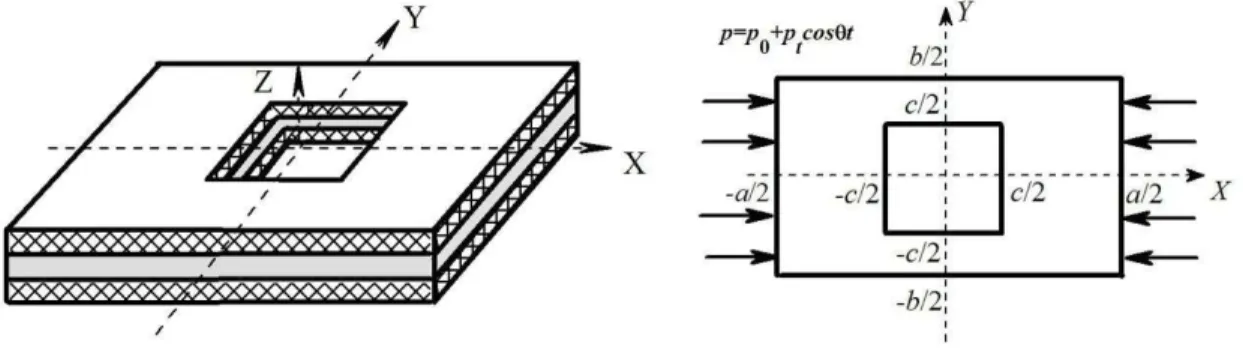
To illustrate our approach let us consider symmetrically laminated plate with central cutout (Fig. 1). In this case it is needed to determine the pre-buckle stress state of the laminated plate.
Sup-pose the plate is loaded longitudinally along the edges parallel to axis OY (
2
a
x ).
Figure 1 Form of plate with cutout.
Boundary conditions of two types are considered:
1. The plate is assumed simply supported on the outer border, but cutout is free (SS-F):
0
w , Mx 0, Nx p, Nxy 0, x y, 1, 1:
2
a
x ;
0
w ,My 0, u 0, Ny 0, x y, 2, 2:
2
b
y ;
0
n
M , Qn 0, Nn 0, Tn 0, x y, 3, 3 \ 1 2 .
(14)
0
w , Mx 0, Nx p, Nxy 0, x y, 1, 1 :
2
a
x ;
0
w , Mn 0, Nn 0, Tn 0, x y, 4, 4 \ 1.
(15)
Numerical results are obtained for material with the following relations for the elasticity coeffi-cients: E11=141.0 Gpa, E22=9.23 Gpa, G12=G13=5.95 Gpa, G23=2.96 Gpa, ν12= 0.313.
The structures of solution [7,8] for above mentioned boundary value problems (4)-(5), (7), (8), (9)-(10) are taken in the form:
1. boundary conditions SS-F (14):
1 0 0
w P ;ui 2 Pi, vi Pi 2, i 1,2;
2. boundary conditions SS-SS (15):
1 0
w P ;ui Pi, vi Pi 2, i 1,2,
where P P0, j j 1, 4 are indefinite components of the structure presented as an expansion in
a series of some complete system (power polynomials, trigonometric polynomials, splines etc.),
0 2
, 0, , 0, , 0
x y x y x y are equations of the boundary domain and its parts
0 1 2 and 2. For constructions of functions x y, , 0 x y, , 2 x y, theory of
the R-functions is used:
1 0 2 0 3 0 4
,
x y f f f f , 0 x y, f1 0 f2, 2 x y, f2 (16)
where 0, 0 are R-operations [7,8] represented below
2 2
0
x y x y x y , x 0y x y x2 y2.
Functions f ii, 1..4 in (16) are determined as
2 2 1 1 0 2 a f x a , 2 2 2 1 0 2 b f y b , 2 2 3 1 0 2 c f x c , 2 2 4 1 0 2 c f y c
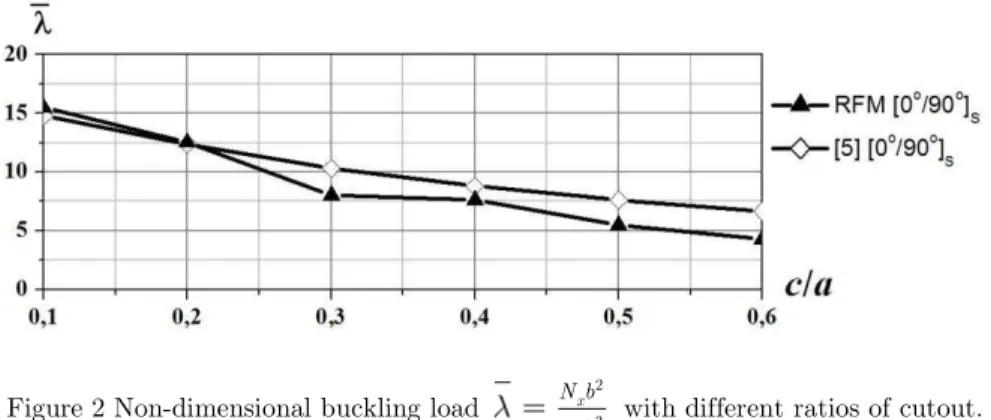
To validate the proposed approach we investigate cross-ply four layers laminated plate with free cutout, boundary conditions (14) and for a=b=0.5m, h=0.005m. This problem had been solved by Dash S. and others in [5]. The accuracy and the efficiency of the present method are established through comparison of non-dimensional buckling load 23
2
x
N b
Figure 2 Non-dimensional buckling load 23 2
x
N b
E h with different ratios of cutout.
Further calculations are carried out for geometrical parameters a/b=2, h=0.005m and bounda-ry conditions (15). The influence of cutout size on non-dimensional frequencies
2 2
2
/
La E h for various values of static component of load p0 is presented in the table 1.
Table 1. Effect of cutout size on natural frequency 2 2 2
/
La E h
/
c b
0 0 0
0 / 90 / 0 0 / 90 / 90 / 00 0 0 0 0 / 90 / 0 / 90 / 00 0 0 0 0
0 / kr
p p
0 0.25 0.75 0 0.25 0.75 0 0.25 0.75 0.1 19.197 16.894 10.051 19.290 16.886 9.923 19.038 16.605 9.733 0.2 22.937 19.979 11.684 22.533 19.602 11.453 22.082 19.194 11.185 0.25 24.237 21.169 12.535 23.825 20.842 12.556 23.354 20.388 12.080 0.4 32.835 29.564 20.527 31.874 28.546 19.504 30.879 27.447 17.993
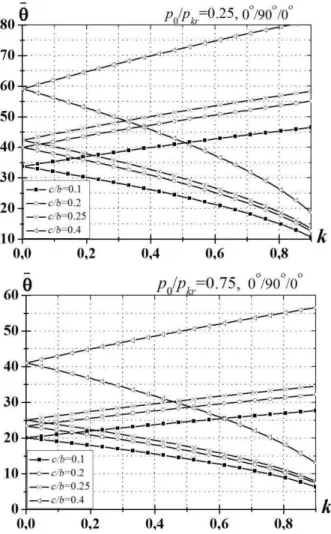
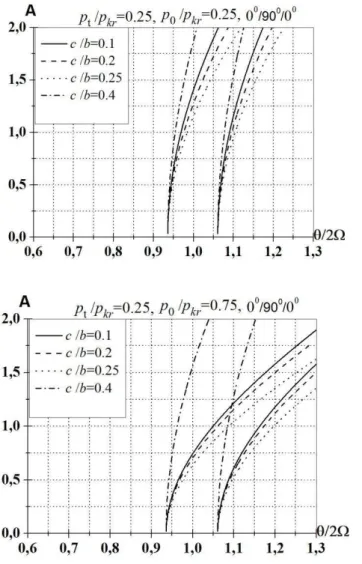
Effect of parameter of cutout size (c/b 0.1, 0.2, 0.25, 0.4 ) on instability regions ( 1 2 1 k, 2 2 1 k) are studied for p0 /pkr=0.25, 0.75, fig. 3. Obtained results
Figure 3. Instability zones for different size of cutout (SS-SS, p0/pkr=0.25,0.75).
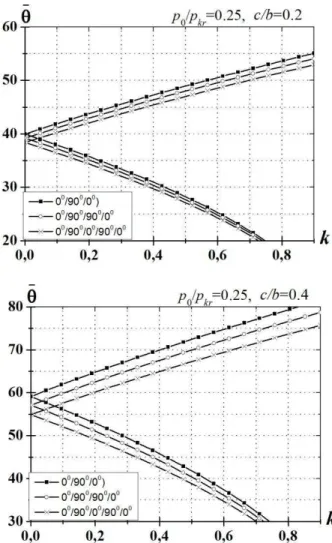
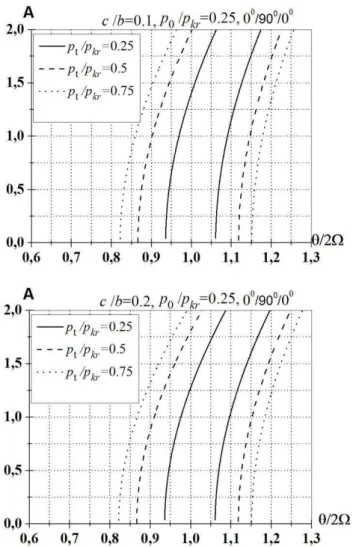
Instability analysis is fulfilled for 3,4,5 layers plates. (fig.4). Results are obtained for p0/pkr=0.25 and
/ 0.2, 0.4
Figure 4. Instability zones for different number of layers (SS-SS, p0/pkr=0.25, c/b 0.2, 0.4).
Nonlinear parametric vibrations are investigated for 3-layers plate. Effect of load parameter pt
on response curves is shown on fig.5. Calculations are performed for c/b 0.1, 0.2, p0 /pkr
Figure 6. Response curve for different size of cutout (SS-SS, p0/pkr=0.25, 0.75).
The effect of size of cutout on the response curves is analyzed for p0/pkr=0.25, 0.75, pt /pkr
=0.25. The extension of cutout leads to increase of the vibration amplitude. Change of the static component of the load p0 affects the slope of response curves.
5 CONCLUSIONS
applied to study dynamical stability and nonlinear vibrations of simply supported rectangular plate with both free and simply supported central square cutout. The numerical results for buck-ling loads, instability regions and amplitude-frequency response curves are obtained for various size of cutout, number of layers, parameters of load. Note that due to increase of cutout size of simply supported plate, instability regions tend to shift to higher excitation frequency with exten-sion of instability regions, showing destabilizing effect of cutout on behavior of plate. The effect of layers number on instability zones is not significant for plates with small cutout, but increase of cutout leads to essential influence of layers number. The amplitude-frequency response curves change the slope and location according to variation of values of the load components.
References
1. S. A. Ambartsumyan Theory Of Anisotropic Plates: Strength, Stability, & Vibrations. // Taylor & Fran-cis; 2 edition (1991). P.360.
2. Awrejcewicz J. Research of stability and nonlinear vibration of plates by R-Functions Method / J. Awrejcewicz, L. Kurpa, O. Mazur // Modeling Simulation and control of Nonlinear Engineering Dynamical Systems. UK, Springer, 2009. P.179-189.
3. Awrejcewicz J., Kurpa L., Mazur O. On the parametric vibrations and meshless discretization of orthotropic plates with complex shape. International Journal of Nonlinear Sciences and Numerical Simulation. 2010, V. 11, Is. 5, P. 371 386.
4. Bolotin V.V. The dynamic stability of elastic systems, // Holden-Day, 1964 P. 451.
5. Dash S. Stability of laminated composite curved panels with cutout using finite element method / Dash S., Asha, A. V., Sahu, S K. Proceedings of the International Conference on Theoretical, Applied Computational and Experimental Mechanics (ICTACEM 2004), December 28-31, 2004 IIT, Kharagpur.
6. Datta P. K. and Biswas S. Research Advances on Tension Buckling Behavior of Aerospace Structures: A Review. International Journal of Aeronautical and Space Sciences, vol. 12, issue 1, P. 1-15.
7. Rvachev V.L. (1982). The R-Functions theory and its Some Application, Naukova Dumka, Kiev, 1982. (in Russian),
8. Kurpa L.V., R-functions Method for Solving Linear Problems of Bending and Vibrations of Shallow Shells. Kharkiv NTU Press, Kharkiv, 2009, in Russian.
9. Qatu M. S., Sullivan R. W., Wang W . Recent research advances on the dynamic analysis of composite shells: 2000 2009. Composite Structures, Volume 93, Issue 1, December 2010, P. 14-31.
10.Sahu S. K., Datta P. K. Dynamic Stability of Laminated Composite Curved Panels with Cutouts. Journal of Engineering Mechanics, Vol. 129, No. 11, November 2003, pp. 1245-1253.
11.Sahu S. K. Research Advances in the dynamic stability behavior of plates and shells: 1987-2005 Part1: conservative system / S. K. Sahu P. K. Datta // Applied mechanics reviews. 2007. 60. P.65-75.
12.Sahu S. K., Datta P. K. Dynamic stability of curved panels with cutouts. Journal of Sound and Vibration. V. 251, Issue 4, 2002, P. 683 696
13.Simitses G. J. Instability of dynamically loaded structures / G. J. Simitses // Applied mechanics reviews. 1987. P. 1403 1408.