http://dx.doi.org/10.1590/0104-530X0893-15
Resumo: A gestão do Conhecimento (GC) é um tema que vem despertando o interesse de muitos pesquisadores nas últimas décadas, sendo grande parte das contribuições orientadas por etapas, denominadas processo de GC. Por se tratar de um tema abrangente, as publicações sobre o processo de GC apresentam contribuições multidisciplinares e, desta forma, esta pesquisa tem por objetivo conceituar este processo, analisando as principais abordagens que orientam o estudo de cada etapa, e, também, levantar as principais publicações que tratam do tema, classiicando‑as quanto à sua área de contribuição. Para alcançar estes objetivos, este artigo é orientado por uma pesquisa teórico‑conceitual, na qual foram estudados 71 artigos. Os resultados desta pesquisa apontam que o processo de GC é constituído de quatro etapas: aquisição, armazenamento, distribuição e utilização do conhecimento. Na fase de aquisição, as temáticas estudadas são aprendizagem organizacional, absorção de conhecimento, processo criativo e transformação do conhecimento. Na fase de armazenamento, as contribuições tratam do indivíduo, organização e tecnologia da informação, enquanto na fase de distribuição os estudos concentram‑se nas temáticas contato social, comunidade de prática e compartilhamento via tecnologia de informação. E, por im, na fase de utilização, são abordados os temas forma de utilização, capacidade dinâmica e recuperação e transformação do conhecimento. Palavras-chave: Processo de gestão do conhecimento; Aquisição de conhecimento; Armazenamento de conhecimento; Distribuição de conhecimento; Utilização de conhecimento; Pesquisa teórico‑conceitual.
Abstract: Knowledge Management (KM) is a subject that has aroused the interest of many researchers in the last decade, being great part of contributions driven by steps, named KM process. Because it is an embracing theme, publications about KM process have multidisciplinary contributions and, thus, this research aims to conceptualize this process, analyzing the main approach that guides the study of each stage, and also, to raise the main publications on the subject, classifying them as to their contribution area. To reach these goals, this article is oriented by a theoretical-conceptual research, in which 71 articles were studied. The results indicate that the KM process consists of four stages: acquisition, storage, distribution, and use of knowledge. In the acquisition phase, the studied themes are organizational learning, knowledge inception, creative process and knowledge transformation. In the storage phase, the contributions deal with a person, an organization and information technology, while in the distribution phase the studies concentrate in social contact themes, practice community and sharing via information technology. And, inally, in the use phase, we address the form of use, dynamic capacity and retrieval and knowledge transformation. Keywords: Knowledge management process; Knowledge acquisition; Knowledge storage; Knowledge distribution; Uses of knowledge; Theoretical-conceptual research.
Knowledge Management Process:
a theoretical-conceptual research
O Processo de Gestão do Conhecimento: uma pesquisa teórico-conceitual
Rodrigo Valio Dominguez Gonzalez1
Manoel Fernando Martins2
1 Universidade Estadual de Campinas – UNICAMP, Rua Pedro Zaccaria, 1300, CEP 13484-350, Limeira, SP, Brazil,
e-mail: [email protected]
2 Universidade Federal de São Carlos – UFSCar, Rodovia Washington Luís, Km 235, SP 310, CEP 13565-905, São Carlos, SP, Brazil,
e-mail: [email protected]
Received Aug. 8, 2015 - Accepted Abr. 23, 2016
Financial support: FAPESP (process nº 2013/02872-5) and CNPQ (process nº 445205/2014-8).
1 Introduction
Organizational knowledge is considered, nowadays, an asset that, although intangible, generates competitive advantage to the organization. To Grant (1996), competitive advantage is reached through continuous improvement and process innovation and of product, and knowledge is the organizational resource that
allows the organization to develop activities of improvement and innovation.
according to which the competitive advantage of an organization is subjected to knowledge.
Although many of its central points are not new to the academic world, the study of Knowledge Management (KM) is a recent concept, discussed more fully in the 1990s, treated as a process that
promotes the low of knowledge between individuals
and groups within the organization, consisting of four main steps: acquisition, storage, distribution and use of knowledge (Durst & Edvardsson, 2012; Liao et al., 2011; Argote et al., 2003; Cormican & O’Sullivan, 2003).
The main purpose of this article is to discuss, from a theoretical background, the steps that make up the KM process in organizations, and in addition,
examine the aspects that deal with each stage of this
process and classify the main theme of references around these perspectives.
There are two main perspectives of study on the
KM process. The irst, referred to in this article as low based on organizational development, focuses
on increasing the knowledge storage and reuse of the knowledge repository (Gonzalez et al., 2014). In this perspective, KM refers to the development of methods, tools, techniques and organizational
values that promote the low of knowledge between
individuals and the retrieval, processing, and use of this knowledge in improving and innovating activities (Yang, 2010). The second important area, called
process-based low, has as its main interest the study
of the contribution of Information Technology (IT) as a mechanism to stimulate the creativity of individuals to develop new values to the business (Teece, 2007).
This way, organizations need to prepare themselves internally so that knowledge can circulate among individuals and, in addition, be used in actions that result in some kind of improvement. Around this
context, emerges the question that guides this article:
“How is the process of knowledge management in organizations, considering the perspectives aimed at organizational development and processes”? And yet: “What are the main aspects that relate to each phase of the KM process”?
2 Methodology
This article presents an exploratory research to
highlight the practices related to the KM process, using theoretical and conceptual methodology. The purpose of this methodology is to build an overview of the subject, providing a basis for future studies that seek to improve the available concepts (Forza, 2002).
According to Miguel (2007), the main purpose of a theoretical-conceptual survey involves performing conceptual modeling to enable identification,
theoretical survey to elucidate the steps that constitute the process of KM in organizations and, subsequently, an analysis of the main objectives are carried out, as well as of the main organizational actions involving each phase of the KM process.
The survey was conducted through literature review, including articles of major journals that deal with the subject of knowledge management. The selection of journals surveyed took into account two factors:
the JCR index of the journal and the theme covered
by the journal. Regarding journals that deal with various issues including knowledge management, such as management, operations management and
information system, we considered the JCR index
greater than 1.0. The research was focused on the following databases: Elsevier, Emerald, Informs Pubs Online, and Inderscience. The choice of databases considered the theme treated by the journals, in this case, information and knowledge and managerial sciences. The survey also found journals that deal
exclusively with issues related to KM. The latter
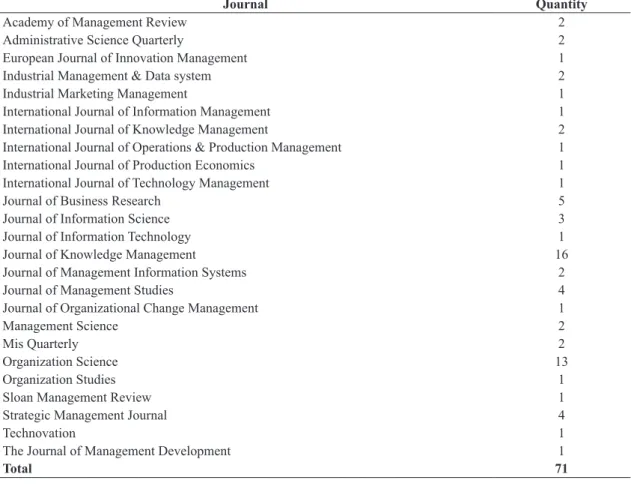
group includes: Journal of Knowledge Management, International Journal of Knowledge Management, and International Journal of Knowledge Management Studies. Table 1 summarizes the number of articles surveyed per journal, totalizing 71 articles.
Within these journals, we used as criterion for search the following keywords: knowledge acquisition, knowledge storage, knowledge distribution, knowledge sharing, knowledge utilization, organizational learning, knowledge absorption, knowledge transformation, community of practice, knowledge
exploitation, knowledge exploration, and dynamic
capacity. Figure 1 illustrates the model that guides the theoretical-conceptual survey of this article.
3 Knowledge in the organizational
context
Due to its intangible and directly related to the
human mind nature, it is dificult to precisely deine
knowledge. According to Kakabadse et al. (2003), the terms “knowledge” and “information” are used interchangeably, however, it is useful to distinguish
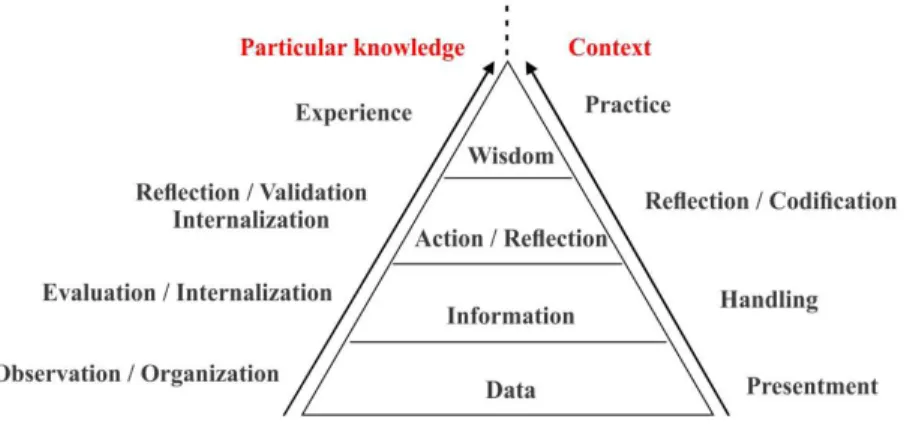
them. The chain of knowledge is a low consisted of data-information-realization-action/relection-wisdom
(Figure 2).
Knowledge, therefore, is developed through an evolutionary cycle. From the observation and data organization, begins a process of learning, in which from structured data, attains the particular knowledge, i.e., belonging to an individual or group of individuals. This process ends with the gain of wisdom by the
same time, it starts the process of routine, which
begins with data about a speciic context of a given
organization, and then the practice reaches a certain task (Kakabadse et al., 2003).
The knowledge classiication in the explicit and
tacit dimensions was, initially proposed by Polanyi
(1967). The explicit portion refers to formalized
knowledge, expressed in the form of data, formulas, speciications, manuals and procedures (Kogut &
Zander, 1992). Tacit knowledge, on the other hand,
is deined by Polanyi as non-verbalized, intuitive
knowledge. Spender (1996) suggests that tacit
knowledge is best deined as knowledge that has not
yet been abstracted from the practice.
Table 1. Number of articles surveyed per journal.
Journal Quantity
Academy of Management Review 2
Administrative Science Quarterly 2
European Journal of Innovation Management 1
Industrial Management & Data system 2
Industrial Marketing Management 1
International Journal of Information Management 1
International Journal of Knowledge Management 2
International Journal of Operations & Production Management 1
International Journal of Production Economics 1
International Journal of Technology Management 1
Journal of Business Research 5
Journal of Information Science 3
Journal of Information Technology 1
Journal of Knowledge Management 16
Journal of Management Information Systems 2
Journal of Management Studies 4
Journal of Organizational Change Management 1
Management Science 2
Mis Quarterly 2
Organization Science 13
Organization Studies 1
Sloan Management Review 1
Strategic Management Journal 4
Technovation 1
The Journal of Management Development 1
Total 71
Deep understanding of what is the tacit and explicit knowledge to adopt initiatives for KM is extremely important. If the explicit part of knowledge is most
valued by these initiatives, the company can minimize KM to procedures related to information system. However, when the two portions of knowledge are dealt with in a coordinated and combined manner, the organization can achieve sustainable competitive advantage (Tsoukas, 1996).
Explicit knowledge is considered the best way
to impart knowledge (Sveiby, 1997). However, this feature makes it susceptible to imitation by competitors, which makes it fragile as the sole source of competitive advantage of organizations, for presenting low degree of appropriateness (Nelson & Winter, 1982). Tacit knowledge, in turn, is practical,
intrinsic to people, non-transferable and speciic to context, therefore, of dificult formulation and
communication. It is through this knowledge that the organization can generate innovation and new knowledge (Molina et al., 2010; Nelson & Winter, 1982). Because it is a concept closely related to the human ability to perform tasks, tacit knowledge has been used to support the core competencies settings and organizational skills (Molina et al., 2010; Prahalad & Hamel, 1990).
Tsoukas (1996) states that the two types of
knowledge, tacit and explicit, are mutually constituted
and essentially inseparable. In particular, the author argues that tacit knowledge is a component contained in all knowledge and that they should not be analyzed
in isolation. Such interaction between tacit and explicit
can be demonstrated in models of knowledge creation as the “knowledge spiral”, proposed by Nonaka & Takeuchi (1995), which proposes the conversion of
knowledge in tacit to explicit state.
Therefore, knowledge is an asset that the organization develops over time through organized action of
its individuals within a context that permeates the
organization. It is up to the organization to identify
the two types of knowledge (tacit and explicit) and
develop a process to manage this asset, i.e., the KM process.
4 Management of Knowledge
Process
In the literature, the importance of KM as a tool to achieve competitive advantage is a consolidated fact. All organizations need to mobilize their knowledge to promote and support their strategies, and KM indicates the system of organization and mobilization of knowledge acquired by the organization. From the point of view of literature review, it is possible to list different models that address the control group (Table 2).
These different models point to a variety of issues around KM. The models can be analyzed in two main
areas. The irst refers to KM as a restricted subject to
IT scope. One of the main problems about IT on the
KM contribution is the dificulty and/or impossibility
to register the tacit knowledge of individuals, because it is impossible, according to the author, to absorb or scan the content of human mind and store it inside a database (Bhatt, 2002). Regarding the importance of tacit knowledge, the author argues:
The effective knowledge creation, speciically tacit, depends on strong relationships between members of the organization [...] Knowledge management should focus its efforts on tacit knowledge, experimenting with new organizational structures, culture and reward systems to increase social relations in such a way that implicit knowledge is expressed, shared, and argued (Bhatt, 2002, p. 36).
The second, in turn, considers organizational development, emphasizing structure and organizational culture as facilitating the interaction between individuals, enhancing knowledge sharing (Rowley, 2001).
Although many publications emphasize the information system processes for the conduct of KM, this cannot be mistaken with a vast electronic library
that stores information. The focus of KM process is on connecting people, causing them to think and act together (Alvesson & Kärreman, 2001; Bhatt, 2002).
The KM must match IT with business processes, constituting an activity that develops, stores, and transfers knowledge, in order to provide the members of the organization information necessary to make correct decisions (Pinho et al., 2012; Hung et al., 2005).
KM models based on IT secure the knowledge from static information, neglecting the role that individuals have about this process (Sveiby, 1997).
Alavi & Leidner (2001), Pinho et al. (2012), Liao et al. (2011), Cormican & O’Sullivan (2003), and Vorakulpipat & Rezgui (2008) treat KM as a
process with speciic phases, which have as main
objective the dissemination of knowledge for later reuse by other individuals and groups, and subsequent transformation of their content, generating new knowledge.
Magnier-Watanable & Senoo (2008) propose a model (Figure 3) surrounding the organizational characteristics and KM process. The phases of the KM process described by Magnier-Watanable and Senoo are used in the remainder of the article, since it is present in line with the KM models described by other authors. The organizational characteristics, according to the authors, include the structure (vertical and horizontal), the form of association (individual and collective), the relationship type (systematic and ad hoc), and strategy (reactive and innovative). The KM process consists of the following stages: acquisition (focused and opportunistic), storage (private and public), diffusion (prescriptive and adaptative), and
application (exploitation and exploration) of tacit and explicit knowledge in order to support the innovative
organizational process.
Each of the organizational characteristics impacts more directly on one of the four phases of the KM
Table 2. Models for Knowledge Management.
Author Models
Poynder (1998) - KM is a topic restricted to IT, having as central topics computer network and group ware; - KM is a matter relating to human resources with an emphasis on organizational culture and
the formation of working groups;
- KM depends on the development of organizational processes that promote the capture, evaluation and measurement of know-how of the organization.
Swan et al. (1999) - Models based on IT are focused on intensive processing and dissemination of information; - Community-based models emphasize dialogue and collaboration networks. The purpose of
these models is the exploitation of knowledge, based primarily on the interaction between individuals.
Alvesson & Kärreman (2001)
KM models are established from the combination of two elements: the interaction of media (social and techno structure) and the management mode of intervention (coordination and control). From these two axes, the authors deine four models:
- Community-based models, derived from social interaction and managerial intervention. Emphasis on the sharing of ideas;
- Models based on normative control, arising from the social interaction and managerial intervention. Emphasis on the regulatory control. The organizational culture acts as a repository of knowledge;
- Models based on stored experiences, arising from the interaction based on techno structure and coordination based on management intervention. Emphasis on the formation of a “library” of knowledge;
- Models based on rules and modes of action, arising from the interaction based on techno structure, and control based on management intervention. Emphasis on the development of templates that describe speciic modes of action.
Lee & Kim (2001) - Management model: it has as central element the development of the “knowledge worker”, also including leadership, autonomy, performance measures and reward, organizational structure and culture;
- Technical model: it has as central element IT. This perspective emphasizes the facilitation of the process of storage and distribution of knowledge through KM systems, including data mining, discussion forums, internet and intranet.
Schultze & Leidner (2002)
- Goal Model: knowledge is seen as an object to be discovered. Knowledge is identiied in a variety of ways and places, and acts in the coding technology of this knowledge;
process. Structures with many hierarchical levels tend to practice a KM-based encoding; and less rigid structure hierarchically practices a KM focused on the sharing of tacit knowledge, based on personal relationships (Merat & Bo, 2013).
Membership relates to how the employee feels as a member of an organization, i.e., belonging to a social
context (Pinho et al., 2012; Brown & Duguid, 2001),
directly interferes in the knowledge storage process. The relationship, which deals with the communication process within the organization, ranges between systematic (formal and interdepartmental relations) and
ad hoc (informal and interdepartmental relations), and interferes with the process of distribution of knowledge
(Boh et al., 2013). The type of strategy of the irm,
which ranges between reactive (conservative and aiming to maintain the status quo of the organization) and innovative (proactive and aiming to promote organizational results), interferes with the process of knowledge use (Holmqvist, 2004).
The success of initiatives aimed at KM is conditioned to the ability of the organization to promote the continued institutionalization of knowledge (Crossan et al., 1999; Grant, 1996) from the retrieve of the knowledge originated in subjects to later retain it in their organizational memory, in a process comprising the steps of acquisition, storage, distribution, and use of knowledge. The following sections consist of a conceptual survey on each of these four steps comprising the KM process.
4.1 Knowledge acquisition
The acquisition relates to the intra-organizational
process that facilitates the creation of tacit and explicit
knowledge, starting from individuals and integrating
the organizational level as well as the identiication and absorption of information and external knowledge
source (Gold et al., 2001; Huber, 1991), therefore, this study assumes that acquisition is the creation of knowledge within the organization through a
learning process, and also the acquisition of external
knowledge, originated in associative action with other organizations, business consulting, and universities.
The irst group of references which deals with the
acquisition of knowledge focuses its attention on the learning process. Zollo & Winter (2002) state that the learning process is responsible for two sets of organizational activities: operational routine, which
deals with the irm’s functionality, and dynamic
capabilities that enable improvement (routine
modiication). Routines are stable behavior patterns
that characterize the organizational reactions from a
variety of internal or external stimuli, generating two patterns of behavior. The irst involves performing
procedures previously known in order to generate income for the organization, i.e., to use the organizational capabilities (Grant, 1996). The second aims to establish changes in routines in order to increase the competitive advantage (Teece et al., 1997).
The accumulation of experience is the process
by which organizational routines are developed and established within the organization and accumulate tacit knowledge. This process of accumulation of knowledge, called cumulative, makes the organization able to develop innovations, proposing technological advances (Anand et al., 2010; Teece, 2007).
The cumulative depends on the organizational capacity to absorb knowledge, which is the second group of publications that deal with the acquisition process. Absorption refers to the ability of an organization to recognize the value of certain knowledge, assimilate it, and apply it in order to obtain competitive advantage (Cohen & Levinthal, 1990). According to the authors, the fundamental notion of this concept focuses on the fact that organizations need to access their primary knowledge to assimilate and use new knowledge, i.e., the primary accumulation of knowledge increases the potential for future learning.
While organizations with higher absorption capacity tend to be more dynamic (Teece et al., 1997;
Volberda et al., 2010), i.e., able to exploit opportunities
in the environment, regardless of the actual performance, organizations with lower absorption capacity tend to
be more reactive, as they seek ways to correct their faults, based on performance standards that do not mean technological advancement. The organizational reactivity and proactivity concepts are long-term,
i.e., irms that reach a proactive level, for example,
remain this way for their own aspiration to research new opportunities (Cohen & Levinthal, 1990).
The third group of references emphasizes the role of the creative process within an organization, which
starts from the moment that knowledge is identiied
as a problem solution. In cases in which the degree of
innovation is too low or the dependence of expertise
is stable, simple knowledge transformation can be
suficient strategy for sharing knowledge among
individuals, groups, and organization. In cases in which the rate of innovation is high, the specialized knowledge requires transformation to be integrated (Carlile & Rebentisch, 2003).
Finally, the fourth group of references dealing with the knowledge acquisition process emphasizes the role of knowledge transformation. Transformation involves specialization in two directions: “specialization within” and “specialization through” (Carlile & Rebentisch,
2003). The irst deals with the development and
improvement of knowledge, while the second refers to the integration of different specialized knowledge. For the authors, the bottleneck for the transfer of knowledge is in “specialization through” due to the
dificulty in establishing a common language.
Nonaka & Takeuchi (1995) point out that the creation is directly linked to the development of spaces that promote interaction between individuals, which are called “ba”, including physical and virtual aspects of the organization that stimulate the creation
of knowledge. For the authors, these spaces should
provide experience sharing conditions, the articulation
of mental models of individuals via dialogue, the
systematization of knowledge and, inally, the incorporation of explicit knowledge.
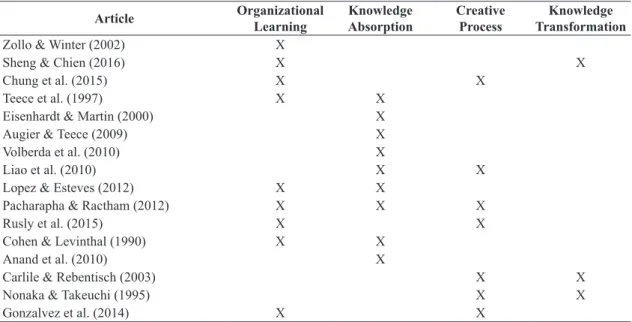
Thus, references dealing with the knowledge acquisition process work their contributions to four major issues: organizational learning, creative process of individuals and groups within the organization, transforming the organizational knowledge, and knowledge absorption. Table 3 summarizes the contribution of the areas of the articles researched.
4.2 Knowledge storage
The knowledge storage stage refers to the organizational memory formation process, in which knowledge is formally stored in physical memory systems and informally retained as values, rules and beliefs that are associated to culture and organizational structure (Alavi & Leidner, 2001; Argote et al., 2003). Walsh & Ungson (1991, p. 61) emphasize
the importance of this phase, deining organizational
memory as follows: “[...] stored information from
an organization’s history that can be expressed to
bear on present decisions [...]”, i.e., it is information stored about history of the organization, which are considered in these decisions.
Grant (1996) points out that the main role of
the irm is the integration of individual specialized
knowledge, and that hierarchical coordination of the
irm failures in the integration process. The irm, in this context, has connotation of knowledge repository
(Grant, 1996), characterized as a physical location
Table 3. Articles related to knowledge acquisition.
Article Organizational
Learning
Knowledge Absorption
Creative Process
Knowledge Transformation
Zollo & Winter (2002) X
Sheng & Chien (2016) X X
Chung et al. (2015) X X
Teece et al. (1997) X X
Eisenhardt & Martin (2000) X
Augier & Teece (2009) X
Volberda et al. (2010) X
Liao et al. (2010) X X
Lopez & Esteves (2012) X X
Pacharapha & Ractham (2012) X X X
Rusly et al. (2015) X X
Cohen & Levinthal (1990) X X
Anand et al. (2010) X
Carlile & Rebentisch (2003) X X
Nonaka & Takeuchi (1995) X X
ways. Walsh & Ungson (1991) identify ive types of knowledge repositories (“bias”). The irst is the
individuals who compose the organization, which are
based on their experiences and direct observations. Culture deines the way of thinking and feeling the
problems by individuals. The third repository is the transformation process that occurs through the development, selection, and analysis of new working methods, which are subsequently socialized. Structure stores the set of rules, hierarchies, and attributes
that deine the functional model of the organization.
Finally, ecology helps in the sharing process within the organization.
Lin (2007) explains that knowledge storage implies
in a conversion process involving organization,
structuring, storage and, inally, the combination of
knowledge in order to facilitate future use by those concerned. Thus, information technology (IT) appears as a key tool in this phase, offering three applications: (i) encoding and knowledge sharing; (ii) creation of corporate knowledge directories; (iii) creation of networks of knowledge (Alavi & Leidner, 2001).
However, authors such as Rowley (2001), Thompson & Walsham (2004) and Huysman & Wulf (2006) attenuate the importance of the IT in knowledge
retention phase. Huysman & Wulf (2006) explain that
organizations need to create a culture that encourages knowledge sharing. According to Rowley (2001), not all tacit knowledge must necessarily be transformed
into explicit, since these two types of knowledge are
complementary and interdependent (Gao et al., 2008). Rowley (2001, p. 234) still ponders: “Not all tacit
knowledge needs to be made explicit; the organization
needs to develop a shared understanding of which types of knowledge need to be articulated and shared.
Thus, it is possible to distinguish three main principles that guide the references of knowledge
storage. The irst considers the importance of the
enabling a greater accumulation of knowledge (Madsen et al., 2003; Gonzalez et al., 2014).
The second major factor in the publications is the knowledge storage by means of organizational pathways, called knowledge institutionalization (Grant, 1996). In this institutionalization process the importance of structure and organizational culture as retention vehicles outstands. Thus, culture carries part of organizational knowledge through the values, beliefs, and actions that are considered valid between individuals and groups; and the organizational structure mobilizes part of knowledge through patterns, routines, and established hierarchy (Martins & Meyer, 2012; Levy, 2011).
And IT, in turn, is the third important factor in publications about knowledge storage. Whereas
knowledge has an explicit portion, capable of encoding
through physical memories, such as databases, IT acts as a support function in the knowledge storage process (Alavi & Leidner, 2001). Table 4 classiies the publications surveyed between these four main factors related to the knowledge storage.
4.3 Knowledge distribution
Knowledge distribution refers to the process by which new information from different sources are shared and eventually can drive the creation of new knowledge, understanding and information (Huber, 1991). However, according to Lee & Yang (2000, p. 790), this sharing process requires the organization to mobilize in order to create a “sharing environment”:
“The most effective way to disseminate knowledge and best practices is through systematic transfer. This is, to create a knowledge sharing environment [...]”.
The mere fact that the organization has possession
of knowledge is insuficient. The organization should ensure the low of knowledge in order to enable the
Table 4. Articles related to knowledge storage.
Article Indivídual Organization Information Technology
Alavi & Leidner (2001) X X X
Argote et al. (2003) X
Walsh & Ungson (1991) X X
Martins & Meyer (2012) X
Levy (2011) X X
Thompson & Walsham (2004) X
Huysman & Wulf (2006) X X
Madsen et al. (2003) X X
El Louadi & Tounsi (2008) X
Yigitcanlar et al. (2007) X X
learning process between individuals, resulting in improved performance (Yuan et al., 2010).
Levine & Prietula (2012) identify four ways to
transfer knowledge. The irst, called self-learning,
refers to the knowledge acquired by manual
reports of the irm containing relevant information.
The second form refers to changes that occur due
to contact of individuals of the irm, in a social life
perspective. The performative relations is the third
mode of knowledge transfer and include the speciic knowledge exchanges in a group, coming from communities of practice which dominate speciic
knowledge and a common language (Brown & Duguid 2001; Lave, 1998). Finally, the fourth form
of distribution of knowledge is based on exchanges
that an organization performs with other companies,
i.e., external knowledge that the organization acquires.
Therefore, the forms of interaction and distribution
of knowledge consider their tacit and explicit state.
Self-learning is basically based on the distribution
via explicit knowledge. However, other forms
highlighted by Levine and Prietula refer to tacit and
explicit knowledge exchanges.
The classiication of references dealing with the
distribution of knowledge process will be based on three
aspects: the exchange of experiences and knowledge
between individuals through social contact, in a
perspective of sharing tacit and explicit knowledge;
sharing knowledge via communities of practice; and
distribution of explicit knowledge supported by IT. Regarding explicit knowledge, it can be shared
by IT systems, but also through social interaction of people (Argote et al., 2003). People should contribute to that knowledge to integrate a “knowledge network”, and IT alone does not depose important barriers to KM. According to Lee & Yang (2000), IT does not change the behavior of people, it does not increase the managerial commitment, and it does not create a shared understanding among people.
Freeze & Kulkarni (2007) identify four ways in which knowledge can be found in the organization (Table 5) and each of these states has speciic forms of distribution.
The term “expertise” is best understood in Portuguese
as the ability to develop certain task. Its transfer strategy is given by the interaction and collaborative
action among individuals and retention is part of a competence management strategy.
The learned lessons encompass the knowledge gained when tasks or projects are developed by individuals, being also treated as “best practices” or “internal benchmarks” (Alavi & Leidner, 2001). Once the lesson is learned, the organization has to research a strategy in order to make this knowledge
explicit, deined with knowledge documents. (Freeze
& Kulkarni (2007).
Much of the developed knowledge is incorporated by the organization in the form of policies and procedures, which represent the institutional knowledge
required for eficient and consistent operation of an
organization, in the case of organizational routine that enables the division and specialization of work (Dijk et al., 2016; Garicano & Wu, 2012; Nelson & Winter, 1982).
However, Brown & Duguid (2001) argue that there are differences between what is written and what individuals actually perform. This aspect is due to the fact that these practices and procedures do not
refer simply to the distribution of explicit knowledge. Freeze & Kulkarni (2007) and Gao et al. (2008) explain
that there is a continuum in which part of the tacit
knowledge is converted to explicit. Between these two extremes there is a domain of knowledge called
by the authors as implicit or tacit knowledge that is
potentially amenable to explanation, but also still embedded only in individual expertise, dominated
by a group or community.
In this perspective, communities of practice (CoP)
are examples of groups whose individuals have an intense exchange of knowledge. The term was,
innovatively treated by Wenger and Lave (Lave, 1998), who highlighted the importance of sharing information within a group as a means of producing informal learning, which spreads internally or across its borders.
The concept of CoP was developed at the organizational level by Brown & Duguid (2001) in order to facilitate learning process, dissemination of knowledge, and formation of identity in organizational groups. These groups develop a common identity
and a social context that helps in the sharing process.
Collectively, individuals create a vision of the work
and the world that should relect the organization
Table 5. Knowledge distribution modes.
Type Nature Source
Expertise Tacit Human experience
Learned lessons Tacit/Implicit Front-line
Documents Explicit Reports (bottom-up)
Policies and procedures Implicit/Explicit Reports (top-down)
easily shared.
The CoPs are coordinators of learning, giving meaning to the work of individuals and the group identity through active participation of its members. Thus, the integration of three aspects – learning, meaning of work, and identity – generates legitimacy to groups (Hwang et al., 2015).
Thus, it is clear that the knowledge distribution process has not only the use of IT related to the
dissemination of explicit knowledge, but also involves
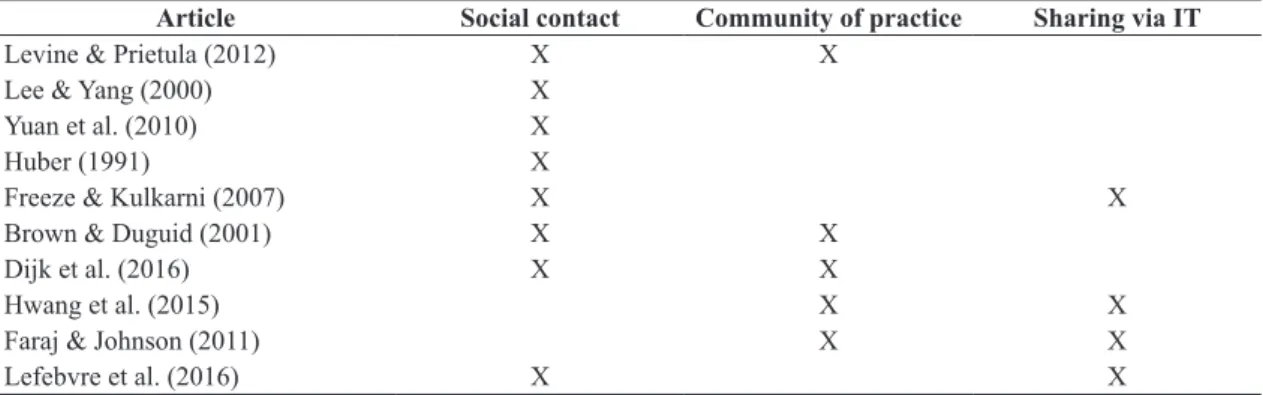
organizational routines that enable direct contact between individuals in order to disseminate the tacit and implicit portion of knowledge. Table 6 shows the main publications dealing with the thematic
distribution of knowledge, classiied in knowledge
sharing via social contact, sharing through practice
and explicit knowledge, and knowledge sharing
supported by IT.
4.4 Knowledge use
According to Zack (1999), knowledge use is associated with the ability of individuals of an organization to locate, access, and use information and knowledge stored in the formal and informal organization of memory systems.
Knowledge must be used as the basis for the development of new knowledge through integration,
innovation, creation, and extension of the existing
knowledge basis, and should still be used as a basis
for decision making. Thus, the use has an exploitative
character of knowledge when through it decision or improvements are made, using, therefore, the same
knowledge basis; or an explorative character, when
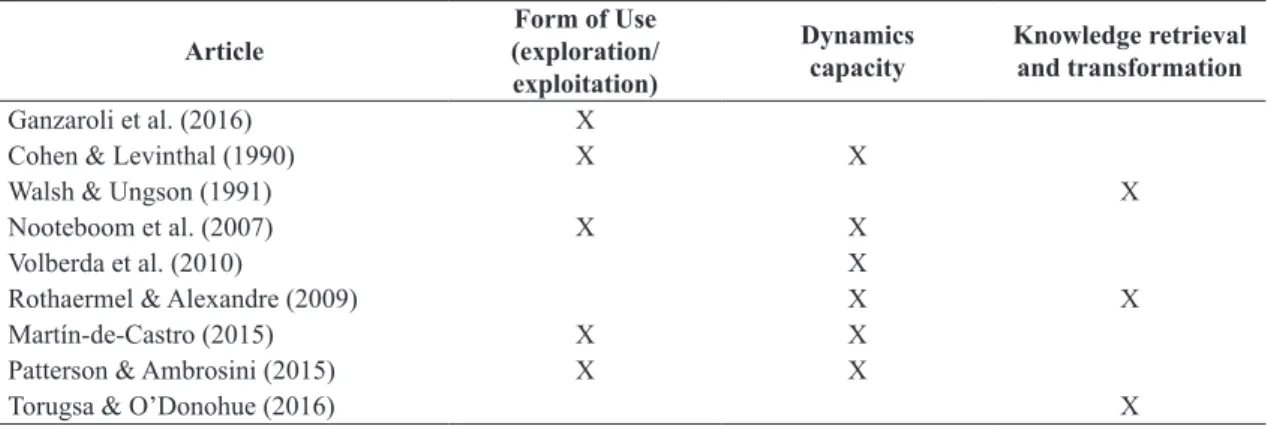
the knowledge basis is used as a primary knowledge to create new knowledge in an innovative proposal (Cohen & Levinthal, 1990; Ganzaroli et al., 2016; Nooteboom et al., 2007).
company: reactive or innovative. The irst strategy exploits existing knowledge, i.e., it is limited to use knowledge in order to facilitate a deined strategy. The innovative strategy uses an explorative model
to differently compete in the current market or in new markets.
Walsh & Ungson (1991) call knowledge use as a retrieval process, which manifests itself in two levels.
The irst, called automatic, refers to the retrieval of
information through routine, using for this purpose procedures, structure, and a culture c shared among individuals in their workplaces. The second, called controlled, is achieved through changes in retention pathways outlined in the retention process. Since the retrieval of the information originated in the ecological transformation phase – structure – is automatic, the only way to monitor the retrieval is through the redesign of these retention elements.
The use is based on the way in which the activities are historically developed in the organization, however,
when the complexity of tasks increases, the use must
be adapted to respond to new situations. This process requires an interactive effort between research and evaluation of knowledge and involves two main
phases. The irst of them is a “research space”, i.e.,
an effort to pursuit knowledge. From this research phase, a set of solutions that constitutes the second phase is developed, in which an alternative should be selected by means of an evaluation process (Carlile & Rebentisch, 2003).
With the process of using knowledge and the relection on the experiences of the decisions and actions taken, knowledge can be revised, addressing an individual learning process which can support the creation of new knowledge, or replace the existing knowledge, with a view to dynamic capacity (Volberda et al., 2010).
Table 6. Articles related to knowledge distribution.
Article Social contact Community of practice Sharing via IT
Levine & Prietula (2012) X X
Lee & Yang (2000) X
Yuan et al. (2010) X
Huber (1991) X
Freeze & Kulkarni (2007) X X
Brown & Duguid (2001) X X
Dijk et al. (2016) X X
Hwang et al. (2015) X X
Faraj & Johnson (2011) X X
Regarding dynamic capabilities, Teece et al. (1997,
p. 516) deine them as “[...] the ability of the irm to integrate, build, and reconigure their internal powers
in order to quickly respond to the environmental changes”. An important implication of this concept
is that irms compete not only from the perspective of exploiting their skills already mastered, but also
supporting its competitive strategy in the development and renewal of their organizational skills. Eisenhardt & Martin (2000) and Zollo & Winter (2002) cite the research and development activities, alliances and acquisitions, technology transfers and routines as
examples of dynamic capabilities.
Grant (1996) and Zollo & Winter (2002) share the position that the dynamic capabilities originate from the learning process, constituting a systematic
method for modifying the routine of the irm. Zollo &
Winter (2002) highlight three learning mechanisms that
enable dynamic capabilities: experience accumulation,
knowledge articulation, and knowledge encoding. These mechanisms constitute a cycle of evolution
of knowledge, i.e., a form of the irm build and
renew knowledge and establish new knowledge to organizational routines. This cycle puts into practice
the exploration and exploitation in order to seek
solutions to the latent needs of the environment and convert these solutions into routines.
Thus, references dealing with knowledge use can be divided into three groups according to the emphasis
of the approach. The irst group emphasizes how to use knowledge, i.e., if the irm uses exploratory or exploitation approach of knowledge; the second group addresses the dynamic capability of the irm to
rebuild its skills in a learning process; and the third deals with the process of retrieval and transformation of this knowledge in the organization. Table 7 shows
the main citations of this KM phase classiied for
these three groups.
Thus, the four stages of the KM process allow the organization to create, retain, disseminate, and reuse knowledge, treating it as an asset that can generate
competitive advantage. Although not all organizations have a structured process, the KM may be rooted in
the very conduct and in the organizational context.
5 Analysis
This study was structured around the knowledge management process. Before starting the discussion
around this process, it is noteworthy that the deinition and classiication of knowledge are extremely important.
Knowledge should not be mistaken with information
or data. In fact, knowledge is the inal result of an
evolutionary cycle, which requires observation,
evaluation, relection, and experience, i.e., knowledge,
unlike data and information, only materializes with human activity (Kakabadse et al., 2003).
Other important characteristics that must be
considered are its classiication. Knowledge can be tacit or explicit, i.e., inherent in human skills and competencies, or codiiable respectively. Each of these portions of knowledge (tacit and explicit) has
a different perspective regarding the management
(Tsoukas, 1996). While explicit knowledge can be easily
stored and disseminated through procedures and the very organizational structure, using IT as a facilitator of its retention and distribution, tacit knowledge, in turn, requires organizational development to create a culture that encourages sharing (Martins & Meyer, 2012), in addition to a structure that facilitates the integration of individuals and knowledge.
The models that address KM process are structured
preliminarily around this classiicatory concept of
knowledge. You can divide the contributions of these
perspectives into two main groups. The irst suggests
that KM is a matter related to IT, which, according Boisot (1998), provides conditions for that knowledge to become an industrial commodity that provides
proits. Gao et al. (2008) call this predominance of IT
on the KM process as “Hard Track”, which emphasis
is on explicit knowledge.
Table 7. Articles related to knowledge use.
Article
Form of Use (exploration/ exploitation)
Dynamics capacity
Knowledge retrieval and transformation
Ganzaroli et al. (2016) X
Cohen & Levinthal (1990) X X
Walsh & Ungson (1991) X
Nooteboom et al. (2007) X X
Volberda et al. (2010) X
Rothaermel & Alexandre (2009) X X
Martín-de-Castro (2015) X X
Patterson & Ambrosini (2015) X X
groups. A “positive” organizational culture is key to promote learning and sharing skills and knowledge (Irani et al., 2009; Boh et al., 2013). Gao et al. (2008) and Schultze & Leidner (2002) also emphasize the need to create a socialization space that fosters the creation and sharing of knowledge, such as the “Ba-Space” (Nonaka & Takeuchi, 1995), communities of practice (Brown & Duguid, 2001), and the culture geared to sharing knowledge (Sveiby, 1997), with a “Soft Track” view (Gao et al., 2008).
The IT must be understood as a KM support tool. Therefore, organizations should work towards the construction of an organizational environment that fosters continuous improvement of individuals, the
exchange of knowledge, and stimulating trial and
error process, encouraging knowledge use. IT must act as a mechanism facilitating knowledge storage
and distribution processes, increasing the low of
information between individuals, and aiding in the retention and institutionalization of knowledge.
Deepening on the characterization of the KM process,
the article deined it through four stages: acquisition,
storage, distribution, and use of knowledge. Because it is a large, multidisciplinary process, every step of KM can be studied from different perspectives. The theoretical framework of this article raised the main approaches featuring the four stages of the KM process, listing the main associated articles.
Thus, the publications dealing with the knowledge acquisition process are focused on four main themes.
The irst refers to organizational learning, which deals with the acquisition as a process of reconiguration
of internal routines. The second deals with the ability of the organization in absorbing knowledge. This capability depends on the presence of primary knowledge that facilitates the absorption of new knowledge (Augier & Teece, 2009; Liao et al., 2010). The third part deals with the creative process, which depends on the organizational stimulus for the development of human resources and teamwork that
results in improvements and innovations. And inally,
the transformation of knowledge, mainly approached by Nonaka & Takeuchi (1995), states that the acquisition
of knowledge is expressed by a transformation process in which knowledge migrates from explicit state to implied, a context called “knowledge spiral”, which depends on creating an organizational context that
encourages interaction between individuals and hence the sharing of knowledge.
The second stage of the KM process is the storage of knowledge. This step aims to retrieve learned lessons and best practices, forming the organizational memory (Madsen et al., 2003; Levy, 2011). Organizations that
have dificulty in knowledge retention lose part of their
dynamic capability. Thus, publications dealing with knowledge storage are focused on three main factors.
The irst refers to the human being, and the organization
must develop its individuals constantly to improve their respective capacities to absorb new knowledge. The organization is the second important means of knowledge retention. At this point, the interest is primarily focused on organizational culture, which carries the values, beliefs, and ways of acting of its
individuals, and organizational structure that deines
how decision-making, hierarchy, and organizational assignments are carried out (Martins & Meyer, 2012; Gonzalez et al., 2014). Information technology is the third important factor in publications on knowledge storage, focusing mainly on technological tools to
facilitate the retention of explicit knowledge (El Louadi
& Tounsi, 2008).
The third stage of the KM process refers to the distribution of knowledge. At this stage, the focus is around the sharing and distribution of knowledge between individuals and groups within the organization. As in the retention phase, the difference between
implicit and explicit knowledge becomes important
for distributing knowledge. Tacit knowledge is essentially shared by the interactions and social
contact, which is the irst major theme of this stage.
The second theme in publications dealing with the knowledge distribution refers to the formation of
communities of practice. The irst factor, social
contact, is more closely related to the development
of working groups that allow the low of knowledge
between individuals (Levine & Prietula, 2012). On the other hand, the communities of practice are focused on the formation of groups of individuals who may be physically distant, but who share primary knowledge, identity, and goals (Brown & Duguid 2001; Dijk et al., 2016). The third relevant factor to knowledge distribution is the use of IT. At this point, as well as in relation to knowledge storage, its contribution is related to the dissemination of
the explicit knowledge stored, and as a facilitator
to the communication of communities of practice. Finally, the fourth stage of the KM process is knowledge use. At this stage, interest is focused on forms of location and access to knowledge created and stored. It is through the use of retained knowledge that the organization closes the cycle of knowledge transformation, since knowledge was created under certain conditions, stored and distributed among individuals and, at this point, used for another purpose, promoting its transformation and the creation of new
knowledge (Ganzaroli et al., 2016). The irst topic
addressed in publications refers to the form of use, i.e.,
reactive manner, usually related to solving problems
presented by processes; or considers an exploitative
view of knowledge in which the organization innovates from the consolidated knowledge basis (Cohen & Levinthal, 1990). The dynamic capability, related to the organizational capacity to rebuild its skills, is the second important issue dealt with in the use of
publications. In this context, the interest is related to the ability of the irm to use the knowledge in order to be internally modiied and respond to new market demands (Ganzaroli et al., 2016). And inally, retrieval
and transformation of knowledge is the third aspect studied in the literature. Authors who preliminarily dealt with the use of this perspective were Walsh & Ungson (1991), whose main concern is around the way how retrieval and transformation occur: automatic or controlled. Automatic retrieval occurs through the current procedures and organizational structure,
i.e., through organizational routines. In this context,
the authors consider that the routines compose the knowledge automatically used by the organization. The controlled retrieval occurs when there is the transformation of routines, i.e., knowledge is processed to achieve superior performance.
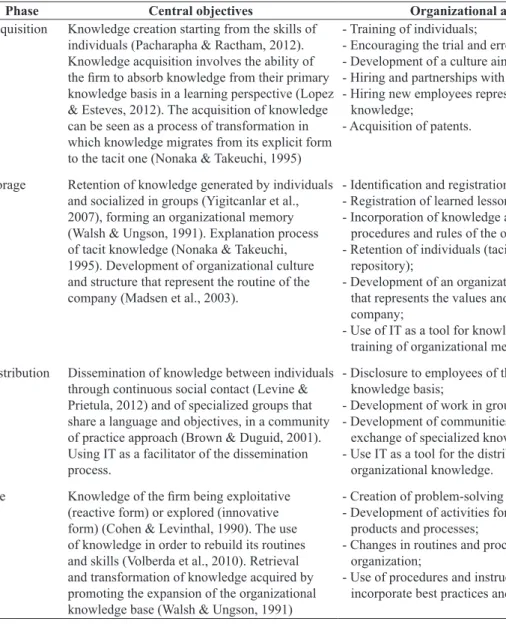
Table 8 summarizes the main objectives of each phase of the KM process. In addition, organizational actions related to each of the stages are listed, which are dealt with by the references researched in this article.
6 Final remarks
The knowledge management issue has been studied by many researchers for some decades. For a better understanding and analysis, the KM should be studied as a process consisting of the following
Table 8. Knowledge Management Process and Organizational Actions.
Phase Central objectives Organizational actions
Acquisition Knowledge creation starting from the skills of individuals (Pacharapha & Ractham, 2012). Knowledge acquisition involves the ability of the irm to absorb knowledge from their primary knowledge basis in a learning perspective (Lopez & Esteves, 2012). The acquisition of knowledge can be seen as a process of transformation in which knowledge migrates from its explicit form to the tacit one (Nonaka & Takeuchi, 1995)
- Training of individuals;
- Encouraging the trial and error process; - Development of a culture aimed at learning; - Hiring and partnerships with other irms; - Hiring new employees representing new
knowledge;
- Acquisition of patents.
Storage Retention of knowledge generated by individuals and socialized in groups (Yigitcanlar et al., 2007), forming an organizational memory (Walsh & Ungson, 1991). Explanation process of tacit knowledge (Nonaka & Takeuchi, 1995). Development of organizational culture and structure that represent the routine of the company (Madsen et al., 2003).
- Identiication and registration of best practices; - Registration of learned lessons;
- Incorporation of knowledge acquired in procedures and rules of the organization; - Retention of individuals (tacit knowledge
repository);
- Development of an organizational culture that represents the values and beliefs of the company;
- Use of IT as a tool for knowledge retention and training of organizational memory.
Distribution Dissemination of knowledge between individuals through continuous social contact (Levine & Prietula, 2012) and of specialized groups that share a language and objectives, in a community of practice approach (Brown & Duguid, 2001). Using IT as a facilitator of the dissemination process.
- Disclosure to employees of the retained knowledge basis;
- Development of work in groups;
- Development of communities of practice - exchange of specialized knowledge; - Use IT as a tool for the distribution of
organizational knowledge.
Use Knowledge of the irm being exploitative (reactive form) or explored (innovative form) (Cohen & Levinthal, 1990). The use of knowledge in order to rebuild its routines and skills (Volberda et al., 2010). Retrieval and transformation of knowledge acquired by promoting the expansion of the organizational knowledge base (Walsh & Ungson, 1991)
- Creation of problem-solving teams; - Development of activities for improving
products and processes;
- Changes in routines and procedures of the organization;
each of these phases of the KM process consists of several themes. This article achieves its goal of
deining the KM process, conceptualizing its stages,
and also identifying the main factors and aspects that relate each of these steps. Initially, the research
identiied the main approaches that support the
models for KM. It is possible to conclude that the models for KM are guided by two main features, called “soft track” or concerned models with organizational development, regarding organizational culture and structure, skills development, and work organization. On the other hand, there is the model of “hard track” type, i.e., models oriented to IT tools that seek to facilitate the process of storage and distribution of knowledge.
Regarding the KM process itself, this research has
identiied four speciic phases: acquisition, storage,
distribution, and use of knowledge. For each phase
we identiied factors that inluence the research.
In the case of knowledge acquisition, it is concluded that four themes are dealt with: organizational learning, absorbing knowledge, creative process, and transformation of knowledge. Knowledge storage is studied around the individual, organization, and information technology. Knowledge distribution, in turn, is analyzed from the perspective of social contact, community of practice, and sharing via IT. Finally, knowledge use is covered around the form
of knowledge use (exploitation or exploration),
dynamic capability, and knowledge transformation and retrieval.
The article also contributes assessing the main journals dealing with the KM process, analyzing 71 articles and classifying their contributions regarding the themes that guide the four phases of the KM process. Thus, this article is presented as a guide
to KM researchers concerning the identiication of
approaches and bibliographies related to the KM process.
This article meets its goal of mapping phases of the
KM process and identiies two groups of organizational actions that support this process. The irst, also called
“soft”, is concerned with the development of an
organizational context which supports the creation,
dissemination, and use of the acquired knowledge. The main initiatives that support this action group are aimed at the training of individuals, involving the development of new skills, the structuring of routine work, and problem solving in groups, to encourage the socialization of knowledge and sharing of tacit knowledge, development of organizational routines that incorporate the acquired knowledge, the development of a culture that encourages the
exchange of knowledge and encouragement and
senior management, as it comes to changing habits and patterns of organizational behaviors. The second group, called “hard”, involves the use of IT as a support mechanism for knowledge distribution and storage processes.
Therefore, since knowledge has a tacit and an
explicit characteristic, the management process of
this asset requires actions that go beyond the use of IT, requiring a transformation of the culture and of the very organizational structure.
Regarding the development of future studies, there
are two types proposed. The irst one dealing with the
qualitative form of each of the approaches regarding the four stages of the KM process, characterizing, via case study or action research, such approaches.
The second refers to conducting a conirmatory analysis of the factors identiied in each phase of the KM process, being also an exploratory analysis, seeking to identify new factors that explain these
steps, using, for that purpose, multivariate data
analysis with conirmatory and exploratory approach
respectively.
Acknowledgements
The authors thank FAPESP (São Paulo Research Foundation), process 2013/02872-5 and CNPq
(National Counsel of Technological and Scientiic Development) – process 445205/2014-8 for inancial
assistance to the development of this research.
References
Alavi, M., & Leidner, D. E. (2001). Knowledge management and knowledge management systems: conceptual foundations and research issues. Management Information Systems Quarterly, 25(1), 107-136. http://dx.doi. org/10.2307/3250961.
Alvesson, M., & Kärreman, D. (2001). Odd couple: making sense of the curious concept of knowledge management. Journal of Management Studies, 38(7), 995-1018. http:// dx.doi.org/10.1111/1467-6486.00269.
Anand, J., Oriani, R., & Vassolo, R. S. (2010). Alliance activity as a dynamics capability in the face of a discontinuous technological change. Organization Science, 21(6), 1213-1232. http://dx.doi.org/10.1287/ orsc.1090.0502.
Argote, L., Mcevily, B., & Reagans, R. (2003). Managing knowledge in organizations: an integrative framework and review of emerging themes. Management Science, 49(4), 571-582. http://dx.doi.org/10.1287/mnsc.49.4.571.14424.
El Louadi, M., & Tounsi, I. (2008). Do organizational memory and information technology interact to affect organization information needs and provision? International Journal of Knowledge Management, 4(4), 21-39. http://dx.doi. org/10.4018/jkm.2008100102.
Faraj, S., & Johnson, S. L. (2011). Network exchange patterns in online communities. Organization Science, 22(6), 1464-1480. http://dx.doi.org/10.1287/orsc.1100.0600.
Forza, C. (2002). Survey research in operations management: a processo-based perspective. International Journal of Operations & Production Management, 22(2), 152-194. http://dx.doi.org/10.1108/01443570210414310.
Freeze, R. D., & Kulkarni, U. (2007). Knowledge management capability: defining knowledge assets. Journal of Knowledge Management, 11(6), 94-109. http://dx.doi.org/10.1108/13673270710832190.
Ganzaroli, A., De Noni, I., Orsi, L., & Belussi, F. (2016). The combined effect of technological relatedness and knowledge utilization on explorative and exploitative invention performance post-M&A. European Journal of Innovation Management, 19(2), 167-188.
Gao, F., Li, M., & Clarke, S. (2008). Knowledge, management, and knowledge management in business operations. Journal of Knowledge Management, 12(, 2), 3-17. http:// dx.doi.org/10.1108/13673270810859479.
Garicano, L., & Wu, Y. (2012). Knowledge, communication, and organizational capabilities. Organization Science, 23(5), 1382-1397. http://dx.doi.org/10.1287/orsc.1110.0723.
Gold, A. H., Malhotra, A., & Segars, A. H. (2001). knowledge management: an organizational capabilities perspective. Journal of Management Information Systems, 18(1), 184-214.
Gonzalez, R. V. D., Martins, M. F., & Toledo, J. C. (2014). Mapping the organizational factors that support knowledge management in the Brazilian automotive industry. Journal of Knowledge Management, 18(1), 611-630.
Gonzalvez, M. A. A., Toledo, O. A. C., & Rodriguez, A. R. I. (2014). The management and construction of knowledge as an innovation strategy for collaborative learning through the use and creation of learning communities and networks. International Journal of Knowledge Management, 10(4), 38-49. http://dx.doi. org/10.4018/ijkm.2014100103.
Grant, R. M. (1996). Toward a knowledge-based theory of the firm. Strategic Management Journal, 17, 109-122.
Holmqvist, M. (2004). Experiential learning processes of exploration and exploitation within and between organizations: an empirical study of product development. Organization Science, 15(1), 70-81. http://dx.doi. org/10.1287/orsc.1030.0056.
performance. Organization Science, 20(2), 410-421. http://dx.doi.org/10.1287/orsc.1090.0424.
Bhatt, G. D. (2002). Management strategies for individual knowledge and organizational knowledge. Journal of Knowledge Management, 6(1), 31-39. http://dx.doi. org/10.1108/13673270210417673.
Boh, W. F., Nguyen, T. T., & Xu, Y. (2013). Knowledge transfer across dissimilar cultures. Journal of Knowledge Management, 17(1), 29-46. http://dx.doi. org/10.1108/13673271311300723.
Boisot, M. H. (1998). Information space: a framework for learning in organizations, institutions and culture. London: Routledge.
Brown, J. S., & Duguid, P. (2001). Knowledge and organization: a social-practice perspective. Organization Science, 12(2), 198-213. http://dx.doi.org/10.1287/ orsc.12.2.198.10116.
Carlile, P. R., & Rebentisch, E. S. (2003). Into the black box: the knowledge transformation cycle. Management Science, 49(9), 1180-1195. http://dx.doi.org/10.1287/ mnsc.49.9.1180.16564.
Chung, H. F. L., Yang, Z., & Huang, P. H. (2015). How does organizational learning matter in strategic business performance? The contingency role of guanxi networking. Journal of Business Research, 68(6), 1216-1224. http:// dx.doi.org/10.1016/j.jbusres.2014.11.016.
Cohen, W. M., & Levinthal, D. A. (1990). Absorptive capacity: a new perspective on learning and innovation. Administrative Science Quarterly, 35(1), 128-152. http:// dx.doi.org/10.2307/2393553.
Cormican, K., & O’Sullivan, D. A. (2003). Collaborative knowledge management tool for product innovation management. International Journal of Technology Management, 26(1), 53-68. http://dx.doi.org/10.1504/ IJTM.2003.003144.
Crossan, M., Lane, H. W., & White, R. E. (1999). An organizational learning framework: from intuition to institution. Academy of Management Review, 24(3), 522-537.
Dijk, A., Hendriks, P., & Romo-Leroux, I. (2016). Knowledge sharing and social capital in globally distributed execution. Journal of Knowledge Management, 20(2), 327-342. http://dx.doi.org/10.1108/JKM-07-2015-0268.
Durst, S., & Edvardsson, I. R. (2012). Knowledge management in SMEs: a literature review. Journal of Knowledge Management, 16(6), 879-903. http://dx.doi. org/10.1108/13673271211276173.
Research, 64(7), 728-736. http://dx.doi.org/10.1016/j. jbusres.2010.08.001.
Liao, S., Wu, C., Hu, D., & Tsui, K. (2010). Relationships between knowledge acquisition, absorptive capacity and innovation capability: an empirical study on Taiwan’s financial and manufacturing industries. Journal of Information Science, 36(1), 19-35. http://dx.doi. org/10.1177/0165551509340362.
Lin, H. F. (2007). A stage model of knowledge management: an empirical investigation of process and effectiveness. Journal of Information Science, 33(6), 643-659. http:// dx.doi.org/10.1177/0165551506076395.
Lopez, V. W. B., & Esteves, J. (2012). Acquiring external knowledge to avoid wheel re-invention. Journal of Knowledge Management, 17(1), 87-105. http://dx.doi. org/10.1108/13673271311300787.
Madsen, T. L., Mosakowski, E., & Zaheer, S. (2003). Knowledge retention and personnel mobility: the nondisruptive effects of inflows of experience. Organization Science, 14(2), 173-191. http://dx.doi. org/10.1287/orsc.14.2.173.14997.
Magnier-Watanable, R., & Senoo, D. (2008). Organizational characteristics as prescriptive factors of knowledge iniciatives. Journal of Knowledge Management, 12(1), 21-36. http://dx.doi.org/10.1108/13673270810852368.
Martín-de-Castro, G. (2015). Knowledge management and innovation in knowledge-based and high-tech industrial markets: the role of openness and absorptive capacity. Industrial Marketing Management, 47, 143-146.
Martins, E. C., & Meyer, H. W. J. (2012). Organizational and behavioral factors that influence knowledge retention. Journal of Knowledge Management, 16(1), 77-96. http://dx.doi.org/10.1108/13673271211198954.
Merat, A., & Bo, D. (2013). Strategic analysis of Knowledge firms: the links between knowledge management and leardership. Journal of Knowledge Management, 17(1), 3-15. http://dx.doi.org/10.1108/13673271311300697.
Miguel, P. A. C. (2007). Estudo de caso na engenharia de produção: estrutura e recomendações para sua condução. Produção, 17(1), 216-229.
Molina, V. B., Amado, J. B., & Arostegui, M. N. P. (2010). Managerial perceptions of the competitive environment and dynamic capabilities generation. Industrial Management & Data Systems, 110(9), 1355-1384.
Nelson, R., & Winter, S. (1982). An evolutionary theory of economic change. Cambridge: Belknap Press/Harvard University Press.
Hung, Y. C., Huang, S. M., Lin, Q. P., & Tsai, M. L. (2005). Critical factors in adopting a knowledge management system for the pharmaceutical industry. Industrial Management & Data Systems, 105(2), 164-183. http:// dx.doi.org/10.1108/02635570510583307.
Huysman, M., & Wulf, V. (2006). IT to support knowledge sharing in communities, towards a social capital analysis. Journal of Information Technology, 21(1), 40-51. http:// dx.doi.org/10.1057/palgrave.jit.2000053.
Hwang, E. H., Sinh, P. V., & Argote, L. (2015). Knowledge sharing in online communities: learning to cross geographic and hierarchical boundaries. Organization Science, 26(6), 1593-1611. http://dx.doi.org/10.1287/ orsc.2015.1009.
Irani, Z., Sharif, A. M., & Love, P. E. D. (2009). Mapping knowledge management and organizational learning in support of organizational memory. International Journal of Production Economics, 122, 200-215.
Kakabadse, N. K., Kakabadse, A., & Kouzmin, A. (2003). Reviewing the Knowledge management: towards a taxonomy. Journal of Knowledge Management, 7(4), 75-91. http://dx.doi.org/10.1108/13673270310492967.
Kogut, B., & Zander, U. (1992). Knowledge of the firm, combinative capabilities and the replication of technology. Organization Studies, 3, 383-397.
Lave, J. (1998). Cognition in practice: mind, mathematics and culture in everyday life. Cambridge: Cambridge University Press.
Lee, C., & Yang, J. (2000). Knowledge value chain. Journal of Management Development, 19(9), 783-794. http:// dx.doi.org/10.1108/02621710010378228.
Lee, J. H., & Kim, Y. G. (2001). A stage model of organizational knowledge management: a latent content analysis. Expert Systems with Applications, 20(3), 299-311. http://dx.doi.org/10.1016/S0957-4174(01)00015-X.
Lefebvre, V. M., Sorenson, D., Henchion, M., & Gellynck, X. (2016). Social capital and knowledge sharing performance of learning networks. International Journal of Information Management, 36(4), 570-579. http:// dx.doi.org/10.1016/j.ijinfomgt.2015.11.008.
Levine, S. S., & Prietula, M. (2012). How knowledge transfer impacts performance: a mutilevel model of benefits and liabilities. Organization Science, 23(6), 1748-1766. http://dx.doi.org/10.1287/orsc.1110.0697.