Work in primary health care: a
comprehensive mental health care
TRABALHO NA ATENÇÃO BÁSICA: INTEGRALIDADE DO CUIDADO EM SAÚDE MENTAL
TRABAJO EN LA ATENCIÓN PRIMARIA DE SALUD: INTEGRALIDAD DEL CUIDADO EM SALUD MENTAL
1RN, M.Sc. in Psychiatric Nursing, Laboratory Specialist at the Department of Maternal-Infant and Psychiatric Nursing, School of Nursing at University of
São Paulo. São Paulo, SP, Brazil. [email protected] 2RN, Ph.D., Professor at the Department of Maternal-Infant and Psychiatric Nursing, School of Nursing
at University of São Paulo. São Paulo, SP, Brazil. [email protected] 3RN, Doctoral student at the Department of Maternal-Infant and Psychiatric Nursing, School
of Nursing at University of São Paulo. São Paulo, SP, Brazil. [email protected]. 4RN, Associate Professor at the Department of Maternal-Infant and
Psychiatric Nursing, School of Nursing at University of São Paulo. São Paulo, SP, Brazil. [email protected] 5RN, Ph.D., Professor at the Department of
Maternal-Infant and Psychiatric Nursing, School of Nursing at University of São Paulo. São Paulo, SP, Brazil. [email protected]. 6RN, Ph.D., Professor at
the Department of Maternal-Infant and Psychiatric Nursing, School of Nursing at University of São Paulo. São Paulo, SP, Brazil. [email protected]. 7RN,
Associate Professor at the Department of Maternal-Infant and Psychiatric Nursing, School of Nursing at University of São Paulo. São Paulo, SP, Brazil. [email protected]. 8RN, Associate Professor at the Department of Maternal-Infant and Psychiatric Nursing, School of Nursing at University of São Paulo.
O
RIGINAL
A
R
TICLE
RESUMO
Este estudo tem por objetivo cartografar o cuidado ao usuário com necessidades no campo da saúde mental em uma Unidade Básica de Saúde, analisando o trabalho em equipe à luz da integralidade das ações de saúde. Seus participantes são trabalhado-res de saúde, de diferentes profissões, que fazem parte dos processos de trabalho em saúde mental do serviço. A técnica de cole-ta de dados utilizada foi o fluxograma analisador. Os resultados nos mostram que, na Unidade Básica, os fluxos conectivos en-tre os diversos trabalhadores - e enen-tre estes e os usuários - vêm produzindo e proliferan-do vários e distintos espaços coletivos de trocas, possibilitando ações de saúde ali-nhadas à perspectiva da integralidade, atra-vés de uma compreensão ampliada do pro-cesso saúde-doença mental, construída pela valorização das relações humanas e das subjetividades envolvidas no espaço do trabalho em saúde.
DESCRITORES
Saúde mental.
Equipe de assistência ao paciente. Atenção primária à saúde. Assistência integral à saúde. Cartografia.
Juliana Reale Caçapava1, Luciana de Almeida Colvero2, Wânia Regina Veiga Martines3, Ana Lúcia
Machado4,Ana Luísa Aranha e Silva5, Divane de Vargas6, Márcia Aparecida Ferreira de Oliveira7,
Sônia Barros8
ABSTRACT
This study intends to map the health care given to the usuary with needs in the men-tal health field in a primary health care unity, analyzing the team work in the light of the integrate primary health care prac-tices. The participants are health workers from different professions, who belong to the service's mental health working pro-cesses. The data collection technique used was the analytic flowchart. The results show us that the connective flows among the professionals and between them and the health unity's, in the primary health care unit, has been producing and prolifer-ated diverse exchanges' spaces, making possible health actions aligned to the inte-grality in people's care through a enlarged understanding of health mental disease process, by means of human relationships' valuation and subjectivities involved in the health work space.
KEY WORDS
Mental health. Patient care team. Primary health care. Comprehensive health care. Cartography.
RESUMEN
Este estúdio de abordaje cualitativa tiene como objetivo cartografiar el cuidado al usuário con necessidades en lo campo de la salud mental en uma Unidad Básica de Sa-lud, a través de la análisis del trabajo en equi-po a la luz de la integralidad de las acciones de salud. Sus partipantes son trabajadores de salud mental, de diferentes profesiones, que son parte de los procesos de trabajo en salud mental de lo servicio. La colección de datos fue construida mediante lo fluxograma analizador. Los resultados muestran que, en la Unidad Básica, los flujos conectivos entre los diversos trabajadores - y entre estes y los usuarios - están a producir y proliferar vários y distintos espacios colectivos de intercâm-bios, permitiendo acciones integrales de sa-lud a través de una comprensión ampliada del proceso de salud-enfermedad mental, construida por médio de la valorización de las relaciones humanas y de las subjetividades involucradas en lo espacio del trabajo en salud.
DESCRIPTORES
Salud mental.
1254
Rev Esc Enferm USP 2009; 43(Spe 2):1253-7 www.ee.usp.br/reeusp/Work in primary health care: a comprehensive mental health care
Caçapava JR, Colvero LA, Martines WRV, Machado AL, Aranha e Silva AL, Vargas D, Oliveira MAF, Barros S
INTRODUCTION
Research on mental health in Primary Health Care show that, although Basic Health unit (BHU) workers acknowl-edge social factors as determinants of the population’s health-disease process, the object of their work is the mental illness and, starting from this object, diagnoses and medication prescriptions are the most valued means or work instrument for interventions involving people with mental health needs(1).
About this discussion, the comprehensiveness of health care needs to be addressed in different dimen-sions to be achieved as fully as possible. This gives rise to the notions of focused comprehensiveness and expanded
comprehensiveness(2).
Expanded comprehensiveness refers to each health service’s articulation with a more complex network, com-posed of other health services and institutions that do not necessarily belong to the health sector; that is, compre-hensiveness at the macro level. Focused comprehensive-ness, on the other hand, is defined as the fruit of efforts and the confluence of different types of
knowl-edge in a multiprofessional team, in the
con-crete and unique space of health services(2).
For the articulation of health actions in services, professionals need to acknowledge and evidence existing connections and links between interventions, either related to their own work process or to the actions of other team members(3).
In view of these premises, the goal in this
research is to reach a deeper understanding of a health service’s micro-policy, through subjects’ daily actions in their mutual relations and in the scenario they act in(4).
OBJECTIVE
The aim of this research is to map care for users with mental health needs at a BHU, analyzing teamwork in the light of the comprehensiveness of health actions.
METHOD
A qualitative design was chosen, which can incorpo-rate the issue of meaning and intentionality as inherent in actions, relations and social structures. The latter are considered in their development and transformation, as human constructions that can be apprehended through daily reality and experience(5).
The study context is a BHU in São Paulo city, which is also considered a Complementary Practice Center, since it offers Traditional Chinese Medicine and Homeopathic care.
Data collection was based on the collective construction of an analytic flow chart, involving health workers who are active in mental health work processes at the service: psychologist (two); nursing auxiliary (one); physician (three); social worker (one). Two meetings were held, each of which took approximately 90 minutes.
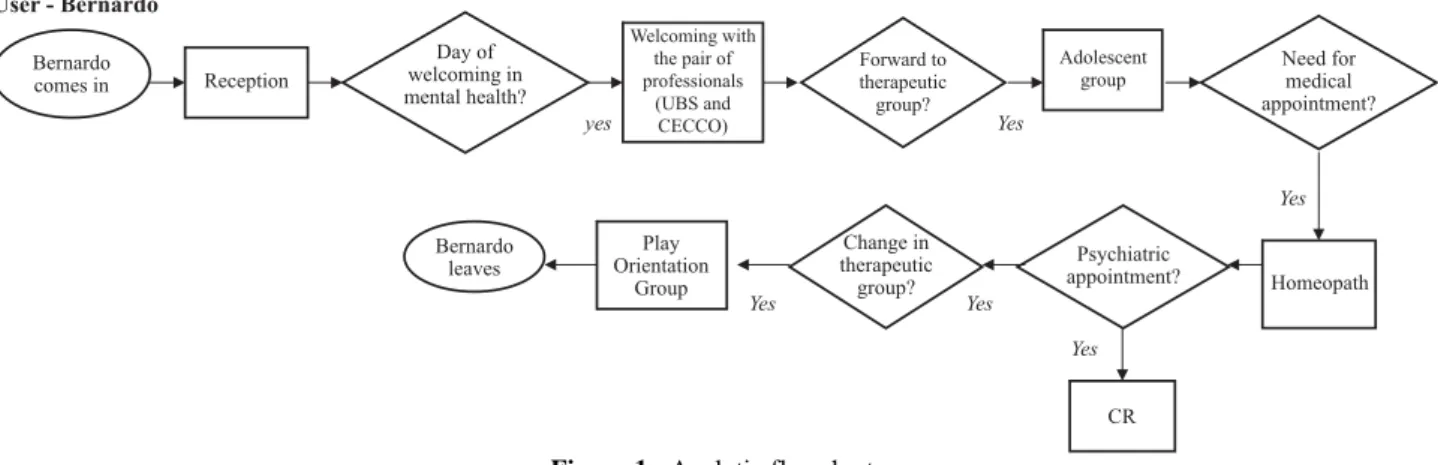
The analytic flow chart can be defined as a diagram used to draw all steps in the work process, based on the user’s trajectory through the service, that is: entry into or exit from the service production process (represented by the ellipse); moments of decision making to continue the work (repre-sented by the parallelogram) and the moment of interven-tion, action on the process (represented by the rectangle)(6).
Therefore, workers should choose a typical user, which they should take a closer look at to describe his/her tra-jectory through the services, asking them to take into ac-count some proposed guidelines in this choice: attending the service for at least six months, which permits a picture that is more in line with the reality of their daily work; having received care from at least three service sionals, so as to assess the integration among profes-sionals’ actions and the service’s relations with the user(7).
All names mentioned here are fictitious. Approval for the research was obtained from the Research Ethics Committee at the São Paulo Municipal Health Secretariat (opinion No 283/07).
RESULTS
Flow chart description
Workers chose the user Bernardo who, according to them, stood out because he had mobilized the entire multiprofessional team.
Bernardo’s entry into the service departed from his mother Manuela, who contacted the service’s social worker with a demand for advice on where to get medication. In their talk, Manuela complained of feeling depressed and was forward to the psychologist. Before this consultation however, the social workers contacts her colleague to dis-cuss the case. During the consultation with the psycholo-gist, this professional invites Manuela to participate in the Psychotherapy Group (GP) at the BHU, where the user first mentions Bernardo, saying, according to the psychologist, that she had a son with a problem, because he presented the same behaviors as her late husband, who was schizophrenic and was hospitalized for many years; a situation that, ac-cording to Manuela, was very difficult to live with.
In the GP, the mother is advised to bring her son to the service on one of the dates set for mental health welcom-ing. Participating in Bernardo’s welcoming, who was 16 years old, the same psychologist forwards him to the Ado-lescent Group (GA).
The
comprehensiveness of health care needs to be addressed in different dimensions
Thus, Bernardo starts to participate in the GA, while his mother Manuela continues in the GP and, on the psychologist’s invitation, also takes part in the Parent Orientation Group (GOP).
At a given time, the mental health team professionals decide, through these discussions, in view of his articula-tions and interacarticula-tions, that Bernardo should also be seen by the homeopath, who was a member of the same team and worked with groups of children and school health. That physician feels the need to forward Bernardo to the psychiatrist of the referral service for the same territory, called Referral Center (CR) here.
The health professionals responsible for the GA also perceive that, as the user displays quite a regressed behav-ior, he did not manage to bond with the group. This issue was discussed in the mental health team meeting. It was decided to forward Bernardo to the Group of Children aged 10 and 11 years, the Play Orientation Group (GOL). Accord-ing to the psychologist and the homeopath, who coordi-nated the group, that was the group where he went better.
This trajectory shows that (individual and collective) conversation networks took form, which connected the mental health team workers, welcoming both Bernardo and Manuela at the service, also permeated by two-weekly mental health team meetings and a flow of informal
con-versation among workers, feeding users’ power to pro-duce relations in different spaces at the BHU.
What happened then was that, due to a severe ophthal-mological problem, his mother took Bernardo to a general hospital, where physicians forwarded him to the psychia-try sector. At this sector, the adolescent was diagnosed with schizophrenia, although BHU mental health team pro-fessionals found that controversial, considering not only the signs and symptoms, but particularly the family con-text involved:
Bernardo was labeled with schizophrenia by a more clinical psychiatric view, which does not have much to do with reading the family, it is more of psychopathology (Geranium).
And, from the general hospital, Bernardo was forwarded to the CAPS but, at the same time, remained at the BHU for a short time, approximately one month. According to the social workers, Manuela still attended the service, because she participated in the GP, although she missed a lot of meetings; she had given up the GOP however. According to BHU professionals, with regard to Bernardo, Manuela’s visits were important, even if time went by between differ-ent visits, because these offered opportunity to talk, ask questions about the adolescent, a way of knowing how he was getting along in life, how the relation between mother and son was going...
yes Yes
Yes
Yes Yes
Yes Reception
Day of welcoming in mental health?
Welcoming with the pair of professionals
(UBS and CECCO)
Forward to therapeutic group?
Adolescent group
Need for medical appointment?
Homeopath Psychiatric
appointment?
CR Change in
therapeutic group? Play
Orientation Group Bernardo
leaves
User - Bernardo
Bernardo comes in
Figure 1 - Analytic flowchart
DISCUSSION
Based on the BHU’s first welcoming of Manuela, when she met with the social worker, it could be observed that qualified listening and good conversation can facilitate the user’s flow at the service as, when the social workers investigated Manuela’s needs, much beyond simply ad-vising her about the medication, which was her demand, this approaches a notion of care that goes beyond techni-cal care, which implies caring for the person, getting in-volved with her(8).
According to the physician Tulip, who is an acupunc-turist, her professional experienced at the BHU gradually
provided her with an expanded look on the clinic, through which she started to understand physical pain as an ex-pression of mental pain, exemplifying a case in which a patient considerably improves when the physician starts
to give herself more to the relationship, through interested
listening, which granted both an insight that the problem
in question was related to way the user had been facing her life.
de-1256
Rev Esc Enferm USP 2009; 43(Spe 2):1253-7 www.ee.usp.br/reeusp/Work in primary health care: a comprehensive mental health care
Caçapava JR, Colvero LA, Martines WRV, Machado AL, Aranha e Silva AL, Vargas D, Oliveira MAF, Barros S
cided what therapeutic itineraries had to be attempted, thus touting singularities and welcoming one another. According to Violet, even in difficult situations (cases of sexual abuse and suicide attempts were mentioned), work-ers know they have someone to share things with; they have support that grants them security to continue...
With regard to Manuela and Bernardo, the way profes-sionals attempted to interconnect both cases stands out, promoting comprehensive care through a broader under-standing of both users’ psychic suffering.
The flow chart revealed the BHU mental health team’s sensitization and mobilization with respect to the case, articulating and interacting so as to seek possibilities to welcomeBernardo and establish bonding with the ser-vice, despite the difficulties professionals mentioned to involve Manuela in the perspective of promoting the adolescent’s autonomy in life, dissuading her from her obstinacy to put a diagnostic label on her son; to the ex-tent that this was only given by another health service.
And, according to Amaryllis, the wealth of this team’s work in relation to this case was the professionals’ avail-ability and the space they received, democratic and di-rected by collective action, with powers to intervene, be-cause it was care for Bernardo and two other adolescents that led to the creation of the adolescent group at the BHU. Hence, according to Geranium, the construction of this group occurred:
[...] through a lot of discussion, ‘going for it together’ and removing that immediate urge to solve things, thinking about discussing the type of solution we could offer and what the person wants; that is when things started to work out and we obtained an increasingly close discourse [...].
At the time of data collection, BHU mental health team professionals reported that they knew about Bernardo’s good evolution through Manuela and Peony (who worked at the service and at the CAPS; he participated in an ado-lescent group at the CAPS and was also dating a user. This news was considered very positive, as one of the main difficulties indicated with regard to the user was his af-fection. Moreover, the social worker comments that Bernardo had received a free public transport ticket, and that he had started to move around the neighborhood by bus alone.
Then, they were asked how this care had affected them as workers and how, in their opinion, it had affected users, their way of being, thinking, acting and feeling. Some
in-sights emerged about their teamwork processes at the BHU,
reflecting on how they shared cases by privileging spaces
for discussion and exchange with dynamism and tuning.
It was proposed that workers should attempt to return to each person’s care concept and reflect on whether they
would propose changes in mental health work processes at the BHU and, if yes, what these changes would be. Then, it was perceived that, based on this discussion, the maps of conflicts this team faces at the BHU were truly revealed, as they reported that unfortunately, this articulation and interaction did not take place with other service profes-sionals, who did not want to work in groups and even manifested this during technical meetings.
According to Amaryllis, this impermeability among dif-ferent professional categories is very bad because, on the opposite:
When there is an exchange, this thing we see here in this team is gone, looks are different, and this benefits the patient...
In this perspective, some issues can be raised about the importance of a health service turning into a comfort-able, participatory and satisfactory space, as this would be a way of valuing workers and give them the chance to be liberating and creative(9).
FINAL CONSIDERATIONS
According to the findings, at the BHU, the organization of mental health work processes is engendered by the work of a team that interacts and articulates when welcoming users, that is, triggering multiple conversation networks during meetings between those users and other workers, users, services and the community; in short, encounters among life territories, guided by the axis of comprehen-sive care.
On the opposite, it was noticed that the workers also perceive, in their daily work, relations that do not allow professional groups to meet – in the sense of articulating knowledge and actions to produce health intervention projects – considering these relations as capturing the users’ subjective world and their way of representing and constructing health needs because, based on this care mode, users can include their complex world of will, desire and knowledge.
Hence, the collective construction of the flow chart mobilized workers’ discussion on affective relations be-tween the subjects involved in service meetings, either workers or users, in the perspective of a critical-reflexive look on conversation spaces at the health services.
REFERENCES
1. Caçapava JR, Colvero LA. Estratégias de atendimento em saúde mental nas Unidades Básicas de Saúde. Rev Ga-úcha Enferm. 2008;29(4):573-80.
2. Cecílio LCO. As necessidades de saúde como Conceito Estruturante na Luta pela Integralidade e Equidade na Atenção em Saúde. In: Mattos RA, Pinheiro R, organiza-dores. Os sentidos da integralidade na atenção e no cuidado à saúde. Rio de Janeiro: IMS/UERJ- CEPESC/ ABRASCO; 2001. p. 113-50.
3. Peduzzi M. Trabalho em equipe de saúde no horizonte normativo da integralidade, do cuidado e da democra-tização das relações de trabalho. In: Pinheiro R, Barros de Barros ME, Mattos RA. Trabalho em equipe sob o eixo da integralidade: valores, saberes e práticas. Rio de Janeiro: CEPESC/ABRASCO; 2007. p. 161-78.
4. Franco TB. As Redes na Micropolítica do Processo de Trabalho em Saúde. In: Pinheiro R, Mattos RA, organiza-dores. Gestão em Redes: práticas de avaliação, forma-ção e participaforma-ção na saúde. Rio de Janeiro: CEPESC/ IMS/UERJ/ABRASCO; 2006. p. 459-74.
5. Minayo MCS. O desafio do conhecimento: a pesquisa qualitativa em saúde. São Paulo: Hucitec; 2004.
6. Franco TB. Fluxograma descritor e projetos terapêuticos para análise de serviços de saúde, em apoio ao plane-jamento: o caso de Luz (MG). In: Merhy EE, Magalhães Júnior HM, Rimoli J, Franco TB, Bueno WS. O trabalho em saúde: olhado e experienciando o SUS no cotidiano. São Paulo: Hucitec; 2003. p. 161-98.
7. Carvalho LC, Merhy EE, Silva Júnior AG. Refletindo sobre o ato de cuidar da Saúde. In: Mattos RA, Pinheiro R, organizadores. Construção da integralidade: cotidiano, saberes e práticas em saúde. Rio de Janeiro: IMS/UERJ/ ABRASCO; 2003. p. 115-30.
8. Sadala MLA, Silva FM. Cuidando de pacientes em fase terminal: a perspectiva de alunos de enfermagem. Rev Esc Enferm USP. 2009;43(2):287-94.