Abstract
The institutionalization of health services evalua-tion tools is a strategic challenge for the develop-ment of the Brazilian National Health System (SUS). The aim of the study was to explore the potential of cluster analysis as a technical tool to support the SUS management. Steps for constructing clusters applied to a concrete reality are presented and dis-cussed, by analyzing a type of health care emergency services (AMA), in São Paulo city. The strategy was based on using secondary data to construct homo-geneous groups, which allows multivariate analysis, enhancing the interpretation of the relationship between these data. The study findings indicate that this technique has the potential to be used by institutional actors in the SUS management to evaluate and to monitor health services in big cities or health regions.
Keywords: Health Evaluation; Clusters Analysis; Health Management; Health Services; National health system.
Oswaldo Yoshimi Tanaka
University of São Paulo. Public Health School. Department of Public Health Practice. São Paulo, SP, Brazil.
E-mail: [email protected]
Marcos Drumond Júnior
Municipal Health Department of São Paulo. Epidemiology and Information Coordination.
São Paulo, SP, Brazil.
E-mail: [email protected]
Elier Broche Cristo
Ministry of Health. São Paulo, SP, Brazil.
Municipal Health Department of São Paulo. São Paulo, SP, Brazil. E-mail: [email protected]
Sandra Maria Spedo
Federal University of São Paulo. Escola Paulista de Medicina. De-partment of Preventative Medicine. São Paulo, SP, Brazil. E-mail: [email protected]
Nicanor Rodrigues da Silva Pinto
Federal University of São Paulo. Escola Paulista de Medicina. De-partment of Preventative Medicine. São Paulo, SP, Brazil. E-mail: [email protected]
Correspondence
Oswaldo Yoshimi Tanaka
Av. Dr. Arnaldo, 715, Cerqueira César. CEP 01246-904. São Paulo, SP, Brazil.
Cluster analysis as a tool for management
improvement in the SUS
Resumo
A institucionalização de ferramentas de avaliação de serviços de saúde é um desafio estratégico para o desenvolvimento do Sistema Único de Saúde (SUS). O objetivo do estudo realizado foi explorar o potencial da análise de clusters (análise por conglomerados) enquanto ferramenta de apoio à gestão do SUS. São apresentadas e discutidas as etapas do processo de construção dos clusters aplicadas a uma realidade concreta, por meio da análise de serviços de saúde de tipo pronto atendimento (AMA), do município de São Paulo. A estratégia metodológica baseou-se na uti-lização de dados secundários para a construção de agrupamentos homogêneos, o que permite análise de múltiplas variáveis potencializando a interpre-tação da relação entre as mesmas. Os achados do estudo indicam que essa técnica tem potencialidade para ser utilizada por atores institucionais da gestão do SUS na avaliação e monitoramento de serviços de saúde, em municípios de grande porte ou em regiões de saúde.
Palavras-chave: Avaliação em Saúde; Análise por Conglomerados; Gestão em Saúde; Serviços de Saúde; Sistema Único de Saúde.
Introduction
Since its establishment and regulation at the end of the 1980s, the Brazilian Brazilian National Health System (SUS) has been implemented with emphasis on expanding access to services, particularly prima-ry health care, and on decentralizing management, by means of municipalization.
The implementation of the SUS represented both an increase in already existing health activities and services, as well as the creation of new ones, which, in this new policy, came under the responsibility of municipalities which had, historically, assumed a very limited role in managing health. This new municipal responsibility in implementing health activities, implicated in organizing the political and administrative structures — health departmen-tal secretariats, or divisions– necessary to enable services to be managed.
In this context, it is important to consider that “the new health system management responsi-bilities require evaluation to be incorporated as a component of the planning process, as an activity able to support decision-making and as an auxiliary element in initiatives aimed at changing the care model” (Silva, 1999).
However, in the last two decades health assess-ment practices have focused on external evaluation, for questions of strictly academic interest, as well as the demand of SUS managers, particularly from the Ministry of Health. For Felisberto (2006), ad-vances during this period were limited to isolated initiatives, not necessarily grounded in the needs of management and not incorporated into practice in the services. Only from the mid-2000s has the Minis-try of Health been developing activities to establish health monitoring and evaluation (Felisberto, 2006; Carvalho et al., 2012).
of the actors involved. However, it is important to consider that establishing a monitoring and evalu-ation culture in the SUS, conducted by institutional actors in daily management, is a complex process that depends on numerous conditions, such as the manager’s political commitment to being available and to training professionals.
A study conducted in the late 2000s, involving 577 Municipal Health Secretariats in different Brazilian States, reflects this reality. The authors highlighted the effects of the process of establishing health monitoring and evaluation. Among the find-ings it stands out that 38% of the secretariats did not have mechanisms to monitor and evaluate how goals and resources set out in Municipal Health Plan. Moreover, about a third of these institutions did not have any professional who worked specifically in the area (Miranda; Carvalho; Cavalcante, 2012).
Methodological approaches to evaluation should prioritize the participatory perspective as a mechanism of successive approximation to complex realities, as well as promoting the construction of dialogue and, consequently, of evaluation mecha-nisms together with the decision makers (Denis, 2010). Despite the different alternatives proposed for incorporating evaluation into health system and service management, there is no evidence that they are used to mobilize resources in order to achieve the principles of universality, integrality and fairness (Tanaka, 2006; Furtado; Laperrièrre, 2011).
To overcome this situation, the Ministry of Health has been developing actions aimed at spread-ing monitorspread-ing and evaluation methodological pro-cesses and practices, as well as the use of tools and technologies to support management in decision-making (Carvalho et al., 2012). In this sense, it is important to identify instruments and evaluation techniques that may be used by institutional actors involved in SUS management processes.
The clustering technique, been translated as ‘ cluster analysis ‘ or ‘ grouping analysis’ or even ‘analysis of groupings’ has been used in studies in diverse areas of knowledge and, in particular, health (Sousa; Galante; Figueiredo, 2003; Feitosa; Almeida, 2007; Gonçalves; Penna, 2007; Oliveira et al., 2010).
The purpose of this article is to present and discuss the potential of cluster analysis as a tool
for monitoring and evaluating health services and used by institutional actors in SUS management in health regions or in large municipalities.
Methodological construction for
using cluster analysis to evaluate
health care services
Conceptual aspects
Clustering methodology is an approach to multi-variate statistical analysis (Mardia; Kent; Bibby, 1979; Johnson; Wichern, 1995). This technique al-lows groups with homogeneous characteristics to be identified, which can be used when you have at least three numeric variables. One of the most com-monly used techniques in clustering is k-means, consisting of disaggregating the set of objects into smaller subsets, according to their characteristics (variables). Following mathematical calculations of distance you can assign a measure of proximity (similarity) to all pairs of objects and between each object and the subgroups. Later, in an iterative pro-cess, i.e., repeating the previous steps, the subgroups are formed in such a way that the distances between the members of the sub-group are minimal and the distances between subgroups maximized.
One way of presenting the results of clustering (k subsets of objects) is heatmaps (arrays of colors), in which each cell corresponds to the position occupied by the value of a particular variable in an object or unit of analysis. Besides the heatmaps for all sub-groups generated, it is also possible to analyze heat-maps of centroids, the central point, calculated by the mean values of the variables, for each subgroup. In the latter, it is possible to identify the behavior of each variable in the subgroups visually.
analyzed. The ideal is to add or remove a single variable at a time. Variables that can be calculated from others that are already part of the clustering should not be included.
The analysis described here were implemented using the Estatística R (librarystats) analysis program and a local database was created in the PostgreSQL platform. Both applications are free software.
Stages of constructing clusters
This study seeks to make use of clusters, understood as a process in which management teams make decisions on implementing health policy (Tamaki et al., 2012) into a management tool. Recognizing the importance of formal SUS management instru-ments in promoting participation and democratic management, it is considered necessary to produce knowledge for less normative, ad hoc, decision making directed at less structured objects, without predefined indicators, in a timely manner and with appropriate monitoring of specific SUS manage-ment processes.
Constructing the clusters consisted of the fol-lowing steps: defining the unit of analysis, defining the dimensions of reality or analytical categories to approach these units, selecting indicators to inform the defined dimensions and characterize its profile and performance, using available secondary data, constructing clusters and analyzing them and other selected variables seeking to characterize its valid-ity for guiding decision-making.
Sources of data
The data sources used were: population estimates from the Fundação Seade, Outpatients’ Informa-tion System (SIA-SUS), NaInforma-tional Register of Health Care Establishments (CNES), SIGA (Integrated Care Management System-SMS-SP), Specific care records and spreadsheets from the Outpatients Medical Care services (AMA) of the SMS Primary Care Coor-dination (CAB-SMS-SP), CEInfo Electronic Bulletin1 (SMS-SP Epidemiology and Information Center) and the Health Needs (INS-CEInfo)2.
The numeric variables used in the analysis were: total average monthly medical consultations, resident population of potential SUS users in the AMA reference area, ratio of AMA services referrals to primary health care units (UBS) as part of total referrals to UBS, ratio of referrals to total medical consultations conducted, Health Needs index, rate of medical consultations in AMA according to the po-tential SUS user population in the area, the direction of the statistically significant trend in medical con-sultations, proportion of basic health units technical reserves used by AMA referrals and working time in days since the date activities began until April 1, 2011. Categorical variables were used to study how the AMA were distributed in the clusters according to features that included categories of management type, partner responsible for the management of the unit and region in which the services was located.
To calculate the trend of production of services the data available for the years 2008 to 2011 were considered. The other secondary databases cor-respond to 2011, because they are the most recent data at the time of this research.
Results: using
clusters
to evaluate
AMA services
This proposal has been applied in a large city and the unit of analysis was the AMA. It is an emergency care service established in the city of São Paulo from 2006 onwards, expanding the supply of services catering to spontaneous demand.
These services have been promoted as an inno-vative model of Primary Care, created to absorb the demand of users with acute clinical situations, of low and medium complexity, focusing on risk and the continuity of activities health risk approach and guarantee continuity of activities of promotion, prevention and health care in traditional basic units or of family health (São Paulo, 2009). The objec-tive was to increase the population’s access to the primary health network, through the provision of services that enable agile responses to the need for
1 Available at: <http://www.prefeitura.sp.gov.br/cidade/secretarias/upload/saude/arquivos/boletimeletronico/n01popsus.pdf>. Acessed on 23/3/2013
immediate medical assistance, with a commitment to direct users needing follow-up to Primary Health Units (UBS).
Services not requiring prior scheduling or medi-cal records are presented as the UBS rearguard for primary care emergency cases, on the one hand, and, on the other, as a strategy to withdraw less serious demands from emergency health care services. And still providing access to a range of the most common radiological and laboratorial complementary exams in primary care emergencies.
The dimension of implementing the proposal in terms of changing the pattern of provision and expanding access is evidenced by the large number of units established, with substantial increases in basic consultations recorded in the information system (Tanaka; Drumond Jr., 2010). Such relevance could justify the choice of this object of analysis through the need to understand the impacts of this large-scale policy on the organization of primary health care and its impact on other levels of the system. However, beyond this objective which is transcendent, the proposal seeks to identify ways to improve the performance of the units in the mu-nicipal health system organization, in particular primary health care.
For this analysis, we used two of the four attri-butes of primary health care: access and continuity (Starfield, 2002), as analytical categories.
The concept of access proposed by Donabedian (1973) highlights the type services provided and the ability to respond to the health needs of a popula-tion, distinguishing two dimensions: a) geographi-cal – space, distance, time, locomotion: b) socio-polit-ical - social capacity to use public services, focusing policies, economic difficulty. On the other hand, Frenk (1985) defines access as the capacity to plan service provision which, when confronted with the power of the population use, results in accessibility of health services. Andersen (1995) conceptualizes access as entering health service conditional on user’s perception of their own health condition and the predisposition to use the services available, in-troducing the concept of dynamic access. The United States Institute of Medicine (Millman, 1993) defines access as the use of health services in the shortest possible time, to obtain the best possible result.
Once access to health services is achieved it is of the utmost importance to guarantee continuity of care, in order to achieve the expected results in the effective delivery of health services, in the health regions’ care network.
Continuity is directly related to the user’s degree of adherence to health services. According to Rosen-stock (1990), in the behavioral type, continuity would be achieved if there were concern regarding signs and symptoms, based on the belief that the actions avail-able can bring health benefits and propensity to ac-tion. Another kind of continuity, proposed by Dutton (1986), is that in which the use of the services would be the product of interaction between the user and the service professionals. Thus, there would be a dif-ference between use, determined by the user, and the utilization, determined by the health professionals.
In this way, services organized for appropriate use need to be assessed concerning the concrete possibility of being available and not postponing and/or perhaps worsening the health problem for which this service was originally sought.
However, this first contact will not be enough if continuity of care is not provided, enabling the pro-cedures necessary for diagnosis and/or monitoring the health problem to be carried out, which should occur in a service able to create a bond with the user.
When the emergency care units receive the users, they provide quicker and more timely access. How-ever, there is a need to ensure continuity of care. To this end, it is important to know and analyze user referrals, whether to more complex levels of technol-ogy, for diagnosis and treatment, or for basic health units to build ties with the network of services.
The proposal to construct a management tool that supports decision-making, based on the activi-ties carried out in AMA and its articulations with other units in the SUS services network assumed that the proper functioning of the AMA could be characterized by its own production, as an indicator access, and its articulation with the SUS networks as an indicator of continuity of care.
The methodological approach to building clusters to assess the AMA
priority use of secondary data, routinely produced in SUS databases in the municipality of São Paulo. To do so, the first step was to identify the variables available from these bases to create a new menu of possibilities to reflect relevant aspects in under-standing the operation of the AMA.
Based on the theoretical model, and taking into account the explanatory hypotheses, sets of vari-ables that allowed the clusters to be characterized, with the discriminatory capacity of differentiated standards of function were tested. This was an in-teractive process, by successive approximations, based on analysis of the results obtained with each group of variables. At this stage identifying auto cor-relation of variables guided the choice of those that would ensure a greater number of events to enhance the stability of the findings for the groups. The pro-cess continued until a variable composition capable of building enough groups that were distinct from others and internally homogeneous was achieved.
To analyze access, we decided to use the average monthly totals of medical consultations, because it had larger numerical expression and therefore greater stability in the second grouping patterns, in addition to showing high correlation with specific procedures such as collecting clinical pathology exams and administering medications.
Absolute total production was considered accord-ing to potential demand, usaccord-ing potential SUS user resident population as an indicator. To obtain the population by area of AMA practice the population of areas covered by the UBSs, associated with their respective AMA services were considered. It should be stressed that for one of the clusters potential demand could not be defined, as it grouped AMA services located in hospitals. These services had no established reference to the UBS by the SMS-SP, however it showed enough of a pattern to be included in a specific group.
To analyze continuity of care, two indicators were used: local integration and integration with the system. Local integration refers to AMA services referrals to the reference primary health care units. Integration with the system was taken as referrals to any kind of SUS service in the municipality, which would indicate the articulation of the services stud-ied with the entire network.
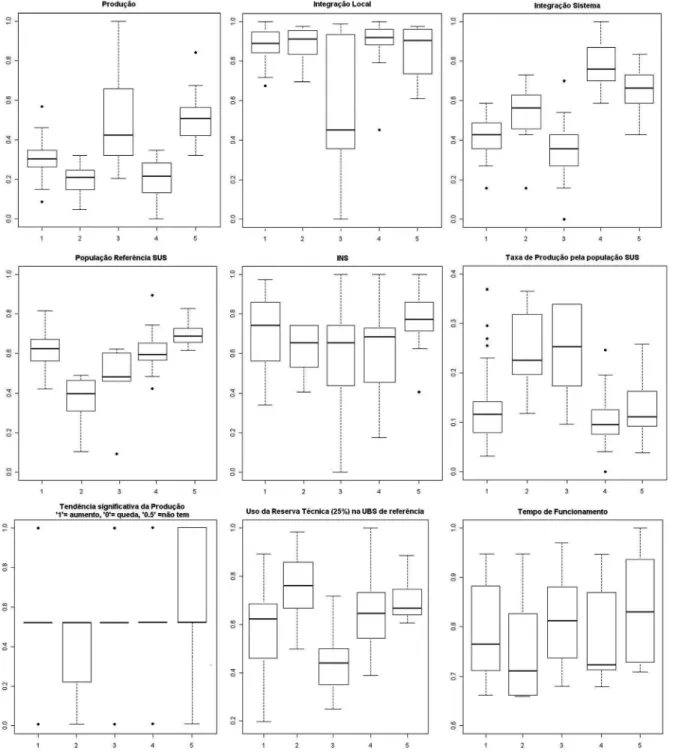
In order to complement the analysis of the defined clusters, other variables were tested us-ing boxplots, characterizus-ing the median and the internal variability to the cluster. This technique made it possible to incorporate new elements that strengthen the analysis, provided by the construc-tion of the clusters.
Characterizing the clusters constructed
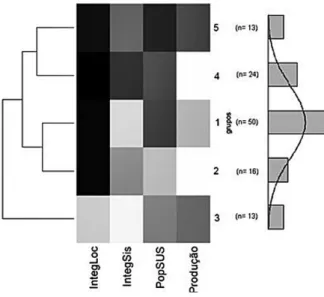
One way of synthetically characterizing the clusters of AMA services, which contribute to analyzing and defining its patterns, can be seen in Figure 1
Regularities and dissimilarities were observed, en-abling five clusters to be characterized. The groups produced by K-means technique, in their graphic rep-resentation of heatmaps, are represented in Figure 2. The five AMA service clusters enabled different patterns of medical consultation production and of articulation with the SUS municipal health service network to be identified
• cluster 1- formed of 50 AMA, showed poor
inte-gration with the municipal health care network, although referrals were made to the reference UBS. It has the second largest SUS user popula-tion of all the clusters and producpopula-tion was aver-age,
• cluster 2- formed of 16 AMA, showed average
integration with the municipal network, with referrals preferring the reference UBS. It has the smallest SUS user population of the clusters and low absolute production
• cluster 3- formed of 13 AMA, showed lower inte-gration with the reference UBS and with other services in the municipal network. This cluster had a medium-low SUS user population and the second largest production. The data from the five units for which all the necessary information was available were used to construct the heatmap. Eight AMA were added to this cluster as they had the same characteristics, not having a defined reference population.
• cluster 4- formed of 24 AMA, had the highest
Figure 2 - Heatmaps of the five clusters, based on the following variables: Local Integration, Integration with the System, SUS reference population and Production Figure 1 - Heatmaps with the centroids of the five clusters and histogram accompanied by a density line
• cluster 5- formed of 13 AMA, had the second
greatest integration with the municipal network and high level of integration with the reference UBS. It had the largest SUS user population and the highest production of the clusters.
Based on the cluster construction, a descriptive study of the behavior of the other available variables, selected according to cluster, was conducted. In this stage, analyses of boxplots (Figure 3) and tables of variable distribution according to cluster (Table 1) were used.
Table 1 includes partnerships made by the Mu-nicipal Health Secretariat to establish the services analyzed, the management type and location accord-ing to health region.
A concentration of the type of agreement and of partnership 10 can be seen in cluster 3, which is also noteworthy for its poor integration, both local and with the system, despite high production and lower health needs (INS). There are also units which have been established for a longer time, this profile may reflect the decision to expand rapidly and of the impact on production upon implantation, without many connections integrating it with the network, such findings suggest that these units could be incorporated as emergency care units maintaining these characteristics.
On the other hand, cluster5 composed of units also established at the start of the process, in ter-ritories of high health need, high local and system integration and with potentially the highest user population in the city suggests that they comple-ment precarious primary health care. It was the only cluster with increasing production during the period analyzed, indicating growing demand. An in-depth analysis could be conducted, aiming to identify gaps in the primary health care in these territories where the AMA may be operating to fill gaps in care. The concentration of the same partnership as in cluster3 may indicate facility establishing activities.
Cluster1, concentrated in partnership 8 and in Region B shows poor integration with the system and low use of the technical reserve, despite good local integration. It also has a low rate of production in contrast with high health care needs and poten-tial demand, suggesting the needs for adjustments concerning its integration into the network of this deprived region.
Table 1 - Details of the five clusters constructed from the 116 units. For each cluster, ‘n’ (number of units) and other characteristics such as type of management, partnerships and region located are shown
Clusters
Characteristics 1 2 3 4 5 Total
N 50 16 13 24 13 116
Type of management Agreement 28 9 12 16 8 73
Contract 21 7 1 8 5 42
Partnership
Partner _1 2 0 1 1 2 6
Partner _2 2 3 0 0 2 7
Partner _3 0 0 0 7 2 9
Partner _4 1 0 1 1 0 3
Partner _5 0 2 0 2 0 4
Partner _6 0 0 0 1 0 1
Partner _7 0 1 0 1 0 2
Partner _8 12 1 1 0 0 14
Partner _9 1 2 1 2 0 6
Partner _10 31 7 9 9 7 63
CRS
Region _A 0 3 0 4 1 8
Region _B 22 3 3 2 1 31
Region _C 13 2 2 2 3 22
Region _D 5 3 2 8 6 24
Region _E 10 5 6 8 2 31
and, especially, to the choice of possible interven-tions for the problems identified.
Potential for using cluster analysis
in evaluating the SUS health service
network
The SUS has made significant progress in imple-menting the principle of universality, resulting in the incorporation of more than 90 million Brazil-ian citizens into the system. However, it should be noted that this relative success has generated new demands and pressure seeking to implement the principles of integrity and fairness in the system.
In this direction, and to this end, the federal Gov-ernment enacted decree No. 7,508 (Brasil, 2011) that, regulating Law 8,080/90, proposes the construction of health regions, an organizational arrangement that would have more power to implement the
prin-ciples of universality, integrality and fairness in the SUS, overcoming some of the limitations.
Organizing care networks in health regions should be defined with a view to the process of constructing different municipal health systems, in compliance with the operating standards of the 1990s, as well as the 2006 Health Agreement.
In this context, the need for permanent evalua-tion both of the processes of reorganizaevalua-tion of the system, and the services themselves is reaffirmed. Decree 7,508 itself points out such a need. However, although recognized, no responsibility is assigned to and specific federal entity.
The decision to work with a secondary data base enables this tool to be used in different contexts of health system compliance, strengthening the or-ganization of complex data into easily understand groupings, communication and use at different levels of health care management.
The possibility of using a descriptive statistical technique, incorporating the complexity of contexts in the analysis, enables significant relationships between the different variables to be identified, ex-tending the scope of the proposed tool for decision-making in these contexts. It should be noted that the application of this tool requires a compatible number of services enabling comparisons and as-sociations and ratings such as cluster analysis to be conducted.
It should be considered that incorporating as-sessment tools into everyday life, while a regular management technology and practice, continues to be very challenging and requires some basic conditions for implementation. Among these are the significant constraints to their institutionalization. It is essential that an evaluation policy, including management tools, is established in the SUS, as pre-sented in this article, in large municipalities and/or health regions, to regulate its own services, as well as those provided by the private sector.
References
ANDERSEN, R. M. Revisiting the behavioral model and access to medical care:does it matter? Journal of Health and Social Behavior, Los Angeles, v. 36, p. 1-10, mar. 1995. Disponível em: <globalhealth. stanford.edu/resources/Revisiting_Behavioral_ Model_and_Access.pdf>Acessoem: 22 mar. 2013.
BRASIL. Decreto nº 7.508, de 28 de junho de 2011. Regulamenta a Lei nº 8.080, para dispor sobre a organização do Sistema Único de Saúde – SUS. Brasília, DF, 2011. Disponível em: <http://www. planalto.gov.br/ccivil_03/_ato2011-2014/2011/ decreto/D7508>. Acesso em: 22 mar. 2013.
CARVALHO, A. L. B. et al. A gestão do SUS e as práticas de monitoramento e avaliação: possibilidades e desafios para a construção de uma agenda estratégica. Ciência & Saúde Coletiva, Rio de Janeiro, v. 17, n. 4, p. 901-911, 2012.
DENIS, J. L. Institucionalização da avaliação na administração pública. Revista Brasileira de Saúde Materno Infantil, Recife, v. 10, p. s229-s333, 2010. Suplemento 1.
DONABEDIAN, A. Aspects of medical care
administration. Boston: Harvard University Press, 1973.
DUTTON, D. Finantial, organizational and professional factors affecting health care
utilization. Social Science & Medicine, Montreal, v. 23, n. 7, p. 721-735, 1986.
FEITOSA, T. M. P.; ALMEIDA, R. T. Perfil de produção do exame citopatológico para controle do câncer do colo do útero em Minas Gerais, Brasil, em 2002. Cadernos de Saúde Pública, Rio de Janeiro, v. 23, n.4, p. 907-917, 2007.
FELISBERTO, E. Da teoria à formulação de uma Política Nacional de Avaliação em Saúde: reabrindo o debate. Ciência & Saúde Coletiva, Rio de Janeiro, v. 11, n. 3, p. 553-563, 2006.
FELISBERTO, E. et al. Análise da sustentabilidade de uma política de avaliação: o caso da atenção básica no Brasil. Cadernos de Saúde Pública, Rio de Janeiro, v. 26, n. 6, p. 1079-1095, 2010.
FRENK, J. Conceptual measurement of
accessibility. Salud Pública de México, Mexico, v. 27, n. 5, p. 438-453, 1985.
FURTADO, J. P.; LAPERRIÈRRE, H. A avaliação da avaliação. In: ONOCKO, R. C.; FURTADO, J. P. (Org.). Desafios da avaliação de programas e serviços de saúde. Campinas: Ed. Unicamp, 2011. p. 19-39.
GONÇALVES, M. J. F.; PENNA, M. L. F. Morbidade por tuberculose e desempenho do programa de controle em municípios brasileiros, 2001-2003. Revista de Saúde Pública, São Paulo, v. 41, p. 95-103, 2007. Suplemento 1.
JOHNSON, R.; WICHERN, D. Applied Multivariate Statistical Analysis. New Jersey: Prentice-Hall; 1995.
MARDIA, K.; KENT, J.; BIBBY, J. Multivariate Analysis. New York: Academic Press, 1979.
MIRANDA, A. S.; CARVALHO, A. L. B.;
CAVALCANTE, C. G. C. S. Subsídios sobre práticas de monitoramento e avaliação sobre gestão governamental em Secretarias Municipais de Saúde. Ciência & Saúde Coletiva, Rio de Janeiro, v. 17, n. 4, p. 913-920, 2012.
OLIVEIRA, D. C. et al. Efecto de las desigualdades socioeconómicas enlamortalidad de laciudad de Fortaleza, Ceará, Brasil durante el año de 2007. Revista Española de Salud Pública, Madrid, v. 84, n. 4, p. 441-450, 2010.
ROSENSTOCK, I. M. The health belief model: explaining health behavior through expectancies. In: GLANZ, K.; LEVIS, F.; RIMER, B. K. (ED.). Health behavior and health education: theory, research and practice. San Francisco: Jossey Bass, 1990. p. 39-62.
SÃO PAULO. Secretaria Municipal de Saúde. Coordenação da Atenção Básica. Diretrizes Técnicas da Assistência Médica Ambulatorial na Atenção Básica. São Paulo: PMSP/SMS, 2009. Disponível em: <http://www.prefeitura.sp.gov.br/ cidade/secretarias/upload/saude/arquivos/ama/ AMA_ManualDiretrizesTecnicas.pdf> Acesso em: 22 mar. 2013.
SILVA, L. M. V. Avaliação do processo de descentralização das ações de saúde. Ciência & Saúde Coletiva, Rio de Janeiro, v. 4, n. 2, p. 331-339, 1999.
SOUSA, L.; GALANTE, H.; FIGUEIREDO, D. Qualidade de vida e bem-estar dos idosos: um estudo exploratório na população portuguesa. Revista de Saúde Pública, São Paulo, v. 37, n. 3, p. 364-371, 2003.
STARFIELD, B. Atenção primária: equilíbrio entre necessidades de saúde, serviços e tecnologia. Brasília, DF: Unesco/Ministério da Saúde, 2002.
TAMAKI, E. M. et al. Metodologia de construção de um painel de indicadores para o monitoramento e a avaliação da gestão no SUS. Ciência & Saúde Coletiva, Rio de Janeiro, v. 17, n. 4, p. 839-850, 2012.
TANAKA, O. Y. Caminhos alternativos para a institucionalização da avaliação em saúde. Ciência & Saúde Coletiva, Rio de Janeiro, v. 11, n. 3, p. 564-576, 2006.
TANAKA, O. Y.; DRUMOND JR., M. Análise
descritiva da utilização de serviços ambulatoriais no Sistema Único de Saúde segundo o porte do município, São Paulo, 2000 a 2007. Epidemiologia e Serviços de Saúde, Brasília, DF, v. 19, n. 4, p. 355-366, 2010.
TANAKA, O. Y.; TAMAKI, E. M. O papel da avaliação para a tomada de decisão na gestão de serviços de saúde. Ciência & Saúde Coletiva, Rio de Janeiro, v. 17, n. 4, p. 821-828, 2012.
Authors’ contributions
Tanaka, Drumond Jr., Broche-Cristo, Spedo and Silva Pinto parti-cipated in designing the study, analyzing and discussing the data and writing the article. Broche-Cristo drew up the plan for the statistical analysis.