http://dx.doi.org/10.1590/0037-8682-0180-2013
Major Article
InTrODUcTIOn
Address to: Dr. Leonardo Cordenonzi Pedroso de Albuquerque. Av. NS 15 s/n (109 Norte), 77001-090 Palmas, TO, Brasil.
Phone: 55 63 3232-8158; 55 63 8404-1513 e-mail: [email protected] Received 8 September 2013
Accepted 23 January 2014
HIV/AIDS-related visceral leishmaniasis: a clinical
and epidemiological description of visceral
leishmaniasis in northern Brazil
Leonardo Cordenonzi Pedroso de Albuquerque
[1],
Iatan Rezende Mendonça
[1],
Polyana Nascimento Cardoso
[1],
Leonardo Rodrigo Baldaçara
[1],
Myrlena Regina Machado Mescouto Borges
[1],
Joelma da Costa Borges
[1]and Maria Cristina da Silva Pranchevicius
[1][1]. Curso de Medicina, Universidade Federal do Tocantins, Palmas, TO.
ABStRACt
introduction: This study aimed to describe the main features of visceral leishmaniasis (VL), both related to and independent
of human immunodei ciency virus (HIV) infection, in patients who were registered in Tocantins, Brazil. Methods: Data from
1,779 new patients with VL, 33 of whom were also infected with HIV, were reviewed. Results: The incidence of VL/HIV
coinfection increased from 0.32/100,000 inhabitants in 2007 to 1.08/100,000 inhabitants in 2010. VL occurred predominantly in children aged 10 years or younger, while VL/HIV was more common in patients aged between 18 and 50 years. There were more male patients in the VL/HIV group than in the VL group. Relapse rates were also considerably higher in the VL/HIV (9.1%) group than in the VL group (1.5%). Despite a similar clinical presentation, VL/HIV patients exhibited a higher proportion (24.2%) of concomitant infectious diseases and jaundice. Pentavalent antimonials were used for the initial treatment of VL and VL/HIV infections. However, amphotericin B deoxycholate and liposomal amphotericin B were also widely used in the treatment of VL/HIV coinfection. The mortality rate was higher in the VL/HIV coinfection group (19.4%) than in the VL group (5.4%). Furthermore, the mortality rate due to other causes was signii cantly higher in the VL/HIV group (12.9%) than in the VL group (0.7%). Conclusions: The study showed that the incidence, clinical characteristics and outcomes among the VL and VL/HIV
patients in this state are similar to those from other endemic regions, indicating that both infections are emerging with increasing
frequency in Brazil.
Keywords: Visceral leishmaniasis. Epidemiology. Public health. HIV-related visceral leishmaniasis. Urbanization.
Visceral leishmaniasis (VL) is a vector-borne parasitic disease caused by several Leishmania spp., and if untreated, death occurs in 90% of cases1. VL is endemic to 70 countries2,
and approximately 90% of the VL cases documented on
the American continent occur in Brazil3. It is considered an
underreported disease, and some studies have demonstrated a high
frequency of relapses during follow-up. VL symptoms include fever, weight loss, hepatosplenomegaly, lymphadenopathy, pancytopenia and hypergammaglobulinemia4. Some cases of
VL present atypically, as they involve the lungs, pleura, oral mucosa, larynx, esophagus, stomach, small intestine, skin and
bone marrow5. There is regional variation in the response to
antileishmanial drugs, and recommendations for treatments
vary by region6 as a result.
Since 1980, more than 608,230 cases of AIDS have
been registered in Brazil, with an incidence of 17.9/100,000 inhabitants in 20107, and unlike VL, the propagation of HIV
transmission to regions with lower urbanization rates and to small and medium-sized cities has been observed2. HIV
infections increase the risk of developing VL by 100- to
2,320-fold in endemic areas, reduce the likelihood of a therapeutic
response and greatly increase the probability of relapse2.
However, VL promotes the clinical progression of HIV and the development of AIDS-dei ning conditions8.
In general, patients with coinfections show very similar
clinical features to classical VL9, although the usual clinical
features associated with VL (prolonged fever, spleen and liver enlargement, wasting and pancytopenia) are not always
present, and atypical presentations occur more often in immunocompromised patients. Furthermore, a clinical diagnosis
can also be more difi cult to establish due to other concomitant
opportunistic diseases10.
resULTs MeTHODs
in this study, we aimed to report the results of a comparative study (based on data from the Information System for Notii able
Diseases) on the epidemiology, clinical presentation, drugs used
and outcome of both VL and VL/HIV patients in Tocantins, the newest Brazilian state, between 2007 and 2010.
Study design and data collection
A descriptive study of coni rmed cases with VL and VL/HIV infections was conducted between 2007 and 2010 in Tocantins, Brazil. Tocantins is the newest state of the country (created
in 1988) and is located in the central part of Northern Brazil. The 2010 census estimated that the state had a population of
1,383,445 inhabitants, distributed over 277,720.520km2, and
a population density of 4.98 inhabitants per square kilometer;
moreover, it comprises 139 municipalities.
The study was based on the data from the Information System for Notii able Diseases (Sistema de Informação de Agravos de Notifi cação – SINAN). The patients were divided into two groups: the VL group, consisting of patients without
HIV infection, and the VL/HIV coinfection group, consisting
of patients with VL and HIV (with and without AIDS). An epidemiological description was produced from both groups. However, reports in which the "HIV coinfection", "drug initially administered" and "developments in the case" i elds were left blank or incomplete were excluded from both groups. In this database, the diagnosis of VL was made by the presence of symptoms, a blood test for coni rmation (immunological
methods) and a parasitological diagnosis.
inclusion and exclusion criteria
The study included patients diagnosed with VL due to the presence of amastigotes in bone marrow smears or indirect immunol uorescence, which were considered positive with
results higher than 1:80, and clinical manifestations that included
hepatomegaly or splenomegaly, anemia and thrombocytopenia. The study excluded patients undergoing prior treatment with
antileishmanial drugs.
The “LV Investigation Form” included an “HIV coinfection”
i eld. Cases were selected for the study using this information. Patients with a coni rmed diagnosis of VL and positive HIV serum tests were included, while those who left the “HIV coinfection” i eld blank or marked it as negative were excluded. Co-infected patients were diagnosed with HIV by ELISA, and the result was coni rmed by either indirect immunol uorescence (IIF) or western blot analysis. Associated causes were considered for patients who, regardless of the efi cacy of the treatment, eventually died from cytopenia or thrombocytopenia, and data were discarded in cases where the patient underwent an inadequate treatment course (e.g., someone who should have been treated with amphotericin B because they had cardiovascular involvement but was treated with Glucantime instead), suffered adverse reactions to the medication, such as renal or hepatic insufi ciency, or developed
associated infections such as pneumonia or severe sepsis.
Subjects from 0-65 years of age of either sex were included in the study. Females who were pregnant or lactating were not excluded. Exclusion criteria included forms with insufi cient
information regarding the initial drug used in the treatment, HIV coinfection status and the progression of the case.
data analysis
Data were codified and analyzed using the Statistical Package for the Social Sciences (SPSS for Windows, version 17.0). The variables used for comparative analyses were
gender, age, scholarship, clinical manifestations, initial drug
use and development of the disease. All variables are presented as numbers and proportions, and age and scholarship are
also presented as means and standard deviations (SDs). The
indicators were considered to be the following: the lethality of
the VL and VL/HIV infections; the mortality rate directly related
to VL and linked to other causes in both groups; the relapse rate
in each group; and the annual rate of VL/HIV coinfection. Only
new cases were used for the analysis, except for the analysis of relapses. The chi-squared test was used to calculate the difference in the nominal variables between the two groups. The differences in the means between the two groups due to age and scholarship were calculated using Student’s t-test. A signii cance level (α) of 0.05 was considered statistically relevant. The variables with signii cant results were inserted in the stepwise multivariate model to determine the odds ratios (ORs) with 95% coni dence intervals (CIs) for the association between
the HIV/VL coinfection. We used HIV positivity as a dependent
variable, each factor as an independent variable and age, gender and scholarship as covariates. Alpha was set at p < 0.05.
Ethical considerations
The study was approved by the Committee of Ethics in
Human Research (Comitê de Ética em Pesquisas com Seres Humanos) of the Federal University of Tocantins (Universidade
Federal do Tocantins – UFT) (number 030/2009) and was conducted in accordance with the ethical guidelines of the
Declaration of Helsinki (created in 1964 and revised in 2002).
Permission to conduct the study was obtained from the Health
Department of the State of Tocantins (Secretaria da Saúde do
Estado do Tocantins – SESAU).
According to SINAN, 1,779 VL patients were registered in Tocantins between 2007 and 2010. Of those, 33 (2.1%) were coinfected with HIV. There were no data for VL/HIV coinfection
status, the initial drug used or developments in the case in 210
reports; thus, these patients were excluded from the comparative analysis. During the same period, there were 23 relapses in the
VL group and 3 relapses in the VL/HIV group. Among these
26 cases, i ve were excluded due to the lack of data regarding
the initial drug used for treatment and developments in the case. Figure 1 depicts the incidence rate per year for LV/HIV and LV-only cases. The incidence of LV/HIV coinfections
FIGURE 1 – Incidence of VL/HIV-coni rmed cases per 100,000 habitants per year in Tocantins, Brazil, from 2007 to 2010. VL/HIV: visceral leishmaniasis and human immunodei ciency virus coinfection group; VL: visceral leishmaniasis single infection group; *Incidence: number of new cases per 100,000 habitants per year.
0.00 0.20 0.40 0.60 0.80 1.00 1.20
2007 2008 2009 2010
VL/HIV
VL /H IV
0.00 5.00 10.00 15.00 20.00 25.00 30.00 35.00
2007 2008 2009 2010
VL
VL
VL/HIV VL
Year Population N Incidence* N Incidence*
2007 1,243,627 4 0.32 385 30.96
2008 1,280,509 5 0.47 398 31.08
2009 1,292,051 7 0.62 322 24.92
2010 1,383,453 14 1.08 398 28.88
Year VL/HIV VL
2007 0.32 30.96
2008 0.47 31.08 2009 0.62 24.92
inhabitants in 2008, to 0.62/100,000 inhabitants in 2009 and, i nally, to 1.08/100,000 inhabitants in 2010. The incidence of LV alone decreased from 30.96/100,000 inhabitants in 2007, to 31.08/100,000 inhabitants in 2008, to 24.92/100,000 inhabitants in 2009 and, i nally, to 28.88/100,000 inhabitants in 2010.
Details regarding the demographic characteristics of the
VL and VL/HIV groups are provided in table 1. The mean age
of the VL/HIV group (27.9±15.1) was higher than that of the VL group (18.0±14.9); t=4.134, p<0.01. The more frequent age range for VL/HIV patients was 18-50 years, which is considered
the economically active population in Brazil. In the VL group,
there were more patients aged 10 years and younger (χ2=35.873,
p<0.01). The mean scholarship was higher in the VL group (6.9±3.7) than in the VL/HIV group (5.2±3.4), but the proportion between study stages was not signii cant (χ2=10.461, p=0.06).
The proportion of male patients was higher in the LV/HIV group (78.8%) than in the VL group (57.5%); χ2=5.878, p=0.01. The
relapse rate was also considerably higher in the VL/HIV group (9.1%) than in the VL group (1.5%); χ2=11.328, p=0.01.
Despite the similar clinical presentation among the VL
patients with or without HIV coinfection (table 2), a higher
proportion (24.2%) of patients in the VL/HIV group had
TABLE 1 -Demographic characteristics of patients with visceral leishmaniasis and visceral leishmaniasis associated with HIV in Tocantins, Brazil, from 2007 to 2010.
Demographic characteristics VL/HIV patients VL patients χ2/t p
Age in years (Mean, SD)a 27.9±15.1 18.0±14.9 1.456 <0.01
0-10 8 24.2 900 58.6 35.873 <0.01
11-17 0 0.0 136 8.9
18-50 24 72.7 402 26.2
>50 1 3.0 98 6.4
Years of scholarship (Mean, SD)b 5.2±33.4 6.9±3.7 4,736 0.02
none 1 3.0 24 1.6 10.461 0.06
primary school 12 36.4 418 27.2 secondary school 7 21.2 189 12.3
university 0 0.0 16 1.0
unknown 13 39.4 902 57.5
Genderc
male 26 78.8 887 57.7 5.878 0.01
female 7 21.2 649 42.3
Case type
new case 30 90.9 1,503 98.5 11.328 0.01
relapse 3 9.1 23 1.5
VL/HIV: visceral leishmaniasis and human immunodei ciency virus coinfection group; VL: visceral leishmaniasis single infection group.
χ2: chi-square. t: T-student test. aAge is presented as the mean and standard deviation (SD) in the i rst line and divided into groups by number and proportion below. bScholarship is presented as the mean and SD in the i rst line and divided into groups by number and proportion below. cGender is presented as a number and proportion.
concomitant infectious diseases (χ2=6.023, p=0.02) and jaundice
(χ2=4.599, p=0.04).
The drugs most frequently used in the treatment of patients
in both groups are shown in table 3. The drug of choice for the
initial treatment of VL (84.2%) and VL/HIV coinfection (62.5%) was pentavalent antimonials (χ2=19.935; p<0.01). However,
amphotericin B deoxycholate and liposomal amphotericin B
were also widely used for the treatment of VL/HIV.
The mortality rate (table 3) was higher in the VL/HIV
coinfection group (19.4%) than in the VL group (5.4%). The VL-related mortality rate was 4.7%, and the VL/HIV-related mortality rate was 6.5%. Furthermore, the mortality attributed to other causes was signii cantly higher in the VL/HIV group (12.9%) than in the VL group (0.7%); χ2=47.973, p<0.01.
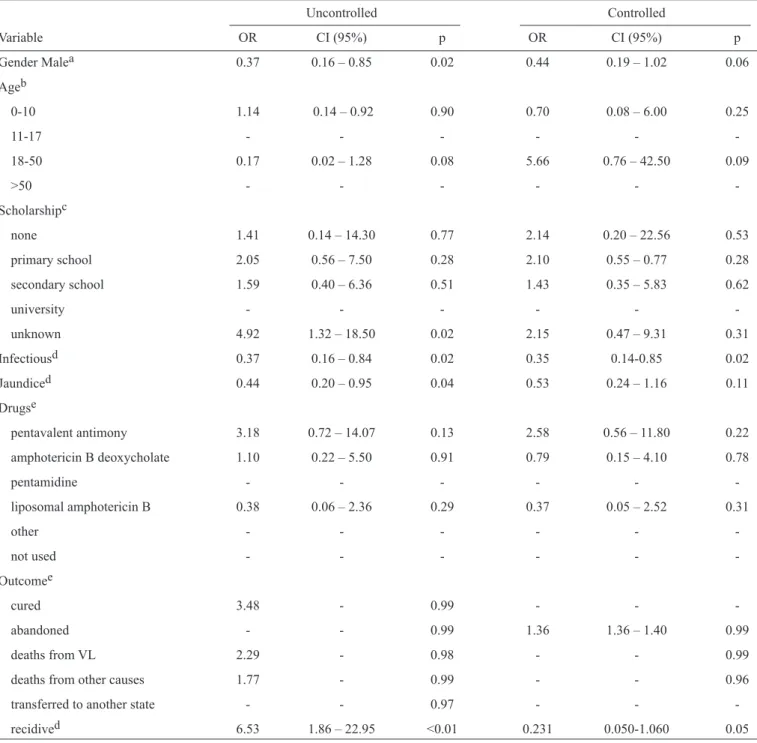
For the multiple logistic regression analysis, we selected HIV positivity as a dependent variable and the following factors as independent variables: gender, age, scholarship, concomitant infections, jaundice, drugs, outcome and the occurrence of relapse. Gender, scholarship and age were selected as covariates. It was observed that being HIV positive was a risk factor for concomitant infections (OR=0.35, CI=1.14-0.85, p=0.02) and relapse (OR=0.23, CI=0.05-1.05, p=0.05). For more details,
TABLE 2 - Clinical characteristics of visceral leishmaniasis patients with or without HIV coinfection.
Characteristics VL/HIV patients VL patients χ2 p
Fever 31 93.9 1,488 96.9 0.902 0.34
Weakness 28 84.8 1,354 88.2 0.336 0.357
Weight loss 25 75.8 1,119 72.9 0.138 0.44 Mucocutaneous pallor 22 66.7 1,117 72.7 0.636 0.27 Splenomegaly 20 60.6 1,082 70.4 0.227 0.38 Hepatomegaly 17 51.5 969 63.1 0.952 0.21
Cough 17 51.5 830 54.0 0.085 0.45
Concomitant infectious diseases 8 24.2 175 11.4 6.023 0.02
Edema 5 15.2 214 13.9 0.072 0.47
Jaundice 9 27.3 215 14.0 4.599 0.04
Hemorrhage 0 0.0 50 3.3 1.079 0.35
VL/HIV: visceral leishmaniasis and human immunodei ciency virus coinfection group; VL: visceral leishmaniasis single infection group;
χ2: chi-square.
TABLE 3 - Drugs used in the treatment of patients with visceral leishmaniasis and patients with visceral leishmaniasis associated with HIV and
their clinical outcomes in Tocantins, Brazil from 2007 to 2010.
Characteristics VL/HIV patients VL patients χ2 p
Drugs
pentavalent antimony 20 62.5 1,272 84.2 19.935 <0.01
amphotericin B deoxycholate 7 21.9 154 10.2
pentamidine 0 0.0 4 0.3
liposomal amphotericin B 3 9.4 22 1.5
other 0 0.0 18 1.2
not used 2 6.2 40 2.6
Outcome
cured 25 80.0 1,349 89.8 47.973 <0.01
abandoned 0 0.0 7 0.5
deaths from VL 2 6.5 71 4.7 deaths from other causes 4 12.9 11 0.7 transferred to another state 0 0.0 65 4.2
The transmission of VL has gradually spread to various
Brazilian regions. It is believed that rural-urban migration, agroindustrial and man-made projects such as dams, irrigation systems and wells as well as deforestation contribute to the
dissemination of this disease14. In Tocantins, located in northern
Brazil, new urban VL cases have been reported since 200011. DIscUssIOn
TABLE 4 – Results from the multiple logistic regression analysis.
Uncontrolled Controlled
Variable OR CI (95%) p OR CI (95%) p
Gender Malea 0.37 0.16 – 0.85 0.02 0.44 0.19 – 1.02 0.06
Ageb
0-10 1.14 0.14 – 0.92 0.90 0.70 0.08 – 6.00 0.25
11-17 -
-18-50 0.17 0.02 – 1.28 0.08 5.66 0.76 – 42.50 0.09
>50 - - -
-Scholarshipc
none 1.41 0.14 – 14.30 0.77 2.14 0.20 – 22.56 0.53
primary school 2.05 0.56 – 7.50 0.28 2.10 0.55 – 0.77 0.28
secondary school 1.59 0.40 – 6.36 0.51 1.43 0.35 – 5.83 0.62
university -
-unknown 4.92 1.32 – 18.50 0.02 2.15 0.47 – 9.31 0.31
Infectiousd 0.37 0.16 – 0.84 0.02 0.35 0.14-0.85 0.02 Jaundiced 0.44 0.20 – 0.95 0.04 0.53 0.24 – 1.16 0.11
Drugse
pentavalent antimony 3.18 0.72 – 14.07 0.13 2.58 0.56 – 11.80 0.22
amphotericin B deoxycholate 1.10 0.22 – 5.50 0.91 0.79 0.15 – 4.10 0.78
pentamidine -
-liposomal amphotericin B 0.38 0.06 – 2.36 0.29 0.37 0.05 – 2.52 0.31
other -
-not used -
-Outcomee
cured 3.48 - 0.99 - -
-abandoned - - 0.99 1.36 1.36 – 1.40 0.99
deaths from VL 2.29 - 0.98 - - 0.99
deaths from other causes 1.77 - 0.99 - - 0.96 transferred to another state - - 0.97 - - -recidived 6.53 1.86 – 22.95 <0.01 0.231 0.050-1.060 0.05
OR: odds ratio; CI: coni dence interval. aControlled by age and scholarship; bControlled by gender and scholarship; cControlled by gender and
age; dControlled by gender, age and scholarship; eControlled by gender, age, scholarship and case type; -: Parameter set to zero or there were
not enough parameters to be calculated. Result close to zero.
This suggests that environmental changes such as the destruction
of the cerrado vegetation, the construction of new cities and the rapid and intense migration of rural populations to urban
peripheries could have played a role in the transmission of VL. HIV/AIDS is also endemic in Brazil15, and an increase in the
internalization of HIV infection. In VL-endemic regions, HIV infection increases the risk of developing clinically evident leishmaniasis. Leishmaniasis is endemic to Tocantins and is in
the process of expanding both geographically and in magnitude. However, information on coinfection by VL and HIV in the northern region of Brazil is still scarce. Thus, our objective was to describe the main epidemiological and clinical features of
VL/HIV-infected and VL-infected patients in Tocantins. During the four years of this study (2007-2010), the
signii cant number of VL cases when compared to the number of VL/HIV cases could have been overestimated because no HIV test was performed preceding the completion of the “LV Investigation Form”, which resulted in only 33 patients completing the "HIV infection" i eld.
Additionally, of the total number of reports for VL infection, 210 records had incomplete “HIV infection” i elds. This reinforces the importance of i lling out the form in full,
as the information contained in it is extremely important for the planning and execution of surveillance and disease control.
The highest prevalence rate (47.7%) of VL infection in children ≤ 5 years old was reported in other region of Brazil16,17,
with similarly high prevalence rates reported in other countries18-20,
and it could rel ect increased exposure to sandl ies20. In our study,
there were two cases of VL in pregnant patients who transmitted
the disease congenitally to their infants21. The diagnosis of VL
among pregnant women was parasitological due to the presence
of Leishmania in the bone marrow aspirate. PCR amplii cation
of parasite kDNA from newborn bone marrow samples suggested that the leishmaniasis was transmitted vertically because the newborns developed signs of the disease shortly after birth21.
VL/HIV coinfections were most commonly observed in the age range of 18-50 years (72.7%), and the proportion of male patients was higher in the LV/HIV group (78.8%) than in the VL group (57.5%). The same scenario was found in the central-west region of Brazil between 2000 and 200612, the southeast region
between 2000 and 20058 and the northeast region between 2001
and 200522. This shows that cases of coinfection have spread
throughout Brazil.
Although it has been proposed that VL/HIV coinfections show different clinical manifestations – a lack of visceromegaly
or fever, for instance23, 24 – our study is in accordance with other
reports25, 7 that show that the initial clinical presentation of
VL/HIV patients is similar to that of HIV-negative individuals,
with fever, splenomegaly and hepatomegaly associated with weakness, weight loss, mucocutaneous pallor, airway infections and/or diarrhea, edema and jaundice. The only difference in symptoms between the two groups was an increased prevalence of infection in HIV-infected patients (25.9% versus 10.7%). However, our study coni rms the i ndings of previous reports showing that HIV-induced immunosuppression impairs the body’s protective mechanisms against intracellular parasites,
such as Leishmania species. Additionally, VL could induce
intracellular HIV replication, thus speeding up the clinical
course of the HIV infection26-28. Consequently, it also
demonstrates that VL has emerged as a serious opportunistic infection in HIV-infected patients29.
The treatment for VL in HIV-infected patients is limited
to pentavalent antimonials (sodium stibogluconate (SSG) and
meglumine antimoniate) and amphotericin B (AmB, typically in the liposomal formulation AmBisome, Gilead Sciences
Inc., Astellas Pharma, North Deeri eld, IL)25. Although the
use of pentavalent antimonials is no longer recommended
in HIV-infected patients by most experts in the i eld, due to their unacceptable toxicity and high rates of treatment failure
and mortality30, we used pentavalent antimonials as the i rst
choice of treatment for VL and VL/HIV infections in our study. In 2005, the World Health Organization stressed the
need for multicenter trials of i rst-line treatment and secondary prophylaxis for patients with VL infected with HIV and the need to include treatment regimens with liposomal amphotericin B31.
Nevertheless, the number of patients who received amphotericin B deoxycholate and liposomal amphotericin B was much higher in the VL/HIV group (31.3%) than in the VL group (11.7%). This indicates that the WHO recommendations for liposomal AmB as the best treatment choice for coinfected patients because of its success rate in the HIV-positive
population2 were followed.
In 2011, the Brazilian Health Ministry (Ministério da
Saúde do Brasil) published a new guideline32 recommending
the use of AmB deoxycholate as the i rst-choice drug in the treatment of VL/HIV coinfection. However, some studies have demonstrated a high frequency of relapses during follow-up2,33,
further supporting the need for combined therapies.
Furthermore, a VL/HIV-coinfected patient’s severely immunocompromised state could hinder the destruction of the
parasite and contribute to an increased predisposition to frequent
relapses34. This tendency toward relapses was observed in our
studies (data not shown).
The immune deficiency caused by HIV facilitates the
multiplication of the Leishmania parasite and further reduces the rates of cure through conventional treatments2,7,35,36. The lethality
among the VL/HIV patients in this study was substantially higher than that in the VL patients (data not shown). Generally, infectious complications and bleeding are the main risk factors for death in children with LV. Furthermore, the involvement of the liver in children, which is generally not pronounced and is reversible after treatment, could be quite severe, causing a
fatal outcome37. Lethality in the VL/HIV group prevailed in
individuals older than 40 years, coni rming the observation that adults older than 45 years have a higher risk of dying, possibly
due to immune decline at this age. The progression of the disease
symptoms with a consequent delay in diagnosis and treatment of patients with VL or VL/HIV has been identii ed as a risk
factor for death38. Adverse reactions, including renal and liver
failure, cardiac abnormalities and pancreatitis, and hepatitis drugs were also death-precipitating factors. The efi cacy of the therapeutic approach could not be ascertained, and our results are in accordance with other reports7,34,37. Considering that other
opportunistic diseases frequently develop during VL episodes in VL/HIV patients33, there was a highly accentuated death rate
regarding the laboratory and clinical proi les of patients and their association with death from VL could assist in clinical
management and reduce lethality39-41. Therefore, since 2011,
the Brazilian Health Ministry (Ministério da Saúde do Brasil) has recommended the differential diagnosis of opportunistic infections and the use of serological tests for HIV in patients
with VL in VL-endemic regions such as Tocantins.
There are some limitations to our study. Although the
sample size was large, the number of HIV patients was small, which restricted our multivariate analysis. Because it was only possible to analyze the variables that were included on the notii cation form (data from the Information System for Notii able Diseases), other associations could not be ascertained. However, this is the i rst comparative study on the epidemiologic and clinical features of coni rmed cases of VL and VL/HIV infections in Tocantins, Brazil. Thus, our results contribute to increasing our knowledge of VL and VL/HIV infections, which can be used to implement strategies for the prevention
and control of these diseases.
In conclusion, the VL and VL/HIV infections that occur
in northern Brazil are comparable to those reported by other studies performed in other endemic areas throughout the world, attesting the fact that VL and VL/HIV infections have been emerging with increased frequency in Brazil. Therefore, there
is a distinct need to develop and implement methods to identify
new forms of treatment and to improve the diagnostic accuracy
and therapeutic management of health services that function to control these diseases.
AcKnOWLeDGMenTs
The authors wish to thank the Secretaria de Sáude do Estado do Tocantins (Health Department of the State of Tocantins),
SESAU–TO, for facilitating access to the data and for the valuable assistance provided in verifying the consistency of the SINAN databases.
references
The authors declare that there is no conl ict of interest. cOnfLIcT Of InTeresT
1. Maia-Elkhoury ANS, Alves WA, Sousa-Gomes ML, Sena JM, Luna EA. Visceral leishmaniasis in Brazil: Trends and Challenges. Cad Saude Publica 2008; 24:2941-2947.
2. Alvar J, Aparicio P, Aseffa A, DenBoer M, Cañavate C, Dedet JP, et al. The relationship between leishmaniasis and AIDS: the second 10 years. Clin Micro Biol Rev 2008; 21:334-359.
3. Harhay MO, Olliaro PL, Costa DC, Costa CHN. Urban parasitology: visceral leishmaniasis in Brazil. Trends Parasitol 2011; 27:403-409.
4. Mandell GL, Bennett JE, Dolin R. Mandell, Douglas and Bennett’s principles and practice of infectious diseases, 6th Ed. Philadelphia (PA): Elsevier Churchill Livingstone; 2005 p. 2428-2442.
5. Sundar S, Chakravarty J. Liposomal amphotericin B and leishmaniasis: dose and response. J Glob Infect Dis 2010; 2:159-166.
6. Ministério da Saúde (MS). Secretaria de Vigilância em Saúde, Departamento de DST, AIDS e hepatites virais. Boletim Epidemiológico - AIDS e DST. Brasília: MS; 2012.
7. Cota GF, Sousa MR, Rabello A. Predictors of visceral leishmaniasis relapse in HIV infected patients: a systematic review. PLoS One 2011; e1153. 8. Hurissa Z, Gebre-Silassie S, Hailu W, Tefera T, Lalloo DG, Cuevas LE,
et al. Clinical characteristics and treatment outcome of patients with visceral leishmaniasis and HIV coinfection in northwest Ethiopia. Trop Med Int Health 2010; 15:848-855.
9. Souza GF, Biscione F, Greco DB, Rabello A. Slow clinical improvement after treatment initiation in leishmania/HIV coinfected patients. Rev Soc Bras Med Trop 2012; 45:147-150.
10. Orsini M, Canela JR, Disch J, Maciel F, Greco D, Toledo Jr A, et al. High frequency of asymptomatic Leishmania spp. infection among HIV-infected patients living in endemic areas for visceral leishmaniasis in Brazil. Trans R Soc Trop Med Hyg 2012; 106:283-288.
11. Sousa-Gomes ML, Maia-Elkhoury ANS, Pelissari DM, Lima Jr FEF, Sena JM, Cechinel MP. Coinfecção Leishmania-HIV no Brasil: aspectos epidemiológicos, clínicos e laboratoriais. Epidemiol Serv Saude 2011; 20:519-526.
12. Nascimento ET, Moura MLN, Queiroz JW, Barroso AW, Araujo AF, Rego EF, et al. The Emergence of concurrent HIV-1/AIDS and visceral leishmaniasis in Northeast Brazil. Trans R Soc Trop Med Hyg 2011; 105:298-300.
13. Alexandrino-de-Oliveira P, Santos-Oliveira JR, Dorval MEC, Costa FCB, Pereira GROL, Cunha RV, et al. HIV/AIDS-associated visceral leishmaniasis in patients from an endemic area in Central-West Brazil. Mem Inst Oswaldo Cruz 2010; 105:692-697.
14. World Health Organization (WHO). The Leishmaniasis and leishmania/ HIV Coinfection. WHO: 2000; [Cited 2013 September 03] Available at: apps.who.int/inf-fs/en/fact116.html/.
15. Daher EF, Fonseca PP, Gerhard ES, Leitão TM, Silva Júnior GB. Clinical and epidemiological features of visceral leishmaniasis and HIV Coinfection in i fteen patients from Brazil. J Parasitol 2009; 95:652-655. 16. Goés MAO, Melo CM, Jeraldo VLS. Série Temporal da leishmaniose
visceral em Aracaju, Estado de Sergipe, Brasil (1999 a 2008): aspectos humanos e caninos. Rev Bras Epidemiol 2012; 15:298-307.
17. Botelho ACA, Natal D. Primeira descrição epidemiológica da leishmaniose visceral em Campo Grande, Estado do Mato Grosso do Sul. Rev Soc Bras Med Trop 2009; 42:503-508.
18. Sarkari B, Hatam G, Ghatee MA. Epidemiological features of visceral leishmaniasis in Fars Province, Southern Iran. Iranian J Publ Health 2012; 41:94-99.
19. Deribe K, Meribo K, Gebre T, Hailu A, Ali A, AseffaA, et al. The Burden of Neglected Tropical Diseases in Ethiopia, and opportunities for integrated control and elimination. Parasit Vectors 2012; 5:240. 20. Piscopo TV, Azzopardi CM. Leishmaniasis. Postgrad Med J 2007; 82:
649-657.
21. Mescouto-Borges MRM, Maués E, Costa DL, Pranchevicius MC, Romero GS. Congenitally transmitted visceral leishmaniasis: report of two Brazilian human cases. Braz J Infect Dis 2013; 17:263-266. 22. Maia-Elkhoury ANS, Lucena F, Sousa-Gomes ML, Alves WA, Paz L.
Co-infecção da leishmaniose visceral e AIDS no Brasil. Rev Soc Bras Med Trop 2007; 40 (suppl I):124.
23. Fernandez Guerrero ML, Aguado JM, Buzon L, Barros C, Montalban C, Martin T, et al. Visceral leishmaniasis in immunocompromised Hosts. Am J Med 1987; 83:1098-1102.
24. Badaro R, Carvalho EM, Rocha H, Queiroz AC, Jones TC. Leishmania donovani: An opportunistic microbe associated with progressive disease in three immunocompromised patients. Lancet 1986; 1:647-648.
25. Jarvis JN, Lockwood DN. Clinical Aspects of Visceral Leishmaniasis in HIV infection. Curr Opin Infect Dis 2013; 26:1-9.
Spain in the era of highly active antiretroviral therapy. J Clin Micro Biol 2002; 40:762-767.
27. Berhe N, Wolday D, Hailu A, Abraham Y, Ali A, Gebre-Michael T, et al. HIV viral load and response to antileishmanial chemotherapy in co-infected patients. AIDS 1999; 13:1921-1925.
28. Alvar J, Cañavate C, Gutiérrez-Solar B, Jiménez M, Laguna F, López-Vélez R, et al. Leishmania and human immunodei ciency virus coinfection: The i rst 10 years. Clin Micro Biol Rev 1997; 10:298-319. 29. Grabmeier-Pi stershammer K, Poeppl W, Brunner PM, Rappersberger K,
Rieger A. Clinical challenges in the management of Leishmania/HIV coinfection in a non-endemic area: a case report. Case Rep Infect Dis 2012; 2012:787305.
30. World Health Organization (WHO). Control of the leishmaniasis: report of a meeting of the WHO Expert Committee on the Control of Leishmaniases, Geneva, 22-26 March 2010. [Cited 2013 September 09] Available at: whqlibdoc.who.int/trs/WHO_TRS_949_eng.pdf. 2010/. 31. World Health Organization (WHO). Report of a WHO informal consultation
on liposomal amphotericin B in the treatment of visceral leishmaniasis. WHO: 2005. [Cited 2013 September 09] Available at: http://www.who.int/ neglected_diseases/resources/AmBisomeReport.pdf. 2005
32. Ministério da Saúde (MS). Secretaria de Vigilância em Saúde, Departamento de Vigilância Epidemiológica. Manual de recomendações para diagnóstico, tratamento e acompanhamento de pacientes com a coinfecção Leishmania-HIV. Brasília: MS; 2011.
33. Russo R, Laguna F, Lopez-Velez R, Medrano FJ, Rosenthal E, Cacopardo B, et al. Visceral leishmaniasis in those infected with HIV: clinical aspects and other opportunistic infections. An Trop Med Parasitol 2003; 97 (Suppl I):99-105.
34. Horst R, Collin SM, Ritmeijer K, Bogale A, Davidson RN. Concordant HIV infection and visceral leishmaniasis in Ethiopia: the inl uence of antiretroviral treatment and other factors on outcome. Clin Infect Dis 2008; 46:1702-1709.
35. Bentwich Z. Concurrent Infections that rise the HIV viral load. J HIV Ther 2003; 8:72-75.
36. Cacopardo B, Nigro L, Preiser, Famá A, Satariano MI, Braner J, et al. Prolonged Th2 cell activation and increased viral replication in
HIV-Leishmania coinfected patients despite treatment. Transactions Trans R Soc Trop Med Hyg 1996; 90:434-435.
37. Bourgeois N, Lachaud L, Reynes J, Rouanet I, Mahamat A, Bastien P. Long-term monitoring of visceral leishmaniasis in patients with AIDS: relapse risk factors, value of polymerase chain reaction and potential impact on secondary prophylaxis. J Acquir Immune Dei c Syndr 2008; 48:13-19.
38. Collin SM, Coleman PG, Ritmeijer K, Davidson RN. Unseen Kala-azar deaths in south Sudan (1999-2002). Trop Med Int Health 2006; 11: 509-512.
39. Oliveira JM, Fernandes AC, Dorval ME, Alves TP, Fernandes TD, Oshiro ET, et al. Mortality due to visceral leishmaniasis: Clinical and laboratory characteristics. Rev Soc Bras Med Trop 2010; 43:188-193.
40. Costa CH, Werneck GL, Costa DL, Holanda TA, Aguiar GB, Carvalho AS, et al. Is severe visceral leishmaniasis a systemic inl ammatory response syndrome? a case control study. Rev Soc Bras Med Trop 2010; 43:386-392.