Genetic Polymorphisms Affect Mouse and
Human Trace Amine-Associated Receptor 1
Function
Xiao Shi1,2,3, Nicole A. R. Walter1,3, John H. Harkness1,3, Kim A. Neve1,2,3, Robert W. Williams4, Lu Lu4,5, John K. Belknap1,2,3, Amy J. Eshleman1,3, Tamara J. Phillips1,2,3, Aaron Janowsky1,2,3,6*
1Veterans Affairs Portland Health Care System, Portland, Oregon, United States of America,2The Methamphetamine Abuse Research Center, Oregon Health & Science University, Portland, Oregon, United States of America,3Department of Behavioral Neuroscience, Oregon Health & Science University, Portland, Oregon, United States of America,4Department of Genetics, Genomics and Informatics, University of Tennessee Health Science Center, Memphis, Tennessee, United States of America,5Jiangsu Key Laboratory of Neuroregeneration, Nantong University, Nantong, Jiangsu, China,6Department of Psychiatry, Oregon Health & Science University, Portland, Oregon, United States of America
Abstract
Methamphetamine (MA) and neurotransmitter precursors and metabolites such as tyra-mine, octopatyra-mine, andβ-phenethylamine stimulate the G protein-coupled trace amine-associated receptor 1 (TAAR1). TAAR1 has been implicated in human conditions including obesity, schizophrenia, depression, fibromyalgia, migraine, and addiction. Additionally TAAR1 is expressed on lymphocytes and astrocytes involved in inflammation and response to infection. In brain, TAAR1 stimulation reduces synaptic dopamine availability and alters glutamatergic function. TAAR1 is also expressed at low levels in heart, and may regulate cardiovascular tone.Taar1knockout mice orally self-administer more MA than wild type and are insensitive to its aversive effects. DBA/2J (D2) mice express a non-synonymous single nucleotide polymorphism (SNP) inTaar1that does not respond to MA, and D2 mice are pre-disposed to high MA intake, compared to C57BL/6 (B6) mice. Here we demonstrate that endogenous agonists stimulate the recombinant B6 mouse TAAR1, but do not activate the D2 mouse receptor. Progeny of the B6XD2 (BxD) family of recombinant inbred (RI) strains have been used to characterize the genetic etiology of diseases, but contrary to expecta-tions, BXDs derived 30–40 years ago express only the functional B6Taar1allele whereas
some more recently derived BXD RI strains express the D2 allele. Data indicate that the D2 mutation arose subsequent to derivation of the original RIs. Finally, we demonstrate that SNPs in humanTAAR1alter its function, resulting in expressed, but functional, sub-func-tional and non-funcsub-func-tional receptors. Our findings are important for identifying a predisposi-tion to human diseases, as well as for developing personalized treatment oppredisposi-tions.
a11111
OPEN ACCESS
Citation:Shi X, Walter NAR, Harkness JH, Neve KA, Williams RW, Lu L, et al. (2016) Genetic
Polymorphisms Affect Mouse and Human Trace Amine-Associated Receptor 1 Function. PLoS ONE 11(3): e0152581. doi:10.1371/journal.pone.0152581
Editor:Anuja Ghorpade, University of North Texas Health Science Center, UNITED STATES
Received:December 4, 2015
Accepted:March 16, 2016
Published:March 31, 2016
Copyright:This is an open access article, free of all copyright, and may be freely reproduced, distributed, transmitted, modified, built upon, or otherwise used by anyone for any lawful purpose. The work is made available under theCreative Commons CC0public domain dedication.
Data Availability Statement:All relevant data are within the paper.
Introduction
The G protein-coupled trace amine-associated receptor 1 (TAAR1) is stimulated by neuro-transmitter precursors and metabolites such asβ-phenethylamine (β-PEA), tyramine, synephr-ine and octopamsynephr-ine, which are present in the central nervous system at concentrations
approximately 100-fold lower (0.1-10nM) than concentrations of dopamine, norepinephrine or serotonin [1], and trace amines have been reported to produce neuromodulatory effects at submicromolar concentrations [2–4]. Multiple reports describe the role of TAAR1 in physiol-ogy and behavior, including predisposition to drug abuse, as well as drug abuse-related effects. Amphetamines and drugs with disparate structures, including lysergic acid diethylamide (LSD) and amiodarone metabolites also stimulate the receptor [5–8].Taar1knockout (KO) mice have an exaggerated locomotor response to MA, and the spontaneous firing rate of their dopamine neurons is increased compared to wild type mice [9,10]. Quantitative trait locus (QTL) analysis using DNA from selectively bred MA high drinking (MAHDR) and low drink-ing (MALDR) mice, which were derived from a C57BL/6 (B6) x DBA2/J (D2) F2 cross identi-fied a QTL with a large effect on chromosome 10 [11] that includes the mouseTaar1 (mTaar1) gene [12], suggesting that this gene plays a role in MA oral self-administration [13]. D2 mice drink more MA than B6 mice and express a non-synonymous single nucleotide polymorphism (SNP) formTaar1. Furthermore, MAHDR mice are homozygous for this D2 allele, whereas MALDR mice are homozygous for the B6 allele or are heterozygous [12]. Like D2 and
MAHDR mice,Taar1KO mice on a B6 background orally self-administer more MA than wild type mice, and importantly, the behavior is linked to a loss of sensitivity to the aversive effects of the drug in all three genotypes. In addition to inhibiting dopamine release, selective TAAR1 agonists (RO5256390, RO5263397) attenuate cocaine-induced locomotor activity, as well as activity induced by N-methyl-D-aspartate receptor agonists, suggesting that the TAAR1 influ-ences endocrine [14] and neuropsychiatric disorders including depression, schizophrenia, and psychosis [10,15–19].
Pharmacological evaluation of the role of TAAR1 in various behaviors is difficult because TAAR1 ligands including amphetamines and ergolines interact with other receptors and/or with neurotransmitter transporters [20]. Recently, a series of compounds that are more selec-tive for the TAAR1, including the partial agonists RO5203648 [17,21] and RO5263397 [18], and the full agonists RO5256390 [18] and RO5166017 [16], have been used to demonstrate that the TAAR1 is involved in drug responses that are relevant to human behaviors, possibly by altering dopaminergic and serotonergic function [16]. Qualitative drug effects on the TAAR1 are consistent across species, but quantitative effects (EC50or IC50values) differ, making it difficult to draw conclusions about the human response using data derived from experiments involving rodents or non-human primates [16,22,23]. Site-directed mutagene-sis and drug effects have been helpful in modeling TAAR1 structural requirements for ligand binding and/or function [24,25], although knowledge of which amino acid residues are required for binding of ligands and which are involved in response and regulation is not complete.
There are about 50 synonymous and 50 non-synonymous SNPs in the humanTAAR1
(hTAAR1), but there are no reports describing functional effects of the SNPs. A change in the
function of the hTAAR1 could have important implications for detecting the predisposition to several diseases, as well as for their treatment. Here we describe SNP-induced changes in both mouse and human TAAR1 function. The mouse sequencing data disagree with predicted hap-lotypes based on PCR marker genotyping data and indicate that behavior-genotype correla-tions in RI strain mice are not valid for TAAR1. The pharmacology of the SNPs extends studies on receptor modeling, and suggests that SNPs inhTAAR1could provide a useful
was supported in part by NIAAA U01 AA016662, U01 AA013499, and U01 AA014425. The contents of this article may not necessarily represent the views of the U.S. Department of Veterans Affairs or the United States Government. The funders had no role in study design, data collection and analysis, decision to publish, or preparation of the manuscript.
screening tool for determining the predisposition to a variety of human diseases, as well as a tool for individualizing treatments using TAAR1-specific therapies.
Materials and Methods
Drugs and reagents
β-PEA and tyramine were purchased from Sigma (St Louis, MO, USA). MA and LSD were gen-erously provided by NIDA Drug Supply Program. Polyethylenimine (PEI, MW 40000) was purchased from Polysciences (Warrington, PA, USA). For experimentsin vitro, the TAAR1 antagonist, N-(3-Ethoxy-phenyl)-4-pyrrolidin-1-yl-3-trifluoromethyl-benzamide (EPPTB) [26] was first diluted in DMSO, and subsequently diluted into cAMP assay buffer for a final DMSO concentration of 0.1%.
Transient and stable transfection and cell culture
HEK293 cells were grown in DMEM supplemented with 10% fetal clone serum, penicillin G (100U/mL), and streptomycin sulfate (100ug/mL). Chinese hamster ovary cells (CHO-K1, ATCC) were grown in HAM/F12 medium containing 10%FCS. The plasmid DNAs containing the full-length coding region of the mousemTaar1and thehTAAR1(including a C-terminal GFP tag) were obtained from OriGene (Rockville, MD, USA). Mutation of themTaar1gene was created using the QuickChange Lightning Kit (Agilent). Mutation was verified by sequenc-ing. Mouse constructs were transfected into HEK293 cells using Lipofectamine 2000 (Invitro-gen). Stable transfectants were selected in 600μg/ml G418 and subsequently analyzed for
cAMP accumulation using the EIA kit (Cayman). Similar methods were used to construct the
hTAAR1SNPs from the reference sequence. The constructs of thehTAAR1that included SNPs
were transiently transfected into CHO-K1 cells using PEI (1μg/μl; PEI:DNA = 1:2). cAMP
accumulation assays were performed 48 hours post-transfection. Expression levels of the hTAAR1 protein, including variants, were determined by measuring GFP intensity in 105cells using a Perkin Elmer Victor X light fluorescence reader.
cAMP accumulation assay
Cells expressing the B6- and D2-like constructs were seeded at a density of 2×10⁵cells/well in 48-well tissue culture plates two days before an assay, with culture medium containing 10% FCS. CHO cells were plated in 24-well plates at a density of 4 X 10⁵cells/well after transfection. One day before the assay, cells were switched to culture medium containing 10% charcoal stripped FCS and incubated overnight. Experiments were completed in assay buffer as previ-ously described [27]. Seven concentrations ofβ-PEA, tyramine, LSD or MA (10−8to 10−4) were added and cells were incubated for 60 min in the presence or absence of 10μM EPPTB (30 min
pre-incubation). cAMP accumulation was measured using a cAMP EIA kit (Cayman Chemi-cal, Ann Arbor MI), according to the manufacturer’s instructions. All experiments were con-ducted with duplicate determinations.
Taar1
sequencing
Genomic DNA from B6, D2 and many of the older and newer BxD RI mouse strains was extracted from ear or tail tissue using QuickExtract DNA Extraction Solution (Epicentre, Madison, WI).Taar1DNA was PCR amplified using a HotStar Taq kit (Qiagen, Valencia, CA) with sequence specific primers surrounding the SNP-containing region (forward5’-CAC CAACTGGCTCCTTCACT-3’, reverse5’-CGGTGCTGGTGTGAACTTTA-3’). PCR products
(Qiagen, Valencia, CA). Purified DNA was sequenced at the Oregon Health & Science Univer-sity sequencing core using the forward primer to amplify themTaar1gene. Sequences of PCR products were aligned and compared withmTaar1sequence (NM_053205.1).
Confocal microscopy
Cells were plated on poly-L-lysine coated glass coverslips, and then fixed with 4% paraformal-dehyde for 15min. Coverslips were mounted on glass slides using the Prolong Anti-fade kit (Invitrogen), and cells were imaged using a laser-scanning confocal Leica TCS SP5 microscope with 40× objective. Consecutive sections were sequentially scanned with 488 nm lasers, and sections were imaged at 0.97μm intervals.
Data analysis
Dose-response curves for cAMP accumulation were analyzed by nonlinear regression. Signifi-cant differences were assessed by one-way analysis of variance (ANOVA) or two-way ANO-VAs of genotype byβ-PEA, MA or tyramine concentration using the program GraphPAD Prism (San Diego, CA). P values<0.05 were considered significant.
Results
mTaar1
in standard inbred strains
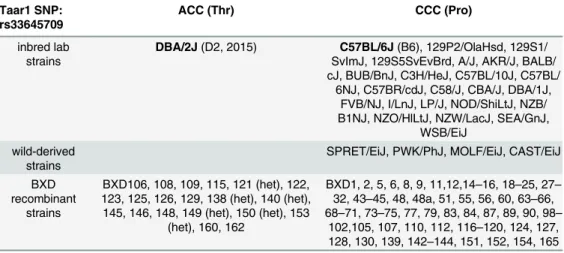
mTaar1is a single exon gene with few SNPs. The 29 strains listed inTable 1have been
sequenced by the Wellcome Trust Sanger Mouse Genomes Project [28]. There are 11 missense alleles, each unique to a single strain, i.e., a rare or minor allele. Importantly, SNP, rs33645709, specific to DBA/2J (Jackson Laboratory) changes a proline to a threonine in the amino acid sequence (P77T). Also on mouse chromosome 10, is the cluster of nine trace amine receptor genes (Taar1–Taar9), which spans from 23,920,387 to 24,109,564 base pairs. Within that entire genomic region, rs33645709 inTaar1is the only sequence variant between B6 and D2 mouse strains. There are other SNPs inTaar2throughTaar9among other mouse strains, but
Table 1. Only recently derived BXD RIs have the SNP variant found in the current D2 mice.Tissue or DNA from B6, D2, and the listed BXD RIs was obtained, prepared, and sequenced as described in Methods. Only the D2 inbred mouse strain and a subset of recently derived BXD RIs express a non-synonymous SNP at position 229, resulting in a threonine to proline substitution at position 77 (P77T) in the second transmem-brane domain of mTAAR1. Het: heterozygous for the B6 and D2 alleles.
Taar1 SNP: rs33645709
ACC (Thr) CCC (Pro)
inbred lab strains
DBA/2J(D2, 2015) C57BL/6J(B6), 129P2/OlaHsd, 129S1/ SvImJ, 129S5SvEvBrd, A/J, AKR/J, BALB/ cJ, BUB/BnJ, C3H/HeJ, C57BL/10J, C57BL/
6NJ, C57BR/cdJ, C58/J, CBA/J, DBA/1J, FVB/NJ, I/LnJ, LP/J, NOD/ShiLtJ, NZB/ B1NJ, NZO/HlLtJ, NZW/LacJ, SEA/GnJ,
WSB/EiJ wild-derived
strains
SPRET/EiJ, PWK/PhJ, MOLF/EiJ, CAST/EiJ
BXD recombinant
strains
BXD106, 108, 109, 115, 121 (het), 122, 123, 125, 126, 129, 138 (het), 140 (het), 145, 146, 148, 149 (het), 150 (het), 153
(het), 160, 162
BXD1, 2, 5, 6, 8, 9, 11,12,14–16, 18–25, 27–
32, 43–45, 48, 48a, 51, 55, 56, 60, 63–66,
68–71, 73–75, 77, 79, 83, 84, 87, 89, 90, 98–
102,105, 107, 110, 112, 116–120, 124, 127,
128, 130, 139, 142–144, 151, 152, 154, 165
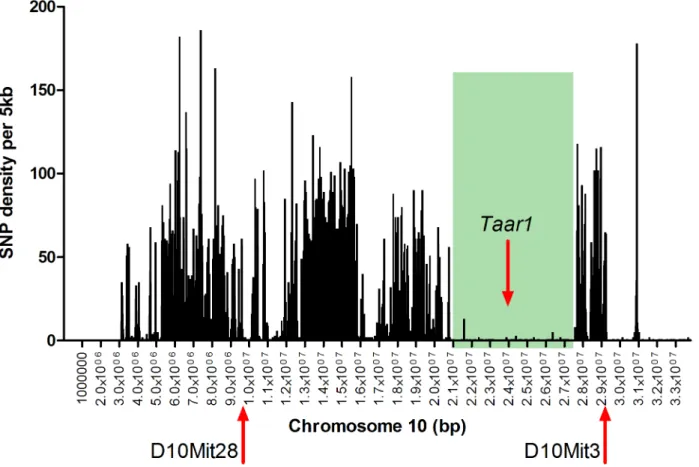
theTaarcluster is in a region with few B6 versus D2 variants (Fig 1), with only 1 missense vari-ant in over 7 Mb.
Mouse
Taar1
in BXD recombinant strains
In the interest of correlating themTaar1allele with behavior, we turned to the BXD RI strains, which have been tested for thousands of phenotypes over many decades [29–31]. The PCR genotyping markers that have been used in the BXD RI strains spanningmTaar1are
D10Mit28 at 9.413375 Mb and D10Mit3 at 29.152196 Mb (build GRCm38,Fig 1) and show a mix of B6 and D2 alleles for three earlier phases of RI strain development (derived beginning ca 1969, ca 1991, and ca 1998). For those RI strains with the same allele (B6 or D2) for both of the spanning markers, we predicted the same genotype for themTaar1sequence at position 229 (Fig 1), based on B6 and D2 haplotypes (i.e., tightly linked genes on a chromosome inher-ited together). Surprisingly, upon sequencingmTaar1at position 229 in 67 of the RIs, we found only the B6 allele (Table 1). The B6 and D2 haplotypes in this region are likely main-tained, meaning that the other SNPs in this region appropriately match the B6 or D2 haplo-types, indicating that themTaar1mutation occurred in the D2 population at the Jackson Laboratory after the first sets of BXD RI strains were derived. To confirm that the D2 allele is a recent spontaneous mutation, as opposed to being an allele lost in the RIs due to negative selec-tion pressure, we examined RIs BXD #105 to BXD 165 that are currently being inbred from F2
Fig 1. B6 vs D2 SNP density on proximal chromosome 10 (from 5 kb–33.8 Mb).SNPs between B6 and D2 were counted in 5kb bins. D10Mit28 and
D10Mit3 are the original PCR markers used in the BXD RI genotyping spanning themTaar1region [29–31]. The green shading indicates the 7 Mb region in
whichmTaar1has the only D2 missense SNP.
intercrosses that began ca. 2008 with new B6 and D2 breeders from the Jackson Laboratory. Table 1indicates that some of those RIs possess the D2 SNP, which was not seen in the earlier derived RIs, confirming that the mutation is of recent origin.
Effects of a non-synonymous SNP on agonist-induced function of
mTAAR1
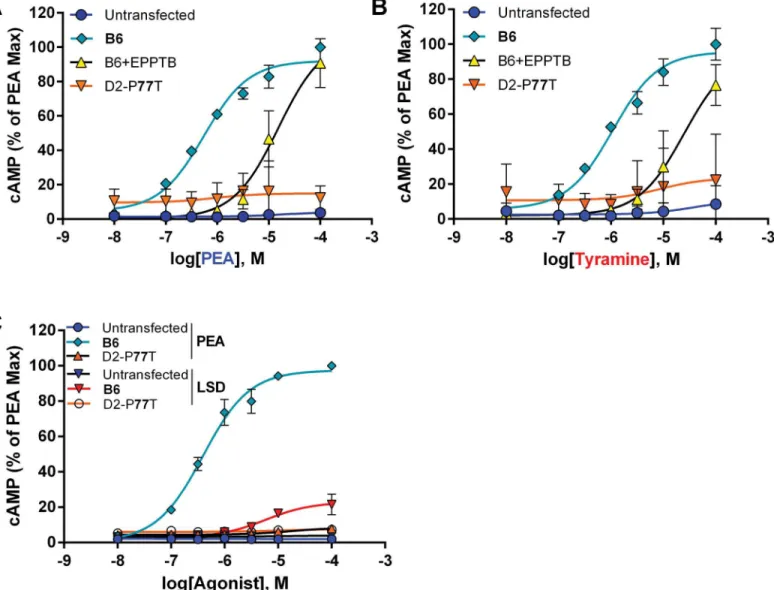
The effects of the P77T substitution on cAMP response to the physiological agonistsβ-PEA and tyramine in the mTAAR1 were examined using cells expressing the recombinant B6- and D2-like receptors. We have previously reported the effects of MA on mTAAR1-mediated cAMP production [12].Fig 2A and 2Bindicate thatβ-PEA and tyramine (respectively) stimu-late B6 but not D2 (P77T) mTAAR1 receptor-mediated cAMP accumulation. Additionally, LSD has no effect on either receptor (Fig 2C). Drugs have a rank order of potency ofβ-PEA
Fig 2.β-PEA and tyramine stimulate recombinant B6 but not D2 mTAAR1.The endogenous ligands,β-PEA (A) and tyramine (B) elicited a dose-dependent response in mammalian cells expressing recombinant B6-like, but not the D2-like (P77T) mTAAR1. Dose-response curves for the recombinant B6-like receptor were shifted to the right by EPPTB (10μM).β-PEA EC50= 0.547±0.03μM; Tyramine EC50= 0.940±0.12μM. LSD has no effect on either receptor (C).
(EC50~547nM)>MA (EC50~826nM, from [12])>tyramine (EC50~940nM). The TAAR1 antagonist, EPPTB, inhibited the response to agonists, shifting theβ-PEA and tyramine dose-response curves to the right. Maximal dose-response of the B6 receptor did not differ across agonists. Our previous work using confocal microscopy and western blot analyses indicates that both B6- and D2-type recombinant receptors are robustly expressed in the cytoplasm of HEK-293 cells [12]. Thus, lack of response is not due to reduced expression. Likewise, the cellular mem-brane is not a barrier for these agonists, which can diffuse across both artificial and synapto-somal membranes [32,33].
Human
TAAR1
: Effects of non-synonymous SNPs on agonist-induced
function
There are close to 50 non-synonymous and 50 synonymous SNPs reported forhTAAR1 (dbSNP database, NCBI). Eight of the SNPs were individually constructed inTAAR1of the ref-erence human sequence that was GFP-tagged at the C terminus, and transfected into CHO cells.Fig 3depicts the location of the SNPs in a schematic diagram of hTAAR1. The rationale for characterizing the selected amino acids includes the observation that transmembrane (TM) 7 mutations are in highly conserved motifs: NPXXY is one of the most highly conserved motifs in G protein-coupled receptors, and W291 is also conserved. R312 in the C terminus is part of a Phe-Arg-Lys (FRK) sequence that is conserved among catecholamine receptors including dopamine D1 and D2 receptors. The tyrosine and lysine in intracytoplasmic (IC) loop 3 are in
Fig 3. Schematic transmembrane topology of hTAAR 1.(Adapted from [35].) Amino acid residues incorporated in the transmembrane domains are shaded in gray, residues putatively involved in ligand binding are colored red. N-linked glycosylation at N 10 and N 17, as well as the disulfide bridge linking C 96 and C 182, is indicated according to the annotation in Swiss Prot entry TAR1_HUMAN. Known non-synonymous SNPs in the hTAAR1 that may produce changes in receptor function are boxed in blue (as determined from NCBI SNP Database). Indicated is the amino acid change induced by the SNP as: reference amino acid, residue number, change amino acid (Term = Termination). Further details, including the SNP nucleotide change are provided in the text.
the G protein-coupling region. The C182Y substitution destroys a highly conserved di-sulfide bridge. Thus there was a high probability for some of these SNPs to alter receptor function. hTAAR1 responded to bothβ-PEA (EC50= 0.66 ±0.13μM) and MA (EC50 = 8.27±2.1μM)
stimulation (Fig 4A).β-PEA was used to stimulate the receptors because it is more potent at hTAAR1.Fig 4Bindicates that one of the chosen variants (K218I) results in a sub-functional receptor, while the variants, C74Y (a rather conservative amino acid substitution) and C265W (near the C-terminus) mediate receptor responses that are not statistically different from the response of non-transfected cells, i.e., these variants are non-functional. The nonlinear regres-sion of the curve yielded an EC50forβ-PEA at C74Y and T252A of 0.12uM and 40uM,
Fig 4.β-PEA and MA stimulate hTAAR1, and hTAAR1 SNPs reduce or eliminate receptor function.A.β-PEA and MA increased cAMP production in CHO cells expressing the hTAAR1. There was a significant dose × agonist interaction (F (18, 56) = 15.70,p<0.0001.*p<0.01 for comparison between the indicated group and the untransfected control.+p<0.01 for comparison between PEA and MA groups. B.β-PEA dose-response curves in untransfected CHO cells and cells expressing the hTAAR1 variants. EPPTB (10μM) caused a rightward shift in theβ-PEA dose-response curve. There was a significant dose × receptor variant interaction (F (42,147) = 3.189; p<0.0001).*p<0.05 comparing C182Y and untransfected control cells;**p<0.0001. ns = non-significant. Data shown are means±SEMs from at least three independent experiments, each conducted with duplicate determinations. C. Confocal images of receptor expression in transfected cells.
respectively. The maximum response elicited byβ-PEA at C182Y was significantly different from the untransfected control, with an EC50of 16uM compared with the reference hTAAR1. Additionally, the TAAR1 antagonist, EPPTB (10μM), had an inhibitory effect on cAMP
accu-mulation in response toβ-PEA by the reference hTAAR1. However, the responses of hTAAR1 toβ-PEA in the presence or absence of EPPTB are not statistically different. This is consistent with reports in the literature that EPPTB is more potent at mTAAR1 compared to hTAAR1 [34,35]. As with the D2 mouse P77T SNP, confocal microscopy of GFP-tagged human recep-tors indicated that all were expressed in CHO cell cytoplasm (Fig 4C), so the lack of response to agonist by some variants was not due to SNP-induced loss of expression.
Discussion
The occurrence of spontaneous mutations in the BXD RIs has been noted previously (e.g., [36, 37]). Prior to the most recent derivation of BXD RIs (ca 2008), there were three independent phases of BXD RI derivation that occurred over a period of about 30 years, and none of the sets of progeny strains express the functional mTAAR1 D2 variant. It is unlikely that the non-functional P77T D2 allele existed before the derivation of the original RIs, and was subse-quently lost due to negative selection pressure in all three independent phases of RI derivation [36]. Rather, the mutation occurred more recently, but prior to the derivation of the more recent BXD RIs. This conclusion is supported by the latest derivation of RIs (#105–165), some of which express the non-functional variant. The derivation is still in process but began with D2 mice in ca. 2008. Therefore, the mutation arose subsequent to 1998 (after the last of the three early derivations) and before 2008. Additionally, the mutation must have occurred at The Jackson Laboratory, the source of the D2 mice used in these studies. Unfortunately, the absence of the mutation in the earlier derived RIs precludes correlation analysis with thousands of phe-notypes with themTaar1SNP [31]. However, the mutation segregates in the more recently derived RIs and they can be used to map other traits tomTaar1, and to modifiers ofmTaar1 effects. Of critical importance are the sequencing results (Table 1) that did not agree with PCR marker-based haplotypes. Haplotype data available from marker genotyping of the RIs is often used to correlate behavior with genotype, but in this particular case, the potential impact of the
Taar1polymorphism would be missed using the marker data.
The availability of a non-functional native receptor provides a genetic tool for use in behav-ioral and biochemical studies, and for comparison to studies using KO mice that do not express TAAR1. As opposed to an engineered KO, it is possible that a receptor incapable of responding to agonists can still participate in protein-protein interactions that modulate other signaling pathways, including effects on signal transduction related to the association of TAAR1 and dopamine D2 receptors [38,39]. Effects of Taar1-related changes on these interaction partners could account for MA-related behavioral differences.
Our previous report [12] indicates that the P77T variant in the D2 strain does not respond to MA andFig 2provides the first data comparing the effects of the putative physiological ago-nists,β-PEA and tyramine, on the function of the B6 and D2 strain TAAR1 receptors. Experi-ments were conducted using trace amine concentrations from 10 nM to 100μM and maximal
the mutation is associated with increased MA drinking, MA-induced conditioned place prefer-ence, and confers a lack of sensitivity to aversive effects of MA and MA-induced hypothermia [12,13,40–42].
The functional consequences of numerous non-synonymous SNPs in the humanTAAR1 have not previously been described. However, non-synonymous SNPs in a receptor can have functional consequences by changing cellular signal transduction. For example, the SNPs in the humanμ-opioid receptor alter cAMP-stimulated CRE transcription [43], ERK
phos-phorylation [44], and also decrease receptor desensitization following morphine pre-treat-ment [45]. Based on data from behavioral experiments with D2, B6, MAHDR and MALDR mice [12], we hypothesized that SNPs in thehTAAR1should affect receptor-coupled signal transduction. At least one SNP resulted in a sub-functional, as opposed to a non-functional receptor. There are no known animal models for this functional variant, but some of the human variants could produce the high MA intake phenotype seen in mice. The non- and sub-functional human variants could also predispose subjects to other deleterious MA-related consequences, as well as disorders MA-related to other addictive substances and (or) other organ systems and diseases. Although breeding for ethanol-related behaviors has not resulted in any QTLs in the chromosomal region that includesTaar1,Taar1KO mice prefer ethanol in a 2-bottle choice paradigm, and are more sensitive to the sedative effects of etha-nol [46]. The regulation of TAAR1 receptor expression has also been described in T cells [37] and the effects of exposure of primary human astrocyte cultures to MA and HIV-1 increases TAAR1 mRNA expression [47]. The consequences of SNP-induced structural or functional changes in TAAR1 on HIV-1-mediated receptor expression are unknown, but could result in altered cellular response to the viral infection. In addition to human astro-cytes, TAAR1 is expressed on mouse T and B cells, and stimulation of T cells byβ-PEA regu-lates T cell function as measured by changes in cytokine expression signal transduction intermediates [48,49]. Thus, human subjects with sub- or non-functional lymphocyte TAAR1 may have altered sensitivity to circulating trace amines, as well as an altered inflam-matory and immune response.
A number of additional phenotypic effects associated with TAAR1 have been identified.
Taar1KO mice are less sensitive to doses of apomorphine that induce stereotypy [50]. In
dopamine transporter KO mice with reduced synaptic dopamine, amphetamine andβ -phe-nethylamine inhibit hyperactivity, possibly via TAAR1 activation. Furthermore, the receptor may play a role in the effects of drugs used to treat Parkinson’s disease [51,52]. A role for TAAR1 in symptoms of chronic migraine, which is accompanied by significantly elevated lev-els of tyramine, has also been described [53]. In the periphery, TAAR1 receptors have been identified in cardiac ventricular tissue, and TAAR1 function has been implicated in cardiac arrhythmias. Recently, D2 mice have been identified as a model of familial hypertrophic car-diomyopathy [54] and these were likely D2 mice that possess the non-functionalTaar1 muta-tion. In addition, TAAR1 receptors are expressed inβ-cells of pancreatic islets [55], and have been implicated in diabetes, obesity, and in kidney, liver, gastrointestinal and pancreas disor-ders [56,57].
Acknowledgments
We would like to thank Harue Baba, and Jason Erk for technical support, Kari J. Buck for help-ful suggestions, and David K. Grandy, Oregon Health & Science University, for generous provi-sion of EPPTB.
Author Contributions
Conceived and designed the experiments: XS NW KAN TJP AJ. Performed the experiments: XS NW LL. Analyzed the data: XS NW JKB AJE TJP AJ. Contributed reagents/materials/analy-sis tools: NW KAN RWW AJ. Wrote the paper: XS JHH KAN RWW JKB AJE TJP AJ LL.
References
1. Berry MD. Mammalian central nervous system trace amines. Pharmacologic amphetamines, physio-logic neuromodulators. J Neurochem. 2004; 90(2):257–71. Epub 2004/07/02. doi:
10.1111/j.1471-4159.2004.02501.xPMID:15228583.
2. Baud P, Arbilla S, Cantrill RC, Scatton B, Langer SZ. Trace amines inhibit the electrically evoked release of [3H]acetylcholine from slices of rat striatum in the presence of pargyline: similarities between beta-phenylethylamine and amphetamine. J Pharmacol Exp Ther. 1985; 235(1):220–9. Epub 1985/10/
01. PMID:3930699.
3. Ishida K, Murata M, Kato M, Utsunomiya I, Hoshi K, Taguchi K. Beta-phenylethylamine stimulates stria-tal acetylcholine release through activation of the AMPA glutamatergic pathway. Biological & pharma-ceutical bulletin. 2005; 28(9):1626–9. Epub 2005/09/06. PMID:16141528.
4. Federici M, Geracitano R, Tozzi A, Longone P, Di Angelantonio S, Bengtson CP, et al. Trace amines depress GABA B response in dopaminergic neurons by inhibiting G-betagamma-gated inwardly rectify-ing potassium channels. Mol Pharmacol. 2005; 67(4):1283–90. Epub 2005/01/13. doi:10.1124/mol.
104.007427PMID:15644497.
5. Borowsky B, Adham N, Jones KA, Raddatz R, Artymyshyn R, Ogozalek KL, et al. Trace amines: identi-fication of a family of mammalian G protein-coupled receptors. Proc Natl Acad Sci U S A. 2001; 98 (16):8966–71. Epub 2001/07/19. doi:10.1073/pnas.151105198PMID:11459929; PubMed Central
PMCID: PMCPMC55357.
6. Bunzow JR, Sonders MS, Arttamangkul S, Harrison LM, Zhang G, Quigley DI, et al. Amphetamine, 3,4-methylenedioxymethamphetamine, lysergic acid diethylamide, and metabolites of the catecholamine neurotransmitters are agonists of a rat trace amine receptor. Mol Pharmacol. 2001; 60(6):1181–8.
Epub 2001/11/28. PMID:11723224.
7. Rickli A, Kopf S, Hoener MC, Liechti ME. Pharmacological profile of novel psychoactive benzofurans. Br J Pharmacol. 2015. Epub 2015/03/15. doi:10.1111/bph.13128PMID:25765500.
8. Snead AN, Miyakawa M, Tan ES, Scanlan TS. Trace amine-associated receptor 1 (TAAR1) is activated by amiodarone metabolites. Bioorg Med Chem Lett. 2008; 18(22):5920–2. Epub 2008/08/30. doi:10.
1016/j.bmcl.2008.08.013PMID:18752950; PubMed Central PMCID: PMCPMC3609712.
9. Lindemann L, Meyer CA, Jeanneau K, Bradaia A, Ozmen L, Bluethmann H, et al. Trace amine-associ-ated receptor 1 modulates dopaminergic activity. J Pharmacol Exp Ther. 2008; 324(3):948–56. Epub
2007/12/18. doi:10.1124/jpet.107.132647PMID:18083911.
10. Wolinsky TD, Swanson CJ, Smith KE, Zhong H, Borowsky B, Seeman P, et al. The Trace Amine 1 receptor knockout mouse: an animal model with relevance to schizophrenia. Genes Brain Behav. 2007; 6(7):628–39. Epub 2007/01/11. doi:10.1111/j.1601-183X.2006.00292.xPMID:17212650. 11. Belknap JK, McWeeney S, Reed C, Burkhart-Kasch S, McKinnon CS, Li N, et al. Genetic factors
involved in risk for methamphetamine intake and sensitization. Mamm Genome. 2013; 24(11–12):446–
58. Epub 2013/11/13. doi:10.1007/s00335-013-9484-9PMID:24217691; PubMed Central PMCID: PMCPmc3880562.
12. Harkness JH, Shi X, Janowsky A, Phillips TJ. Trace Amine-Associated Receptor 1 Regulation of Meth-amphetamine Intake and Related Traits. Neuropsychopharmacology: official publication of the Ameri-can College of Neuropsychopharmacology. 2015; 40(9):2175–84. Epub 2015/03/06. doi:10.1038/npp.
2015.61PMID:25740289; PubMed Central PMCID: PMCPmc4613607.
13. Wheeler JM, Reed C, Burkhart-Kasch S, Li N, Cunningham CL, Janowsky A, et al. Genetically corre-lated effects of selective breeding for high and low methamphetamine consumption. Genes Brain Behav. 2009; 8(8):758–71. Epub 2009/08/20. doi:10.1111/j.1601-183X.2009.00522.xPMID:
14. Raab S, Wang H, Uhles S, Cole N, Alvarez-Sanchez R, Kunnecke B, et al. Incretin-like effects of small molecule trace amine-associated receptor 1 agonists. Molecular metabolism. 2016; 5(1):47–56. Epub
2016/02/05. doi:10.1016/j.molmet.2015.09.015PMID:26844206; PubMed Central PMCID: PMCPmc4703809.
15. Galley G, Stalder H, Goergler A, Hoener MC, Norcross RD. Optimisation of imidazole compounds as selective TAAR1 agonists: discovery of RO5073012. Bioorg Med Chem Lett. 2012; 22(16):5244–8.
Epub 2012/07/17. doi:10.1016/j.bmcl.2012.06.060PMID:22795332.
16. Revel FG, Moreau JL, Gainetdinov RR, Bradaia A, Sotnikova TD, Mory R, et al. TAAR1 activation mod-ulates monoaminergic neurotransmission, preventing hyperdopaminergic and hypoglutamatergic activ-ity. Proc Natl Acad Sci U S A. 2011; 108(20):8485–90. Epub 2011/04/29. doi:10.1073/pnas.
1103029108PMID:21525407; PubMed Central PMCID: PMCPMC3101002.
17. Revel FG, Moreau JL, Gainetdinov RR, Ferragud A, Velazquez-Sanchez C, Sotnikova TD, et al. Trace amine-associated receptor 1 partial agonism reveals novel paradigm for neuropsychiatric therapeutics. Biol Psychiatry. 2012; 72(11):934–42. Epub 2012/06/19. doi:10.1016/j.biopsych.2012.05.014PMID:
22705041.
18. Revel FG, Moreau JL, Pouzet B, Mory R, Bradaia A, Buchy D, et al. A new perspective for schizophre-nia: TAAR1 agonists reveal antipsychotic- and antidepressant-like activity, improve cognition and con-trol body weight. Mol Psychiatry. 2013; 18(5):543–56. Epub 2012/05/30. doi:10.1038/mp.2012.57
PMID:22641180.
19. Espinoza S, Lignani G, Caffino L, Maggi S, Sukhanov I, Leo D, et al. TAAR1 Modulates Cortical Gluta-mate NMDA Receptor Function. Neuropsychopharmacology: official publication of the American Col-lege of Neuropsychopharmacology. 2015. Epub 2015/03/10. doi:10.1038/npp.2015.65PMID: 25749299.
20. Eshleman AJ, Carmolli M, Cumbay M, Martens CR, Neve KA, Janowsky A. Characteristics of drug interactions with recombinant biogenic amine transporters expressed in the same cell type. J Pharma-col Exp Ther. 1999; 289(2):877–85. Epub 1999/04/24. PMID:10215666.
21. Pei Y, Lee J, Leo D, Gainetdinov RR, Hoener MC, Canales JJ. Activation of the trace amine-associated receptor 1 prevents relapse to cocaine seeking. Neuropsychopharmacology: official publication of the American College of Neuropsychopharmacology. 2014; 39(10):2299–308. Epub 2014/04/12. doi:10.
1038/npp.2014.88PMID:24722355; PubMed Central PMCID: PMCPMC4138750.
22. Reese EA, Bunzow JR, Arttamangkul S, Sonders MS, Grandy DK. Trace amine-associated receptor 1 displays species-dependent stereoselectivity for isomers of methamphetamine, amphetamine, and para-hydroxyamphetamine. J Pharmacol Exp Ther. 2007; 321(1):178–86. Epub 2007/01/16. doi:10.
1124/jpet.106.115402PMID:17218486.
23. Xie Z, Miller GM. Trace amine-associated receptor 1 is a modulator of the dopamine transporter. J Pharmacol Exp Ther. 2007; 321(1):128–36. Epub 2007/01/20. doi:10.1124/jpet.106.117382PMID:
17234899.
24. Cichero E, Espinoza S, Gainetdinov RR, Brasili L, Fossa P. Insights into the structure and pharmacol-ogy of the human trace amine-associated receptor 1 (hTAAR1): homolpharmacol-ogy modelling and docking stud-ies. Chem Biol Drug Des. 2013; 81(4):509–16. Epub 2012/08/14. doi:10.1111/cbdd.12018PMID:
22883051.
25. Reese EA, Norimatsu Y, Grandy MS, Suchland KL, Bunzow JR, Grandy DK. Exploring the determi-nants of trace amine-associated receptor 1's functional selectivity for the stereoisomers of amphet-amine and methamphetamphet-amine. J Med Chem. 2014; 57(2):378–90. Epub 2013/12/21. doi:10.1021/
jm401316vPMID:24354319.
26. Liu X, Grandy DK, Janowsky A. Ractopamine, a livestock feed additive, is a full agonist at trace amine-associated receptor 1. J Pharmacol Exp Ther. 2014; 350(1):124–9. Epub 2014/05/07. doi:10.1124/
jpet.114.213116PMID:24799633; PubMed Central PMCID: PMCPmc4170122.
27. Watts VJ, Wiens BL, Cumbay MG, Vu MN, Neve RL, Neve KA. Selective activation of Galphao by D2L dopamine receptors in NS20Y neuroblastoma cells. The Journal of neuroscience: the official journal of the Society for Neuroscience. 1998; 18(21):8692–9. Epub 1998/10/24. PMID:9786976.
28. Keane TM, Goodstadt L, Danecek P, White MA, Wong K, Yalcin B, et al. Mouse genomic variation and its effect on phenotypes and gene regulation. Nature. 2011; 477(7364):289–94. Epub 2011/09/17. doi:
10.1038/nature10413PMID:21921910; PubMed Central PMCID: PMCPmc3276836.
29. Taylor BA, Wnek C, Kotlus BS, Roemer N, MacTaggart T, Phillips SJ. Genotyping new BXD recombi-nant inbred mouse strains and comparison of BXD and consensus maps. Mamm Genome. 1999; 10 (4):335–48. Epub 1999/03/24. PMID:10087289.
31. Andreux PA, Williams EG, Koutnikova H, Houtkooper RH, Champy MF, Henry H, et al. Systems genet-ics of metabolism: the use of the BXD murine reference panel for multiscalar integration of traits. Cell. 2012; 150(6):1287–99. Epub 2012/09/04. doi:10.1016/j.cell.2012.08.012PMID:22939713; PubMed
Central PMCID: PMCPmc3604687.
32. Berry MD, Shitut MR, Almousa A, Alcorn J, Tomberli B. Membrane permeability of trace amines: evi-dence for a regulated, activity-dependent, nonexocytotic, synaptic release. Synapse (New York, NY). 2013; 67(10):656–67. Epub 2013/04/09. doi:10.1002/syn.21670PMID:23564683.
33. Gulaboski R, Cordeiro MN, Milhazes N, Garrido J, Borges F, Jorge M, et al. Evaluation of the lipophilic properties of opioids, amphetamine-like drugs, and metabolites through electrochemical studies at the interface between two immiscible solutions. Analytical biochemistry. 2007; 361(2):236–43. Epub 2006/
12/21. doi:10.1016/j.ab.2006.11.006PMID:17178092.
34. Stalder H, Hoener MC, Norcross RD. Selective antagonists of mouse trace amine-associated receptor 1 (mTAAR1): discovery of EPPTB (RO5212773). Bioorg Med Chem Lett. 2011; 21(4):1227–31. Epub
2011/01/18. doi:10.1016/j.bmcl.2010.12.075PMID:21237643.
35. Lindemann L, Ebeling M, Kratochwil NA, Bunzow JR, Grandy DK, Hoener MC. Trace amine-associated receptors form structurally and functionally distinct subfamilies of novel G protein-coupled receptors. Genomics. 2005; 85(3):372–85. Epub 2005/02/19. doi:10.1016/j.ygeno.2004.11.010PMID:
15718104.
36. Shifman S, Bell JT, Copley RR, Taylor MS, Williams RW, Mott R, et al. A high-resolution single nucleo-tide polymorphism genetic map of the mouse genome. PLoS Biol. 2006; 4(12):e395. Epub 2006/11/16. doi:10.1371/journal.pbio.0040395PMID:17105354; PubMed Central PMCID: PMCPMC1635748.
37. Lu H, Wang X, Pullen M, Guan H, Chen H, Sahu S, et al. Genetic dissection of the Gpnmb network in the eye. Invest Ophthalmol Vis Sci. 2011; 52(7):4132–42. Epub 2011/03/15. doi:10.1167/iovs.10-6493
PMID:21398278; PubMed Central PMCID: PMCPMC3175941.
38. Espinoza S, Salahpour A, Masri B, Sotnikova TD, Messa M, Barak LS, et al. Functional interaction between trace amine-associated receptor 1 and dopamine D2 receptor. Mol Pharmacol. 2011; 80 (3):416–25. Epub 2011/06/15. doi:10.1124/mol.111.073304PMID:21670104; PubMed Central
PMCID: PMCPmc3164335.
39. Espinoza S, Ghisi V, Emanuele M, Leo D, Sukhanov I, Sotnikova TD, et al. Postsynaptic D2 dopamine receptor supersensitivity in the striatum of mice lacking TAAR1. Neuropharmacology. 2015; 93:308–
13. Epub 2015/02/28. doi:10.1016/j.neuropharm.2015.02.010PMID:25721394.
40. Shabani S, Dobbs LK, Ford MM, Mark GP, Finn DA, Phillips TJ. A genetic animal model of differential sensitivity to methamphetamine reinforcement. Neuropharmacology. 2012; 62(7):2169–77. Epub
2012/01/28. doi:10.1016/j.neuropharm.2012.01.002PMID:22280875; PubMed Central PMCID: PMCPMC3320769.
41. Shabani S, McKinnon CS, Cunningham CL, Phillips TJ. Profound reduction in sensitivity to the aversive effects of methamphetamine in mice bred for high methamphetamine intake. Neuropharmacology. 2012; 62(2):1134–41. Epub 2011/11/29. doi:10.1016/j.neuropharm.2011.11.005PMID:22118879;
PubMed Central PMCID: PMCPMC3297479.
42. Shabani S, McKinnon CS, Reed C, Cunningham CL, Phillips TJ. Sensitivity to rewarding or aversive effects of methamphetamine determines methamphetamine intake. Genes Brain Behav. 2011; 10 (6):625–36. Epub 2011/05/11. doi:10.1111/j.1601-183X.2011.00700.xPMID:21554535; PubMed
Central PMCID: PMCPMC3320762.
43. Fortin JP, Ci L, Schroeder J, Goldstein C, Montefusco MC, Peter I, et al. The mu-opioid receptor variant N190K is unresponsive to peptide agonists yet can be rescued by small-molecule drugs. Mol Pharma-col. 2010; 78(5):837–45. Epub 2010/08/13. doi:10.1124/mol.110.064188PMID:20702761; PubMed
Central PMCID: PMCPmc2981363.
44. Deb I, Chakraborty J, Gangopadhyay PK, Choudhury SR, Das S. Single-nucleotide polymorphism (A118G) in exon 1 of OPRM1 gene causes alteration in downstream signaling by mu-opioid receptor and may contribute to the genetic risk for addiction. J Neurochem. 2010; 112(2):486–96. Epub 2009/
11/07. doi:10.1111/j.1471-4159.2009.06472.xPMID:19891732.
45. Wang D, Quillan JM, Winans K, Lucas JL, Sadee W. Single nucleotide polymorphisms in the human mu opioid receptor gene alter basal G protein coupling and calmodulin binding. The Journal of biologi-cal chemistry. 2001; 276(37):34624–30. Epub 2001/07/18. doi:10.1074/jbc.M104083200PMID:
11457836.
46. Lynch LJ, Sullivan KA, Vallender EJ, Rowlett JK, Platt DM, Miller GM. Trace amine associated receptor 1 modulates behavioral effects of ethanol. Subst Abuse. 2013; 7:117–26. Epub 2013/07/19. doi:10.
4137/sart.s12110PMID:23861588; PubMed Central PMCID: PMCPmc3682756.
2014/06/21. doi:10.1016/j.neuropharm.2014.06.011PMID:24950453; PubMed Central PMCID: PMCPmc4315503.
48. Panas MW, Xie Z, Panas HN, Hoener MC, Vallender EJ, Miller GM. Trace amine associated receptor 1 signaling in activated lymphocytes. J Neuroimmune Pharmacol. 2012; 7(4):866–76. Epub 2011/11/01.
doi:10.1007/s11481-011-9321-4PMID:22038157; PubMed Central PMCID: PMCPmc3593117.
49. Babusyte A, Kotthoff M, Fiedler J, Krautwurst D. Biogenic amines activate blood leukocytes via trace amine-associated receptors TAAR1 and TAAR2. J Leukoc Biol. 2013; 93(3):387–94. Epub 2013/01/15.
doi:10.1189/jlb.0912433PMID:23315425.
50. Sukhanov I, Espinoza S, Yakovlev DS, Hoener MC, Sotnikova TD, Gainetdinov RR. TAAR1-dependent effects of apomorphine in mice. Int J Neuropsychopharmacol. 2014; 17(10):1683–93. Epub 2014/06/
14. doi:10.1017/s1461145714000509PMID:24925023.
51. Sotnikova TD, Beaulieu JM, Espinoza S, Masri B, Zhang X, Salahpour A, et al. The dopamine metabo-lite 3-methoxytyramine is a neuromodulator. PLoS One. 2010; 5(10):e13452. Epub 2010/10/27. doi: 10.1371/journal.pone.0013452PMID:20976142; PubMed Central PMCID: PMCPmc2956650.
52. Sotnikova TD, Zorina OI, Ghisi V, Caron MG, Gainetdinov RR. Trace amine associated receptor 1 and movement control. Parkinsonism Relat Disord. 2008; 14 Suppl 2:S99–102. Epub 2008/07/01. doi:10.
1016/j.parkreldis.2008.04.006PMID:18585080.
53. D'Andrea G, D'Amico D, Bussone G, Bolner A, Aguggia M, Saracco MG, et al. The role of tyrosine metabolism in the pathogenesis of chronic migraine. Cephalalgia. 2013; 33(11):932–7. Epub 2013/03/
16. doi:10.1177/0333102413480755PMID:23493762.
54. Zhao W, Zhao T, Chen Y, Zhao F, Gu Q, Williams RW, et al. A Murine Hypertrophic Cardiomyopathy Model: The DBA/2J Strain. PLoS One. 2015; 10(8):e0133132. Epub 2015/08/05. doi:10.1371/journal. pone.0133132PMID:26241864; PubMed Central PMCID: PMCPmc4524617.
55. Regard JB, Kataoka H, Cano DA, Camerer E, Yin L, Zheng YW, et al. Probing cell type-specific func-tions of Gi in vivo identifies GPCR regulators of insulin secretion. J Clin Invest. 2007; 117(12):4034–43.
Epub 2007/11/10. doi:10.1172/jci32994PMID:17992256; PubMed Central PMCID: PMCPmc2066199.
56. Grandy DK. Trace amine-associated receptor 1-Family archetype or iconoclast? Pharmacol Ther. 2007; 116(3):355–90. Epub 2007/09/25. doi:10.1016/j.pharmthera.2007.06.007PMID:17888514;
PubMed Central PMCID: PMCPmc2767338.
57. Sotnikova TD, Caron MG, Gainetdinov RR. Trace amine-associated receptors as emerging therapeutic targets. Mol Pharmacol. 2009; 76(2):229–35. Epub 2009/04/25. doi:10.1124/mol.109.055970PMID:
19389919; PubMed Central PMCID: PMCPmc2713119.
![Fig 3. Schematic transmembrane topology of hTAAR 1. (Adapted from [35].) Amino acid residues incorporated in the transmembrane domains are shaded in gray, residues putatively involved in ligand binding are colored red](https://thumb-eu.123doks.com/thumbv2/123dok_br/18354471.353428/7.918.61.816.531.950/schematic-transmembrane-topology-residues-incorporated-transmembrane-residues-putatively.webp)